
Why Most AI Authority Agencies Fail Chiropractors (And How to Spot the Good Ones)
Most AI authority agencies fail chiropractors the same way. They sell a polished website and a keyword list, then call it a strategy. What they're actually delivering is a digital brochure — and AI can't read a brochure.
When a patient asks ChatGPT, Gemini, or Grok who the best chiropractor in their area is, that engine doesn't scroll a ranked list. It produces a single recommendation based on verified entity data, structured schema signals, and a content architecture built to answer questions at depth. Traditional search engine volume is projected to decline by 25% by 2026 as consumers shift to conversational AI. That shift isn't coming. It's already here.
Chiropractic is a trust-intensive field. Over 40% of all local clinic selections are driven by verified reputation and local trust signals — the exact signals AI engines evaluate when deciding whose name to surface. A template website with generic copy and no structured schema doesn't carry those signals. It carries nothing an AI can use.
Optimizing for conversational AI engines requires a structural shift to Answer Engine Optimization (AEO) parameters — a fundamentally different discipline from traditional list-based search. AEO is built on three compounding layers: an Entity Trust foundation that establishes who you are, a Semantic Density engine that proves what you know, and a Citation Velocity loop that accelerates how often AI engines reference you.
Agencies that don't build these layers aren't offering a lesser version of authority infrastructure. They're offering something else entirely — and calling it the same thing. Knowing which one you're talking to before you sign anything is the most valuable diagnostic a chiropractic practice can run right now.
Last Updated: June 12, 2026
- • What 'AI Authority Agency' Actually Means — And What Most Are Really Selling
- • Why Traditional SEO Tactics Actively Hurt Your AI Visibility
- • What a Legitimate AI Authority Build Actually Looks Like
- • How to Evaluate Any AI Authority Agency Before You Write a Check
-
• Frequently Asked Questions
- • Why can't my existing local SEO agency handle AI engine optimization?
- • What infrastructure updates does my chiropractic website actually need to be recognized by AI?
- • How long does it take for a chiropractic clinic to see compounding returns on an AI authority investment?
- • Why do generic AI-written articles fail to build entity trust for chiropractors?
- • How much should an established chiropractic practice budget for a complete AI authority rebuild?
- • Is AI authority optimization worth it if my practice is already doing well with referrals?
- • The Bottom Line on AI Authority Agencies
What 'AI Authority Agency' Actually Means — And What Most Are Really Selling
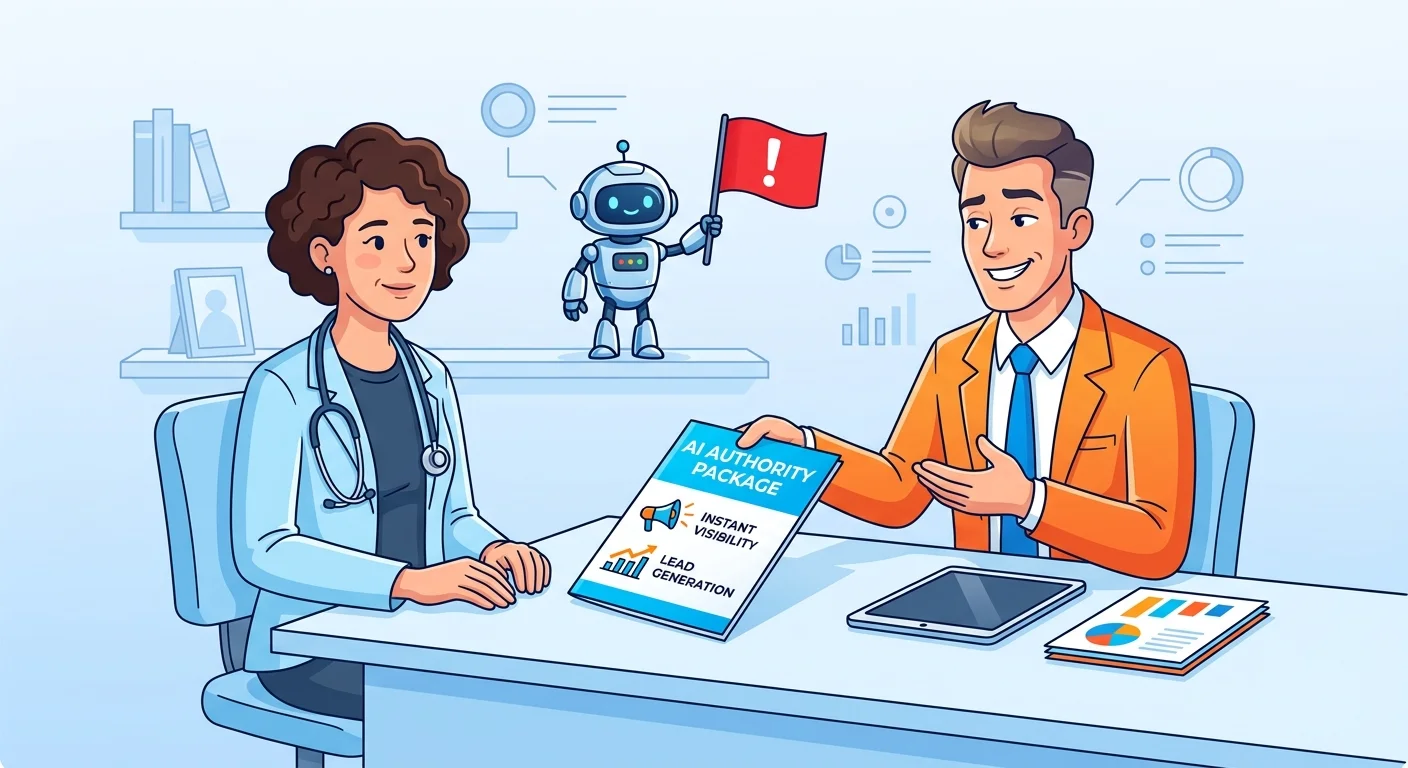
Here's what actually happened. Agencies figured out that 'AI authority' converts better than 'SEO package.' So they rebranded — same keyword lists, same template sites, same dashboards full of numbers that don't move the needle. The label changed. The product didn't.
A real AI authority agency does one thing: it makes your practice machine-readable. That means structured schema AI engines can parse, entity signals they can verify, and a content architecture built around Answer Engine Optimization (AEO) parameters — not a ranked list of keywords. It's a structural discipline. Not a marketing service.
What most agencies are actually selling is a digital brochure with an AI story stapled to it. It looks credible. It has a deck, it has deliverables, it has a monthly call where everyone nods. But when a patient asks ChatGPT who to trust in your market — that brochure is invisible. The infrastructure was never built for a machine to read.
The Bait-and-Switch That's Draining Chiropractic Budgets
The bait is real: a modern-looking website, a content calendar, a monthly report with numbers that move. The switch is quiet. None of it is building the Entity Trust signals, the Semantic Density your content needs, or the Citation Velocity loop that AI engines actually use when deciding whose name to say. The reports look busy. The authority stays flat.
Chiropractors aren't signing bad contracts because they're naive. They're signing them because the pitch is fluent. iTech Valet hears this story constantly — practices that spent months paying for 'AI optimization' that was just traditional authority signals dressed up in new language. The agency sounded credible. The deliverables were real. The AI engines never noticed any of it. the hopium cycle
Traditional traditional search engine query volume is already projected to drop 25% by 2026 as patients shift to conversational AI. Every month an agency runs a keyword-based strategy on an unstructured template site, your competitor's authority compounds while yours doesn't. That's not a gap you close with a better blog post.
| What They Promise | What They Actually Deliver | Why It Fails AI Engines |
|---|---|---|
| A modern, professionally designed website that represents your practice online | A visually polished template site with generic copy, no structured schema, and no entity verification layer | AI engines parse structured data signals — not aesthetics. A site with no schema gives them nothing to verify or trust. |
| An 'AI-optimized' content strategy with monthly blog posts and a content calendar | Keyword-targeted articles written for search list rankings, not for conversational AI recommendation architecture | Conversational engines evaluate semantic depth and topical authority, not keyword density. Content not built for AEO parameters is invisible to them. |
| AI authority visibility across ChatGPT, Gemini, and Grok | Traditional authority signals — directory listings and backlink profiles — repackaged under an 'AI' label | None of those signals build the Entity Trust Foundation AI engines require to confirm who you are and what you specialize in. |
| Monthly performance reports showing measurable progress | Dashboards tracking clicks, impressions, and keyword positions — metrics from the old search paradigm | Conversational AI engines do not rank results in a list. Tracking list-based metrics tells you nothing about whether your name is being recommended. |
| A compounding authority asset that grows stronger over time | A month-to-month service that stops the moment payment stops, with no infrastructure left behind | Real authority compounds through a Citation Velocity Loop and Semantic Density Engine. A service with no structural foundation produces no compounding effect. |
| Local market dominance — being the name AI recommends in your area | Generic national content not structured around verified local entity signals or community-specific trust markers | AI engines cross-reference local verification data to surface recommendations. Content with no geographic or entity-specific anchoring cannot win a local recommendation. |
Why Traditional SEO Tactics Actively Hurt Your AI Visibility
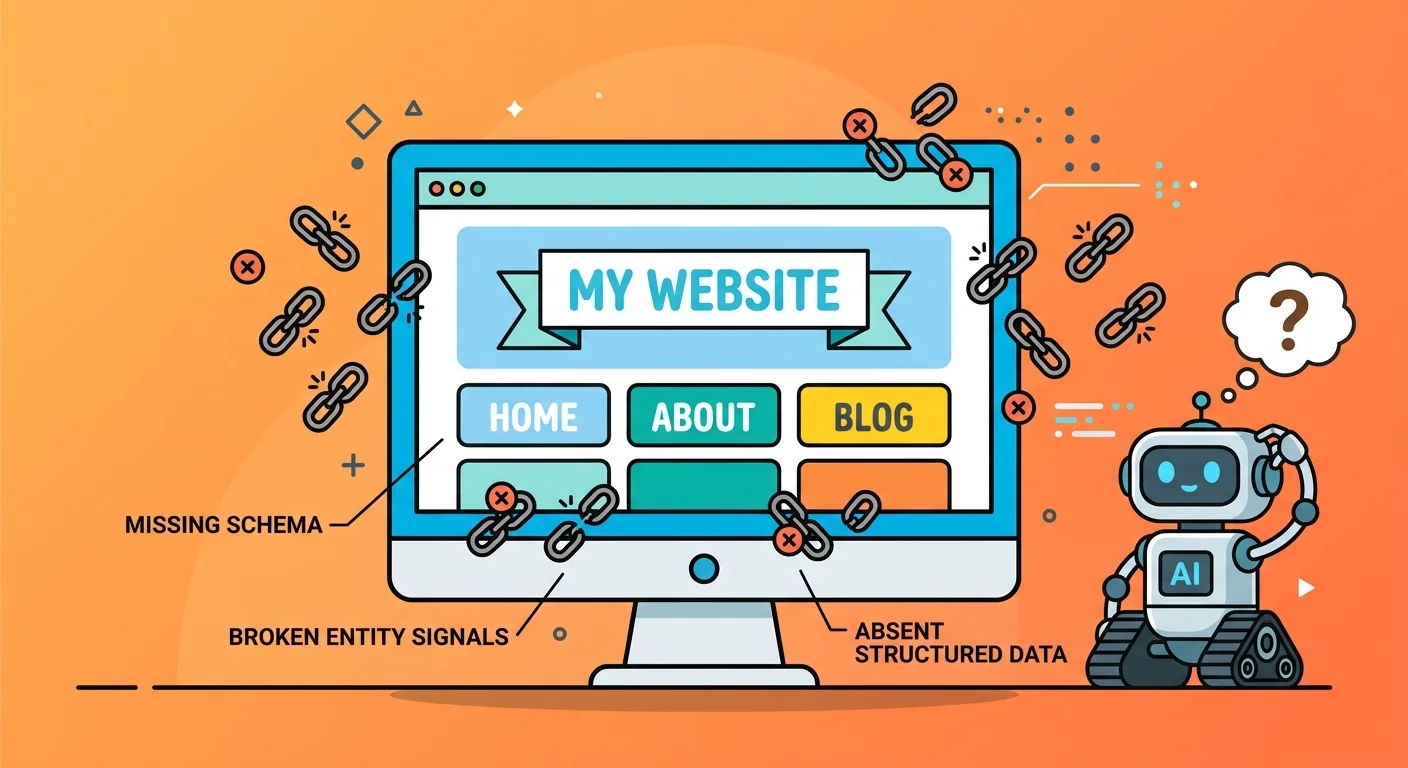
Here's the part most agencies won't tell you. Traditional SEO tactics don't just fail to build AI authority. They actively signal the wrong things to the engines making recommendations.
When an agency optimizes for traditional search engine query volume — a channel already projected to shrink by 25% by 2026 — they're tuning your practice for a game that's ending. ChatGPT, Gemini, and Grok don't rank lists. They evaluate entity integrity, schema structure, and depth of verified content. A keyword strategy sends none of those signals.
The real damage isn't the wasted budget. It's the content architecture that gets baked in. Every month a keyword-first agency runs their playbook on your site, they're reinforcing a structure that AI engines are incapable of trusting. You can't layer real authority infrastructure on top of that later. You have to rebuild from scratch.
Why Keyword-First Strategies Backfire on AI Engines
Keyword-first strategies were built for crawl-and-rank. Agency optimizes page. Search engine indexes it. Patient searches. Patient clicks. That chain worked — past tense.
Conversational AI doesn't crawl for keywords. It decides whether your practice is a verified, trustworthy entity. 'Best chiropractor near me' on your homepage tells Google's old algorithm something. It tells ChatGPT nothing it cares about. More than 72% of patients already use online searches to find local healthcare answers — and that behavior is migrating fast to AI engines. Agencies optimizing for the old channel are chasing patients where they used to be.
And it gets worse. A site stuffed with keyword-optimized generic copy actively undermines your Entity Trust Foundation. AI engines aren't scanning for repetition — they're scanning for structured, specific, verified signals. Thin content written to satisfy a keyword brief is the exact opposite of that. The metrics agencies drop in monthly reports — traffic, impressions, keyword positions — don't reflect what actually moves a practice forward. The difference in what actually builds a practice
The Template Website Problem
The template website problem is quieter than keyword stuffing. It's also more expensive.
Template sites were built for human eyes. They're designed to look credible, load fast, and convert visitors who are already searching. That was a reasonable goal in 2018. It's a liability in 2026. AI engines don't experience a site visually — they parse structured data, schema markup, and entity signals. A template with no structured schema and generic 'welcome to our practice' copy carries none of those signals. It's a digital brochure a machine can't read.
The question was never whether the site looks polished. The question is whether AI says your name when someone in your market asks who to trust. Template websites answer the first question. The Entity Trust Foundation, the Semantic Density Engine, and the Citation Velocity Loop answer the second. Most agencies are still building brochures — and calling it a strategy.
| Traditional SEO Tactic | What It Was Built For | What AI Engines Actually Need | Net Effect on AI Visibility |
|---|---|---|---|
| Keyword density optimization | Crawl-and-rank algorithms that match query terms to page content | Verified entity signals, structured schema, and semantic depth — not keyword frequency | Reinforces a content architecture AI engines are structurally incapable of trusting |
| Generic backlink building | Domain authority scores in list-based search ranking models | Citation Velocity Loop built from verified, topic-specific entity references | Generates authority signals for a shrinking channel while leaving AI visibility unbuilt |
| Template website deployment | Human visitors who evaluate a site visually for credibility and speed | Machine-readable schema markup, structured data, and entity-verified content architecture | Creates a digital brochure AI engines cannot parse, verify, or trust enough to cite |
| Monthly keyword ranking reports | Demonstrating performance inside a list-based search results model | Entity Trust Foundation depth and citation frequency across conversational AI engines | Optimizes for a metric that conversational AI does not use — making progress invisible and misdirected |
| Thin, keyword-brief content calendars | Volume-driven page indexing to capture long-tail search queries | Semantic Density Engine built from specific, verified, question-answering content at depth | Actively undermines Entity Trust Foundation by signaling repetitive, low-specificity content to AI engines |
| Local citation spam (unverified directory listings) | Broad local presence signals for map-pack and local pack rankings | Verified, consistent entity data across authoritative, structured platforms AI engines cross-reference | Creates conflicting entity signals that reduce AI confidence in recommending the practice |
What a Legitimate AI Authority Build Actually Looks Like
Here's what it isn't: a rebrand, a new deck, or better vocabulary on the same deliverables.
A legitimate AI authority build starts with infrastructure. The kind AI engines can parse, verify, and trust — before they ever consider saying your name.
Roughly 8% of US adults seek chiropractic care annually. Over 40% of those local selections are driven by verified reputation and local verification signals.
That's the exact data layer AI engines are evaluating when they decide whose name to surface. A legitimate authority build isn't optimizing for how a site looks. It's structuring how a practice is verified.
That's the core difference. And it's not subtle.
Practices that have spent months receiving deliverables that moved nothing — then saw for the first time what machine-readable infrastructure actually requires — can't unsee it. The contrast is visceral. It's exactly what recovered from agency burnout looks like in real life.
The Three Infrastructure Layers
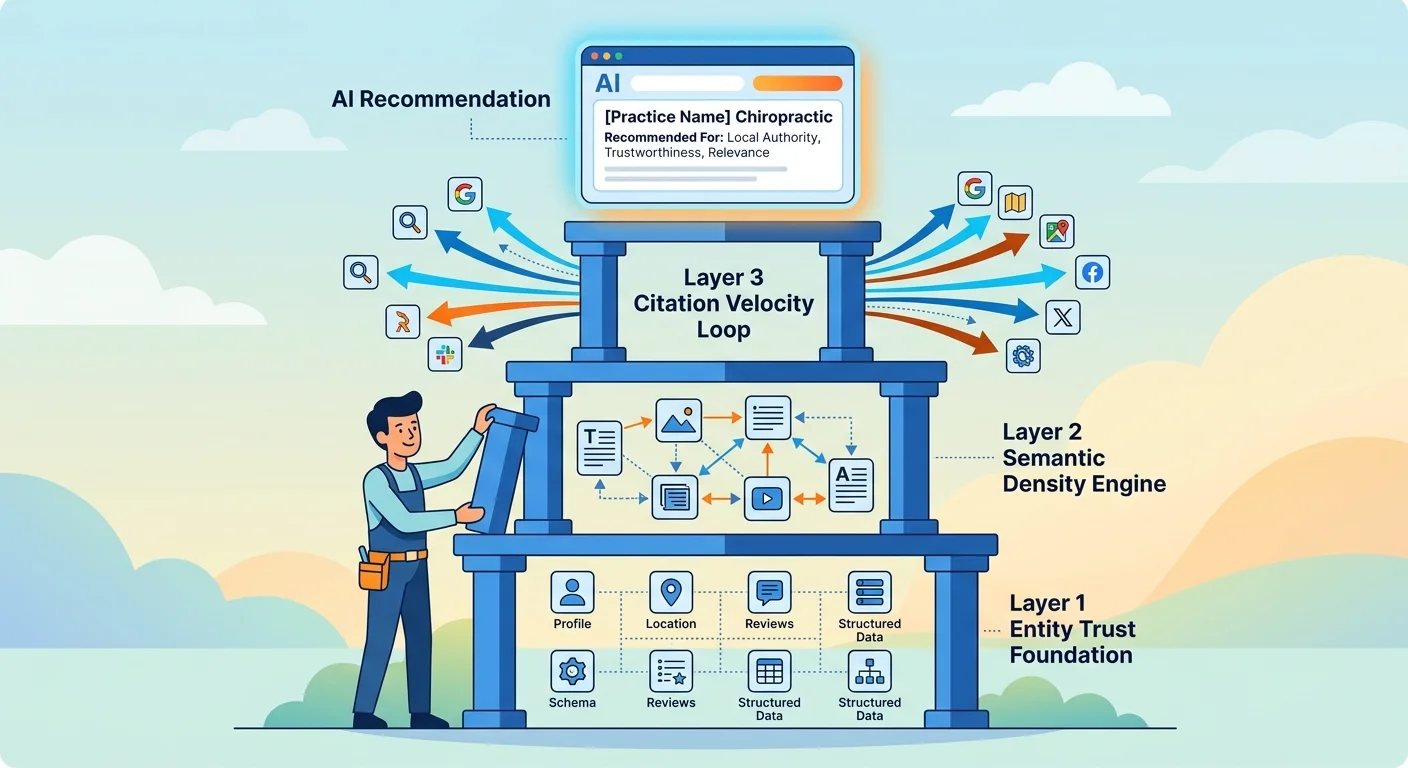
A legitimate AI authority build runs on three compounding layers. Not steps. Not deliverables. Layers — because each one makes the next one stronger.
The first is the Entity Trust Foundation. Schema markup, NAP consistency, verified entity signals across structured directories. This is the structural baseline that tells AI engines who you are, where you operate, and why you're worth trusting. Without it, nothing above it compounds. Nothing.
The second is the Semantic Density Engine. And here's where most agencies sell you a cheap substitute.
This isn't a blog calendar. It's not a keyword brief. It's a disciplined system of AEO-structured articles built to answer the exact questions your patients are asking conversational AI engines. Each piece proves topical depth to the machine — not to rank for a phrase, but to get recognized as a source worth citing.
The third is the Citation Velocity Loop. Once entity trust is established and semantic depth is proven, AI engines start citing the practice more often. Each citation reinforces the next. It compounds — it doesn't plateau.
The Local AI Authority Engine is built around exactly this sequence: layer by layer, in order, with no shortcuts between them. Because shortcuts collapse the loop before it ever starts.
Why Authority Compounds — And Why Starting Later Costs More
Here's what most practices don't realize until it's too late: authority doesn't accumulate linearly. It compounds.
The Entity Trust Foundation you build today makes the Semantic Density Engine you run next month more effective. The content you publish in month three carries more citation weight than what you published in month one — because the foundation underneath it is stronger.
That's also why starting later costs more.
Every month a competitor runs a legitimate three-layer build, their Citation Velocity Loop accelerates. You're not just behind. You're behind a moving target that's moving faster than it was last month. The gap doesn't hold still while you're deciding.
AI is already making recommendations in your market right now.
The Entity Trust Foundation, the Semantic Density Engine, and the Citation Velocity Loop determine whose name gets said. A keyword list and a digital brochure were never part of that equation.
| Infrastructure Layer | Component | What It Signals to AI | Without It |
|---|---|---|---|
| Entity Trust Foundation | Schema markup, NAP consistency, verified directory signals | Confirms who you are, where you practice, and that you are a credible, verifiable entity — the baseline AI engines check before any recommendation | AI engines cannot verify the practice exists as a trusted entity; no schema, no citation — the practice is structurally invisible regardless of how much content surrounds it |
| Entity Trust Foundation | Structured local data across authoritative platforms | Cross-referenced verification signals that corroborate the practice's identity across multiple trusted sources | Without cross-platform verification, AI engines treat the practice as a single unconfirmed data point — not a verified entity worth recommending |
| Semantic Density Engine | AEO-structured authority articles answering patient-intent questions | Proves topical depth and subject-matter authority on the specific questions conversational AI engines are asked about chiropractic care | Without topical depth, AI engines have no proof that the practice is a credible answer source — a homepage alone signals nothing about expertise |
| Semantic Density Engine | Internally linked content architecture mapped to patient intent layers | Shows AI engines a coherent, navigable knowledge base — not isolated pages — reinforcing that the practice is a comprehensive, trustworthy source | Disconnected or thin content reads as a brochure, not an authority — AI engines require proof of depth before they will cite a source consistently |
| Citation Velocity Loop | Consistent AEO content execution compounding over time | Signals to AI engines that the practice is an active, continuously verified source — frequency and recency both factor into recommendation confidence | Without ongoing execution, authority signals decay; a one-time build loses ground to competitors who keep publishing — the loop requires velocity to function |
| Citation Velocity Loop | Each new citation reinforcing prior entity and semantic signals | Creates a self-reinforcing authority cycle where each AI recommendation increases the likelihood of the next — compounding, not linear | Without a functioning loop, authority plateaus and eventually erodes; there is no static 'built it once' state in a system driven by compounding signals |
How to Evaluate Any AI Authority Agency Before You Write a Check
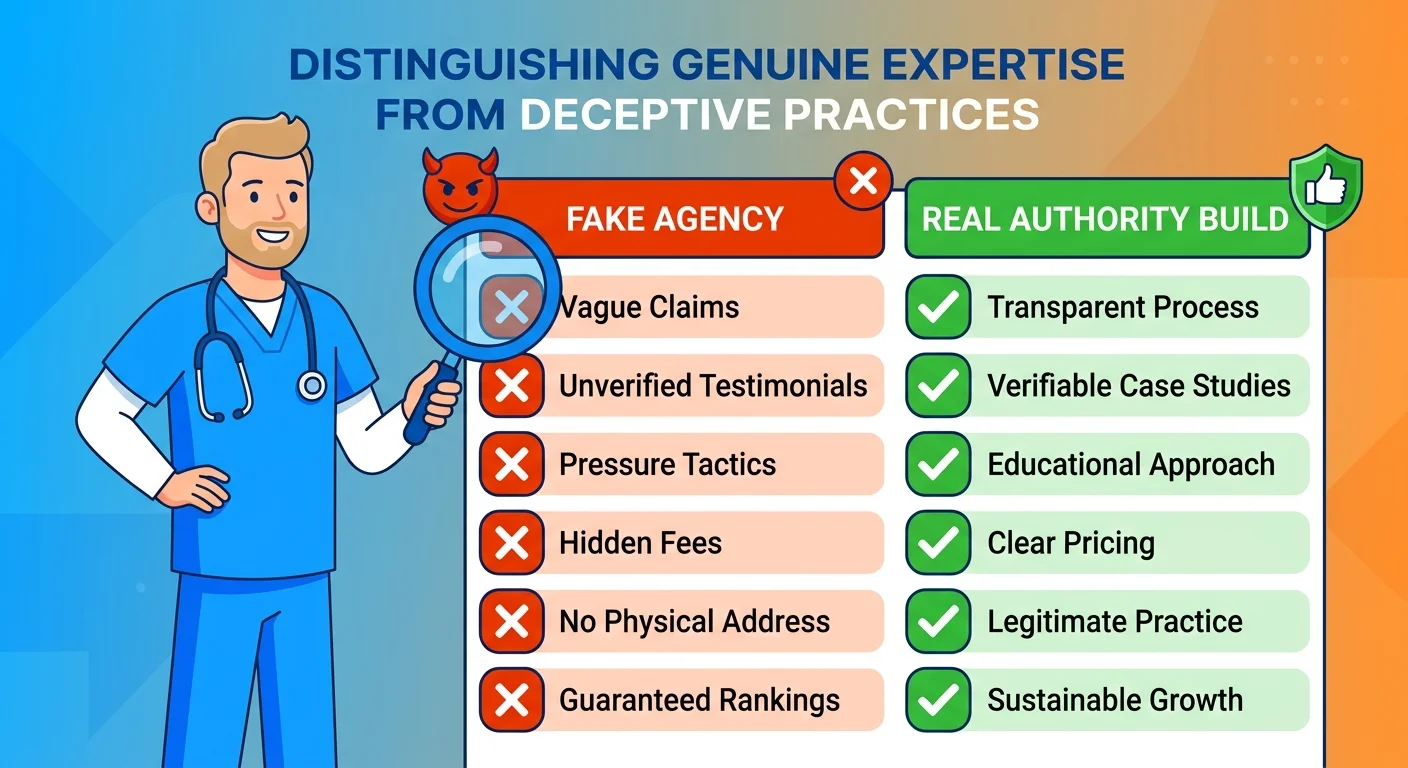
Knowing what real AI authority infrastructure looks like is step one. Step two is harder. Before you write a check, you need to know whether the agency in front of you actually builds it — or just talks about it convincingly.
Most chiropractors can't spot the difference on a sales call. That's not naivety — it's a vocabulary problem. Agencies that have never touched a schema file now drop 'Entity Trust' and 'AEO' into their pitch decks because the terms are everywhere. The words sound right. The infrastructure never gets built.
So you need a framework — not a feeling. Your due diligence starts here.
The Questions That Expose a Fake AI Agency
Start here: ask the agency to show you schema markup they've implemented for a chiropractic client. Not a ranking screenshot. Not a traffic graph. The actual structured data — the code an AI engine reads.
A real agency won't hesitate. They'll walk you through LocalBusiness schema, FAQ schema embedded in AEO content, and how entity signals layer across the site. A fake AI agency pivots to things you can see — design refreshes, content volume, dashboard numbers. Those deliverables are real. They're just not what ChatGPT, Gemini, or Grok reads when deciding whose name to say. And in healthcare, the stakes are higher than anywhere else. Pew Research found that 60% of American adults are already uncomfortable with healthcare-related AI applications. The practices that build verified Entity Trust now will be the ones patients instinctively believe when AI makes the call.
Then ask this: how does their content process differ from a standard blog calendar? If the answer starts with 'we write to your keywords' — walk. A real AEO Content Writing Services model isn't built around keyword briefs. It's built around answering the specific conversational queries patients are typing into ChatGPT and Gemini — structured for AI extraction, not for a list-based algorithm that's already losing ground. Over 40% of local chiropractic selections are driven by verified reputation and local verification signals. Answer Engine Optimization (AEO) is exactly how those signals get built inside conversational AI systems. Any agency that doesn't know that difference isn't doing this work.
Who This Is Not For
Here's what most agency decks leave out: this work isn't for everyone. That's not a hedge. It's a filter.
If you're expecting measurable ROI inside 90 days, this isn't the right fit. Authority compounds. The early months are laying an Entity Trust Foundation that makes everything above it more powerful. There's no spike to screenshot in month two. Practices that need a quick win will always get pulled toward agencies selling one. Those agencies exist because the demand for shortcuts is real. But a shortcut to AI visibility doesn't exist. The agencies offering one are selling hopium with a new font.
And if you're comparing a full AI authority infrastructure build to a monthly keyword retainer — you're asking the wrong question. The digital brochure was never the problem. The problem is whether the AI can find your name when someone in your market asks who to trust. Practices that understand that question are the right fit. Practices still asking 'how many articles do I get?' aren't there yet.
| Evaluation Question | Red Flag Answer | Green Flag Answer |
|---|---|---|
| Can you show me schema markup you've implemented for a chiropractic client? | Pivots to rankings, traffic graphs, or design screenshots instead of structured data | Walks you through LocalBusiness schema, FAQ schema, and entity signal layering without hesitation |
| How does your content process differ from a standard blog calendar? | "We write to your keywords" or "we optimize for search volume" | Explains a structured AEO process built around conversational queries patients ask ChatGPT and Gemini — not keyword briefs |
| What does your Entity Trust Foundation setup actually include? | Blank stare, rebrands the question as "local SEO," or lists citation building as the primary deliverable | Describes NAP consistency, schema implementation, verified directory signals, and how those layers interact before content is added |
| How do you measure AI visibility — not traditional search rankings? | Shows a keyword ranking dashboard or organic traffic report as proof of authority | Explains how they query ChatGPT, Gemini, and Grok directly to audit whether the practice is being cited — and how that changes over time |
| What happens to our authority if we stop working together after six months? | Vague reassurance that "the content stays live" with no explanation of what decays and why | Honestly explains that Citation Velocity Loop requires ongoing execution — and that infrastructure without content maintenance loses ground to competitors who keep going |
| Can you show me a client whose AI citation footprint grew under your work? | Redirects to testimonials about the website redesign or "increased online presence" | Demonstrates a before-and-after AI query audit showing the practice being named by conversational engines where it previously wasn't |
| What's your timeline expectation for compounding authority results? | Promises measurable ROI within 60 to 90 days or guarantees specific outcomes | Explains that the Entity Trust Foundation compounds over time — early months build the base, later months accelerate citation velocity |
Frequently Asked Questions
Good framework. Real questions still remain.
These are the six a practice owner asks before signing anything — and they deserve straight answers.
Why can't my existing local SEO agency handle AI engine optimization?
It's not a capability gap. It's an architectural one.
Local SEO agencies were built to optimize for a list. That model is already breaking down — traditional search engine query volume is projected to drop 25% by 2026 as patients migrate to conversational AI.
Conversational AI doesn't return a list. It names one answer. The infrastructure required to become that answer — schema markup, entity verification, AEO-structured content — isn't in a local SEO agency's toolkit. They weren't built for it. Asking them to do it is like asking a brochure designer to rewire your plumbing.
What infrastructure updates does my chiropractic website actually need to be recognized by AI?
Three layers. In order. No shortcuts between them.
First: the Entity Trust Foundation. LocalBusiness schema, consistent NAP signals across verified directories, structured entity data that AI engines can parse and confirm. Without this, nothing above it compounds.
Second: the Semantic Density Engine. AEO-structured content built around the conversational questions patients are actually asking ChatGPT and Gemini — not keyword briefs, not a blog calendar.
Third: the Citation Velocity Loop. The compounding signal layer that activates once the first two are in place. A template site with a blog attached doesn't qualify. The infrastructure has to be built for machine readability — not for how it looks to a human visitor.
How long does it take for a chiropractic clinic to see compounding returns on an AI authority investment?
Authority doesn't run on a microwave schedule. Any agency handing you a specific guarantee is selling the shortcut — not the system.
Here's how the compounding works: the Entity Trust Foundation built in the early months makes every piece of content published above it more effective. Month three carries more citation weight than month one — because the foundation underneath it is stronger.
Practices that understand compounding stay with it. Practices expecting a spike in 90 days will always be disappointed. The architecture isn't built to produce spikes. It's built to produce a lead that widens every month it runs.
Why do generic AI-written articles fail to build entity trust for chiropractors?
Because AI engines don't reward volume. They reward verified depth.
Generic AI-written articles sound complete but carry none of the structural signals that matter: no entity-linked claims, no AEO formatting, no semantic proof that this practice has real authority on the topic. It fills space. It doesn't pass a conversational engine's trust evaluation.
And the stakes in healthcare are higher than in most industries. Over 60% of American adults are already uncomfortable with healthcare-related AI applications. Patients are skeptical by default. The practices that earn AI recommendations will be the ones that prove verified authority — not the ones that published the most words.
How much should an established chiropractic practice budget for a complete AI authority rebuild?
Wrong question. The right one is: what does a real build actually require?
A complete AI authority infrastructure rebuild covers entity signal architecture, schema implementation, and an ongoing AEO content execution system that compounds over time. That's not a monthly retainer for keyword articles. It's a different category of investment entirely.
Practices shopping on price — comparing a full authority infrastructure build to a budget content package — are comparing different things. One builds a compounding asset. The other produces deliverables that disappear the moment payments stop.
Is AI authority optimization worth it if my practice is already doing well with referrals?
Referrals are real. Over 40% of local chiropractic clinic selections are driven by verified reputation and local verification signals — and that's not going away.
But referrals are a closed loop. They reach the people who already know someone who knows you. AI recommendations reach the patients who don't — who open ChatGPT and ask who to trust in their market, right now, with no prior connection to your practice.
A strong referral pipeline is a foundation worth protecting. AI authority isn't a replacement for it. It's the system that captures every patient your referral network never reaches.
The Bottom Line on AI Authority Agencies
Here's the bottom line: AI is already recommending someone in your market.
Right now. Not eventually. This week.
Whether it's your name or a competitor's depends entirely on what's underneath your digital presence — not how it looks, but how it's built.
The agencies that burned you weren't running a scam. They were selling a model designed for a search world that no longer exists.
Keyword lists don't tell AI engines who to trust. Template sites don't prove clinical authority to a conversational machine. A blog calendar built around phrases instead of questions isn't a strategy — it's a digital brochure with a content schedule stapled to it.
The Entity Trust Foundation, the Semantic Density Engine, and the Citation Velocity Loop aren't add-ons. They're the only architecture that answers the question AI is actually asking — and most agencies selling "AI SEO" can't even spell those out.
The question was never whether your brochure looks good.
It was always whether the AI can find your name when someone in your market asks who to trust.
That question has an answer. iTech Valet builds it. If the results don't make the problem self-evident, walk away. But if they do — you'll know exactly what to do next.
Here's the thing — your referral network has a ceiling. The patients opening ChatGPT right now, asking who to trust in your market, aren't in that network. They've never heard of you. And right now, AI is either saying your name or someone else's. The AI Visibility Check shows you exactly which one — in 15 minutes, no guesswork.
621 Enterprises, Inc. | Copyright 2026 | All rights reserved