
Why Your Clinic's Digital Footprint Reads Like a Scattered Case File to AI
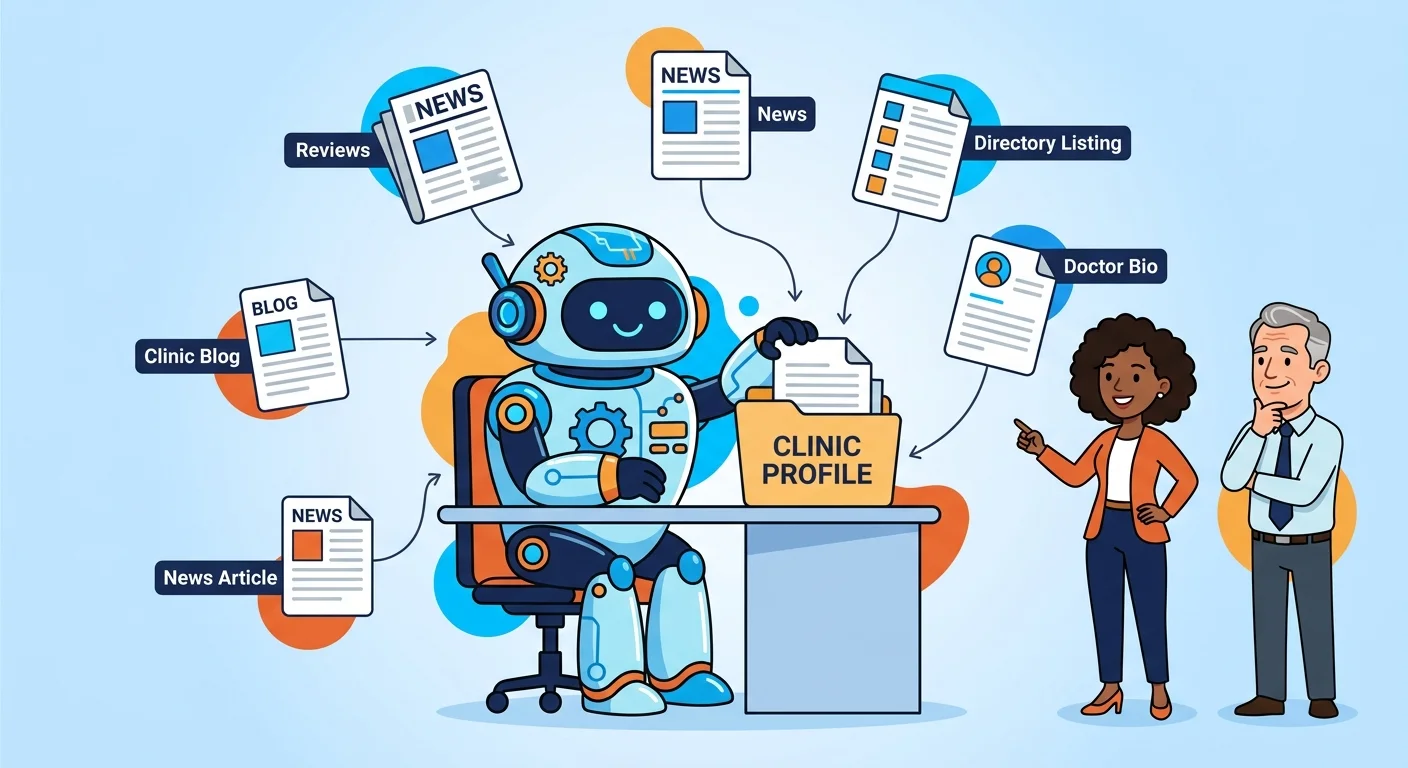
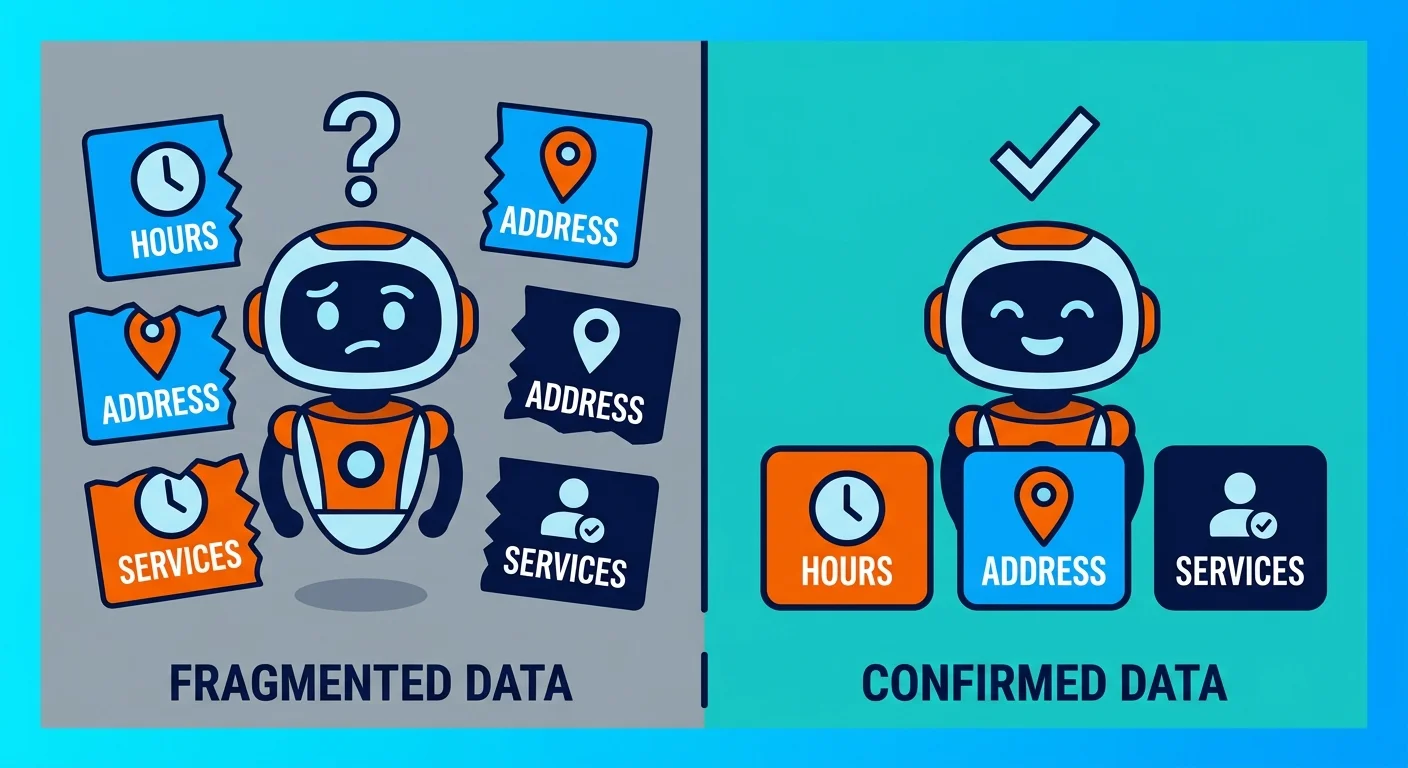
AI doesn't read your website. It reads everything about your clinic scattered across the web, then treats that mess as one record it has to reconcile.
That shift matters because the way patients find local care has fundamentally shifted from a list of links to a single, synthesized answer. Nobody hands the engine a clean intake form. It has to build the case file itself, out of whatever fragments exist, before it ever writes a recommendation.
For a clinic, that unstructured data is everywhere. Patient reviews on third-party sites, articles in the local news, your own blog posts, your doctor bios. None of it was written to agree with the rest. A directory listing has no idea what your homepage says about your hours, and neither one was written with the other in mind. That's the scattered case file problem in its rawest form.
Chasing keyword position tracking never touches this problem. A clinic can hold a strong spot in the classic ten blue links and still hand the AI a contradictory file. If your phone has gone quiet even while your website looks fine, the reason often traces back to exactly this kind of fractured record, which is the pattern examined in why clinic phone calls stall even as competitors dominate AI search.
Why Keyword Position Tracking Can't Fix a Coherence Problem
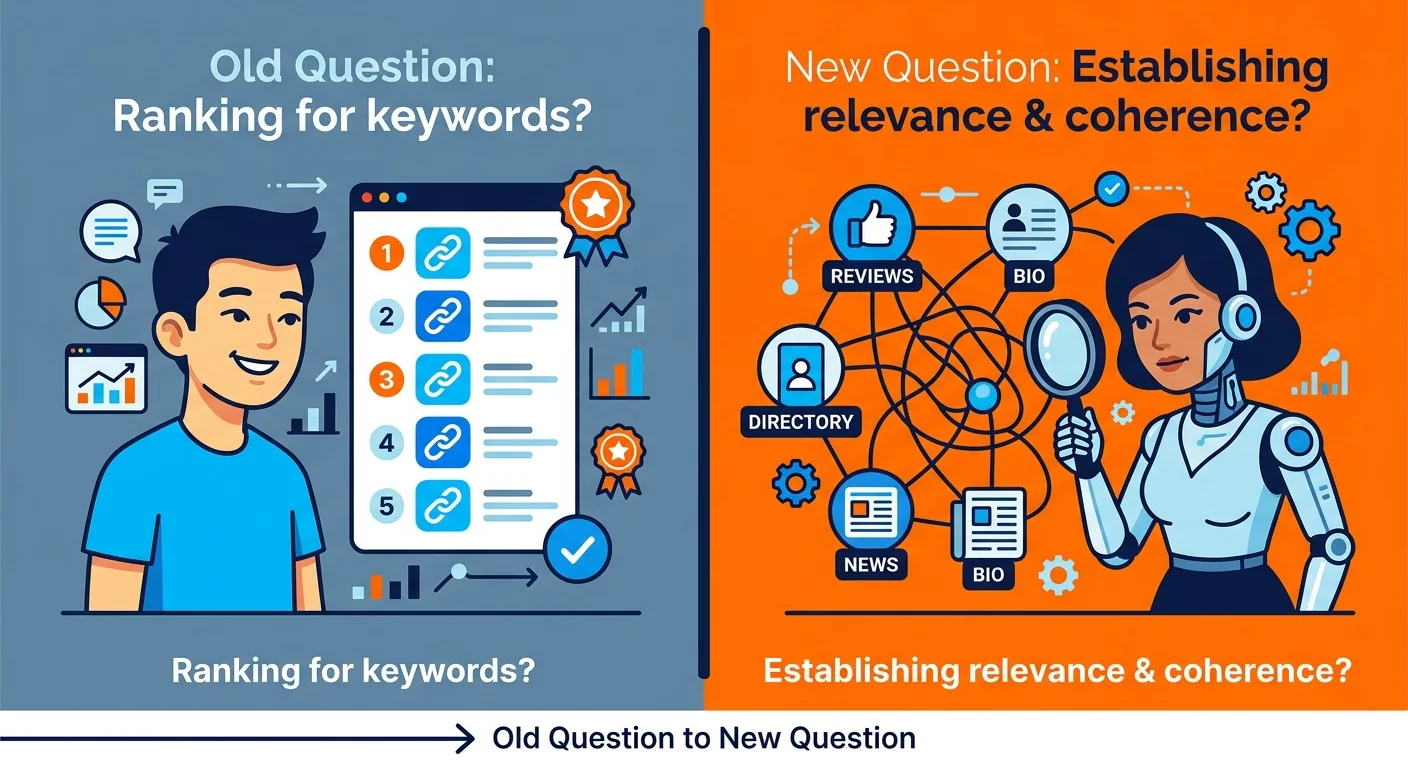
Here's the thing: keyword position tracking measures the wrong layer entirely. It tells you where a page sits in the classic ten blue links. It says nothing about whether the AI's assembled case file on your clinic actually holds together.
And that difference isn't cosmetic. Traditional search optimization was a narrow job, really, just matching queries to pages so a crawler could find your site.
But the new job is a different animal, not a bigger version of the old one. It means making your clinic's entire digital footprint legible to AI, every fragment scattered off your own site included, which is exactly what a position report was never built to see.
Why Keyword Position Tracking Fails to Answer the New Question
So position tracking answers a question nobody's asking anymore. It tells you where you rank, not whether your record resolves cleanly.
You can hold a strong spot and still project pure confusion to the engine building your case file. The two numbers just aren't measuring the same thing.
That gap is exactly what fuels the psychology behind why some clinics vanish from AI-generated answers entirely. A patient never sees the ranking report. They see whether an answer engine names your clinic at all, or quietly resolves the mess by recommending someone else.
Tracking a keyword's position and reconciling a scattered record aren't competing priorities. They're unrelated disciplines wearing the same dashboard, and only one of them still decides whether a clinic gets recommended.
How AI Actually Decides Your Clinic Is a Real, Distinct Entity
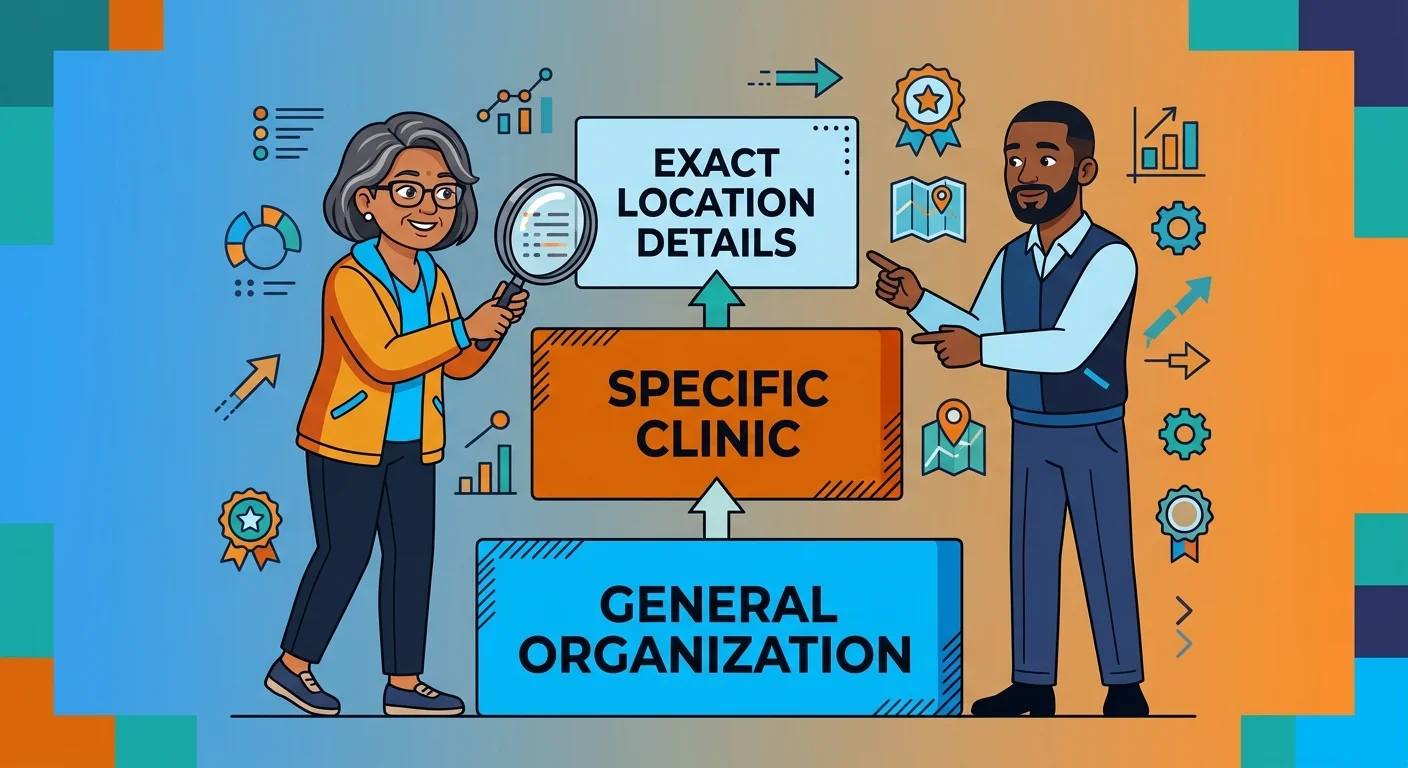
Entity recognition is the mechanism that turns a scattered pile of mentions into one confirmed clinic. It's not matching a name to a webpage.
The engine has to decide, from fragments spread across dozens of unrelated sources, that this review, this directory listing, and this news mention all point to the same physical place. Get that wrong and the case file splits in two.
A clinic can get recommended under a slightly different name on one site and ignored on another, because the engine never tied that mention back to the entity it already trusts. Distinct-entity resolution happens first, before trust, sentiment, or consistency ever get a look.
| Entity Layer | What AI Is Checking | Example in a Clinic's Data |
|---|---|---|
| Coarse Entity Type | Whether the mention refers to an organization at all, as opposed to a person, product, or unrelated noun | A review mentioning "the clinic" gets tagged as an organization before anything more specific is decided |
| Fine-Grained Entity Subtype | Whether that organization is refined into a specific subtype, distinguishing a healthcare business from a general company or service listing | A directory tag that separates a medical practice from a generic wellness storefront sharing the same block |
| Coarse Location Type | Whether an address or place reference is recognized as a location at all, before any specificity is assigned | A blog post naming a neighborhood is flagged as a location mention, nothing more |
| Fine-Grained Location Subtype | Whether that location is refined into a specific subtype, such as a street address rather than a general city or transit reference | A patient review citing a suite number resolves to a street-level location tied to one building, not a general area |
| Cross-Source Entity Linking | Whether separate mentions across unrelated sources are recognized as describing the same physical clinic rather than treated as unrelated entities | A news article, a directory listing, and a patient review all get linked to one confirmed clinic instead of splitting into three unverified fragments |
Distinguishing General Mentions From Specific Clinic Details
Named entity recognition works in layers, not one flat pass. Research on unstructured domain text describes coarse- and fine-grained entity types, where a general organization label gets sharpened into something more specific, like an organization-company subtype, drawn from German mobility, traffic, and transit texts.
The same layered logic runs on place. A general location mention gets refined into a specific location subtype, the gap between naming a city and naming a street address, a pattern documented in arXiv.
Applied to a clinic, the engine isn't just asking is this a business. It's asking is this a healthcare organization, at this exact street location, distinct from every other business sharing the block.
Why Data Consistency Across the Web Decides Entity Trust
Once the entity is confirmed, trust is the next test. This is where the scattered case file either resolves cleanly or comes apart.
Consistency across sources is what lets the engine commit to a version of the truth. A clinic whose hours, specialties, and address agree everywhere gives it nothing to hesitate over.
But a clinic whose details conflict from one source to the next forces the engine to guess, hedge, or quietly drop it from the answer. That fragility is exactly what traditional authority reporting never surfaces, which is the gap covered in how legacy visibility reports mask a clinic's AI recommendation losses.
Which Sources AI Actually Trusts When Your Data Conflicts

So the clinic exists. Now the engine has to pick whose version of the facts it believes when sources disagree, and not every source gets an equal vote.
Testing across 13 open-weight LLMs turned up the same pattern every time. The models trust institutionally-corroborated information, the kind sitting in government listings or newspaper coverage, over anything sourced from people and social media, a hierarchy documented in the ACL Anthology.
That pecking order hits your case file directly. A patient's offhand comment on a review site just doesn't carry the weight of a local news mention or a licensing record.
| Source Type | Trust Weighting Behavior | What This Means for a Clinic |
|---|---|---|
| Government and licensing records | Treated as the highest-weight source, rarely questioned once matched to the clinic entity | A clinic's official credentials and registration details anchor the rest of the case file |
| Local news mentions | Weighted as institutionally corroborated, similar in standing to government listings | A single accurate press mention can outweigh several inconsistent directory entries |
| Clinic's own website and blog content | Trusted for detail, but only when it agrees with what other sources already say | Self-published claims that contradict outside sources create hesitation rather than confidence |
| Patient reviews and social media mentions | Weighted lowest among the source types, useful mainly for sentiment rather than fact resolution | Glowing reviews cannot substitute for consistent institutional facts when sources conflict |
| Directory listings | Treated as user-generated content regardless of how complete the profile appears | Filling in more directory fields does not raise a clinic's standing in a conflict |
This Isn't for Clinics Chasing a Quick Directory Fix
This isn't for clinics hunting a quick directory fix. Claiming a few listing profiles and calling the data problem done misreads what the engine's actually weighing.
A directory submission is user-generated content wearing an infrastructure costume. The second sources start disagreeing, it drops to the bottom of the trust hierarchy, no matter how many fields you filled in.
Word-of-mouth used to be the whole game for a local clinic. That model doesn't carry over to how engines build a recommendation, which is exactly the shift covered in why personal referrals no longer protect a clinic from disappearing in AI answers.
How Sentiment Buried in Reviews Shapes Whether AI Recommends You
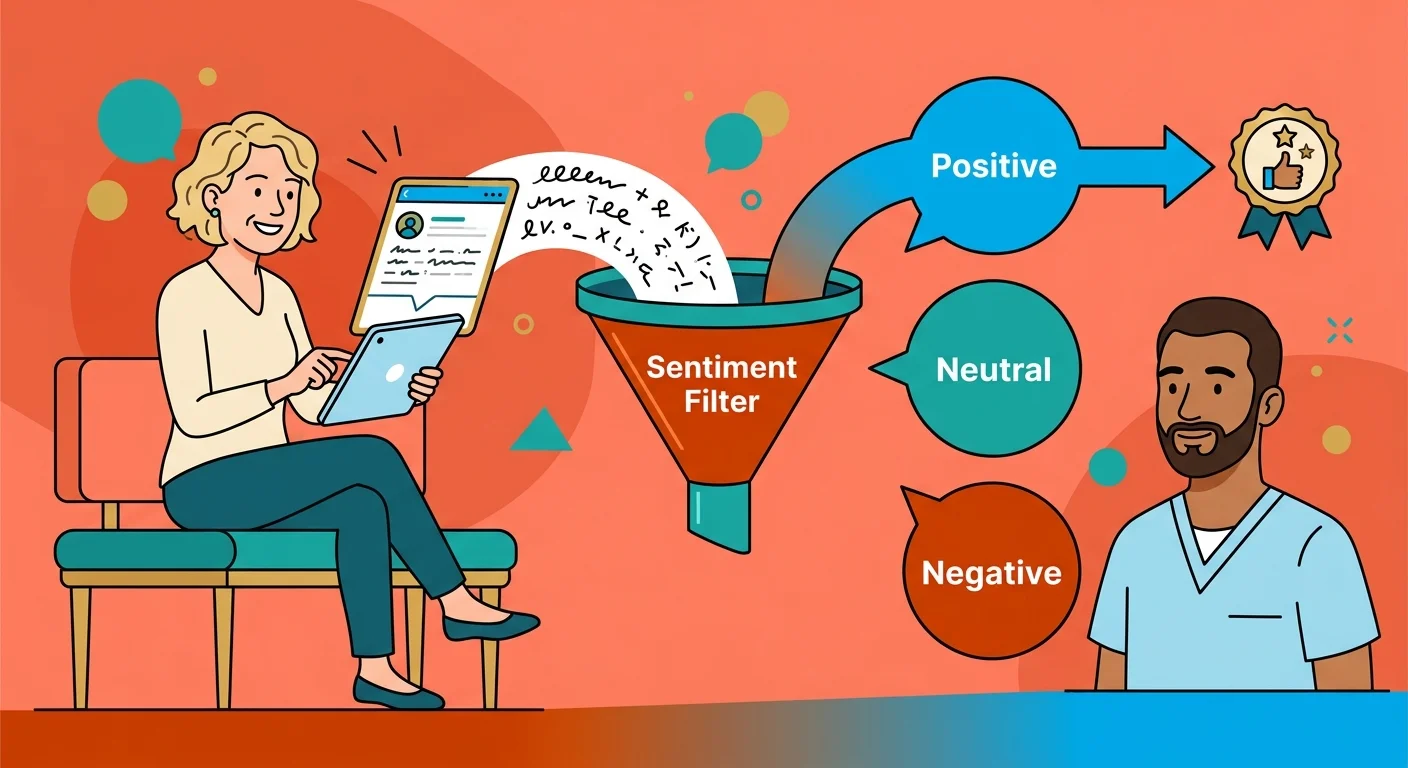
Sentiment is the layer nobody puts on a dashboard. And it's the one that decides whether the case file reads as a recommendation or a warning.
An engine reading a review doesn't just note that it exists. It reads the language wrapped around your clinic's name and tags the tone as favorable, neutral, or negative before that mention ever counts toward a recommendation.
This is the same trick commercial recommendation systems already run for e-commerce. Those systems chew through unstructured reviews about goods and services and pull out polarity on purpose, so the sentiment, not just the star count, sharpens which result surfaces, a mechanism documented in published research data on opinion mining.
Why a Generic Website Isn't Enough Even With Great Reviews
A polished homepage can't override a sentiment problem sitting in your third-party reviews. The engine isn't grading the website. It's grading the reconciled record.
A clinic can publish confident, well-written pages about its specialties and still get buried if the sentiment scattered across outside reviews reads as mixed or hostile. Your homepage is one fragment in a much bigger case file, and it doesn't get the deciding vote.
Here's why a clinic can look strong on paper and still lose the recommendation. Great copy describes what the clinic intends. Sentiment in reviews describes what patients actually lived through, and the engine weighs the second one heavier than the first.
The Real Cost of Letting AI Guess at Your Clinic's Facts
Sentiment tells the engine how a fragment feels. It doesn't tell the engine whether that fragment is even true.
And that second failure is the pricier one. A clinic can survive a mixed review. What it can't survive is an AI confidently stating the wrong address, the wrong hours, or a service you dropped years ago.
The real cost of an incomplete case file isn't a lower ranking. It's a fabricated fact standing in for the one the engine couldn't find — handed to a patient with the same confident tone as anything true.
Where Hallucinated Clinic Details Actually Come From
Hallucination isn't random noise. It's what happens when the engine hits a gap in the record and fills it anyway, because the answer has to come out fluent whether or not the fact was ever confirmed.
And this isn't some fringe risk hitting a handful of sloppy systems. When researchers benchmarked general-purpose AI models against roughly 800,000 queries to measure factuality, state-of-the-art models showed hallucination rates between 58 and 88% — a finding detailed in published trade reporting on generative AI factuality.
That range isn't a footnote. It's the baseline habit of the very engines a patient asks to recommend a clinic.
So a clinic with a thin, contradictory footprint isn't some passive bystander to that number. It's handing the engine more gaps to guess through — on a system already prone to inventing facts more often than not.
How to Read Your Own Clinic's Unstructured Data Trail

So where does a clinic actually start untangling this? Not with another position report.
Start with the scattered case file sitting outside the clinic's control. That's the thing the engine reads before the clinic ever gets a say.
That means pulling the same fragments an AI would pull. Reviews, directory listings, news mentions, the clinic's own pages, all laid side by side. Then read them for the story they tell together, not one at a time.
| Audit Step | What to Check | Why It Matters to AI |
|---|---|---|
| Identity Consistency Check | Name, address, specialty, and hours compared word for word across the clinic's own pages, directory listings, and third-party mentions | Conflicting details force the engine to guess or hedge, which is exactly when a clinic gets quietly dropped from a recommendation |
| Sentiment Scan | The tone embedded in reviews and outside mentions, read as favorable, neutral, or hostile rather than just counted as stars | A polished homepage cannot outweigh a sentiment problem sitting in the reconciled record the engine actually trusts |
| Completeness Gap Check | Whether the scattered record answers the specific questions a patient might ask, or leaves silence where a fact should be | Every unanswered gap is an invitation for the engine to fill the blank on its own, with no guarantee the fill is true |
| Source Weight Review | Which fragments come from institutional sources like licensing records or news coverage versus user-generated listings and reviews | Engines lean on institutionally-corroborated fragments when sources disagree, so low-weight fragments rarely settle a conflict |
Auditing the Three Data Layers That Matter Most
Three layers matter more than the rest. And each one maps to a stage in how the engine builds its case file.
First layer is identity data: name, address, specialty, hours, checked for exact agreement across every source that names the clinic. Second is sentiment, the tone baked into reviews and mentions, which the engine tags favorable, neutral, or hostile before a recommendation ever forms. Third is completeness, whether that scattered record actually holds the specific facts a patient might ask about, or leaves gaps the engine fills on its own.
A clinic auditing these three layers isn't chasing a score. It's checking whether its own case file would survive being assembled by a machine with no patience for ambiguity.
Why AI-Generated Summaries Are Getting Cited Ahead of Your Own Words
Here's something most clinics never see coming. The engine's own summary of a clinic often gets cited ahead of the clinic's original words, even when the underlying page ranked lower.
And this isn't a fluke of one platform. Analysis of Google AI Overviews on YMYL queries found AI-generated documents get cited more often than human-authored ones, even after controlling for retrieval rank, a pattern detailed in published research data on citation behavior in generated answers.
That finding flips the whole audit. A clinic isn't just competing to be read anymore. It's competing to be the source an engine trusts enough to fold into its own summary, ahead of the clinic's own sentence.
Frequently Asked Questions
The mechanism kicks up a few edge cases every clinic eventually asks about. Here are the ones that come up most.
What specific types of unstructured data do AI engines analyze to evaluate a local clinic?
Reviews, directory listings, local news mentions, licensing records, and the clinic's own pages. If it names the clinic, its location, or its services, it's raw material for the case file. Doesn't matter whether the clinic controls it or not.
How does an AI determine the 'best' clinic to recommend if multiple clinics have good reviews?
When several clinics all show strong sentiment, the engine leans on which record agrees with itself and answers the actual question. A clinic with matching details everywhere and no open gaps edges out one that just has good reviews.
Can a new clinic with no reviews ever be recommended by an AI search engine?
Yes, but the identity data has to be airtight. A new clinic with a consistent name, address, specialty, and hours everywhere gives the engine less to second-guess than an established clinic full of contradictions.
Why might an AI recommend a competitor's clinic even if my website is more detailed?
A more detailed website doesn't win if the competitor's scattered footprint agrees with itself and yours doesn't. The engine grades the reconciled record, not the homepage.
Does having a more 'technical' or 'medical' website help an AI understand my clinic's expertise?
Only if that depth agrees with what third-party sources say elsewhere. A medically dense page sitting next to contradictory directory data still reads as an unresolved case file to the engine.
How does information from third-party sites like Yelp or Healthgrades influence AI recommendations?
Third-party sites carry real weight because they sit outside the clinic's control, which makes them harder for the engine to write off as self-promotion. Consistent details and favorable sentiment there reinforce the same case file the clinic's own pages are trying to build.
Where This Leaves Your Clinic
A scattered case file was never going to resolve itself. Entity resolution, trust weighting, sentiment, completeness — every layer this article walked through exists for one reason. The engine has to build a verdict out of fragments nobody ever wrote for that purpose.
Chasing keyword position tracking or placing in the classic ten blue links doesn't touch a single one of those layers. The clinic that wins the recommendation isn't the one with the best copy. It's the one whose scattered footprint agrees with itself everywhere an engine bothers to look.
That's the shift this whole article has been arguing for: stop optimizing for a list of links, start making the record coherent enough for a machine to trust. The AI Invisibility Diagnostic exists to do exactly that reading, before iTech Valet closes a single gap — so a clinic can finally see its own case file the way an engine already does.