
The Uncomfortable Pattern Behind AI Overview Citations

The direct answer already named the pattern. Journals win by default because they show up with a proof chain built in. Here's the uncomfortable part — it's what happens when practices react to that pattern the wrong way.
Most practices, and most agencies advising them, treat this as a content problem. Write a longer article, cite more studies, hire a better writer, and eventually the AI system will notice. It will not. Generative search systems are not scoring prose quality against a curve; they are checking whether a claim resolves to a verifiable entity, and a better-written unverified page still resolves to nothing.
The scale of that default isn't subtle. One analysis of health-related AI Overview citations found academic research and medical journals made up just 0.48%, with only 34.45% coming from sources built for medical accuracy at all. That leaves 65.55% pulled from sources never designed for evidence-based standards in the first place. A practice fighting for that remaining share isn't fighting for quality — it's fighting other unverified sources for scraps the machine was never built to trust.
That same pattern shows up elsewhere. When phone calls stop matching search visibility, it's rarely a weaker article at fault. It's a missing credential signal a competitor's entity profile already carries, and published research data confirms the gap is structural, not stylistic. The old rules of authority are being rewritten, and healthcare sits at the sharpest edge of it.
Why 'Write A Better Article' Is Broken Advice

So what do traditional search optimization advisors keep telling practices? Write a better article. Sharper headline, more words, a few more citations stapled to the bottom.
Here's the thing — that advice isn't broken because the writing doesn't matter. It's broken because it aims at the wrong layer of the problem entirely.
The Content-Quality Trap Traditional Optimization Sells
The whole method assumes an AI engine reads your page the way a person does, weighing clarity and depth. It doesn't.
A generative search system is hunting for entity-level proof, not pretty paragraphs. Polish can make a false claim read beautifully and leave a true one failing verification anyway.
That's the content-quality trap. You pour effort into prose while a competitor with worse writing pulls ahead — because its credentials resolve to a source the machine already trusts, a gap worth understanding when you're breaking the citation monopoly local competitors currently hold.
What Article Polish Cannot Fake
Article polish can't fake a license number. It can't fake a hospital affiliation, a board certification, or a named clinician tied to a verifiable institutional record.
Those are structural facts, not style choices. No rewrite in the world substitutes for the Entity Trust Chain a medical journal already carries by default.
What Makes A Medical Journal Machine-Trustworthy
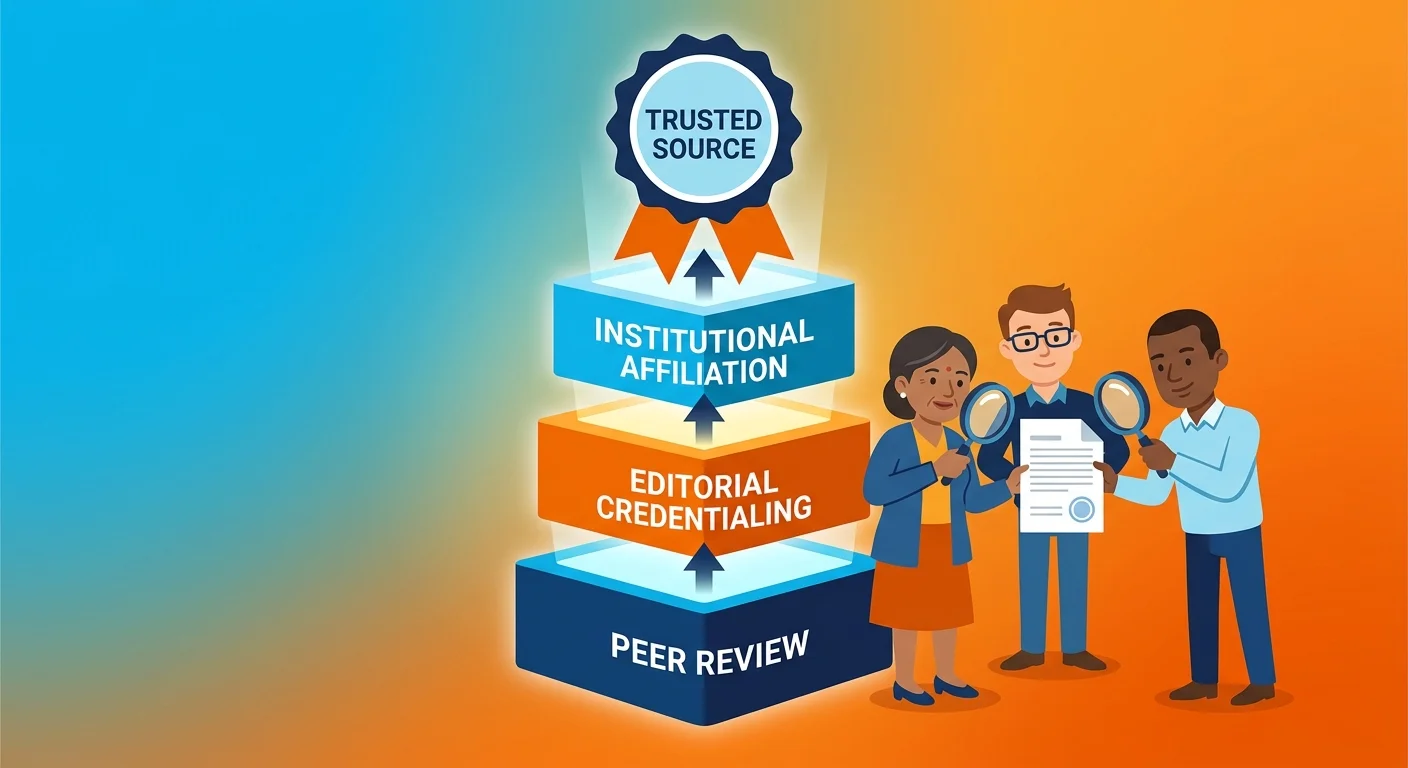
A journal doesn't earn trust by sounding authoritative. It earns it because its structure hands the machine something to check.
Named authors, an institutional affiliation, a documented review process, disclosed credentials — every one resolves to a verifiable entity. That's the language a generative search system already speaks fluently. A practice website is still learning to speak it back.
| Trust Signal | What A Journal Provides | What A Standard Article Provides |
|---|---|---|
| Named Authorship | A credentialed author tied to a real institutional affiliation, verifiable against public records | An author byline that names a person but rarely connects that name to a checkable license or role |
| Institutional Backing | Publication under a recognized medical institution or academic body, itself a verifiable entity | A practice name attached to the page, without a resolvable institutional record behind it |
| Review Process | A documented peer review process that other experts must clear before publication | An internal edit or approval step that leaves no external, checkable trace |
| Credential Disclosure | Board certifications, degrees, and clinical affiliations disclosed as part of the publishing structure itself | Credentials mentioned in an author bio, disconnected from any machine-verifiable record |
| Entity Resolution | A structure built so every claim resolves back to a verifiable source of clinical authority | Well-written prose that reads convincingly but resolves to nothing a machine can independently confirm |
How Google's Own Standards Define Medical Trust
Google says as much in its own quality guidance. High-quality medical information demonstrates expertise, authoritativeness, and trustworthiness — and the Google search quality rater guidelines name health content written by doctors and produced by a medical institution as the working example.
That example isn't a throwaway. It names the exact combination a journal supplies by default: a credentialed author, tied to an institution, publishing through a vetted process.
A practice blog can claim expertise in the author bio. What it can't do is make that claim machine-verifiable without connecting the author, the license, and the institution into a structure the AI system can confirm on its own — which is exactly what the Entity Trust Chain does.
Where YMYL Turns Caution Into Citation Behavior
Here's where the earlier stakes turn into everyday citation behavior. Health questions carry consequences serious enough that generative systems default to caution over confidence.
Google's own systems weight expertise and trust signals harder for anything that could seriously affect a person's health, money, safety, or wellbeing — a category the industry calls YMYL. And Google Search Central documents that weighting directly.
This isn't some brand-new rule. It's the same weighting the industry has leaned on for years, now amplified by systems that must pick one answer instead of ten blue links. Caution was always the setting. AI search just turned up the dial.
Knowledge Graphs And The Verification Layer
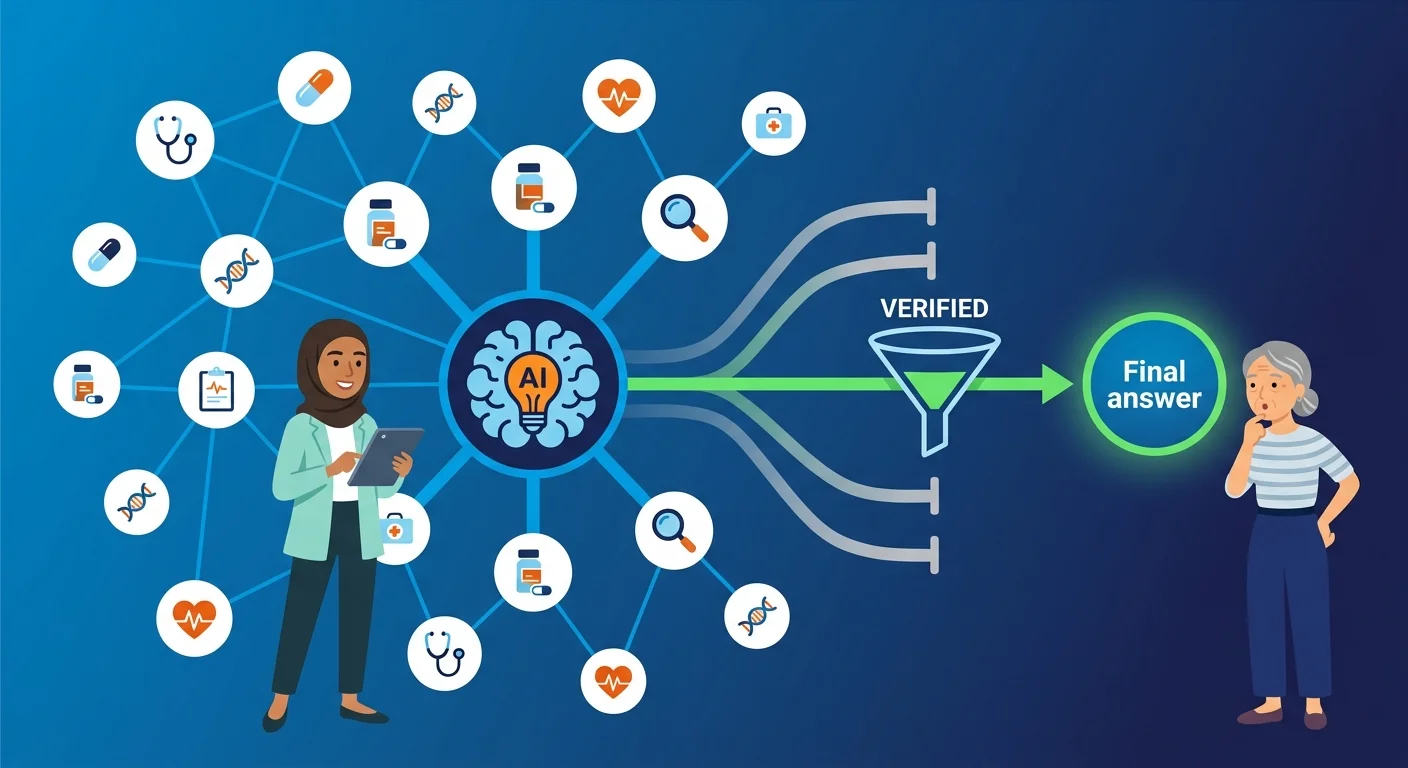
A knowledge graph is what turns a credential claim into something a machine can actually check. It maps entities — a clinician, an institution, a license, a condition — into relationships the system can traverse and confirm.
This is the mechanical layer under everything so far. Journals win by default because their claims already sit inside that verifiable structure. A practice website's claims usually don't.
| Verification Step | Function | Outcome |
|---|---|---|
| Non-Codified Knowledge Intake | The system draws on the unstructured knowledge inside a large language model, the same broad reasoning ability that lets it draft a fluent answer in the first place. | A raw claim exists, but it carries no proof and cannot yet be trusted on its own. |
| Structured Knowledge Cross-Check | That raw claim is checked against a medical concept knowledge graph, where clinicians, institutions, licenses, and conditions already sit connected in verifiable relationships. | The claim either resolves to something real inside the graph or it does not. |
| Triplet Verification And Filtering | Generated triplets are tested against the grounded graph, and anything that fails the check is filtered out before it ever reaches the final answer. | Only contextually accurate, verifiable information survives to the surface. |
| Authority Scoring | Surviving claims are then weighed for how much authority to assign the source behind them, using judgment methods built to output an absolute authority score. | The source is ranked against ground-truth authority patterns, not against how polished its prose reads. |
How A Knowledge Graph Checks A Claim Before It Answers
Picture the journal as a fluent speaker of a language built entirely from verifiable credentials. The practice website? Still speaking a different dialect — one the AI engine can't fully parse until something translates it.
And a working example of that translation already exists in medical research. One knowledge graph-based agent system, called KGARevion, fuses the unstructured knowledge inside large language models with the structured, codified knowledge held in medical concept knowledge graphs.
Then it checks the claims it generates against that grounded graph, filtering out errors and keeping only what's accurate and contextually relevant — a verification process laid out in published research data. That one design choice explains the whole pattern this article's been describing. Verification happens before the answer, not after, which is exactly why an unverified claim never gets a shot at competing.
Judging Authority The Way A Machine Judges It
So once a system can verify a claim, it still has to decide how much authority to hand the source behind it. That judgment isn't guesswork. It follows patterns researchers have tested head-on.
Methods that spit out an absolute authority score — whether by ranking sources in a list or comparing them in pairs — correlate most closely with ground-truth authority labels across every setting tested, a finding documented on the arXiv preprint server. That's the same standard a practice's entity profile gets measured against, a gap why authority visibility reports miss AI recommendation loss digs into further. A credential that can't resolve to a verifiable score is one the machine treats as unproven.
Who This Reality Is Not For

So who's wasting their breath here? Any practice betting the fix is better prose. If your whole plan is a sharper headline or a fatter word count, this reality wasn't built for you.
And it's not for practices treating the Entity Trust Chain as optional — some nice-to-have you'll bolt on later once the content calendar's full. A credential that never resolves to a verifiable entity stays invisible, no matter how many articles you pile around it. Volume won't close that gap.
Now, none of this means you scrap content marketing. It means you change what you're actually proving — authority to a machine, not just to a reader scrolling past.
Building The Entity Trust Chain Piece By Piece
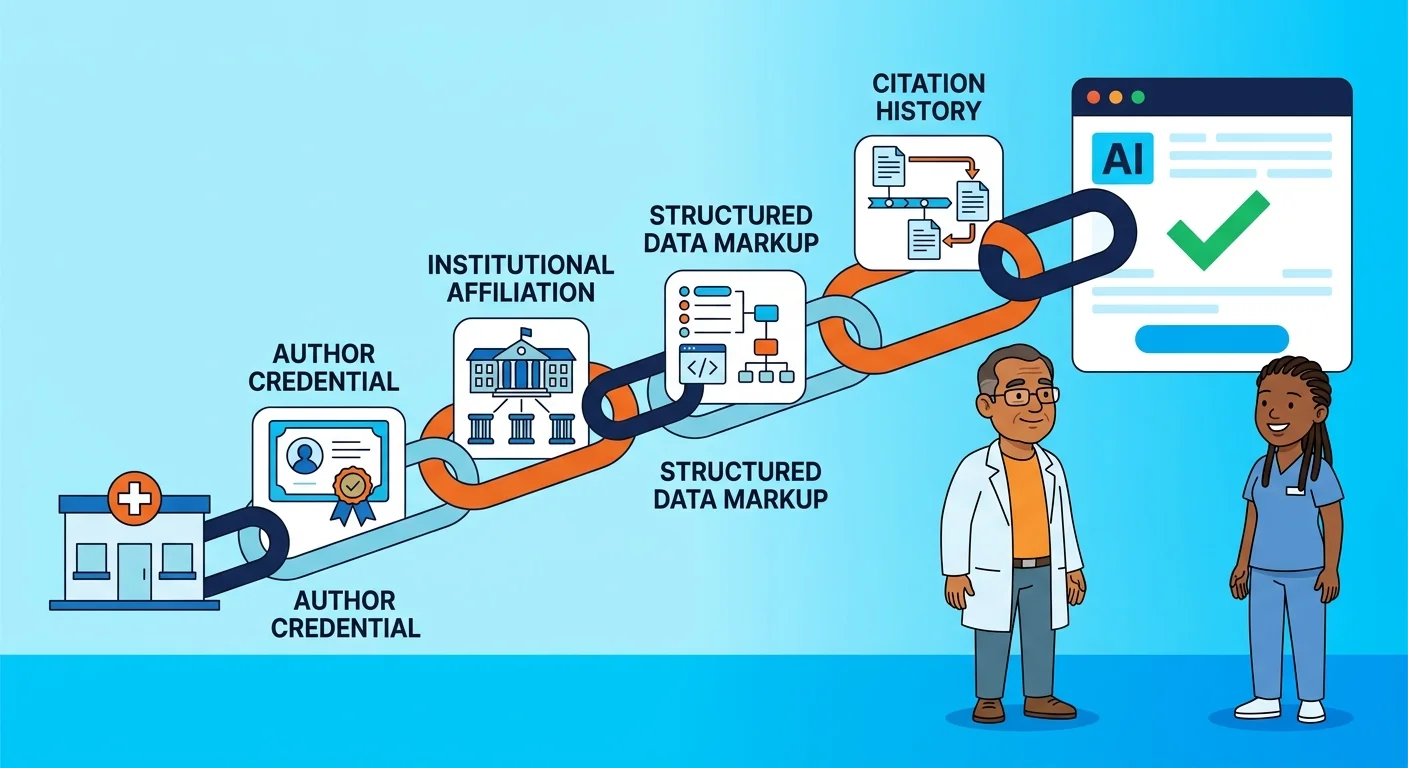
Qualification is only half the job. A practice that's stopped chasing better prose still has to build something in its place. That something is the Entity Trust Chain — and you assemble it piece by piece, you don't buy it whole.
Every piece maps to a real-world credential a machine can check on its own. Author identity, institutional affiliation, structured data — each does a distinct job. None of them fills in for another.
| Entity Trust Chain Component | What It Verifies | Where It Lives On The Site |
|---|---|---|
| Author Credential Resolution | Confirms the clinician behind the content is a real, licensed practitioner tied to a named institution | Author bio page and physician schema markup embedded in the page header |
| Institutional Affiliation Mapping | Verifies the practice or clinician connects to a recognized hospital, university, or accredited body rather than an unverifiable standalone claim | Organization schema and structured about page content |
| Credential And License Fields | Proves a stated board certification or license actually exists and matches a checkable record | Structured data fields attached to author and organization schema |
| Structured Data Markup | Translates real-world relationships between clinician, institution, and claim into a format a generative search system can parse directly | Site-wide schema layer across service pages, author pages, and article templates |
| Content-to-Entity Consistency | Confirms the digital record matches the real-world credential exactly, with no mismatched names, titles, or affiliations | Cross-referenced across bio pages, schema markup, and published article bylines |
Author Credentials As A Machine-Readable Signal
Start with the author. To a generative search system, an anonymous claim is an unverifiable one. And a name on a bio page isn't the same as a name resolved to a credential.
Resolving it means tying the clinician to a license, a board certification, and a named institution — in a format the system can parse, not just read. A byline is a label. A resolved entity is a fact.
Skip that step and you're still speaking the dialect the AI engine can't fully parse. The credential is real. It just hasn't been translated into a structure the machine can traverse.
Schema Markup And Structured Data Requirements
Structured data is that translation layer. It's the markup that tells a generative search system exactly what an author is, what institution stands behind them, and what the page claims — without making the system guess at any of it.
Physician schema, organization schema, credential fields — none of it is decoration. It's the same machine-readable relationship a knowledge graph already uses to connect a clinician to a license and an institution to a claim.
A page without that markup forces the AI system to guess at entities from raw prose. A page with it hands over a verified relationship instead of an inference — and a verified relationship is what survives the filtering step a grounded knowledge graph runs before it trusts an answer.
Linking Real-World Credentials To The Digital Record
None of this holds if the digital record and the real credential don't match. A license number in schema has to point to an actual, checkable license. An institutional affiliation has to be a real one.
Here's the piece traditional search optimization advisors keep skipping — because it was never their discipline. Linking a verifiable credential to its digital record is entity infrastructure work, not article writing. And it's the exact gap a medical journal never has to close.
Frequently Asked Questions
Same objections come up every time this lands on a practice owner's desk. So here they are, answered straight.
Can a standard 'authority' article ever outrank a medical journal for a health query in AI search?
Rarely, and never by writing better prose. It can compete once the author, the institution, and the credentials resolve to a verifiable entity through an Entity Trust Chain. Polish alone won't close that gap.
Does having a doctor write our blog content help it get cited by AI search engines?
Only if that doctor's identity resolves to a checkable credential. A byline naming a physician means almost nothing to a generative system. What matters is whether the license and institution behind it are machine-verifiable.
How does schema markup for medical practices influence AI citation preference?
It hands a generative search system a verified relationship instead of a guess. Physician schema, organization schema, and credential fields let the system confirm who the author is and where they practice. No inferring it from raw prose.
Why don't backlinks from major news sites give my medical article enough authority for AI Overviews?
Because a news mention proves visibility, not clinical credibility. It never resolves a clinician's license, board certification, or affiliation into the entity structure a health query actually checks.
If AI prioritizes journals, is there any point in writing consumer-facing health content anymore?
Yes, but the purpose shifts. Consumer-facing content still builds trust with readers and props up the entity signals search systems verify. That holds even when a journal wins the direct citation.
The Bottom Line
A medical journal didn't wind up fluent in this language by luck. Its whole structure was built for verification long before any AI engine showed up to reward it. A practice website speaks a different dialect until an Entity Trust Chain translates its credentials into something the machine can confirm on its own.
That translation is the real job now. Not a sharper headline, not a longer article, not one more polish pass on prose the system was never going to check for credentials anyway. What actually moves a machine's read on your authority is a resolved author, a verified institutional affiliation, and structured data that matches the real-world record.
Here's the thing: this is a foundational shift, not a content tactic, and traditional search optimization playbooks were never built to close this exact gap. So start where the verification actually happens. See where your practice's Entity Trust Chain breaks down with an AI visibility check from iTech Valet.