
Why AI Engines Skip Businesses That Look Like Everyone Else
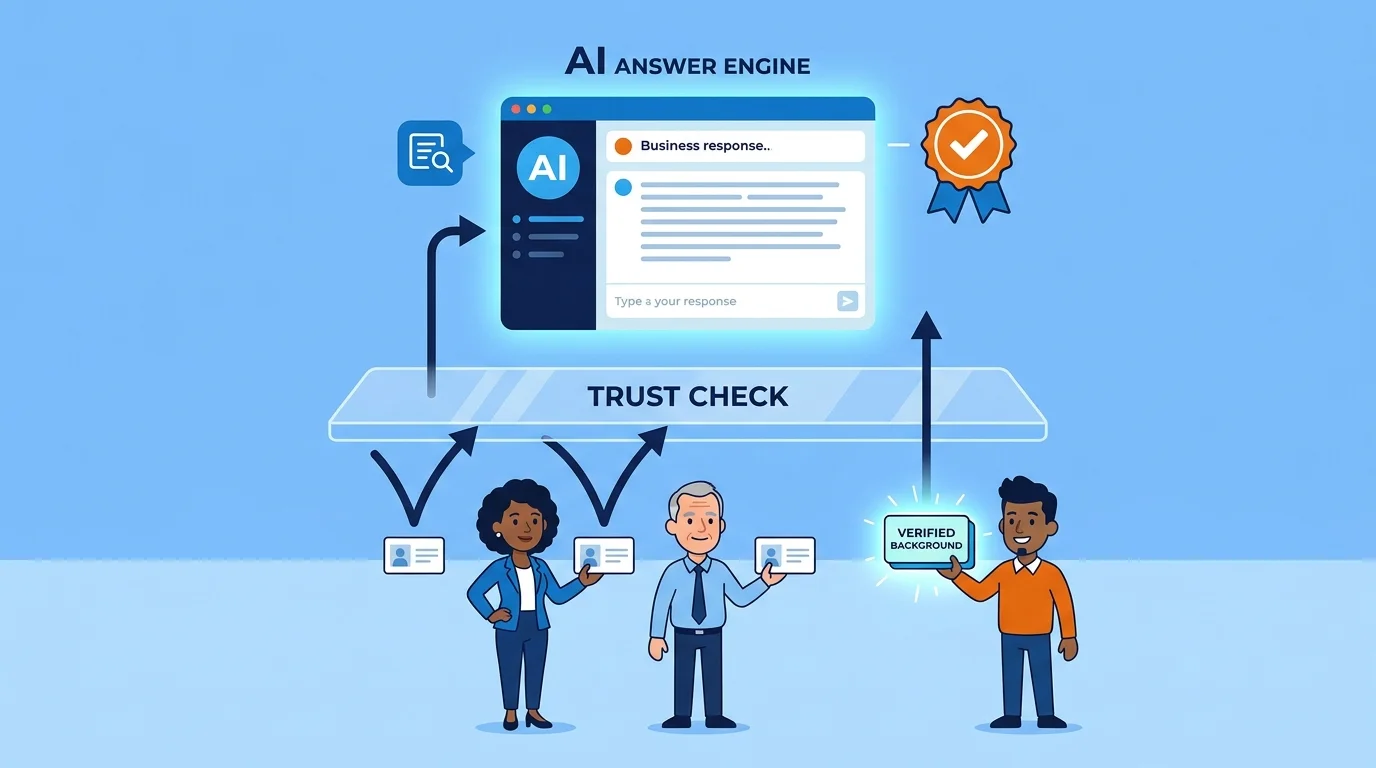
Most businesses still chase placing in the classic ten blue links like it's the finish line. And look, that habit made sense once. It doesn't anymore, because in the new era of generative search, ranking number one is no longer a guarantee of visibility.
Here's the thing an engine can do: read your page, pull the facts right off it, and hand the citation to someone else anyway. That's the citation gap in the wild. It happens when an AI answers the user's question but never names your business as a source, usually because it can't verify you're an authority on the topic.
Now, this part matters, because it's the opposite of what everyone assumes: publishing more content doesn't close that gap. Most businesses pour their energy into traditional search optimization tactics and skip the one thing that counts — turning the founder's real-world expertise into a machine-readable entity. Volume with no verified identity behind it just stacks more anonymous pages on the pile.
That's exactly why lookalike businesses get skipped. Nothing tells one unverified page apart from the next, so the engine defaults to whatever source it can actually confirm. Understanding how a founder's documented history anchors that verification is what turns you into a cited source instead of background noise.
The Traditional Search Optimization Playbook Wasn't Built for This
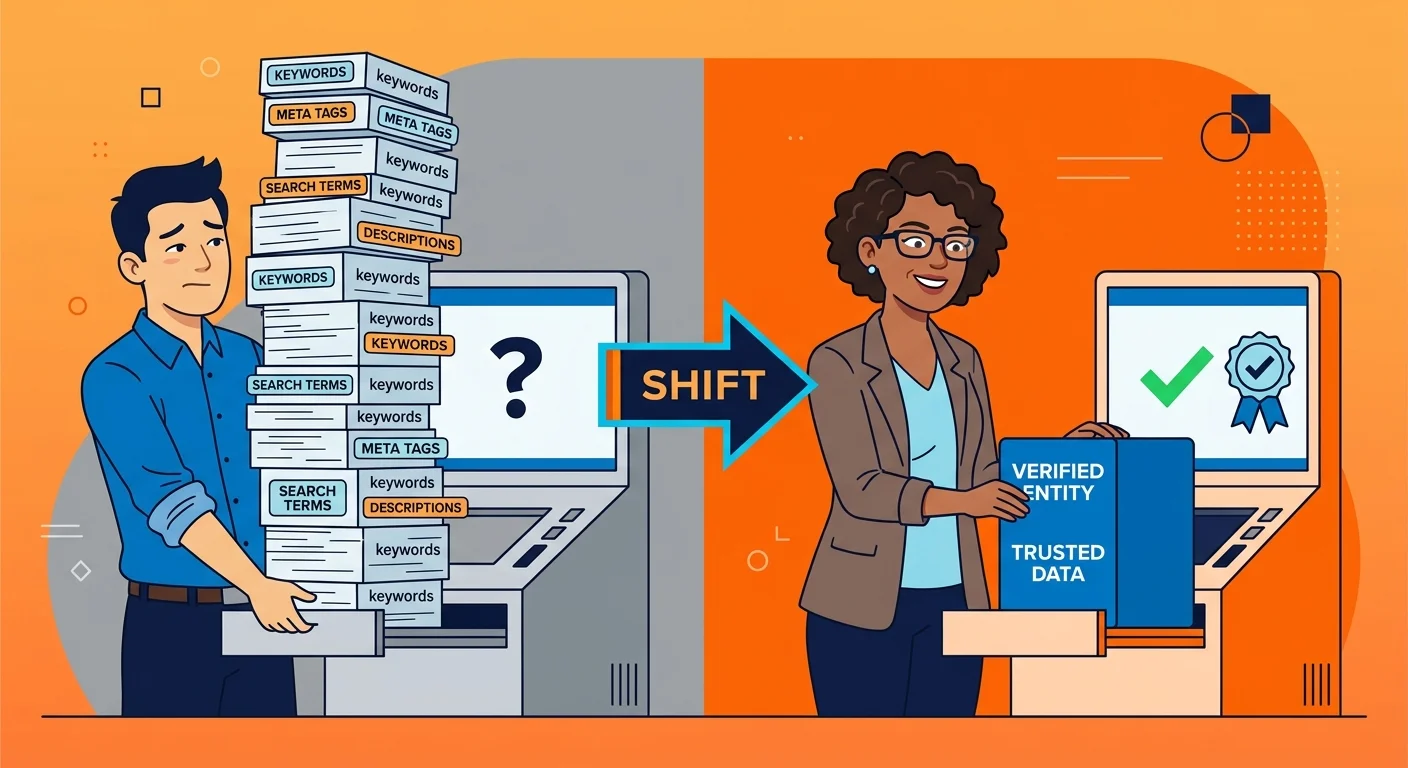
The traditional search optimization playbook was built to satisfy an index. It was never built to pass a verification check. That gap is the whole problem.
Keyword density, meta tags, acquiring inbound links — they all assume one thing: a crawler ranks pages, and ranking is the finish line. Generative engines don't play that game. Before they'll repeat a claim to a user, they ask whether it traces back to a confirmed, real-world source.
A page can tick every traditional search optimization box and still carry zero verifiable identity. No founder, no credentials, no documented experience. Just optimized text sitting in the vault with nothing inside worth citing.
Why Keyword-First Tactics Leave AI With Nothing to Verify
Keyword-first tactics were never built to answer the question a generative engine actually asks. It isn't "does this page use the right terms." It's "who's responsible for this claim, and can that person be confirmed."
Google's automated ranking systems look for a mix of factors that surface experience, expertise, authoritativeness, and trustworthiness — and trust carries the most weight, according to Google Search Central. Keyword placement touches none of that directly.
A page stuffed with the right terms still reads as anonymous. And anonymous pages are exactly what a citation gap is made of.
This is where the multimodal signals that answer engines lean on to confirm who actually wrote something matter more than another round of keyword-targeted articles ever will. Video, verified bylines, consistent cross-platform authorship — they hand an engine what a keyword never can: a confirmable person behind the claim.
The Cost of Treating Authority as a Content Problem
Treat authority as a content problem and you'll always think the fix is another page. Treat it as an identity and data problem, and you see the truth: no volume of pages substitutes for a verified entity behind them.
The cost shows up quietly. A business publishes on schedule, watches its keyword position tracking hold steady, and still finds a competitor's founder quoted in the generative answer instead.
That's not a content shortfall. It's an empty vault problem — real-world experience that never got structured into anything a machine could confirm. Filling it isn't optional if the goal is to be the source an engine trusts enough to cite.
What Counts as Machine-Readable Experience — And What Doesn't

Not every fact about a founder counts as machine-readable experience. Some of it reads as verified fact to an AI engine. The rest reads as noise it skips right past.
And here's the catch: it's got nothing to do with how impressive the experience sounds to a person. What matters is whether it can be structured, confirmed, and traced back to a real, documented source.
| Background Type | Machine-Readable When | Common Failure Point |
|---|---|---|
| Licensing or Credentialing Record | When it is held by an independent board or registry an engine can check without relying on the founder's own claim | Listing the credential only on the business's own site, with no independent record to confirm it against |
| Published Byline or Authored Article | When authorship is consistent across platforms and attributed the same way every time | A single guest post with no pattern behind it, so the engine has nothing to confirm consistency with |
| Documented Speaking Engagement or Interview | When the appearance is recorded on a third-party platform outside the business's own control | An event mentioned only in internal marketing copy, with no outside trace of it ever happening |
| Personal Anecdote or Origin Story | When the story is tied to a verifiable event, date, or third-party record rather than the founder's retelling alone | Living only inside a sales pitch or internal deck, where no engine can trace it back to anything real |
| Structured Person Data | When the credential, title, and affiliation are encoded so an engine can parse who holds what and where to verify it | Treating the founder's bio as plain text instead of structured markup, leaving the same facts unreadable to a machine |
Credentials That Translate
Credentials that translate all share one trait. They exist somewhere an engine can check on its own, without taking the founder's word for it — a licensing board record, a published byline, a documented speaking gig, each one confirmable outside the business's own site.
Structured data markup is what turns that confirmable fact into something a machine can actually parse at scale. Encode a credential as structured Person data and you do more than list it. You tell the engine exactly what it is, who holds it, and where to go verify it.
Consistent authorship across platforms works the same way. Credit a founder the same way, quote them the same way, link them the same way across sources, and you build a pattern an engine can confirm. Understanding how founder-specific brand signals compound into faster citation is what turns a single credential into a durable pattern.
Experience That Doesn't Translate
Experience that doesn't translate is the flip side. It's real, it happened, and it still counts for nothing in a generative answer.
Unverified anecdotes land here every time. A founder's story about a brutal client or an early flop might be one hundred percent true. But if it only lives in a sales pitch or an internal deck, no engine can confirm it — and no engine will cite it.
This is where the vault metaphor really earns its keep. A generic, unverifiable anecdote is exactly the kind of story large language models spit out on their own: research on machine-generated fiction found human-written stories are suspenseful, arousing, and diverse in structure, while stories generated by large language models, according to research published on the arXiv preprint server, come out homogeneously positive and flat. The engine already generates that same bland narrative by default. So why would it cite a founder's story that reads exactly the same way?
How Verifiable Identity Actually Closes the Gap
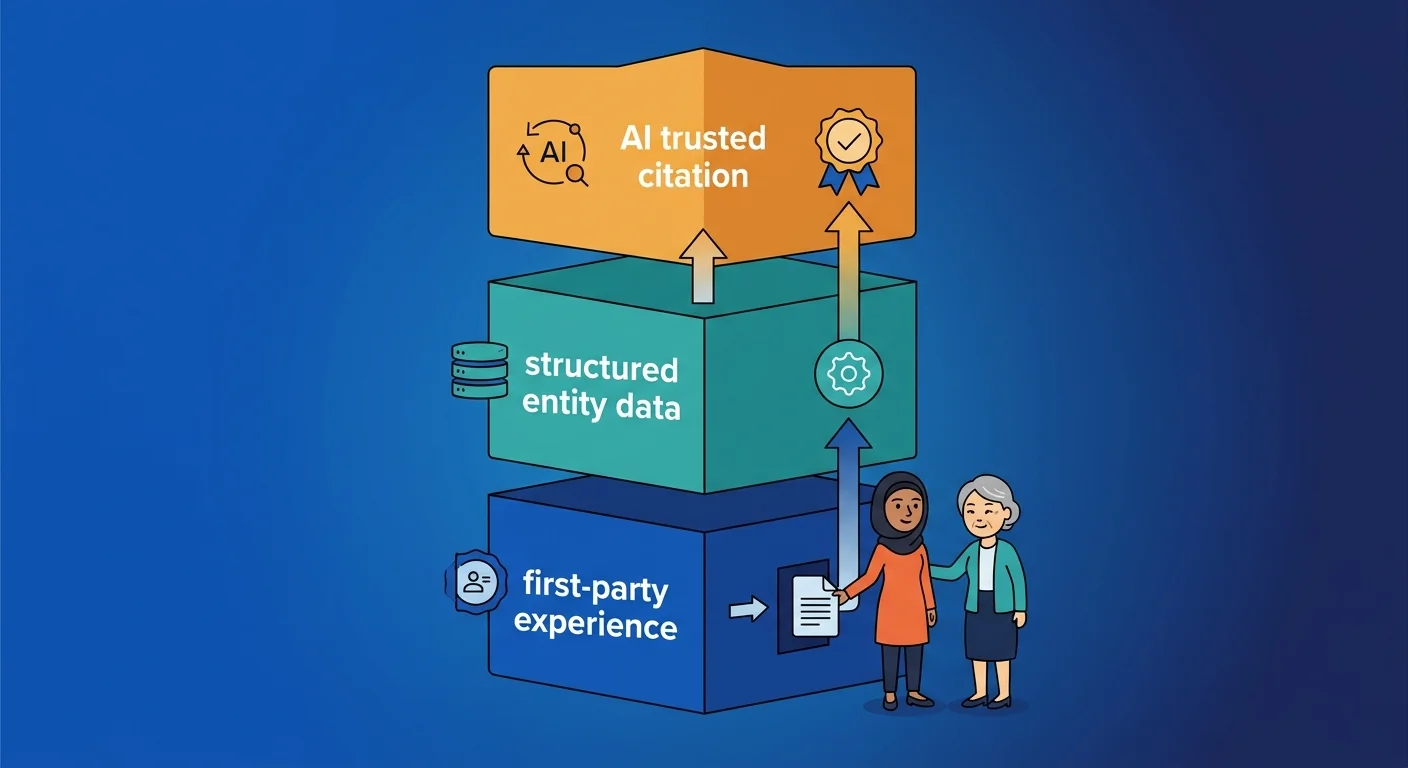
Verifiable identity closes the citation gap by handing a generative engine something it can check instead of something it just has to take on faith. A machine-readable entity isn't a claim about a founder. It's the structure that lets an outside system confirm the claim itself.
That confirmation step is the whole mechanism. An engine that can trace a credential, a byline, or a documented history back to a real person treats that source differently than one it can't verify at all.
| Trust Signal | What It Measures | Founder-Level Data Source |
|---|---|---|
| Documented Authorship | Whether a real, named person can be traced behind a specific claim or piece of content | Bylines, published credentials, and licensing records tied to the founder's legal name |
| Cross-Platform Consistency | Whether the same founder is credited, quoted, and linked the same way across independent sources | Recurring mentions, interviews, and profiles that match in name, title, and background details |
| Structured Entity Data | Whether a credential or history is encoded so a machine can parse it directly, not just read it as text | Person schema markup describing the founder's role, credentials, and verifiable history |
| Independent Verification | Whether a credential or claim can be confirmed somewhere the business itself does not control | Third-party records such as licensing boards, speaking engagements, or press coverage |
| Narrative Specificity | Whether an account of experience contains detail an engine cannot mistake for generated filler | First-party stories tied to dates, roles, and outcomes that only the founder could document |
Trust Signals Generative Engines Actually Weigh
Trust isn't spread evenly across sources, and it isn't handed out at random either. Language models running inside retrieval-augmented generation pipelines can favor documents marked as human-authored over ones carrying no authorship signal at all.
That lean toward documented authorship isn't a footnote. It's the same dynamic behind why unverified pages lose citations to competitors whose founders are structured as confirmable entities.
A related pattern shows up well outside the founder-authority space. Research into how audiences judge movie entities inside Wikipedia hyperlink networks found only 10% overlap between audience judgment and structural authority at the top 10 entities, and 34% at the top 100 — proof that surface popularity and verified structural standing aren't the same signal, and an engine has to pick which one it trusts. Generative engines make that same choice every time they decide who earns the citation, and structural, confirmable authority is exactly the signal a founder's documented background is built to supply.
Where First-Party Experience Prevents Fabricated Answers
First-party experience does something a generated paragraph can't pull off alone: it grounds an answer in a fact that actually happened to someone real. That grounding is what stops a generative engine from filling the gap with something fabricated.
Retrieval-augmented generation exists for a reason — models using it still drift toward unsupported or contradictory claims even with the right material sitting right in front of them. A verified founder entity is one of the few inputs that closes that drift instead of feeding it.
Clinics hit this exact wall when the practice's authority lives entirely behind a generic brand voice. Working through how a clinic rebuilds its authority infrastructure around a named founder instead of an anonymous brand voice shows what that structural shift looks like in practice.
This is where the vault metaphor earns its keep. Fill it with confirmable credentials, documented history, and consistent authorship, and an engine has verified fact to cite — researchers found that adding authorship information changes how large language models attribute answers, according to findings hosted in the ACL Anthology, while separate work archived through work archived through the ACL Anthology showed that models fine-tuned on high-quality datasets can catch and mitigate hallucinated claims at a level rivaling far bigger systems. Both point to the same truth: an engine grounded in first-party material produces a trustworthy answer. Leave the vault empty, and it fabricates the generic junk no business wants stamped with its name.
This Isn't for Businesses Chasing a Quick Placement Trick
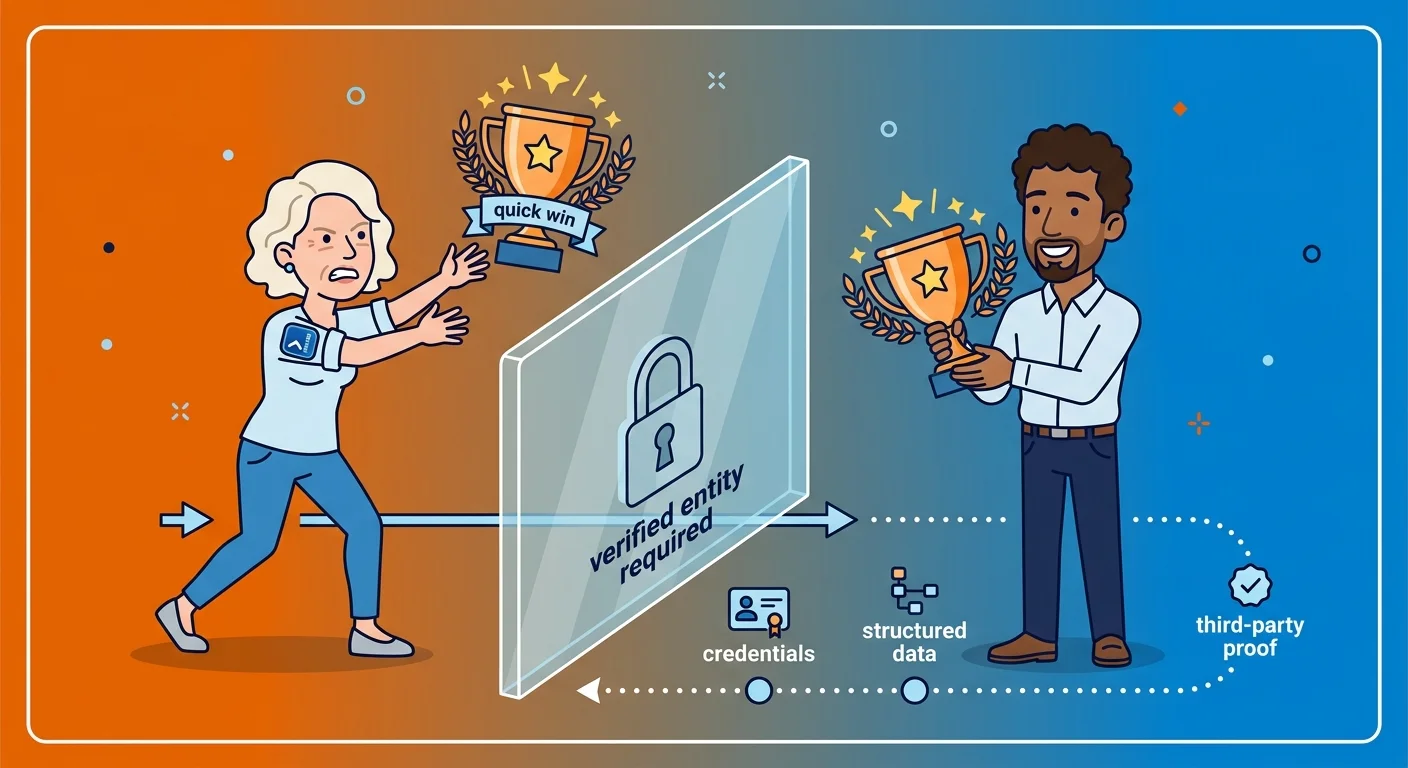
This one's not for businesses chasing a quick placement trick.
If all you want is a single mention, a fast quote, a one-time citation to screenshot and move on, none of this vault-building matters. Structuring a founder's verified identity is long-term infrastructure, not a stunt.
A citation gap doesn't close because you got lucky once. It closes when the entity behind the claim stays confirmable every single time an engine checks.
Chasing a shortcut around verification means chasing the wrong fix. No keyword-targeted article, no clever anchor, no placement hack replaces a documented founder history. The vault either holds verifiable fact or it doesn't.
So who is this for?
It's for businesses willing to structure a founder's real credentials, real history, and real authorship into something an engine can confirm on its own. And it's for founders willing to be the confirmable person behind the claim, not an anonymous byline hiding behind a brand voice.
That qualification matters more than it sounds like it should.
Turning a Founder's Background Into Structured, Citable Data
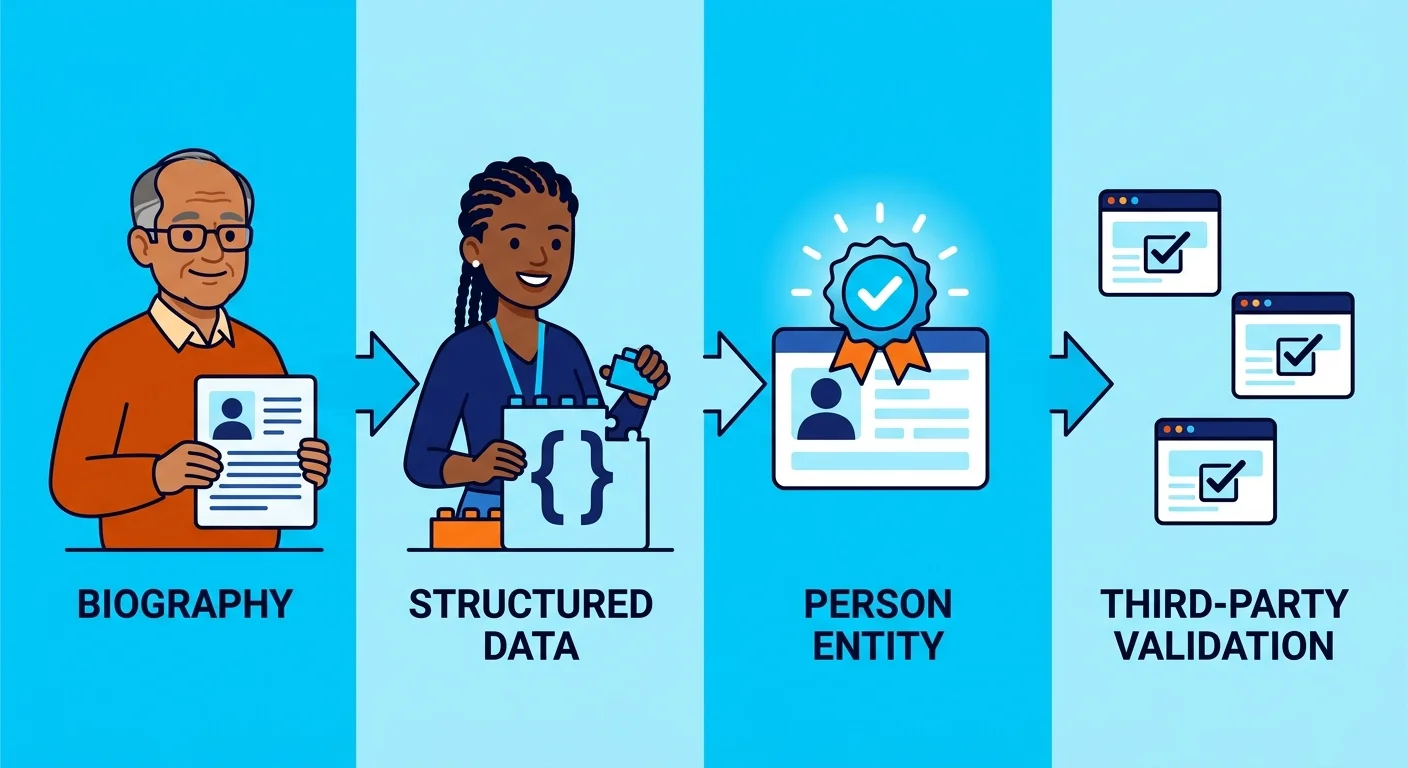
The vault only matters if someone fills it. So who does the filling?
Turning a founder's background into something an engine can confirm is a build, not a wish. It starts with structured data. Then it gets reinforced by verification the business doesn't control.
| Implementation Step | What It Establishes | Verification Method |
|---|---|---|
| Encode credentials as structured Person data | Confirms who the founder is, what they hold, and where the credential lives | Machine-readable markup an engine can parse directly, independent of surrounding page copy |
| Attach each credential to an outside, checkable source | Establishes that a claim is confirmable rather than self-reported | A licensing board record, published byline, or documented speaking engagement an engine can trace independently |
| Maintain consistent authorship across platforms | Builds a durable pattern of the same founder credited the same way everywhere | Cross-referencing how the founder is named, quoted, and linked across multiple independent sources |
| Secure third-party validation of the founder's history | Fills the vault with material the business did not write about itself | Press mentions, industry interviews, and directory listings authored by someone other than the founder |
Mapping Background to Schema and Structured Data
Person schema is the foundation. It tells a machine who the founder is, what they hold, and where that credential gets checked.
A name on its own isn't an entity. A name tied to a credential, a role, and a verifiable source is.
Every credential worth encoding needs three things. It has to be specific, it has to be attributable to the founder directly, and it has to point somewhere off the business's own site.
A vague job title flunks all three. A licensing record, a documented certification, or a named speaking credit passes, because every one of them can be checked without taking the founder's word for it.
Where Third-Party Validation Fits In
Structured data doesn't fill the vault. It just organizes what's already inside.
What actually fills the vault comes from outside the business. A press mention, an industry interview, a third-party directory listing, a documented speaking gig — none of it written by the founder.
That's exactly why an engine gives it weight. A claim a business makes about itself is unverified by definition. A claim an independent source confirms is the confirmable fact the vault was built to hold.
Frequently Asked Questions
The vault metaphor handles the big strategic question. These handle the tactical ones.
How do AI search engines like Google's AI Overviews verify a founder's expertise?
It checks whether a claimed credential resolves to a real, independent source. Google's own guidance on ranking systems calls trust its most important signal. And here, trust means confirmable, not asserted.
What specific types of real-world background are most valuable for building entity authority?
Licensed credentials, documented certifications, named speaking gigs, and third-party press mentions carry the most weight. Every one lives outside the founder's own site. That's exactly what makes it checkable.
Can a new founder with a strong background compete with established brands in AI search?
Yes. An engine doesn't care how old your brand is. It cares whether the entity behind the claim can be confirmed, and a new founder with a documented history beats an established brand hiding behind an anonymous voice.
If my real-world experience isn't online, how can I make it visible to AI engines?
Offline experience has to become a documented, linkable record before an engine can touch it. A licensing board listing, a directory entry, or a published interview does that translation for you.
What's the difference between personal branding and building a verifiable founder entity for AI search?
Personal branding shapes how a founder sounds. A verifiable founder entity is a structured, checkable identity an engine confirms no matter the tone or the story.
How does structured data help translate a founder's offline credentials into online authority?
Person schema ties a founder's credentials, role, and outside sources straight to their name in machine-readable form. That's what lets an engine trace an offline credential back to a confirmable fact instead of an unverified claim.
Where This Leaves You
An empty vault isn't a neutral state. It's a standing invitation for a generative engine to answer without you — or worse, to answer about you and get it wrong.
Trust doesn't go to the loudest voice. It gets built on the verifiable identity and experience of the author, and that verification either exists or it doesn't. So a founder's real-world background is one of two things: structured into a machine-readable entity an engine can confirm, or sitting unverified and unusable no matter how good it sounds in a pitch.
That's the whole decision in front of you. Fill the vault with confirmable credentials, documented history, and consistent authorship, and a generative engine has something real to cite instead of something to guess at. Leave it empty, and a competitor's structured founder entity takes the answer where yours should have been. Start closing that gap with an AI visibility check.