
Why Answer Engines Keep Skipping Over Founders They Should Be Citing
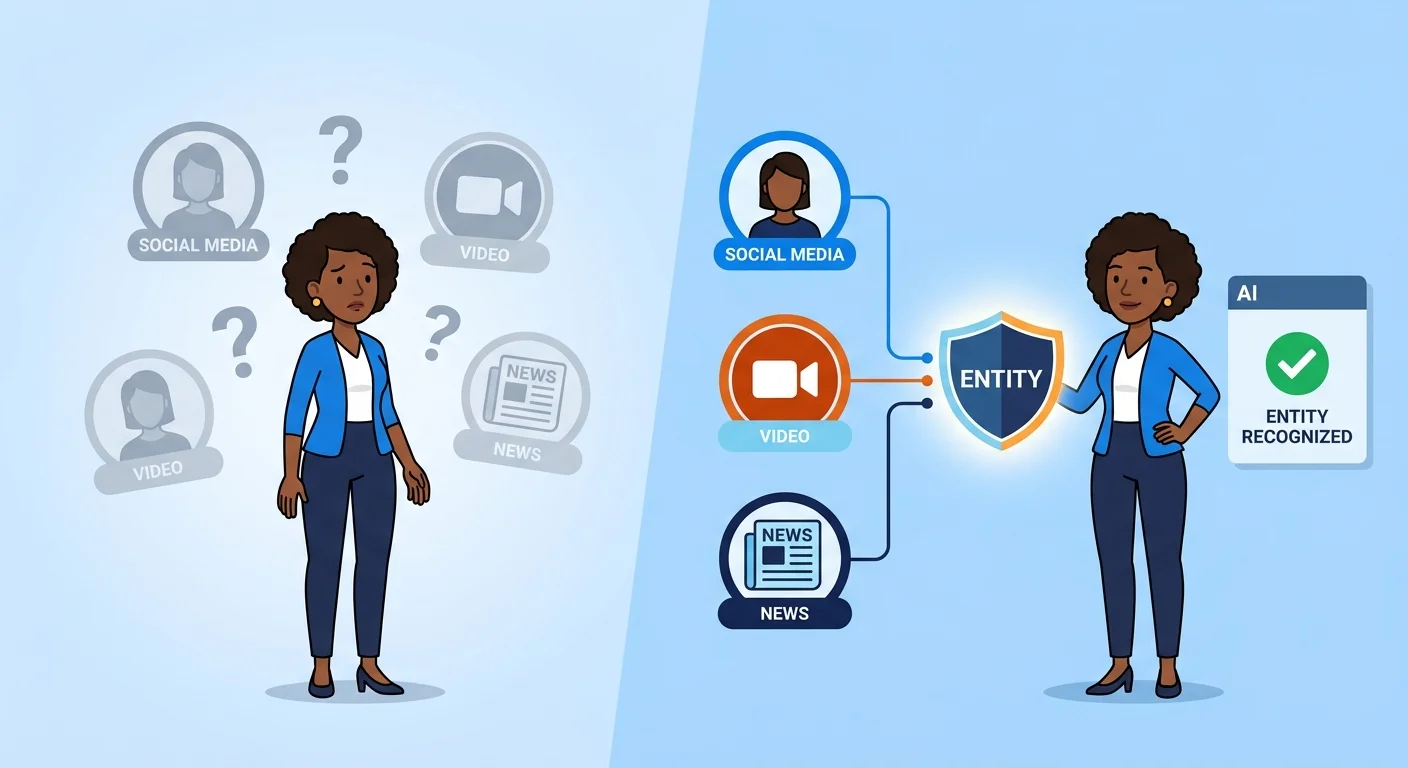
Answer engines skip founders all the time, and it's rarely because the work isn't good enough. It's because the entity behind the work never resolved into something a model could trust.
Here's the reaction first: in the age of AI-driven search, who you are is as important as what you publish. A brilliant article tied to an author nobody can verify? That's a coin flip for citation, not a lock.
So the mechanism matters. Generative systems don't reward volume the way traditional search optimization once did. They reward resolvable identity — a name the model can match, confirm, and stand behind.
That's the real shift under all of this. Citation velocity is no longer just about the volume of backlinks; it's about how quickly AI models can verify and trust the entity creating the content. Founders who miss that keep publishing straight into a void.
The Scattered-Profile Trap
Picture a founder's online presence as a stack of witness statements. One profile says one thing. Another platform says something close — but not quite the same.
None of those statements is sworn. And none of them gets corroborated against the others in a way a machine can check fast.
So an answer engine reading that scattered record does what any careful investigator would. It hesitates — and hesitation kills a citation before it ever happens.
But a single, consistent entity record reads like an affidavit instead. Every detail lines up, every platform confirms the last, and the model can cite it with confidence instead of caution.
That's the real cost of the scattered-profile trap. It isn't just messy — it actively suppresses citation for founders whose expertise would otherwise qualify, a gap explored further in how a founder's decades of hands-on experience get formally linked to the company's credibility.
What Attribution Models Actually Struggle With
Attribution models don't struggle with talent. They struggle with proof they can actually check.
A claim of expertise sitting on one bio page, backed up nowhere else, gives the model nothing to cross-reference. It can't verify a credential it only sees once.
And that's exactly why consistency across formats carries so much weight. A name, a claim, and a body of work have to agree everywhere they show up — or the model just moves on to a source it can confirm faster.
Turning Real-World Expertise Into a Verifiable Entity
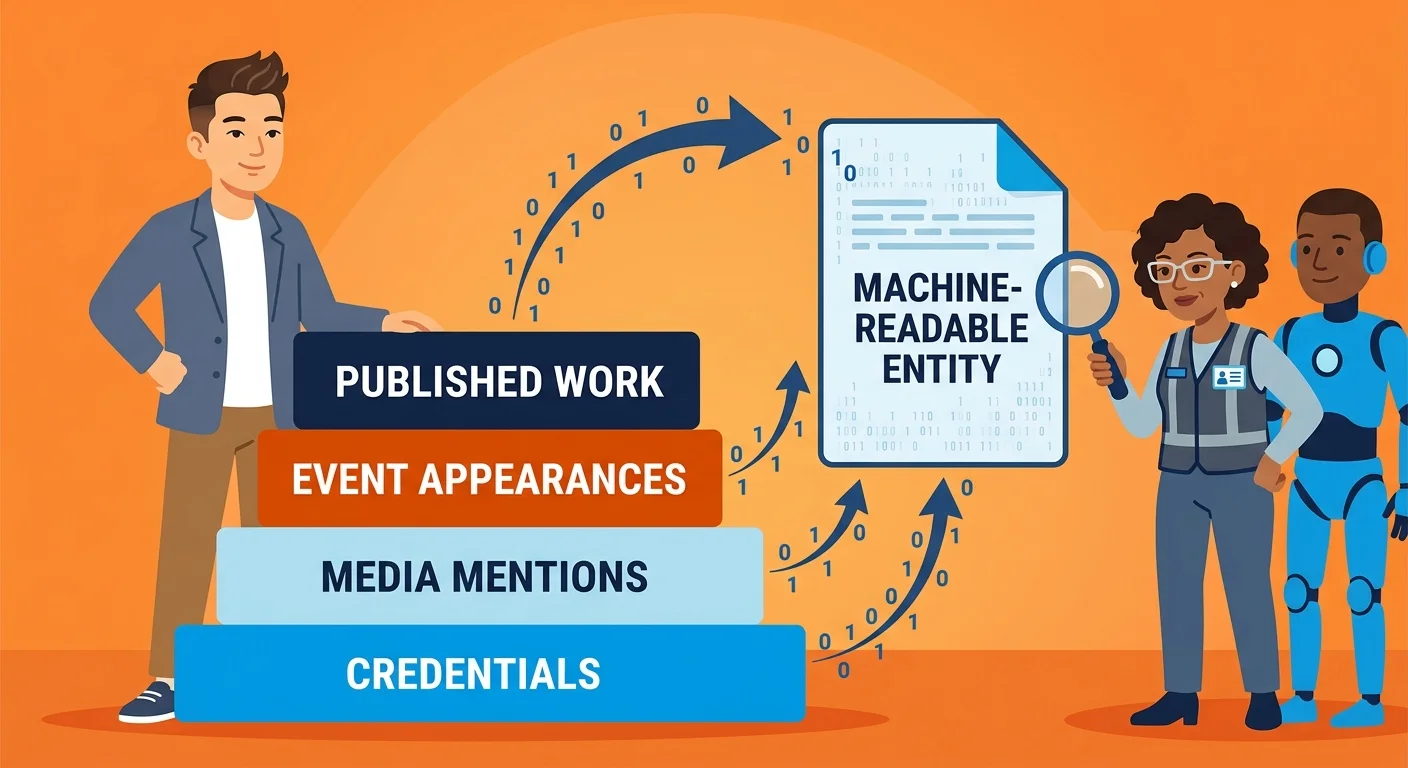
So how does a founder actually build that affidavit instead of leaving scattered witness statements behind? It starts with a shift in mindset, not a tool purchase.
Most founders treat their personal brand as a public relations asset — something for visibility and goodwill, not a technical tool for building authority with search engines. And that framing is exactly why so many of them stay invisible to answer engines despite genuinely impressive careers.
Here's the urgency founders haven't caught up to yet: answer engines are actively hunting for real-world proof to validate the authors they cite. The gap isn't talent. It's translation.
| Signal Type | What It Proves | Where AI Models Look For It |
|---|---|---|
| Credentials | Formal expertise tied to a specific, verifiable body of work rather than a vague title | Degree listings, licensing boards, professional affiliation directories, and consistent bio statements across platforms |
| Media Mentions | Third-party corroboration that the founder's expertise is recognized outside their own channels | Press coverage, guest interviews, industry publication bylines, and citations that name the founder directly |
| Professional History | A coherent timeline of where the founder built their expertise and how long they've practiced it | Company bios, directory listings, professional profiles, and prior employer or venture references that all agree |
| Structured Data Markup | The technical signal that explicitly ties a name to a person entity and a specific body of work | Person schema implementation embedded in site code, read directly by crawlers rather than inferred from prose |
| Multimodal Presence | Reinforcement of identity through formats beyond text, where verification increasingly happens | Video appearances, podcast audio, and transcripted spoken content that models can cross-reference against written claims |
The Building Blocks of a Machine-Readable Founder Entity
A machine-readable founder entity isn't built from one asset. It's assembled from several categories of proof, each one confirming the others.
Credentials come first — degrees, certifications, licenses, affiliations, stated the same way everywhere they show up. Then come media mentions: third-party coverage that names the founder for their expertise, not just for their company.
Professional history matters too. Where the founder worked, what they built, how long they've done it — all of it has to line up across every bio, profile, and directory listing.
But none of these blocks work alone. A credential without corroborating coverage is just a claim. A credential confirmed by outside sources becomes a fact a model can act on.
Where Structured Data Fits Into the Picture
Here's where the technical layer earns its keep. Structured data markup is what tells a model, flat out, that this name is a person and this body of work belongs to them.
Without it, a model has to infer identity from unstructured text — slower, and far less reliable. With it, entity resolution happens almost instantly, because the model isn't guessing anymore. Structured data is the difference between a model guessing at identity and a model confirming it.
It's the same underlying mechanism unpacked in what actually stops a founder's real history from closing citation gaps in AI search results, and it works whether the founder is a solo practitioner or leads a big team. The markup doesn't replace the real-world proof. It just tells the model where to find it and how to trust it.
Not Every Founder Needs the Same Level of Signal Depth
Not every founder needs the same depth of signal reinforcement, and pretending otherwise just burns effort. The right level depends on how much ambiguity already surrounds that founder's name and work.
Got a common name, a crowded industry, or a thin public record? You need heavier reinforcement — more platforms, more consistent detail, more corroborating mentions, because the model has more ambiguity to clear.
A founder with a distinctive name and a well-documented history needs less scaffolding — just consistency held over time. This was never about volume. It's about resolvability, and that target moves for every founder.
Beyond Text: Why Multimodal Proof Matters Now
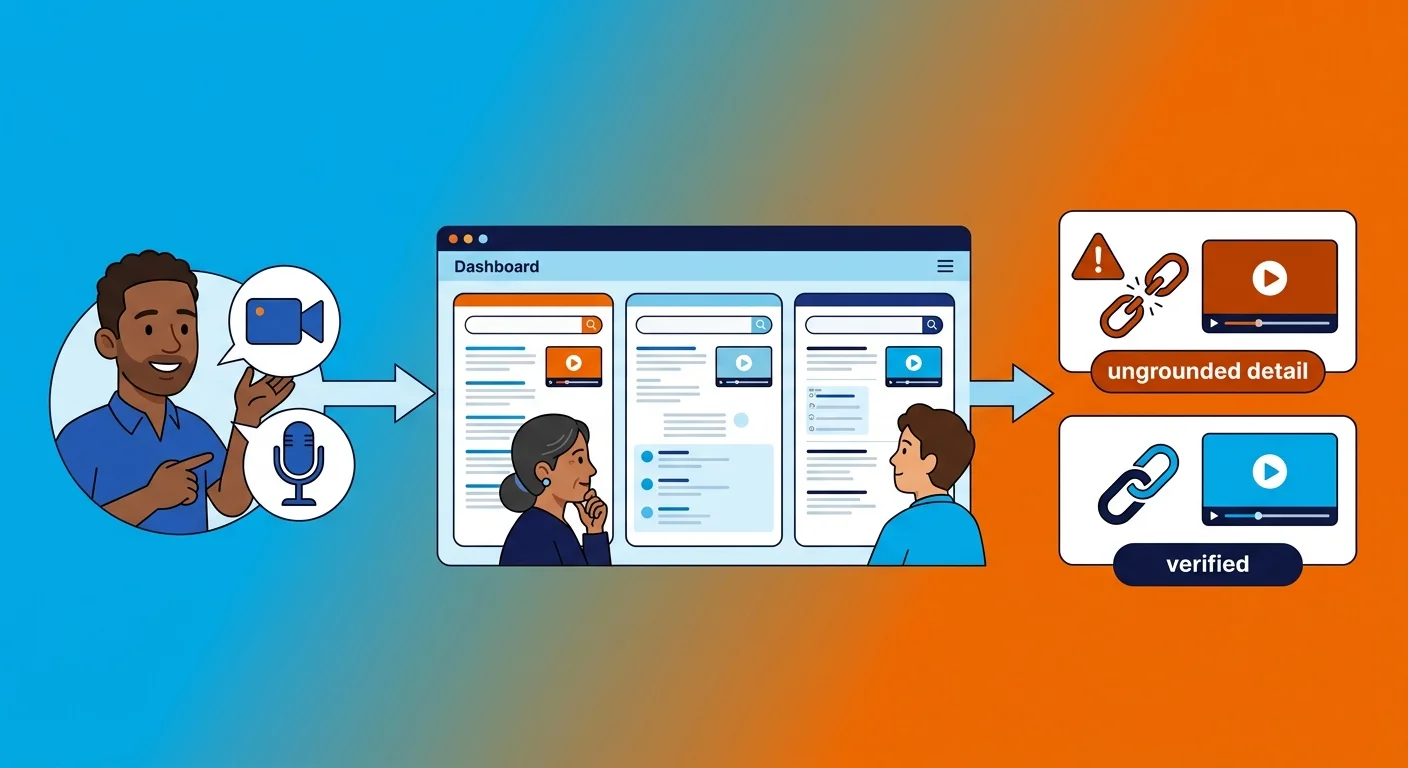
So far, this has all been text. Bios, credentials, structured data markup. But answer engines don't stop at the written page anymore.
They're pulling video and audio into the evidence pool too. A founder's spoken presence becomes one more signal to check against the written entity record.
And that shift raises the stakes. A founder who only exists in text has half an affidavit, not a whole one.
| Evaluation Focus | Reported Figure | What It Signals For Founders |
|---|---|---|
| Video citation failure mode | Ungrounded but plausible-sounding specifics | A founder's video appearance is only as strong as the checkable statements inside it, not the footage itself |
| Generative search attribution accuracy | 51.5% | Even cited content is frequently unsupported by its own sources, so a founder's entity record has to be independently verifiable rather than assumed credible |
How Generative Search Engines Grade the Evidence They Cite
Here's the uncomfortable part first: generative systems citing video don't fail by contradicting it. They fail by inventing details that sound plausible but were never actually said.
Research into multimodal generative search shows the dominant failure mode isn't a flat contradiction of the source video. It's the system injecting precise, confident specifics pulled from its own training data instead of the footage itself, details that can't be verified against what was actually said or shown, a pattern documented in findings published on the arXiv preprint server.
That matters for founders. It means a video citation gets graded on whether the claims inside it can be checked, not on whether the video exists.
A recorded interview with clear, verifiable statements about a founder's background gives the model something solid to confirm. A vague appearance gives it something to hallucinate around instead, which is exactly why the mechanics behind video and audio validation deserve closer attention than most founders give them.
But Doesn't a Strong Social Following Already Prove Authority?
But doesn't a strong social following already prove authority? Fair question. The answer's no.
A following is a popularity signal, not a verification signal. It tells a model people are watching, not that the claims attached to that person are true.
Attribution accuracy is a bigger problem than most founders realize. Broader research into generative search engines found only 51.5% of the content those systems produced was entirely supported by the sources they cited, a gap detailed in arXiv. A big audience doesn't close that gap. Only a verifiable, cross-checkable entity record does.
Turning Entity Signals Into an Operating Habit

Building the entity is one project. Keeping it accurate is a whole different one — and most founders never plan for the second.
So the affidavit isn't something you file once and forget. It's a record that has to hold up every single time a model checks it again.
That means treating entity signals as an operating habit, not a launch task. New credentials, new coverage, new appearances — all of it has to feed back into the same coherent record, or the affidavit drifts right back toward scattered witness statements.
| Audit Step | Touchpoint Checked | Alignment Goal |
|---|---|---|
| Bio and credential sweep | Every bio page, directory listing, and professional profile carrying the founder's name and title | Identical credential language and job history on every platform, with no stray version left uncorrected |
| Media mention review | Third-party coverage, guest appearances, and interviews that reference the founder by name | Each mention reinforces the same expertise claims already stated on owned bio pages |
| Structured data check | Person schema markup attached to the founder's name across owned and syndicated pages | Markup consistently points back to the same verified identity rather than fragments of it |
| Multimodal presence audit | Video appearances, podcast guest spots, and recorded talks tied to the founder's name | Spoken claims about background and credentials match the written entity record exactly |
| Drift monitoring | New coverage, new credentials, and new appearances added after the initial build | Fresh signals get folded into the existing record instead of sitting unreconciled beside it |
Auditing and Aligning Every Founder Touchpoint
Here's where most founders stall out. They build the entity once, feel good about it, and never look at it again.
An honest audit starts with a list: every place a founder's name, title, or background shows up in public. Bio pages, directory listings, guest spots, professional profiles, even old interviews still indexed somewhere out there.
Then you check each touchpoint against the others for agreement — not just whether it's accurate on its own. A credential that's right on one page but missing or misdated on another still reads as ambiguity to a model doing pattern-matching, which is exactly the kind of gap examined in why automated content operations struggle to earn the same trust a real founder can.
Attribution research backs up why this diligence matters. The strongest model in one evaluation of automatic attribution only hit about 80% macro-F1 on in-distribution tasks, a ceiling documented in published research data that shows real limits in verifying who actually said what. So a founder's own record has to be airtight — the model already struggles to get attribution right with clean signals, and it won't close that gap for someone whose record contradicts itself.
Frequently Asked Questions
So let's get specific. Here are the questions founders actually ask once they see what's getting verified — and why it matters.
How does a founder's real-world background prevent AI search citation gaps?
It gives a model something to cross-check instead of take on faith. Credentials, coverage, and history confirmed across several sources close the gap a single unverified bio leaves wide open.
Why do answer engines prioritize multimodal signals like video to validate author entity authority?
Because text is easy to fake and hard to check. A recorded appearance with verifiable statements gives an answer engine something to confirm against the written record, not just another claim to trust blind.
What is the role of Person schema markup in boosting a founder's citation velocity?
It tells a model outright that a name is an entity, and that specific work belongs to it. Without that markup, the model has to infer identity from raw text — slower, and far easier to get wrong.
Can a strong social media presence for a founder directly impact their company's visibility in AI Overviews?
Not directly, and not on its own. A big following signals popularity, not verified expertise. It's no substitute for a cross-checkable record that ties the founder's claims to corroborating sources.
How do search engines differentiate between a founder's personal brand and their company's brand when assigning authority?
They resolve them as two separate entities that happen to be linked. A founder's personal authority lifts the company's profile only when the two records stay consistently cross-referenced — never merged into one assumption.
What are the first steps to consolidating a founder's various online profiles into a single, cohesive entity for search engines?
Start with an honest audit of every place the founder's name and credentials show up publicly. Then fix every inconsistency between them before you add a single new platform or mention.
Where This Leaves You
So here's where this actually leaves you. Citation velocity was never a volume game. It's a trust game, and a model either verifies that trust in seconds or it doesn't.
Every scattered bio, every uncorroborated claim, every profile that reads a little different from the last one is a witness statement an answer engine can't act on. A machine-readable founder entity is the affidavit that replaces all of them at once. That's the shift this whole piece has been building toward, and it's the one most founders still haven't made.
The landscape doesn't reward the founder with the most profiles. It rewards the one whose record holds up the instant a model checks it, and that's a posture you build once and maintain on purpose, not something that happens by accident. If you want a clear read on where your own entity signals stand right now, start with a free AI Visibility Check.