
Why a Faceless Clinic Brand No Longer Satisfies What AI Search Engines Are Looking For
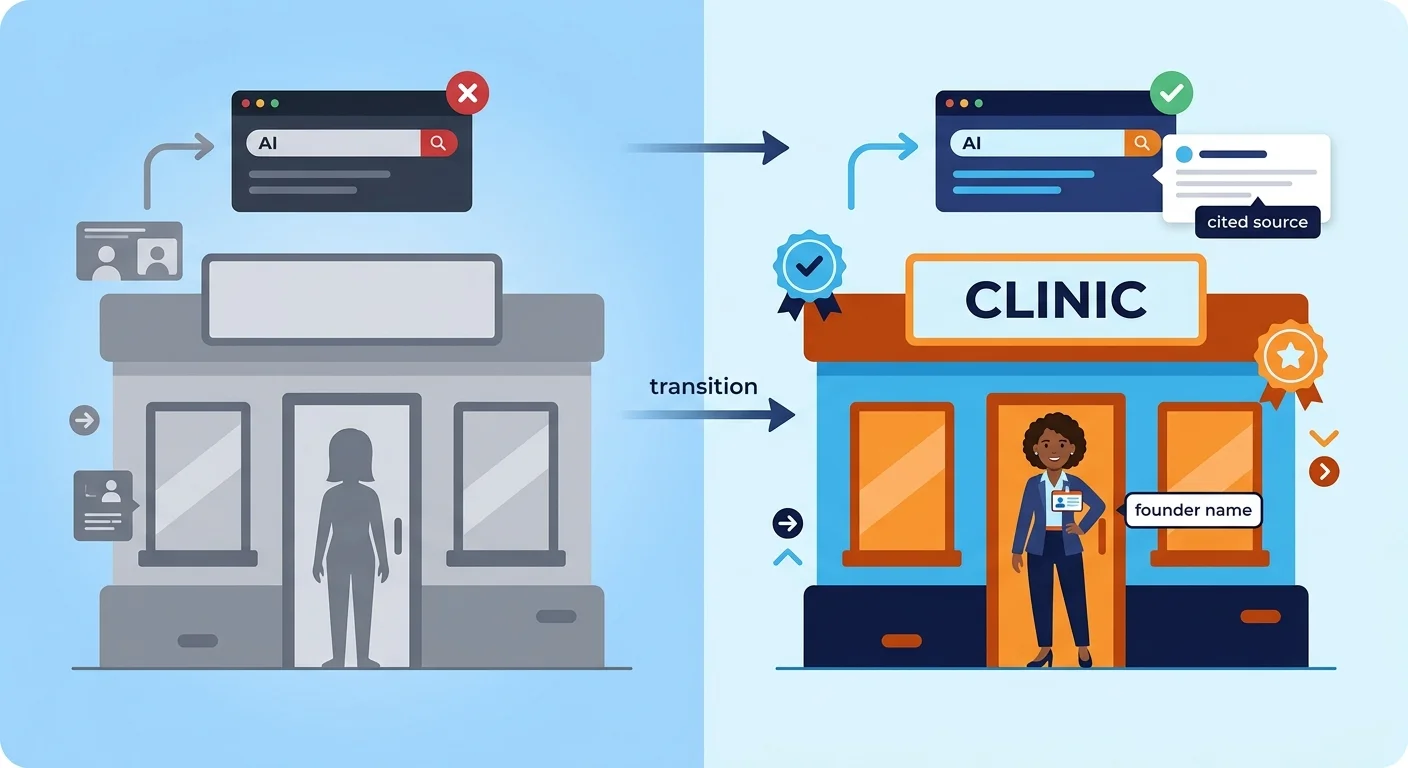
Here's the shift: AI search doesn't reward the generic clinic brand the way traditional search used to shrug and tolerate it. For years, you could win with a polished, faceless brand and nothing more. Now that AI runs the show, that faceless setup is a straight-up liability.
The unsigned letter is the whole problem. Correct facts sitting on a page mean nothing to a citation system if no one puts their name to them. An AI engine can't verify, credit, or cite a claim with no accountable author behind it.
Here's the thing: AI answer engines aren't hunting for brands. They're hunting for authors and cited sources they can trust. That flips what practitioners actually have to build, and it's exactly why some clinics started asking how does a founder's background actually anchor that trust chain in the first place.
A brand name can't answer that question. Only a named, verifiable practitioner can. That's the shift this whole infrastructure exists to finish.
Why Anonymous Authorship Fails the Trust Test
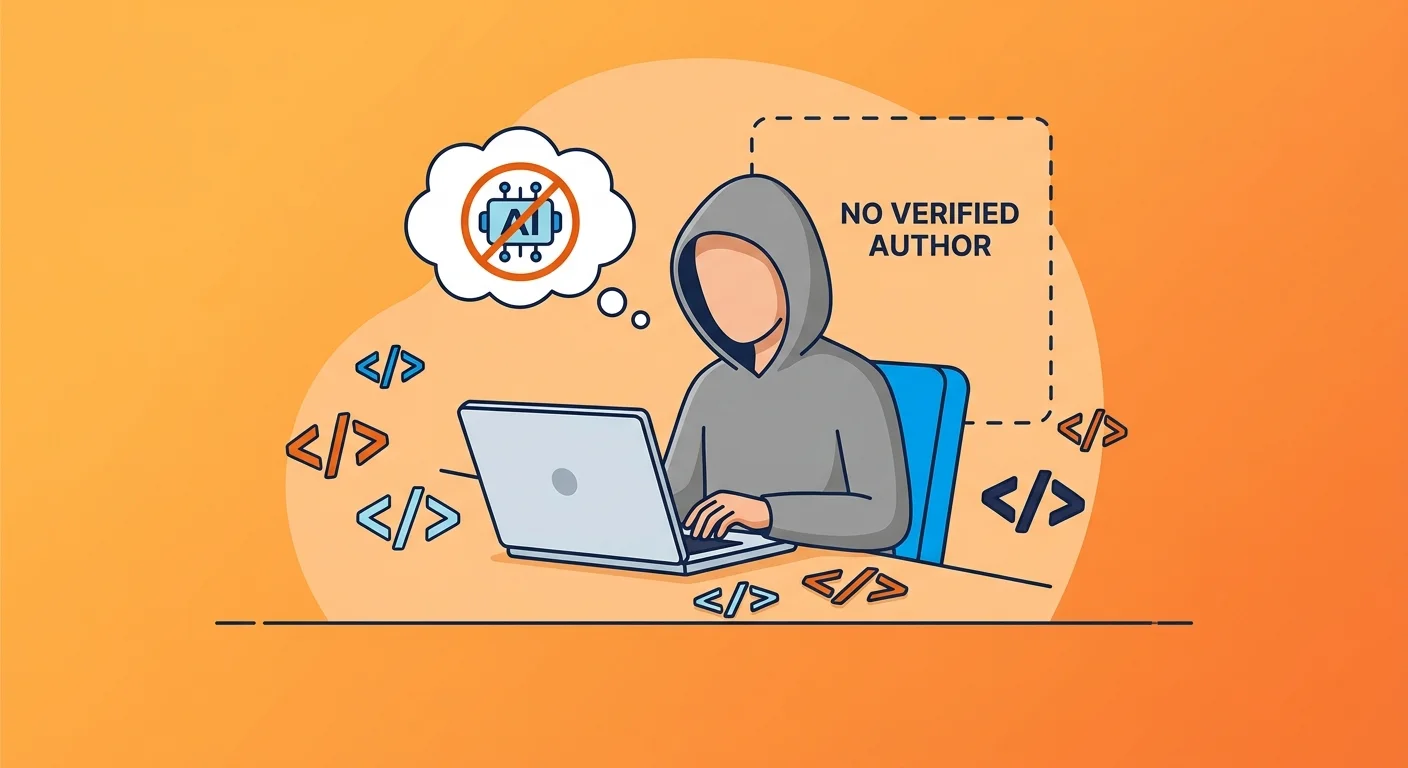
Anonymous authorship fails for a simple reason: trust systems need a named party to hold accountable. A clinic that hands out advice with no credited practitioner is asking an AI engine to vouch for a claim nobody signed.
And that request gets refused. The unsigned letter stays unsigned, and unsigned letters don't get cited.
Generic corporate voice used to be fine, back when traditional search optimization ranked pages by keyword match instead of source credibility. AI citation systems don't play that game. They ask who said this, and an anonymous blog post has no answer.
Why Unattributed Blog Content Is a Dead End for AI Citation
Here's why unattributed blog content is a dead end: it gives an evaluation system nothing to resolve. No name to check against a professional directory, no credential to weigh, no track record to confirm.
Look at the numbers. An analysis of 107,352 websites cited in Google AI Mode found that no schema type beyond the baseline showed any measurable advantage for inclusion, per published research data. That matters here because the missing ingredient isn't exotic markup. It's a verified author wired to the content.
Byline attribution flips the outcome, and you can measure it. When author bylines got added to blog pages, treated pages roughly doubled in AI citations on Bing against a 34% gain on untreated control pages, according to published research data. Publish without that attribution and you're leaving that gain on the table.
The Problem With Treating Structured Data as a Checkbox
Treat structured data as a checkbox and you get the same dead end in a new outfit. A clinic can implement schema perfectly and still flunk the trust test if that schema describes an organization but never names a verifiable person.
The markup exists. The entity behind it doesn't. That gap is exactly what how does entity resolution reward verifiable human knowledge graph nodes digs into.
Code without a confirmed practitioner is decoration, not infrastructure. It signals effort while delivering none of what AI evaluation is actually built to find: a specific, checkable human behind the claim.
What Google's E-E-A-T Framework Actually Rewards
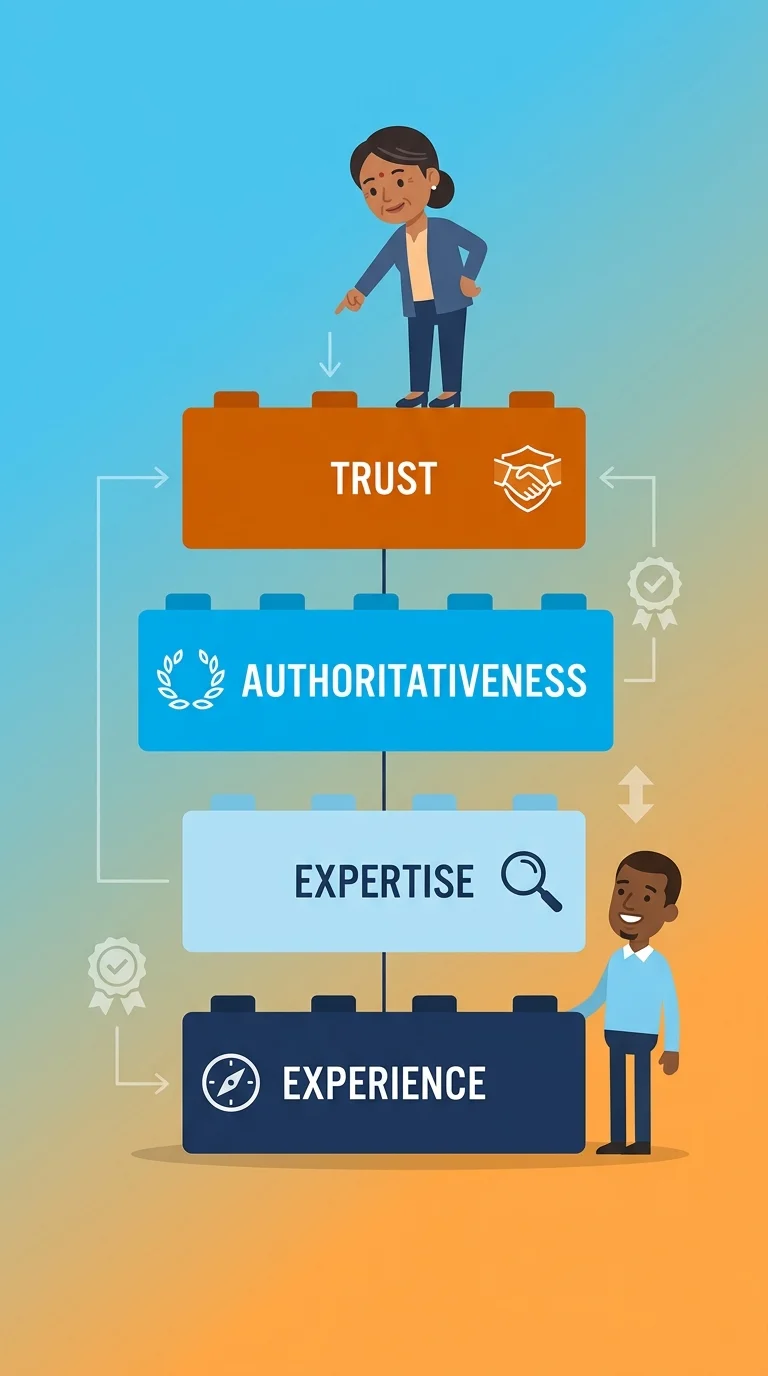
Here's the thing: Google's ranking systems don't grade a page on markup alone. Per Google's documentation, they weigh a mix of factors to decide which content actually shows experience, expertise, authoritativeness, and trustworthiness. The industry calls that shorthand E-E-A-T, and it's the exact standard the unsigned letter flunks.
Trust is the whole center of that framework. The other three qualities exist to build trust, not stand in for it. A clinic can prove expertise all day and still lose if nothing on the page lets a machine verify who's claiming it.
And this is where the fix parts ways with what most clinics already try. Founders figure a solid bio page or an about section covers it, but the personal brand assets that actually move citation velocity are structural, not narrative. Trust comes from resolvable identity, not from well-written copy.
| E-E-A-T Component | What It Signals | How a Founder Demonstrates It |
|---|---|---|
| Experience | Firsthand, lived familiarity with a condition, procedure, or patient scenario, not secondhand summary. | The founder documents direct clinical encounters under a verified name, tying specific cases to a resolvable practitioner rather than an anonymous voice. |
| Expertise | Formal training, credentials, and technical command of the subject matter. | The founder's credentials are declared through author schema and cross-referenced against professional directories, so the claim of expertise resolves to a checkable person. |
| Authoritativeness | Recognition from other credible sources that this practitioner is a legitimate reference point on the topic. | The founder's identity stays consistent across the clinic's domain and external professional profiles, letting automated systems confirm the same node is being cited elsewhere. |
| Trustworthiness | The central signal the other three qualities exist to build, confirming an accountable party stands behind the claim. | The founder's name is structurally linked to the clinic's organizational schema, closing the gap between an implied author and a confirmed, citable one. |
The Difference Between Demonstrated Experience and Demonstrated Expertise
Google's framework treats experience and expertise as cousins, not twins. Some content earns trust because it shows lived experience with a condition or a procedure. Other content earns it because it shows formal expertise: credentials, training, the real thing.
A founder-led setup needs both signals pinned to a verified name. That split matters to patients too, since about two-thirds of Americans who get health info from providers rate it as extremely or very accurate, according to Pew Research Center. An anonymous page can't carry either signal, because there's no confirmed person for the trust to attach to.
How Entity Resolution Actually Identifies a Verifiable Practitioner
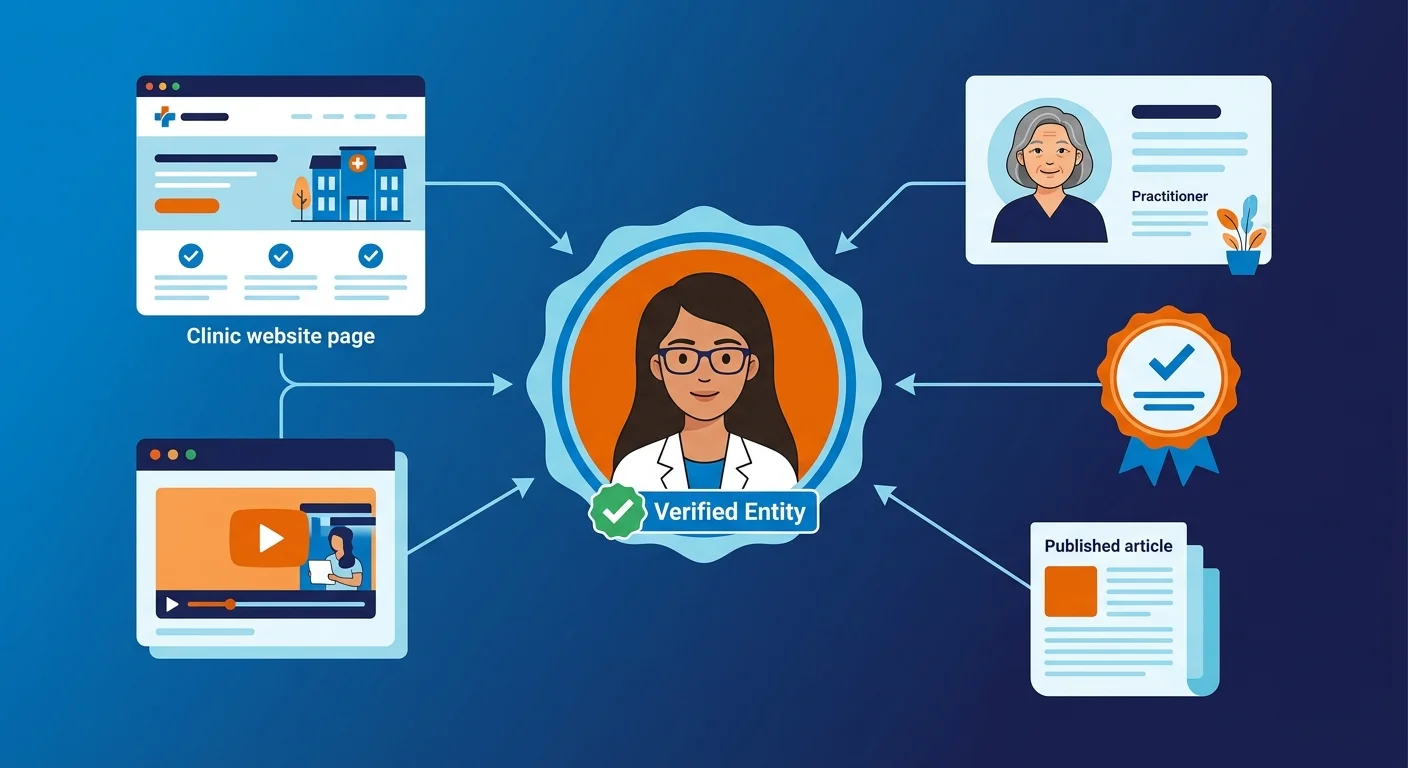
So how does the letter finally get signed? Entity resolution. It's the technical process automated systems use to decide that scattered mentions of a name all point to one real person.
Founder-led authority lives or dies on that call. Making a specific practitioner the verifiable, machine-readable face of a clinic's expertise only works if resolution systems can confirm that face is actually real.
Here's the catch: a name by itself resolves nothing. A practitioner's name on a webpage, a professional directory, and a credentialing body all have to line up before an evaluation system treats them as one confirmed node instead of three unrelated strings of text.
How AI Systems Match Scattered Signals to One Real Person
Resolution works by cross-referencing signals, not by trusting any single one. A biography, a professional profile, an industry directory listing, a credential record — each one carries a fragment of who this person is.
None of those fragments proves anything on its own. But when the name, the credentials, and the affiliation match across every last one of them, the system stops treating the practitioner as a claim and starts treating them as a confirmed entity worth citing.
Where a Founder's Identity Has to Live Across the Web
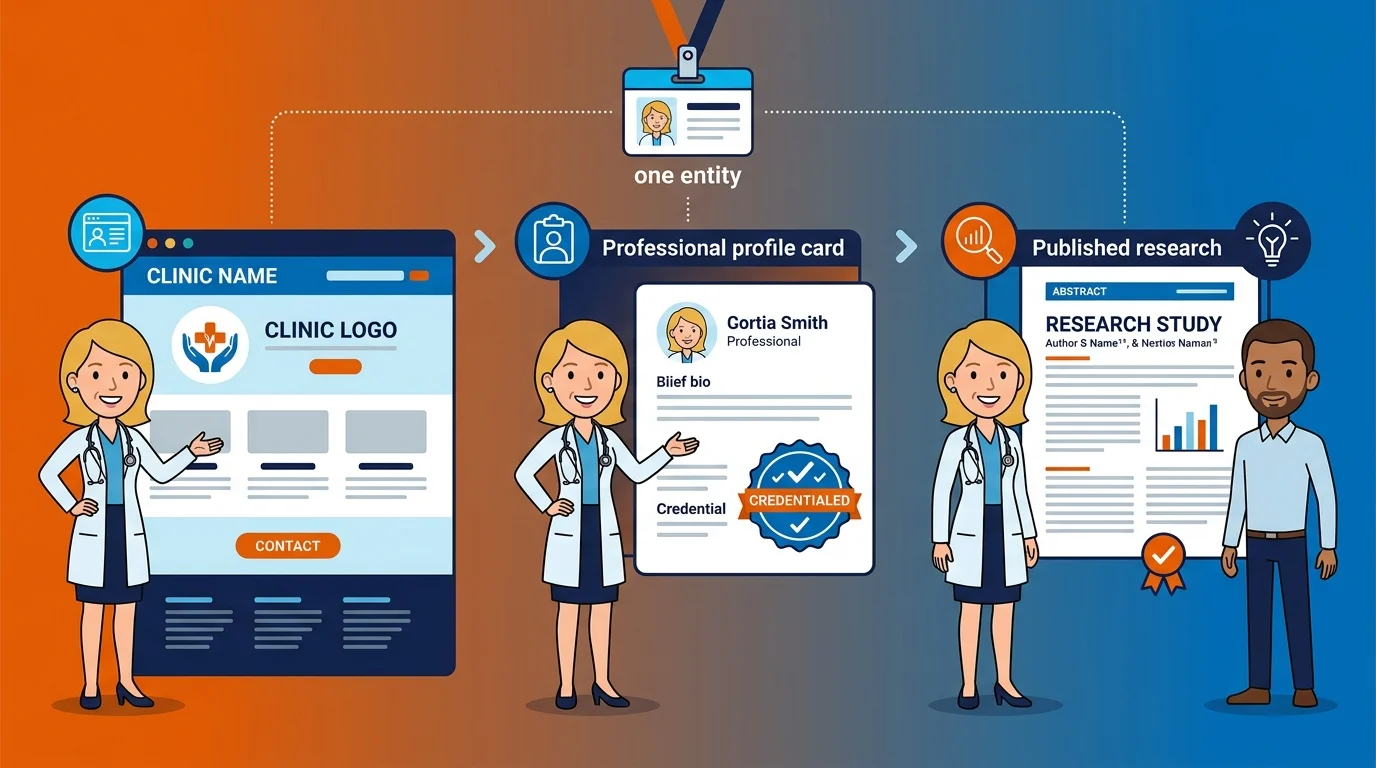
One signature won't cut it. For entity resolution to work, a practitioner's name has to show up consistently everywhere an automated system might go looking.
That means the clinic's own domain, the professional directories, the credentialing bodies, and the third-party platforms all carry the same confirmed identity. The letter doesn't get signed because one page finally names an author. It gets signed when that same signature turns up everywhere the letter travels.
| Off-Site Location | Authority Signal It Carries | Why AI Engines Weight It |
|---|---|---|
| The Clinic's Own Domain | The primary node where the practitioner's name, credentials, and expertise first get published and structurally tagged. | This is the foundational claim. AI engines treat it as an assertion made by the entity itself, not yet corroborated. |
| Professional Directories | A third-party confirmation that the named practitioner holds the credentials and standing they claim on the clinic's site. | Directory listings sit outside the clinic's control, so a matching entry functions as independent verification rather than self-reported information. |
| Credentialing Bodies | A formal record tying the practitioner's name to a recognized qualification or license. | Credentialing sources carry institutional weight that a webpage alone cannot replicate, anchoring the entity to a verifiable standard. |
| Industry and Professional Platforms | A public profile showing consistent history, affiliation, and activity tied to the same name and credentials. | Consistency across platforms is what lets resolution systems collapse scattered mentions into one confirmed node instead of treating them as separate, unrelated entries. |
| Third-Party Recognition | Any external acknowledgment of the practitioner's expertise that neither the clinic nor the practitioner controls directly. | Recognition the entity did not author itself is the strongest corroboration signal, since it cannot be dismissed as self-promotion. |
The Anti-Persona: Who This Transition Isn't For
This isn't for clinics chasing a quick visibility bump before the next algorithm update. Building a verifiable knowledge graph node takes sustained, coordinated work across a bunch of platforms.
And it's not for practitioners who won't attach their own credentials, history, and name to what the clinic publishes. A founder who wants the authority payoff without the personal exposure is asking for something founder-led infrastructure just can't hand over.
It's also not for clinics that treat schema as a one-time technical fix. Anonymous authorship dressed up in markup is still anonymous authorship. If the practitioner behind the content won't be findable, checkable, and consistent across platforms, no amount of structured data closes that gap.
Consolidating Off-Site Authority Signals
Off-site presence pulls real weight here. A practitioner's professional profile, their industry directory listing, any outside recognition of their credentials — each one works as its own independent confirmation point.
An evaluation system doesn't just check the clinic's own website. It checks whether the same name, the same credentials, and the same affiliation show up consistently on platforms the clinic doesn't control.
That independent confirmation is what separates a claim from a fact in a citation system's eyes. A clinic asserting its founder's expertise is one signal. A professional directory, a credentialing body, and an external profile all agreeing with it is corroboration, and corroboration is what turns a resolvable name into a trusted, citable entity.
How to Build the Verifiable Practitioner Node Step by Step
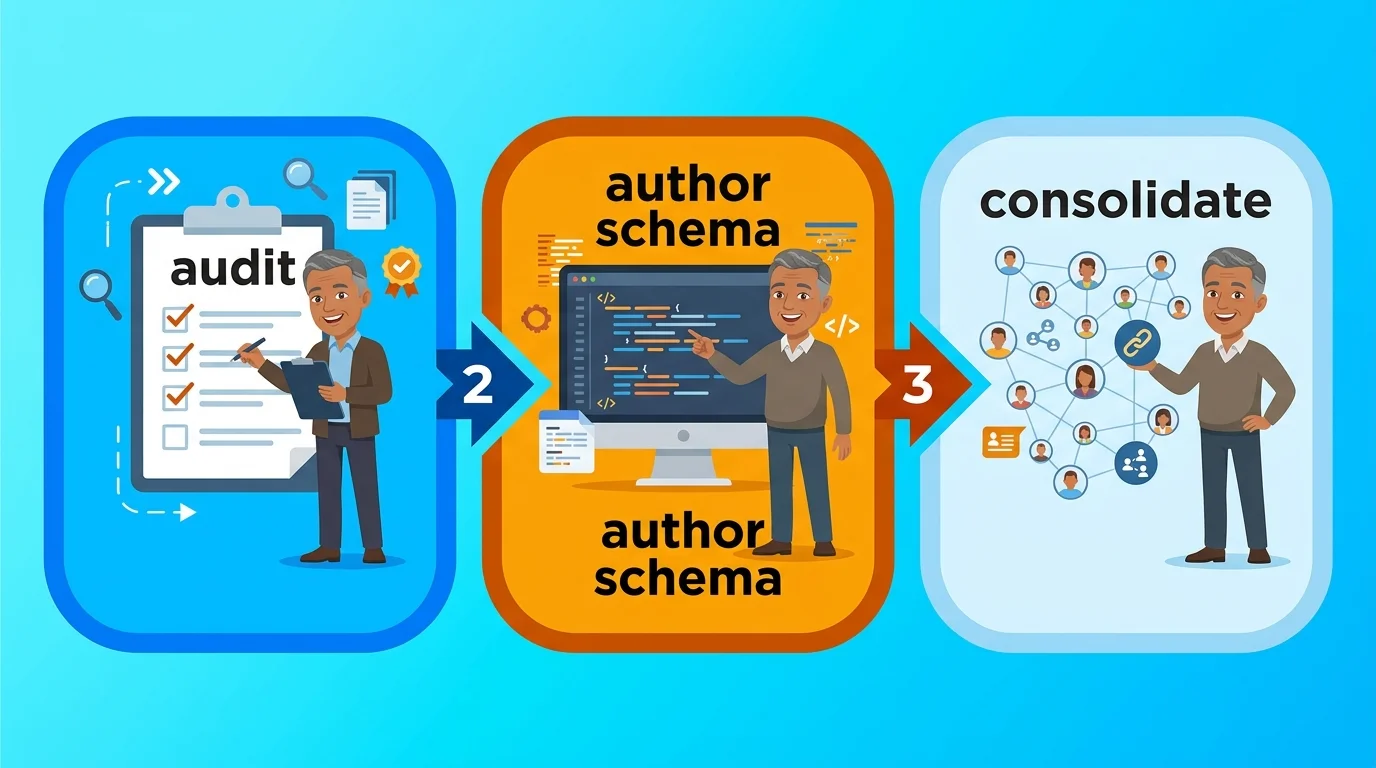
Qualification's done. Now comes the build — the concrete steps that turn an unsigned letter into a signed one.
It happens in two stages. First you audit what's already out there. Then you structure the entity in code so evaluation systems can actually confirm it.
| Implementation Step | What It Establishes | Signal It Sends to AI Engines |
|---|---|---|
| Audit the founder's name across every existing platform | A documented baseline of every inconsistency in title, credential wording, or affiliation | Confirms whether the practitioner can currently resolve as one entity or three contradictory strings |
| Correct mismatched titles and credentials across directories and bio pages | A consistent identity footprint with no contradicting claims left unresolved | Removes the exact mismatch signals that stop entity resolution from confirming one node |
| Encode the practitioner's name, credentials, and affiliation directly into the page's structured data | A machine-readable author entity attached to the clinic's published expertise | Directly reflects the byline effect, where treated pages showed a 34% gain over untreated control pages |
Auditing Your Current Founder Footprint
Start by searching the founder's name across every platform where the clinic already shows up. Flag every inconsistency in title, credential wording, or affiliation.
Say a directory lists an outdated title while the bio page lists the current one. That contradiction isn't cosmetic. It's exactly the mismatch that stops an evaluation system from resolving the name into one confirmed entity.
Write down every gap before you touch a line of code. Skip this step and you end up structuring markup around an identity that still contradicts itself somewhere else.
Structuring the Author Entity in Code
Once the footprint's clean, the author entity gets built into the site's structured data. This is where that credited byline — the one that drove measurably higher citation gains earlier — actually gets encoded, not just shown on the page.
The practitioner's name, credentials, and affiliation to the clinic all have to be declared right in the page's markup. A visible byline isn't enough if the underlying code never names an author.
This isn't a rebrand dressed up in new language. It's a technical restructuring of the clinic's digital identity — one that hands an automated system something concrete to check instead of a page it just trusts.
Frequently Asked Questions
Before anyone signs off on the budget, the build sequence kicks up a few practical objections. Here are the ones that land first.
How long does it take for search engines to recognize a founder as an authority after making these changes?
There's no fixed timeline, and refusing to promise one is honest. It hinges on how fast the practitioner's identity resolves consistently across platforms. Clean, corroborated signals resolve faster than ones that contradict each other.
Can a clinic with multiple practitioners build a founder-led brand, or does it have to be a single person?
Sure, multiple practitioners can each become a resolvable entity. But every one needs their own name, credentials, and affiliation encoded separately. A shared, generic byline defeats the purpose for all of them.
What's the biggest mistake clinics make when trying to transition from a faceless brand to a founder-led one?
They stop at a visible bio page and figure the job's done. The identity has to live in the underlying markup and get corroborated off-site. Describing it in prose isn't enough.
Do I need to be active on social media to build a successful founder-led authority infrastructure?
Social platforms help as one more corroboration point. But they're not the core requirement. What matters more is a consistent identity across directories, credentialing bodies, and the clinic's own structured data.
How does a founder-led brand affect patient trust and conversion rates compared to a generic clinic brand?
A named, verifiable practitioner reads as more credible than an anonymous clinic voice. That mirrors how patients already weigh information from providers they can actually identify. A resolvable entity gives both the reader and the evaluation system someone to trust.
Where This Leaves Your Clinic's Authority
An unsigned letter can get every fact right and still convince nobody. There's no name at the bottom to hold accountable. That's been the default for most clinic websites for years, and it just doesn't survive in a world where AI systems pick who to cite by checking who actually said the thing.
Founder-led authority closes that gap. It's not a softer logo or a friendlier headshot on the homepage. It's a founder's name, credentials, and affiliation encoded consistently enough that an evaluation system resolves them into one confirmed entity and cites it without hesitation.
Once that node exists, the letter's signed. The clinic's expertise stops being an anonymous claim and turns into a verifiable one, pinned to a practitioner an automated system can check on every platform that carries their name. That's the whole difference between hoping an AI engine trusts your content and building the infrastructure that gives it no reason not to, and it starts with seeing exactly where your founder's identity resolves today and where it still argues with itself, which is what an AI Visibility Check is built to show you.