
What Entity Resolution Actually Rewards (And Why Most Sites Miss It)

So what runs this whole process? AI engines cross-reference every signal about a name against structured data, third-party citations, and credential markers. They don't read a homepage and take its word for it — they check whether the claim of expertise holds up across independent sources.
Here's the assumption that trips up most businesses. They pour everything into piling up keywords and links, and completely miss the shift toward entity-based authority. That plays to a ranking algorithm that no longer decides who gets surfaced.
Keyword-chasing builds pages, not a person an AI engine can verify. Faceless corporate content makes it worse, because a byline-free article gives the resolution process nothing to anchor an identity to. What anchors that trust is the founder's own background, documented consistently over time — see how Gerek Allen's two decades of experience anchors that trust chain.
And that gap is precisely how a ghost profile forms. It's a person or business that exists online only in scattered, unverified fragments an AI engine can't confidently stitch together. Without consistent entity signals, even the real deal stays trapped in that fragmented, unresolved state.
Why Keyword-Chasing Leaves You a Ghost Profile
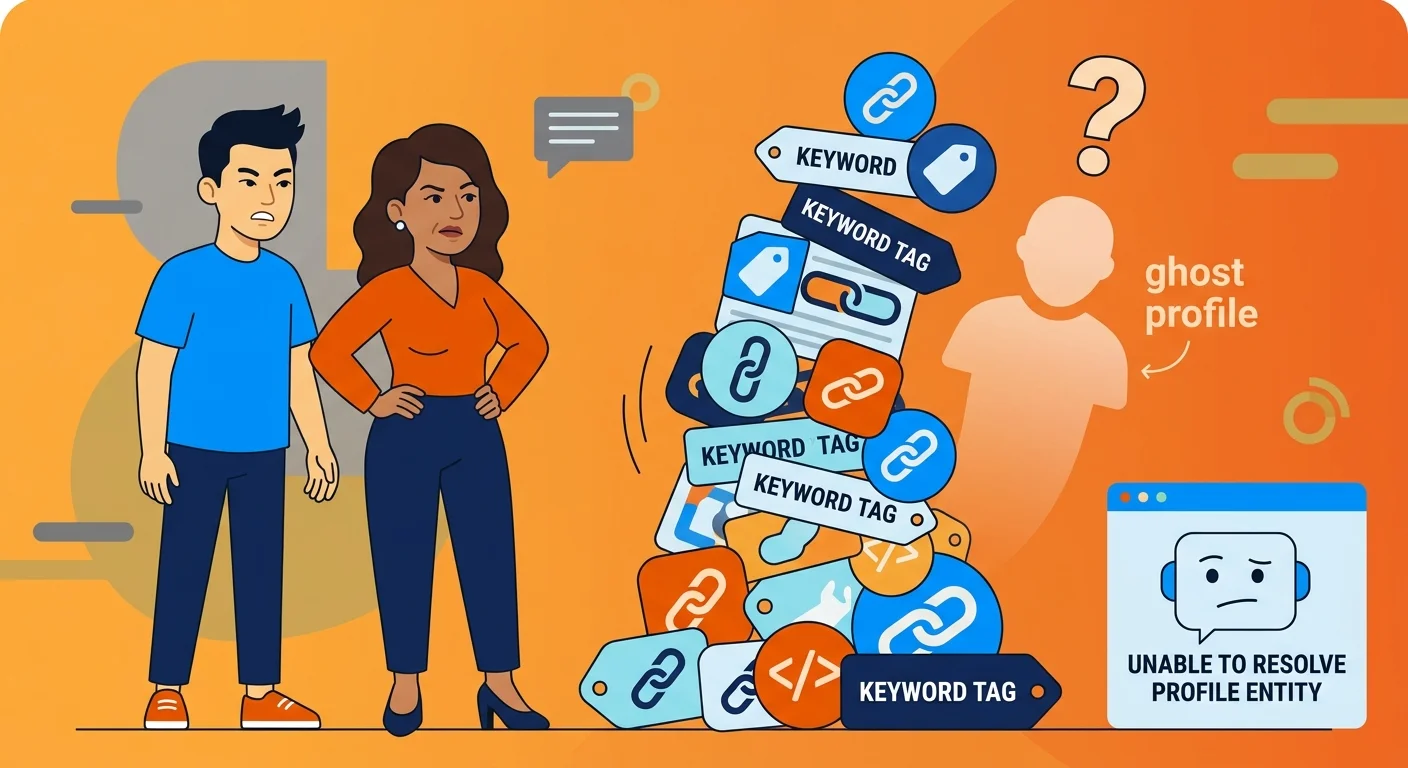
So what actually happens when a business dumps its whole budget into keyword-chasing instead of entity verification? It builds pages. It doesn't build a person or a business an AI engine can actually identify.
Here's the mechanism most businesses never stop to look at. The old model was built for placing in the classic ten blue links, so it rewarded volume: more pages, more keyword-targeted articles, more links pointing back home. Entity resolution asks a completely different question — not how many pages mention a name, but whether independent sources agree on who that name belongs to.
And that mismatch is why a business can own keyword position tracking and still read as a ghost profile. The pages exist. The verified identity behind them doesn't.
The Problem With Chasing Keyword Position Tracking Alone
Traditional search optimization trained a whole industry to treat position tracking as the finish line. That finish line no longer decides who gets surfaced.
An AI engine resolving a founder's identity couldn't care less that a page ranks well for some phrase. What it wants to know is whether the name on that page lines up with credentials, employer records, and third-party mentions everywhere else.
So position tracking measures visibility to a ranking algorithm. It says nothing about whether an entity-resolution system can tell that founder apart from every other person who shares a similar name or field.
This is the exact wall that generative entity-disambiguation systems keep hitting. Entity descriptions carry the crucial detail needed to tell similar entities apart, yet those descriptions get overlooked in existing generative approaches, as a paper on entity description modeling hosted on the arXiv preprint server documents. A business chasing keyword position tracking never builds that description at all, so there's nothing for the system to read even if it wanted to.
Why Faceless Corporate Content Never Resolves Into an Entity
Now look at the other half of the failed approach: content with no named author behind it. Faceless corporate content reads fine to a human. It reads as nothing to an entity-resolution process.
An unsigned article hands an AI engine no name to cross-reference, no credential to verify, no consistent identity to build trust around. A page with no author is a page with no entity to resolve.
And that's the structural gap a clinic slams into the moment it tries to move past this pattern, which is exactly what transitioning a clinic's authority infrastructure toward a named founder tackles. Faceless content and keyword-chasing are the same failure wearing two different outfits. Neither one produces the thing entity resolution actually rewards: a verifiable human node.
The Anatomy of a Verifiable Human Node

So what does a resolved entity actually look like once you strip the failures away? It looks like a verifiable human node: a digital representation of a person so well-documented and cross-referenced that an AI system can trust their expertise and identity without guessing.
That trust isn't granted on faith. It's assembled from specific, checkable signals that either exist or they don't.
Some of those signals live inside the content itself. Others live in how consistently a name, a credential, and a body of work show up everywhere else a system might go looking for confirmation.
| Signal Type | What It Confirms | Where AI Engines Look |
|---|---|---|
| Byline Attribution | Whether a named, accountable individual stands behind the content | Author bylines, linked author bio pages, and consistent name placement across the site |
| Credential Markers | Whether the claimed expertise is specific and checkable rather than generic | Structured author descriptions, professional titles, and defined roles tied to the name |
| Cross-Site Consistency | Whether the same name, title, and focus area agree everywhere the entity appears | Multiple pages, profiles, and third-party mentions compared against each other for matching detail |
| Third-Party Corroboration | Whether sources outside the business itself confirm the person's expertise and role | Independent citations, external profiles, and structured data unaffiliated with the entity's own site |
| Structured Data Markup | Whether machine-readable signals exist for a system to parse rather than infer | Schema markup and other structured fields attached to the author or entity in question |
The Signals That Make an Entity Description Trustworthy
Here's where entity descriptions matter way more than most businesses assume. An author line that says only a name tells an AI engine almost nothing it can actually verify.
But a description carrying real credentials, a defined role, and a documented history hands the system something to check against outside sources. That distinguishing detail is exactly what generative entity-disambiguation still gets wrong most often, because the descriptions that separate one professional from another with a similar name are usually thin or missing entirely.
And thinness isn't the only way to fail. So is inconsistency, where the same person's title, employer, or focus area shifts from one page to the next.
An AI engine reading conflicting descriptions has no reliable way to pick which version is true. A verifiable human node depends on the description agreeing with itself everywhere it shows up — and that consistency is a big part of what separates a resolved identity from a scattered one, a distinction explored further in why video signals now factor into confirming an author's real-world authority.
Where Authorship Signals Fit Inside E-E-A-T
Now shift to the framework these signals actually feed. Authorship isn't a courtesy line at the top of an article. It's a direct input into how content quality gets judged.
Here's the thing that helps a reader intuitively judge whether content is credible: knowing exactly who created it. That's the identity question sitting underneath every expertise and trust assessment, and it's why clear authorship matters as much to a system as it does to a human, a point made directly in Google's documentation on evaluating who stands behind a page.
A byline alone is a start, not a finish. The byline has to lead somewhere — to background, credentials, and a body of work an AI engine can cross-reference and confirm.
This Isn't for Businesses Chasing a Quick Placement Bump
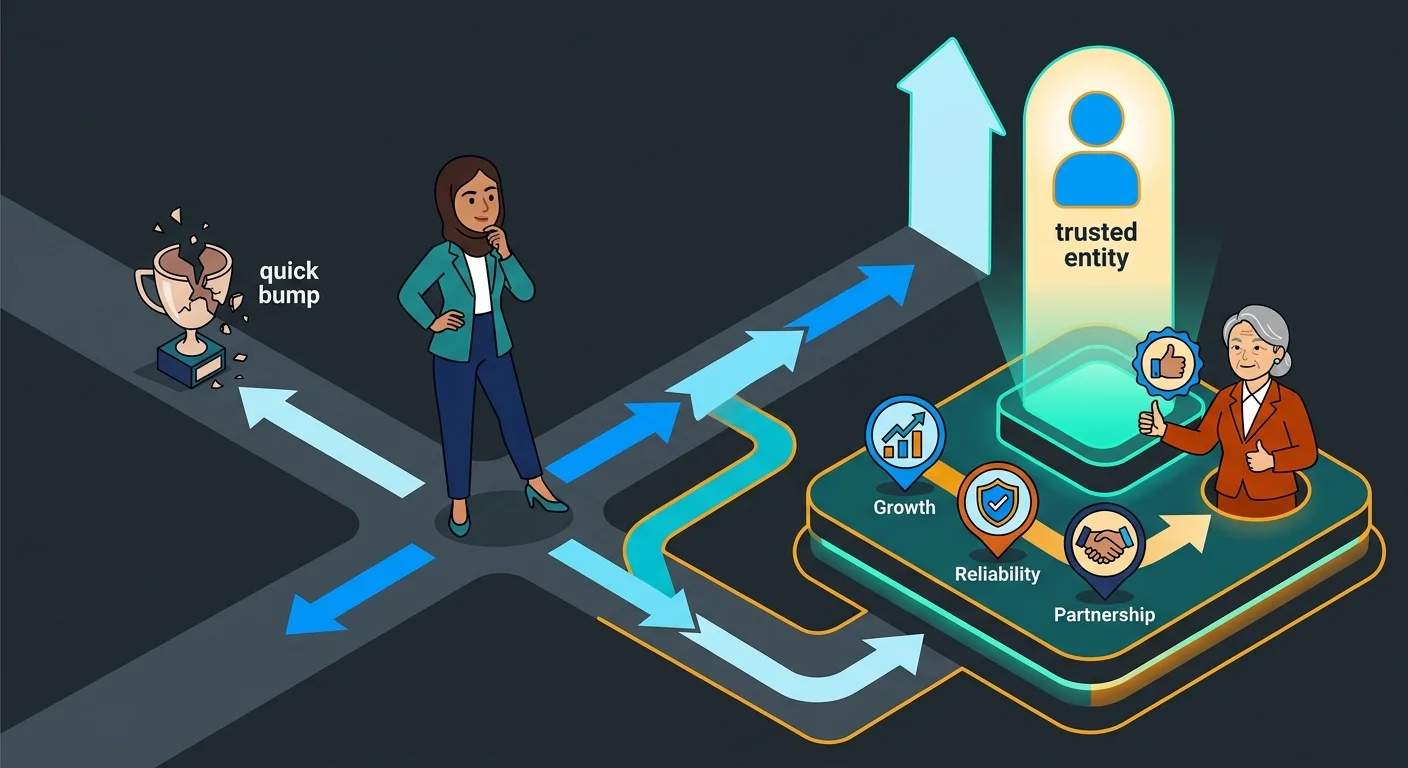
So let's draw the line clean. This isn't for a business chasing a quick placement bump off a handful of keyword-targeted articles.
That business wants position tracking to move inside a few weeks. It doesn't want a documented identity an AI engine can confirm on its own. Entity resolution doesn't run on that clock — it rewards consistency stacked across independent, structured sources over time, not a burst of content aimed at a ranking algorithm that no longer decides who gets surfaced.
Here's the harder truth sitting under that mismatch. In the age of AI-driven search, being vaguely known online is the same as being invisible. A business that wants the look of authority without the verification work behind it is choosing to stay a ghost profile — visible in fragments, unresolved as an identity, and skipped by the exact systems it's trying to reach.
How AI Engines Cross-Check One Source Against Another

So how does an AI engine pick who to trust when two pages disagree about the same entity? It doesn't just flip a coin.
It measures agreement. A source that keeps lining up with what other independent sources say about a name, a credential, or a business earns more weight in that system's trust math.
But a source that fights the consensus, or stands alone with nobody backing it up, gets discounted. That's no human reviewer handing out a penalty. It's the mechanical result of checking one claim against every other claim the system can find.
| Source Condition | Effect on Standing | Why It Happens |
|---|---|---|
| Corroborated by independent sources | Standing strengthens and the entity earns more weight in trust calculations | Independent sources agreeing on the same name, credential, or claim signals a resolved identity rather than a scattered one |
| Corrupted or altered claims | Standing degrades in proportion to how far the claim strays from consensus | The cross-checking mechanism discounts a source relative to how much it disagrees with everything else the system can find |
| Isolated with no corroboration | Standing stays weak even if the content itself looks credible | A single uncorroborated source gives an AI engine nothing external to confirm the claim against |
| Consistent across every appearance | Standing compounds over time as the same details keep reappearing | Repetition without contradiction is treated as accumulating evidence rather than a coincidence |
What Happens When a Source Gets Corrupted
Here's the cleanest look at that mechanism actually running. Researchers studying deep web book seller databases deliberately corrupted a slice of the sources, then watched how those systems reacted.
And the result wasn't a cliff. AI search engines that rank sources by their agreement with other sources showed that a corrupted source's SourceRank drops almost linearly with the corruption level, a pattern documented in published research data on source ranking behavior.
That linearity matters. It means the system isn't just stamping sources trustworthy or untrustworthy in a flat yes-or-no.
But Doesn't Traditional Search Optimization Already Cover This?
But doesn't traditional search optimization already handle this kind of cross-checking? Not the way entity resolution needs it handled.
Traditional search optimization was built to please a ranking algorithm scoring pages on keyword position tracking. It was never built to reconcile conflicting descriptions of one person across independent, structured sources. And that's exactly the corruption-detection problem entity resolution solves.
Verifiable Credentials and the Next Layer of Machine Trust

So credentials and cross-references handle the trust problem inside content that already exists. But a whole layer is forming underneath that one, built to standardize how identity gets verified in the first place.
That layer is verifiable credentials — a technical standard, not a marketing phrase. It hands distributed systems a shared way to confirm who issued a claim and whether it still holds up.
| Build Stage | What Gets Assembled | Signal It Sends AI Engines |
|---|---|---|
| Foundational Identity | A named founder's bio, credentials, and role documented consistently across owned pages | An initial reference point exists, though it remains unverified by outside parties |
| Cross-Referenced Presence | Third-party mentions, professional profiles, and structured citations that echo the same facts | Independent corroboration begins accumulating, reducing the odds of a discounted or corrupted source |
| Credentialed Verification | A claim issued by a trusted third party and cryptographically tied to the founder's identity | Proof replaces assertion, giving an AI engine a checkable basis for trust rather than a self-report |
| Resolved Entity Status | Every fragment above reconciled into one consistent, cross-checked identity | The founder stops functioning as a ghost profile and starts functioning as a verifiable human node |
Building the Credential Layer Around a Founder's Identity
Here's what makes this worth watching. Verifiable credentials have recently been standardized by the World Wide Web Consortium as a core piece of Self-Sovereign Identity systems.
Those systems pair decentralized identifiers with verifiable credentials, so distributed participants can confirm claims about each other without routing every check through one central authority. The goal is more secure, more trustworthy digital communication between parties who've never dealt with each other directly, a shift detailed in a technical specification published on the arXiv preprint server.
Now think about what that means for a founder's identity specifically. A credential isn't just a claim somebody makes about themselves.
It's a claim a trusted issuer makes and cryptographically stands behind. A verifiable human node built on that foundation carries proof, not assertion — and that's exactly where entity resolution starts trusting a founder's identity instead of just indexing it.
Assembling the Cross-References That Confirm an Identity
So how does a founder actually assemble the cross-references that make an identity resolvable today, before every issuer runs a formal credentialing system? It starts with consistency across every place a name and role already show up.
A founder's bio, employer records, professional profiles, and third-party mentions all have to agree on the same facts. Disagreement anywhere in that chain is exactly the kind of corruption entity-resolution systems are built to catch and discount.
That's the discipline behind a founder-led authority system: fewer scattered mentions, more corroborated ones. A ghost profile stays a ghost profile until every fragment of it gets pulled into a single, cross-referenced, verifiable identity an AI engine can actually confirm.
Frequently Asked Questions
So let's knock out the rest, one question at a time. These are the specifics people ask once the big picture clicks.
What is the difference between a knowledge graph and a simple database?
A simple database just stores records in isolation. A knowledge graph wires those records together, so an AI engine can confirm how one entity relates to another instead of reading each fact alone.
How can I check if my business has a well-defined entity in Google's Knowledge Graph?
Search a business or founder's exact name next to their industry. Watch for a summary panel of verified facts. If nothing distinct shows up, that identity is still unresolved, not confirmed.
Does having a Wikipedia page help with entity verification?
It can, but only if the underlying facts already agree everywhere else. Build a Wikipedia page on a scattered, unverified identity and you've just handed a system one more inconsistent source to weigh.
What's the first step in creating a verifiable knowledge graph node for a founder?
Start by auditing every place a founder's name, title, and credentials already show up. Any disagreement between those sources is the first corruption an entity-resolution system will flag.
How long does it take for search engines to recognize and trust a new verifiable entity?
There's no fixed clock, and refusing to promise one is the honest answer. Recognition builds as independent sources keep corroborating the same facts. Consistency held over time beats any single update.
Where This Leaves You
So here's where this actually lands. Entity resolution was never going to reward keyword-chasing or faceless corporate content, because neither one hands an AI engine a name it can verify.
What it rewards is a verifiable human node — a founder whose credentials, byline, and cross-references agree with each other everywhere a system looks. That agreement is the whole game now. Traditional search optimization was never built to play it.
So every business still betting on scattered, unverified mentions is choosing to stay a ghost profile, and AI-driven search has no way to surface what it can't confidently resolve. That's not a future risk. It's the current state of anyone skipping this work today, and the way out starts with an AI visibility check.