
What Counts as a Rented Metric Versus an Ownable Authority Asset
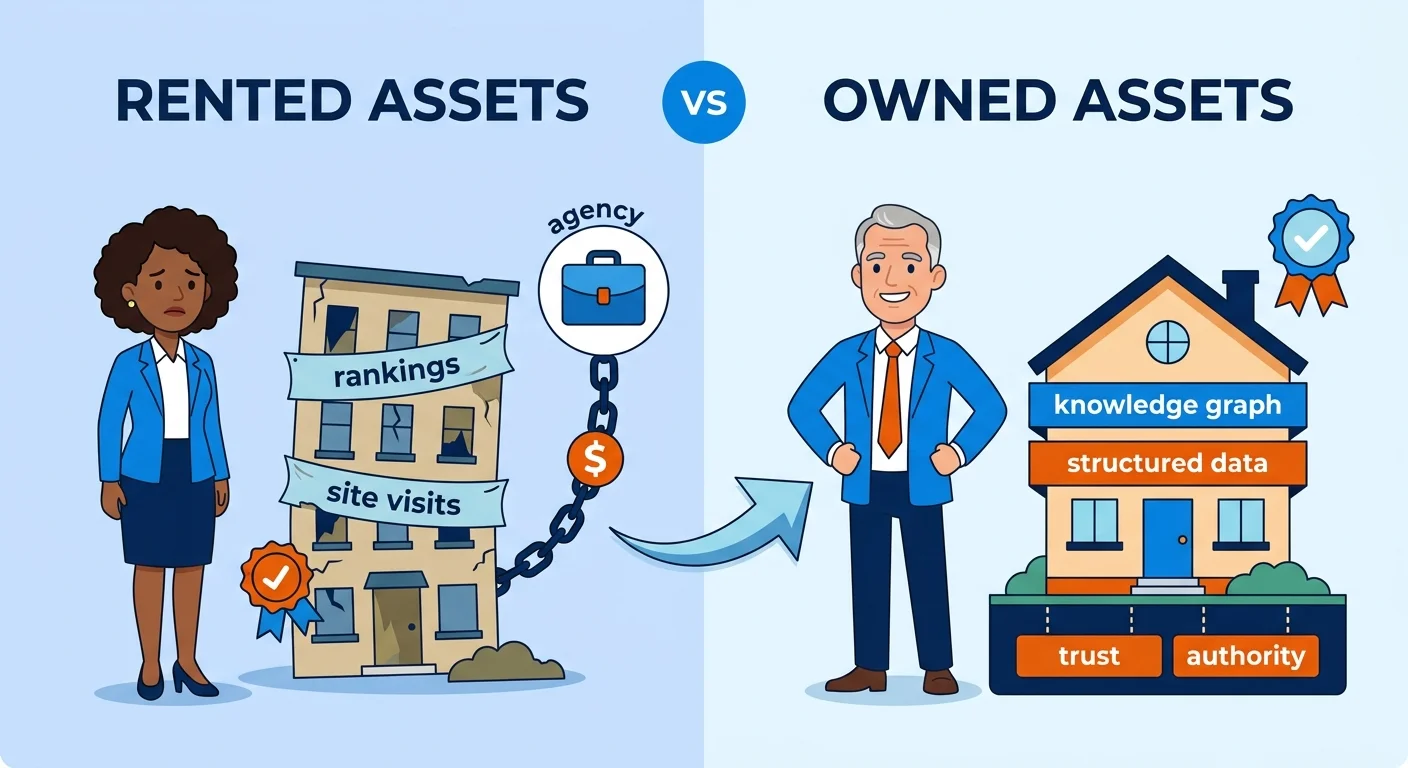
Here's the line that matters most in this whole audit: does the metric survive if you cancel the contract, or does it evaporate the second the invoice stops? That one question separates rented visibility from an ownable authority asset. And most business owners have never been taught to ask it.
Rented metrics are performance snapshots tied to an active service. Placing in the classic ten blue links, keyword position tracking, site visit volume — none of them exist as infrastructure you hold outside the agency's dashboard.
Ownable authority assets are a different animal. They're files, records, and structured data that live on your own domain and in your own systems, no matter who manages them.
So when an audit only reports on temporary performance indicators, it's measuring the wrong layer entirely. Most agency audits are stuck right here — tracking numbers that bounce up and down instead of checking whether anything permanent got built underneath them.
| Metric Type | Example | Who Controls It | What Happens If You Cancel |
|---|---|---|---|
| Rented Metric | Placement in the classic ten blue links | The agency's active management and continued billing | Placement disappears once optimization work and payments stop |
| Rented Metric | Site visit volume tied to paid campaigns | The ad platform and the agency running it | Site visits drop off immediately when the spend ends |
| Rented Metric | Keyword position tracking dashboards | The agency's reporting tool and login credentials | Access to the historical data vanishes with the contract |
| Ownable Authority Asset | Structured knowledge graph describing business entities | The business itself, on its own domain and systems | The knowledge graph stays intact and keeps functioning |
| Ownable Authority Asset | Comprehensive schema markup library | The business itself, embedded directly in its own site code | The markup remains live and citable by answer engines |
| Ownable Authority Asset | Consistent entity data across owned platforms | The business itself, independent of any single vendor | The entity records persist and stay exportable to any new provider |
The Vanity Metrics Trap
Vanity metrics feel productive because they move. A ranking shifts, a dashboard flashes a green arrow, and it looks like progress.
But movement isn't ownership. None of those numbers can be exported, transferred, or handed to a new provider — because they were never yours. They were a byproduct of someone else's active management.
That's the trap. An owner sees a good report and assumes the business got stronger, when really only the rented visibility got stronger — and rented visibility has an expiration date baked into the billing cycle.
Why Placement Reports and Site-Visit Dashboards Don't Prove Ownership
Placement reports and site-visit dashboards answer a narrow question: is this page being shown right now, and are people clicking it right now? They say nothing about whether your expertise has been structured so machines can read it and reuse it.
Now compare that to a knowledge graph or a schema markup library. Those artifacts describe your business's entities, relationships, and credentials in a format an answer engine can cite directly. And they keep working whether or not a report gets generated that month.
This is exactly why the audit has to look past the dashboard and into the infrastructure layer — the same layer explored in why authority infrastructure pricing starts where it does. An ownable authority asset is any piece of digital infrastructure you control completely and that clearly tells AI engines what you're an expert at. A placement report can't make that claim about itself.
How Machine-Readable Data Actually Builds Authority
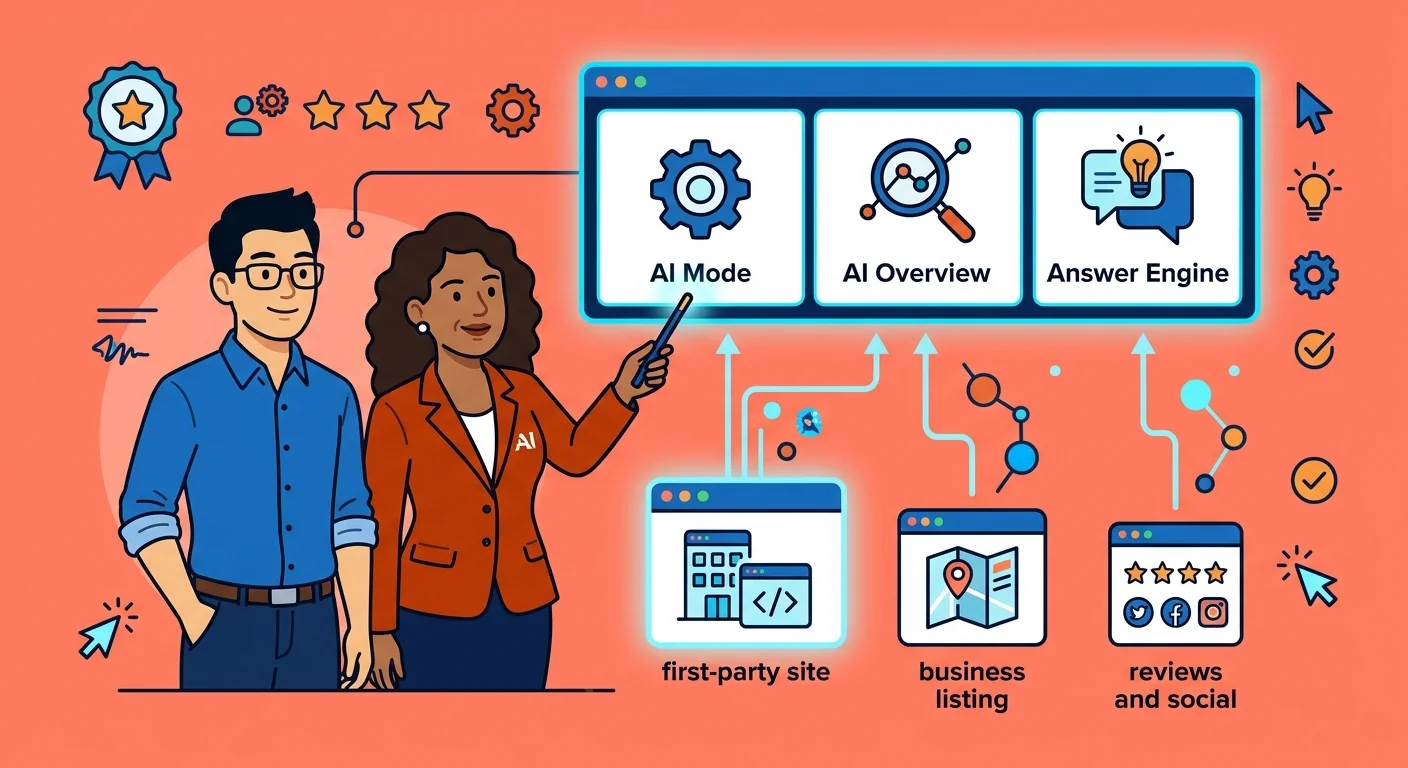
So what actually earns a citation inside an answer engine? It comes down to one thing: whether your data is structured well enough for a machine to parse it, verify it, and trust it.
Here's the thing — answer engines don't read a page the way you do. They pull entities, relationships, and facts out of your structured markup, then decide which source deserves the citation for a given query.
And that decision rewards specificity. Clean schema markup, consistent entity data, and a defined knowledge graph hand the engine something concrete to cite. None of that? You've handed it nothing to hold onto.
| Citation Source Type | Share of AI Citations | What This Means for Your Audit |
|---|---|---|
| First-Party Website Data | 44% of citations | This is the asset your audit must confirm the agency actually built — structured data on your own domain, not a rented listing. |
| Business Listings | 42% of citations | Useful, but a listing lives on a platform you don't control — it can't be exported or transferred the way owned schema can. |
| Reviews and Social Content | 8% of citations | The smallest share by far — an audit weighted toward review management is auditing the least leveraged asset class. |
| Cross-Engine Citation Overlap | 13% shared URLs | Since AI Mode and AI Overviews rarely agree on a source, your audit can't chase one engine's algorithm — it has to verify structural signals every engine can independently confirm. |
How AI Engines Decide What to Cite
Here's the part almost no owner ever gets explained: citation isn't proportional to popularity. According to Search Engine Journal's reporting, AI Mode and AI Overviews cited the same URLs only 13% of the time as of September 2025 — which means each engine is grading source quality on its own, not copying some shared ranking.
Now that gap matters enormously for an audit. If two major answer engines rarely agree on which source to trust, then durable citation can't be about chasing one engine's algorithm.
It has to come from structural signals every engine can verify independently — the same entity data, the same schema, the same knowledge graph, no matter which system is reading. That's the layer an agency should be building. And it's exactly the layer covered in what a slow-moving agency relationship actually costs you over time.
Where First-Party Data Fits in the Citation Hierarchy
So where does your own website land in this hierarchy? Higher than most owners assume.
First-party websites account for 44% of citations in generative AI answers across ChatGPT, Gemini, and Perplexity, according to Insider Intelligence. Business listings follow at 42%. Reviews and social content trail way back at 8%.
That ordering is a mandate, not a footnote. It means the single highest-leverage asset an agency can build for you sits on infrastructure you already own outright — your domain, your schema, your structured data — not a rented listing or a review platform you don't control.
Who Should Not Bother Running This Audit
This audit isn't for everyone. It's built for the owner who's willing to look past the dashboard and ask uncomfortable questions about what they actually own.
Want a report that just confirms you made a smart call? Skip this entirely. This process is built to surface gaps, not soothe egos.
So who's it for? Owners who get that a real audit isn't about catching an agency in a mistake — it's about re-aligning the investment toward durable authority that can't be rented back to you month after month.
| Report Line Item | Ownership Signal Present | Ownership Signal Absent |
|---|---|---|
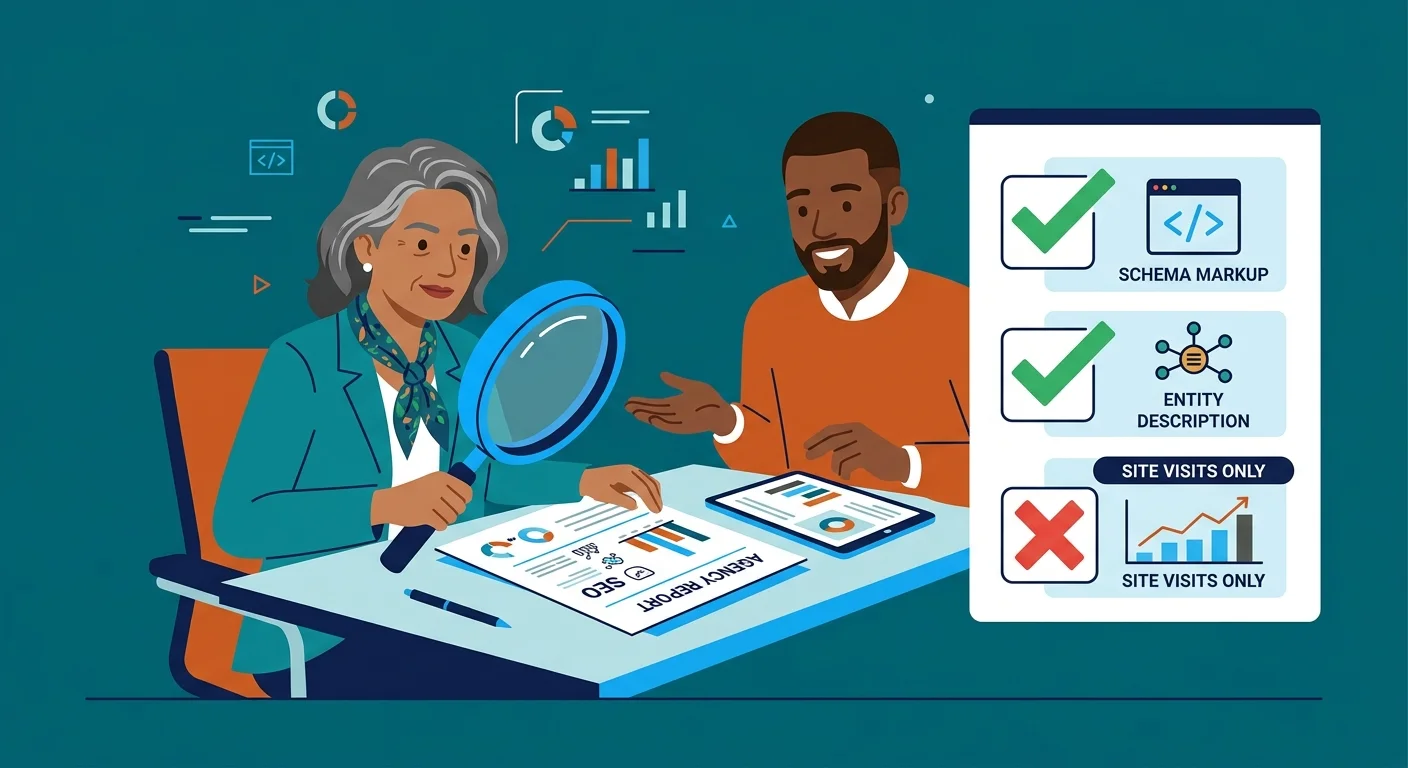
| Structured data files and schema markup libraries | Report names the specific files, entities, or schema types published on your own domain | Report references only that structured data exists somewhere, with no file, entity, or format named |
| Knowledge graph entries and entity relationships | Report shows entity definitions and relationships documented and stored under your ownership | Report mentions a knowledge graph in passing without showing what it actually contains |
| Placement in the classic ten blue links | Report treats placement as one input among several, not the headline metric | Report leads every summary with placement movement as the sole measure of progress |
| Site visit volume | Report contextualizes site visits against what infrastructure produced them | Report presents site visits alone as evidence the engagement is working |
| Canonical content ownership | Report confirms content lives on infrastructure you control outright, exportable on demand | Report never addresses whether content or its underlying data could be exported at all |
The Line-by-Line Audit Checklist for Your Agency's Deliverables
Start with the most basic question: what does the agency's own reporting actually show you owning? Pull the last few reports and sort every line item into two columns — one for infrastructure, one for performance snapshots.
Structured data files, schema markup libraries, and knowledge graph entries go in the ownership column. Placement figures and site-visit charts go in the performance column — no matter how good they look.
Here's a useful parallel from a completely different field. Speech recognition researchers found a system using entity descriptions alongside phonetic matching hit a 46% relative reduction in character error rate for named entities with high phonetic confusion — a result documented in the ACL Anthology.
That case is about audio transcription, not answer engines. But the lesson carries over cleanly: precision jumps when a system has structured entity descriptions to reference instead of leaning on surface-level matching — which is exactly why your business needs its own structured entity data, not a generic placement report.
Reading Your Agency's Reports for Ownership Signals
Once the checklist is built, look at the language inside the reports themselves. Ownership signals tend to hide in plain sight, buried under sections labeled as wins.
Hunt for phrases describing something built, published, or structured on your own domain. That's a different animal from a phrase describing something that merely moved, climbed, or improved this month.
And if you want to know exactly what's at stake when that reporting relationship ends, what happens to your incoming inquiries the day the agency contract stops lays out the mechanics in full. A report that never once mentions ownership is telling you something too — it's telling you the agency has nothing durable to show.
Why Knowledge Graphs Need Maintenance, Not Just Setup
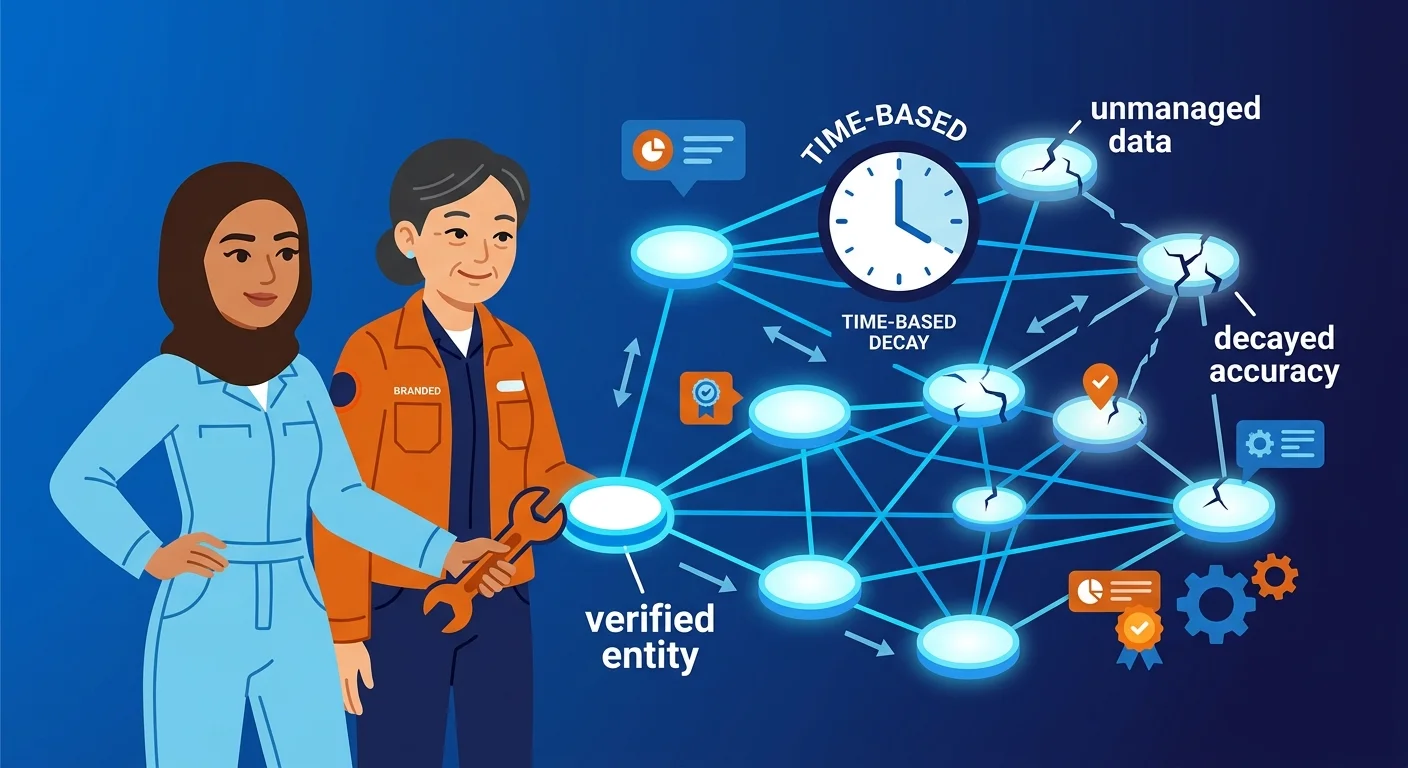
Building a knowledge graph isn't the finish line. It's the foundation pour — and foundations crack when nobody checks on them.
Here's what most agencies never tell you: entity data decays. Details change, relationships shift, and a graph that was dead-on at launch quietly drifts out of sync with reality.
So an audit that only confirms the graph exists is asking half the question. The other half is whether anyone's keeping it current — and how to tell a marketing retainer apart from real infrastructure work depends heavily on which answer you get.
| Maintenance Approach | Retrieval Performance Impact | Audit Action Item |
|---|---|---|
| No temporal weighting applied | Retrieval treats every entity as equally current, so stale relationships surface as often as verified ones | Ask the agency whether entity records carry timestamps and whether those timestamps influence what gets surfaced |
| Uniform decay across all entities | Aging entities lose relevance at the same flat rate regardless of how critical or volatile that data actually is | Request the decay logic in writing and confirm it treats high-change entities differently from stable ones |
| Scheduled verification cadence | Entities get reviewed on a fixed calendar, catching drift before an answer engine cites outdated information | Pull the last review date for every major entity and compare it against how often the business itself changes |
| Event-triggered updates | Changes to credentials, locations, or offerings push an immediate refresh instead of waiting for the next scheduled pass | Confirm what business events automatically trigger a knowledge graph update and who owns that trigger |
What Happens When Entity Data Goes Unmanaged
Unmanaged entity data doesn't just sit still. It goes stale. And stale data actively misleads the systems that lean on it.
An answer engine cross-references timestamps, update frequency, and consistency signals when it decides how much to trust a source. Treat every entity the same no matter when it was last verified, and retrieval quality collapses.
Researchers studying knowledge graph retrieval found that uniform decay performs 18 × worse than no temporal weighting — a gap documented on the arXiv preprint server. That number is what happens when a system stops telling fresh entity data apart from abandoned entity data.
Setting an Ongoing Verification Cadence
That's the mechanism behind why a one-time build quietly bleeds value. Nobody revisits the graph, the timestamps go stale, and the retrieval math starts working against the business instead of for it.
So a proper audit asks for the verification cadence in writing. It wants to know how often entity data gets reviewed, who reviews it, and what triggers an update outside that schedule.
Frequently Asked Questions
Before you run this checklist against your own reports, here are the questions we hear most. Each one gets a straight answer, not a hedge.
What is the difference between an ownable authority asset and a vanity metric like keyword ranking?
A vanity metric is temporary — it stops the second the payment stops. An ownable authority asset is infrastructure you control outright: structured data, a knowledge graph, entity records. That keeps working no matter who's billing you.
How can I tell if my agency is building assets I truly own versus just renting visibility for me?
Simple test: does the deliverable live on your own domain, and does it survive if you cancel? If it vanishes the day you stop paying, you were renting visibility. You weren't building anything.
What specific structured data outputs should I be looking for in an agency audit report?
Look for schema markup files, entity relationship data, and knowledge graph entries with a documented update cadence. Placement charts and site-visit graphs don't count — no matter how polished they look.
If I fire my agency tomorrow, what specific authority assets should I be able to take with me?
You should walk out with your schema markup, your structured entity data, and your knowledge graph records intact. If nothing transfers, the agency built nothing you owned.
Why don't traditional search optimization reports give a clear picture of my company's authority for AI search engines?
Those reports track placement and site visits. Both are rented, and both are reversible. They say nothing about whether your expertise is structured for an answer engine to read and cite.
What does a knowledge graph asset look like in a practical sense for my business?
In practice, it's a structured file describing your entities, credentials, and relationships in a format a machine reads directly. It sits on your domain and keeps answering queries whether or not anyone runs a report that month.
Where This Leaves You
So here's where all of this actually leaves you. Every report an agency ever handed you sorts into one of two columns — and only one of them survives the day the invoice stops.
A landlord can raise your rent, change the terms, or sell the building out from under you — and a placement report works exactly the same way. An ownable authority asset is the deed itself: structured data, a maintained knowledge graph, entity records that stay current, all sitting on your domain. That infrastructure answers to you, not to whoever's billing you this month.
Stop grading your agency on how the rent looks this quarter. Ask what you actually hold the title to — because that's the only audit question that survives once an answer engine, not a ranking page, decides whether you get cited. See what your business actually owns right now.