
What a Marketing Retainer Actually Buys You Each Month
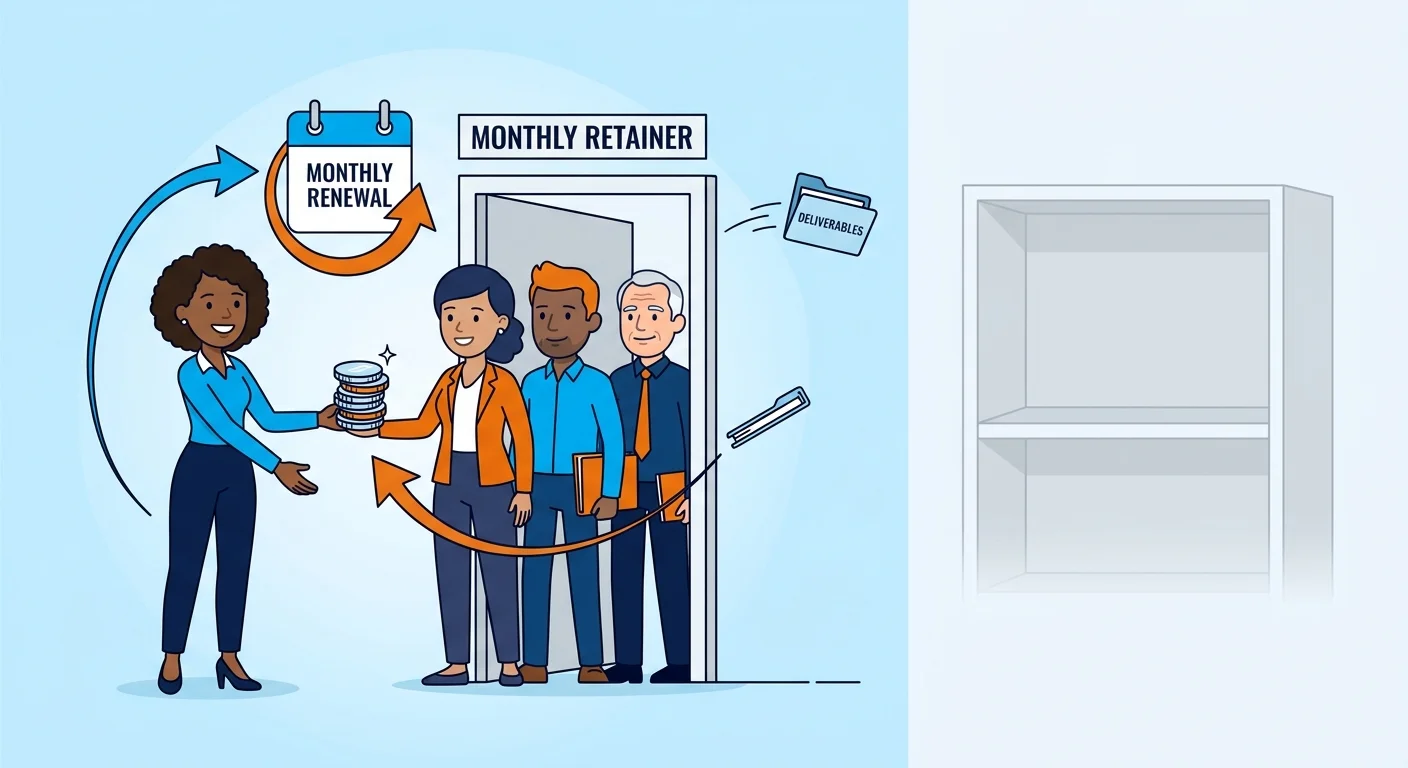
A marketing retainer is really just an agreement to rent labor and tactics, month after month. You pay, an outside team runs a fixed slate of tasks, and the whole thing resets every thirty days.
So what does that fee actually buy? Usually a bundle of recurring busywork: social posting, ad management, a handful of keyword-targeted articles, and a report showing site visits.
None of it is wrong, exactly. It's just structurally temporary, built to be renewed instead of owned.
Here's the thing: plenty of businesses end up stuck in an agency burn cycle, paying monthly fees for activity that spikes and then fades, building no lasting equity. The invoice recurs. The asset never accumulates.
The Standard Scope of a Recurring Agency Agreement
A typical scope of work reads like a checklist: so many social posts, a set ad spend to manage, and a quota of keyword-targeted articles shipped on a schedule.
Look closely and it's always hours-for-hire, dressed up as strategy. The agency's calendar drives the work, not any plan for what you'll actually own when the contract ends.
Why This Model Feels Efficient at First
Early on, this model feels efficient. Tasks get checked off, reports land on time, and something visibly happens every single month.
But activity isn't ownership. If you want to see why the alternative asks for a bigger upfront commitment, it's worth reading what actually separates a five-figure infrastructure build from a smaller starting engagement, because the difference was never about effort. It's about what survives once the invoice is paid.
Why the Old Visibility Playbook Is Losing Its Grip

So why does the checklist model keep bleeding ground? Because generative AI in search has rewritten what visibility even means. It rewards deep, structured expertise now, not shallow keyword-stuffed content.
Here's the problem. A retainer built on keyword-targeted articles and a fixed posting cadence was designed for a results page that doesn't behave the way it used to. That page answers the question itself now, before a single click happens.
Line up what businesses are still chasing against what actually moves an answer engine, and the mismatch jumps out. Old KPIs measure activity on a page nobody has to visit anymore.
How AI Overviews Are Rewiring the Click
Look at what people actually do once an AI-generated summary shows up. In Google searches from March 2025 among US adults, users who saw an AI summary clicked a traditional search result in just 8% of visits.
Users who didn't see a summary clicked through 15% of the time, per Pew Research. That gap isn't a rounding error. It's the mechanism replacing placing in the classic ten blue links as the finish line worth chasing.
What Businesses Are Chasing Versus What Actually Moves Now
Here's the thing: businesses are still budgeting for site visits and keyword position tracking, metrics built for a click that increasingly never comes. Meanwhile, the domains actually earning citations inside AI Overviews look nothing like a typical retainer's output.
YouTube is the most cited domain in AI Overviews today, and it's grown 34% over the last six months, according to Ahrefs' research. That's structured, owned expertise winning citations, not rented activity. Anyone still keeping score the old way should read what actually separates a five-figure infrastructure build from a smaller starting engagement, because the scoreboard itself has changed.
The Five Diagnostic Signals That Separate Renting from Owning
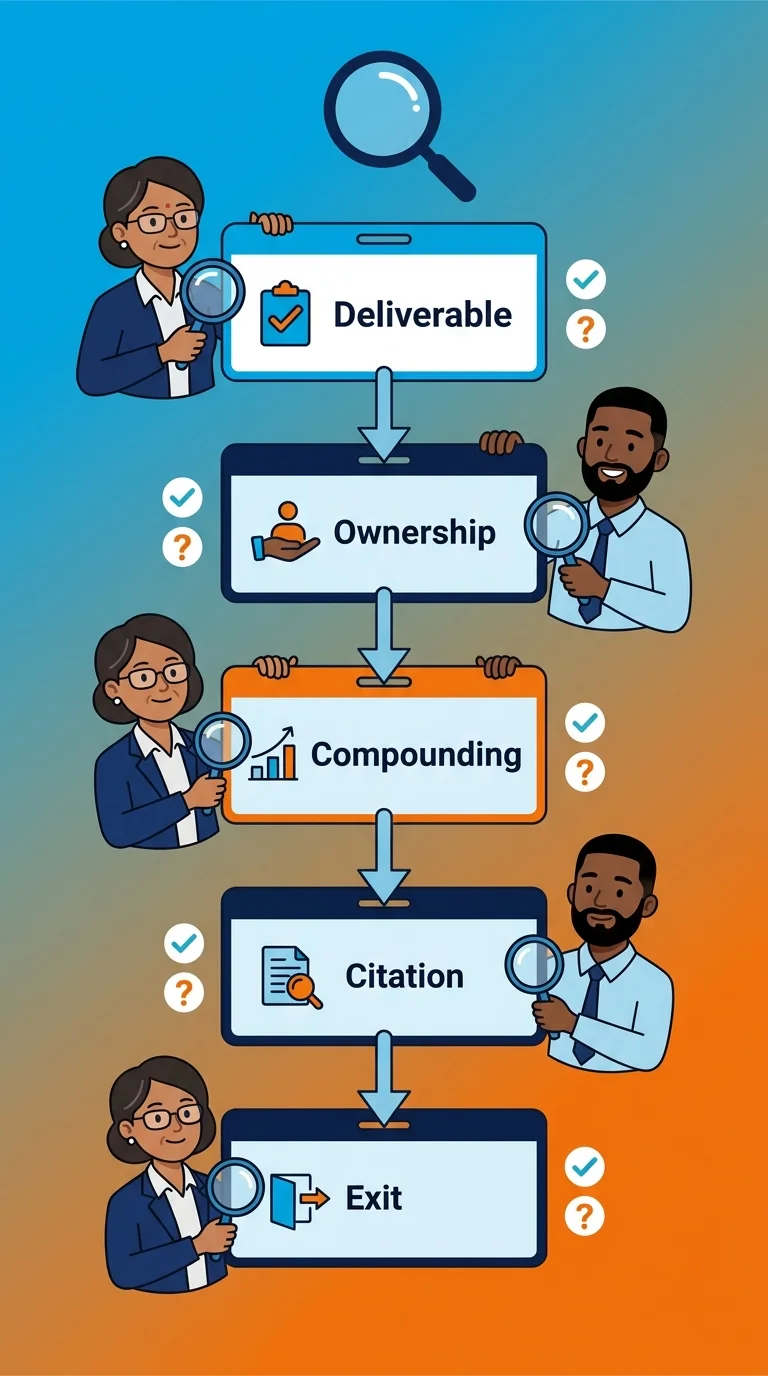
So how do you actually test what you're paying for? Five signals separate a rented tactic from an owned asset, and every one of them exposes the same buried question.
Here's that question, plain: does this spend survive the invoice, or vanish with it? Run any line item through these five tests and the answer shows up fast.
The five signals are the Deliverable Test, the Ownership Test, the Compounding Test, the Citation Test, and the Exit Test. Together they tell you whether you're renting an apartment you'll one day vacate, or pouring a foundation you keep.
| Signal | What a Retainer Looks Like | What Authority Infrastructure Looks Like |
|---|---|---|
| The Deliverable Test | An activity report showing tasks completed, such as posts published or ads managed, tied to no lasting structural asset. | A structured library of expertise, built with the semantic depth and structure needed for citation, that stands on its own after delivery. |
| The Ownership Test | Controlled by the agency's internal process and calendar, executed on the vendor's schedule rather than the client's. | Controlled entirely by the business itself, a proprietary asset the brand owns forever regardless of who built it. |
| The Compounding Test | Resets every renewal cycle, so last year's spend produces no residual value once the contract lapses. | Compounds over time, because each new piece of expertise reinforces what was already built rather than expiring. |
| The Citation Test | Rarely builds the semantic depth an answer engine needs, so generative AI systems have little to quote with confidence. | Built specifically to be found and quoted directly by generative AI systems as the authoritative source on a topic. |
| The Exit Test | Stops producing anything the moment payment stops, leaving only a record of past activity. | Keeps earning citations and reinforcing authority long after any single invoice or engagement ends. |
Signal 1 and Signal 2: The Deliverable Test and The Ownership Test
The Deliverable Test asks a blunt question: once the check clears, what physical or structural thing actually exists? The Ownership Test asks who controls that thing — the agency's process, or your business.
Here's the thing: a marketing retainer is rented labor and tactics, run on someone else's schedule and owned by nobody but the vendor. Authority Infrastructure flips both tests, because it's a permanent, proprietary library of expertise your brand owns forever, no matter who built it.
Signal 3 and Signal 4: The Compounding Test and The Citation Test
The Compounding Test asks whether last year's spend still earns its keep today. The Citation Test asks whether generative AI systems can actually find your asset and quote it directly.
Rented tactics fail the Compounding Test by design, resetting every renewal. And most retainer output fails the Citation Test too, because a scattered content calendar rarely builds the semantic depth an answer engine needs to cite anything with confidence. Owners who bristle at a bigger structural commitment should see why that very skepticism is the obstacle unpacked in the trust gap behind resisting premium authority assets — the hesitation itself is a signal.
Signal 5: The Exit Test
The Exit Test is the simplest of the five: stop paying, then look at what's left. A retainer leaves an activity report. Authority Infrastructure leaves a library that keeps earning citations long after the relationship ends.
Reading the Signals in Practice
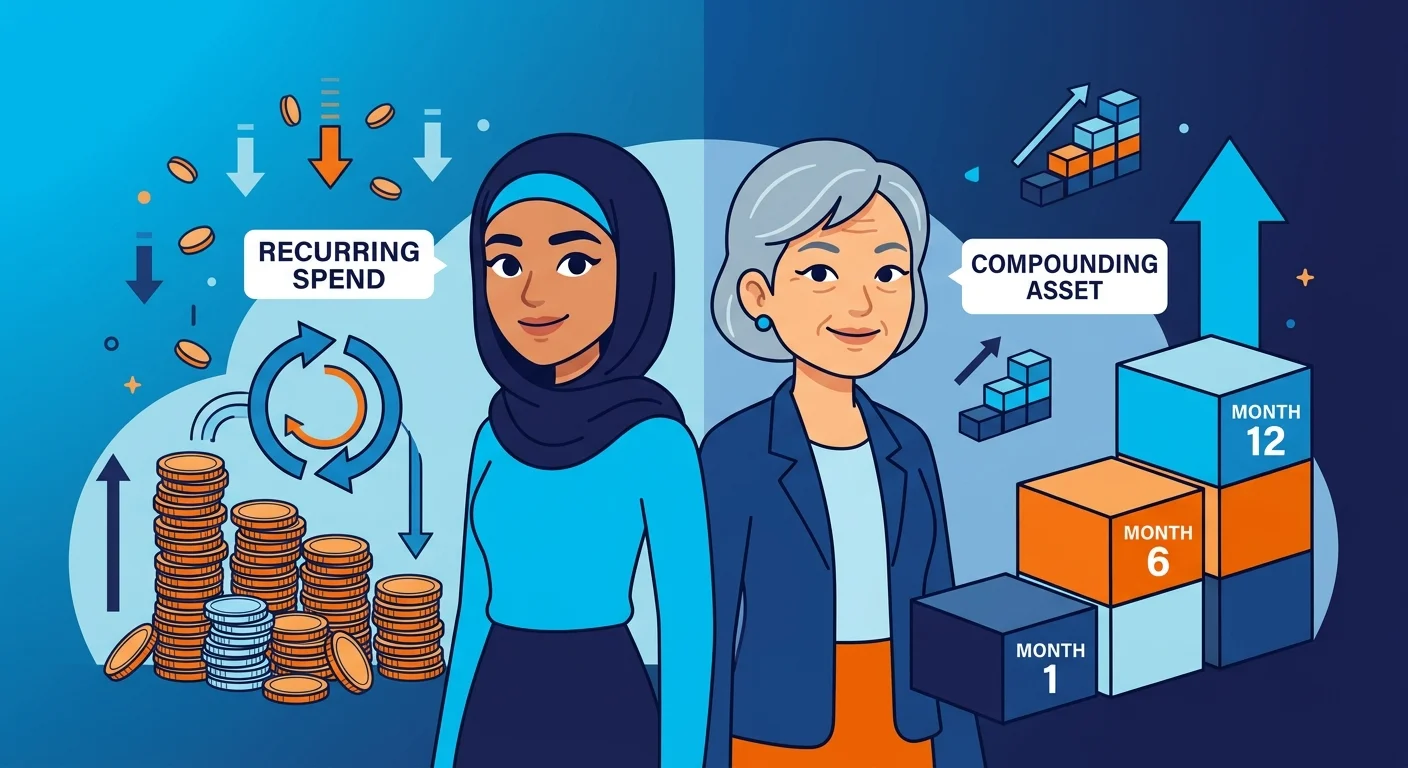
So what do these five signals look like when you point them at a real decision instead of a checklist?
Picture two businesses spending about the same amount over the same stretch. One renews a retainer every month. The other funds a structural build it'll own outright.
Run both through the Deliverable Test and the split shows up instantly. One leaves a stack of monthly reports. The other leaves a structured knowledge asset built for how a reranker actually picks sources: a system trained on DIG scores to prioritize documents hit a 17.9% gain in exact match accuracy over naive retrieval on the NaturalQA benchmark, evidence laid out on the arXiv preprint server. That's the machinery deciding what gets surfaced, and unstructured retainer output was never built to satisfy it.
| Line Item | Retainer Model | Authority Infrastructure Model | 12-Month Outcome |
|---|---|---|---|
| The Deliverable Test | A stack of monthly activity reports summarizing tasks completed on the agency's own schedule. | A structured knowledge asset engineered around the topics an answer engine needs to trust a source. | The reports pile up and are forgotten. The structured asset keeps existing, ready to be cited again. |
| The Ownership Test | The agency controls the process, the calendar, and the underlying files, not the business paying for them. | The business owns the finished library outright, regardless of who was hired to help build it. | Ending the relationship strips the business of nothing, because the asset was never on loan. |
| The Compounding Test | Each renewal starts the clock over, with last month's spend producing no residual value today. | Each new piece reinforces the ones already published, deepening topical authority with every addition. | One business is still buying the same result twice. The other is standing on a taller foundation. |
| The Citation Test | Output is organized around a publishing calendar, not around the semantic clusters an answer engine needs. | Output is organized around topic depth, built so a generative system can find and quote it directly. | One library remains invisible to an answer engine. The other keeps surfacing as the cited source. |
| The Exit Test | Stopping payment leaves behind an activity report and nothing that continues earning attention. | Stopping payment leaves behind a library that keeps earning citations long after the invoice is closed. | The rented arrangement ends at the lease. The owned foundation keeps appreciating. |
A Side-by-Side Spend Comparison
Now run the Citation Test, and the gap gets sharper. Retainer content is usually organized around a publishing calendar, not around the topic clusters an answer engine needs to actually trust a source.
Authority Infrastructure is organized the opposite way. Semantic clustering research shows a method called PRISM improves topic separability over both established local topic models and clustering built on large embedding models, while needing only a handful of LLM queries to train, per a paper on the arXiv preprint server. Owners who want a concrete way to track whether that structure is paying off should look at a framework for measuring what a completed infrastructure build keeps returning, because the Exit Test only means something if you can watch the compounding happen. Run the apartment against the foundation one more time: one ends at the lease, the other keeps appreciating.
What Generative Engines Actually Reward Instead

So what are these systems actually rewarding, mechanically? Not keyword density. And definitely not how often you hit publish.
Generative engines are built to find the one source that answers a question most completely, then quote it. That pick favors depth and structure over sheer volume.
Here's the thing: a retainer tuned for the old scoreboard never had a reason to build that depth. Authority Infrastructure was built for nothing else.
Information Gain Over Repetition
The mechanism has a name worth knowing: information gain. An answer engine checks whether your source adds anything a reader couldn't already grab somewhere else.
One article that restates common knowledge scores low, no matter how tightly it targets a phrase. A structured library that digs deeper than the rest of the field scores high, and that's exactly the asset a retainer's calendar was never built to produce.
Why Keyword-Targeted Articles Alone Cannot Satisfy an Answer Engine
So can a stack of keyword-targeted articles clear that bar alone? No. Each one answers a single narrow query, off in its own corner, with nothing tying it to the pieces around it.
But an answer engine isn't judging one article in isolation. It's judging whether a whole topic cluster shows the kind of separable, well-organized expertise that clustering research already links to better recognition over scattered content, without relearning the topic from scratch every time.
Look back at the retrieval mechanics already on the table: a system built to pick sources rewarded structure over repetition, and rewarded the asset that stayed useful long after it went live. A checklist of disconnected posts was never built to clear that bar. A proprietary library, built to compound, was built for exactly that.
The Building Blocks of a Durable Authority Asset
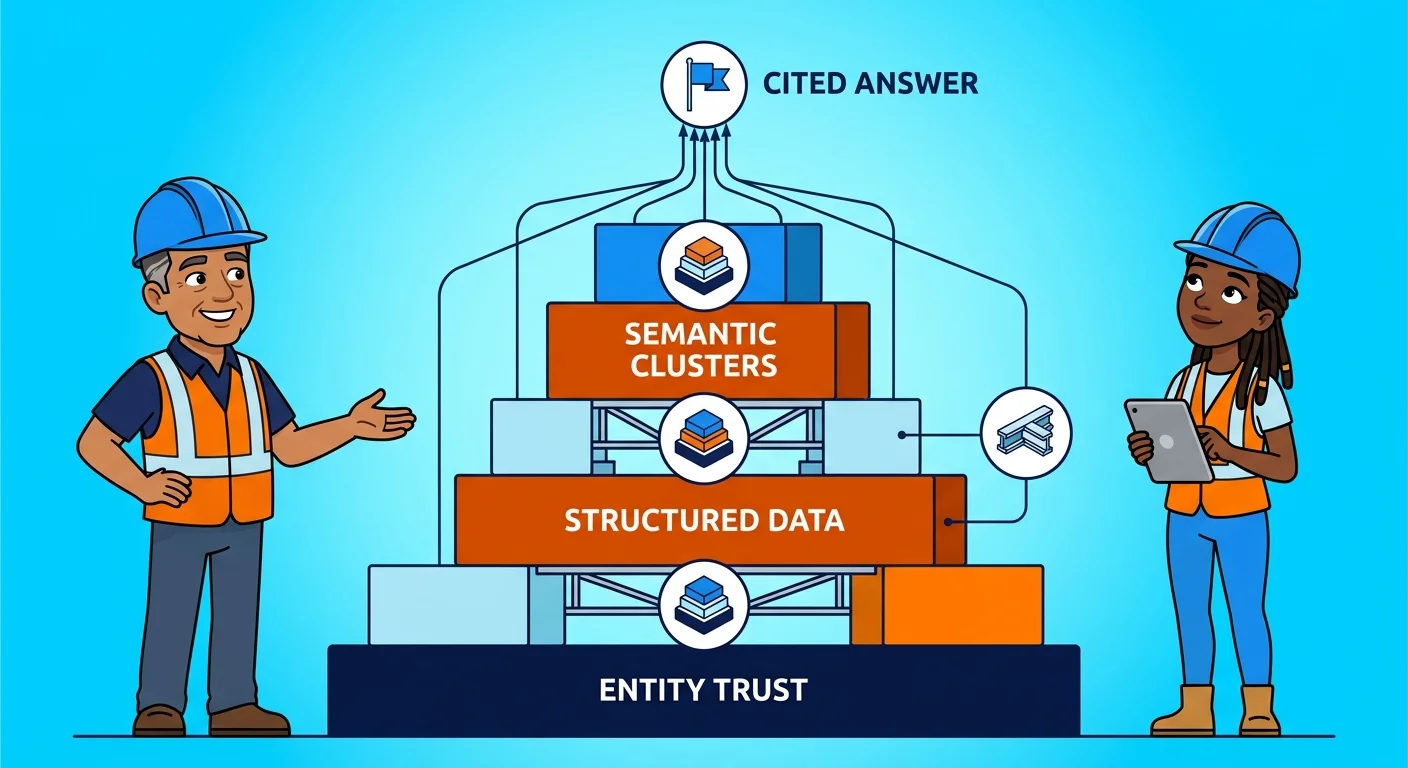
So what actually goes into a foundation instead of a lease payment? Three components. Each one load-bearing, each one built to outlast the invoice that paid for it.
None of them show up on a typical retainer's monthly report. And that's no oversight. That report was never built to track what an answer engine actually weighs.
| Infrastructure Component | What It Does | Why a Retainer Skips It |
|---|---|---|
| Structured Data & Schema Markup | Tells generative systems exactly who a brand is, what it does, and why it holds authority on a given topic. | Invisible on a monthly activity report, so it gets skipped in favor of deliverables a client can visibly point to. |
| Semantic Topic Clusters | Connects interlinked, topically exhaustive pages into one coherent body of expertise an answer engine can trust. | A publishing calendar chases scattered phrases one post at a time, never building the connective structure a cluster requires. |
| Entity Trust Signals | Builds a recognition layer that carries forward into every future query on the same subject once established. | Retainers are scoped to a renewal cycle, not to compounding recognition that outlasts any single invoice. |
| Information-Gain Depth | Resolves a question so completely that an answer engine finds nothing left to add from another source. | A calendar built around keyword-targeted articles rewards volume and frequency, not the depth this component demands. |
Entity Trust and Structured Data as Load-Bearing Elements
Here's the thing: an answer engine can't cite a business it can't confidently identify. Structured data is how a brand tells these systems exactly who it is, what it does, and why it's trustworthy on a topic.
A retainer rarely touches this layer. It's invisible on a report, so it gets skipped for deliverables that are easier to point at.
But entity trust compounds the same way the rest of Authority Infrastructure does. Once a system recognizes a brand as credible on a topic, that recognition carries into every future query on the same subject, the way a video platform's owned library keeps earning fresh citations instead of starting over each cycle.
Semantic Clusters as the Framework's Connective Tissue
Semantic clusters are the connective tissue holding the whole thing together. One article sits alone. A cluster of interlinked, topically exhaustive pages tells an answer engine that a brand has covered the subject from every angle it needed to.
That's the structural difference a checklist model can never fake. A retainer scatters posts chasing scattered phrases. A cluster builds one coherent body of expertise, and coherence is exactly what a citation-hungry system is built to reward.
Frequently Asked Questions
So the five signals are clear. Now for the practical questions sitting right underneath them.
How is authority infrastructure priced differently than a monthly marketing retainer?
A retainer is priced like rent: ongoing labor and tactics, due again next month. Authority Infrastructure is priced as a build, because what you walk away with is a permanent library your business owns outright, not a service you keep leasing.
What are the first signs that a marketing retainer is just renting visibility and not building a real asset?
Watch for reports stuffed with activity and nothing durable behind them. Here's the tell: if canceling would erase everything you paid for, that spend never built equity. It funded the agency burn cycle.
Can't I just have my current agency 'do' authority infrastructure?
Not if that agency is built around the retainer model. An operation that sells recurring tactics has zero incentive to hand you a permanent asset it stops billing for.
How long does it take to build authority infrastructure before we see a return?
Authority Infrastructure compounds instead of resetting, so returns build over time rather than spiking and fading like a rented campaign. The foundation keeps paying out long after a comparable retainer would've renewed again.
Is authority infrastructure a one-time project or an ongoing commitment?
It starts as a build, then becomes an asset you maintain and expand, not one you keep renting. Once the library exists, ownership shifts from monthly dependency to ongoing stewardship.
Does dropping a marketing retainer mean giving up online promotion entirely?
No. It means redirecting that spend from rented tactics toward a structural foundation that supports every future promotional effort instead of expiring with the invoice.
Where This Leaves You
So where does that leave the next dollar you were about to commit? Not on another renewal notice. And not on another report full of activity nobody outside your agency can even see.
A retainer is still a lease. It buys you temporary occupancy of a ranking or a flicker of visibility, and it comes due again next month. Authority Infrastructure is the foundation poured under that same address, and it's yours whether or not the invoice keeps landing.
Here's the thing: the businesses winning citations inside AI Overviews aren't the ones renewing the biggest retainer. They're the ones who quit paying rent on their own expertise and started building a library an answer engine can actually trust. So if your next dollar is still going toward occupancy instead of ownership, see what an Authority Infrastructure build looks like for your business.