
What a Zero-Click Citation Monopoly Actually Is
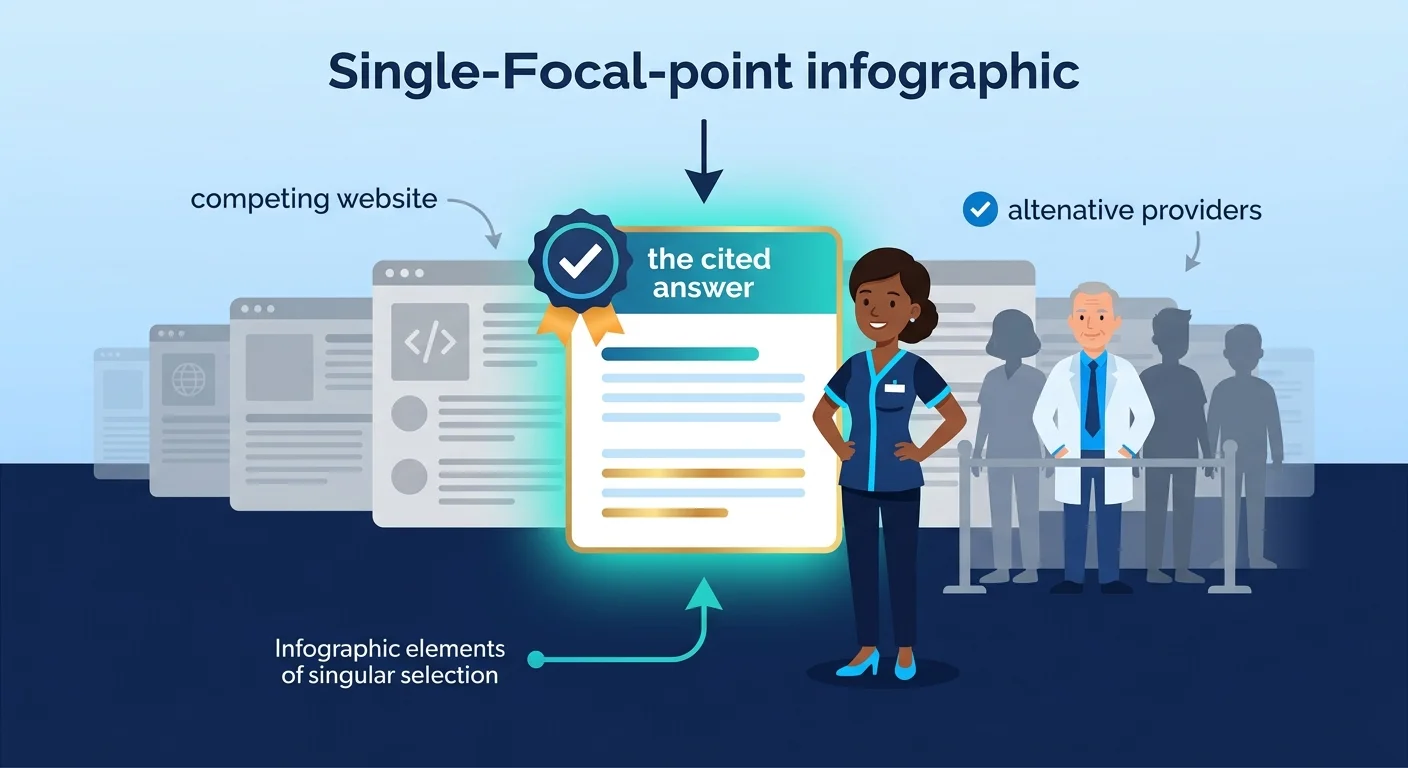
So what does this actually look like once the mechanism kicks in? Picture the AI answer box less like a leaderboard and more like a courtroom verdict. One authority gets named as the ruling source, and every other candidate simply vanishes from the record.
That's the core of a zero-click citation monopoly. AI models aren't ranking a shelf of comparable providers side by side. They pick one, and the rest vanish no matter how good they are.
Here's the thing worth sitting with: the one source an answer names beats every address it leaves off. A results page was a shelf you shared with competitors, but a synthesized answer is a verdict with no shelf at all. That's why a practice's older approach to healthcare answer engine optimization now returns almost nothing in AI-generated answers, even when that content once looked strong under older evaluation methods.
Now look at what the battle for attention has actually become. It's no longer a fight over the results page. It moved entirely into one AI-synthesized answer, parked above everything else a patient might otherwise scroll toward.
Why Chasing the Ten Blue Links Misses the New Battlefield
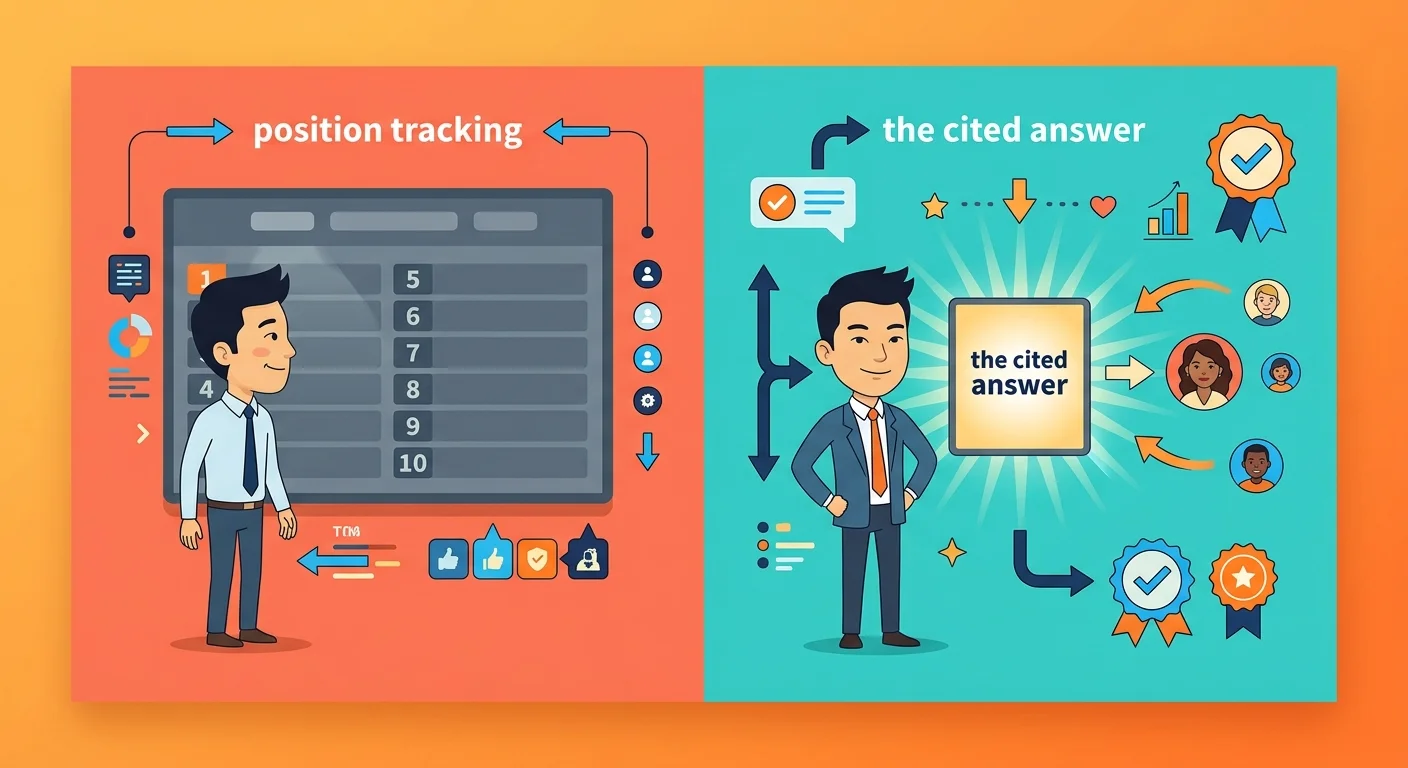
Here's the old scoreboard practitioners are still watching: keyword position tracking. Watching a term climb toward the top of the rankings used to mean progress, because progress and visibility were the same thing back when a results page held ten competing links side by side.
But that scoreboard stopped measuring anything once answers took the place of links. A synthesized answer names one source, so where a term sits on a results page nobody scrolls to says nothing about whether a provider becomes that named source.
So most of what gets sold as AI visibility isn't a new discipline at all. It's traditional search optimization wearing new vocabulary, aimed at a target that behaves nothing like a results page.
| Search Category | AI Overview Appearance Rate | What This Means for Providers |
|---|---|---|
| Local search queries | 7.9% | A provider cannot rely on volume of local searches alone, since the synthesized answer appears for a narrow share of them and names only one source when it does. |
| All keyword categories (baseline) | 20.5% | The gap between this baseline and the local rate shows the citation opening is scarcer for local healthcare questions than for search generally, raising the cost of missing it. |
The Problem With Treating Keyword Position Tracking as the Finish Line
Position tracking treats visibility like a spectrum, where a provider sits third, seventh, or twelfth and still grabs some share of attention. Zero-click citation status isn't a spectrum. A provider is either the named authority or gone from the synthesized answer entirely, with no middle rank anywhere inside that answer box.
That binary is exactly why the old scoreboard misleads. A term can hold a strong position by traditional search optimization measures while the practice attached to it never once shows up inside a generated answer, because rank and citation run on completely different mechanisms.
Look at how narrow the local opening already is. Overview-style answers surface on just 7.9% of queries flagged as local searches, well below the 20.5% baseline across all keyword categories in desktop results, which means the local citation opportunity is scarcer, not more abundant, than general search would have you believe, a pattern documented in Ahrefs' research on where these answers actually appear.
Now weigh what that scarcity does to a provider still optimizing for site visits. Chasing a bigger pile of clicks does nothing to lock down the narrower, higher-stakes slot where an AI system commits to one name and drops the rest.
This is the final move the market is making, and it's why an older toolkit can't follow. The shift isn't from one set of link tactics to a better set of link tactics; it's the move from optimizing for lists of links to engineering a machine-readable identity, a distinction examined further in how a synthesized answer actually gets assembled from a provider's scattered web data.
How AI Engines Actually Decide Which Provider to Cite

So how does a generative model actually pick its one authority out of a field of comparable providers? The answer has almost nothing to do with the tactics practices have spent years perfecting.
Start with the reaction most operators have: schema markup, long treated as a near-guaranteed lever, doesn't buy the citation by itself. It's necessary scaffolding. It's not the deciding vote.
That distinction matters, because most practices still treat structured data as the finish line. It's closer to the starting gate, and the mechanism behind why is worth naming in full.
Why Schema Markup Alone Does Not Buy the Citation
Look at what actually happens when a generative system fetches a page in real time. Five major AI systems — ChatGPT, Claude, Perplexity, Gemini, and Google AI Mode — didn't use schema markup at the moment of retrieval.
Instead, each one pulled only the visible HTML content off the page. JSON-LD, Microdata, and RDFa sat there unread, ignored at the exact moment a citation decision was getting made.
And this held across pages that had already earned 100+ AI Overview citations between August 2025 and March 2026, which kills the idea that schema just needed more time to pay off. Adding schema produced no major uplift in citations on any platform.
So the practices still buying structured-data add-ons as a standalone fix are optimizing a layer the retrieval step frequently skips right past. Structured Data Deployment still matters, but only as a verification layer beneath visible content a model can already read — never as the thing that wins the citation on its own, a distinction laid out further in what a condition page's schema needs to actually carry to be checked.
How Multi-Source Synthesis Changes What 'Being a Source' Means
Now turn to the deeper reason a single well-optimized page rarely wins the citation alone. Being a source and being the source stopped being the same claim, and the gap between them is structural.
In multi-source retrieval-augmented generation systems, the generation component has to connect and synthesize information pulled from more than one place. Real-world applications routinely need information scattered across multiple sources, because no single source is enough to answer the user's question, a mechanism detailed in the arXiv preprint server.
That changes what a provider is actually competing to become. The target isn't the single best page on the open web. It's the single most synthesizable identity across every page the model pulls from.
A page can be well written, well designed, and still lose the synthesis contest if its entity details, credentials, and reviews sit inconsistently across the sources a model draws from. Consistency across sources is what lets Entity Consolidation hold together once a system starts stitching fragments into one answer, and consistency is exactly what vanishes when schema gets treated as decoration instead of confirmation of content a model can already see — a gap Ahrefs' study traces straight back to how these systems fetch pages in the first place.
Where the Practice of Buying Directory Placements Breaks Down
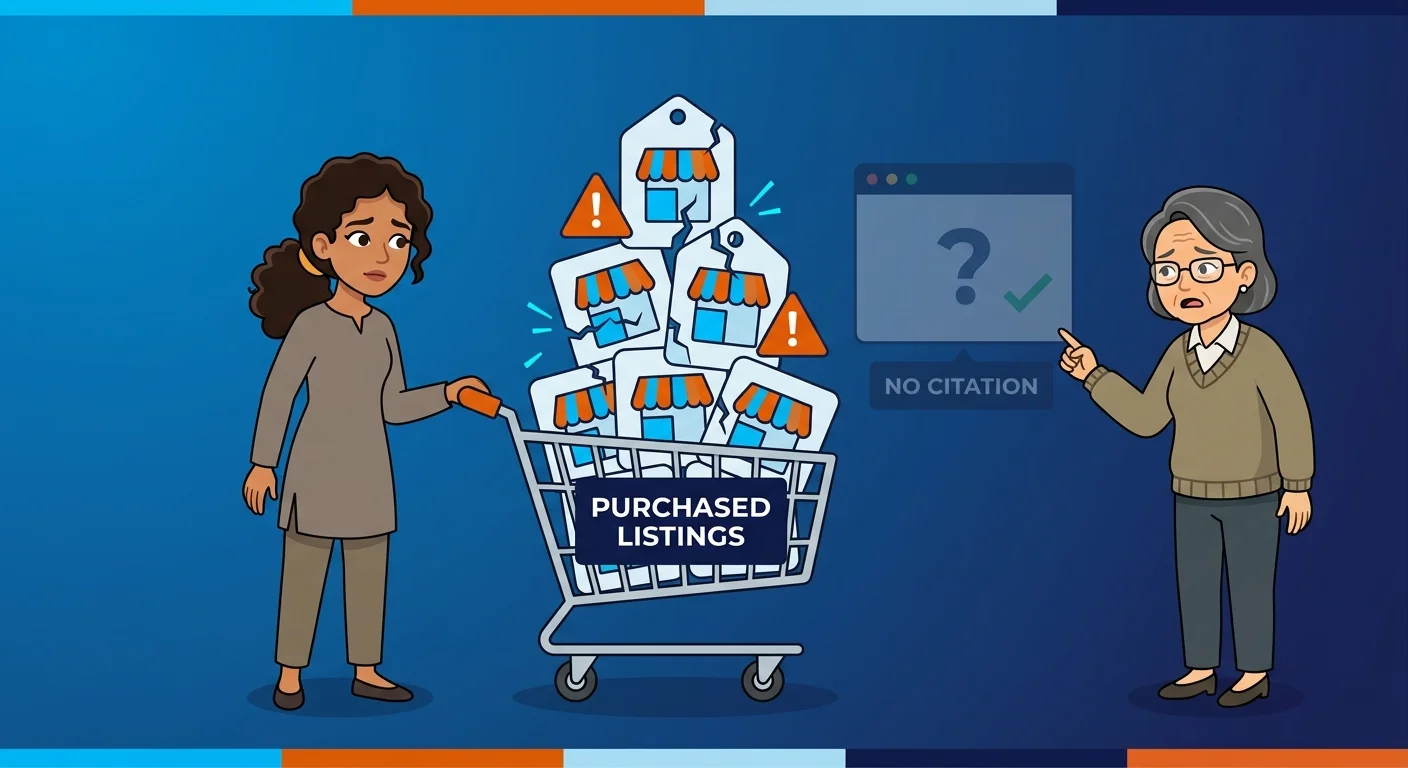
Directory-listing purchases are the cleanest example of presence mistaken for citation. A practice pays for placement across a stack of third-party directories, and the listing shows up — consistently, indefinitely. But sitting on a shelf isn't the same claim as being the authority pulled off that shelf, and a synthesized answer only ever makes the second claim.
A study measured this gap head-on. Citation presence was tracked across five AI engines using a median of at least 10 runs per engine, with 95% confidence intervals applied to isolate whether paid directory placement moved citation frequency at all — a design laid out in published industry reporting on how these systems were tested. And the pattern held regardless of how many directories carried the listing.
So the method breaks at the level of mechanism, not effort. Directory purchases add addresses to a system already drowning in addresses; they don't consolidate the identity a model needs to name one winner. Chasing that consolidation directly, through AI Authority System services, solves the actual constraint instead of renting more shelf space the verdict never reads from.
Building the Machine-Readable Identity Layer

So what actually stops a model from picking one provider over another? It's not a single tactic. It's a layered identity a machine can verify without guessing.
Here's the shift worth naming plainly. The final move away from lists of links was never about better links — it was about engineering an identity a system can read once and trust everywhere it shows up.
That identity holds together across three layers. Entity Consolidation, Structured Data Deployment, and Review and Reputation Signal Density each solve a different piece of the same verification problem.
| Layer | What It Establishes | Primary Data Source |
|---|---|---|
| Entity Consolidation | A single, contradiction-free identity: name, credentials, location, and affiliations that read identically wherever a model encounters them | Practice-owned profiles, credentialing records, and every third-party listing that mentions the provider |
| Structured Data Deployment | Machine-parseable confirmation of facts already stated in visible content, verified rather than conjured from markup alone | Schema embedded on practice pages, cross-checked against the visible HTML a model actually retrieves |
| Review and Reputation Signal Density | A pattern of specifics — conditions treated, outcomes described, credentials referenced — repeated across enough sources to read as fact rather than anecdote | Patient reviews and reputation mentions accumulated across the platforms a model draws from |
Entity Consolidation
Entity Consolidation is the foundation the other two stand on. It means a provider's name, credentials, location, and affiliations read identically everywhere a model might run into them.
A system stitching fragments from a dozen sources has no patience for contradiction. A credential listed one way on a practice page and another way on a directory entry forces a choice — trust one version, or trust neither.
That's why some practices with genuinely strong care records never surface as the named source. A system can't consolidate what the provider itself never bothered to align.
Structured Data Deployment
Structured Data Deployment is the layer most practices already think they've solved. The markup's on the page, technically correct, dutifully installed.
But installed isn't the same claim as read. This section already showed that retrieval skips right past markup a lot of the time, pulling from visible content instead.
So Structured Data Deployment earns its spot here as confirmation, not conjuring. It backs up what the visible page already states, handing a system a second machine-parseable route to the same facts — never a hidden shortcut around stating them clearly.
Review and Reputation Signal Density
Review and Reputation Signal Density is the layer that behaves least like a static asset. Reviews pile up, decay in relevance, and vary in how consistently they mention the specifics a system needs.
A thin trickle of reviews naming only a star rating gives a model almost nothing to synthesize. Density means reviews that name conditions treated, outcomes described, and credentials referenced — repeated across enough sources to read as pattern, not anecdote.
That's the throughline across all three layers. A maintained identity passes the next check on its own, while a rented listing has to hope the check never runs anywhere it isn't.
Operationalizing the Identity Build in Sequence
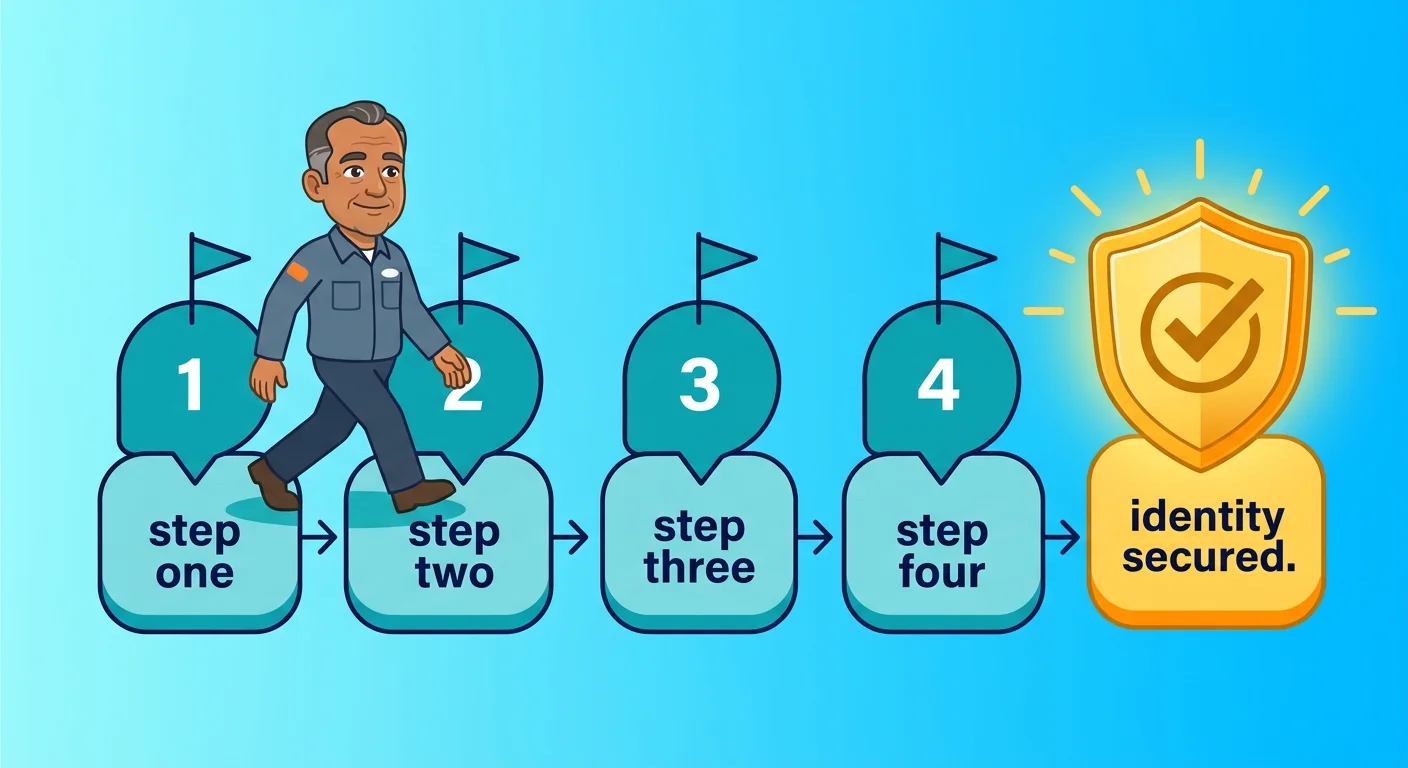
So these three layers aren't a checklist you knock out once. They're a sequence — each one leans on the layer built before it holding steady.
Build them out of order and you end up with a gorgeously marked-up page a system still won't cite. Structure with no consolidated entity underneath it has nothing solid to confirm.
| Step | Action | Dependency |
|---|---|---|
| Step 1: Consolidate the entity | Align every version of a provider's name, credentials, location, and affiliations across the practice site, directories, and any third-party listing a model might pull from | None — this is the foundation layer and cannot depend on work that has not started |
| Step 2: Deploy structured data | Add markup that confirms the facts already stated clearly in visible content, treated as a verification layer rather than a standalone fix | Depends on Step 1 — structured data confirming inconsistent facts just formalizes the contradiction |
| Step 3: Build review and reputation signal density | Accumulate reviews that name conditions treated, outcomes described, and credentials referenced, repeated across enough sources to read as pattern | Depends on Steps 1 and 2 — density stacked on an unresolved or unconfirmed entity just piles evidence onto a shaky foundation |
| Step 4: Re-check consistency across sources | Periodically verify that the three layers still agree with each other as directories update, credentials change, or new reviews post | Depends on all three layers being established first — there is nothing to re-check until the sequence has been completed once |
Sequencing the Build
Entity Consolidation goes first, and it's not groundwork to rush past. Every version of a provider's name, credentials, and location has to match before anything stacked on top means much.
Structured Data Deployment comes next, once consolidation is real instead of assumed. Here it confirms what a system already reads on the visible page — never a shortcut around stating those facts plainly.
Review and Reputation Signal Density comes last, because it's the layer that never stops moving. It needs the first two stable underneath it, or piling on reviews just stacks density onto a foundation still contradicting itself elsewhere.
I build AI Authority Systems for service businesses, chiropractors especially, and the sequencing failure I watch play out most is a practice buying reputation tools before its own entity data agrees with itself across five directories. Fixing reviews first is fixing the wrong layer. Order beats effort at any single layer, every time.
Frequently Asked Questions
A handful of questions come up every single time these three layers get explained in order. Here are the straight answers, minus the sequencing detail already covered above.
How does Google's AI decide which healthcare provider to cite in an answer?
It reads across every source it can reach and hunts for agreement. A provider whose name, credentials, and reviews match everywhere gets synthesized into the answer. One with contradictions gets skipped for a source the system can verify faster.
Can a small local clinic compete with a large hospital for AI citations?
Yes. The verdict isn't decided by staff count or building size. It comes down to whether a system can verify one consistent identity, and a small clinic with consolidated data will out-verify a hospital with records fragmented across dozens of pages.
What is the single most important factor for getting cited in a local healthcare AI Overview?
Entity Consolidation, no contest. Structured Data Deployment and Review and Reputation Signal Density both lean on a consistent underlying identity. Build either one first and you're just adding detail to a record a system still can't trust.
If a practice is not cited in the AI answer, does that mean patients will not find it at all?
No, but the practice loses the placement that matters most. Patients can still find a listed practice through other paths. They just won't hear it named as the answer, which is a different and much smaller kind of visibility.
How long does it take to build enough authority to become a primary AI citation source?
There's no fixed clock. The timeline follows the sequence, not the calendar. Entity Consolidation has to be verified and stable before the layers stacked on top of it can compound into a citation.
Does adding schema markup guarantee a citation in an AI-generated answer?
No. Markup works as a confirmation layer beneath content a system already reads on the visible page. It doesn't force a citation on its own.
What role do patient reviews play in how AI engines select a provider to cite?
They supply density a system can synthesize, but only when they name specifics. Reviews that mention conditions, outcomes, and credentials build a pattern. A stream of star ratings alone gives a model almost nothing to work with.
Where This Leaves the Provider Who Wants the Citation
So here's where the courtroom framing finally pays off. An AI answer box isn't a leaderboard where every reasonable candidate gets a seat. It's a verdict — one authority gets named, and every other candidate just vanishes from the record.
That's the whole stakes of a Zero-Click Citation Monopoly, stated plainly. When a system overwhelmingly picks one provider's data as the source of truth, there's no runner-up visibility left to compete for. Being present on the page was never the same claim as being the name the system reads aloud.
For local healthcare specifically, that verdict lands before a patient ever clicks anything. Trust and care decisions form on the system's word alone, which is exactly why Entity Consolidation, Structured Data Deployment, and Review and Reputation Signal Density have to be built in order rather than assembled piecemeal. A provider ready to find out where its own identity currently stands in that verdict can start with an AI visibility check.