
What Synthesis Actually Means Once Answers Replace Links

That reconciliation step is what synthesis actually means. For decades, the whole game in medical marketing was ranking on the first page of Google. That era's over.
Here's the thing. Conversational AI doesn't just rank links anymore. It reads them, blends what they say, and hands back one definitive answer, usually without a single click.
Picture the model as a courtroom weighing testimony, not a directory sorting addresses. Some pages get treated as credible witnesses whose claims shape the verdict, and some get left out of the record entirely. That's exactly the line separating why traditional healthcare visibility tactics stop working against conversational answers from the structural approach a practice's pages need to get believed.
Why Chasing the Ten Blue Links Still Fails the New Synthesis Model
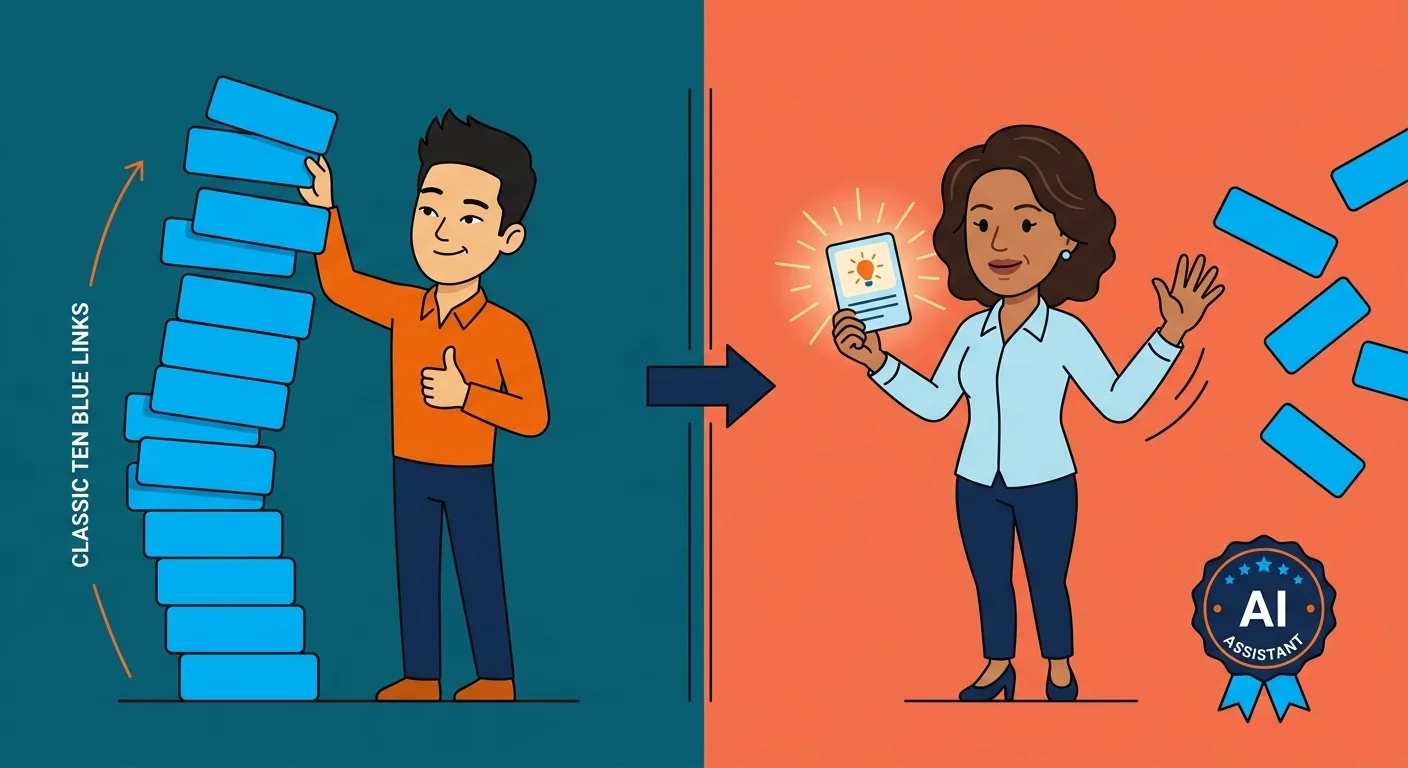
Rankings turned into a vanity metric the day answers replaced links. A spot on the results page only ever mattered when a human still had to click through it to reach the facts.
That trade doesn't happen the same way anymore. Once a model can read, weigh, and reconcile competing pages on its own, where a page sits in a list stops predicting whether its claims survive into the final answer.
So the practice still grading itself on its spot in a ranked list is optimizing for a screen fewer people ever see. Its content can be technically clean and still get skipped, because the distinction between simply being indexed and being the source a model actually recommends has nothing to do with where a page lands in a list.
Why Rankings-as-Metric Practices Collapse Under Synthesis Logic
Keyword position tracking assumes a stable, ranked list is still what a search engine hands over. Under synthesis logic, there's no list to rank inside of. There's only a citation set, built fresh for every question.
A page can hold a strong position in that older framework and still flunk the newer test. If its claims are vague, if its structure buries the facts, or if a competing page says the same thing more cleanly, the model just builds its answer around the clearer source.
That's the collapse. A metric built for a world of clicks can't describe a world where the click is optional. Practices still chasing it are measuring a variable the system already stopped weighting.
What the Zero-Click Data Actually Shows
And the scale of that shift is measurable. Across Google searches between October 2024 and 2025, nearly half, 46.96%, ended without a single click.
That figure describes a search landscape where the answer often lands on the results page itself. A rank that never gets clicked can't generate the visibility a practice is counting on, no matter how high it sits, a pattern documented in published industry reporting on search behavior across this period.
So the competitive question has moved. It's no longer which page ranks highest for a phrase. It's whether a page belongs to the pool of sources a model treats as credible enough to cite, because the new competition is for a place in that citation set, not for a spot in the top ten blue links.
How Large Language Models Actually Score and Select a Source
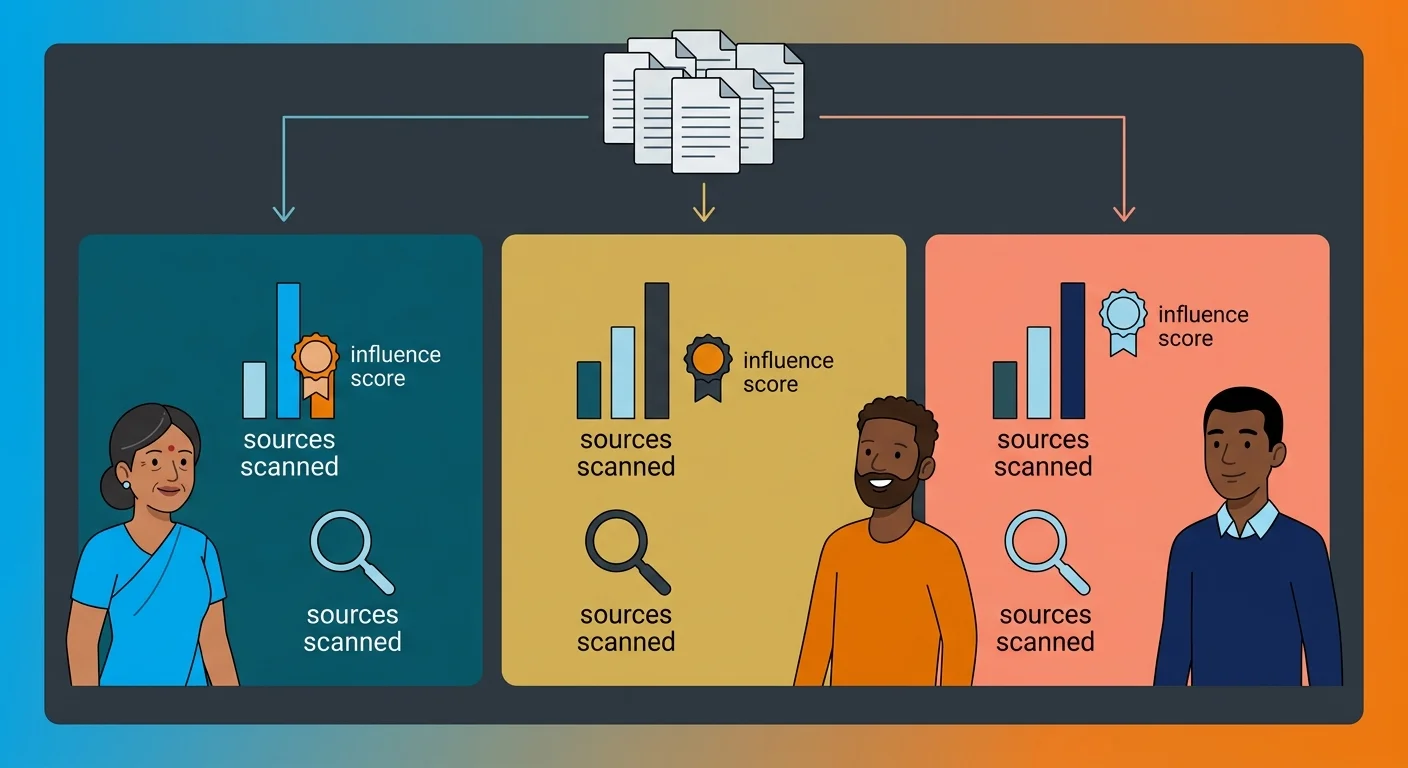
The courtroom metaphor holds because no model believes every witness equally. Each conversational AI platform runs its own scoring logic, and that logic decides how many sources it calls to the stand before it hands down a verdict.
Some platforms call a handful of witnesses and lean hard on what each one says. Others pack the room with a big panel and let the weight of consensus, not any single source's depth, carry the answer.
And that difference in courtroom style isn't theoretical. It shows up in measurable patterns — how many sources get cited per query, and how much any one of them actually shapes the final answer, a pattern examined in the arXiv preprint server's analysis of retrieval behavior across platforms.
| Platform | Average Sources Cited Per Prompt | Average Influence Per Fetched Page |
|---|---|---|
| ChatGPT | Small witness pool, narrow source count | High per-source influence, each fetched page carries substantial weight in the final answer |
| Perplexity | Wide witness pool, broad source count | Low per-source influence, weight spread thin across many fetched pages |
| Mid-sized witness pool, moderate source count | Moderate per-source influence, consensus among sources carries partial weight |
Reading the Platform Gap: ChatGPT, Google, and Perplexity Compared
ChatGPT cites 6.88 sources per prompt on average, and each fetched page carries a mean influence of 0.2713 on the answer. That's a small witness pool where every testimony counts heavily toward the verdict.
Perplexity runs the opposite courtroom. It cites 16.35 sources per prompt — more than twice ChatGPT's pool — yet each fetched page carries a mean influence of only 0.0646 on the final answer.
A wider panel of witnesses doesn't make any single witness matter more. It means the burden of proof gets spread thin across many pages, and no one source dominates the verdict the way a heavily weighted source can under ChatGPT's narrower model. That's exactly why the mechanics behind a single practice controlling every visible answer for a search term depend on which platform a query happens to run through, because a practice judged authoritative by one courtroom's rules isn't automatically judged the same way by another's.
How a Flawed Content Practice Fails Once an AI Model Reads Instead of Lists
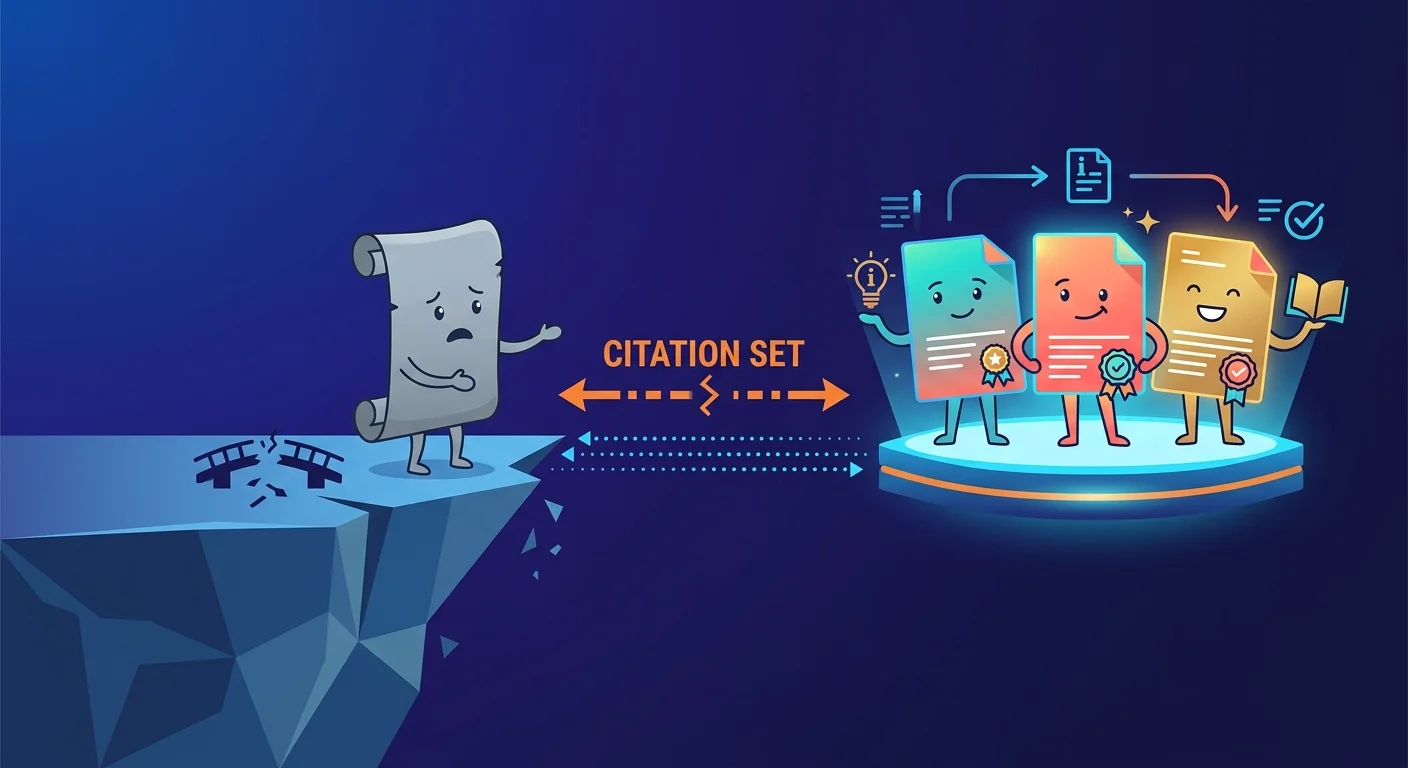
A flawed content practice doesn't fail because its facts are wrong. It fails because it hands a synthesizing model nothing stable to cite, and an unstable source gets dropped from the record before the verdict's ever written.
Here's the failure. This practice treats every page as a pitch, so its claims get buried in promotional framing, hedged with vague language, or scattered across paragraphs that never commit to one checkable sentence. A model reconciling sources finds nothing clean to extract, so it moves on to the next witness.
The moment answers became the point of a search, a ranking stopped telling you who would be quoted. A page can hold a strong position under the old measurement and still add nothing to the answer a reader actually gets handed.
The Mechanism Behind a Missed Citation
The failure starts at reconciliation, once the model has already pulled several sources making related claims. Large language models tested on knowledge conflicts do well at spotting whether the sources disagree at all.
Where they struggle is pinning down exactly which piece of each source clashes with the others, and then producing an answer that cleanly separates one position from the other. That gap in resolution is documented in arXiv, covering how models behave once their sources start disagreeing.
A page full of vague qualifiers and buried claims makes that resolution problem worse, not better. It hands the model an ambiguous fragment at the exact moment the model is least able to sort ambiguity out. And an ambiguous fragment is the one most likely to get discarded instead of synthesized.
What This Practice Costs in Measurable Terms
The cost of that discard isn't a lower spot on a results page. It's exclusion from the answer itself, which is the only place a reader's attention lands anymore.
Anyone who caught the earlier finding, that nearly half of searches close without a click, can see the shape of this cost right away. Being unclickable was survivable when a clear listing still pulled attention. Being unciteable isn't, because there's no listing left to pull it. Structuring pages so their claims survive reconciliation is the work our done-for-you AEO services exist to handle.
What Happens When the Model Finds Two Sources That Disagree
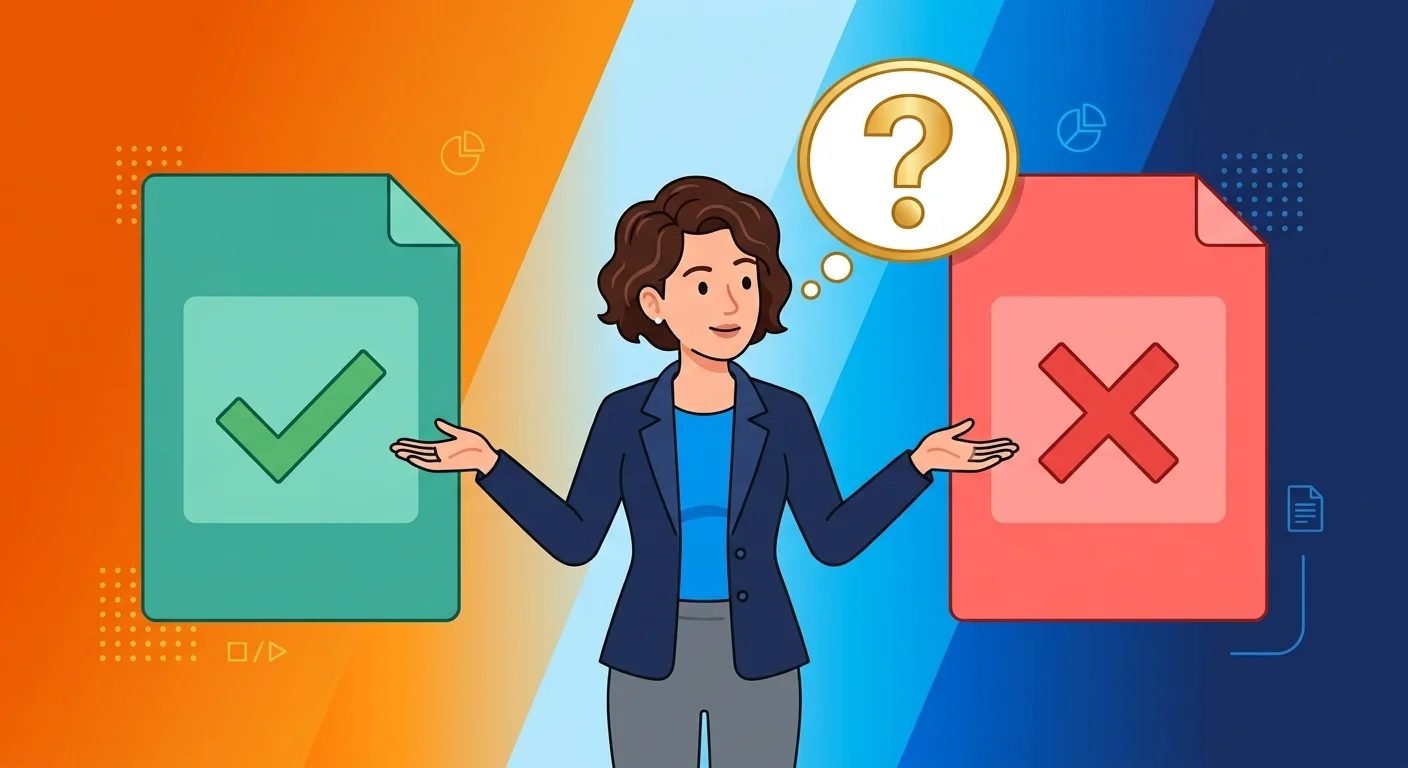
A model almost never builds an answer off one source. It pulls in a handful of pages making related claims, then has to decide what to do when those claims start pointing in different directions.
That's where synthesis stops being simple aggregation and turns into judgment. The model has to weigh which claim survives into the answer, which gets tossed, and whether both even deserve a mention.
Rankings offer nothing here. A high organic position says zero about whether a page's claim wins the reconciliation, because the courtroom weighing testimony quit consulting that old list a while ago.
Why Conflict Detection Is Not the Same as Conflict Resolution
Spotting a conflict and settling one are two different jobs, and a model can nail the first while flunking the second. It'll recognize that two sources disagree without being able to say exactly where the disagreement lives.
That gap shapes how a claim ought to get written in the first place. A page that states its position in one clean, checkable sentence hands the model far less ambiguity than a page burying the same claim under a pile of qualifiers and hedges.
The same uncertainty the model wrestles with internally shows up in how humans cite it. Under APA style, AI output gets treated as algorithmic material, with the organization behind the model listed as the author; Chicago style allows an in-text citation with no matching bibliography entry; MLA style calls the same output a source with no named author at all. Three disciplines, three different answers to a question nobody's settled yet, a divergence laid out in this published academic reference on citation standards.
How Entities and Structured Data Anchor a Model's Confidence
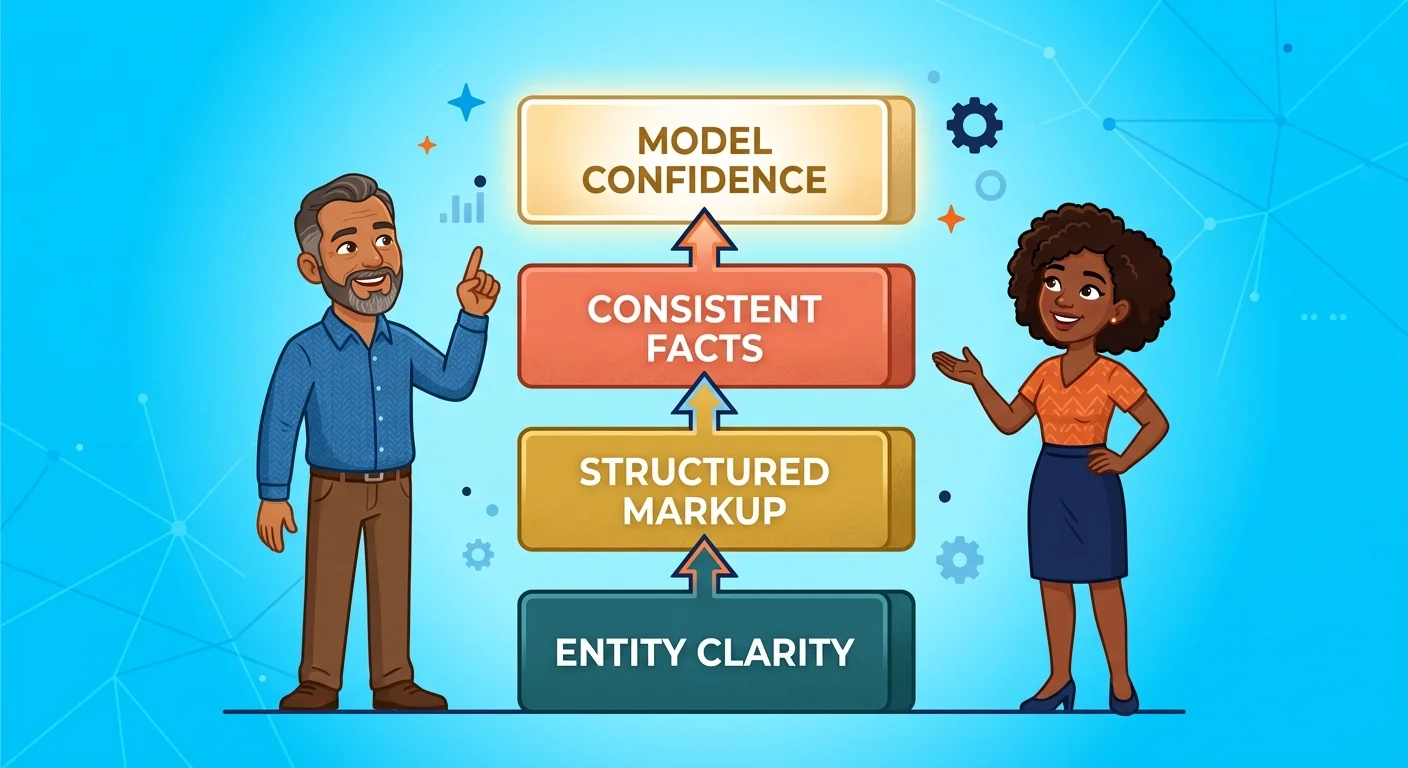
Clear prose isn't enough for a model reconciling conflicting claims. It has to know which clinic, which condition, and which procedure a sentence is actually about before it can weigh that sentence against another.
Named entities are how it gets there. A page that names the specific practice, the specific condition, and the specific credential hands the model a fixed point to anchor a claim to, instead of a string of words it has to interpret from context.
Strip the named entities out and the model's left guessing at what a sentence refers to. And a model that has to guess is a model more likely to drop the claim than resolve it into the answer.
| Structural Element | What It Signals to the Model | Effect on Citation Likelihood |
|---|---|---|
| Named Entity (Practice, Condition, Credential) | A fixed reference point instead of a string requiring interpretation | Higher, since the claim attaches to something specific the model can match against a query |
| Schema.org Markup | A labeled fact rather than a sentence the model has to parse for meaning | Higher, since the claim arrives at reconciliation already resolved |
| Vague or Generalized Prose | An unresolved reference the model cannot confidently tie to a specific entity | Lower, since ambiguous fragments are the ones most likely to be discarded |
| Buried or Hedged Claims | A statement the model cannot extract as a clean, checkable fact | Lower, since an unstable claim gives the model nothing firm to cite |
Why Named Entities Resolve Ambiguity Faster Than Prose Alone
Ambiguity is the raw material of a failed citation. "A provider treats this condition" carries none of the specificity you get from a sentence naming the provider, the condition, and the credential.
Entity recognition works by matching a query's concepts to concepts a page has already named. The clearer the naming, the faster the match. And the faster match is what pulls a page into the citation set instead of straight past it.
This is the same resolution problem the courtroom faces when two witnesses disagree. A witness who states a name, a date, and a specific claim is easier to weigh than one who talks only in generalities. Named entities do for a page exactly what a specific statement does for a witness on the stand.
How Structured Markup Changes What Gets Pulled Into an Answer
Structured markup pushes that same clarity into a format the model doesn't have to interpret at all. Schema.org markup tags a condition, a procedure, or a credential outright, so the model reads a labeled fact instead of parsing a sentence to dig one out.
That changes what gets pulled into an answer. A claim wrapped in explicit markup shows up at reconciliation already resolved, while the same claim buried in unmarked prose still has to survive the ambiguity a model struggles to sort through.
Rankings never measured any of this. Where a page landed in the search listings said nothing about whether its facts were structured for a model to trust them. Getting quoted is a different achievement than getting listed, and only one of those two survives into the answer a reader actually reads.
Formatting the Page So a Model Can Actually Use It
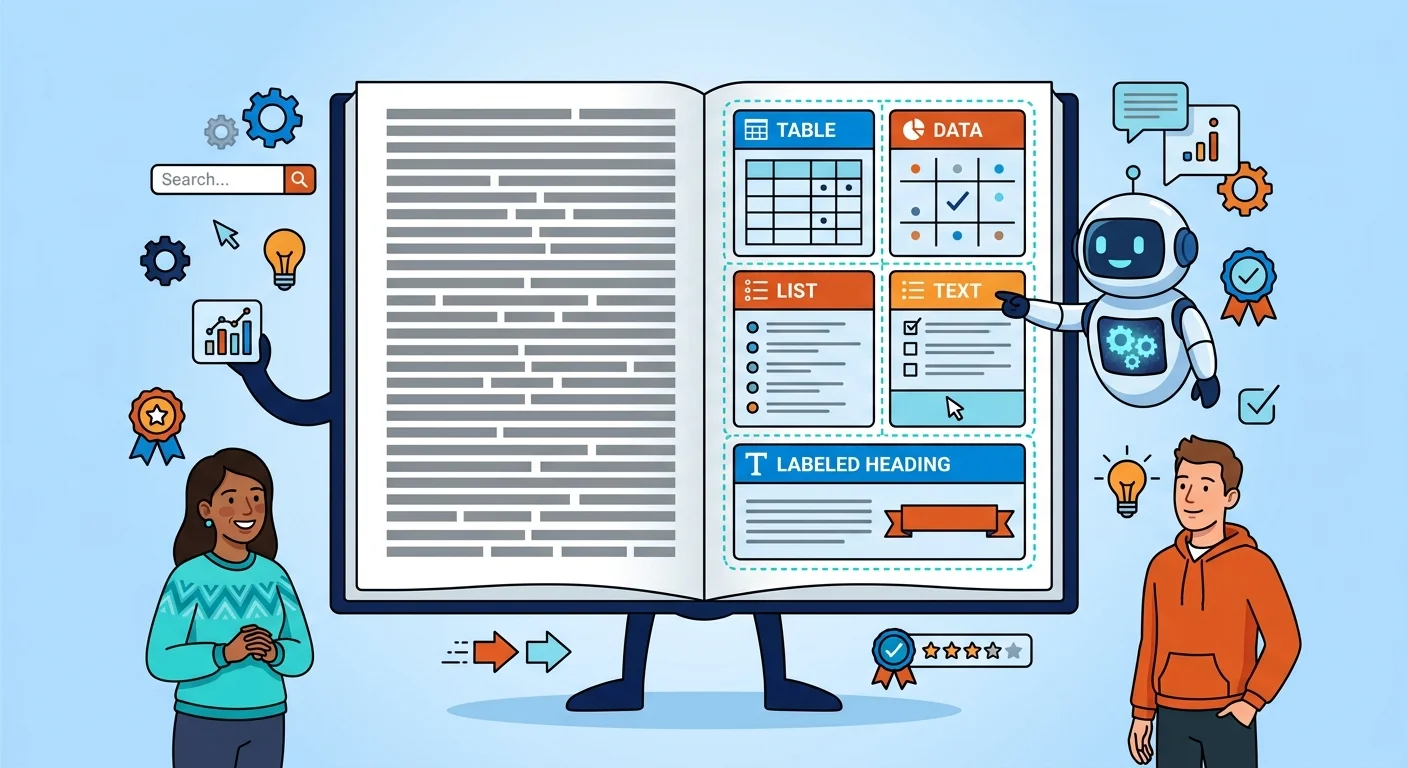
So you've named the entity clearly and marked it up explicitly. One question's still open. Where on the page does a model expect to find the answer it's after?
And that's a formatting question, not a content one. The same fact, correctly named and correctly tagged, still gets skipped if it's buried inside a paragraph the model has to parse instead of a structure it can lift straight out.
Why Tables and Lists Get Pulled Before Paragraphs Do
A table or a list hands the model a claim as a discrete, bounded unit. It doesn't have to decide where one idea stops and the next starts, because the format already drew that line.
A paragraph draws no such line. The courtroom weighing testimony favors the witness who answers in one clear sentence over the one who wraps the same fact inside a long, meandering account, and a model reconciling sources treats a bulleted fact and a fact buried mid-paragraph exactly the same way.
What Gets Lost When a Page Is Written as One Long Block
Write a page as one continuous block and you force the model to do extraction work the page could've done for it. Every claim has to be found, cut loose from its neighbors, and judged for relevance before it's usable at all.
And that extra work is exactly where a claim gets dropped instead of cited. A model's under no obligation to finish reading a dense block, so it stops the moment it has enough to answer, and whatever sits further down never enters the record.
Building the Citation-Ready Page, Step by Step

Everything up to here was diagnosis. This is the sequence that fixes it.
A page becomes citation-ready in an order, not all at once. Each step below builds on the one before it, and jumping ahead undoes the work that earlier step just did.
| Build Step | Primary Purpose | What Confirms It Worked |
|---|---|---|
| Name the entity | State the specific practice, condition, and credential in plain, checkable language before any other claim competes for attention | A model can identify who and what a page is about without inferring context from surrounding prose |
| Structure the claim | Wrap the named fact in a table, a list, or explicit markup so it arrives as a bounded unit rather than a sentence buried mid-paragraph | The claim can be lifted directly by a model without requiring extraction work first |
| Tag with markup | Apply structured markup to conditions, procedures, and credentials so the model reads a labeled fact instead of parsing one out of prose | The same fact appears identically whether read by a person or resolved by a model during synthesis |
| Verify cross-page consistency | Check that a stated fact matches every other place the practice states it, across every page on the domain | No page on the domain contradicts another when a model reconciles claims against each other |
Ordering the Elements a Model Reads First
Name the entity first. Every page should open by stating the specific practice, the specific condition, and the specific credential in plain, checkable language, before anything else fights for the model's attention.
Structure follows naming, never the reverse. Once the entity's named, wrap the fact in a table, a list, or explicit markup so the model reads a bounded claim instead of a paragraph it has to parse. A witness who states a name and a fact plainly gets weighed ahead of one who has to be interpreted, and a page built in this order hands the model that same plain statement to work with.
Verifying the Page Actually Resolves as a Single Source of Truth
A page can nail every step above and still fail if its claims contradict something else on the same domain. Verification means checking that a stated fact matches every other spot the practice states it.
That consistency is what turns a page into a single source of truth instead of one more voice in a crowded, contradictory record. A model reconciling sources has no reason to trust a witness that argues with itself, and the practice whose pages agree with each other is the one most likely to become the witness the model actually calls.
Frequently Asked Questions
The mechanics up top explain how synthesis works. What's left are the questions that mechanism raises once you put it to work.
How does conversational AI decide which medical source is the most trustworthy?
It weighs named entities, structured markup, and internal consistency all at once, and it favors pages whose claims are specific and checkable. A vague or contradictory page rarely survives that weighing.
Can a clinic website become a primary source for an AI-generated answer?
Yes. It happens when a clinic's pages name the practice, the condition, and the credential in checkable language backed by structured markup. Ranking position plays no part in that pick.
What happens when two reliable healthcare websites have conflicting information?
The model treats a conflict as a reconciliation problem, not a coin flip. It leans toward the source whose claim is stated more specifically and confirmed the same way elsewhere on that domain.
Does the AI synthesize data from just websites, or also from medical journals and databases?
Websites are one input of several. Medical journals, institutional databases, and other structured records feed the same synthesis alongside clinic pages.
How can a reader tell if an AI answer about a health condition uses up-to-date information?
There's no reliable outside tell from the answer text alone. The safer move is checking the underlying source pages directly for stated dates and revision history.
Why do different AI platforms cite a different number of sources for the same question?
Each platform runs its own retrieval and weighting, so it pulls a different number of pages before landing on an answer. That gap reflects architecture, not a shared standard for what counts as enough evidence.
The Bottom Line
Every mechanism above lands on the same fork in the road. A model builds its answer the way a courtroom builds a verdict, weighing which testimony gets believed and which gets left out of the record entirely.
The fight isn't for a spot in the top ten blue links anymore. It's for a place in the AI's citation set, the pool of sources it trusts enough to build an answer from. Understanding how these models ingest, weigh, and synthesize your data is the whole game now, and no amount of ranking effort buys your way in.
Your pages either testify clearly enough to get called, or they sit in the record as evidence nobody cites. That's the whole argument this article has made, and it starts with structuring your own data before a model ever has to guess. If that diagnosis matches what your pages are doing right now, the next move is finding out where you actually stand, and checking how your practice's visibility measures up today.