
What AI Recommendation Engines Actually Look For in a Condition Page
Picture the condition page as a witness called before a synthesizing engine. Before it gets quoted, it gets cross-examined.
First thing the engine checks is structure. Does the markup name the condition, its symptoms, and its treatments in a format the engine can parse without guessing?
Then it checks sourcing. Can the page's claims be corroborated against an outside record, or does the page ask to be believed on its own word?
Entity Verification Versus Keyword Matching
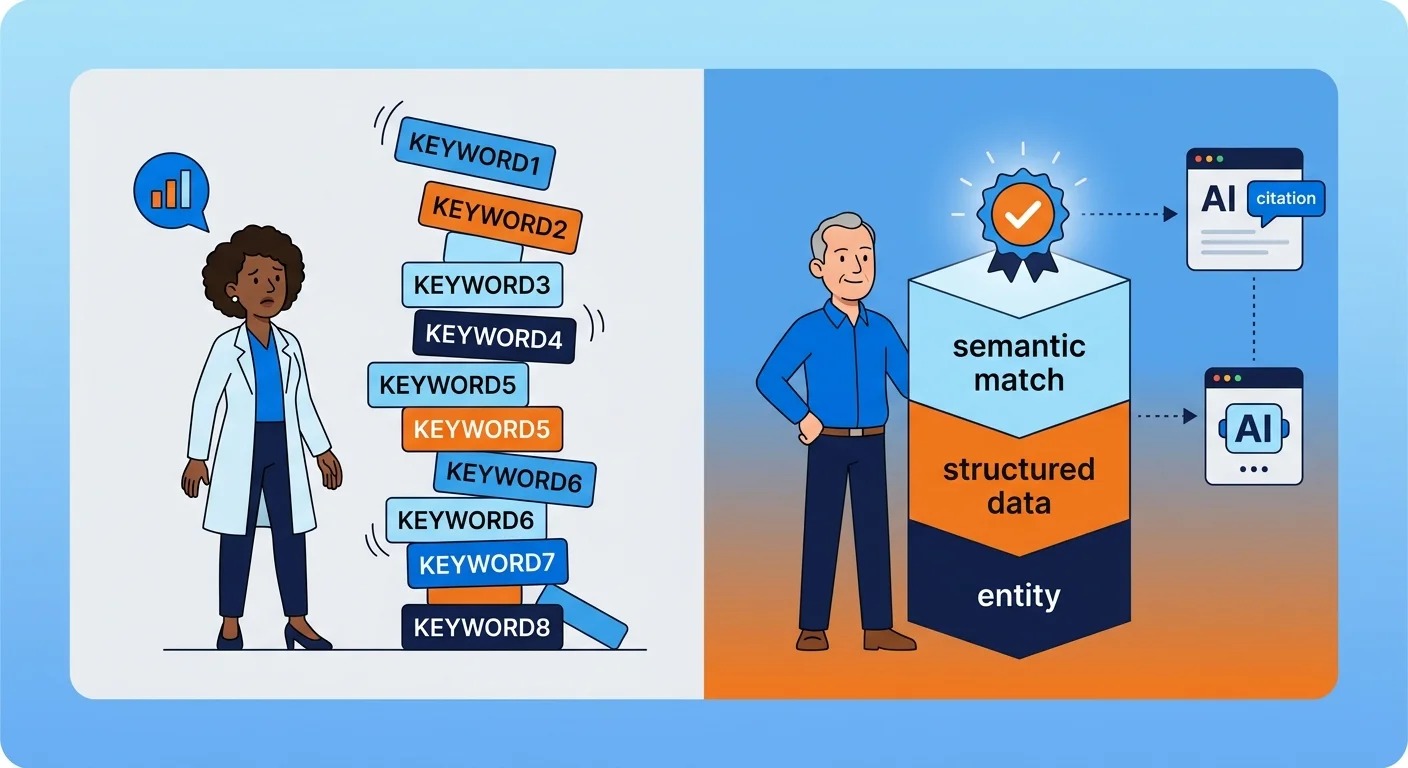
Entity verification has nothing to do with how many times a phrase shows up on a page. Optimizing for AI recommendation engines is a clean break from traditional search optimization: the old game rewarded density, the new one rewards proof.
AI engines prioritize verifiable entity authority over keyword density, which means a page's credibility gets checked against records the page never wrote. So a condition page stops being a document to be scanned and becomes a testimony to be corroborated. Getting quoted beats getting listed, because a listing only has to exist, while a quoted source has to survive cross-examination first.
Semantic Congruence Across the Page and the Wider Site
Semantic congruence is the second thing the engine checks, and it runs wider than the page itself. The engine reads the page against the phrasing patients actually type into an assistant, then checks whether the rest of the site agrees with what that one page claims.
A page can define a condition perfectly and still fail this check if the practice's other pages contradict it or stay silent on it entirely. That inconsistency is exactly what why traditional healthcare answer engine optimization produces no AI visibility traces back to a site-wide pattern, not a single broken page. A site's entity signals either hold together under cross-examination or they don't, and a synthesizing engine treats one strong page surrounded by weak or contradictory ones as an unreliable witness.
Why Keyword-Stuffed Condition Pages Get Passed Over
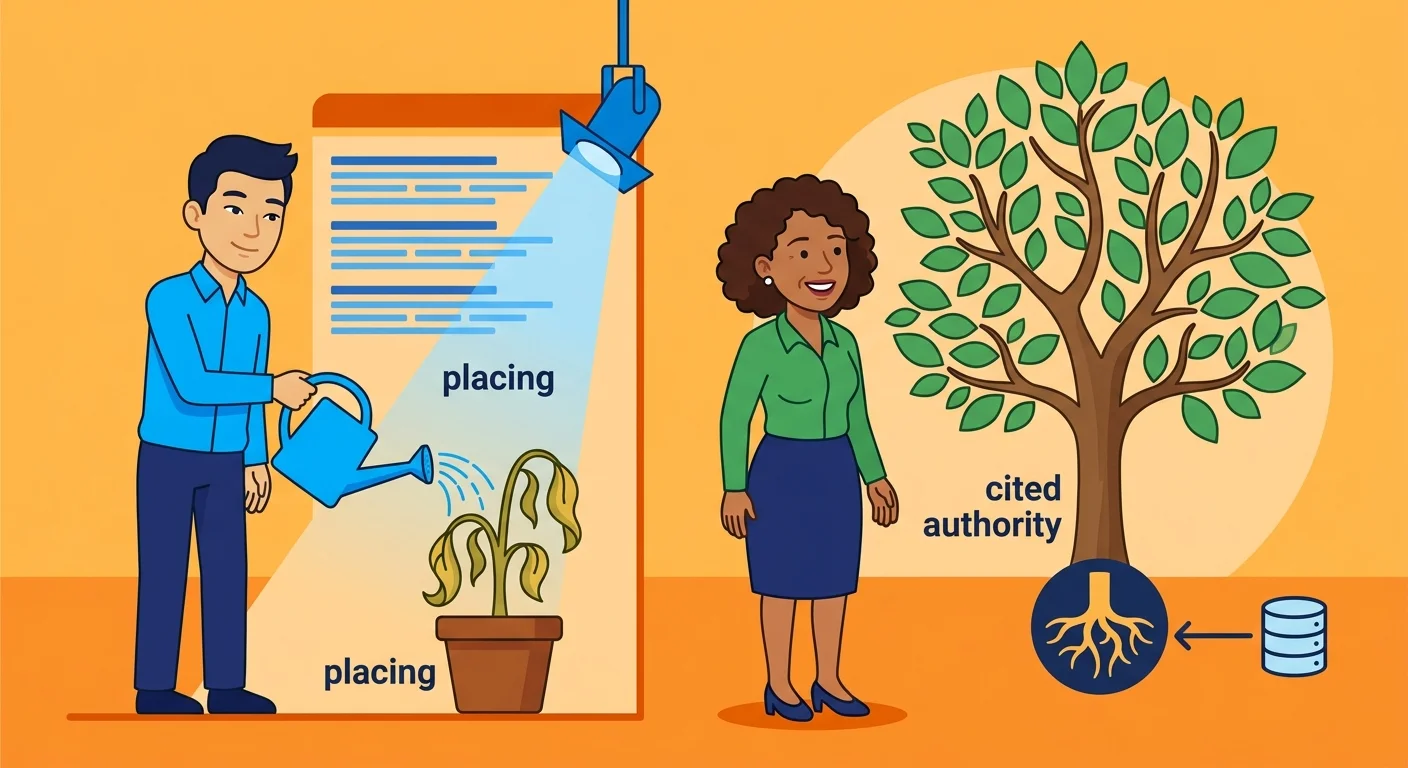
Keyword position tracking measures something a synthesizing engine stopped checking. A page can own the top slot for a condition name and still get skipped when the engine builds its answer.
That gap exists because position tracking counts placement in a list of links. But generative engines don't build a list. They build one answer, and they pull from whichever page survives cross-examination.
So a page optimized purely for position tracking usually has the density and the phrasing an old algorithm rewarded, and none of the structural proof a new one demands. Look at what the engine actually cross-examines: schema, sourcing, corroboration. Position on a results page answers none of that.
The Problem With Chasing Keyword Position Tracking on Condition Pages
Here's the mechanism worth naming straight out: once answers became the interface between a question and a source, rank no longer forecast who would be quoted. A market built entirely around list position optimized for a click, not a quote.
That distinction matters because a click and a citation are graded on different evidence. A click only needed a compelling headline and a familiar position. A citation needs the engine to verify the claim under that headline against something outside the page.
Chasing keyword position tracking on a condition page optimizes for the wrong scoreboard. A practice watches a number move and assumes visibility improved, while the page itself stays unreadable to the process that decides what gets quoted.
Why Rented Attention Never Becomes Cited Authority
But there's a harder problem sitting under the metric mismatch. Position on a results page is rented space, held only as long as the tactic that earned it keeps working against a moving algorithm.
Cited authority behaves nothing like that. Once a synthesizing engine treats a page as a verified source, that trust compounds across every query the condition touches, because the underlying entity signals don't reset with each search.
Rented attention never turns into that kind of standing on its own, no matter how long the rental runs. And the schema and review signals that determine whether a local practice gets cited show what actually earns the transfer from rented position to owned authority. Naming the tactic that fails only helps once the alternative is on the table, which is exactly where the structural elements themselves deserve a closer look.
The Structural Case Against Traditional Search Optimization Tactics
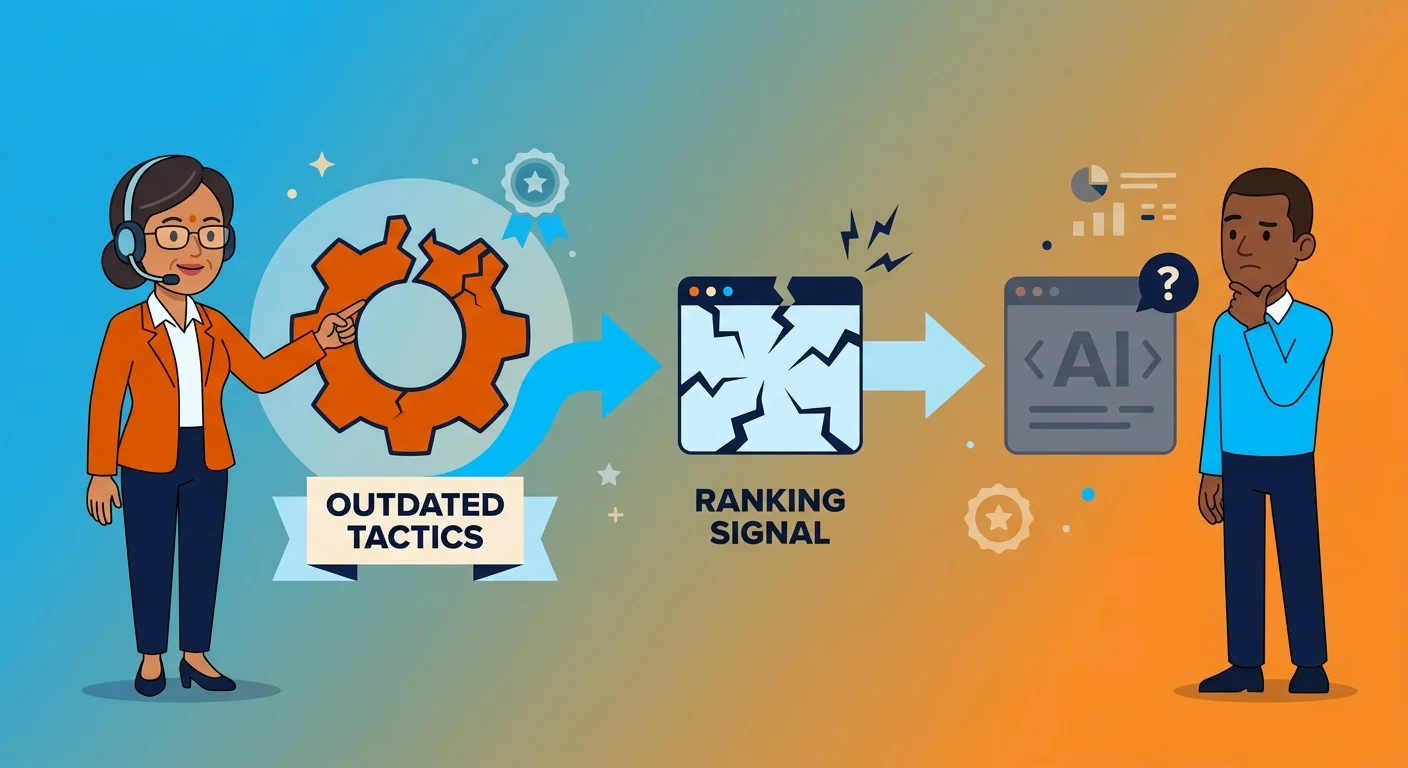
So here's the claim worth saying out loud: AI visibility is traditional search optimization with new vocabulary. Agencies slap a fresh label on the same old tactics and call it progress.
But the new label doesn't touch the machine underneath. A method built to move a spot on a results page can't verify a claim, and renaming it fixes nothing.
How Agencies Selling a Game That Ended Misread the Shift
Here's the thing about a rebrand: it holds up right up until someone checks the deliverable against the new requirement. An agency selling condition-page work still audits keyword density, still counts backlinks, still reports position movement as the win.
None of that answers the question a synthesizing engine actually asks. The engine wants to know whether a claim can be corroborated, not whether a phrase shows up at the right frequency.
That mismatch is why the same playbook keeps shipping under a new name. Selling keyword-targeted articles and calling it AI-ready content doesn't make the page citable, because citability was never the metric the playbook measured.
What Breaks First When a Page Is Built Only for Ranking Signals
Look at what breaks first when a page is built only for ranking signals. It piles up the phrasing an old algorithm rewarded and skips the schema a synthesizing engine needs to parse the claim at all.
That gap shows up the moment the page meets cross-examination instead of a crawler. A condition, a symptom, and a treatment sitting in dense but unstructured prose ask the engine to guess at a relationship the page never declared. The entity-authority framework a page needs to secure a cited answer exists precisely because guessing isn't a step a synthesizing engine takes twice before moving to a page that stated its terms plainly.
So the page keeps its position and loses its citation. A practice watches the number that used to matter hold steady while the answer read back to the patient quotes somebody else's page entirely.
How Review Content Quietly Outweighs On-Page Copy in AI Citations
So far this has all been about the page itself. Schema, sourcing, semantic congruence. But a synthesizing engine doesn't stop at what the page says about itself.
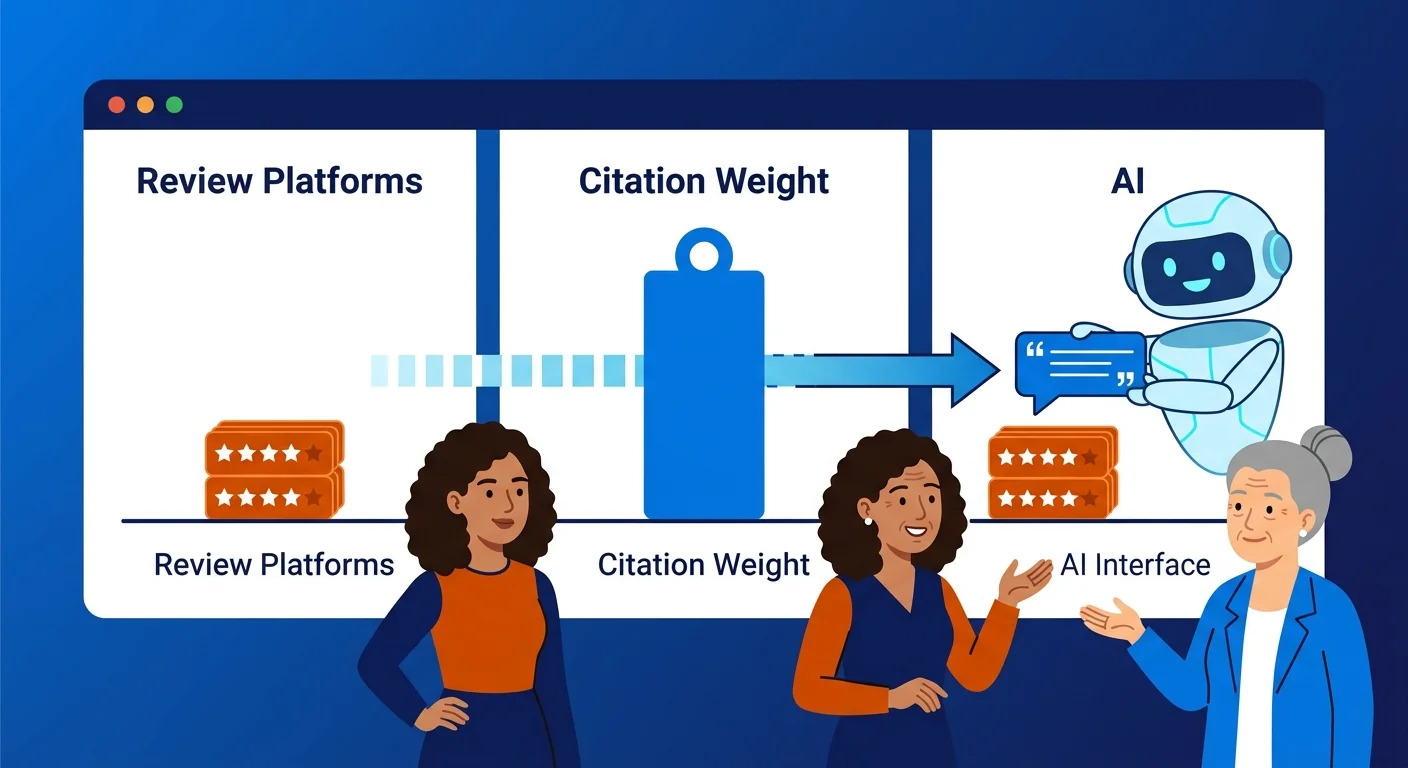
Now the part that runs backwards from instinct. Review content the page never wrote often carries more weight in the engine's cross-examination than the copy sitting right there on the page.
That's not a guess about how the engine behaves. It shows up straight in the citation data, and the pattern is specific enough to change how a condition page gets built.
| Link Source Type | Share of AI Overview Citations | Why It Carries Weight |
|---|---|---|
| Practice-Authored Condition Page | Large share of total on-page volume | States the practice's own expertise, which the engine treats as interested testimony rather than independent proof |
| Review Platform Listings | Small share of total citation links, disproportionately represented among top-cited domains | Carries corroboration from a party outside the practice, which a cross-examining engine weighs as harder to fabricate |
| Institutional and Governmental Sources | Moderate share, concentrated around clinical claims | Confirms medical facts against a record the practice does not control, satisfying the sourcing check directly |
| Aggregated Patient Testimony Across Platforms | Compounding weight as citations accumulate across multiple third-party sites | Builds a pattern of independent agreement that a single page, however well written, cannot replicate alone |
What the Citation Data Actually Shows About Review Platforms
Review platforms sit in a strange spot in that data. They account for just 8.5% of every link cited inside AI Overviews, a thin slice of the total by volume.
And yet that thin slice punches way above its size. Three of the top five most-cited domains in that same published industry reporting turn out to be review platforms, not condition pages, not practice sites.
Why Third-Party Trust Signals Carry Machine-Readable Weight
So why would a synthesizing engine weight a third-party review over a practice's own carefully written page? Because a review wasn't written by the entity it describes.
A page's claim about its own expertise is testimony from an interested witness. A review is corroboration from an outside party, and that's exactly the kind of signal a cross-examining engine treats as harder to fake. Building that externally verified standing is what our authority infrastructure services are built to do, layering third-party trust signals onto the structural elements a condition page already carries.
Building the Schema Layer That Makes a Condition Page Machine-Readable

So the review data closes one question and cracks open another. If corroboration carries that much weight, what does a condition page actually need to hold before an engine can corroborate a single thing?
It starts with schema, not prose. A synthesizing engine can't tell that a paragraph is describing a symptom, a treatment, or a risk factor unless the page declares that relationship in a format the engine reads without guessing.
That declaration is the whole job of a schema layer. It's not decoration hiding behind the page. It's the sworn statement that lets everything the page claims get checked in the first place.
| Schema Property | What It Signals to the Engine | Common Implementation Gap |
|---|---|---|
| Condition Name | Confirms which specific condition the page addresses, so the engine can match a query to the right entity rather than guessing from surrounding prose. | The condition is named in headings and body text but never declared as a discrete property, leaving the engine to infer identity instead of reading it. |
| Associated Symptom | Tells the engine which described experiences belong to this condition specifically, distinguishing shared symptoms from ones unique to it. | Symptoms are listed in a flowing paragraph or bulleted list with no markup tying each item back to the condition it belongs to. |
| Possible Treatment | Signals which interventions the page associates with the condition, letting the engine surface that relationship inside a synthesized answer. | Treatment options are described narratively across several sections, so the engine cannot cleanly extract which treatment maps to which condition. |
| Risk Factor | Establishes what raises a patient's likelihood of the condition, a relationship engines look for when answering preventive or diagnostic questions. | Risk factors are mentioned in passing within introductory copy rather than declared as a structured property the engine can parse directly. |
| Typical Severity | Gives the engine a sense of how serious the condition is treated as, which shapes how confidently it can be cited in a generated answer. | Severity is implied through tone and word choice instead of being stated as a distinct, machine-readable property on the page. |
Mapping the MedicalCondition Vocabulary to Real Page Content
The MedicalCondition vocabulary hands a page a fixed set of properties to declare: the condition's name, its symptoms, its treatments, its risk factors, its typical severity. Each one maps straight to a specific part of the page's existing content.
Here's the mistake most condition pages make. They write the symptom list in flowing prose, sure a reader can follow it, then never mark that list as the condition's symptoms in a form the engine reads directly.
The fix isn't a rewrite. It's a mapping exercise. Existing content gets tagged against the vocabulary's properties, so the paragraph a patient reads and the data an engine parses carry the same claim in two formats at once.
Where the Schema Layer Alone Still Falls Short
But schema on its own doesn't close the case. It only tells the engine what the page is claiming, not whether that claim deserves to be believed.
Structure only becomes standing once something outside the page corroborates it. A rented results position has no outside witness at all. A schema layer that names a claim with nothing to verify it against still asks the engine to trust an interested witness on its word alone.
How Reading Level and Prose Structure Affect Citation Odds

Here's the test most condition pages never run: does their own prose read like trustworthy testimony, or like noise the engine has to work around?
A synthesizing engine doesn't stop at structure. It reads the sentence itself, checking whether the claim inside is stated plainly enough to pull out clean.
So reading level stops being a style choice and becomes part of the cross-examination. Dense clinical prose can bury a clear claim inside a sentence the engine has to untangle before it trusts it.
| Model Output | Reading Level Score | Practical Implication for Condition Pages |
|---|---|---|
| DeepSeek-R1 (Q2 response) | 6.2 | Text sits at an accessible reading level, so a synthesizing engine can extract the underlying claim without a simplification step that risks distorting it. |
| ChatGPT-o3 mini (high) and ChatGPT-o1 (Q2 responses) | above 12.0 | Text lands in a range requiring college-level reading skill, forcing the engine to simplify the claim before it can quote it back, which is a point where citation can drop instead of complete. |
| A condition page's downstream clinical use | not scored on this scale | A physician relying in good faith on the page's AI-shaped recommendation can still face liability if resulting care falls below the standard of care, regardless of the algorithm's confidence. |
What the Reading-Level Data Reveals About Extractable Prose
That untangling costs something you can measure, and the data on AI-generated scoliosis education responses shows exactly where. Across the generated answers, DeepSeek-R1 produced the most accessible text, scoring 6.2 on the reading-level scale used to grade it.
Other models in that same study, published in the journal Nature, climbed well past 12.0 on the identical scale, landing where the researchers flagged college-level reading skill. A page written that hard isn't more authoritative for the difficulty. It's just less extractable, because now the engine has to simplify the claim before quoting it, and every simplification step is a place the citation drops instead of lands.
The Liability Layer Nobody Accounts for When AI Recommends Care
Now look at what happens after that citation gets read to a patient, because the trail doesn't stop at the answer. When a generated response shapes someone's next clinical decision, the page behind it has already joined a chain nobody on the page signed up for.
Physicians sit at the far end of that chain, and the exposure isn't hypothetical. A physician who relies in good faith on an AI or ML recommendation can still face liability if the resulting care falls below the standard the profession requires, no matter how confident the algorithm was.
That standard doesn't bend because a machine made the suggestion instead of a colleague. The malpractice test treats where the recommendation came from as irrelevant, which means a condition page feeding that recommendation carries a downstream weight most operators never price into the copy they publish.
Implementing the Authority Layer Step by Step
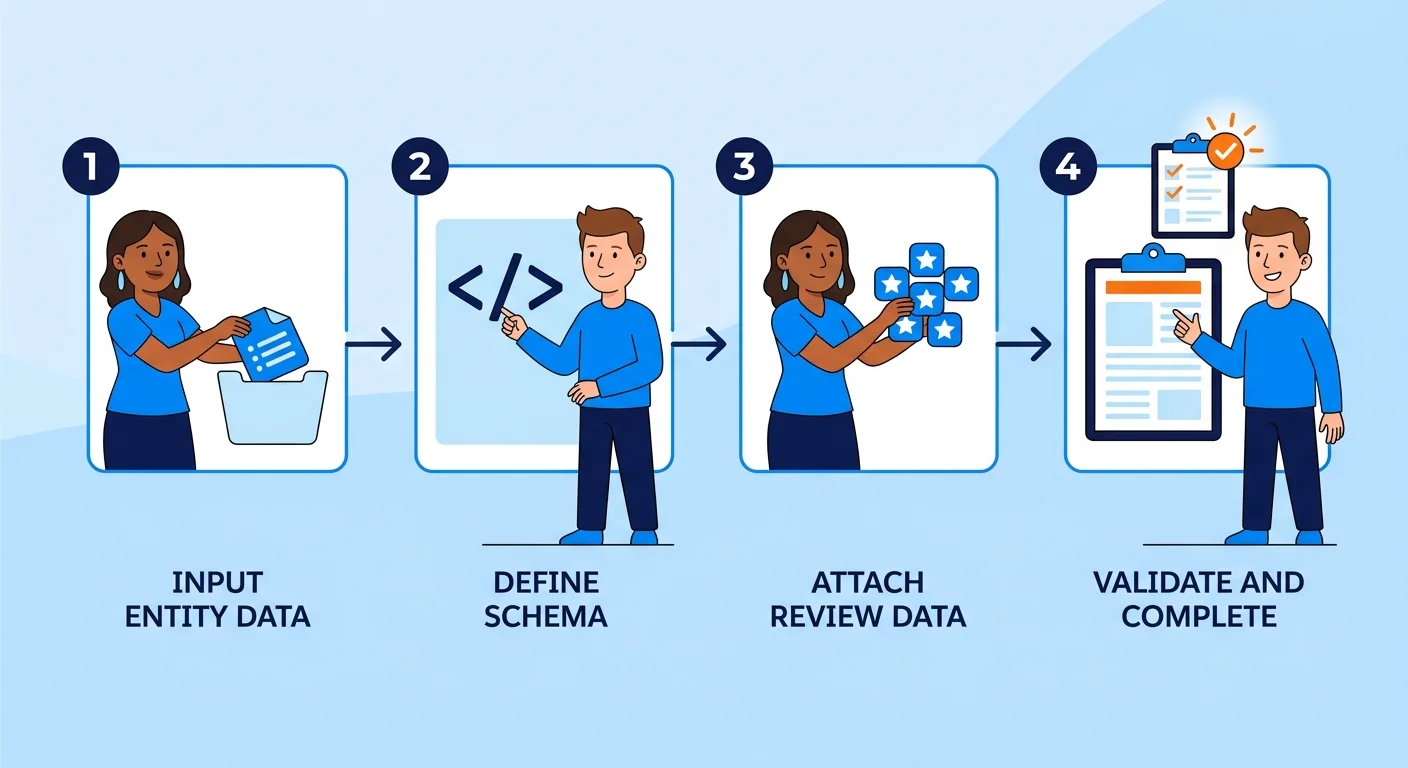
So all that architecture and every failure mode above only matter once they turn into a sequence someone can actually run. The witness has to be prepped before it takes the stand, not while it's already getting cross-examined.
Here's how that prep runs in practice, built for service businesses and chiropractors especially, where a condition page carries real clinical weight. The sequence below moves in the order a synthesizing engine actually checks a page, not the order a content calendar would rather work in.
| Build Stage | Primary Task | Verification Signal |
|---|---|---|
| Entity Mapping | Tag every condition, symptom, treatment, and risk factor against the MedicalCondition vocabulary before drafting new prose | Each schema property resolves to a specific sentence already present on the page |
| Sourcing Layer | Attach an independently checkable citation trail to every claim the schema now declares | No treatment or symptom listed relies solely on the practice's own unverified say-so |
| Corroboration Audit | Cross-check third-party review content against the claims the page and its schema already make | Outside signals echo the page's testimony instead of contradicting or ignoring it |
| Readability Pass | Rewrite dense clinical sentences so a claim can be extracted without the engine simplifying it first | The plain-language version of a claim still matches the schema property it supports |
| Standing Review | Re-audit the live page on a recurring basis as review content and sourcing evolve | Schema, prose, and outside corroboration continue to describe the same claim without drift |
Sequencing Entity Signals Before Publishing a Condition Page
Start with the entity signals, not the prose. Map a condition page's MedicalCondition properties before a single new paragraph gets drafted, because writing first and tagging later is exactly how the mapping gets skipped.
Next comes the sourcing layer. Every claim inside the schema needs a citation trail an engine can check on its own, and every treatment or symptom listed needs a reference that lives outside the practice's own say-so.
Auditing a Live Condition Page Against the Authority Checklist
Auditing a live page starts with a blunt question: can every property in its schema trace back to a sentence on the page itself, or does the markup claim something the prose never states? A mismatch there fails the cross-examination before an engine reads a word of the copy.
From building AI Authority Systems for service businesses, the pattern that keeps surfacing is a page with clean schema and nothing outside it to corroborate the claim. That page still reads as an interested witness no matter how tight its markup is, because structure alone was never the whole testimony.
Frequently Asked Questions
So the build sequence is done. Now come the mechanical questions operators actually run into once they try to put it to work.
How does AI's use of schema.org for medical content differ from traditional search?
Traditional search optimization reads a page for keywords and links. Schema.org hands the engine declared facts about a condition it can check and quote straight, with no guessing at what the prose meant.
Can too much technical medical jargon on a page hurt its chances of being recommended by AI?
It can. Dense clinical phrasing forces the engine to simplify a claim before it quotes it, and every simplification step is one more place the citation drops instead of landing.
If my reviews are on a third-party site, can AI engines still use them to recommend my practice's pages?
Yes. The engine reads third-party review content as outside corroboration of a practice's standing, and that trust signal carries over to the pages it recommends no matter where the review itself sits.
What's the single biggest mistake practices make when trying to optimize condition pages for AI search?
Writing the prose first and tagging it after. That order is exactly how the schema mapping gets skipped, leaving a page that reads clean but declares nothing an engine can verify.
How long does it typically take for an AI engine to recognize a newly optimized condition-specific page as authoritative?
There's no fixed timeline a practice can bank on here. What decides it is whether the corroboration and the schema are both in place, not how many weeks have passed since it went live.
What does the MedicalCondition schema type actually require on a page?
It requires the condition's name, its symptoms, possible treatments, risk factors, and typical severity, all declared as structured properties. Each one has to trace back to a claim the page's own prose actually makes.
Where This Leaves Your Condition Pages
So the whole verdict on condition pages lands on one question. Can the page survive cross-examination, or does it only survive a crawl?
The witness that wins is the one built to be cited, not just found. Schema hands it a sworn statement to stand on. Outside corroboration gives that statement something to be checked against.
Here's the stance this whole article has been building toward. A AI Authority Engine isn't keyword-position tracking dressed up in new language. It's the structural and semantic case your condition page makes for itself before a synthesizing engine ever decides who gets quoted, and the practices willing to build that case now are the ones a patient's answer names later — start building yours with an AI visibility check.