
Why Static Pages Go Silent When AI Writes the Answer

A static page goes silent the moment a generative model stops reading pages and starts assembling answers. Most business websites run on static templates built for humans scrolling a menu, so they're effectively invisible to the systems doing the summarizing now. That locked filing cabinet never gets emptied onto the desk where the answer engine is actually working.
The numbers back it up: among US Google users in March 2025, a classic search link got clicked in just 8% of visits when an AI summary showed up, versus 15% when it didn't. As the Pew Research Center reports, among Google users who encountered an AI summary, 8% of visits included a click on a traditional search result link, compared with 15% of visits without one. So calling AI visibility old-school search work with new vocabulary misses the shift entirely, because a ranked list rewarded being findable while a synthesized answer rewards being citable, and a static page built only to be found gives an engine nothing to pull into any answer it writes, the gap a complete authority engine build is designed to close.
Why Bolting on a Few Schema Tags Doesn't Fix a Static Page
The Mismatch Between Visible Content and Declared Structure
Here's the problem: a page can carry Schema.org tags declaring a service, a credential, a location, while the paragraph a human actually reads never mentions any of it. That mismatch breaks the one contract an answer engine depends on. And Google's own guidance for AI Overviews and AI Mode sits on the same foundation as the rest of its ranking work: helpful, reliable content written for people first.
Why a Patchwork of Tags Never Becomes a Knowledge Graph
Look, a tag answers one question about one element, but a knowledge graph needs every entity linked to everything it relates to, so tags bolted onto scattered pages never form that web, and piling on more of them just gives you a bigger heap of disconnected labels. That's exactly where the entity resolution problem with templates enters the picture, because the gap between labeling a fact and resolving an entity is where this whole approach measurably falls apart. Google's documentation says Google states that the same foundational SEO best practices apply to AI features as to Google Search overall, focusing on helpful, reliable, people-first content. Google's rules say structured data (schema) must match what's actually visible on the page.
The Architecture of a Queryable Authority Engine
| Layer | What It Stores | What It Replaces |
|---|---|---|
| Structured Data Layer | Entities, attributes, and facts tagged in a machine-readable vocabulary so a single service, credential, or location is labeled once and verifiably | Scattered, unlabeled paragraphs where a fact exists only as prose a human has to read and interpret |
| Content Management Layer | Information held separately from its visual presentation, so one update to a fact feeds every page or channel that references it | A static build's hard-coded files, where every change means a manual edit to the underlying page itself |
| Semantic Knowledge Graph | Every tagged entity linked to every other entity it relates to, forming a queryable web an answer engine can traverse | A pile of disconnected tags sitting on separate pages with no relationship defined between them |
| Query Interface | A structure an AI system can address directly, pulling a single verified fact without loading or parsing an entire page | A static menu built for a human to click through drawer by drawer, never meant to answer a machine's question |
The Knowledge Graph Layer
Here's how it works: a knowledge graph defines each entity once, then links it to every entity it touches. That's the moment the locked filing cabinet finally becomes a searchable index. The entity-by-entity build is laid out in building a practice knowledge graph.
The Structured Content Layer
So here's what a working system does first: a content management layer splits the fact from the page showing it, which means one update feeds every channel that asks. As University at Buffalo Libraries reports, a content management system may allow people without specialized knowledge to create, manage, and display text, images, and video, while a static website is hard-coded and is associated with manual changes for updates. Cheap retainers selling visibility without that layer are a trap, because answer engines reward structure, not scattered edits.
How Machine Retrieval Reads a Page Differently Than a Person Does
A person reads a page top to bottom, skimming headings for context. A retrieval system doesn't. It yanks fragments out of order and scores each one against a query on its own, so a sentence that made perfect sense inside its paragraph turns into noise once it's pulled out alone.
| Retrieval Factor | Unstructured Static Text | Structured Entity Data |
|---|---|---|
| Context Boundaries | A fact sits buried inside a paragraph, meaning anything around it | An entity is defined once and tagged with explicit boundaries, so a retrieval system knows where one fact ends |
| Relationship Mapping | Connections between a service, a credential, and a location stay implied, never written down anywhere | Connections are declared directly, so a query can follow the link from one entity straight to the next |
| Fragment Scoring | A pulled sentence loses the surrounding context that made it coherent, so it scores as noise | A labeled fact carries its own context wherever it gets extracted, so it scores as a usable answer |
| Update Consistency | A fact changes in one place but goes stale everywhere else it was ever copied by hand | A fact lives in one structured record, so every surface pulling from it stays current automatically |
| Evaluation Reliability | Retrieval quality depends on how a given system happens to be tuned for that page's layout | Retrieval quality depends on the entity graph itself, which holds steady regardless of the system reading it |
Structured Text vs Unstructured Text in Retrieval
Unstructured text forces a retrieval system to guess at relationships a person catches in a heartbeat, and even the graph-based systems built to fix that don't agree on how to grade themselves. Findings published through Michigan State University show existing GraphRAG systems for text data may be tailored to specific tasks, datasets, and system designs, resulting in heterogeneous evaluation protocols. The research does not settle which system reads a page best. What a business controls is the page itself, and professional AEO implementation turns scattered paragraphs into labeled, linked facts.
Turning a Static Page Into a Queryable Asset
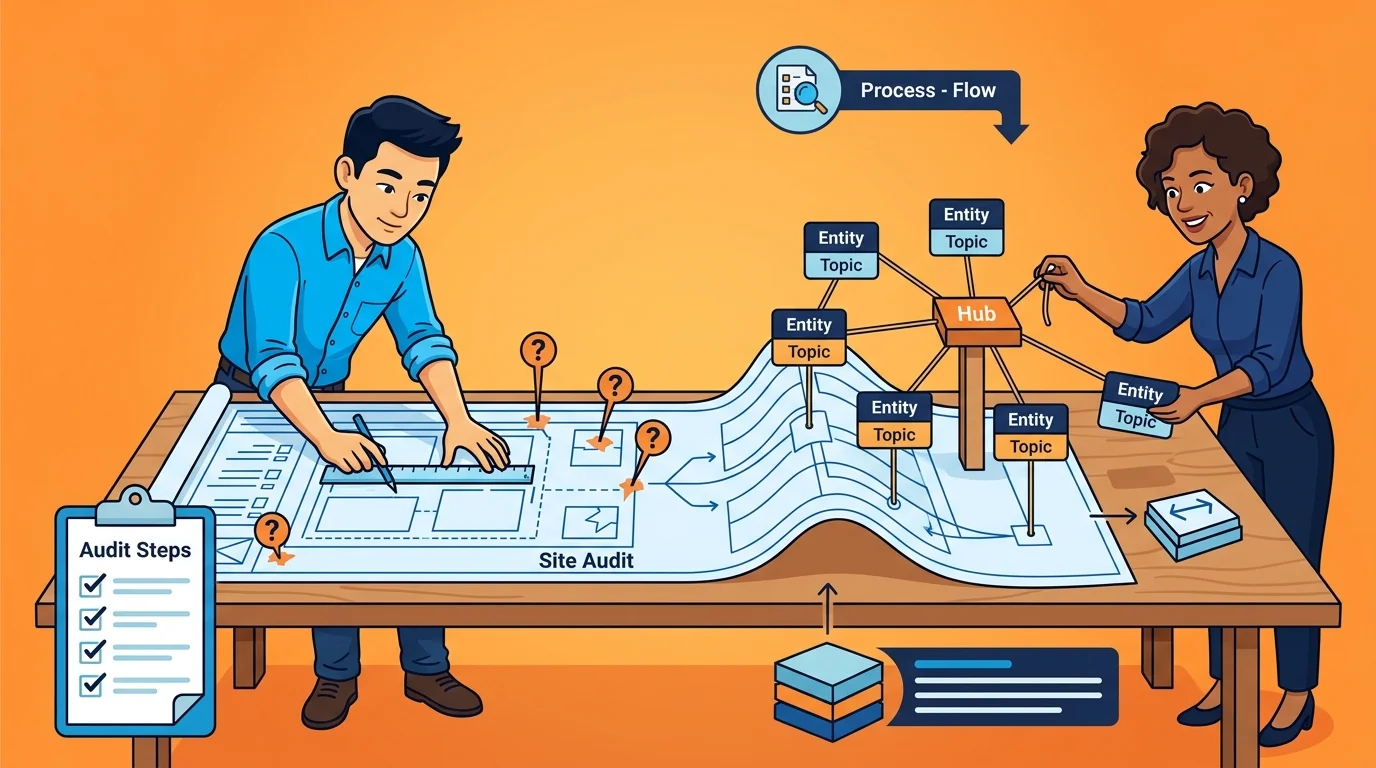
| Step | Operational Task | Output |
|---|---|---|
| Audit the Static Build | Pull every page and catalog what it claims about services, credentials, and locations. | A gap map showing where visible text and tagged data disagree or where tagging is missing entirely. |
| Define Entities Once | Create a single, canonical record for each service, credential, and location inside the content layer. | A durable source record that replaces scattered, duplicated mentions across static pages. |
| Link Related Entities | Connect each defined entity to every other entity it relates to — a service to a credential, a credential to a location. | The semantic web that turns isolated tags into a true knowledge graph. |
| Separate Content From Presentation | Move facts into a content management layer so they can be queried and served independently of any single page's design. | Facts an answer engine can pull directly, instead of text locked inside one static page's layout. |
| Publish for Query, Not Just Display | Expose the linked entity graph in a structured, machine-readable form rather than only as rendered paragraphs. | A queryable asset that functions like a database, not a brochure an engine has no way to search. |
Auditing the Current Site Structure
So where does a team actually start? Pull every single page and write down what it claims about services, credentials, and locations. That audit shows you the gap between what the visible paragraph says and what, if anything, is tagged underneath it (spoiler: usually nothing).
Building and Connecting the Entity Layer
So here's the build order: define each entity once in the content layer, then link it to every entity it touches. That linking step is the whole trick, because it turns scattered tags into the searchable index the filing cabinet never was.
Frequently Asked Questions
Now… this part matters. These questions pin down what a knowledge graph actually does, and what happens to a site that never builds one.
How does a knowledge graph make a static site AI-readable?
A knowledge graph defines every entity once, then links it to related entities. So a query pulls a direct fact instead of parsing a whole page. That linked structure turns the locked filing cabinet into a searchable index.
What is the difference between adding basic structured data and building a full authority infrastructure?
Basic structured data tags each element alone, one label per fact. Full authority infrastructure links every tagged entity to everything it touches. So you get a graph, not a heap of disconnected tags.
Can an existing static website be transformed without a complete rebuild?
Yes. The content layer and semantic layer get built right on top of the existing site. Current pages and visible design stay put.
What platforms are typically used to manage an AI-readable knowledge graph?
Start with a content management system that keeps facts separate from presentation. Pair it with Schema.org markup and a semantic layer connecting entities. That separation lets one update feed every channel that queries it.
What happens to a static unstructured site as AI search grows?
It stays invisible to the systems now assembling answers instead of listing links. A page that never resolves into a recognized entity never becomes a citable source.
How does query fan out change what a page needs to provide?
Query fan out splits one question into several related searches across subtopics and sources. So a page needs resolvable facts on every subtopic it touches. A strong answer to the main question alone won't cut it.
The Bottom Line
A static page was never built to answer a question. It was built to be found, clicked, and read by somebody willing to dig through it.
That era's closing. The filing cabinet only matters once its drawers become an index, and that index is the business asset worth building now, not a technical chore to keep pushing off. A site that stays unstructured stays unquoted, no matter how good the writing inside it is.
So forget sprinkling a few more tags around your pages, because the real call is whether you build the queryable graph underneath them. Start by seeing what an answer engine actually finds on your own site right now by running the AI Visibility Check.