
The Handoff Nobody Announces: Why the Sales Team and the Delivery Team Are Rarely the Same People

Here's the thing about agency staffing: it's built in layers, with senior strategists up top closing deals and a wider bench of coordinators running the day-to-day work. That setup's standard across the industry. On its own, it's not the problem.
The 'bait and switch' — a client sold by a team of senior experts and then handed off to a junior team for execution — is a common frustration in the agency world. It persists because the two jobs look identical on an org chart but produce very different work.
Why the Senior-to-Junior Swap Used to Be a Minor Issue
Under results-page optimization, the work a junior staffer could perform and the work a senior strategist could perform were not that far apart. Both could install a keyword-targeted article, submit it, and watch search position reports move.
The job was closer to a listed-address job: get the business indexed, get the listing filled out, keep the position reports updated. A checklist executed competently by a junior hire produced results that looked much the same as one executed by a founder.
Why That Same Swap Breaks Everything Now
Now… this part matters. Generative answer engines don't reward a finished checklist. They reward earned authority: structured reasoning, third-party validation, and a depth of entity signal no templated process can manufacture.
That is a cited-source job, not a listed-address job, and the distance between a junior execution and a senior one has widened accordingly. Worth evaluating cost, attention, and experience in authority partners before assuming every agency structure handles that distinction the same way.
The Four Operational Signs a Junior Team Has Taken Over
Here's the good news: four operational signals, taken together, separate a junior handoff from ordinary account scaling. And you can spot every one of them without a peek at the agency's internal org chart.
More output is not the same as more authority. A market that rewards earned citation does not hand them out for volume alone, no matter how many keyword-targeted articles a team publishes in a month. The signal strength of a single well-sourced, structurally sound piece outweighs a stack of templated ones.
| Signal | What a Senior-Led Account Shows | What a Junior-Led Account Shows |
|---|---|---|
| Reporting Scoreboard | Explains entity authority, structured data decisions, and earned-media placements as the primary measure of progress | Leads with rank-tracking reports and site visits, treating them as the whole story rather than one input among many |
| Strategic Reasoning | Can walk through why a specific recommendation was made and how it ties back to the account's broader authority position | Can describe what task was completed but not the reasoning behind it, because the reasoning was never transferred |
| Content Approach | Builds structured, well-sourced material tailored to the business, aimed at earning citation in AI-generated answers | Produces templated keyword-targeted articles optimized for volume rather than depth of entity signal |
| Communication Pattern | Proactively flags shifts in the account's standing and raises new considerations before being asked | Sends routine status updates on schedule but goes quiet on anything requiring independent strategic judgment |
Reporting on the Wrong Scoreboard
The first signal is which scoreboard the agency reports against. A junior team defaults to search position reports and site visits because those numbers are simple to pull and simple to chart.
But entity authority doesn't squeeze into one tidy weekly number. It takes explaining structured data choices, earned-media placements, and why a given source got cited. If a report never touches those inputs, it's keeping score on the wrong scoreboard.
Strategic Silence Versus Operational Noise
Signals two and three travel together: strategic silence paired with operational noise. The status updates keep rolling in. The reasoning behind them quietly disappears.
That pattern is what separates a routine handoff from a silent one. And it's exactly what changes when a founder hands off to junior staff: the strategic voice goes quiet while the task list keeps right on moving.
How a Templated Content Pipeline Fails Inside a Generative Answer Engine
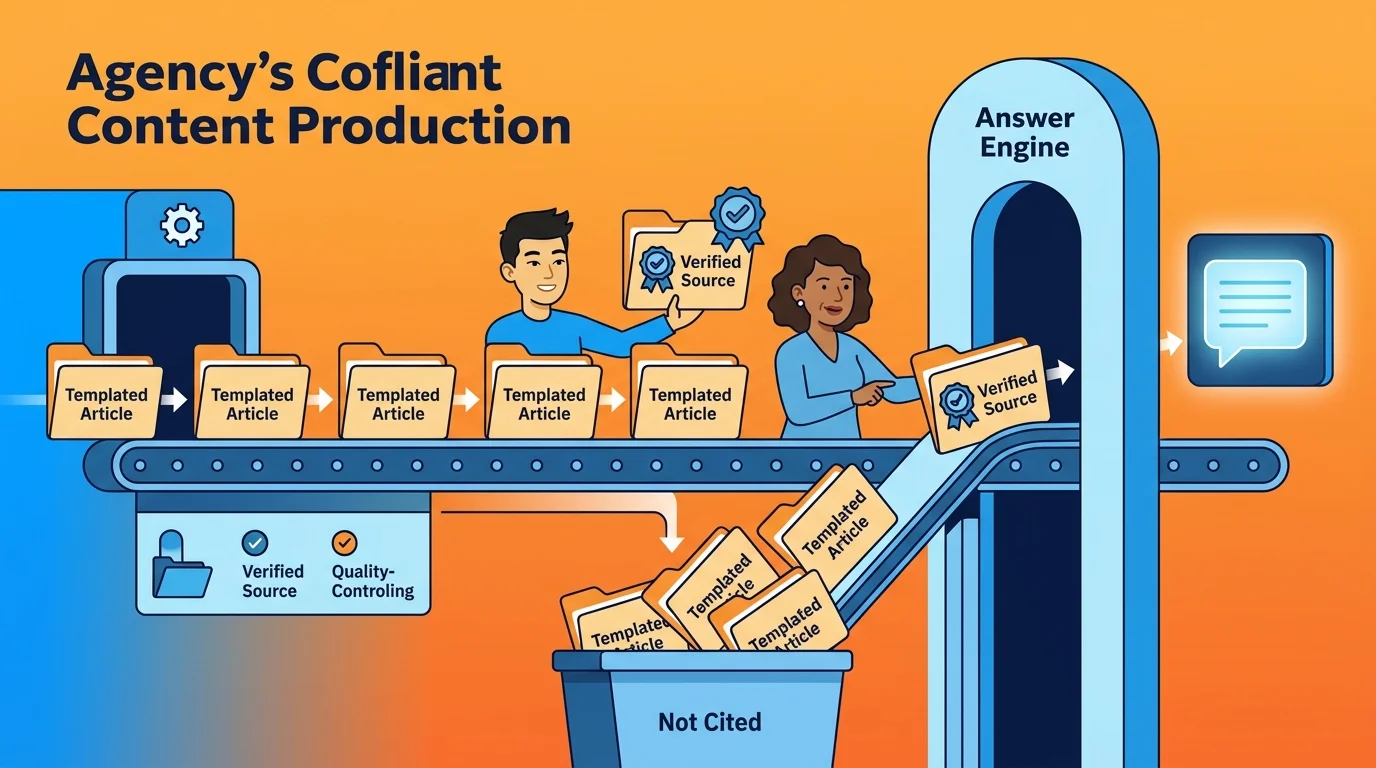
Here's where the pipeline breaks: a templated process treats a keyword-targeted article as done the second it's published and indexed. Generative answer engines don't see it that way at all.
Ma et al. (UNC Charlotte / University of Washington) report that generative search engines may show a measurable preference for citing website content that is more predictable to the underlying LLM, as measured by perplexity, while perplexity is associated with minimal influence on conventional Google search rankings. That's a whole different scoreboard than the one results-page optimization trained agencies to play on.
Where the Failure Shows Up First
Sourcing is where it cracks first. Chen et al. (University of Toronto, preprint) report AI search engines may show a systematic and overwhelming bias toward earned media, meaning third-party authoritative sources, over brand-owned and social content. And a pipeline built to crank out volume has zero mechanism for earning third-party citation, because earned media can't be templated.
Being a listed address never needed outside validation. Being a cited source can't exist without it. That's why staying connected to the founder post-signing matters most right here, where strategic judgment decides which signals get built and which get quietly skipped.
What Entity Authority Actually Requires to Build
Entity authority is built, not declared. It can draw on structured data, verifiable credentials, and a visible trail of third-party validation that a generative model can weigh as evidence. Structured data helps search engines understand the page; Google says no special markup is needed for AI features.
Google's documentation says AI Overviews and AI Mode may require no additional technical requirements beyond being indexed and eligible to be shown in Search with a snippet.
Being indexed is a floor, not a strategy.
| Component | Function | Who Typically Builds It |
|---|---|---|
| Structured data markup | Helps search engines understand the page; Google says no special markup is needed for AI features | A senior strategist who understands schema architecture and can tie it to the entity's actual service structure. |
| Earned third-party mentions | Signals to a generative model that sources outside the business itself vouch for its authority, the bias most AI search engines tested show toward earned media. | A practitioner capable of pursuing legitimate outside coverage, not a coordinator assigned to publish on a schedule. |
| Credential documentation | Establishes verifiable expertise behind the content, giving a model a concrete reason to weigh the source as credible. | Someone with direct knowledge of the business's actual qualifications, not a templated bio inserted by rote. |
| Structured reasoning in content | Builds the kind of predictable, well-organized argument a generative model can parse and cite rather than skim past. | A strategist who writes to explain a position, not a junior hire filling a keyword-targeted article template. |
The Components of a Citation-Ready Entity Profile
No single tactic makes an entity profile citation-ready. Structured data markup, consistent credential documentation, and earned mentions on authoritative third-party sites all feed the same signal, and they only work when they work together.
Notice that none of those pieces can be templated. That's the work behind iTech Valet's done-for-you AEO services, where structural depth replaces checklist volume.
Auditing the Work Product Itself
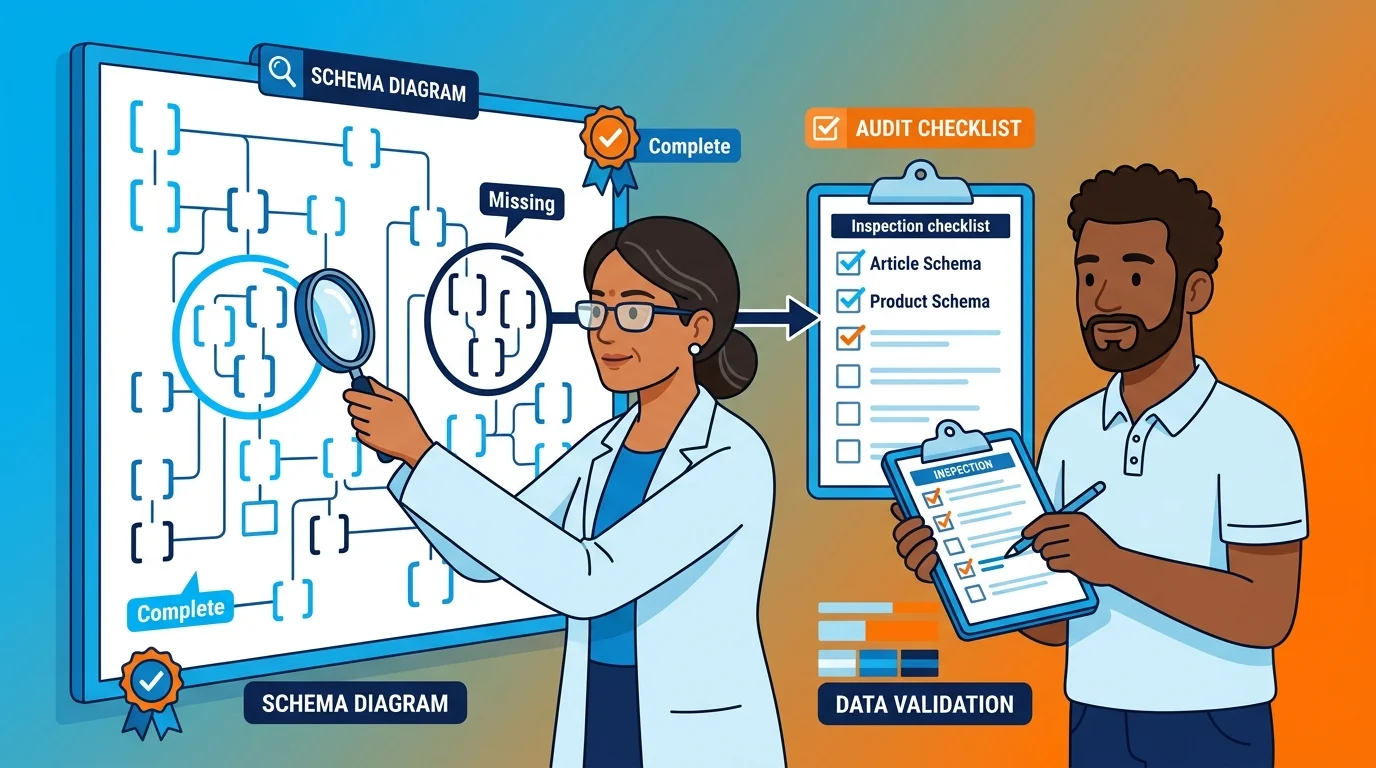
Want the fastest answer? Skip the account manager call and audit the work product itself. A junior pipeline leaves fingerprints all over it: generic structured data, thin credential documentation, and prose that reads like a template with the practice name swapped in.
| Markup Element | Junior-Level Execution | Senior-Level Execution |
|---|---|---|
| Schema Markup | Boilerplate schema copied across client sites, with only the business name swapped between templates. | Schema fields built around this entity's actual services, credentials, and location, verified against what the business does. |
| Credential Documentation | A generic bio paragraph or none at all, with no structured connection to verifiable third-party credentials. | Credentials documented in a format a generative model can parse and weigh as evidence of expertise. |
| Entity Descriptions | Service descriptions that read like a template with the business name inserted, generic enough to fit any competitor. | Descriptions written to reflect what makes this entity specific, tied to the structured data supporting it. |
| Earned Mentions | No active effort toward third-party citation, treating a published article as the finished product. | A visible trail of third-party validation built deliberately, because earned media cannot be templated. |
Reading a Structured Data Implementation Like a Practitioner Would
A practitioner reading the markup asks one question: do these fields describe this clinic, or could they describe any business that went through the same checklist?
Frequently Asked Questions
Every signal above answers a structural question. These answers handle the specific objections that show up once an operator starts digging.
What's the difference between an account manager and a strategist?
An account manager coordinates tasks, schedules, and status updates. A strategist explains why a given structural choice was made and what it builds toward, which is the reasoning a junior handoff tends to lose first.
Is it normal for the agency owner to disappear after the sales process?
It's common, and it's not automatically a problem. It becomes one when the owner's strategic input vanishes without a word. Nobody tells the client the account's direction just changed hands.
What kind of reporting depth should a senior-level team produce?
A senior-level team reports on structured data choices, earned-media placements, and the reasoning behind each one. Reporting that never leaves search position reports and site visits is reporting on the wrong scoreboard.
My agency reports on rankings and site visits, but does that measure AI search visibility?
No. Rank-tracking reports and site visits measure the old results-page game, while AI search visibility depends on entity authority signals those reports were never built to capture.
How does a junior staffing swap affect structured data accuracy?
A junior swap often produces structured data copied across client sites with only the business name changed. That leaves schema fields describing the wrong service, an error senior review typically catches before it ships.
What does Google require for a page to be eligible for AI Overviews citation?
Google states there are no additional technical requirements beyond a page being indexed and eligible to appear in Search with a snippet. Eligibility is a floor, not a guarantee of citation.
The Bottom Line
Here's the verdict: a listed-address job and a cited-source job never needed the same skill. And now that generative answer engines decide who gets cited, the gap between a seasoned practitioner and a junior staffer has blown wide open.
A junior handoff drags the cited-source job right back down into the listed-address one. What you get is a checklist dressed up as a strategy, built for a results-page game generative search quit playing.
Entity authority is built by someone who can explain every structural choice behind it, not assembled by whoever is available that week. If an AI Visibility Check sounds like the next useful step, that is where the question of which job your account is actually getting answered gets settled.