
What Separates a Custom AI Authority Process From an Automated One
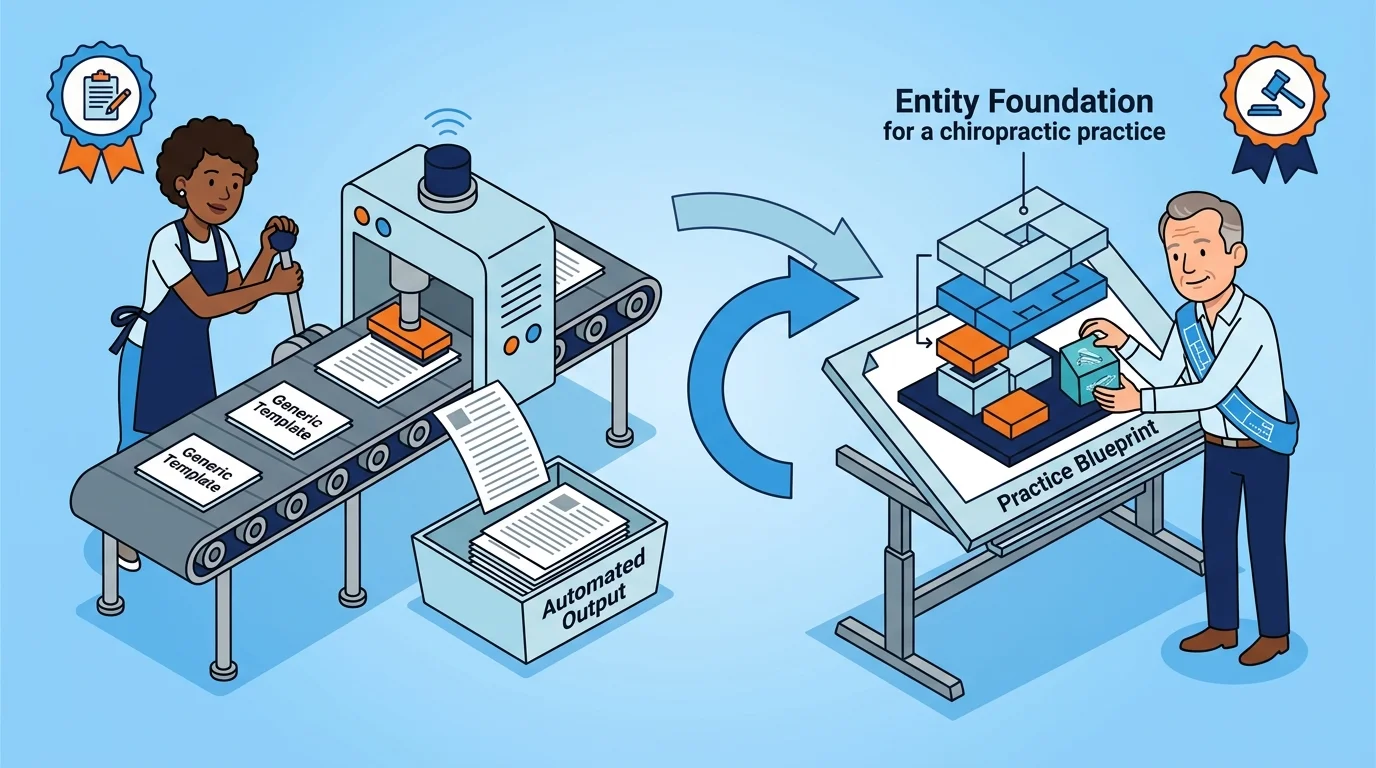
Picture two buildings going up on the same lot. One's a stack of identical templated bricks, slapped together fast and cheap for whoever's paying. The other sits on a foundation poured for one entity, shaped to carry its exact weight.
Read the case for boutique attention versus agency scale for how that distinction plays out when a practice has to choose between the two structures.
Why Volume-Based AI Content Fails to Earn a Citation
So there are really two ways to build AI visibility. One multiplies the same templated structure across clients who have nothing in common. The other pours a foundation for one entity, and only that one.
Cheap retainers live in that first model (and yeah, they're a trap). They only survive by treating every client's content as interchangeable, which is the exact opposite of what a citation demands.
Why Rebranded Templated Content Still Behaves Like Templated Content
Let's keep it real: many agencies just slapped the AI label on their old content services and kept the same volume-based, templated method running underneath. The name changed. The production line didn't.
Here's why that rebrand matters: Google's documentation says Google's spam policies may apply to all web search results, including those from Google's own properties, and policy-violating practices can be detected through automated systems and, as needed, human review. That scrutiny doesn't care what label sits on the output, so it's worth weighing a boutique firm against a larger multi-client agency before assuming either one actually changed how the work gets made.
How a Templated Process Breaks Down Under an AI Overview
Volume shops run on one assumption: more content equals more visibility. That assumption died the day answer engines replaced link directories, because an AI Overview may favor whichever source makes a fact easy to extract and easy to trust (page count never enters into it). Templated content, built for breadth instead of depth, rarely makes it through that filter.
According to Pew Research Center researchers, just 1% of all visits to Google results pages that showed an AI Overview may have resulted in a click to the cited sources. Read how to confirm an agency's answers are true beforehand before buying any agency's story about its own process.
| Content Trait | Automated Output | Custom Process Output |
|---|---|---|
| Depth of coverage | Broad, shallow treatment aimed at hitting a word count or publishing quota across many unrelated topics | Narrow, deep treatment of one entity's actual expertise, built to answer a specific question completely |
| Extractable evidence | Generic statements without definitions, comparisons, or procedural steps an engine can lift as a fact | Definitions, comparisons, and procedural detail structured so a system can extract a single clear answer |
| Entity specificity | Interchangeable prose that could be republished for any competitor with a name swap | Content tied to one entity's knowledge base, unusable for any other practice without rewriting the substance |
| Internal structure | Isolated articles with little connection to each other, each competing for attention on its own | Interconnected pages that reinforce one another, building a single trusted body of knowledge over time |
| Survivability under an algorithm shift | Collapses quickly, since the templated structure behind it is identical to what competitors are running too | Holds up longer, since the foundation was poured for one entity rather than copied across many |
What an AI Engine Is Actually Extracting From a Page
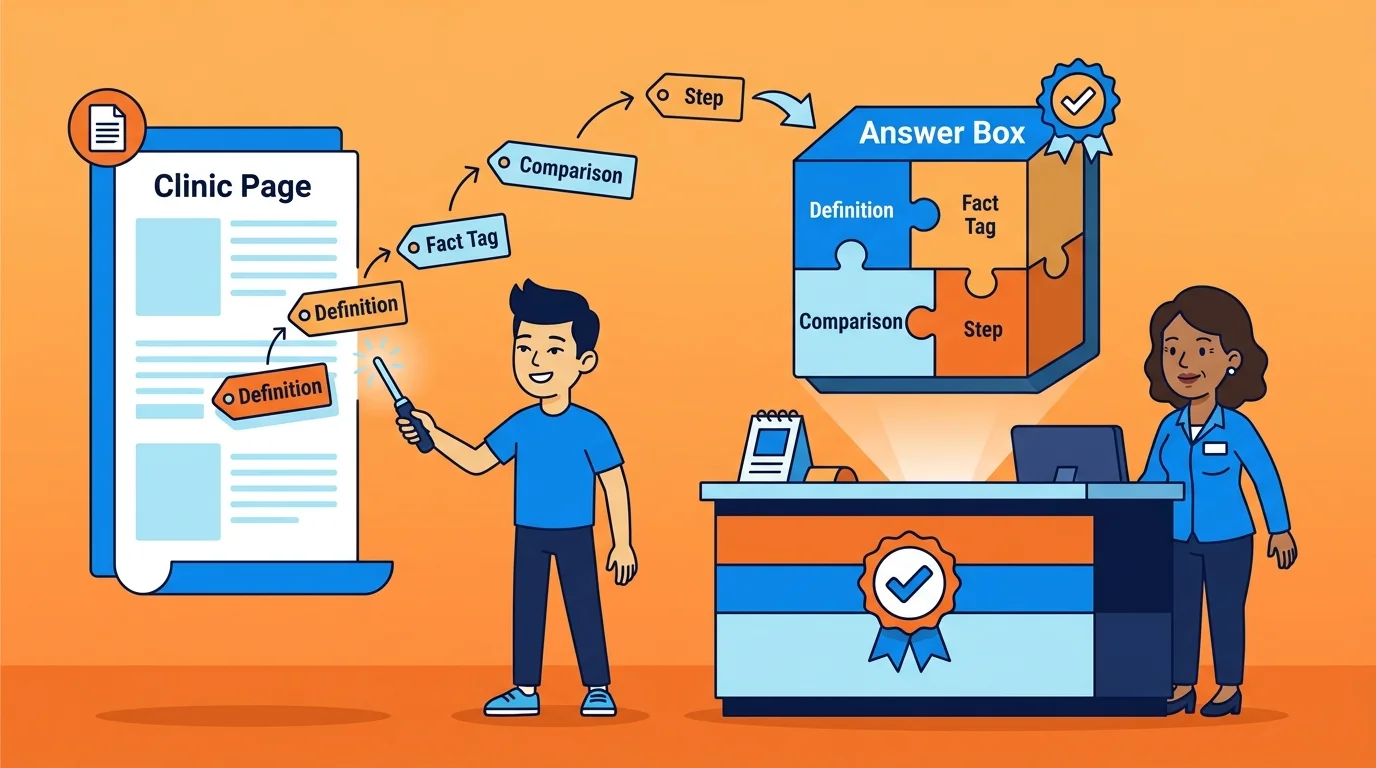
An AI engine does not read a page the way a person does. It scans for extractable units: a clear definition, a precise figure, a comparison, a sequence of steps.
Those units are what get lifted into the answer. Everything else on the page is scaffolding (it helps the engine trust the extraction, but it never gets quoted).
| Extraction Trait | What It Requires | Why Templates Miss It |
|---|---|---|
| Clear Definitions | A precise explanation of a concept tied to one entity's own terminology and practice | Template prompts default to generic phrasing that fits any business, so no definition is specific enough to lift with confidence |
| Precise Figures | Numerical facts drawn from an entity's own documented work or verified sources | Volume-based production has no entity-specific data to draw from, so figures are vague, omitted, or borrowed without context |
| Structured Comparisons | A side-by-side framing that shows how one approach, option, or outcome differs from another | Templates are written in isolation from any specific comparison, producing broad statements instead of structured contrast |
| Procedural Steps | A documented sequence describing how a specific process actually unfolds in practice | Generic content describes outcomes in the abstract because it was never built around a single entity's real workflow |
| Semantic Alignment | Content structured around the exact entity and topic cluster an engine is trying to match | Templated output is built to be reused across unrelated businesses, which dilutes the entity-specific signal an engine needs |
The Traits That Separate a Cited Page From an Ignored One
Zhang, He & Yao (preprint) found high-influence cited pages tend to be longer, more structured, semantically aligned, and richer in extractable evidence such as definitions, numerical facts, comparisons, and procedural steps. Now… this part matters: pages that get cited tend to carry that kind of evidence. A stack of templated bricks rarely carries that density, since it was written to fill space across a pile of unrelated businesses instead of documenting one entity's real expertise.
A foundation poured for one entity produces the opposite. Specific numbers, named comparisons, and procedural steps tied to a single practice's own work are exactly the material an engine can lift with confidence.
What the Eligibility Requirement Does and Does Not Guarantee
Google's documentation says a page must be indexed and eligible to be shown in Google Search with a snippet to be eligible as a supporting link in AI Overviews or AI Mode, with no additional technical requirements. Alright, quick reality check: that bar is technical, not strategic. Clearing it just gets a page into the pool an engine might pull from.
It does not get a page cited. Clearing the bar is where automated volume stops being useful, and where structured, entity-specific depth starts to matter — the kind of depth built through dedicated authority infrastructure services rather than templated output.
How a Knowledge Graph Forms Around a Practice
A single page is a brick, and a knowledge graph is what those bricks become once an engine can see how they connect. Custom work builds that structure on purpose: every article reinforces the same entity, the same expertise and the same set of facts, until the connections themselves turn into evidence. Automated output rarely gets there (each piece was written to stand alone, so nothing locks together).
Why Isolated Articles Cannot Build the Same Structure
Here's the thing: isolated articles can't build that structure, because nothing ties them back to one entity's expertise. That's exactly why cheap retainers are a trap. They buy volume instead of connection, and volume without connection never compounds into something an algorithm shift can't erase.
How to Audit an Agency's AI Process Before You Sign Anything
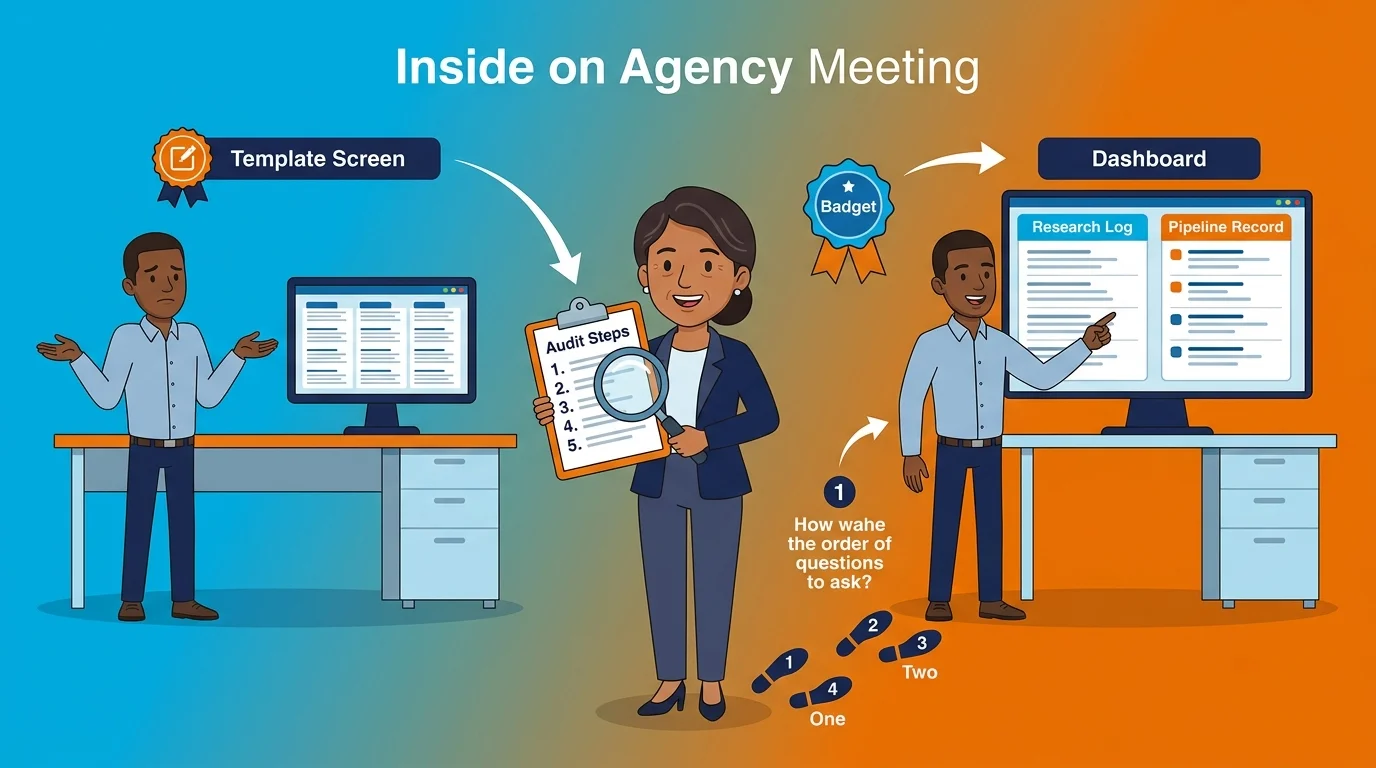
The rise of generative AI in search results has fundamentally changed the marketing landscape for practice owners. That shift means a vendor's claims about its own process deserve verification before a contract gets signed, not after. An agency's process stops being a trust exercise once answers replace links as the thing worth competing for. The questions below turn the foundation-versus-bricks distinction into a checklist any operator can run.
| Audit Step | What to Request | What It Reveals |
|---|---|---|
| Request the entity knowledge base outline | Ask for the specific facts, figures, and procedural details the agency has documented about this one practice | Whether the agency is building depth around a single entity or filling a generic topic list |
| Request a piece-to-piece connection map | Ask how earlier articles link back to later ones and to a shared set of entity facts | Whether the output forms a structure an engine can read as a connected foundation, or stands as isolated bricks |
| Request a sample of extractable evidence | Ask to see definitions, comparisons, and procedural steps drawn from one practice's actual expertise | Whether the content is dense enough for an answer engine to lift with confidence, or too shallow to extract |
| Ask what changes if the publishing cadence slows | Ask whether the process still produces structure without volume, or whether volume is the entire strategy | Whether the agency depends on repetition to stay profitable or depends on depth to stay trusted |
| Ask how the agency verifies its own claims before publishing them | Request examples of how a stated fact was checked against a source before it reached an article | Whether the process treats accuracy as a built-in step or as something assumed after the fact |
The Order to Ask the Questions In
Start with the entity, not the output: ask what specific knowledge base the agency's building around this one practice, and ask it before volume or turnaround ever comes up. Then ask how that knowledge base connects, piece to piece. A vendor who answers with publishing cadence instead of structure is describing bricks, not a foundation.
What a Published Pipeline Record Should Show
A legit pipeline record shows its work, naming the specific facts, figures and procedural details tied to one entity's real expertise (not some generic topic list) and showing how earlier pieces connect to later ones. Here's the kicker: a record that only counts quantity, with nothing linking one piece to the next, documents a stack of templated bricks. That's no foundation.
Frequently Asked Questions
That covers the strategy and the audit order. Now… a few mechanical questions still deserve straight answers.
How can I tell if an agency is just using a generic AI writer for my content?
Pull a handful of articles and read them side by side. Generic content repeats the same topics with nothing tied to the specific practice. Custom work names facts and procedures unique to that one entity.
What specific questions should I ask an agency about their AI process?
Ask what knowledge base is being built around the practice, how individual pieces connect to each other, and where the specific facts in each piece actually came from. Publishing frequency is not an answer to any of those.
Is content that's 100% AI-generated going to be penalized by Google?
Being AI-generated is not the violation. The practice that gets flagged is the one built to manipulate search results, regardless of whether a person or a tool produced it.
Does a custom AI process take longer to show results than an automated one?
Usually, yes. Pouring a foundation takes longer than stacking identical bricks, and that slower start is part of why the result is harder for a competitor to copy.
What does a knowledge graph have to do with a chiropractic practice's online visibility?
A knowledge graph is how an engine recognizes that separate articles connect back to one practice's expertise. Without that connective structure, each piece stands alone and proves nothing by itself.
Can an automated process still build real E-E-A-T for a practice?
Rarely. Experience, expertise, authoritativeness and trust all depend on specific, verifiable detail tied to one entity. Templated volume was never built around any single practice's actual work.
What's the biggest red flag that an AI authority service is just a content spinner?
Broad topic coverage with no entity-specific facts, figures, or procedural detail tied to the practice. A content spinner fills space. A custom process documents expertise.
The Bottom Line
Two structures, same ground. One's a stack of templated bricks, rented out to whoever happens to be buying. The other's a foundation poured for one entity, and only that one.
Only one of them survives an algorithm shift, and it's not the pile of bricks built for a dozen unrelated businesses (an engine can't trust a shape that doesn't exist). A foundation built around your practice's actual expertise compounds instead, because every new piece locks into the structure already standing.
iTech Valet builds that second kind. So before you sign anything, ask what foundation an agency's actually pouring, and start with an AI Visibility Check to see where your practice stands today. Sound fair?