
What Separates a Boutique AI Authority Firm From a Multi-Client Agency
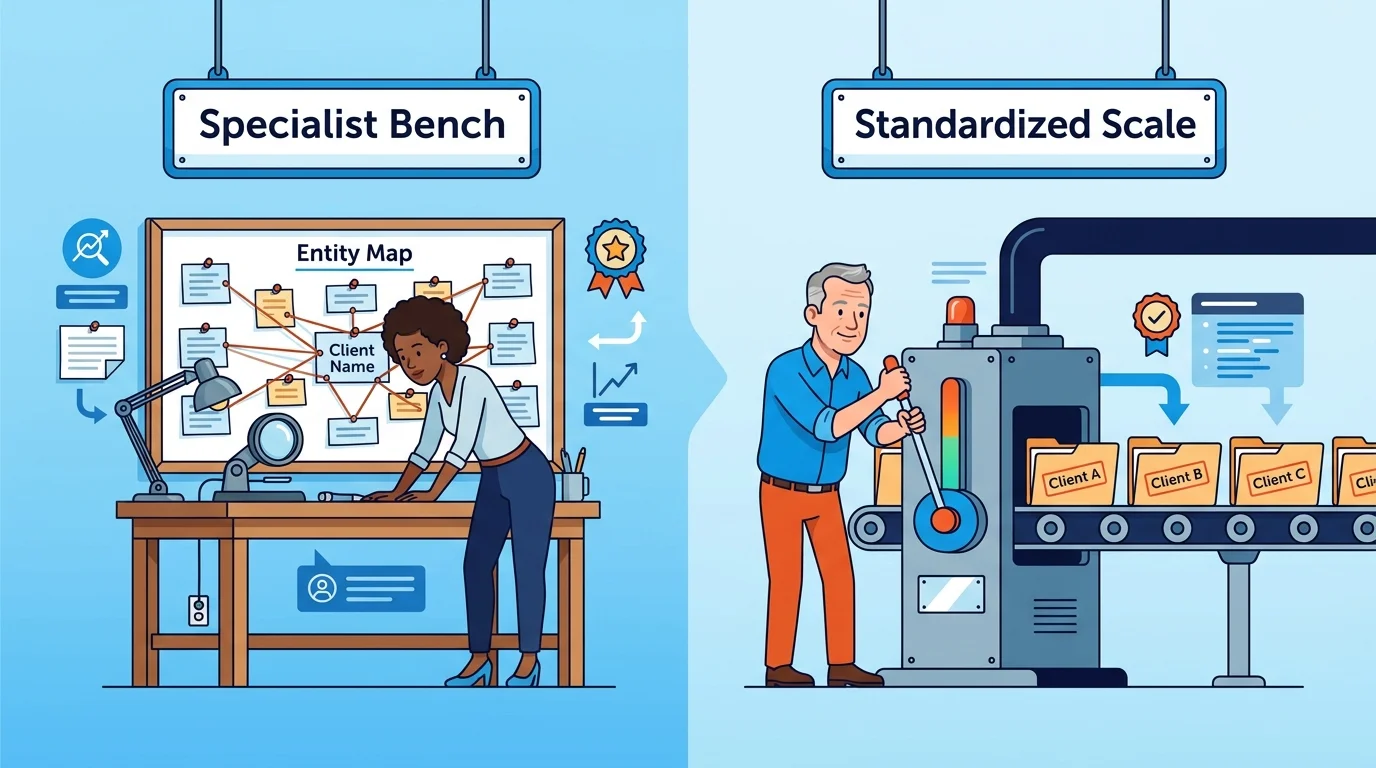
Here's the thing: most docs shopping for a marketing partner hit a fork they never say out loud. One road leads to a specialist bench. The other leads to a generalist desk juggling a dozen unrelated industries.
For many chiropractors, choosing a marketing partner feels like a choice between the perceived safety of a large, multi-client agency and the personalized approach of a boutique firm. That framing misses what actually separates the two models operationally.
The Specialist Bench Model
A boutique firm works like a specialist on a bench, putting deep expertise behind a small roster in one niche, with senior people on every account. So the strategist who builds the plan is the same person running it.
Now… this part matters. That continuity shapes how entity signals get built around one practice, because a short roster leaves time to study one field closely instead of skimming twenty. It's worth digging into the factors that separate boutique founders from large agencies before signing anything.
The Standardized Scale Model
Large, multi-client agencies are built for scale, often leveraging standardized processes and junior-level account managers to serve a broad portfolio of clients across many industries. Scale is the point, not a side effect.
Standardized workflows keep a wide client base moving. But a template built for a broad portfolio rarely produces the kind of specific, consistent entity signal that one niche practice needs to be recognized as a distinct authority.
Why the Generalist Playbook Breaks Down
The generalist playbook breaks down because it was built for a search world that's already gone. Ten blue links rewarded showing up broadly across lots of signals. A single AI answer rewards depth around one subject a machine can actually verify.
So what counts as visible has flipped. Showing up somewhere on a results page used to be the finish line, but now the finish line is being the source an answer engine chooses to cite. And a standardized template rarely earns that for a niche practice.
Rankings as a Metric That Stopped Measuring the Right Thing
Let's keep it real: rank-tracking reports and results-page position numbers are scoring a game that's already changed shape. Look at where the answer now sits. According to Grossman et al. (NJIT), in a December 2025 test, for 51.5% of representative, real-user queries, AI Overviews are generated and displayed above the organic search results.
A metric built for classic search listings does not capture whether a system is citing a practice as an authority. Treating AI visibility as old-school search work with new vocabulary misreads what changed — the measurement stopped matching the mechanism, which is one reason the boutique approach to guarding practice standing treats entity consistency as the real target rather than a position number.
How Answer Engines Actually Decide Who Gets Cited
Here's the kicker: citation runs on a specific mechanism, not a position number. Rankings stopped predicting who gets cited the day answers replaced links.
| Signal | What It Measures | Why It Matters for Citation |
|---|---|---|
| Entity Consistency | Whether a practice appears as one coherent, verifiable subject across every page, listing, and mention tied to it | A fragmented or generic identity signal gives an answer engine no single authority to point to |
| Structured Data | Whether a page's content is marked up so a crawler can parse its meaning rather than guess at it | Structured data helps Google Search understand the page; Google says no special markup is needed for AI features |
| Topical Depth | Whether content around a subject reflects sustained, specific expertise rather than broad, generalized coverage | Depth signals distinguish a genuine authority on a niche from a generalist touching the topic once |
| Source Verifiability | Whether claims on a page trace back to checkable, authoritative information rather than templated assertions | Language models can hallucinate even with authoritative sources in front of them |
Entity Consistency
Entity consistency means a system sees a practice as one coherent, verifiable subject across every page that touches it. A scattered multi-industry template rarely holds that line for a single niche. That's the exact mechanism to test when questioning whether agency size benefits a solo clinic.
Structured Data and Extractable Content
Structured data helps Google Search understand the page. Google's documentation says structured data may help Google understand a page's content and can enable richer search results. But structure alone does not guarantee accuracy once a system drafts an answer. Venkit et al. (Penn State, Salesforce AI Research) found roughly a quarter to a third of statements in answer-engine responses were not supported by the sources they listed.
Where the Multi-Client Model Fails Under Load
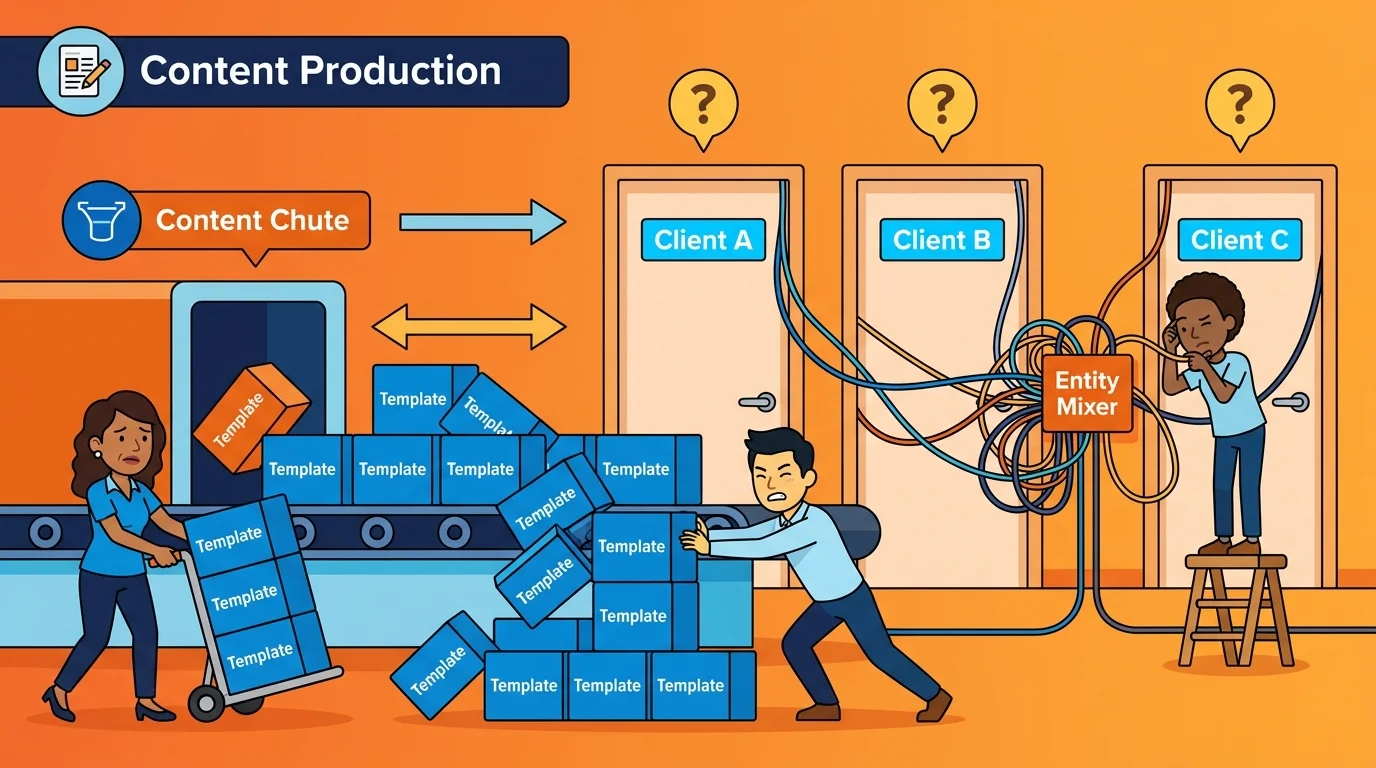
Now… here's where the generalist desk starts to crack: when AI-era demands climb across every account at once, the multi-client model takes the hit everywhere. Google rolls out big, broad changes to its search systems several times a year (it calls them core updates).
Templated Content at Scale
Templated content at scale means one structural pattern gets reused across unrelated practices, with only surface details swapped between accounts.
That pattern cannot hold once a system drafts an answer from inconsistent signals. Google's documentation says Google makes significant, broad changes to its search algorithms several times a year, which it calls core updates.
Entity Confusion Across Co-Located Clients
Entity confusion shows up when one agency runs several practices in the same metro or specialty. Shared templates and recycled service language blur the line a system needs to see each practice as its own distinct subject. Our managed AI visibility programs dodge that overlap by design, because a focused roster has no competing accounts to blur together.
What a Boutique Model Does Differently, Step by Step
So what does a specialist-built firm actually do differently? It runs a sequence, not a template. Once a system picks one cited source instead of a list of links, more output stops meaning more visibility, so the sequence bets on depth in one subject over volume across many.
| Stage | Boutique Approach | Multi-Client Approach |
|---|---|---|
| Discovery and Entity Mapping | A senior strategist studies the practice's services, location signals, and subject matter directly, building a profile around one verifiable entity. | Junior account staff intake a broad client brief and slot it into a standardized onboarding template shared across unrelated industries. |
| Content Architecture | Topics are sequenced to reinforce one practice as a coherent subject, with each page building on the last toward a consistent entity. | Content calendars are built from a generalized template, with the same structural pattern applied regardless of the client's niche. |
| Execution | The same strategist who designed the approach executes it, so no handoff interrupts the entity signal being built. | Execution is handed to junior managers working across many accounts at once, with limited continuity between planning and delivery. |
| Response to Algorithm Change | In our experience, a narrow roster lets the firm study a core update's effect on one niche closely and adjust quickly. | In our experience, a standardized review cycle absorbs algorithm change on a delay, averaged across every industry the agency serves. |
| Measurement | Success is tracked through entity consistency and whether a practice reads as one distinct, verifiable subject. | Success is tracked through legacy metrics like search position reports, which no longer describe whether a system cites the practice. |
Senior Strategist Involvement
The strategist who designs the entity approach stays on the account all the way through execution. No handoff to a junior account manager breaks the pattern a niche practice is building.
Adapting When the Rules Change
Now… a narrow roster also changes how fast a firm reacts when a search system rewrites its own rules. One niche, studied up close, moves faster than a template stuck waiting on a scheduled review across dozens of unrelated accounts.
Reading the Proposal Before You Sign Anything

Want to know how an agency really operates? Read the proposal. What it asks a practice to measure tells you more about specialization than any slide deck ever will.
| Proposal Element | Generalist Red Flag | Specialist Indicator |
|---|---|---|
| Primary Metrics | Rank-tracking reports and results-page position numbers framed as the main success measure | Entity consistency and citation potential discussed alongside any position reporting |
| Content Approach | Standardized template language reused across unrelated industries with surface details swapped per account | Content built around one niche's specific terminology, patient concerns, and clinical context |
| Account Structure | Strategy handed off from a senior pitch team to a junior account manager for execution | The strategist who designs the approach stays involved through execution |
| Visibility Language | Proposal still centers on holding a spot in classic search listings as the finish line | Proposal names being cited inside a generated answer as the actual target |
| Portfolio Scope | Broad client roster spanning many unrelated industries at once | Narrow roster concentrated on one type of practice |
Reporting Metrics That Mean Something Now
A proposal built around rank-tracking reports or results-page position numbers is measuring a game that has already changed shape. Those metrics describe placement on a list of links, not citation inside a single generated answer. A proposal that still centers on holding a spot in classic search listings is reading from an old playbook, no matter how it's packaged.
Frequently Asked Questions
A few questions come up every time this comparison gets made. Each one deserves a direct answer, not a hedge.
How can a boutique firm justify a higher cost if a large agency offers more services in a package?
A package with more line items is not the same as a package with more relevant expertise. Cost reflects where attention goes, and a narrow roster puts senior attention on fewer accounts rather than spreading it thin.
Will a practice get left behind if its boutique agency does not have a massive team and vast resources?
Team size measures headcount, not whether a practice's entity signals stay consistent across every page touching it. A specialist bench studying one field closely covers that mechanism without needing vast resources.
What specific questions reveal whether a large agency understands AI-driven search for a chiropractic practice?
Ask what the proposal measures, not what it promises. A firm fluent in AI visibility talks entity consistency and citation. It doesn't lead with results-page position numbers.
Is it a red flag if an agency proposal still focuses almost exclusively on page one rankings and keyword reports?
Yes. A proposal obsessed with placing in the classic ten blue links runs an old playbook. That playbook was built for links, not one generated answer.
If a large agency works with other chiropractors, does that signal expertise in AI visibility?
Working with other chiropractors shows familiarity with the industry. It does not by itself show whether that work builds verifiable entity signals an answer engine can cite.
How does a boutique firm's approach to content creation differ from a large agency's for AI visibility?
A boutique firm builds content around one verifiable subject, studied in depth. A multi-client agency tends to reuse a structural pattern across unrelated accounts, swapping surface details between them.
The Bottom Line
Here's the verdict: the jump from a list of links to one cited answer rewrote what visibility means. It now rewards one coherent subject, studied up close, over a sprawling portfolio managed from a distance.
A boutique firm builds entity consistency because that's the whole job, not a side project. A multi-client agency builds scale, and scale quietly works against the depth a niche practice needs to be recognized as an authority.
So the specialist bench beats the generalist desk. If you want to see where your practice actually stands with AI right now, start with the AI Visibility Check.