
On its own, a score on the 0-to-10 pain intensity numerical rating scale (PI-NRS) is not very reliable for objectively assessing pain intensity, but the change after treatment is generally considered useful for judging treatment effectiveness. Range of motion is a commonly accepted parameter for assessing spine movement, but it is considered extremely difficult to measure accurately because of the spine’s complex anatomy. For cervical range of motion, there is no agreement on which method is the gold standard. In US chiropractic teaching clinics, disability and functional measures were the most common type of outcome instrument for low back pain, ahead of pain measures. High-influence cited pages tend to be longer, more structured, semantically aligned, and richer in extractable evidence such as definitions, numerical facts, comparisons, and procedural steps.
What AI Engines Look For: Verifiable Numbers in a Clear Structure

Both metrics face the same test.
Can an AI engine pull a clear number from the page? And trust it?
One study of cited pages found that high-influence pages tend to be longer, more structured, and more semantically aligned. They’re also richer in extractable evidence. Definitions. Numerical facts. Comparisons. Procedural steps.
Emerging research on LLM systems points the same way. Content structure, apart from the meaning of the words, significantly influences how large language models process information and generate output.
Here’s why.
A paper from KDD ’24 explains how these engines work. They retrieve relevant documents. Then large neural models write an answer grounded in those sources. The answer comes with attribution, so the user can verify the information.
The full method is in GEO: Generative Engine Optimization.
To my mind, none of this is keyword or backlink work under a new label.
Chasing terms, inbound links and rank positions aims at the wrong target. The engine is deciding something else. Can it make sense of this business? Can it believe what the business says?
Numbers it can check, set out in a clear order, settle that.
I go deeper on this in Star Ratings vs Structured Outcome Profiles: Which Convinces AI Engines?
Pain Scale Ratings: What the Numeric Pain Rating Scale Actually Measures
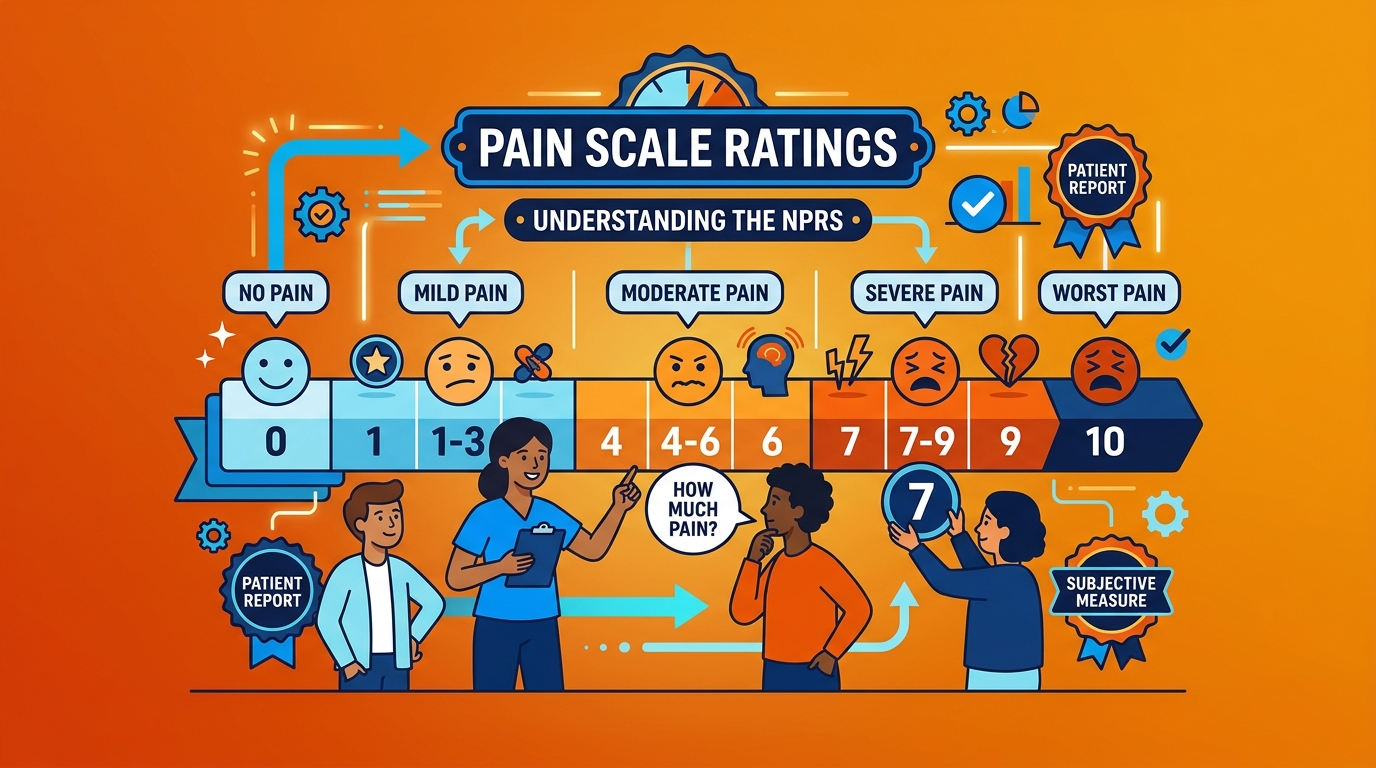
The Numeric Pain Rating Scale (NPRS) is the same 0-to-10 scale the PLOS ONE study below calls the PI-NRS.
It’s an 11-point scale. A “0” means no pain. A “10” means the most intense pain imaginable.
The Shirley Ryan AbilityLab page on the NPRS says it measures the subjective intensity of pain.
That’s also its weak spot.
A study in PLOS ONE says that among commonly used clinical scales, the PI-NRS is considered the most subjective one. It depends on each patient’s sensitivity to pain. The authors say the PI-NRS itself isn’t very reliable for objectively assessing pain intensity.
But the change after treatment, called ΔPI-NRS, is generally considered useful for judging how well a treatment regimen worked.
The study is Clinically significant changes in pain along the Pain Intensity Numerical Rating Scale in chronic low back pain.
How Reliable Is a 0-to-10 Pain Score?
For patients with low back pain, the NPRS has a standard error of measurement of 1.02.
Its minimal detectable change is 2 points, based on a 95% confidence interval.
The test-retest number is more modest.
In chronic pain, a single pair of assessments, one in week 1 and one in week 2, showed adequate test-retest reliability (r = 0.63).
Raw points can also hide the story.
Shirley Ryan AbilityLab says a percent change in NPRS, rather than a raw score change, may give more meaningful information about a patient’s response to pain treatment.
Its example: a change from 3/10 pain to 0/10 may be more meaningful than a change from 8/10 to 5/10.
What Counts as a Meaningful Change on the Scale?
The sources report several cutoffs:
- For low back pain, the NPRS minimal clinically important difference was 1.5 points at 1 week of physical therapy treatment and 2.2 points at 4 weeks.
- In chronic musculoskeletal pain, it was a 1-point or 15% change.
- In 161 chronic low back pain patients, a PI-NRS reduction cutoff of 1.3 to 1.8, depending on pre-treatment pain, picked out patients who were satisfied after treatment. The authors rounded this up to 2 points for general use.
- The same study said the minimal clinically important difference for PI-NRS change can be rounded to 1 point for practical use, regardless of the starting pain level.
In that study, change in PI-NRS had the highest AUC, at 0.770.
Change in HADS depression was next at 0.733. Then EQ5D at 0.686. Then Locomo 25 at 0.648.
Range-of-Motion Data: What Goniometers and Inclinometers Actually Measure
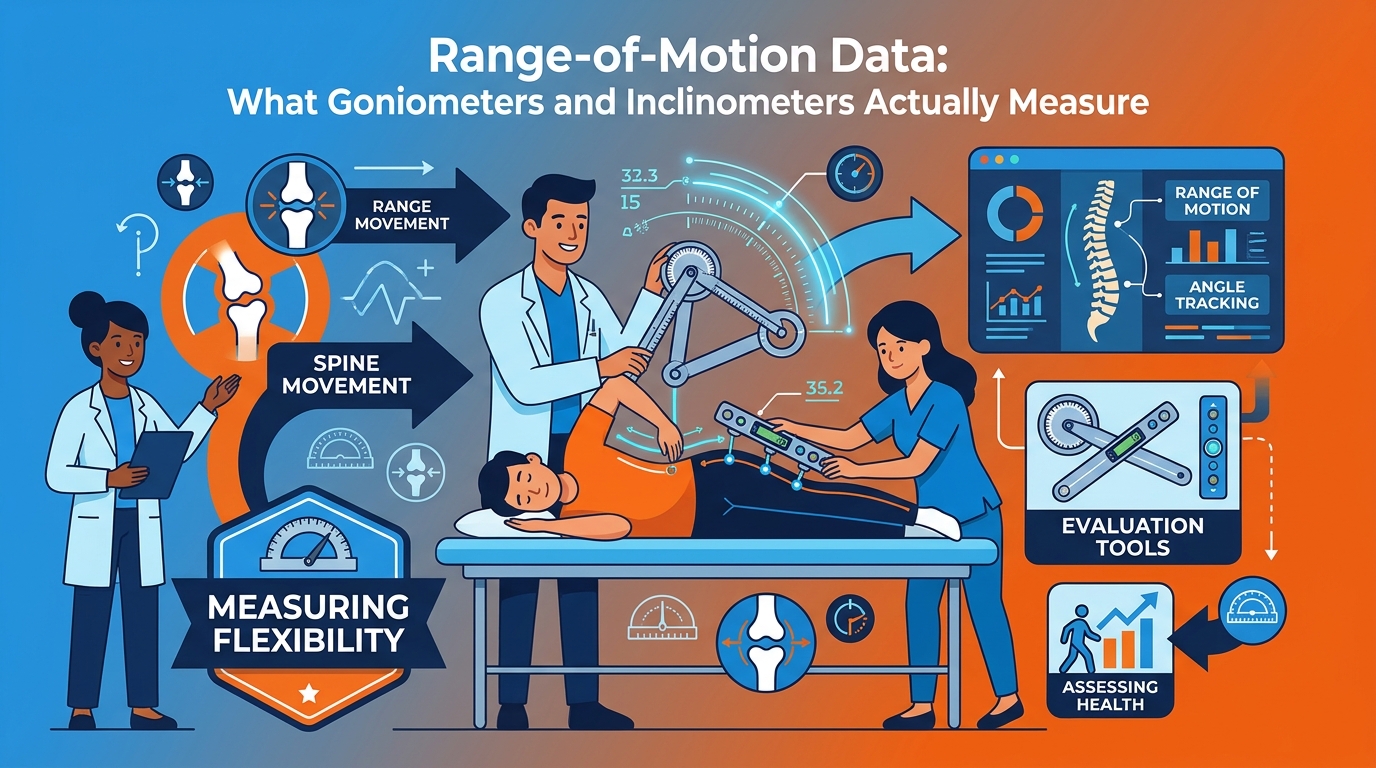
Range of motion is a commonly accepted parameter for assessing and evaluating spine movement.
It’s also thought to be extremely difficult to measure accurately. The anatomy and the associated movements are complex.
In physiotherapy, cervical range of motion is frequently used as a baseline and outcome measure. It documents the effects of interventions and helps adjust treatment plans.
Here’s the catch.
Many tools have been described for measuring cervical range of motion. There’s no agreement on which one is the gold standard.
That leaves repeatability as the number worth reporting. How closely does a tool agree with itself? And with a second examiner?
Cervical Range of Motion: CROM Device Reliability
A study in BioMed Research International, Assessment of Interrater and Intrarater Reliability of Cervical Range of Motion (CROM) Goniometer, reports these numbers.
The CROM goniometer and the “CROM device” named in the earlier work it cites are the same instrument.
- Williams et al. found the CROM device highly reliable for all cervical spine movements, with ICCs of 0.58 to 0.99. Compared with an X-ray gold standard, validity was good, with ICCs of 0.82 to 0.98.
- In one study where three chiropractic students did the examinations, CROM intraexaminer reliability was high (ICC 95% CI 0.96 to 0.99).
- In this study’s own measurements, intrarater and interrater agreement was highest for extension. Intrarater Cronbach’s alpha was 0.85 for one examiner and 0.89 for the other.
- Flexion was weaker. Intrarater Cronbach’s alpha was 0.75 and 0.64, and ICC values were 0.575 and 0.406 for the two examiners.
The study’s conclusion: the CROM goniometer shows interrater and intrarater agreement. It can be recommended for daily clinical practice.
Thoracic Range of Motion: Bubble Inclinometer Data
A second study, The baseline bubble inclinometer measurement of sagittal thoracic spinal range of motion is reliable, compared bubble inclinometers with Vicon motion capture results.
The inclinometers showed moderate to high correlations. Flexion did best, with r = 0.84 to 0.89.
How the neck is held matters.
Accuracy improved when the cervical spine was kept in a nodding, fixed position.
In healthy participants, inclinometer-measured thoracic range of motion was:
- 14.5° in flexion
- 19.0° in extension
- 33.5° in total
The study also notes that imaging such as MRI and X-ray is considered the most precise way to measure spinal motion.
But radiation exposure, operational complexity and time-consuming procedures limit its use.
Which Metric Do Chiropractors Already Track Most?

Neither pain scores nor range of motion lead the list.
Disability measures do.
Among VHA chiropractors, the patient-reported outcome measures listed most often assessed disability. Pain intensity and pain interference came next.
For low back pain, the top tool was the Oswestry Disability Index (n = 75). For neck pain, it was the Neck Disability Index (n = 63).
US teaching clinics look much the same.
Seventeen of the 18 institutions that described their tools (94.4%) reported routine clinical use of patient-reported outcome measures or screening tools for low back pain. Disability and functional measures were the most common type. Then pain measures, psychosocial measures, and others.
The four most common individual tools were:
- Oswestry Disability Index
- A variation of a pain rating scale
- Keele STarT Back Tool
- Patient Specific Functional Scale
Six of 18 institutions (33%) also reported using a tool designed specifically to focus on psychosocial influences.
The details are in the study Clinical application of PROMs and screening tools for low back pain in US chiropractic teaching institutions.
The table below shows what each setting reports using most often.
| Setting | Most-Used Measures |
|---|---|
| VHA chiropractors | Disability, then pain intensity and pain interference |
| VHA chiropractors (by tool) | Oswestry Disability Index (low back, n = 75), Neck Disability Index (neck, n = 63) |
| US chiropractic teaching clinics | For low back pain: disability/functional measures, then pain measures |
A practice that already records these tools has numbers worth sharing.
For showing them without health records, see Proving Chiropractic Outcomes Without Health Records: A Complete Guide.
What Each Metric Gives an AI Engine to Cite

The GEO study tested ways to make content more visible in generative engine responses. Its methods can boost visibility by up to 40%.
Including citations, quotations from relevant sources, and statistics raised source visibility by over 40% across various queries. On Perplexity.ai, a real-world generative engine, the researchers recorded visibility improvements of up to 37%.
One of the methods is called Statistics Addition. It changes content to include quantitative statistics instead of qualitative discussion, wherever possible.
The full paper is GEO: Generative Engine Optimization.
Two cautions come from the research.
First, the GEO study found these strategies work differently across domains. That underscores the need for domain-specific methods.
Second, another study found that completeness and trust cues add smaller gains. Formatting-only edits have little impact.
In my reading, layout alone does little. The numbers carry the weight.
So the winner’s clear to me.
It’s not pain. It’s not range of motion. It’s whichever metric gets reported with its error and its meaningful-change threshold.
A pain score with no band around it is a loose number. An NPRS change reported next to its 2-point minimal detectable change is a number an engine can check.
Same goes for a CROM reading reported with its ICC.
I’d rather see a practice publish three measures with their error bands than a stack of scores with no qualifiers.
An engine recommends what it can make sense of. A short run of clear facts in a sensible order does more for that than sheer output.
And a practice that publishes its measured change gets quoted inside the answer. To me, that beats showing up as one more address on a list.
For the other side of this, read What Separates a Credible Case Summary From Promotional Hearsay?
The table below sets the three measures side by side.
| Metric | What it measures | Strongest reliability evidence | Known weakness |
|---|---|---|---|
| Numeric Pain Rating Scale (NPRS) | Subjective pain intensity, 0 to 10 | Low back pain: standard error of measurement 1.02, minimal detectable change 2 points (95% confidence) | One pair of scores (week 1, week 2): adequate test-retest reliability (r = 0.63) |
| Cervical range of motion (CROM device) | Cervical spine movement, measured with the CROM device | Reliability ICC 0.58–0.99; validity against X-ray ICC 0.82–0.98 | Flexion: intrarater ICC 0.575 and 0.406 for two examiners |
| Thoracic range of motion (bubble inclinometer) | Thoracic spine flexion and extension | Flexion correlation with Vicon motion capture r = 0.84–0.89 | Accuracy was better with the neck held in a nodding, fixed position |
Frequently Asked Questions
Is a pain scale score considered objective evidence?
Not on its own. The NPRS measures the subjective intensity of pain. A PLOS ONE study calls the PI-NRS the most subjective of the commonly used clinical scales. It depends on each patient’s sensitivity to pain. The authors say the PI-NRS itself isn’t very reliable for objectively assessing pain intensity. But the change after treatment is generally considered useful for judging how well a treatment worked.
Can range-of-motion measurements be trusted as reliable?
Depends on the tool and the movement. Williams et al. found the CROM device highly reliable for all cervical spine movements, with ICCs of 0.58 to 0.99. Validity against an X-ray gold standard had ICCs of 0.82 to 0.98. In a study where chiropractic students did the examinations, intraexaminer reliability was high (ICC 95% CI 0.96 to 0.99). In the BioMed Research International study’s own measurements, flexion was weaker, with ICC values of 0.575 and 0.406 for the two examiners. Still, that study concluded the CROM goniometer shows interrater and intrarater agreement. It can be recommended for daily clinical practice.
What change in pain score actually means something clinically?
The sources give a few answers. For low back pain, the NPRS minimal clinically important difference was 1.5 points at 1 week of treatment and 2.2 points at 4 weeks. In chronic musculoskeletal pain, it was 1 point or a 15% change. In 161 chronic low back pain patients, a reduction of 1.3 to 1.8 identified satisfied patients. The authors rounded it up to 2 points for general use. The same study said the minimal clinically important difference can be rounded to 1 point for practical use, regardless of the starting pain level.
Which outcome measures do chiropractors already use most?
Disability measures lead. In US chiropractic teaching clinics, the four most common tools were the Oswestry Disability Index, a variation of a pain rating scale, the Keele STarT Back Tool and the Patient Specific Functional Scale. Six of 18 institutions (33%) also reported using a tool designed specifically for psychosocial influences.
Does adding statistics and citations really help AI visibility?
The GEO study says yes. Its methods can boost visibility in generative engine responses by up to 40%. Including citations, quotations from relevant sources, and statistics raised source visibility by over 40% across various queries. On Perplexity.ai, the researchers recorded improvements of up to 37%. But results vary across domains. That underscores the need for domain-specific methods.
Publish Both Metrics, Each With Its Error Band
Neither metric wins alone.
The PI-NRS by itself isn’t very reliable for objectively assessing pain intensity. But its change after treatment is generally considered useful for judging whether treatment worked.
Range of motion is a commonly accepted measure of spine movement. Yet it’s thought to be extremely hard to measure accurately.
For low back pain, disability and functional measures are what US chiropractic teaching clinics use most.
So credibility comes from publishing the disability measure the profession tracks most. Next to it, pain change and range-of-motion change. Each with its error band and its meaningful-change threshold.
The GEO paper’s Statistics Addition method points the same way. It swaps qualitative discussion for quantitative statistics wherever possible.
To my mind, the outcomes a practice measures and publishes belong to it. Their value keeps building. Attention bought from someone else runs out the day the spending stops.
Our iTech Valet Service Plans & Pricing page shows how we build pages that hold those outcomes.
Want to see where your practice stands with AI assistants today? Run My AI Visibility Check.