
SOCi’s index indicates that in AI recommendations, reviews and ratings act more as a filter for inclusion than as a ranking factor. SOCi found AI-recommended businesses sit at roughly 4.2 to 4.3 stars on the platforms that rely most on reviews. Recommended locations on Gemini average a lower 3.9 stars, and Gemini is grounded in Google Maps, so it behaves differently from ChatGPT and Perplexity. In a citation audit published on arXiv, Structured Data showed a correlation of 0.63 with citation likelihood across the audited pages.
Do star ratings decide what AI engines recommend?
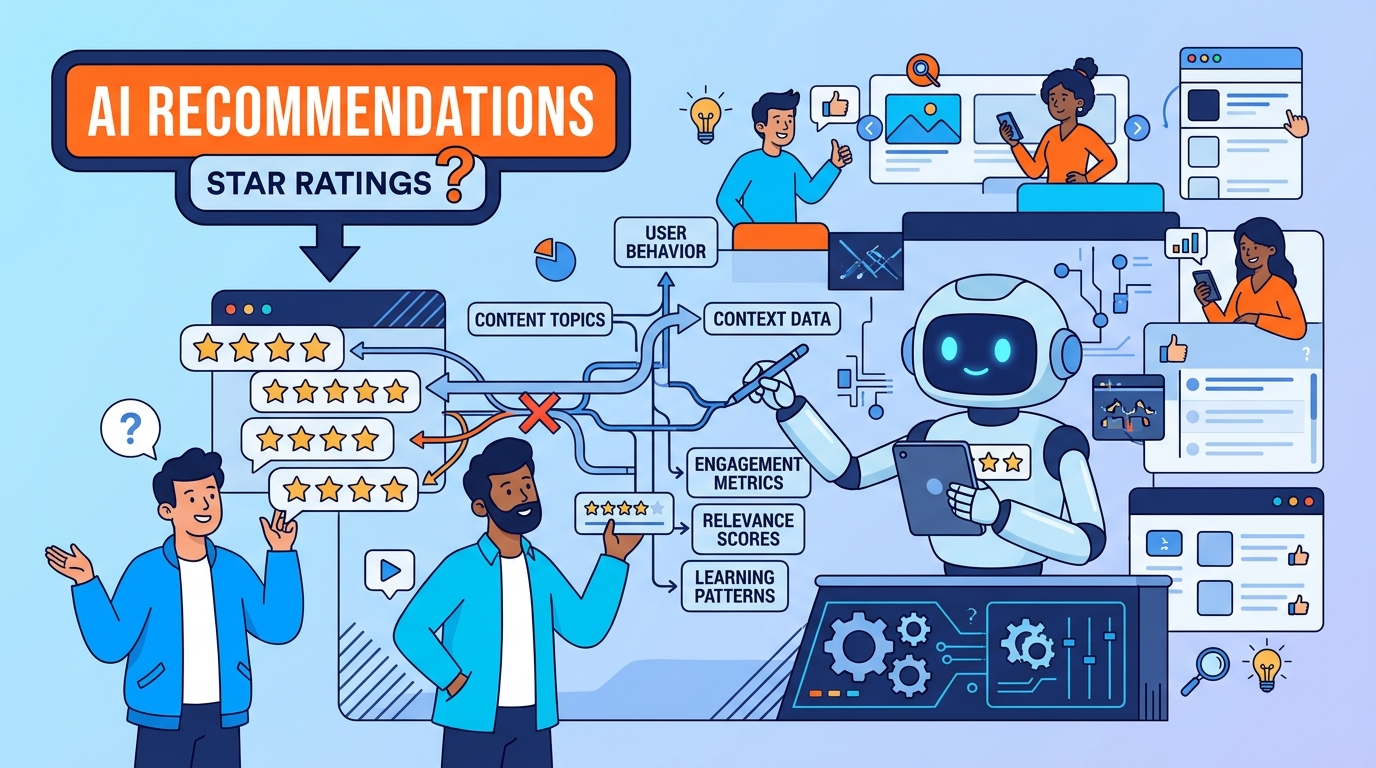
Not the way the star average suggests.
SOCi’s Local Visibility Index finds that reviews and ratings work less as a ranking factor in AI recommendations. They work more as a filter for inclusion.
On the platforms that lean hardest on reviews, AI-recommended businesses sit at roughly 4.2 to 4.3 stars. Gemini’s recommended locations average lower, at 3.9.
SOCi gives the reason. Gemini is grounded in Google Maps. So it behaves differently from ChatGPT and Perplexity.
The filter is narrow.
In SOCi’s 2026 study, ChatGPT recommended barely more than 1 in 100 brand locations (1.2%). Perplexity recommended about 7 in 100 (7.4%). Gemini recommended about 11 in 100 (11.0%).
Those same brands appeared in the Google 3-Pack just over a third of the time (35.9%).
Here’s how the test worked. Each platform was asked to recommend 10 businesses for an industry and market. A location counted as likely recommended only if it appeared in the first 5.
BrightLocal’s research on AI and review trust adds to this.
Citing SOCi’s 2026 index, it reports that fewer than half of the businesses that lead Google local results also appear in AI local recommendations. It also says visibility in ChatGPT local recommendations is 30 times harder to achieve than ranking in Google’s local results.
BrightLocal makes one more point. AI doesn’t “read” reviews the way people do. It looks for patterns across many sources. Its recommendations aren’t always fully up to date. And key nuances from individual reviews can get lost.
Here’s my read.
Star averages and map-pack positions became vanity numbers the day AI started answering the question instead of handing over a list of places.
AI treats a rating as the price of entry. Not the final say.
That gap between Google’s local leaders and AI’s picks tells you something else.
AI visibility isn’t old-school search work under a new label. Chasing keyword targets, inbound links and position numbers aims at the wrong target.
What AI engines want is a business they can make sense of and trust. That’s what I believe.
Here’s the table. It puts the star figures next to the structured data figure. And the gap between Google and AI.
| Signal | What it measures | Evidence of AI impact |
|---|---|---|
| Star ratings (ChatGPT/Perplexity recommended businesses) | Where AI-recommended businesses sit on the platforms that lean hardest on reviews: roughly 4.2–4.3 stars | Ratings work less as a ranking factor and more as a filter for inclusion (SOCi) |
| Star ratings (Gemini-recommended businesses) | Average rating of recommended locations on Gemini: 3.9 | Gemini is grounded in Google Maps, so it behaves differently from ChatGPT and Perplexity |
| Structured data (published audit, correlation only) | Correlation with citation likelihood across audited pages | r = 0.63, with a +39% citation impact |
| AI local recommendation rate across platforms | Share of brand locations each AI platform recommended, against how often the same brands appeared in the Google 3-Pack | ChatGPT 1.2%, Perplexity 7.4%, Gemini 11.0%; Google 3-Pack 35.9% |
| ChatGPT local visibility difficulty | Visibility in ChatGPT local recommendations compared with ranking in Google’s local search results | 30x harder (SOCi Local Visibility Index, 2026, as cited by BrightLocal) |
What structured, verifiable information adds that stars can’t
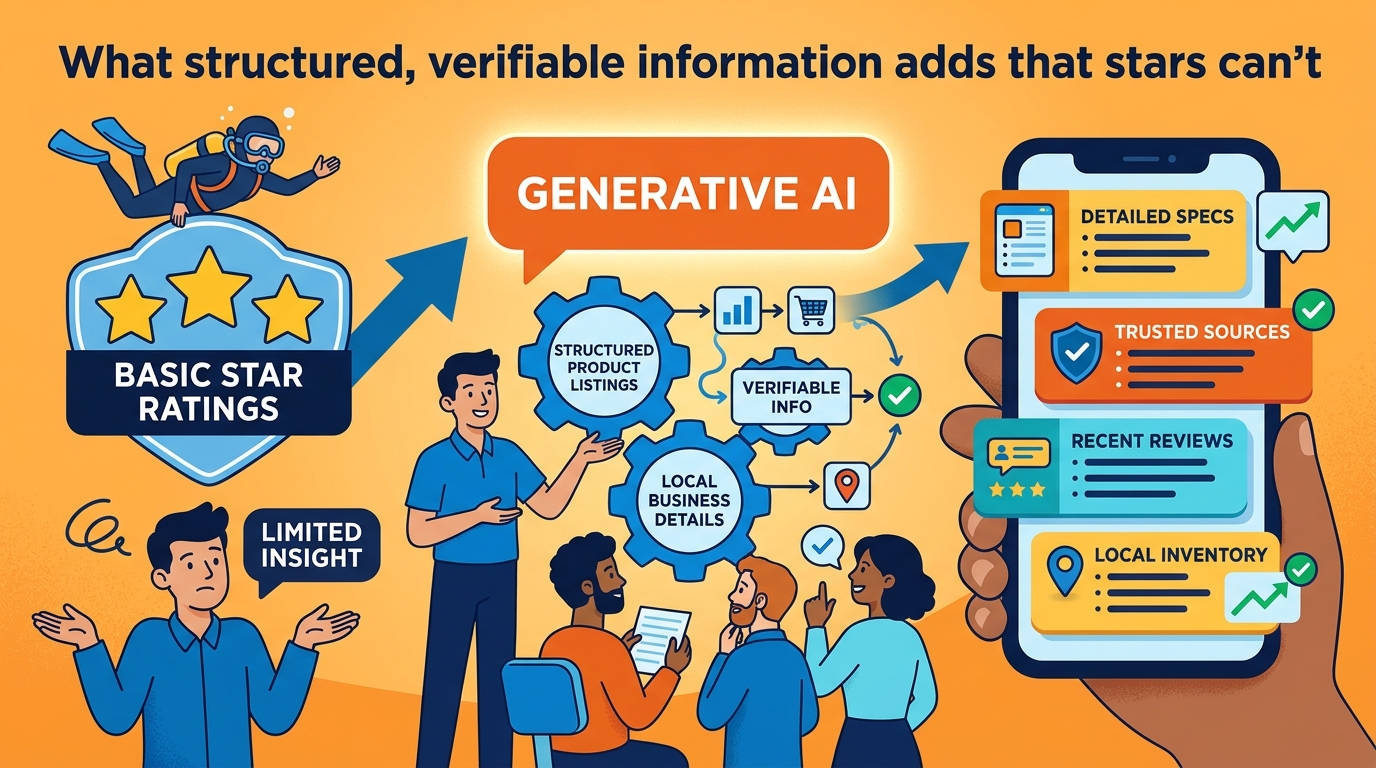
Google says generative AI responses can include product listings, product information and information about local businesses, where appropriate.
It describes structured data as a standardized format. One for providing information about a page and classifying the page content.
Google also says structured data can enable rich results. Those are search results that are more engaging and might encourage people to interact more with a website.
Now the research.
In a citation audit published on arXiv, the Structured Data pillar had a correlation of 0.63 with citation likelihood. It also had a +39% citation impact.
Other pillars sat close by. Metadata and Freshness at 0.68. Semantic HTML at 0.65. Evidence and Citations at 0.61.
These are correlations. They do not show that structured data causes citations.
BrightLocal’s Local Search Ranking Factors 2025 asked experts what most influences local AI search visibility. Here are their top three answers:
- Presence on expert-curated “Best Of” lists
- Dedicated pages for each service
- Prominence on key industry-relevant domains
Here’s my view.
A practice AI can quote as the source of an answer is better placed than one that only shows up as an address on a list. However high its rating.
To prove outcomes without using health records, see Proving Chiropractic Outcomes Without Health Records: A Complete Guide. To decide where that proof should be published, see Should You Publish Outcome Data Across Multiple Platforms?.
Why Google’s review-snippet rules make star ratings unreliable on a practice’s own site
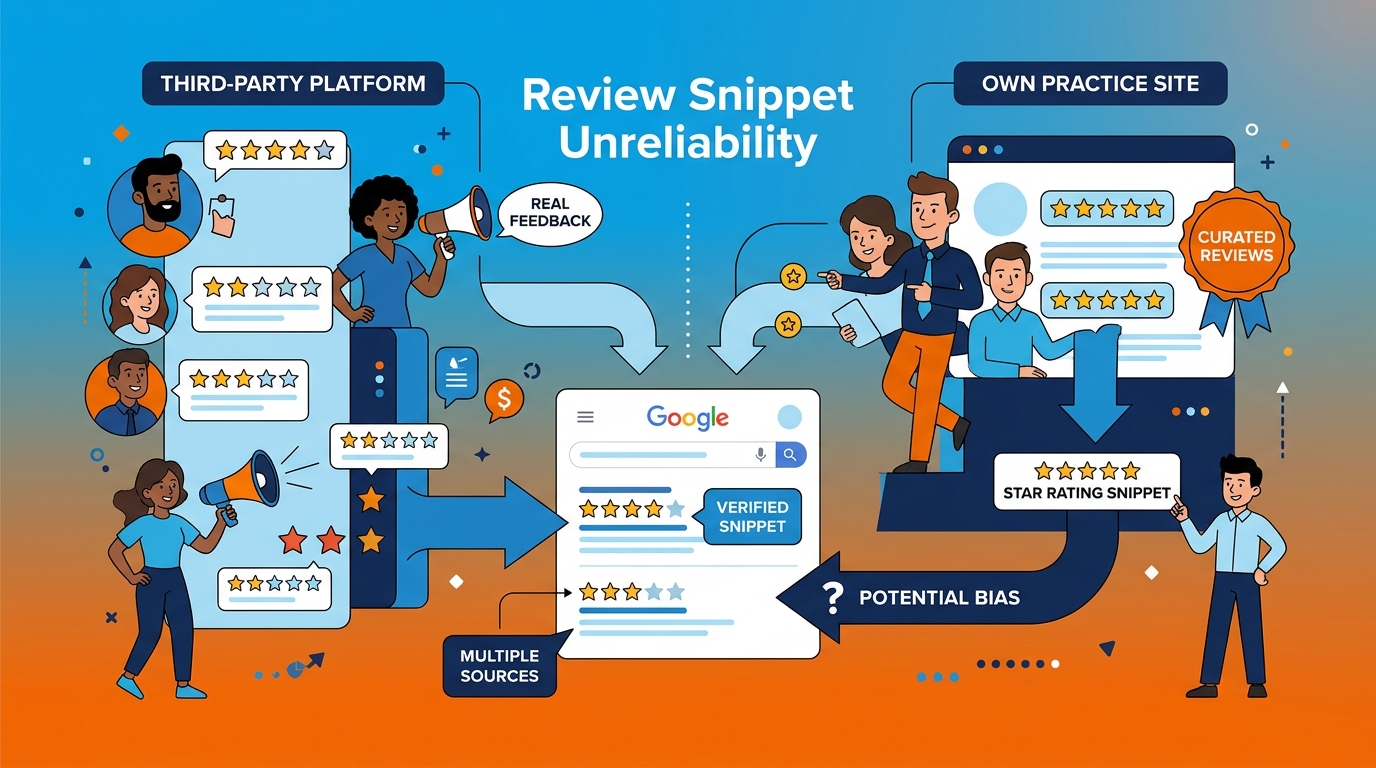
Google’s review snippet guidelines define a review snippet as a short excerpt of a review or a rating from a review website. It’s usually an average of the combined rating scores from many reviewers.
Whether your own site can show one depends on the rules below. Many of them come from Google’s post on making review rich results more helpful. That post explains the self-serving review update.
What review schema can and cannot do on your own website
Here’s the rule.
If the business being reviewed controls the reviews about itself, its pages aren’t eligible for review stars. That covers pages that use LocalBusiness or any other type of Organization structured data.
It applies whether the reviews sit directly in the page’s structured data or come through an embedded third-party widget. Think a Google Business reviews or Facebook reviews widget.
Google’s blog post confirms the widget point.
Google Search won’t display review snippets for those pages. Embedding a third-party widget is seen as controlling the process of linking reviews.
The restriction applies to both Review and AggregateRating markup.
Practical Ecommerce puts it plainly. A company can’t rank with a review rich snippet for reviews about itself. Another company that aggregates those reviews can.
The company hosting the review can’t be the same as the company being reviewed.
BrightLocal’s explainer on review schema agrees.
Adding LocalBusiness review markup to your site won’t generate star ratings in Google search. It doesn’t matter whether you add the reviews and schema yourself or embed a third-party widget that pulls reviews from review sites.
Review schema on your site also doesn’t affect your Google Business Profile. Google controls those stars entirely. They come from customer submissions on Google itself.
Whitespark adds to this.
Google no longer shows review stars in search for testimonials on a business website. Same for third-party reviews embedded with a widget or code.
Review stars in search now come only from third-party review sites. Yelp, Google and TripAdvisor.
Google’s other review snippet rules also apply:
- Ratings must be sourced directly from users. Don’t rely on human editors to create, curate or compile ratings for local businesses.
- Don’t aggregate reviews or ratings from other websites.
- Don’t include fake reviews or undisclosed incentivized reviews on the page or in the structured data.
- Review content you mark up must be readily available to users on the marked-up page.
Google said a business won’t get a manual action just for having self-serving reviews on its site. It does recommend making sure your structured data matches its guidelines.
The update doesn’t affect Business Profiles. It relates only to organic Search.
What happens when a page loses review rich results
A structured data issue can lead to a manual action.
Google says that means the page loses eligibility to appear as a rich result. It doesn’t affect how the page ranks in Google web search.
Whitespark agrees. Losing rich snippets from review schema won’t have a direct impact on rankings.
Reviews still affect rankings overall, though.
Whitespark cites its Local Ranking Factors study. It weights review signals at about 15.4% (15.44%) for the local pack and finder. For organic results, it’s about 6.5% (6.47%).
Why patients still check the stars after AI answers
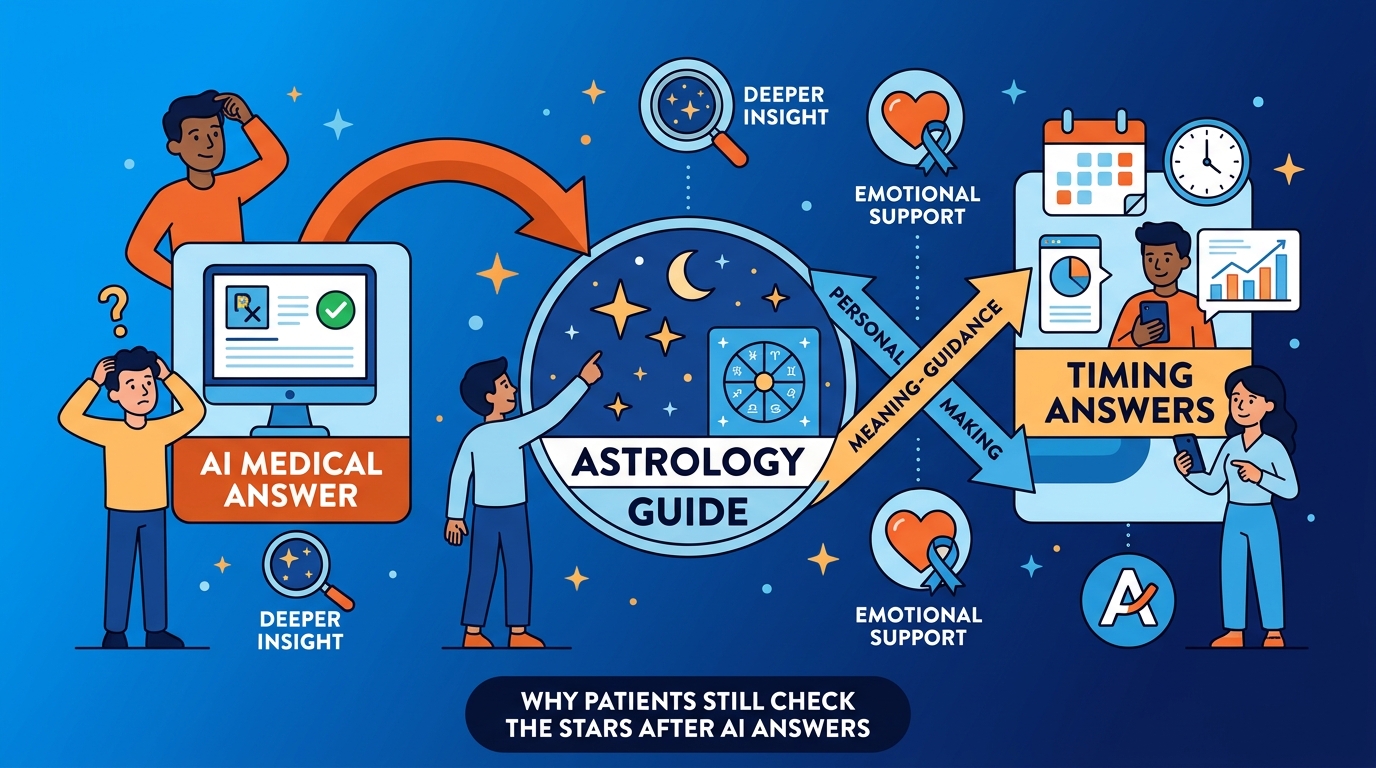
Here’s what patients are doing.
In rater8’s survey, nearly half of patients (47%) have used an AI tool to research healthcare providers. That’s up from about three in ten (31%) in 2025.
Among patients who actually switched providers, rater8 puts AI’s influence at close to four in ten (39%).
BrightLocal reports a similar rise among people looking for local businesses.
The share of consumers using AI for local business recommendations climbed from 6% in 2025 to 45% today.
ChatGPT leads. 31% of consumers used it for business recommendations in the last 12 months. Google’s AI Mode follows at 23%.
SOCi’s consumer research found that just over half of consumers (52%) used an AI tool to research a local business in the last 30 days. The year before, it was 9%.
After the AI answer, most people check.
SOCi found that more than four in five consumers (81%) take an additional verification step after an AI recommendation. Fewer than one in five (19%) contact the business directly. The most common next step is checking reviews, at about a third (33%).
BrightLocal found that 23% of people are happy to rely on an AI review summary alone. Nearly six in ten (59%) check review profiles for more information. And 18% skip summaries entirely.
BrightLocal also found that nearly all AI users (97%) sometimes double-check AI recommendations against real reviews. And 42% always check reviews on native review platforms.
BrightLocal reads this as a sign that AI has become the first step in local business research for many people. Not the final authority.
Its 2026 survey used a representative panel of 1,002 US adults. Of those, 455 had used an AI tool for local business recommendations in the last 12 months.
Here’s how I read it.
Stars control the human step. Even when they don’t win the AI step. More BrightLocal data:
- The top three factors when consumers decide which business to contact are clear and complete info (32%), best or most reviews (30%) and clear pricing (29%).
- Nearly two-thirds of consumers who rejected a business (65%) did so for a review-related reason: negative reviews, a low rating, or no or old reviews.
- Nearly half of small businesses (47%) have fewer than 20 Google reviews, and 47% of consumers won’t use such a business. Only about one in six (16%) have more than 50.
These figures come from BrightLocal’s 2026 roundup of local search statistics.
What to mark up for a structured profile when stars aren’t available
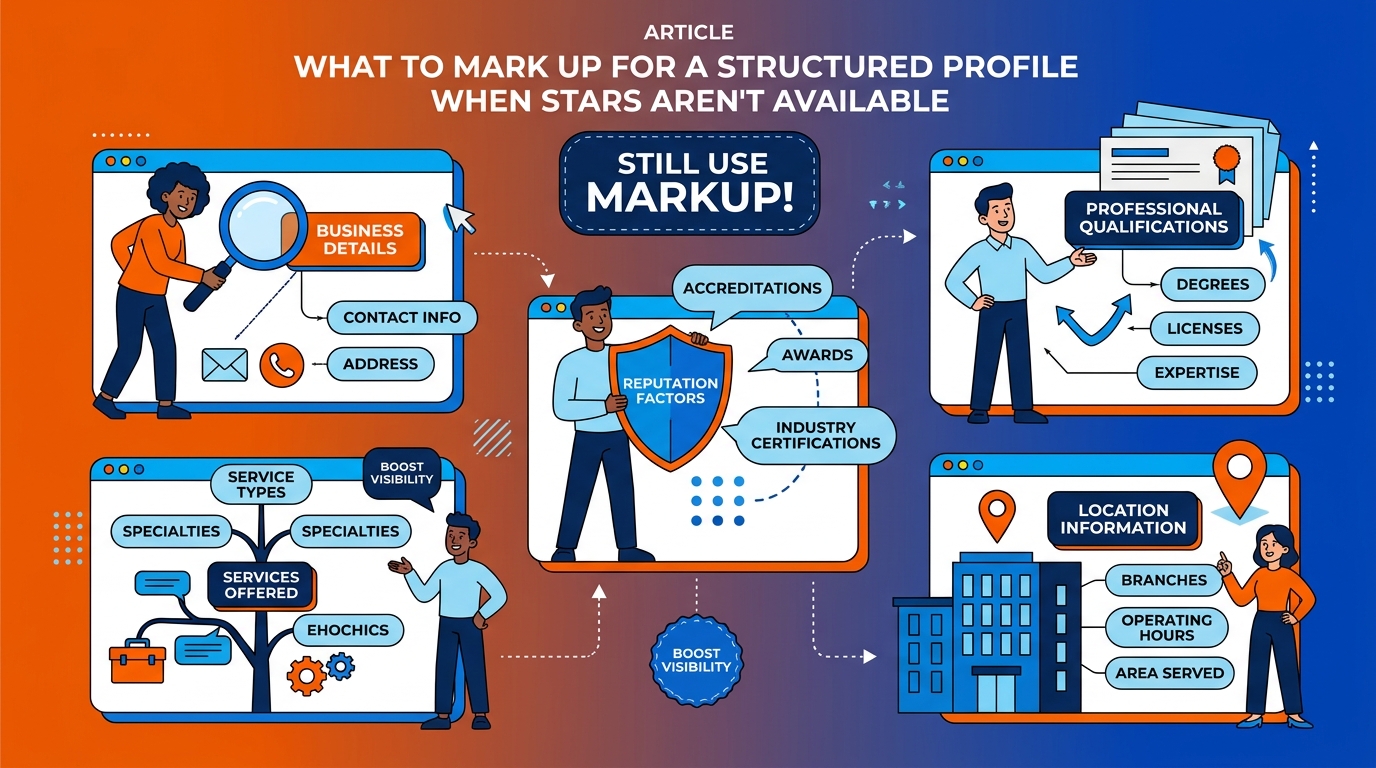
Markup is still allowed. It’s still useful after review stars are ruled out.
Here’s what I believe. AI engines favour the practice they can make sense of over the one that publishes most often.
A short set of well-labelled facts in a sensible order outweighs a stack of extra reviews or pages.
The same idea applies to clinical measures in Pain Scale Ratings vs Range-of-Motion Data: Which Metric Builds Credibility?
Mark up the business itself
Start with the LocalBusiness type. Schema.org describes it as a particular physical business or branch of an organization.
Google says Local Business structured data can tell it about business hours and different departments within a business.
It can also cover reviews. But only if your site captures reviews about other businesses.
Mark up the facts, not the stars
If you can’t get review stars, BrightLocal has a fix.
Mark up your address, contact information, opening hours and frequently asked questions. That helps Google better understand your business.
For the format, BrightLocal recommends JSON-LD. It’s a block of JavaScript added in the head or body of the page.
It’s easy to add and maintain. It doesn’t affect page layout. And Google prefers it.
Frequently Asked Questions
Can a chiropractic practice display star ratings on its own website?
It can show reviews on the page. But Google won’t show them as review stars in search.
If a business controls the reviews about itself, its pages that use LocalBusiness or other Organization markup aren’t eligible for review stars. That includes reviews pulled in through an embedded widget, like Google or Facebook reviews. Google sees embedding a third-party widget as controlling the process of linking reviews.
BrightLocal says LocalBusiness review markup won’t generate star ratings in Google search. Add the reviews yourself or use a widget. Same result.
Whitespark says review stars in search now come only from third-party review sites. Yelp, Google and TripAdvisor.
Does losing review rich results hurt a practice’s Google ranking?
Not directly.
Google says a structured data manual action means a page loses eligibility to appear as a rich result. It doesn’t affect how the page ranks in Google web search.
Whitespark says the same. Losing rich snippets from review schema won’t have a direct impact on rankings.
Do AI tools read reviews the same way people do?
No.
BrightLocal says AI doesn’t “read” reviews the way humans do. It looks for patterns across multiple sources. Key nuances from individual reviews can get lost.
People still look closer. BrightLocal found that 23% rely on an AI summary alone. Nearly six in ten (59%) check review profiles for more information. And 18% skip summaries entirely.
How many patients are already using AI to choose a healthcare provider?
Nearly half.
In rater8’s survey, 47% of patients had used an AI tool to research healthcare providers. That’s up from about three in ten (31%) in 2025.
Among patients who actually switched providers, AI’s influence was close to four in ten (39%).
What should a practice mark up if it can’t show review stars?
The facts.
BrightLocal recommends marking up your address, contact information, opening hours and frequently asked questions. That helps Google better understand your business.
Start with the LocalBusiness type. Schema.org describes it as a particular physical business or branch of an organization. Google says Local Business structured data can tell it about business hours and different departments within a business.
Your next step: see if AI reads your practice as a source it can cite
Most practice owners want to be the one name AI gives when someone asks who to trust.
Here’s the thing. A structured profile on your own site is proof you own. Its value builds over time. Review platforms are rented space. Their rules can change without warning.
iTech Valet Service Plans & Pricing explains how the work is done.
The AI Visibility Check is free and diagnostic. It does not sell. To see how AI engines read your practice today, Run My AI Visibility Check.