
AI search engines show a systematic and overwhelming bias toward earned media, meaning third-party authoritative sources, over brand-owned and social content. Google’s mix is more balanced. One study found that 85.7% of the citations in AI brand answers point to sites the brand does not own, and 14.3% point to sites it owns. Research also confirms that AI search engines cite domain resources with greater diversity than traditional search engines. SOCi says ratings are a necessary signal but not a sufficient one. Being recommended also depends on accurate, complete profiles and on whether the platform can find consistent information about your location.
Why publishing on one platform isn’t enough
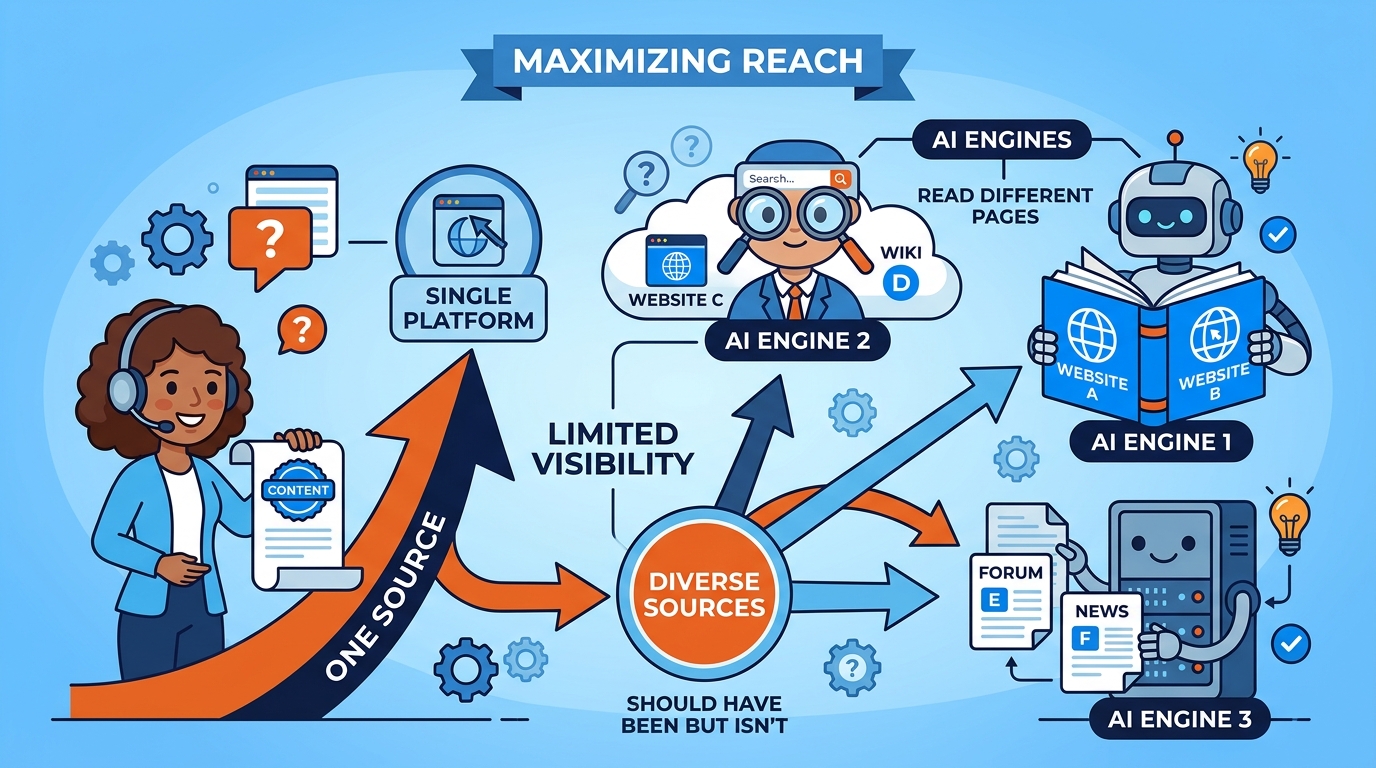
AI engines don’t all read the same pages.
And they lean hard on sites you don’t own.
Here’s the proof.
One study compared the sources pulled by Google search, AI Overviews and Gemini. The sources were substantially different for each one. Their average Jaccard similarity was below 0.2. That’s a score of how much two lists overlap. Not much.
Another study found the same pattern.
AI search shows a systematic and overwhelming bias toward earned media. Earned media means third-party, authoritative sources. AI leans on these more than on brand-owned and social content. Google’s mix is more balanced.
The numbers for brands are sharp.
In AI brand answers, about 86 of every 100 citations (85.7%) point to sites the brand doesn’t own. Only 14.3% point to owned sites.
Your own website is a minority source, even for the best self-cited brand. For many brands, it isn’t a source at all.
Research also confirms that AI search engines cite domain resources with greater diversity than traditional search engines.
A separate local test shows the same thing. Two AI tools rarely agreed on which businesses to recommend: ChatGPT and Perplexity agreed on only 1 in 4 local business recommendations.
Here’s my view.
A business named in one directory entry is easy for an AI engine to skip. A business whose facts show up, matching, across many independent sources? That’s the one the engine can lean on.
I’ll take broad, consistent citation over one listing every time.
Here’s what else I think.
Answer engine work is a different job from old-school search work. Chasing keywords, inbound links and results-page position numbers misses what these engines need.
They need a business whose facts they can follow and believe.
The table below sets out what the research found.
| Finding | Detail |
|---|---|
| Source overlap across Google, AI Overviews, Gemini | Below 0.2 average Jaccard similarity |
| Share of brand-answer citations to sites the brand doesn’t own | 85.7% of citations, against 14.3% owned |
| Citation diversity vs traditional search | AI search cites domain resources with greater diversity |
What happens when AI engines disagree across platforms
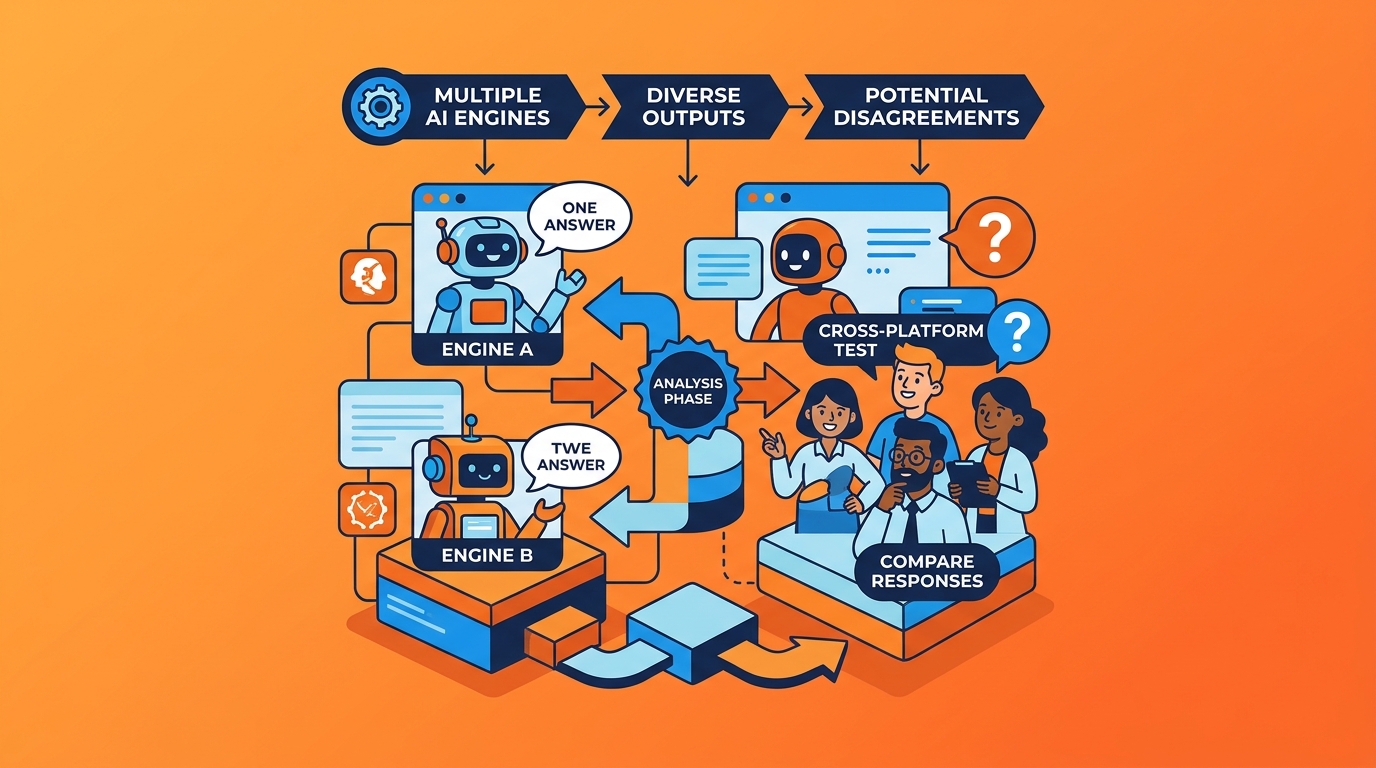
This test is small. It didn’t cover chiropractors. It covered four other industries, all in California.
Treat it as a clue, not a rule.
It still shows how two AI tools can differ on the very same search.
The test comes from ChatGPT and Perplexity agreed on only 1 in 4 local business recommendations. It ran 20 city-and-industry searches.
Perplexity named 99 businesses in its top fives. Only 24 of those also appeared in ChatGPT’s top five for the same search. That’s roughly one in four (24%).
The tools also credited different kinds of sources.
Perplexity most often credited the business’s own website. That’s roughly half of its 99 picks. Local listings and Yelp came next.
ChatGPT most often credited third-party lists. “Best of” directories. Review-widget pages. Aggregators such as ConsumerAffairs, Expertise, Avvo, Birdeye and Yably.
The two tools picked the same #1 business only once in 20 searches.
That search was for plumbers in Fresno.
The table below puts the results side by side.
| Measure | Result |
|---|---|
| Overlap in top-five picks | 24 of Perplexity’s 99 top-five picks also in ChatGPT’s top five (24%) |
| Source preference | Perplexity most often credited the business’s own website; ChatGPT most often credited third-party lists |
| Agreement on #1 pick | Same #1 business once in 20 searches |
Why consistency matters more than platform count
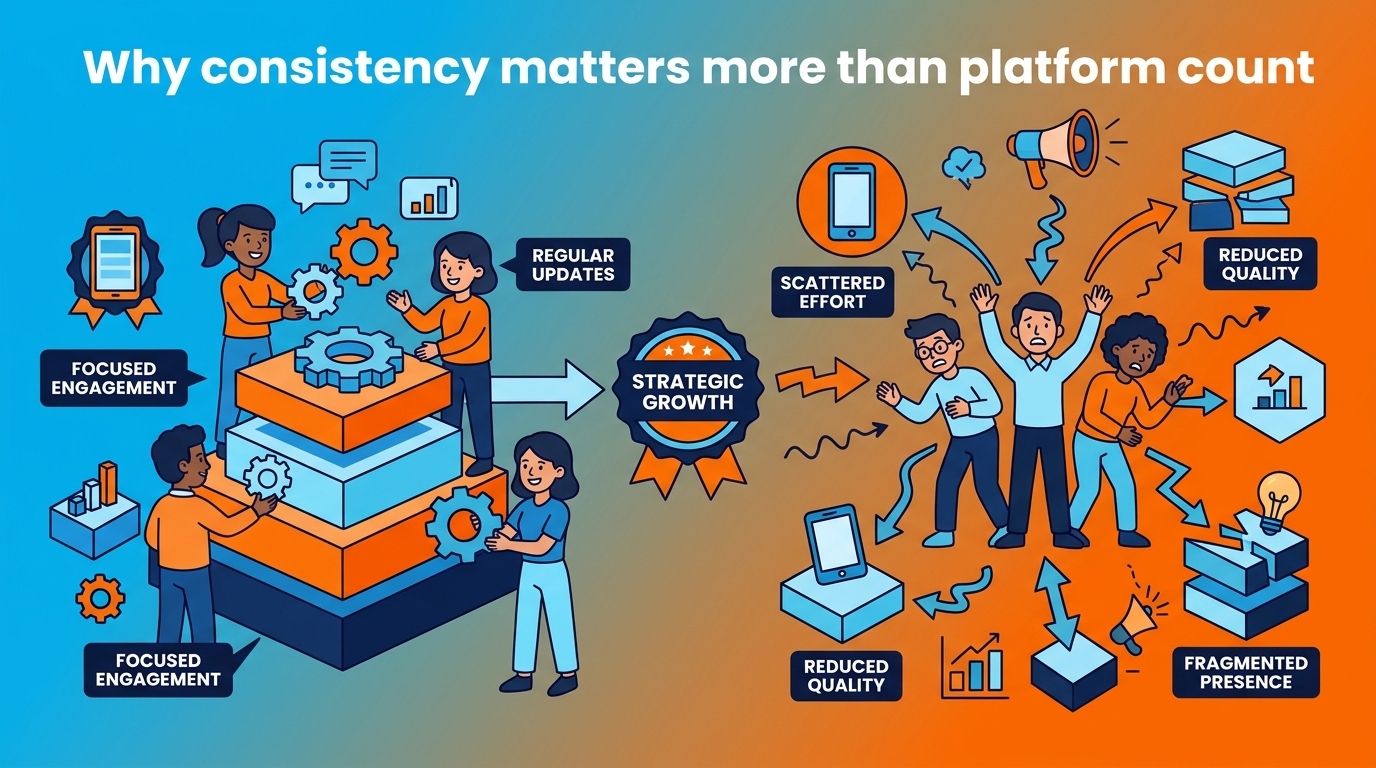
Here’s my view. Adding platforms does little if the details on them disagree.
SOCi says ratings are a necessary signal, not a sufficient one. Being recommended also depends on accurate, complete profiles. And on whether the platform can find consistent information about your location.
The details often don’t match.
Only just over two-thirds (68%) of business contact information on ChatGPT and Perplexity matches the details on Google Business Profiles. That figure comes from the SOCi Local Visibility Index, 2026, as BrightLocal reports it.
AI tools also draw on many kinds of places.
BrightLocal notes that AI responses may include information from reviews, local directories, business websites, social media and other third-party sources. It depends on the tool and the prompt.
In BrightLocal’s 2024 study of ChatGPT Search sources, business websites made up nearly six in ten (58%) of its local search sources. Business mentions made up just over a quarter (27%). Online directories made up about one in seven (15%).
Here’s one that surprises people.
SOCi found that Yelp still supplies about one in ten (10.5%) of what LLMs draw on. Many multi-location brands treat it as an afterthought. SOCi’s index also calls Yelp a significant local content provider to Perplexity.
AI doesn’t read reviews the way a person does.
BrightLocal explains that it looks for patterns across multiple sources. Its recommendations aren’t always fully up to date. Key nuances from individual reviews can get lost.
I think that’s why the pattern across your sources has to agree.
Google’s Business Profiles also draw on more than one source.
Google says it gathers info from different sources, like user reports and licensed content, to help keep a profile accurate. You don’t control every source.
In my view, that makes it more important that the sources you do control match.
Here’s where I land.
Facts published on a site you control gain weight each time another source repeats them. Reach borrowed from a single platform lasts only as long as that platform keeps showing you.
On proving results with published data, see Proving Chiropractic Outcomes Without Health Records: A Complete Guide.
How to keep one canonical version when the same data appears in several places
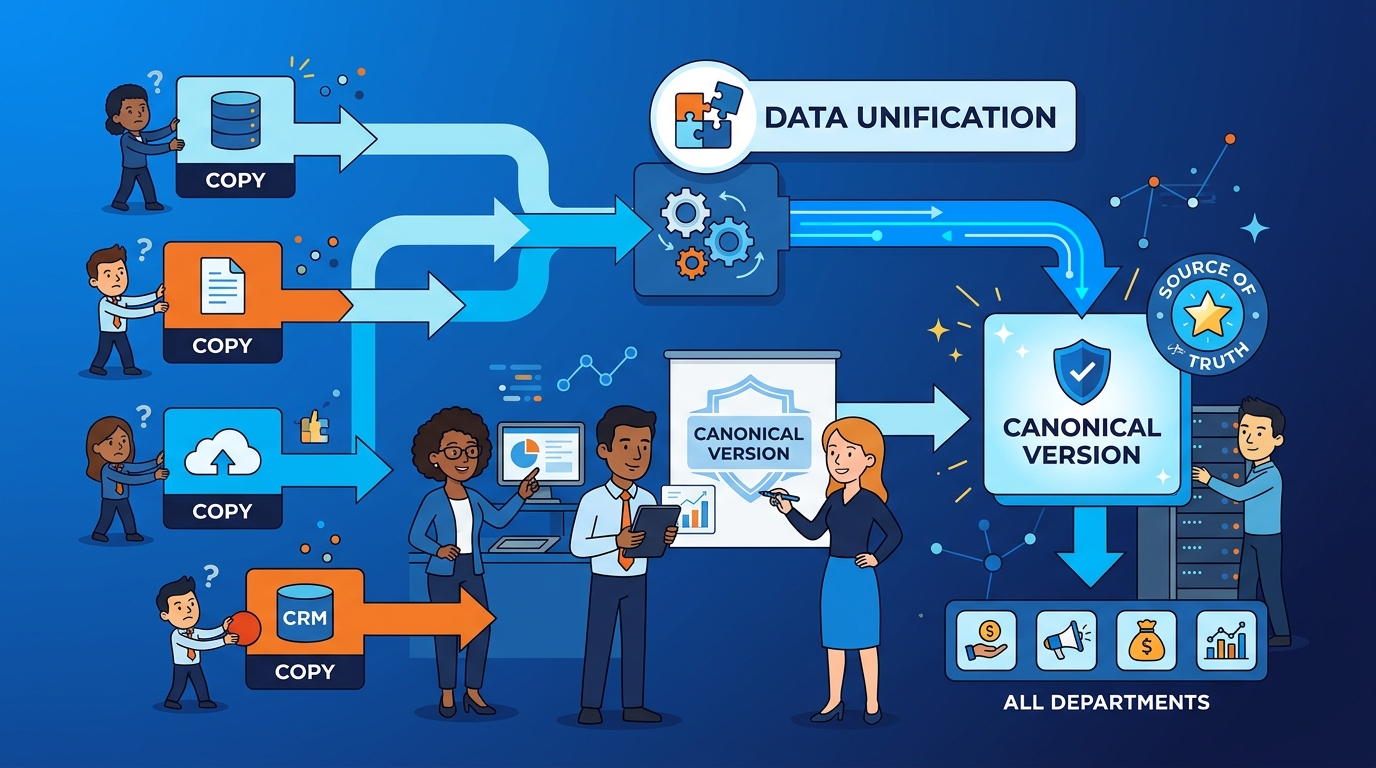
Copies of the same data can compete with each other.
Google’s guidance covers two cases.
First case: the same content reachable under different URLs.
Google says to choose the URL you prefer and put that one in the sitemap. Don’t list every URL that leads to the same content.
Copies on other sites are a different case.
A cross-domain canonical is a canonical link where the duplicate page sits on an entirely different website. Google’s guidance says the canonical link element isn’t recommended for avoiding duplication by syndication partners. The pages are often very different.
The most effective fix is for partners to block indexing of your content. Search Engine Journal covers this in Google Updates Guidance on Cross-Domain Canonicals.
My advice is simple.
Keep the master copy on your own site. Ask partners to block indexing of their copies.
Credentialing rules matter too. They’re set out in What Credentialing Bodies Say About Publishing De-Identified Outcomes.
How to de-identify outcome data safely before publishing it anywhere
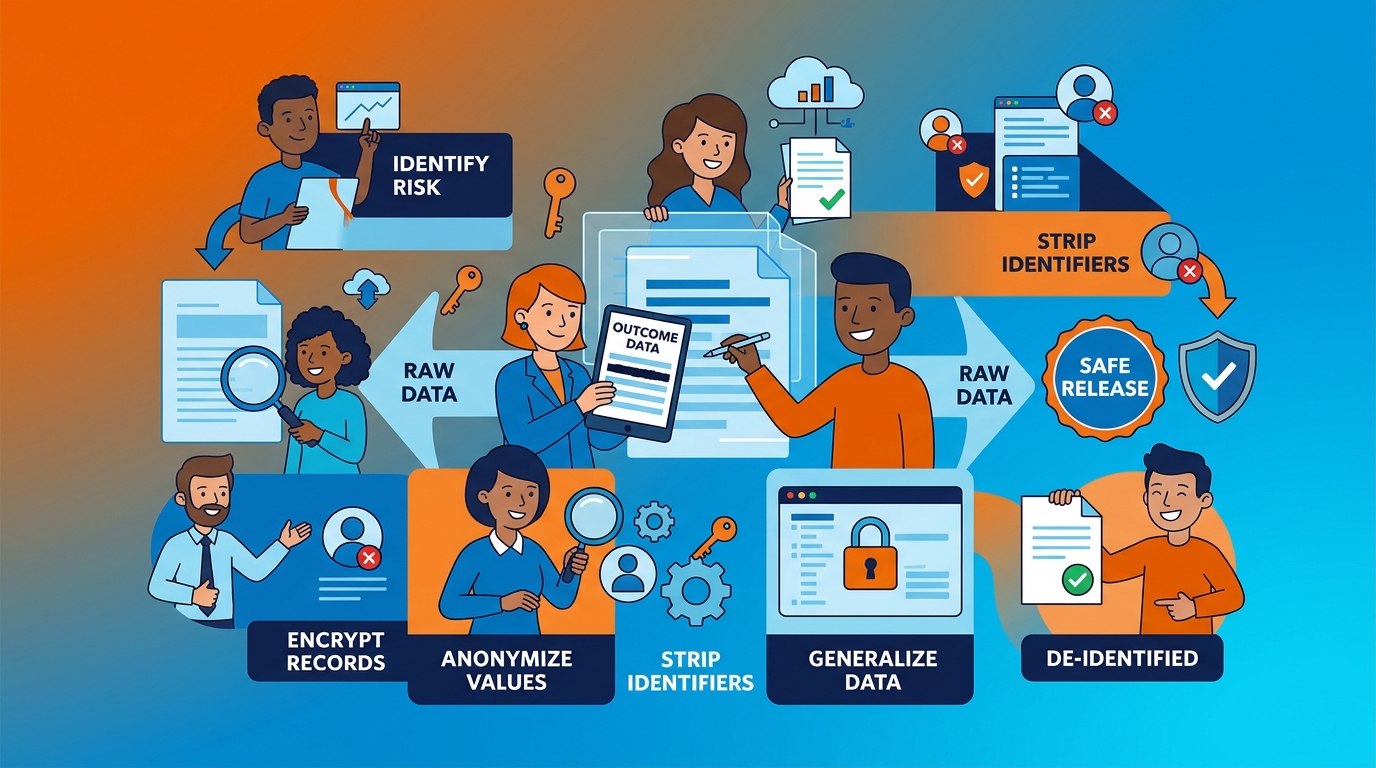
Federal teams that release health data to the public have written down how re-identification happens. They’ve also written down what they do to prevent it.
I’d borrow their methods directly. For the HIPAA side of the rules, see HIPAA-Safe Ways to Publish Chiropractic Outcome Data.
Why re-identification risk grows when the same data appears in multiple places
The risk has a name. The mosaic effect.
A federal report, Minimizing Disclosure Risk in HHS Open Data Initiatives, explains it. Separate pieces of information become significant when they’re combined with other information.
Removing direct identifiers isn’t enough.
The report says doing so doesn’t de-identify a dataset. The remaining variables can act as indirect, or quasi-, identifiers. In combination, they can single out individuals within the population or within well-defined subpopulations.
The report notes that a substantial share of the U.S. population has a unique combination of gender, date of birth and ZIP code.
CDC describes the mosaic effect too.
Information in one dataset may not identify anyone. Combine it with other available datasets, and it may. CDC reduces the risk with k-anonymity levels. But it says the risk is hard to eliminate completely.
Where the data goes matters.
The report says the confidentiality of federal datasets is threatened less by other federal data than by two other sources.
One is datasets compiled by other organizations and released with weak or no de-identification. The other is personal data revealed through social media.
A literature review, Open Government Data Programs and Information Privacy Concerns: A Literature Review, says the standard practice in open government data programs is “release-and-forget.”
The data go out to the public on the Internet. So the data users are unknown. There’s no control over how they use the data.
The review found that re-identification risks are among the significant privacy concerns in that literature.
In my view, posting outcome data across many platforms means the same loss of control.
Steps that keep disclosure risk low without destroying the data’s value
No method brings the risk to zero.
Expert panelists in the federal report generally agreed that disclosure risk can’t be driven to zero without seriously weakening the analytical value of a dataset. CDC puts it more flatly. Re-identification risk can’t be reduced to zero, and its systematic process is designed to keep that risk low.
That process is described in Protecting Privacy and Transforming COVID-19 Case Surveillance Datasets for Public Use.
The federal report offers a useful way to think about risk.
The probability of re-identification equals the probability of an attack times the probability of re-identification if an attack happens.
Here’s what CDC did:
- Know the quasi-identifiers. CDC defines them as fields that may identify a person if they’re rare enough in a dataset or can be combined with other fields or data. Age group, sex and county are examples.
- Drop free text. CDC excluded all free-text fields that could contain personally identifiable information.
- Generalize exact values. CDC left out date of birth. It created an age group field with ten-year bins. The top bin is 80+.
- Require 2-diversity. This keeps a confidential value from being worked out when records share the same quasi-identifier values.
Don’t overdo it, though.
The federal report warns that over-zealous protection can weaken data quality with little improvement in security. Public data can be locked down so hard it becomes useless. Then unused.
Frequently Asked Questions
Do AI tools pull outcome data from the same places Google does?
Largely not. One study found the sources retrieved by Google search, AI Overviews and Gemini are substantially different. Average Jaccard similarity: below 0.2.
Another study found that AI search shows a systematic and overwhelming bias toward earned media. That means third-party authoritative sources, over brand-owned and social content. Google’s mix is more balanced.
Is it risky to publish the same outcome data in more than one place?
It can be. A federal report calls it the mosaic effect. Separate pieces of information become significant when they’re combined with other information.
CDC says data that doesn’t identify anyone on its own may do so when combined with other available datasets. That risk is hard to eliminate completely.
The federal report adds that the confidentiality of federal datasets is threatened less by other federal data. The bigger threats are datasets released by other organizations with weak or no de-identification, and personal data revealed through social media.
Can de-identified outcome data ever be made risk-free?
No. CDC states that re-identification risk can’t be reduced to zero. Its systematic process is designed to keep that risk low.
Expert panelists in the federal report generally agreed that disclosure risk can’t be driven to zero without seriously weakening the analytical value of a dataset.
Should I use a canonical tag if the same outcome data appears on more than one site?
For syndication partners, Google’s guidance says no. The canonical link element isn’t recommended for avoiding duplication by syndication partners. The pages are often very different.
The most effective fix is for partners to block indexing of your content. A cross-domain canonical is a canonical link where the duplicate page sits on an entirely different website.
Can AI recommendations be trusted if they disagree between tools?
Check them.
In a small local test, ChatGPT and Perplexity picked the same #1 business only once in 20 searches. In rater8’s 2026 survey of U.S. patients, two-thirds (66%) said they’d run into incorrect provider information from an AI tool.
Even so, six in ten (60%) said they trusted the AI summary without verifying it further.
Yes, publish in several places, but keep the facts the same
Yes, publish on several platforms.
AI grounds brand answers overwhelmingly in third-party sources. In one study, about 86 of every 100 citations (85.7%) pointed to sites the brand doesn’t own.
Use the same de-identified facts everywhere. Keep one canonical version. Don’t add extra details on each platform.
CDC says data that doesn’t identify anyone on its own may do so when combined with other datasets. That risk is hard to eliminate completely.
Consistency does the work.
SOCi says ratings are necessary but not sufficient. Being recommended also depends on accurate, complete profiles and consistent information.
In my experience, the practice an AI engine names is the one whose facts it can piece together. Not the one with the most posts.
I’d rather see a short, well-ordered set of facts repeated cleanly everywhere than another platform or another pile of posts.
The iTech Valet Service Plans & Pricing page explains how the work is done. To see how AI describes your practice today, Run My AI Visibility Check.