
Pages with a lot of influence tend to be longer, better organized, closer in meaning to the question, and fuller of easy-to-pull-out facts like definitions, numbers, comparisons, and step-by-step instructions. Statistical models show that how well a source matches the topic and where it sits in the list matter most for which source gets cited first. Showing a clear price and a recent date stamp also helps, again and again. Being complete and showing signs of trust add smaller gains, while changes only to formatting make little difference.
Which Older Patients Will Travel Farther for Care
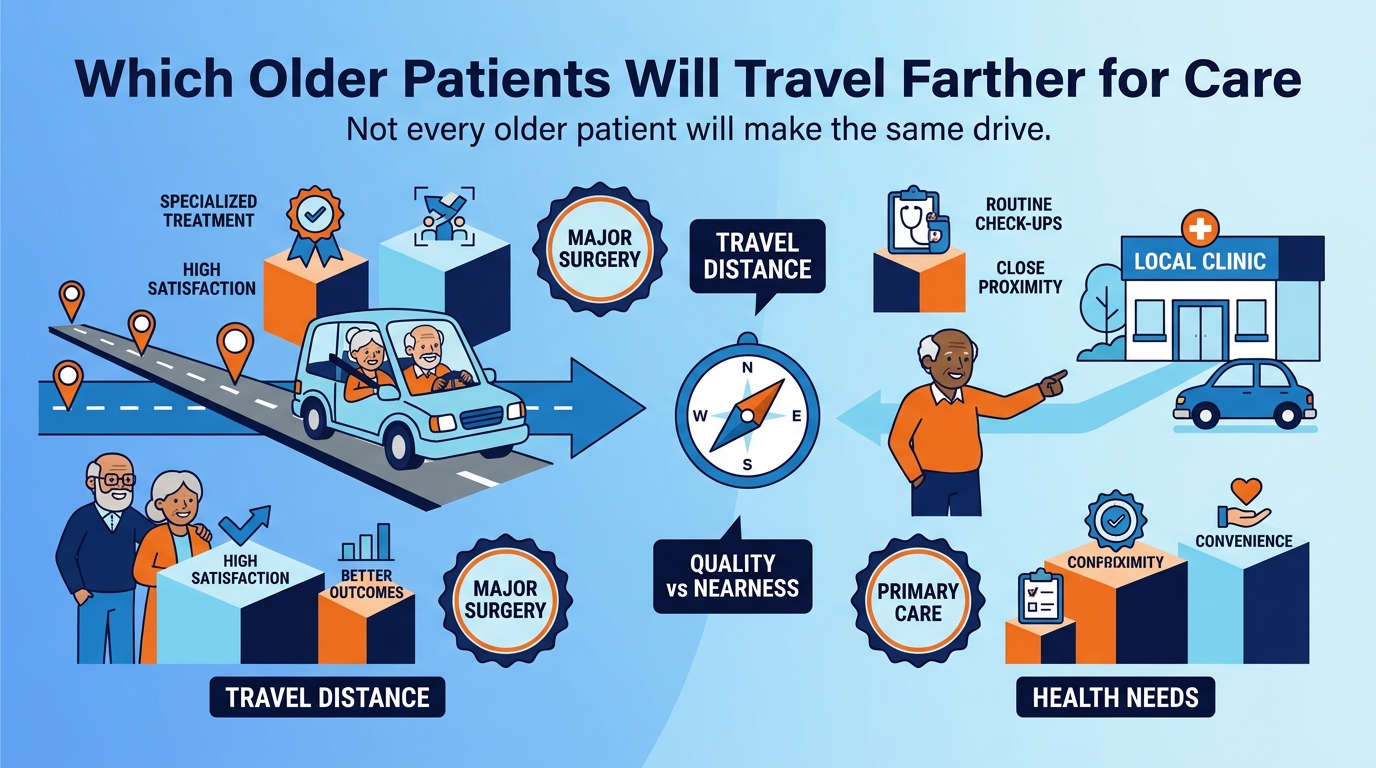
Not every older patient will make the same drive.
A study in JAMA Network Open, Willingness of Older Adults to Travel for Medical Care, shows who says yes to a longer trip.
Here’s the headline.
People with incomes greater than $60,000 would travel about 23 more minutes (22.6; 95% confidence range, 13.3 to 31.9) for specialty care. More than people with lower incomes.
Some groups wouldn’t go as far.
People who lived in or near big cities. People who said they were in fair or poor health. People who said they’d had trouble getting to medical visits in the past.
They were willing to travel for less time.
3,390 people were invited. 2,650 were included in the study.
That’s about eight in ten (78.2%).
USC Dornsife News reports in How far will seniors go for a doctor visit? that rural residents, who often already travel long distances for care, seemed more open to long trips. People with higher incomes, more education, and reliable access to a car said they were more willing to spend more time traveling.
Want to know how far AI tools say a patient should go? Read How Far Will AI Tools Say a Patient Should Travel for Care?
What Gets a Source Cited by AI
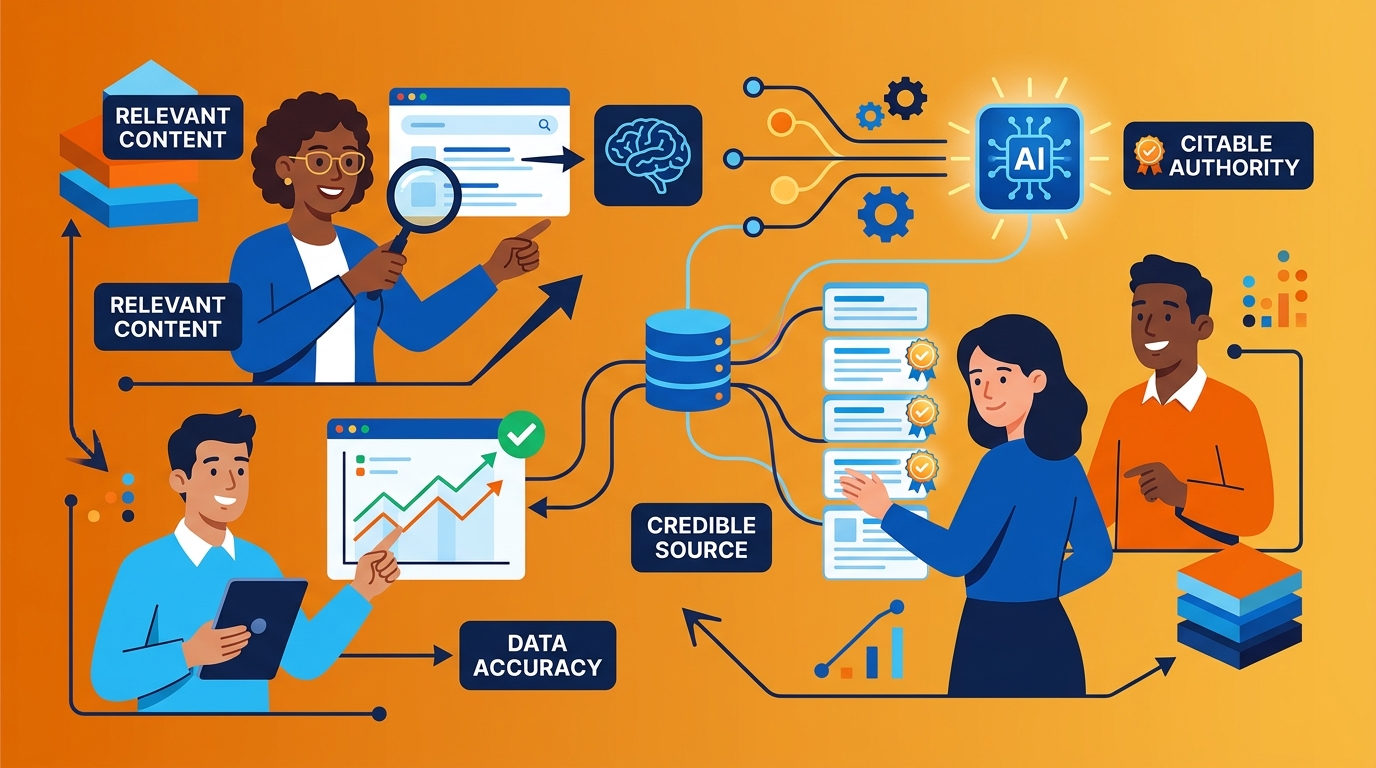
Here’s what the study found.
AI search leans heavily and consistently toward earned media. That means outside, trusted sources. It favors them over content the brand owns and over social media content.
Google doesn’t work that way. Its mix is far more balanced.
When AI answers questions about brands, it leans on outside sources. By far.
About six in seven citations (85.7%) point to sites the brand doesn’t own.
About one in seven (14.3%) point to sites the brand does own.
Here’s where I stand.
I’d rather a clinic be the source an AI names and draws on. Not one more name in a list of businesses.
Being relied on beats being present. So I look hard at the outside sources AI builds its brand answers on.
So what decides which source gets cited first?
Statistical models say two things matter most. How well a source matches the topic. And where it sits in the list.
Being complete and showing signs of trust add smaller gains. Formatting-only changes? They make little difference.
A clear price and a recent date stamp also help. Again and again.
The table below lines these up.
| Factor | Effect on being cited first |
|---|---|
| Topical relevance and list position | Biggest drivers of being cited first |
| Completeness and trust cues | Smaller added gains |
| Formatting-only edits | Little impact |
| Price information and recent timestamp | Consistently helps |
Look at pages on the same website, and content matters in one way. Pages whose title and paragraphs match the questions people ask get cited more. FAQ blocks, structured data, summary boxes, and page speed seem to work only across websites.
High-influence pages tend to be longer, better organized, closer in meaning to the question, and fuller of easy-to-pull-out facts. Those facts are things like definitions, numbers, comparisons, and step-by-step instructions.
I don’t chase publishing volume to get a clinic recommended. I write clear facts in a sensible order and finish the answer. I’ll take one complete page that matches the question over ten pages made to look busy or neat.
How Often AI Medical Answers Go Unsupported by Their Own Citations
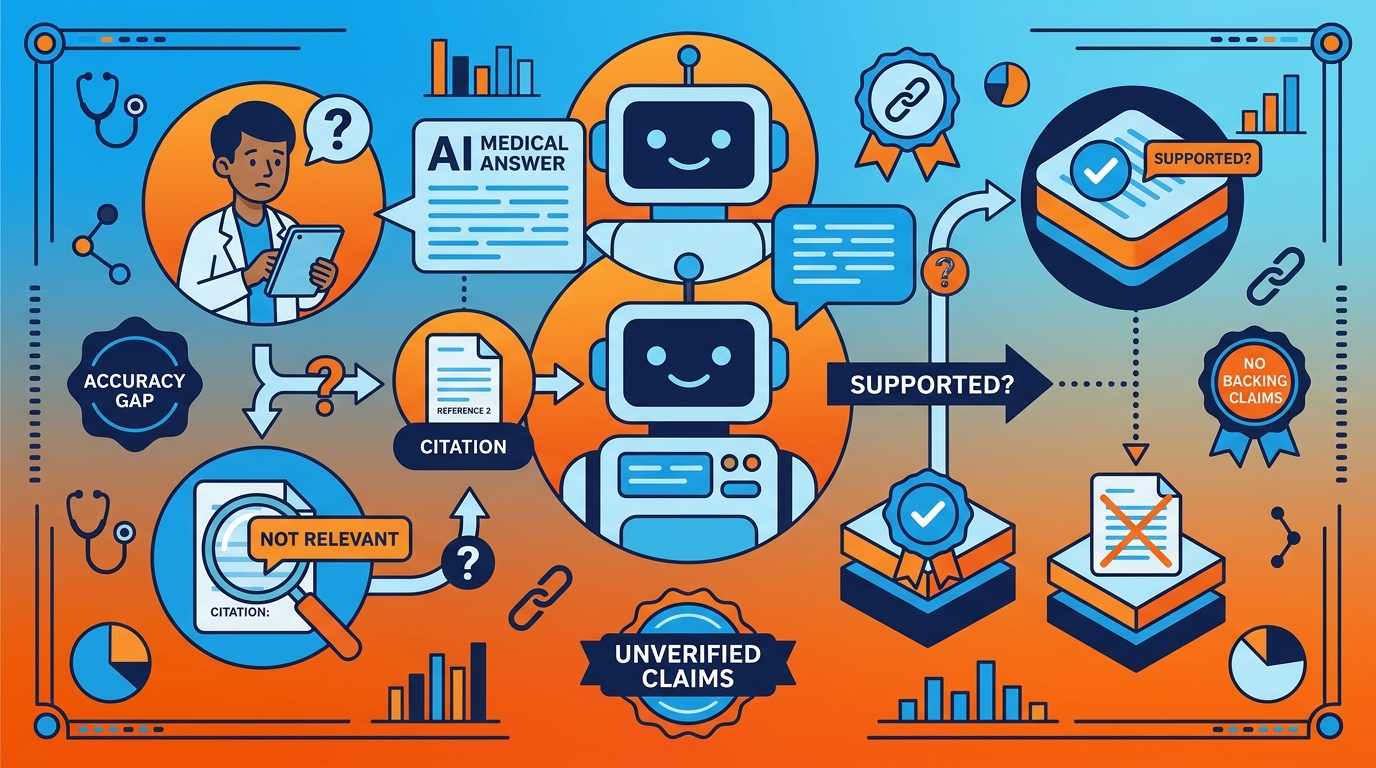
AI answers can carry a citation and still not be backed by it. One study found that between half and nine in ten (50% to 90%) of large language model answers are not fully supported by the sources they cite. Sometimes the sources even contradict them.
Even the better tools slip.
GPT-4o with Web Search left about three in ten (around 30%) single statements unsupported. And nearly half of its answers weren’t fully backed up.
Stanford’s HAI described a new paper. It looked at how four AI search engines answered 1,450 searches.
About half (50%) of the statements they wrote had no citation backing them up.
And only about three in four (75%) of the citations they gave really supported the statements.
Where AI Looks for Local Clinic Information
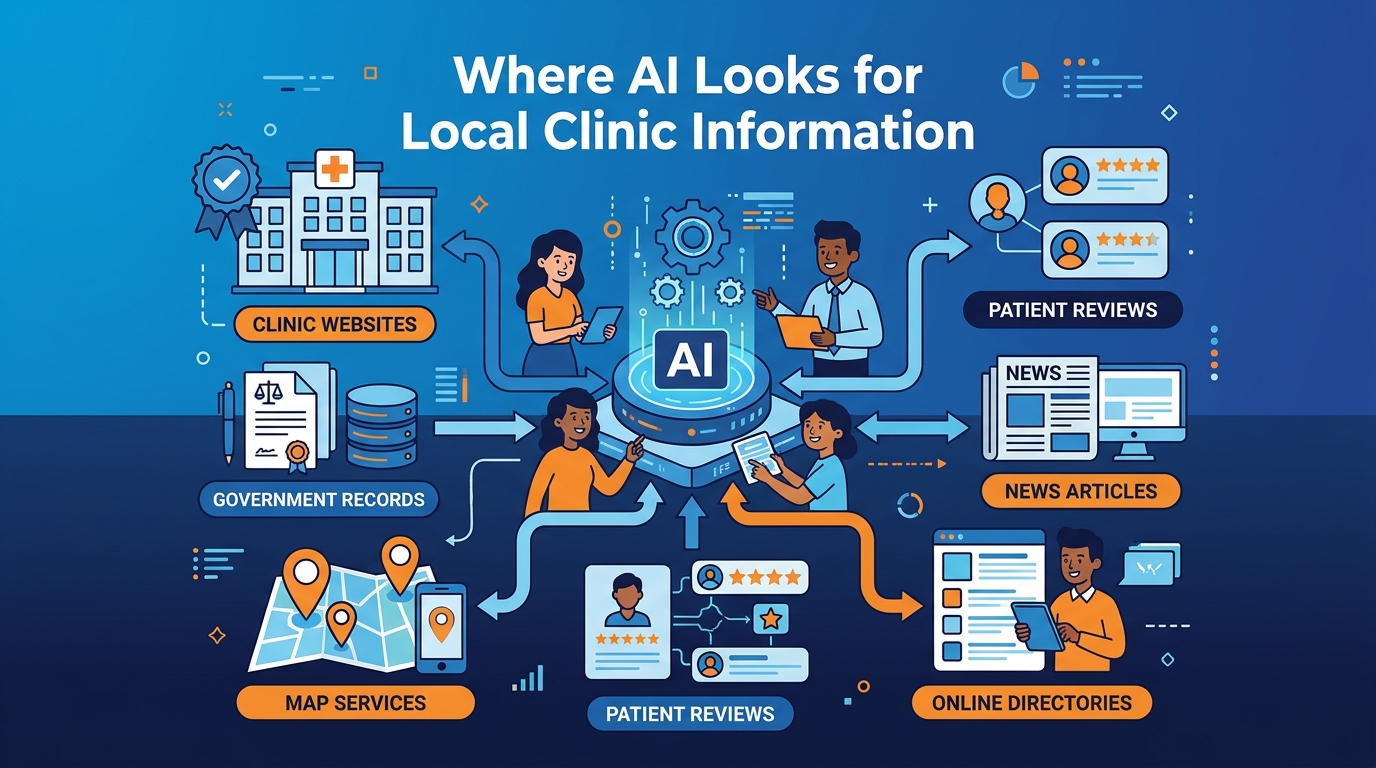
Here’s where the data comes from.
BrightLocal ran 60,970 checks. That’s about 61,000. The team ran 5 prompts at 9 different longitude and latitude points for 1,355 business locations. It used its Local AI Visibility Tracker.
The results are in Top sources and directories for local AI search.
Google Business Profile leads. It makes up a bit more than a quarter (28.5%) of all citations.
Yelp makes up a bit more than one in twelve (8.53%). It’s used more in ChatGPT results.
Here’s the part that stands out. Yelp is by far the most common source ChatGPT uses for local search. It showed up as a source in four out of five (80%) of all ChatGPT answers.
Google’s own AI tools, AI Overviews and AI Mode, pick Google Business Profile as their source of choice.
No surprise. But it shows why claiming your profile matters.
Google used it for virtually every location.
Your own website matters too.
Around 93% of the domains cited were individual business websites. That’s about 93 out of 100.
AI also turns to specialist sources depending on the type of business. The researchers found 415 directories that LLMs used as sources, to one degree or another, when looking for information about a local business. In one part of its breakdown, BrightLocal reports that Instagram and Reddit make up the bulk of the citations.
The table below sets these sources side by side.
| Source | Share or role in local AI citations |
|---|---|
| Google Business Profile | 28.5% of all citations |
| Yelp | 8.53% of all citations, increased usage in ChatGPT results |
| Yelp in ChatGPT specifically | A source in 80% of all ChatGPT answers in local search |
| Google Business Profile in Google’s AI features | Used for virtually every location |
| Individual business websites | Around 93% of domains cited |
| Directories | 415 identified as sources |
BrightLocal’s advice is short.
Get listed on key industry directories for your vertical. Make sure your own website gives clear information about your business, your location or locations, and your services.
I treat getting picked by an AI answer tool as its own discipline. Not classic search work with a new name.
I don’t chase keywords, inbound links, or ranking position. That’s aiming at the wrong target.
Here’s how I see it. These systems are trying to work out who a clinic is and whether it can be trusted. So I put the effort into the profiles and directories they check. Then I make sure those say the same clear things about the clinic.
What Structured Data Can and Can’t Do for a Clinic’s Proof
Structured data is a standardized format. It gives information about a page and classifies what’s on it.
Take a recipe page. It can say what the ingredients are, the cooking time and temperature, the calories, and so on.
Its job is limited.
MedSlots, in Which schema markup should a clinic website actually use?, says schema does not move rankings. It does not guarantee a mention in an AI Overview or in ChatGPT.
Google says plainly that no special markup is needed for its AI features either.
Markup has to tell the truth about the page.
Google’s guidance is that structured data must reflect the visible page. It can’t add facts that aren’t there.
Don’t mark up content that people reading your page can’t see.
One study scored pillars of a page by how closely each is linked to getting cited.
Each one had a p-value below 0.001.
- Metadata and freshness: correlation 0.68 (95% CI 0.64 to 0.72), citation impact +47%.
- Semantic HTML: 0.65 (95% CI 0.61 to 0.69), +42%.
- Structured data: 0.63 (95% CI 0.59 to 0.67), +39%.
- Evidence and citations: 0.61 (95% CI 0.57 to 0.65), +37%.
- Authority and trust: 0.59 (95% CI 0.55 to 0.63), +35%.
- Internal linking: 0.57 (95% CI 0.53 to 0.61), +33%.
Now the threshold analysis from the same study.
A GEO score of 0.70 or higher marks a strong inflection. That 0.70 is a threshold on the GEO score. It’s not a correlation like the figures above.
Sensitivity was 0.78. Specificity was 0.84. Youden’s index J was 0.62.
Want the claims a clinic can back up with visible proof? See Specialized Care Claims That Justify a Longer Patient Drive.
Choosing Schema Types for a Clinic and Its Practitioners
Schema.org’s availableService – Schema.org Property page describes availableService as a medical service available from this provider.
Somewhere between ten thousand and a hundred thousand (10K to 100K) domains use this property. That’s based on monthly aggregations from Google’s web index.
According to MedSlots, the MedicalClinic type adds two more fields on top of the ones it inherits.
availableService and medicalSpecialty.
Since May 2026, physician pages no longer get a rich result.
So Schema App’s Hospital and Clinic Page Best Practices now recommends the type IndividualPhysician.
Structuring Services, Hours and References So AI Can Read Them
Schema App gives a short list of habits for the page itself.
- Group services and specialties in consistent HTML components. Don’t put all your services in one undifferentiated paragraph when each one needs to be targeted on its own.
- When a service or specialty has its own entity home page, link to it internally.
- Make sure reviews and ratings are about the Hospital itself, not a parent organization, a department, a physician, or a separate location. Only use sameAs for URLs that share the same identity as the Hospital.
- Use authoritative external references, such as trusted healthcare directories, social profiles, accreditation pages, or other reputable profiles.
- List opening hours day by day, instead of relying only on compressed ranges like “Monday-Friday”.
MedSlots adds one more rule.
Keep your clinic’s phone number, address and name identical to what’s on your Google Business Profile. And everywhere else your clinic is listed.
Mismatched details across your site and your profile are a more common problem than picking the wrong schema type.
Frequently Asked Questions
Can a clinic mark up its own reviews to look more credible?
No. Under Google’s own rules, a clinic that marks up its own reviews or star rating is explicitly ineligible for the review rich result. That markup is for third-party review sites, not for the business being reviewed.
Does an FAQ block still earn a rich result in Google Search?
No. Google stopped showing the FAQ rich result in Search from May 7, 2026. Keeping FAQPage markup is harmless. But it won’t earn you any extra space on the results page.
Is JSON-LD markup alone enough to improve AI answer accuracy?
No. One study found JSON-LD markup alone gives only modest gains (a change of +0.17, adjusted p-value 0.024).
What worked was an enhanced entity page format. It used llms.txt-style agent instructions, breadcrumbs, and neural search capabilities. That gave about 30% better accuracy (+29.6%) for standard RAG (p less than 10 to the minus 21st power; effect size d = 0.60). The full agentic pipeline got about 30% (+29.8%) (p less than 10 to the minus 21st power; effect size d = 0.61).
Can a provider hide their public NPI registry record?
No. You can’t opt out of or suppress the NPPES record data for health care providers with active NPIs.
The NPI Registry is a query-only database. It’s updated daily. Users can query the NPPES, by NPI or provider name for example, and retrieve the FOIA-disclosable data from the search results.
What AI Cites, and Where a Clinic Can Start
Here’s what the numbers say.
AI bases its answers about brands by far on third-party sources. About six in seven citations (85.7%) point to sites the brand doesn’t own. About one in seven (14.3%) point to sites it does own.
AI also turns to specialist sources, depending on the type of business.
Schema does not move rankings. It does not guarantee a mention in an AI Overview or in ChatGPT.
So the proof that gets cited is proof others can check. On third-party sources. On clear, complete pages.
It’s not a markup trick.
I put a client’s effort and money into assets the business owns. Clear, credible facts about itself. I expect those to keep paying off and grow over time.
I don’t lean on visibility bought through ads or paid placements. It stops the moment the spending stops.
I won’t sell the old search playbook that many agencies still sell.
The conditions it relied on have changed. Clients end up paying for tactics aimed at a landscape that’s gone.
I count that as a problem with what the industry offers. Not with the clinic owners buying it.
How the work is done is laid out on the iTech Valet Service Plans & Pricing page.
Want to see what AI picks up about your practice today? Run My AI Visibility Check.