
A review of choice-overload research assumes that choice overload can occur only when no option is clearly the best and many options are not clearly worse than the others. Otherwise, the review says, the decision is easy no matter how many options there are. One important precondition is that people do not know the options well and have no earlier preferences for them. Answers written by large language models (LLMs, the AI behind chatbots) often follow an in-or-out pattern: a source is either included in a prominent way or left out entirely.
What the Choice-Overload Studies Actually Found
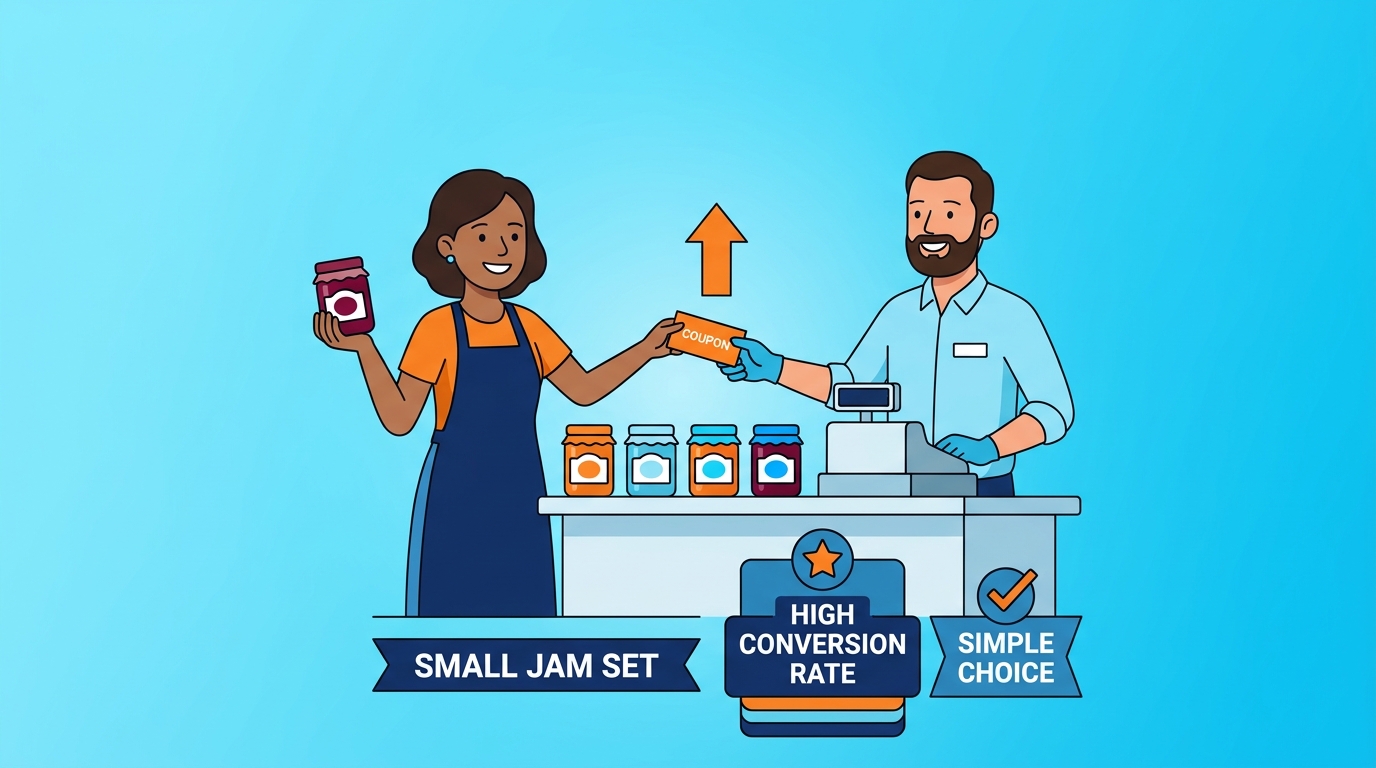
In the jam study, 30% of shoppers who saw the small set of 6 jams at the tasting table bought one with the coupon. In the large set of 24 jams, only 3% of shoppers used the coupon to buy a jam. In a lab experiment, only 12% of people in the large-selection group took a box of chocolates instead of money as pay for taking part. In the small-selection group, 48% took the chocolates.
Then the picture got messier.
A researcher named Scheibehenne (2008) tried to repeat the Iyengar and Lepper (2000) jam study in an upscale supermarket in Germany. He did not find any negative effects of choice overload.
So researchers pooled the data.
A meta-analysis (a study that combines the results of many studies) looked at 63 conditions from 50 published and unpublished experiments, with just over 5,000 (5,036) participants. It found a mean effect size of virtually zero. But the results varied considerably from one study to the next.
The paper is Can There Ever Be Too Many Options? A Meta-Analytic Review of Choice Overload.
Another meta-analysis dug deeper.
It looked at 99 observations covering about 7,200 (7,202) participants. It named four key factors that change how much the number of options leads to choice overload. How complex the set of choices is. How hard the decision task is. How unsure people are of what they prefer. And what the person’s goal in deciding is.
Here’s the part that matters. Its authors found that when those factors are taken into account, the overall effect of the number of options on choice overload is significant. They call that a finding counter to the data reported by prior meta-analytic research.
The paper is Choice overload: A conceptual review and meta-analysis.
The table below lines up each study or condition with what it found and where it came from.
| Study or condition | Finding | Source |
|---|---|---|
| Original jam tasting study | 30% who saw 6 jams bought one with the coupon; 3% who saw 24 jams did | Journal of Consumer Research |
| German supermarket replication | No negative effects of choice overload found | Journal of Consumer Research |
| Lab chocolate experiment | 48% in the small set took chocolates instead of money; 12% in the large set did | Journal of Consumer Research |
| Meta-analysis of 63 conditions | Mean effect size virtually zero, considerable variance between studies | Journal of Consumer Research |
| Meta-analysis of 99 observations | Overall effect significant when moderating variables are taken into account | Journal of Consumer Psychology |
The Conditions Under Which One Name Beats a List
Start with what overload actually is.
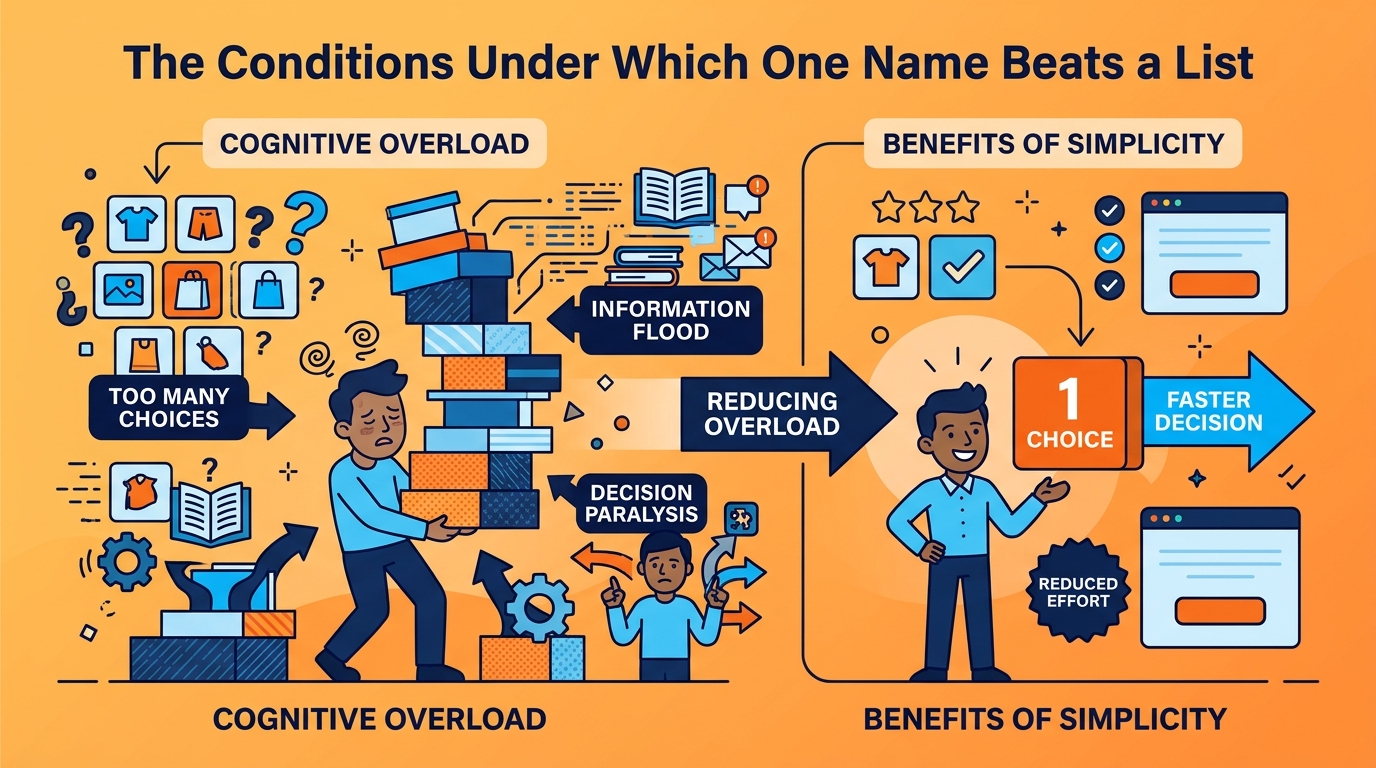
The Journal of Consumer Psychology review says the term choice overload, also called overchoice, is typically used for a case where the complexity of a decision exceeds a person’s cognitive resources. It cites Simon (1955) and Toffler (1970).
The same review finds that overload is helped along by a harder decision task, a more complex set of choices, more uncertainty about what you prefer, and a more prominent, effort-minimizing goal.
Now the other side.
The Journal of Consumer Research review assumes choice overload can occur only if no option is clearly the best and many options are not clearly worse than the others. Otherwise, the decision is easy. However many options there are.
It names one important precondition: lack of familiarity with, or earlier preferences for, the options.
Now picture your new patient picking a provider.
They don’t know the options. No option stands out. The decision is hard.
That’s the setup for overload.
Assistants Tend to Feature a Business Prominently or Leave It Out
Here’s what most people miss.
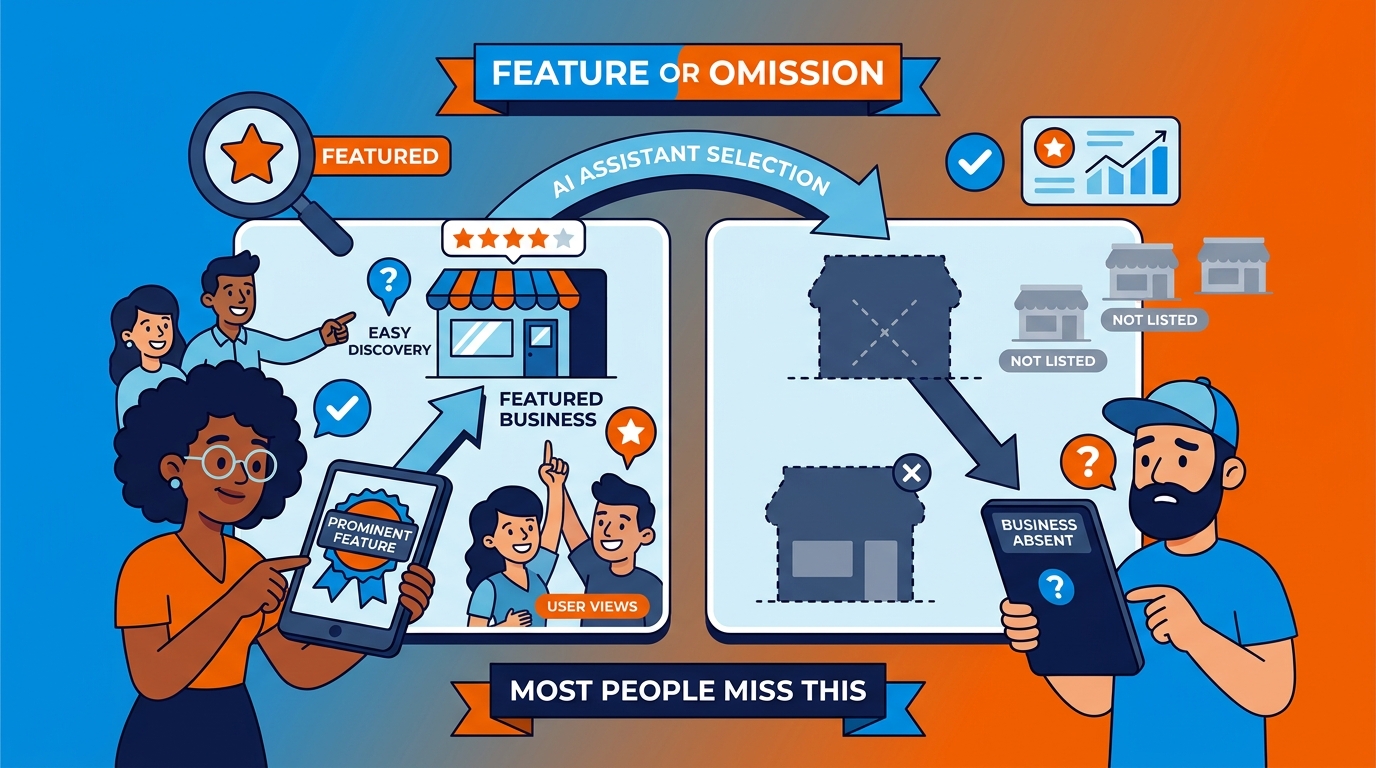
Answers written by large language models often follow an in-or-out pattern. A source is either included in a prominent way or left out entirely.
On ChatGPT, the brand usually named first was named first on 50% of days. It showed up somewhere in the answer on 67% of days. On the days it wasn’t first, it usually had not slipped down the list. It was missing completely.
Here’s a real example.
In ChatGPT’s results, City of Hope hospital in Los Angeles showed up in 69 of 71 answers. That’s a 97% visibility rate. But in the rankings of which hospitals ChatGPT showed, it was the top mention in only 25 of those responses.
Being present and being named first were measured separately. They’re not the same thing.
The tools also differ.
Perplexity and Google cite more sources on average. ChatGPT cites fewer sources, but its average citation influence among fetched pages is substantially higher.
Here’s how I work.
I build for your practice to be the name an assistant names and draws on. Not one more entry in a directory. Being relied on is the target I work toward. Being merely present doesn’t count for me.
What if an assistant keeps naming a competitor? That’s covered in How to Respond When an Assistant Keeps Naming a Rival Clinic.
Why the Same Question Returns Different Names
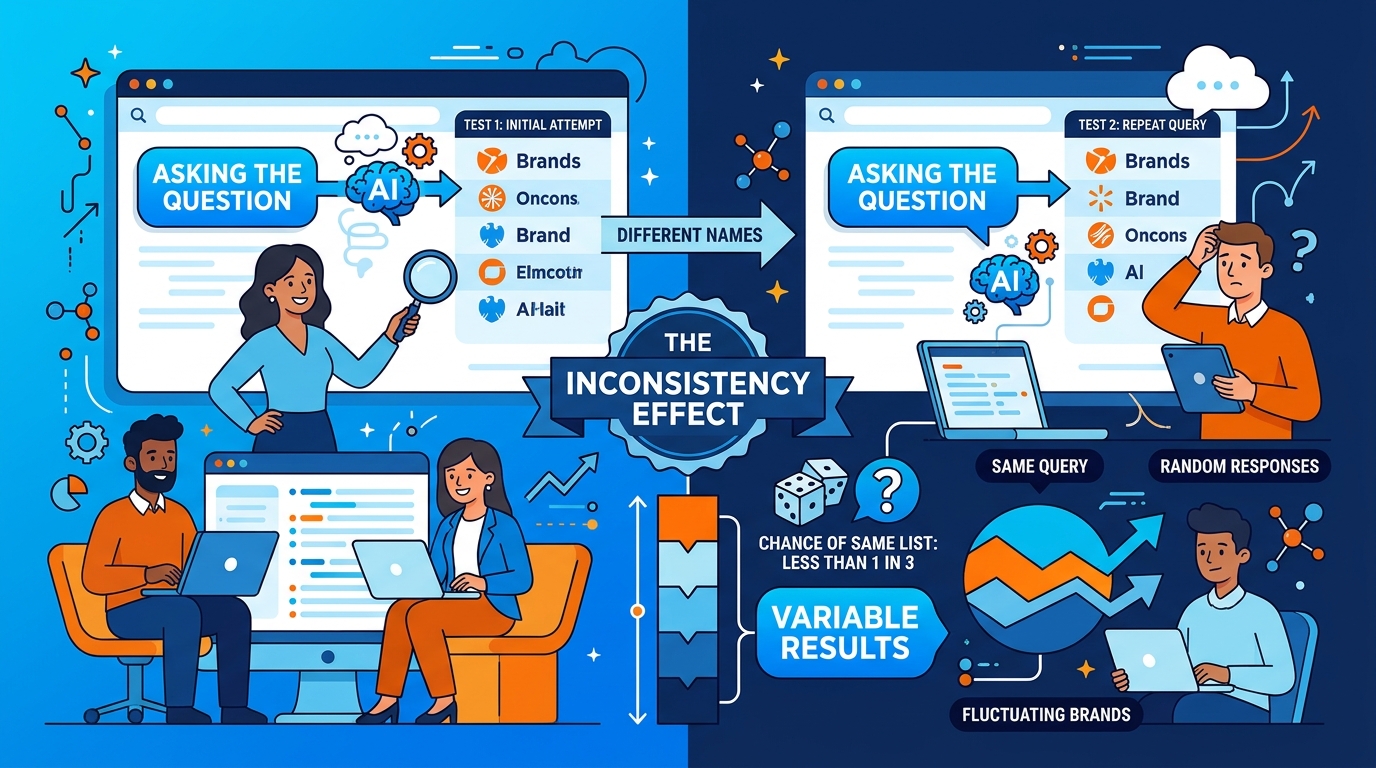
If ChatGPT or Google’s AI is asked the same question 100 times, there is less than a 1 in 100 chance that any two answers give the same list of brands. When the order counts too, the answers are so random that it takes roughly 1 in 1,000 runs before two lists come up in the same order.
In the study, 600 volunteers ran 12 different prompts through each of the 3 tools, a combined 2,961 times. Overall, the prompts had a semantic similarity (how alike their meaning is) of 0.081 on the study’s own scale. The full write-up is AIs are highly inconsistent when recommending brands or products.
With lists that reshuffle from run to run, I don’t use rank-tracking reports to judge how a practice is doing. Since AI tools started giving direct answers instead of lists of links, I treat a site’s spot in a results list as a number that looks good without driving outcomes, and I retire position-tracking as a measure of success.
How Often Consumers Ask AI to Name a Local Business
Consumers meet AI help in two ways.
Some seek it out directly. Over half (57%) use ChatGPT, and about half (51%) use Gemini. Others run into it inside tools they already use. About half (51%) have seen an AI answer at the top of Google results. Roughly 1 in 3 (35%) have clicked into Google’s AI Mode.
About 3 in 10 people (31%) say they’ve asked a platform like ChatGPT, Claude, or Gemini to recommend or find a local business many times. Another 26% have tried it at least once or a few times.
In the same survey, a little over half (55%) have consulted the AI-based summaries from Google and Bing. Nearly half (48%) have interacted with a conversational AI like ChatGPT. These numbers come from Beyond The Stars, 2025.
Want to know what assistant answers do to bookings? Read How Assistant Answers Impact Bookings: A Complete Guide.
Want to know whether assistants name your practice? That’s what the AI Visibility Check looks at.
What People Check Before Contacting a Named Business
A name is not the end of the choice.
When an AI tool recommends a business, more than 8 in 10 consumers (81%) take some kind of verification step before they contact it. They check reviews (33%). They check the business’s social media (20%). They search on their own to confirm details (16%). Or they check multiple sources (12%). Only 19% go straight from the AI recommendation to contacting the business. The details are in Americans are using AI to find local businesses. Most don’t trust it yet.
Among consumers who use AI tools, about two-thirds (67%) say they’ve been given wrong information about a local business at least once.
And about 3 in 10 (30%) say that bad information caused a real inconvenience.
Reviews and word of mouth lead in five of the eight categories studied, from restaurants (41%) to healthcare (38%). According to the Local Discovery Index, 99% of consumers read reviews before a first visit at least some of the time, and 68% do so always or most of the time.
Star ratings act as a gate. About 1 in 5 potential customers (18%) insist on a perfect 5-star rating in order to choose a business. About 1 in 4 (24%) want at least a 4.5 average. About 4 in 10 (37%) require 4 stars or higher. Replies matter too: seventy-two percent of consumers are more likely to choose a business that responds to its reviews, up from 65% in 2025.
Want the steps between a named recommendation and a phone call? They’re traced in From Recommendation to Ringing Phone: Tracing the Assistant Call Path.
Here’s the table. The main checking figures, side by side.
| Check | Figure |
|---|---|
| Take a verification step after an AI recommendation | 81%; 19% go straight to contacting the business |
| Read reviews before a first visit | 99% at least some of the time; 68% always or most of the time |
| Minimum star rating required | 37% require 4+; 24% want 4.5+; 18% insist on 5 |
| More likely to choose a business that responds to reviews | 72%, up from 65% in 2025 |
When you ask me where to put effort and money, I point you at what your practice controls. Clear, credible information about itself. And the reviews and profile a patient checks.
I’d rather build visibility that keeps paying and grows. I won’t rent it through ads or paid placement that stops the day the spending stops.
Frequently Asked Questions
How many businesses does an AI assistant name in one answer?
It varies. In one study, the AI sometimes gave as few as 2 or 3 recommendations, and equally often it gave 10 or more.
Do well-known brands crowd out smaller ones in AI recommendations?
In one test, big names showed up a lot. Across 994 AI responses, headphone brands like Bose, Sony, Sennheiser, and Apple appeared 55 to 77 percent of the time. But that test covered headphones, not local businesses. Don’t read it as a verdict on your practice.
Do people click the sources an AI cites before choosing?
One in three always does. Just 33% always click the links and sources an AI product gives them before deciding to buy from local brands. Another 26% click frequently, and 23% only sometimes. 8% rarely check sources, and 9% never do.
How many people always read reviews before choosing a local business?
About 4 in 10. In the survey, 39% always read local business reviews before choosing one. Another 34%, about 1 in 3, do it most of the time. Your reviews get read.
What do people do when a choice feels overwhelming?
They tend to put it off, or they switch. Higher levels of choice overload (feeling swamped by too many choices) go along with a greater chance of putting off the choice and a greater chance of switching. They also go along with less liking for larger sets of options. And more liking for options that are easy to justify. So be the easy one to justify.
Becoming the One Name
A single name helps most when the person choosing doesn’t know the options and no option stands out. That’s where new patients start.
You want to be the singular recommended choice when AI is asked who to trust. To get there, your practice has to be that name. And it has to hold up when the patient checks.
I treat getting picked by AI answer tools as its own discipline: Answer Engine Optimization. It’s not old-school search work renamed. I don’t chase keywords, inbound links or ranking position.
I put the effort into making it easy for these systems to work out who your practice is and whether it’s credible.
Here’s how the work is done: iTech Valet Service Plans & Pricing. Want to see where your practice stands today? Run My AI Visibility Check.