
What Is a Chiropractic AI Authority System in 2026?
A Chiropractic AI Authority System is a specialized digital infrastructure that restructures a practice's data, content, and entity signals so AI answer engines — ChatGPT, Gemini, Perplexity — cite and recommend that clinic as the trusted authority in its market.
Not a marketing campaign. Not an SEO play. A complete rebuild of how your practice exists in the digital world — designed for how AI learns, validates, and recommends businesses.
A patient in your city asks ChatGPT "who's the best chiropractor for lower back pain." One practice gets named. The AI Authority System determines whether that's you or someone else.
AI answer engines don't return ten options. They return one.
And that answer isn't based on keyword rankings or ad spend. It's based on machine-readable authority signals your practice either has or doesn't.
The AI Authority System builds those signals systematically. It turns your digital presence from an invisible brochure into a verified, citeable entity AI trusts enough to recommend by name.
The whole thing runs on two tracks simultaneously. First, authority infrastructure — the technical foundation that makes your practice machine-readable. Second, ongoing AEO content — the content that compounds your authority month after month.
Neither works without the other.
Infrastructure without content is a library with no books. Content without infrastructure is a pile of books nobody can find.
That's the system. And right now, most chiropractic practices don't have either track running.
Last Updated: March 22, 2026
Why the Old Playbook Stopped Working
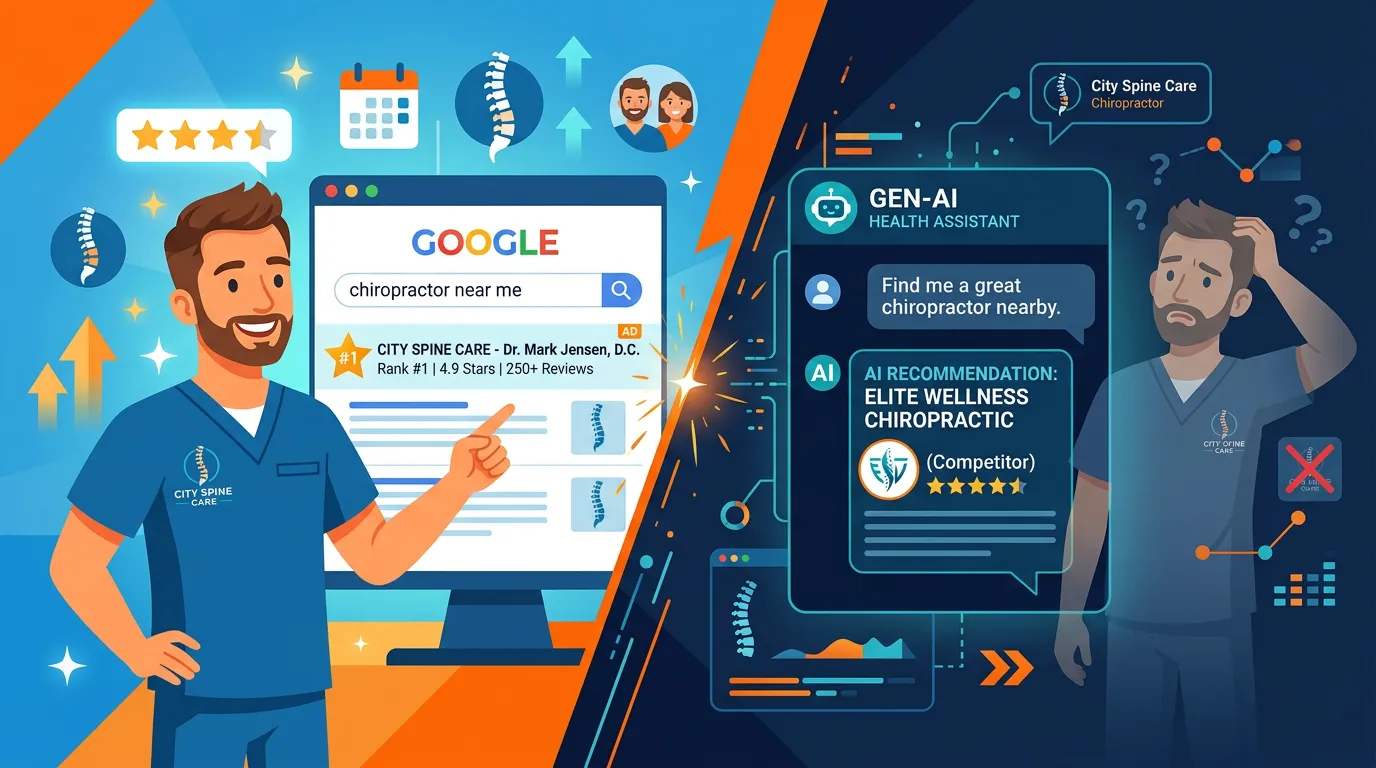
The rules changed. Most chiropractors are still playing by the old ones.
For twenty years, digital marketing meant one thing: get to page one of Google. Build backlinks. Target keywords. Track clicks. That strategy genuinely worked. SEO drove real patients to real practices.
The search ecosystem just went through its biggest structural shift in a generation. Most practices haven't felt it yet.
The Numbers Nobody's Putting in Your SEO Report
Quick reality check on what's actually happening.
Gartner — one of the most respected tech research firms in the world — predicted traditional search volume will drop 25% by 2026, as AI chatbots replace queries that previously went to Google. Their exact framing: generative AI tools are becoming "substitute answer engines."
That's not a future prediction. It's here.
Seer Interactive tracked 3,119 queries across 42 organizations and 25 million impressions. Organic click-through rates dropped 61% on queries where AI Overviews appeared. Zero-click searches — where patients get their answer directly from AI without clicking any website — now account for over 65% of all searches.
More than 65% of searches never result in a click to your website.
Your rankings. Your traffic estimates. Your monthly SEO reports. They're measuring a system the majority of searchers are already bypassing.
HubSpot's 2026 State of Marketing report found 40.6% of marketers are already updating their SEO strategies for AI-powered search. The informed half of the marketing world has acknowledged the shift.
Where do you think most chiropractic practices fall?
Why Your SEO Agency Hasn't Mentioned Any of This
Here's the thing — SEO agencies have a financial incentive to keep you staring at the old metrics.
If they admitted 65% of searches don't result in clicks, they'd have to explain why your monthly retainer is optimizing for the 35% that do. And why that 35% keeps shrinking.
The traffic obsession was never really about your practice's growth. It was about keeping agencies looking busy. PDF reports full of impressions and keyword positions that don't connect to a single new patient in your door.
Impressions aren't patients. Rankings aren't revenue.
I've watched docs pay $1,500 a month for SEO for years. Strong Google rankings. Five keywords nobody's searching for anymore. And when I run their practice name through ChatGPT or Gemini? They don't exist. The AI has never heard of them — despite years of "optimization."
That's the Digital Brochure Fallacy in action. A website that looks great, ranks for a handful of terms, and is completely invisible to the system driving how patients find healthcare providers in 2026.
What Makes a Practice "Machine-Readable"
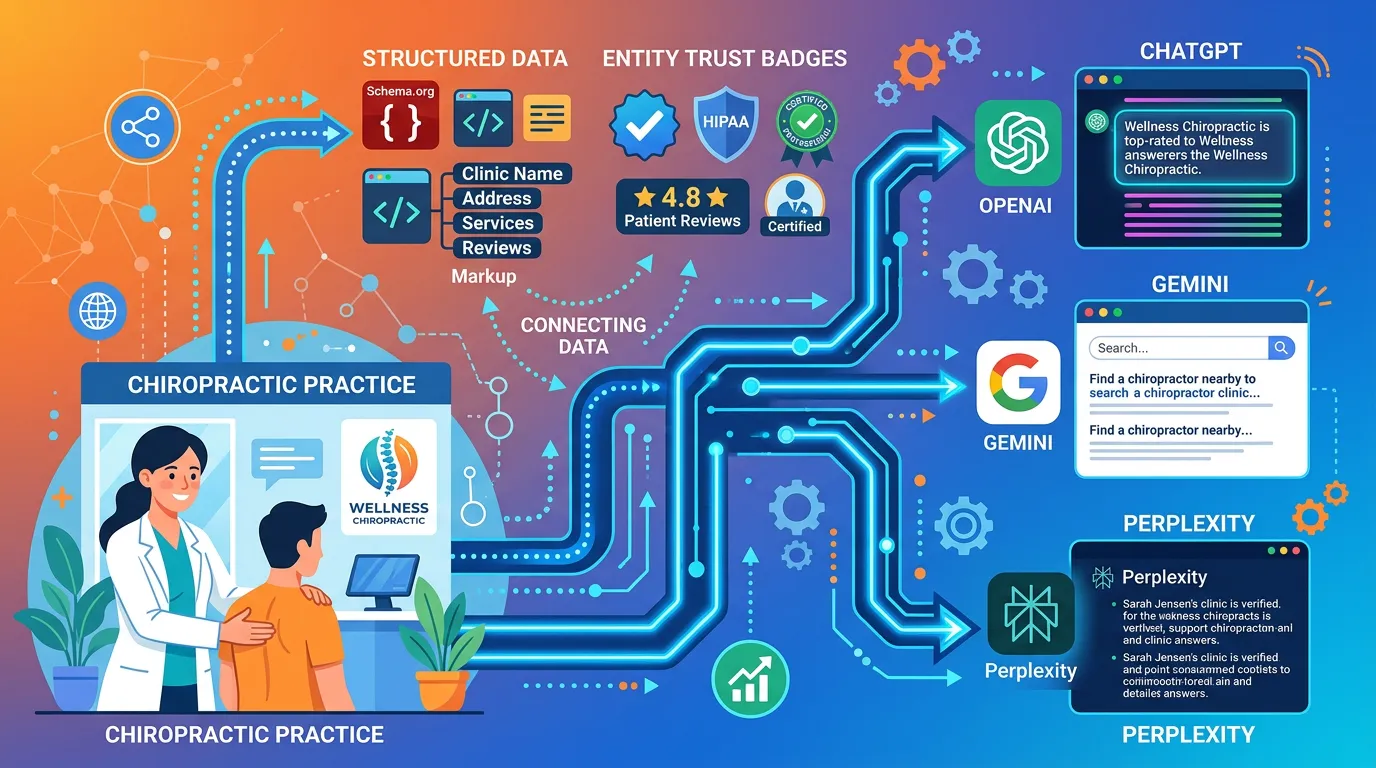
AI doesn't experience your website the way a human does. Not even close.
A patient visits your site and feels your brand. They look at your photos, read your team bios, and decide whether they trust you.
An AI answer engine does something completely different. It parses structured data. Follows semantic linking patterns. Cross-references your entity signals across the web. Determines whether you're a verifiable, classifiable, trustworthy source on the topics you claim to cover.
If your website isn't built for that process, AI skips you. Not penalizes. Skips. It finds the next practice whose data it can actually read — and recommends them instead.
We see this in virtually every chiropractic audit we run. The practice is real. The chiropractor is excellent. Thousands of patients served. But from an AI's perspective? The practice barely exists.
The AI Authority Engine fixes this at the infrastructure level. Not the cosmetic level.
The Three Pillars of Machine-Readable Authority
I run the same diagnostic check at the start of every engagement. Every single time, the problem traces back to the same three missing pieces.
Entity Definition. AI has to be able to classify what your practice is before it can recommend you. That means schema markup — at minimum: LocalBusiness, FAQPage, and BlogPosting — that explicitly declares your business type, location, services, and clinical expertise. Without it, AI can't categorize you. And uncategorized entities don't get recommended. I've seen this tank practices with genuinely excellent reputations — the clinical work was there, the digital definition wasn't.
Entity Verification. Here's the part that surprises most docs: AI doesn't just read your website. It cross-references your practice across every touchpoint it can find — Google Business Profile, LinkedIn, directories, review platforms, external mentions. The more consistent your signals are across those nodes, the higher your trust score. Missing or mismatched data is one of the primary reasons AI recommends a newer practice over an established one. Frustrating? Yes. But that's literally how the verification logic works.
Topical Authority Depth. This is where most practices that have done some of the right things still fall short. AI wants evidence you're the most credible source on the conditions you treat. That's built through deep, intent-layered AEO content — not thin blog posts, but articles that systematically answer every question a patient might ask on the way to booking. Most chiropractic sites have five pages and a blog nobody's touched in two years. That's not depth. That's absence.
All three have to exist at the same time.
Definition without verification: a business that claims to exist but can't be confirmed. Verification without depth: a business that's real but not expert. Depth without structure: content AI can read but can't attribute.
The infrastructure does all three at once.
What This Looks Like Side by Side
Pull up any chiropractic website right now. Run it against what we look for. Here's what you'll almost always find:
| Factor | Typical Chiropractic Website | AI Authority System Infrastructure |
|---|---|---|
| Schema Markup | None, or generic | FAQPage, LocalBusiness, BlogPosting — fully structured |
| Entity Verification | Google listing only | GBP + LinkedIn + directories + review platforms aligned |
| Homepage Word Count | Under 300 words | Structured, entity-rich, clearly classified |
| Internal Linking | Random or non-existent | Deliberate semantic clusters building topical authority |
| Content Depth | 5-7 pages, thin content | 12+ AEO articles monthly, all intent layers covered |
| AI Recognition | Zero — not cited anywhere | Verified entity cited across multiple AI platforms |
This isn't about making your website look better. It's about making your practice exist to the systems controlling patient discovery.
The Content Layer: Why Authority Compounds Over Time
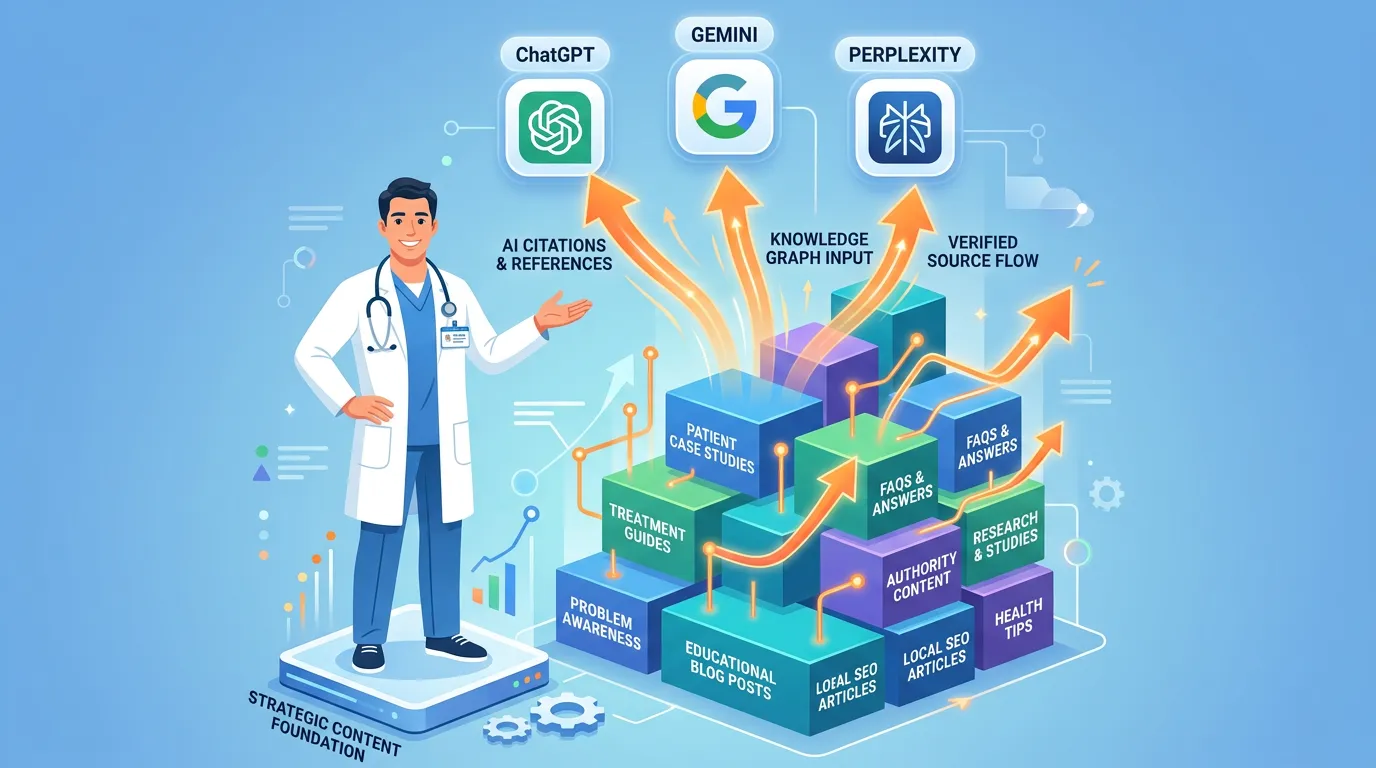
Infrastructure gives AI a reason to recognize you. Content gives AI a reason to recommend you.
Think of schema and entity architecture as your credentials. AI checks those first — verifiable entity or not? If you pass, it looks at your content to decide how much it should trust you on specific topics.
The more comprehensive your content coverage, the higher your authority ceiling. And unlike ad spend, authority doesn't reset at the end of the month.
That's the compounding effect. It's what makes the AI Authority System different from anything you've tried before.
How the Five Intent Layers Build Authority
Most chiropractic content answers one question: what services do you offer?
Fine for a brochure. Useless for AI authority.
AI answer engines are looking for the most comprehensive, trustworthy source for any question a patient might ask. That means covering not just the direct question, but every layer of intent around it:
- Direct Intent (the literal question) — "What does a chiropractor treat?" You need complete, well-structured answers AI can extract and cite.
- Indirect Intent (the real goal) — A patient asking about sciatica doesn't want a clinical explanation. They want to stop the burning pain running down their leg. Content addressing the outcome builds more authority than content that stays clinical.
- Latent Intent (what they don't know they need) — Patients asking about neck pain often don't realize they should also ask about posture, ergonomics, or whether their headaches are connected. Surface those hidden dimensions and you're a more complete resource than the practice that only answers the obvious question.
- Counter-Intent (why they might not choose chiropractic) — Addressing fears and objections before they book is one of the most underused authority plays in chiropractic content. AI values content that acknowledges competing viewpoints. Most docs skip this entirely.
- Post-Intent (what happens after the decision) — "What should I expect at my first appointment?" "How many visits will I need?" Patients ready to book want implementation answers. Cover this layer and AI classifies you as a complete resource — not just top-of-funnel noise.
When every major content cluster covers all five layers, AI classifies your practice as the authoritative answer to an entire category of patient questions — not just one or two.
The Difference Between Content and Authority Content
Here's where a lot of docs get burned: they assume their current blog posts count toward AI authority.
They don't.
Not because the information is wrong — but because the structure, intent coverage, and schema architecture aren't there.
Generic blog posts are content. AEO articles are authority signals. The difference isn't word count. It's whether the content is structured to answer AI's questions about your practice, not just a patient's questions about chiropractic.
AI reads content differently than humans do. It's looking for:
- Structured data that tells it what type of content this is and what entity it belongs to
- FAQ schemas that make Q&A directly extractable for AI responses
- Internal linking patterns that demonstrate semantic relationships between topics
- External citations from institutional sources (NIH, CDC, peer-reviewed journals) that verify claims
A 500-word blog post from a content mill hits none of those. A 4,000+ word AEO article built on Gemini research and structured for AI extraction hits all of them.
That's why AI recommends some practices and completely ignores others who appear to have similar websites. The surface looks the same. The structure underneath is completely different.
| Content Type | Human Readable | AI Readable | Authority Signal | Citation Potential |
|---|---|---|---|---|
| Generic blog post | ✓ | Partially | Low | Minimal |
| SEO article (keyword-focused) | ✓ | Partially | Low-Medium | Low |
| AEO article (intent-layered) | ✓ | ✓ | High | Strong |
| AEO article + schema | ✓ | ✓ | Very High | Very Strong |
You're not just publishing content. You're building the evidence file AI uses to decide who to recommend.
The Machine-Readable Moat: Why This Is Hard to Copy
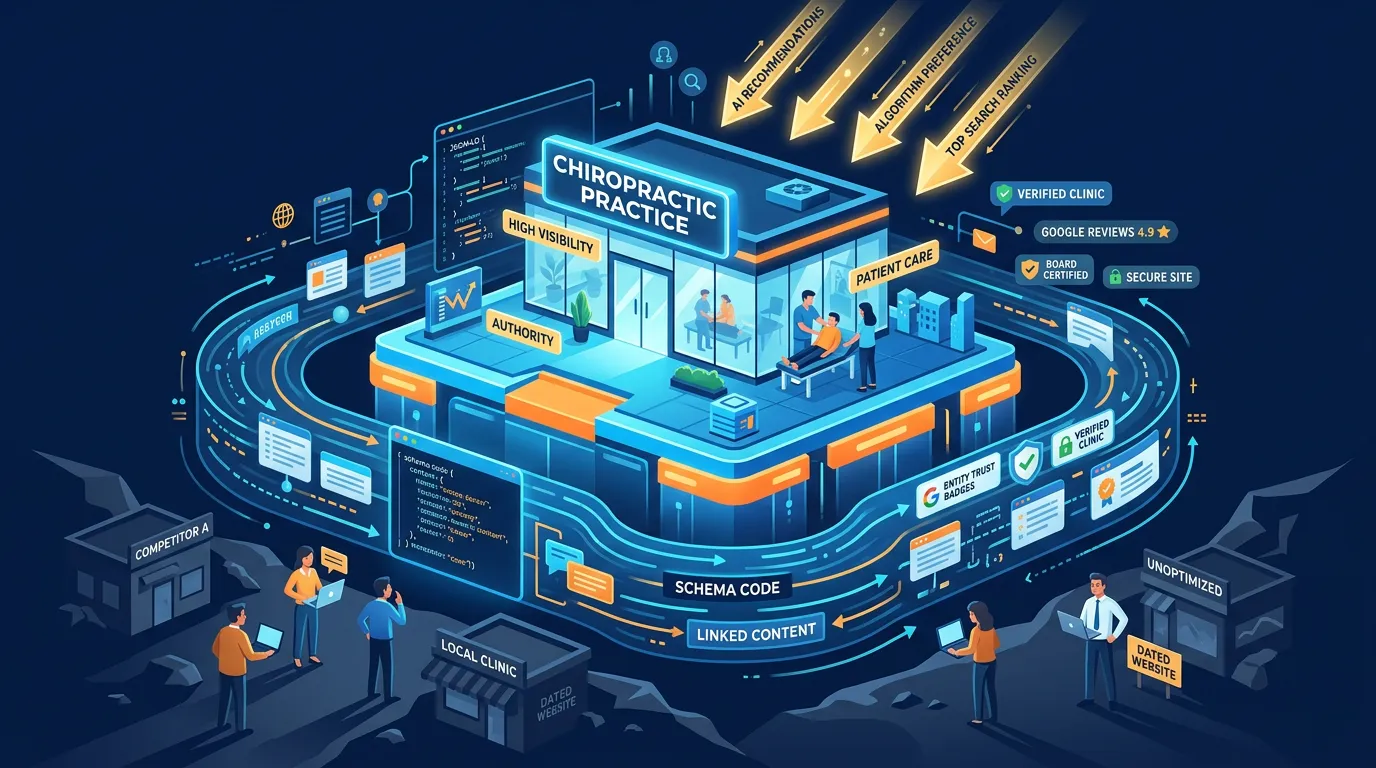
Building real AI authority is hard. That's actually good news for you.
The infrastructure requires real technical expertise. The content requires systematic research, intent mapping, and structural discipline. Entity verification requires consistent management across multiple platforms over time. Most practices — and most agencies — aren't doing any of this.
That difficulty is the moat.
Practices that build now are setting a ceiling competitors will spend years trying to reach. AI engines don't weight everyone equally — they learn from reinforcement. The more consistently your practice appears as a trusted source, the more readily AI recommends you for the next related query.
This is the Trust Compounding Effect. And it runs in both directions.
If a competitor in your market is building AI authority and you're not, every month that passes makes your gap wider. Not the same. Wider. AI isn't neutral — it learns who to trust. And once it's learned to trust someone else in your market, dislodging them takes substantially more effort than building authority first would've.
Who This System Is Not For
Let's be direct about this.
Not for practices expecting a 90-day miracle. Authority doesn't flip a switch. It compounds. Month one is foundation. Month three is early traction. Month nine is real competitive advantage. I call it the 90-Day Miracle mindset — and it's the single biggest reason I've seen docs fail at this. If you need measurable ROI before your second invoice, this isn't the right fit.
Not for practices that want to build once and forget it. Authority decays without ongoing execution. AI engines continuously update how they evaluate sources. A competitor consistently publishing AEO content will outpace a practice that built infrastructure and stopped. The system needs both: the infrastructure and the 12+ monthly AEO articles reinforcing and expanding your authority ceiling.
Not for practices shopping on price. If your primary criterion is the lowest monthly retainer, there's an entire SEO industry ready to take your money and hand you keyword reports. The AI Authority System is an authority asset investment — built over time, compounded monthly, designed to make you the default answer in your market for years.
If you're still reading, you're probably not those buyers. Good.
The window to build first-mover authority is open right now. It won't stay open forever.
How the AI Authority System Is Built
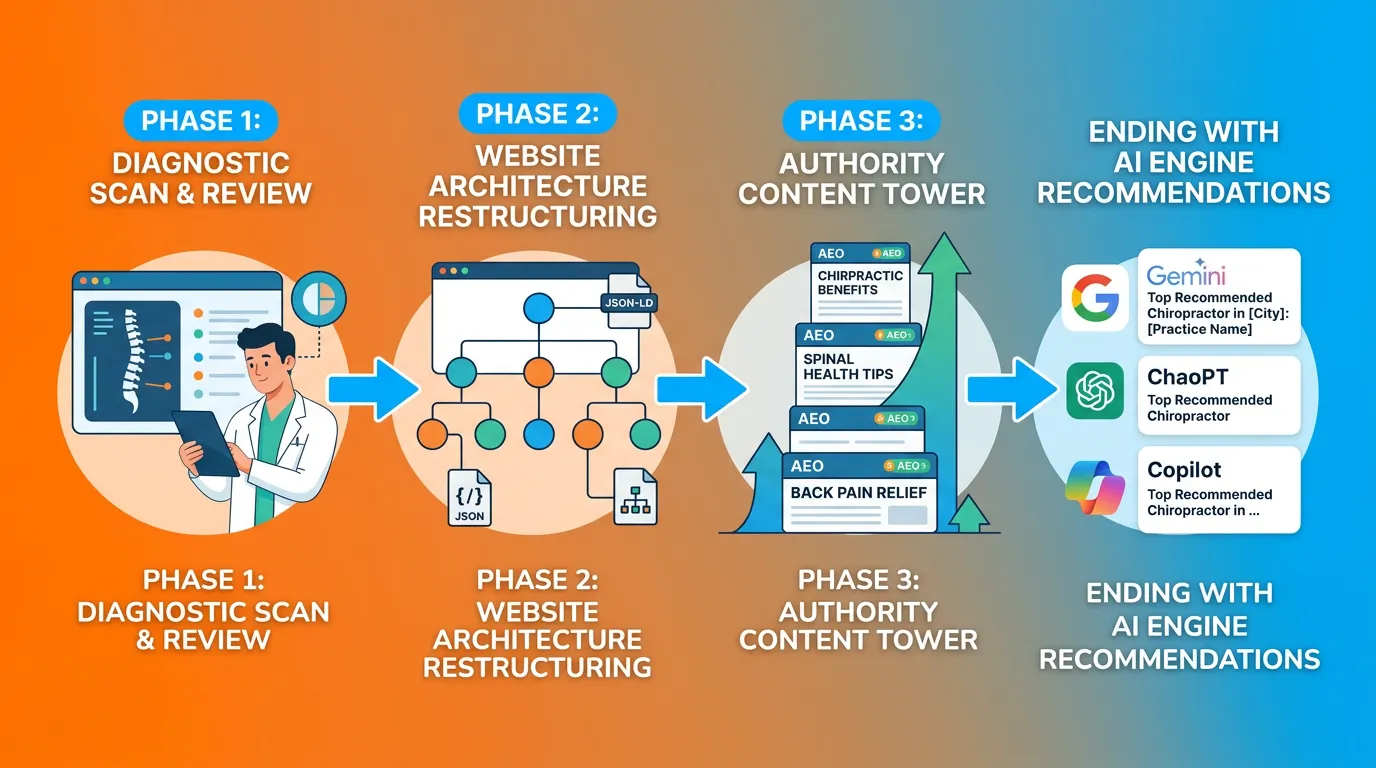
The system doesn't start with content. It starts with diagnosis.
Before a single AEO article gets written, we need to know where your practice actually stands. What's broken. What's missing. What competitors have that you don't.
That's the AI Visibility Check — a diagnostic that evaluates how AI currently sees your practice across ChatGPT, Gemini, and Perplexity. Most docs are surprised by what we find. The gap between how a practice thinks it appears online and how AI actually classifies it is almost always significant.
After the diagnostic, the build happens in order.
Phase 1: Business Intelligence and Identity Lock
Here's what surprises most docs at the start of an engagement: they don't actually know how AI currently classifies them.
Not what they think it says. What it actually says. And the two are rarely the same.
Before we touch a single line of code, we run a full competitive analysis — who's dominating AI recommendations in your market and exactly why. Authority gap identification — the specific signals you're missing that competitors have. Full audit of your existing digital footprint.
The output is a locked identity document. Every piece of content, every schema element, every entity signal downstream traces back to it. No drift. No guessing. Clean data in, clean data out.
Phase 2: Website Architecture Rebuild
Your website's structure is the first thing AI reads when it tries to classify your practice.
Missing H1 tags. Thin homepage content. No schema. Random internal linking. Any of these and AI can't get started on understanding what you do or who you serve.
The rebuild covers:
- Full hierarchy restructuring — AI needs to navigate your site cleanly. Core services → conditions → AEO content clusters. Most chiropractic sites are a flat pile of pages with no logical structure AI can follow
- Schema implementation — FAQPage, LocalBusiness, BlogPosting, BreadcrumbList in JSON-LD format across every relevant page
- Internal linking architecture — deliberate semantic linking that shows AI the relationships between your services, conditions, and content
- Entity graph mapping — every service, condition, and geographic area your practice is authoritative for, in machine-readable format
This is the foundation. Going straight to content without it is like trying to build a second floor before pouring the concrete.
Phase 3: Monthly AEO Content Execution
This is where the compounding kicks in — and where most agencies completely drop the ball.
12+ AEO articles per month, built on systematic research, covering all five intent layers, structured for AI extraction, published directly to your website. Not blog posts. Authority signals — each one expanding the topical map AI associates with your practice, each one deepening the semantic cluster that makes you the go-to resource for chiropractic questions in your market.
The workflow: Gemini handles strategic research and source selection. Claude handles article production. Every article gets a Gemini validation pass before it's published. The client does nothing — no content creation, no platform management, no scheduling. Completely white-glove.
Each article connects to the ones around it. Cross-references. Links back to the authority infrastructure. Answers questions at every intent layer.
Over time, this builds the Machine-Readable Moat — a content architecture so deep that AI consistently returns to your practice as the trusted answer for an expanding range of patient queries.
| Month | AEO Articles Published | Topical Coverage | Authority Status |
|---|---|---|---|
| 1-2 | 24 | Core conditions + services | Foundation |
| 3-4 | 48 | Condition clusters expanding | Early traction |
| 5-6 | 72 | Full intent layer coverage | Active growth |
| 7-9 | 108 | Deep semantic clustering | Strong authority |
| 10-12 | 144 | Market-wide topical dominance | Authority ceiling |
Each article isn't just adding content — it's deepening the semantic relationships AI uses to classify your practice as more authoritative across a wider range of patient questions.
What the Patient Journey Actually Looks Like Now
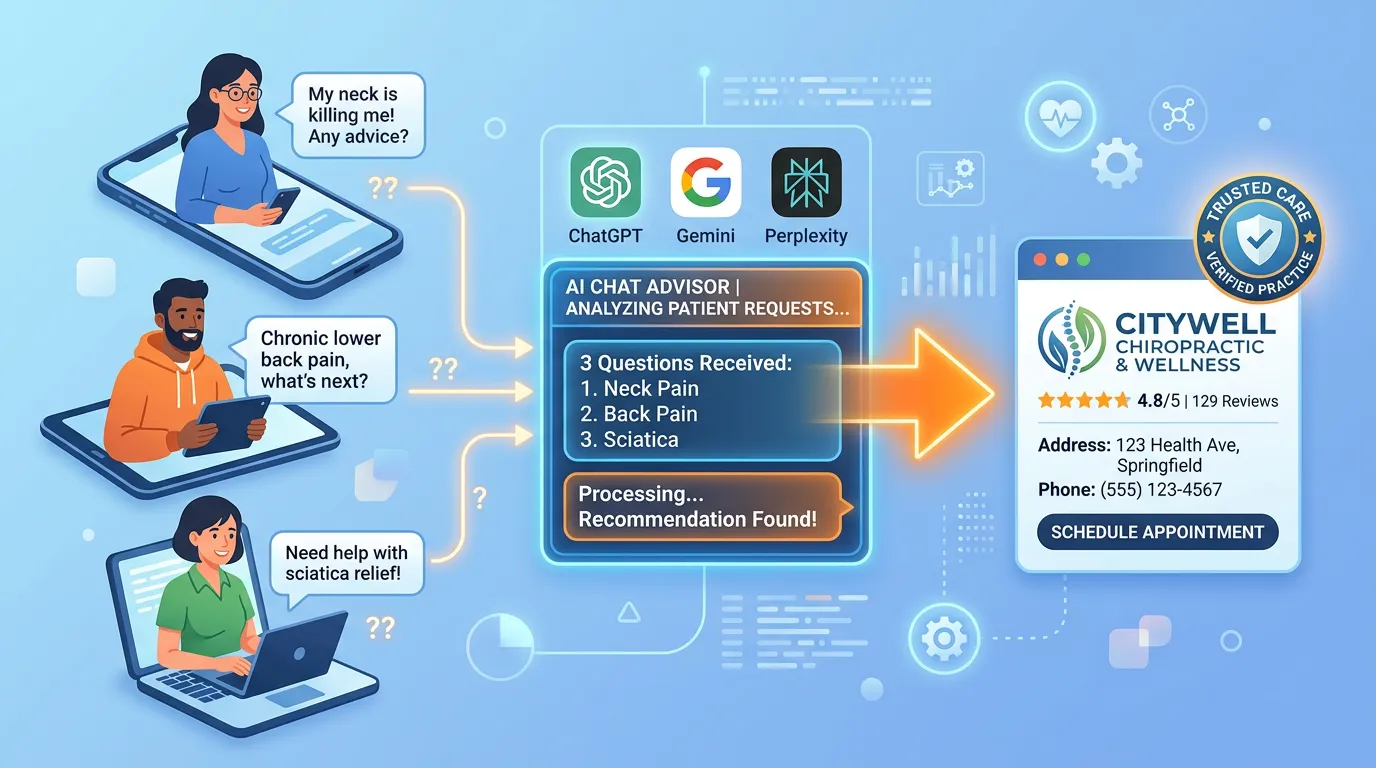
Patients aren't thinking about AI authority systems or schema markup or entity graphs.
They're in pain. They want help. And the way patients are using AI to find a chiropractor is changing faster than most docs realize. They open ChatGPT or Gemini and type something like:
"Who's the best chiropractor for sciatica in [their city]?"
Or they ask Perplexity: "How do I find a chiropractor who specializes in sports injuries near me?"
Or Google's AI Overview answers them before they even scroll down.
In every one of those scenarios, AI synthesizes everything it knows about the topic, the location, and the available providers — and returns one answer. Maybe two or three. Never ten.
Research from Definitive Healthcare found that 58% of consumers now use generative AI for service recommendations. In healthcare specifically, AI is shifting from a research tool to embedded clinical discovery infrastructure — changing how patients find and choose providers before they ever call an office.
Patients using AI to find a chiropractor aren't searching for the practice with the most keywords. They're asking a trusted assistant for a recommendation. They expect an informed, specific answer.
If your practice isn't in that answer, you're not in consideration. And what drives AI to recommend certain chiropractors over others isn't a mystery — it's a measurable infrastructure gap.
The Zero-Click Patient Journey
Here's what most docs running traditional digital marketing haven't fully processed yet.
When a patient searches Google — even without clicking your link — they at least see your name. Passive brand exposure. They might remember you and type your name directly next week.
AI search eliminates even that.
When AI returns an answer, the patient sees the recommended practice, reads the description, and calls — or asks a follow-up in the same AI conversation. They might never see a search results page. They might never see your Google listing.
You can be completely invisible — not just to the patient, but to the entire discovery process. No impressions. No brand exposure. Nothing. Just silence.
That's a fundamentally different competitive dynamic than anything that existed in digital marketing before 2024. The practices that move now have a compounding advantage. The ones that wait are losing ground that's harder to recover every month they stand still.
How AI Actually Decides Who to Recommend
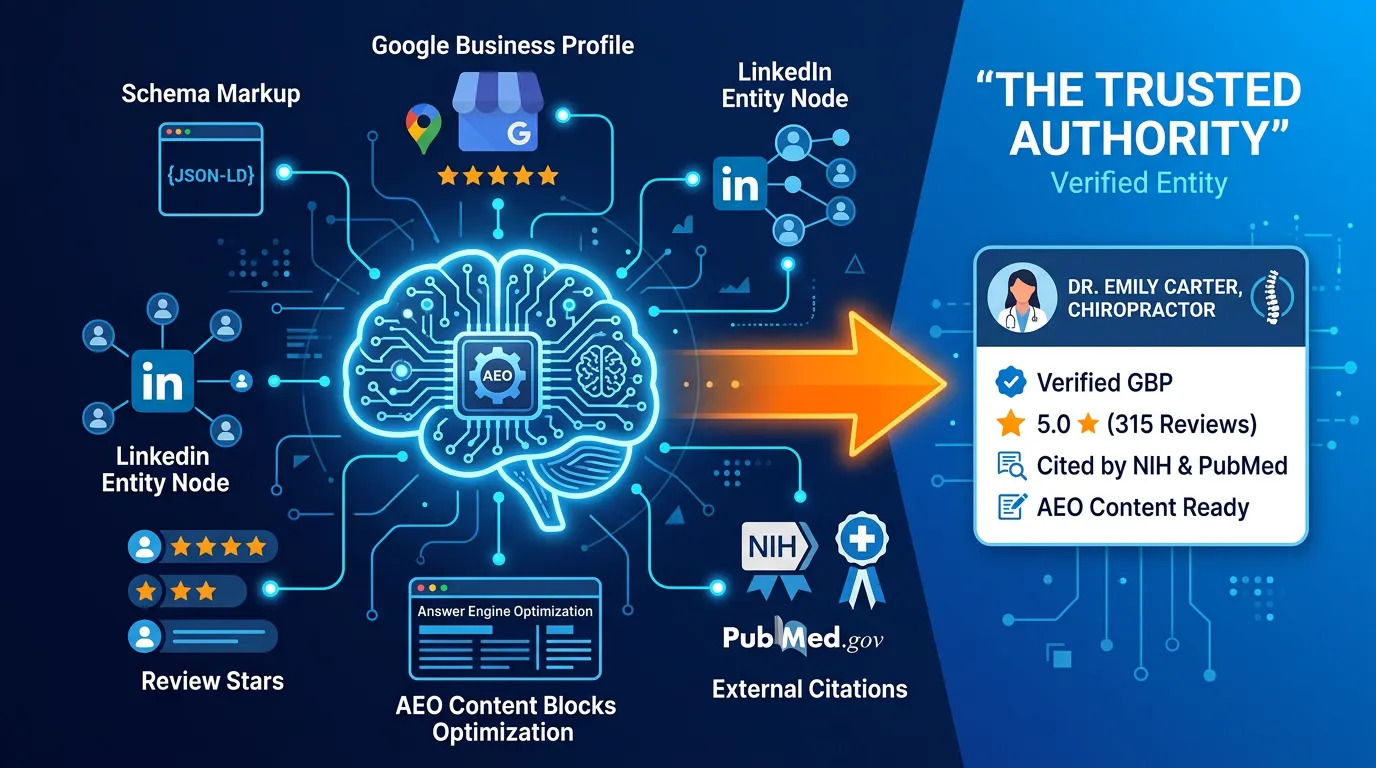
When AI decides which chiropractor to recommend, it's running a verification process most practice owners have never thought about.
Not random. Not ad spend. Not how your website looks.
It's a hierarchy of trust signals AI engines have learned to weigh against each other.
Here's how the verification process breaks down:
Step 1: Entity Recognition. Does AI know your practice exists as a verifiable entity? Consistent NAP (Name, Address, Phone) across platforms, a verified Google Business Profile, and schema markup declaring your business identity.
Step 2: Entity Classification. Does AI know exactly what you are and what you're expert in? A LocalBusiness schema with defined service categories, a content hierarchy mapping your clinical areas, and internal linking demonstrating topical depth.
Step 3: Authority Scoring. How authoritative are you on the topics you claim? This is where content depth matters most — questions answered, comprehensiveness of coverage, external citations backing claims.
Step 4: Trust Verification. Can AI confirm your claims through external validation? Reviews across platforms, consistent entity signals across the web, mentions in credible external sources. This moves you from "recognized" to "trusted."
Step 5: Recommendation. Clear the first four steps — more completely than local competitors — and you get named.
Most chiropractic practices fail at Step 1. Not properly defined as machine-readable entities. The ones that have done entity work often fail at Step 3 — not enough content depth to score as authoritative. The few with both often fail at Step 4 because their external trust signals are inconsistent.
If you want to see exactly where your practice sits against all five steps, a structured digital footprint audit shows you the specific gaps before you invest in a full infrastructure rebuild.
The AI Authority System addresses all five steps in sequence. That's why it's not a marketing campaign. It's the complete set of conditions AI needs to recommend your practice over someone else's.
Frequently Asked Questions
Does an AI Authority System replace my current SEO?
It supersedes it.
Traditional SEO focuses on a system — Google search — that's currently losing 25% of its volume to AI answer engines, per Gartner. The AI Authority System builds for where discovery is actually heading.
That said, you're not walking away from search entirely. The AEO infrastructure we build — schema, content depth, semantic linking — also strengthens traditional search performance. These aren't mutually exclusive.
The difference is priority. We build for AI first. The traditional search benefits are a side effect of doing that well.
How long before AI starts recommending my practice?
Not on a microwave timeline — let's just get that out there.
Most practices see infrastructure stabilization around 90 days, with compounding recommendations as content depth grows. Trust signals accumulate over time. Every month of execution makes the next month's recommendations more likely.
Waiting doesn't make this faster. Every month a competitor is building authority in your market is a month you're further behind when you do start.
What's actually in the infrastructure rebuild?
Full site architecture restructuring. Schema implementation across all relevant page types. Internal linking architecture that builds topical semantic clusters. Entity graph mapping for every service, condition, and geographic area your practice is authoritative for.
We also address your external entity signals — Google Business Profile, LinkedIn, review platforms, directory presence — because AI cross-references all of these when verifying your entity.
The foundation layer. Nothing built on top of it works without it.
Why can't I just use ChatGPT to write blog posts myself?
Content is fuel. But it needs an engine.
Without schema architecture and internal linking, AI sees your content as commodity noise and ignores it. Generic AI-written blog posts don't include intent layering, entity mapping, or the structural signals that tell answer engines to trust you.
This is one of the most common mistakes we see. Docs spend months publishing AI-generated posts and wonder why nothing changed. The content is there. The engine to make it matter to AI isn't.
Monthly service or one-time build?
Hybrid — and both parts are non-negotiable.
We front-load the infrastructure rebuild upfront. Then 12+ high-velocity AEO articles per month maintain and compound your authority.
Authority decays without ongoing execution. AI engines continuously update how they evaluate sources. One-time builds get you a foundation. The ongoing content is what keeps AI recommending you.
What's the real difference between AEO and traditional SEO?
Traditional SEO optimizes for an algorithm that returns a ranked list of links. In traditional search, ranking third still gets you clicks.
In AI search, there's no ranked list. There's one answer.
The infrastructure required to earn that answer — entity trust signals, schema markup, intent-layered content, semantic clustering — is fundamentally different from keyword targeting and backlinks. AEO isn't SEO with different tactics. It's a different discipline built for a different system.
What happens to practices that wait?
The trust compounding effect works against you when a competitor is actively building and you aren't.
Every month they publish AEO content and build entity signals, their authority ceiling rises. AI doesn't reset — it learns and reinforces. Waiting six months doesn't keep you neutral. It gives competitors a six-month head start that compounds every month after.
The practices building now already know how entity trust works for chiropractors — and they're widening the gap while others are still watching.
How does iTech Valet's content process work?
We run a proprietary two-AI validation system.
Gemini handles strategic research — topic analysis, source selection, intent mapping, structural planning. Claude handles article production — executing against that research and producing 4,000+ word AEO articles ready for publication.
Every article gets a Gemini validation pass before it's finalized. The client sees the published article. They don't manage the process, create content, or touch the platform. White-glove is the whole model. We build the authority engine and run it. The client's job is to be an excellent chiropractor.
The Authority Window Is Open Right Now
Most chiropractors haven't moved yet.
They're watching. Waiting to see whether this is a real transformation or another trend that fades in eighteen months. That skepticism's understandable — the industry has sold a lot of hopium over the years.
But this isn't a trend.
The shift from click-based search to AI-driven recommendations is already underway. Measurably. Demonstrably. Gartner, Seer Interactive, HubSpot — every major digital marketing research firm is saying the same thing.
Practices that move now don't just get ahead. They set a ceiling latecomers will spend years trying to reach.
Vibes don't build authority. Infrastructure does. If AI can't verify you, it won't recommend you — no matter how good your patient care is, no matter how long you've been in practice, no matter how many five-star reviews you've earned.
AI gives one answer. If your practice isn't that answer, you don't exist in the recommendation cycle. That's not a prediction. That's how AI answer engines work today, for the patients in your city asking for a chiropractor recommendation right now.
The question isn't whether to build AI authority. It's whether you build it first — or spend twice the effort building it second.
Three years from now, the practices that moved in 2026 will look back at this as the moment the field separated. The ones that waited will be chasing a gap that widened every single month they stood still.
AI authority compounds in one direction. Make sure it's yours.
Wondering whether your current digital presence is actually visible to AI? Or whether competitors have already claimed the recommendation space in your market?
The next step isn't a sales call. It's a diagnostic.
The AI Visibility Check is a 15-minute assessment that evaluates exactly how ChatGPT, Gemini, and Perplexity currently see your practice. Not keyword rankings. Not traffic estimates. The actual AI recommendation status of your practice, right now.
Most docs who run this check are surprised. Years of SEO investment. Strong Google rankings. Excellent patient reviews. Completely invisible on AI — while a competitor with a fraction of their history shows up as the recommended answer.
That gap closes with infrastructure. But infrastructure takes time to build. Every week that passes is a week your competitor's authority ceiling rises.
Want to know where you actually stand? Run your AI Visibility Check — and find out before your competitors do.
621 Enterprises, Inc. | Copyright 2026 | All rights reserved