
How Do You Audit a Chiropractic Clinic's Digital Footprint for AI?
Auditing your chiropractic clinic's digital footprint for AI means checking five things: entity consistency across directories, your Foursquare listing, whether AI is hallucinating your practice details, whether your website is machine-readable, and whether your reviews contain condition-specific language AI uses to classify you as a specialist.
Each one affects whether ChatGPT, Gemini, and Perplexity recommend your clinic — or the one down the street.
Before you do anything else, run this test. Open ChatGPT and type: "Who are the best chiropractors in [your city] for sciatica relief?" Run it in Gemini. Run it in Perplexity. Write down every result.
If your clinic doesn't show up — or shows up wrong — that's your audit before the audit even starts.
Here's what you're checking:
- Entity Consistency (NAP) — One variation in your name, address, or phone number is enough to trigger an entity trust failure.
- Foursquare — Over 70% of ChatGPT's local recommendations pull from Foursquare. Most docs haven't touched that listing in years.
- The Hallucination Test — AI invents wrong details about clinics more than people realize. You need to know if it's happening to yours.
- Schema and Crawler Access — Can AI read your site, or is a technical issue making you machine-invisible?
- Review Sentiment — Do your reviews contain condition-specific language, or just "great experience, highly recommend"?
Fix all five and you stop being invisible. Leave any one broken and the fragmentation persists — no matter how often you update your Google Business Profile.
Last Updated: March 22, 2026
Why Most Docs Get This Wrong From the Start
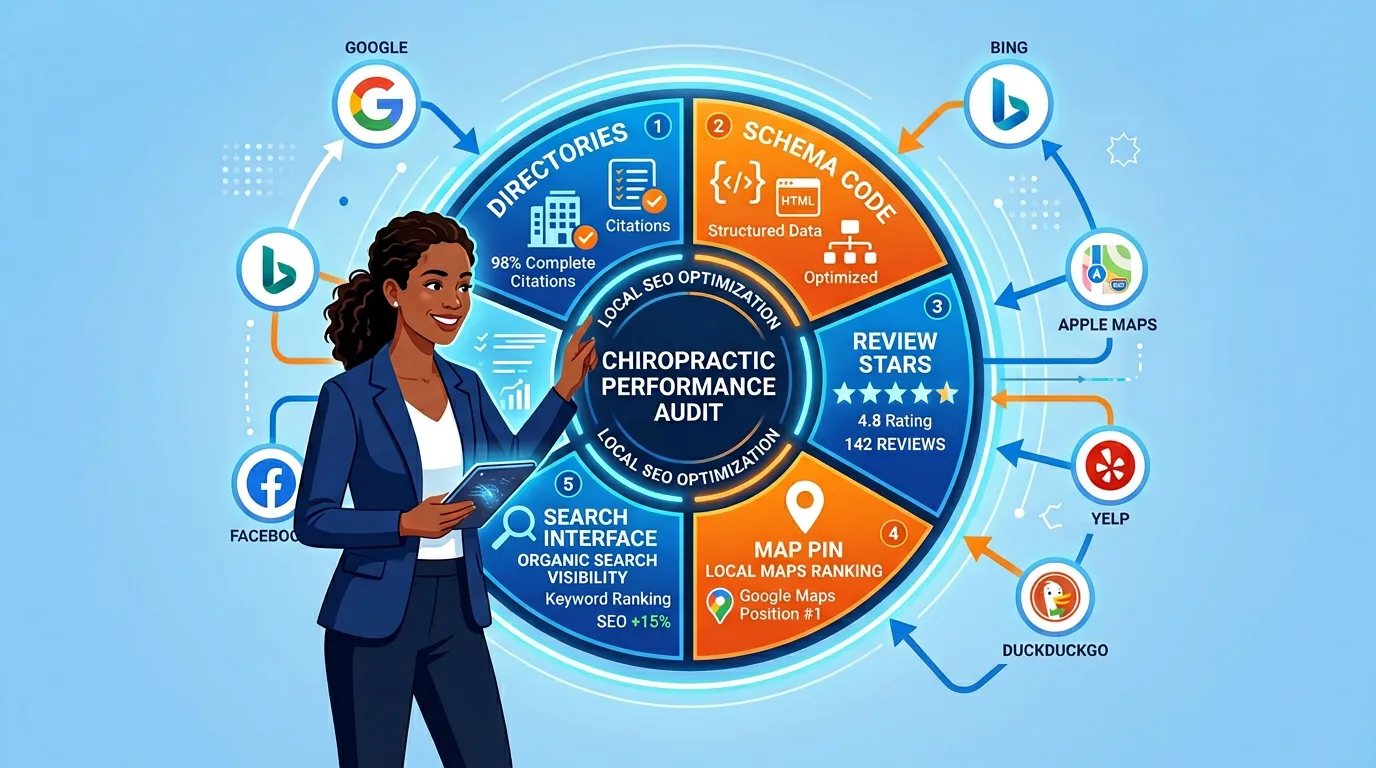
Most chiropractors, when they decide to "fix their online presence," start and stop with Google.
Update the Business Profile. Add photos. Ask for reviews. Done.
That's a Google audit. Not a digital footprint audit. In 2026, those are different things — and only one of them affects whether AI recommends you.
Gartner projects traditional search volume is dropping toward a 25% decline by end of 2026 as patients shift to AI-powered answer engines. And SparkToro's research found 58.5% of all U.S. Google searches are already zero-click — patients get their answer from the results page and never visit your site.
Your Google ranking isn't irrelevant. But it's not the game that decides whether a patient finds you anymore.
The patients worth having — the ones researching specialists, ready to book — are using ChatGPT, Gemini, and Perplexity. And those engines don't care about your Google ranking.
They care about your entity footprint.
Most agencies won't tell you that. Because if they did, they'd have to explain why the $2,000-per-month SEO retainer hasn't touched this problem.
That's the Digital Brochure Fallacy. Build the site. Forget it. Assume it's working. That made sense when Google was the only game. It doesn't anymore.
The audit isn't about your website. It's about how AI understands your entire identity across the web. And if you want to see where you actually stand right now, an AI Visibility Check shows you in 15 minutes.
Why Your Google Ranking and Your AI Visibility Aren't the Same Thing
Quick reality check.
Google ranks pages based on content relevance, backlinks, and behavioral signals. AI engines don't work that way. They verify entity trust. They cross-reference your name, address, phone number, specialty, and founder details across dozens of independent sources. Then they decide whether you're worth recommending.
Whitespark's 2026 Local Search Ranking Factors report formally introduced AI search visibility as its own category for the first time this year. The top-weighted signals for AI recommendations? NAP consistency and review sentiment.
Not backlinks. Not domain authority. Not keyword rankings.
If you've spent years building your presence around the traditional SEO playbook, you've been winning the wrong game.
One game is about convincing an algorithm your content deserves to rank. The other is about convincing an AI engine your business is real and trustworthy.
If you've only played the first game, you're invisible in the second one.
The Ranking-Citation Gap Nobody Talks About
I tell docs this number and most of them don't believe it at first.
Conductor's 2026 AEO/GEO Benchmarks analyzed 100 million AI citations and found that two out of three come from pages that don't rank in Google's top ten.
AI engines pull from a completely different pool than what Google rewards.
They also found ChatGPT drives 83.8% of all AI-referral traffic in healthcare. Not Gemini. Not Perplexity. ChatGPT — which your future patients are using right now to ask who to trust.
And for chiropractic specifically: healthcare has the highest AI Overview presence of any industry on Google. Nearly half — 48.7% — of all healthcare searches trigger an AI-generated summary before a patient ever sees a list of links.
If you're not in that summary, you've already lost that patient. Not ranked lower. Lost them.
That's the gap this audit reveals. A Google-focused strategy doesn't touch it.
| What Traditional SEO Optimizes For | What AI Engines Actually Verify |
|---|---|
| Keyword rankings in Google | Entity consistency across the web |
| Backlinks from other websites | Corroboration across directories (Foursquare, Yelp, Healthgrades) |
| On-page keyword density | Schema markup and structured data classification |
| Click-through rate from search results | Review content with condition-specific keywords |
| Domain authority score | Verified founder identity and multimodal presence |
| Time-on-site behavioral signals | NAP consistency across 20+ data sources |
Step 1: Run the Entity Consistency Check
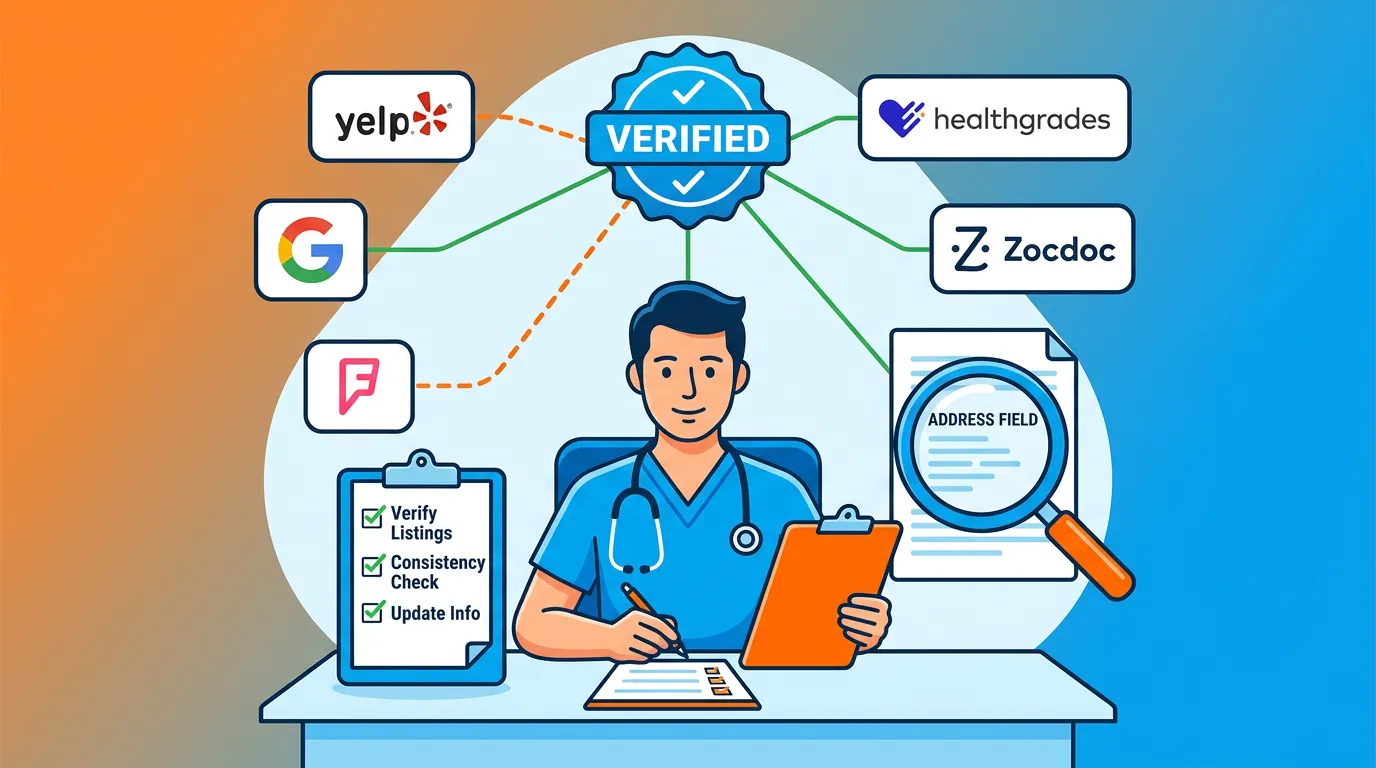
How AI sees your clinic comes down to one thing: whether your information matches everywhere it exists online.
Name, address, phone number — identical, down to punctuation, down to how you abbreviate "Suite."
Open a spreadsheet. Document every listing. Flag every variation. Even one character off registers as a conflict.
Start here:
- Google Business Profile — The foundation, but just one input among dozens.
- Yelp — Feeds both AI training data and real-time browsing.
- Healthgrades — Dominates healthcare-specific AI queries. Missing info here is a real trust gap.
- Zocdoc — Increasingly cited in specialist AI recommendations.
- Apple Maps — Powers Siri. Inconsistency here ripples across the Apple ecosystem.
- Bing Places — Powers ChatGPT's real-time web browsing. Probably the most ignored listing in chiropractic. (Go check yours right now.)
Facebook Business Page — Crawled for corroboration. Your "About" section matters more than you'd think.
The Foursquare Audit: The Platform Nobody's Thinking About
Most docs' jaws drop when they hear this one.
Foursquare — the app nobody's thought about since 2014 — powers over 70% of ChatGPT's local business recommendations. That's the primary database behind the AI engine your future patients use every week.
Foursquare shut down its consumer interface in 2025. But its Place Engine still runs location data for ChatGPT and a growing list of LLM integrations. And since most businesses haven't touched it in years, listings are outdated, incomplete, or unclaimed.
Go to foursquare.com right now and search for your clinic.
- Is it claimed? Unclaimed listings can be edited by anyone.
- Is the address exactly right? Same abbreviations, same suite format, same zip as Google.
- Is your specialty correct? "Chiropractor" and "Alternative Medicine" are very different to an AI engine.
- Do you have photos? Empty listings get deprioritized.
- Is your phone number active? A dead number reads as a closed business.
Claim it. Complete it. Match it to your Google Business Profile exactly.
This one fix often produces the fastest improvement in AI recommendations of anything in the audit.
Building Your NAP Consistency Map
After the major platforms, use Whitespark or Moz Local to surface every place your practice appears online.
| Platform Tier | Platforms to Audit | AI Engine It Feeds |
|---|---|---|
| Tier 1 (Critical) | Google, Foursquare, Yelp, Bing Places | ChatGPT, Gemini, Perplexity |
| Tier 2 (High Impact) | Healthgrades, Zocdoc, Vitals, WebMD Provider | Healthcare-specific AI queries |
| Tier 3 (Supporting) | Apple Maps, Facebook, Yellow Pages, BBB | Siri, entity corroboration |
| Tier 4 (Specialty) | Chiropractor.com, American Chiropractic Association directory | Specialty verification |
Every variation you find is an entity trust failure. Fix them one by one.
"Close enough" isn't close enough for an AI engine pattern-matching thousands of data points at once.
Step 2: Run the Hallucination Test
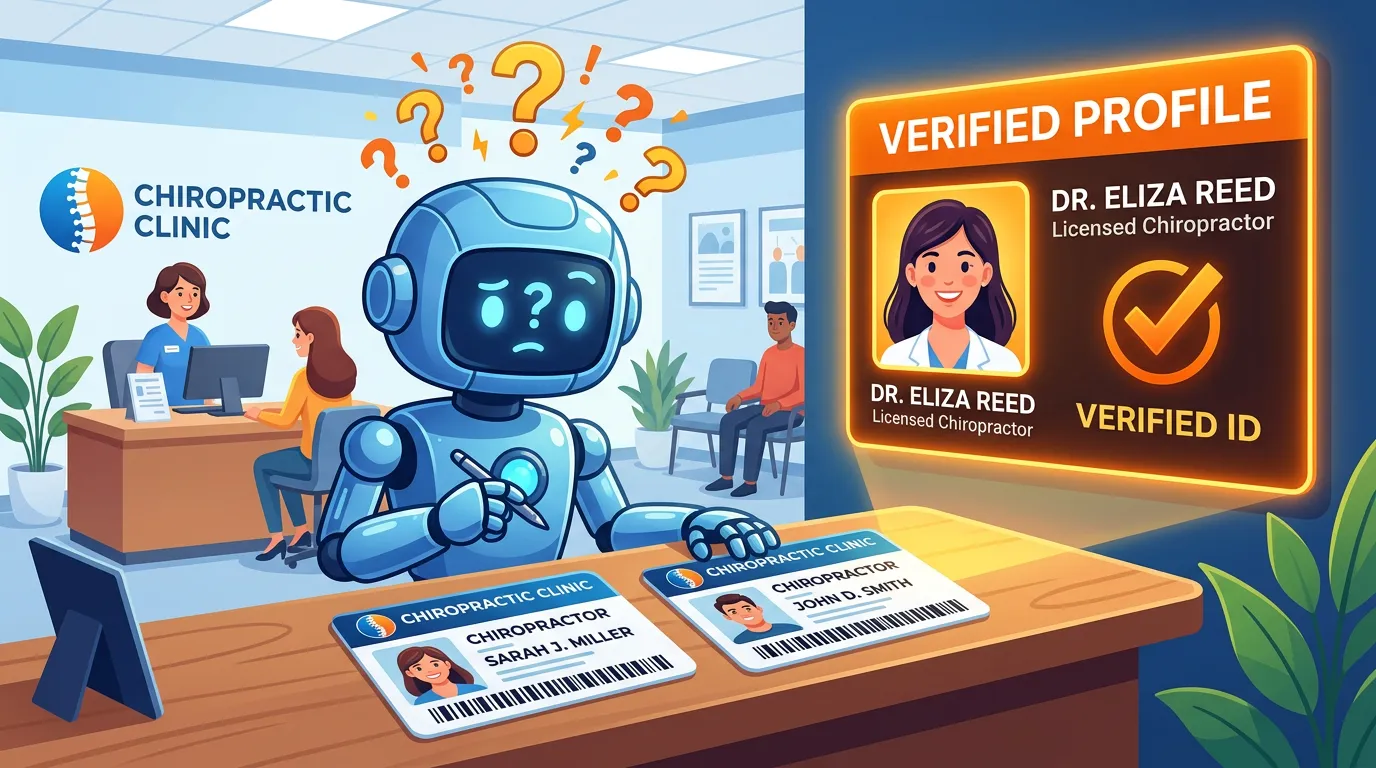
AI engines sometimes make things up. They fill data gaps with the best guess they've got.
That means: wrong founder name. Wrong specialty. A blended identity mixing your clinic's details with a competitor's.
This happens to local healthcare practices more than people realize.
Run this exact prompt across ChatGPT, Gemini, and Perplexity:
"Tell me about [Your Clinic Name] in [Your City, State]. Who is the lead chiropractor or founder, what conditions do they specialize in, what is their address and phone number, and are they currently accepting new patients?"
Write down every response word for word. Then follow up:
"Can you show me a map or confirmation of their location?"
Five Failure Patterns to Look For
You're hunting for five specific problems:
- Identity Drift — AI names the wrong person as your owner or lead doc. Happens when your personal digital presence is too thin to anchor the entity.
- Specialty Mismatch — AI classifies you as "general wellness" instead of a condition-specific specialist. Usually means your descriptions aren't using the terms AI looks for.
- Address Confusion — AI shows an old location or a neighboring business's address. Traces back to NAP inconsistency from Step 1.
- No Result At All — Too many conflicting signals to reconcile. AI hedges or recommends your competitors instead.
- Stale Information — Right name, wrong hours, dead phone number, or a provider who left two years ago.
Every failure type points to a specific fix. Document them all.
Protecting Your Founder Identity
This part matters more than most docs want to deal with.
AI engines that can't find a verified human face and voice connected to a clinic will sometimes fabricate one. Or assign the entity to whoever's most plausible in the surrounding training data.
I've seen it happen firsthand. An AI hallucinated a completely wrong founder's name for a business — because the real founder's footprint wasn't strong enough to anchor the entity clearly.
You fix this by making yourself undeniable. Your name on your site as the author. A complete LinkedIn. Even short YouTube videos where your face and voice connect to your practice.
AI trusts humans with a face and a voice more than nameless organizations. That's not soft marketing — that's how the trust classification works.
Audit Schema Markup and Crawler Access
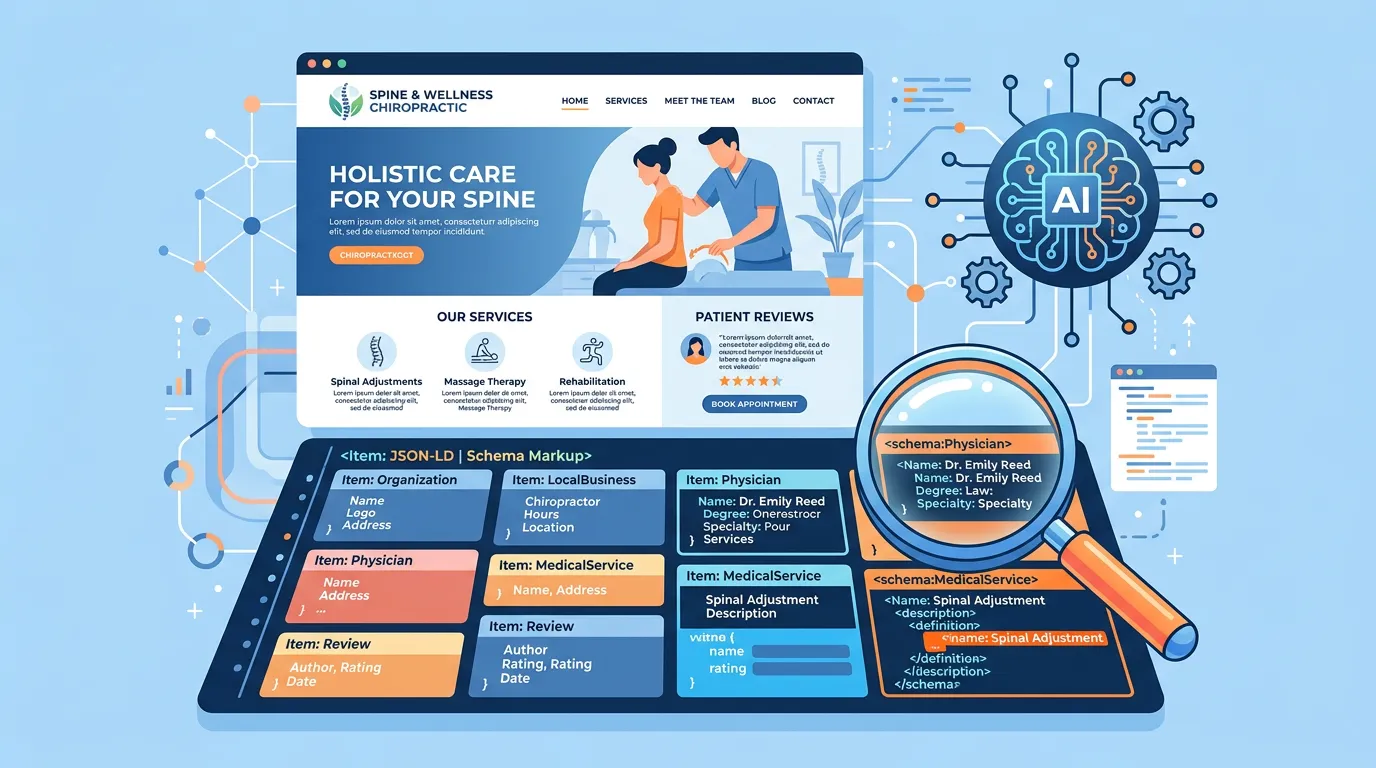
Your website exists in two layers.
The human layer can look great and say all the right things. And still be invisible to AI if the machine layer is broken.
Schema markup is the machine layer. It tells AI engines exactly what your business is, who runs it, and what it does — in a language they read directly. Without it, AI guesses. And when AI guesses on healthcare entities, it goes generic.
What Schema Types a Chiropractic Practice Needs
At minimum, you need these implemented:
| Schema Type | What It Tells AI | Where to Implement |
|---|---|---|
| LocalBusiness / MedicalBusiness | Name, address, phone, hours, specialties, service area | Homepage and Contact page |
| Physician (for individual practitioners) | Credentials, specialty areas, affiliated organization | About page, provider bios |
| FAQPage | Direct Q&A AI engines can extract and cite | Blog posts, service pages |
| BlogPosting | Author attribution, publication date, topic classification | Every published article |
| BreadcrumbList | Site hierarchy so AI understands content organization | All pages |
Medical Business specifically signals this is a healthcare entity. That increases citation probability in health-related queries. Don't skip it.
Technical Blockers That Kill Crawler Access
Schema doesn't help if AI crawlers can't reach your pages.
Quick check:
- Robots.txt — Any disallow rules accidentally blocking crawlers? Pull it up and look.
- Page Speed — Slow pages get abandoned before crawlers finish reading. Run Google PageSpeed Insights.
- Broken Links — Every 404 is a dead end that lowers confidence in your whole site. Use Screaming Frog or Ahrefs.
- Schema Validation — Run your URLs through Google's Rich Results Test to confirm markup is actually readable.
Look — you can nail entity consistency, Foursquare, and reviews perfectly. But if your site has 40 broken links and a misconfigured robots.txt, AI engines will still downgrade your entity.
The machine layer has to work. The human layer doesn't matter if AI can't read it.
Step 4: Audit Review Content and Sentiment
Most docs think about reviews in terms of star ratings.
AI doesn't primarily read stars. It reads words.
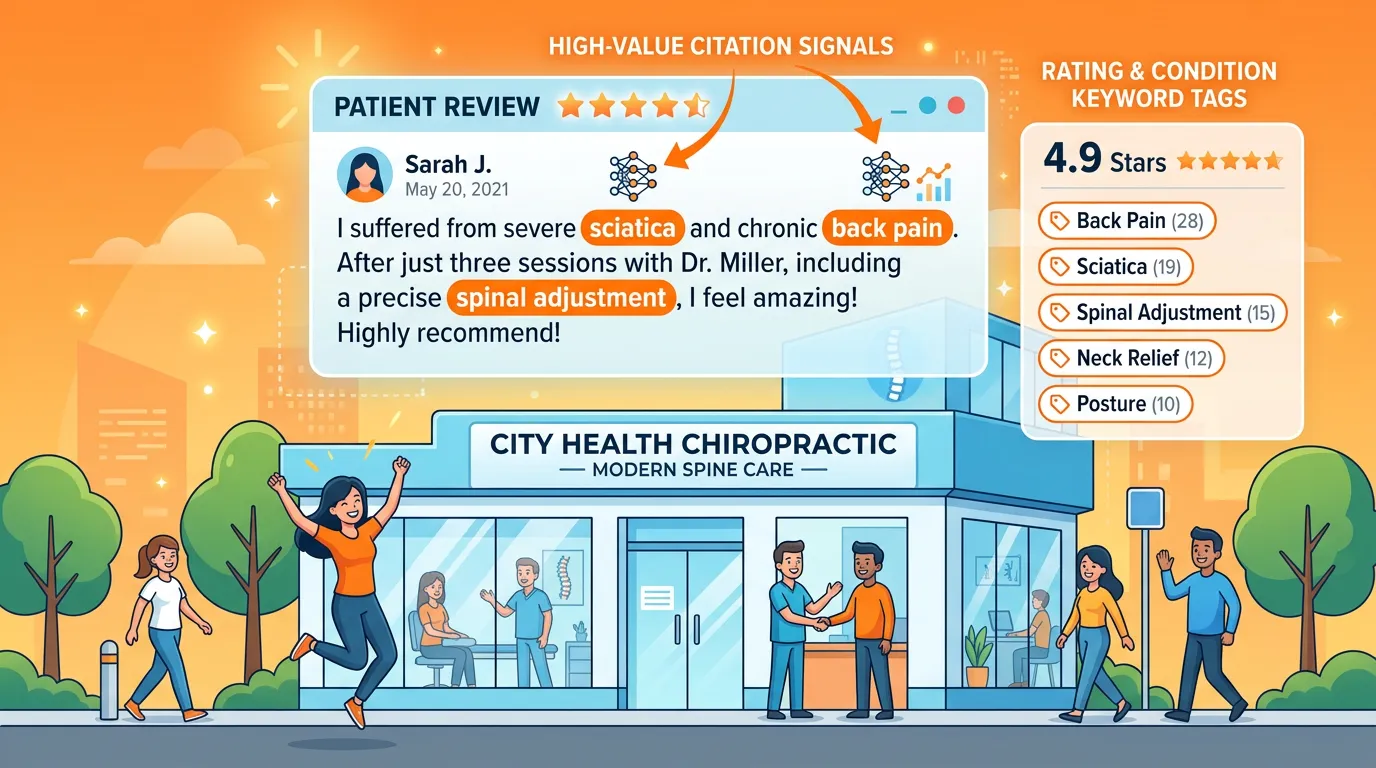
"Sciatica." "Herniated disc." "Lower back adjustment." "Sports injury recovery." Those words in your reviews are how AI decides whether you're a specialist or just another chiropractor in the area. Stars don't do that. Words do.
BrightEdge research tracking AI Overview presence across healthcare shows treatment and procedure queries now trigger AI-generated responses on virtually every search. The content cited in those summaries comes from sources AI has classified as specific and authoritative.
I've watched practices with genuinely strong reputations get filtered out of AI recommendations because every review said some version of "great doc, highly recommend." Positive. Generic. Useless to an algorithm trying to classify what you actually treat.
What Condition-Specific Review Content Looks Like
Compare these two five-star reviews:
Generic: "Great chiropractor, very professional, highly recommend!"
AI-useful: "Dr. [Name] helped me finally get relief from chronic sciatica after two years of pain. The adjustment technique for my L4-L5 disc issue made a real difference after three sessions."
Both are positive. Only one tells ChatGPT this clinic specializes in sciatica treatment using specific chiropractic techniques — which is exactly what surfaces when a patient asks "Who are the best chiropractors for sciatica in [city]?"
Sound familiar? That's the query your future patients are running right now. And how AI recommends chiropractors for back pain comes down directly to whether your reviews contain that kind of language.
Do this check: Open your Yelp and Google reviews. Search for condition terms: sciatica, back pain, neck pain, disc herniation, sports injury, headaches, auto accident, scoliosis, prenatal. Count how many include at least one.
If fewer than 30% of your reviews contain condition-specific language, you're under-signaling your specialty to every AI engine reading your profile.
Why Review Response Rate Matters
Here's one most people don't track.
AI systems weight response rate. A practice owner who responds to reviews — especially the negative ones — looks like an active, engaged business that's still operating. One that actually cares. That reads very differently to an AI engine than a listing that's been sitting untouched for two years.
Pull your response rate on Google and Yelp. Under 70%? That's a fixable trust gap actively suppressing your AI visibility.
Step 5: Audit Your Authority Signal Inventory
Entity consistency tells AI you exist. Authority signals tell AI you're worth recommending.
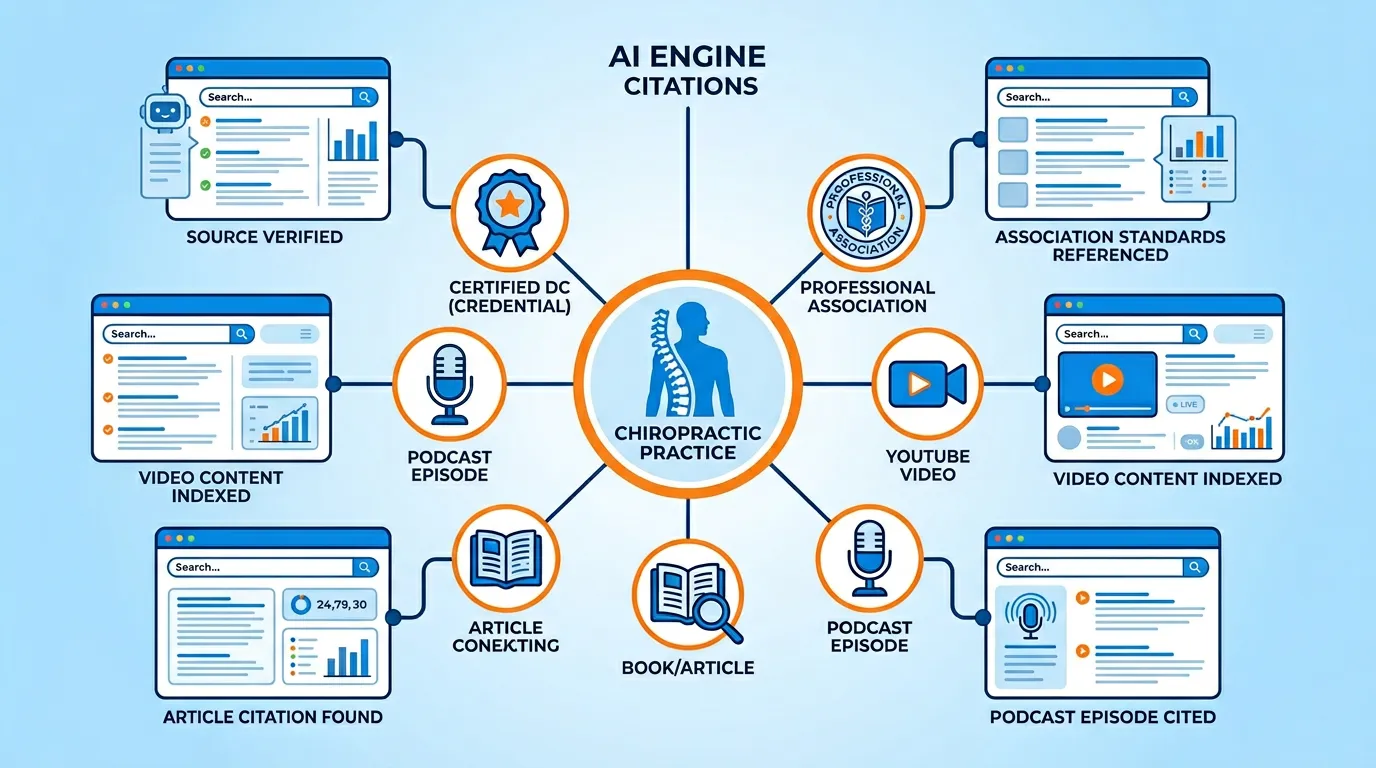
This is the gap I see most often — practices that look solid on paper but are invisible to the AI engines that matter. External, verifiable proof points AI can cross-reference to confirm you are who you say you are. Understanding the full chiropractic AI authority system makes clear why each of these signals compounds on the others:
- Professional association memberships — Are you listed in the ACA's provider directory? Your state association? These are anchor points AI uses to validate specialist classification.
- Published or authored content — Written for any chiropractic, healthcare, or wellness publications? Guest posts on authoritative sites build the corroboration AI picks up.
- Video presence — YouTube videos where your face and voice connect to your practice. AI treats multimodal presence as significantly more credible than text-only entities. A five-minute video on your approach to sciatica does more than your services page.
- Media mentions — Quoted in local news or industry outlets? Third-party citations are direct authority signals.
Condition-specific page content — Not a service menu. Actual educational content about the conditions you treat signals specialist depth that a generic list doesn't.
This Audit Isn't for Everyone
Let me be straight about who this is actually for.
If you want to run this once, tick the boxes, and consider AI visibility permanently solved — this isn't the framework for you.
Authority decays without ongoing execution. The moment you stop maintaining it — updating listings, generating fresh review content, adding new condition-specific content — your entity trust starts to decay.
The 90-Day Miracle Seeker wants a checklist they run one time. The Set-It-and-Forget-It Buyer wants to "do the audit" and walk away. If that's you, you'll be back in the same spot in 12 months. Maybe worse, because your competitors didn't stop.
The practices winning consistent AI recommendations treat auditing your clinic's AI visibility the same way they treat monthly billing reviews. Not a project. A system.
What the Authority Gap Actually Costs You
Real talk on the math.
Conductor's 2026 AEO benchmarks found AI-referred patients convert at roughly twice the rate of traditional organic search visitors. They already asked an AI who to trust, got a name, and showed up ready to book.
Now flip that. If those patients are asking ChatGPT — and ChatGPT names your competitor — your competitor isn't just getting a click. They're getting a pre-sold patient.
Patients don't scroll ten Google results and pick the nicest website anymore. They ask AI for one recommendation. And AI gives one answer.
If that answer isn't you, the gap compounds every month.
Frequently Asked Questions
How do I know if my chiropractic clinic is visible to AI search engines?
Run the test right now: open ChatGPT, Gemini, and Perplexity and ask "Who is the best chiropractor in [your city] for sciatica relief?" If your name doesn't come up — or what comes up is wrong — you've got a footprint problem. A formal AI Visibility Check goes deeper and tells you exactly which gaps are causing it.
What's the difference between a website audit and a digital footprint audit?
A website audit checks what's on your site. A digital footprint audit checks how your entire identity is understood by AI across the web — directories, reviews, schema, entity consistency across Foursquare, Yelp, Zocdoc, Healthgrades, and dozens more. AI doesn't just read your website. It cross-references everything it can find. Those are very different scopes.
Why does my address format matter if it's just one character off?
"123 Main St Suite 4" on Google and "123 Main Street, Ste. 4" on Yelp look like two different businesses to an algorithm. That inconsistency lowers your entity trust — the AI's confidence your practice is a single verified entity. Low confidence means you get filtered out, even if your reviews are great. Feels like a tiny thing. It's not.
Do I need MedicalBusiness schema to get cited by ChatGPT?
Schema alone won't get you cited — but missing it will get you ignored. MedicalBusiness, Physician, and LocalBusiness schema gives AI a machine-readable summary of who you are and what you treat. Without it, AI guesses your classification. And when it guesses healthcare entities, it goes conservative. This connects directly to chiropractic entity authority and how AI decides what kind of practice you actually are.
But doesn't page one on Google mean AI will recommend you? Not the way you'd expect. Conductor found two in three AI citations come from pages outside Google's top ten. AI is rewarding entity trust, not SEO performance. That's a different game — and understanding the future of chiropractic search makes that gap very clear.
How do I test if AI is hallucinating my practice details?
Run this prompt in ChatGPT: "Tell me about [Your Clinic Name] in [Your City]. Who is the founder or lead chiropractor, what conditions do they specialize in, and what is their address?" Run it in Gemini and Perplexity too. Document every discrepancy — wrong name, wrong specialty, wrong address, no result. Those are the guesses patients are getting right now when they ask about you.
How long until AI starts recommending me after I fix the gaps?
No official timeline — AI engines don't publish re-indexing schedules. In practice, most clinic owners see improvement within 60 to 120 days of fully closing the gaps. Partial fixes produce partial results. Fix Foursquare but leave Yelp inconsistent, and the conflicting signals keep suppressing your entity trust. Close every gap. Not just the easy ones.
You Can't Fix What You Haven't Honestly Looked At
Here's what you're going to find when you run this audit.
More fragmentation than you expected. A Foursquare listing nobody's touched in years. Schema that was never implemented right. Reviews that are overwhelmingly positive and totally generic to AI. An authority inventory that looks solid to you and means nothing to an AI engine cross-referencing your whole footprint.
That's not a crisis. That's a clear list.
What this audit confirms every time: if your digital footprint is fragmented, AI doesn't rank you lower. To an AI giving one answer to a patient, you effectively don't exist. There's no second page of AI recommendations. There's one name, or there's no mention at all.
The clinics winning AI citations right now aren't doing it with better websites or more polished content. They built a consistent, machine-readable entity footprint that AI can recommend without second-guessing.
That's what this audit reveals. And it's what the authority infrastructure is built to fix — not once, but as a compounding system that gets harder for competitors to catch up with over time.
The gap widens every month you don't move. So move.
The hardest part of this audit isn't the work. It's realizing the problem existed long before you knew to look for it.
If the test you ran at the top didn't surface your clinic — or surfaced a version AI got wrong — you now know exactly why. And it's fixable.
But it doesn't fix itself.
You ran the test. You found the gaps. Now you need to know exactly how deep it goes.
That's what the AI Visibility Check is for — a 15-minute diagnostic that shows you precisely where your clinic's entity footprint is breaking down across the AI engines your future patients are actually using.
No guesswork. Just a clear picture of whether ChatGPT, Gemini, and Perplexity see your clinic as a trustworthy specialist — or are routing patients somewhere else.
The practices fixing this now are building a compounding advantage. The ones waiting are watching their competitors show up everywhere they don't.
Run your AI Visibility Check →
If AI doesn't know who you are, your next patient doesn't either.

621 Enterprises, Inc. | Copyright 2026 | All rights reserved