
Aetna lists spinal decompression as one type of chiropractic treatment: “This treatment stretches your spine to ease pressure on the discs. A special table or other chiropractic device is usually used.” Healthline says spinal decompression is a therapy that aims to relieve back pain and discomfort by reducing pressure along your spine. Healthline also reports that Medicare says there is “insufficient evidence” of the effectiveness of vertebral axial decompression, so Medicare doesn’t cover it. On Schema.org, the availableService property can be used on a Hospital, MedicalClinic or Physician to name a medical service available from that provider.
How Decompression and Adjustment Differ as Treatments
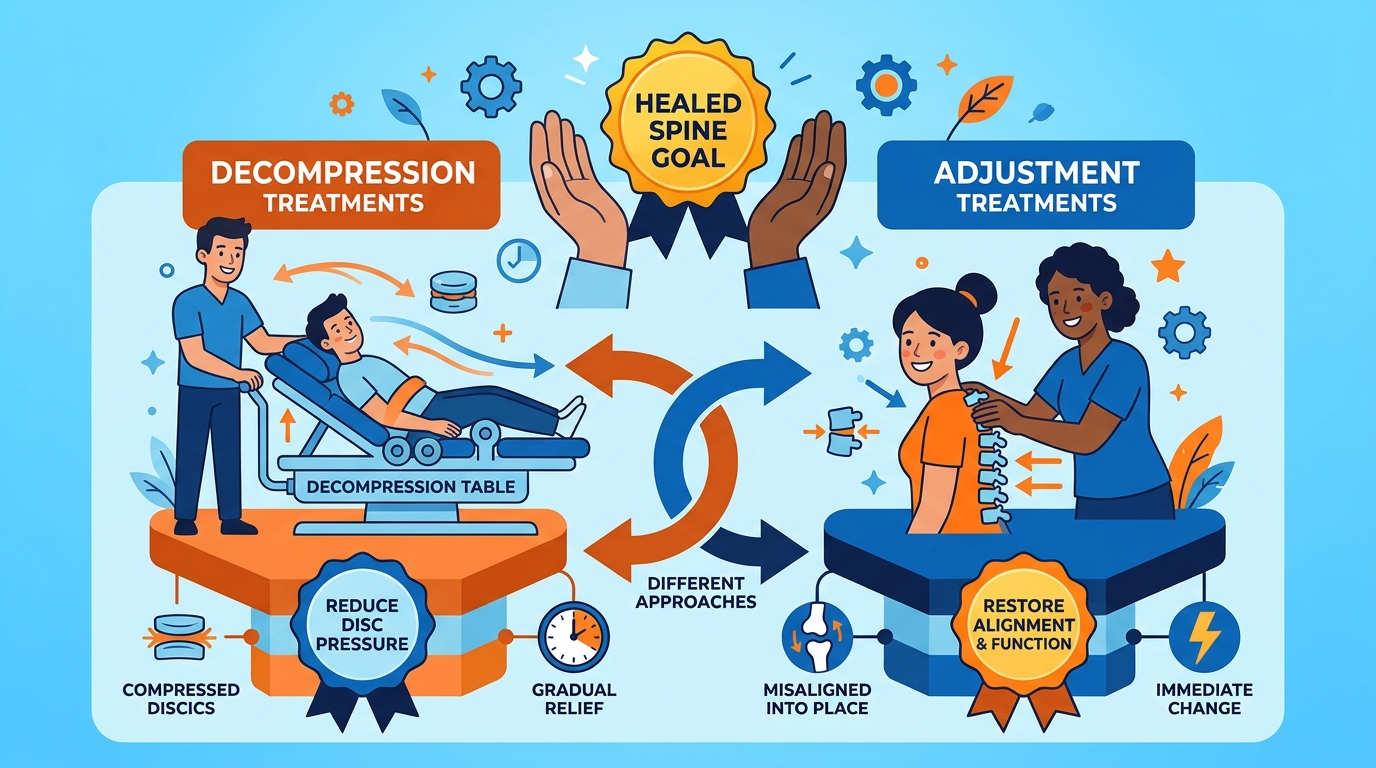
Start with the goal. Healthline says spinal decompression is a therapy that aims to ease back pain and discomfort by taking pressure off your spine. Mutual of Omaha says chiropractors use spinal manipulation done by hand, plus other techniques, to improve alignment, ease pain and support the body’s natural ability to heal.
Now the method. In nonsurgical spinal decompression, your patient lies on a specialized table while a healthcare professional pulls gently on the pelvis and the neck part of the spine. That pulling is called traction. Aetna describes the diversified technique as a type of chiropractic care that uses precise hand thrusts to move bones and joints back into place.
Aetna also lists spinal decompression as one type of chiropractic treatment. It says the treatment stretches the spine to ease pressure on the discs, and a special table or other chiropractic device is usually used. Both of those descriptions come from Aetna’s page, Does Medicare cover chiropractic care?. The traction description comes from Healthline’s page, Does Medicare Cover Spinal Decompression?.
The table below puts the two side by side on method, stated purpose and how an insurer describes each.
| Aspect | Spinal decompression | General chiropractic care |
|---|---|---|
| Method | Lying on a specialized table while a healthcare professional applies traction to the pelvis and cervical spine (Healthline) | Hands-on spinal manipulation and other techniques (Mutual of Omaha) |
| Stated purpose | Relieve back pain and discomfort by reducing pressure along the spine (Healthline) | Improve alignment, relieve pain and support the body’s natural ability to heal (Mutual of Omaha) |
| How an insurer describes it | One type of chiropractic treatment that stretches the spine to ease pressure on the discs, usually with a special table or other chiropractic device (Aetna) | Diversified technique: a type of chiropractic care involving precise hand thrusts to realign bones and joints (Aetna) |
Here’s how I write your pages. I want an AI (artificial intelligence) to name your practice as the source for decompression, not as one more practice lumped into general care. So I keep decompression apart from adjustment on the page. Questions about who is a fit for decompression get their own page, Answering Spinal Decompression Candidacy Questions in a Hub.
This kind of writing is answer engine optimization (AEO) work, and it’s what our AEO Content Writing is for. If you want to see how the work gets done, the iTech Valet Service Plans & Pricing page walks you through it.
Coverage Differences the Content Must State Accurately

Medicare does not cover vertebral axial decompression. Healthline reports that Medicare says there is “insufficient evidence,” meaning not enough proof, that it works. So Medicare doesn’t cover it.
Medicare does cover one chiropractic service. Healthline says the only one is manual spinal manipulation, done by hand, to treat vertebral subluxation. Medicare Part B may cover it.
Two more places to read up on this. Mutual of Omaha’s Medicare Chiropractic Coverage Explained and Chiropractor Billers’ What Does Medicare Cover for Chiropractors? 2026 Billing Guide both deal with Medicare and chiropractic care.
Marking Up Decompression as Its Own Procedure

Schema.org is a shared vocabulary for labeling information on a web page. Here is what an engine can read when your page uses it to label decompression.
- procedureType gives the type of a procedure. Schema.org’s examples are Surgical, Noninvasive and Percutaneous.
- howPerformed is a text field. It describes how the procedure is performed.
- medicineSystem names the system of medicine that includes the entity. Schema.org’s examples are ‘evidence-based’, ‘homeopathic’ and ‘chiropractic’.
- availableService can be used on a Hospital, MedicalClinic or Physician. It names a medical service available from that provider.
Put together, they record the procedure’s type, how it is performed, the system of medicine it belongs to and the medical services a provider makes available. Schema.org describes the related types on TherapeuticProcedure – Schema.org Type and MedicalTherapy – Schema.org Type. I cover how to build pages like this in Building Machine Readable Condition Hubs: A Complete Guide.
I treat getting picked by AI answer tools as its own discipline, not classic search work with a new name. I don’t chase keywords, inbound links or ranking position. I build for engines working out who your practice is and whether it is credible. So I put the effort into markup that tells them what your practice actually offers.
Claims Rules That Apply to Decompression Content
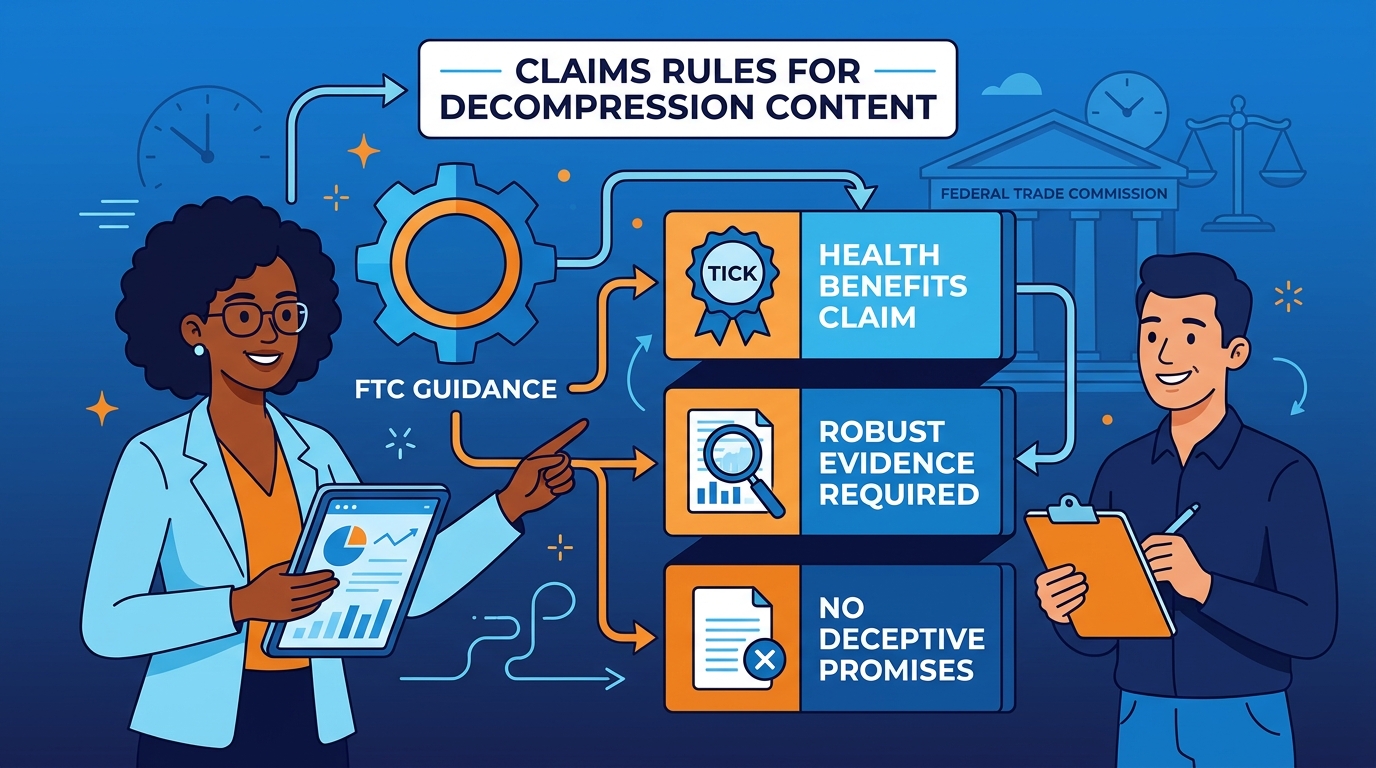
The Federal Trade Commission (FTC) sets out its rules in its Health Products Compliance Guidance. Cooley LLP wrote about the revision in FTC Revises Health Products Compliance Guidance. What belongs on a spinal condition page, and what doesn’t, is covered in What Belongs in a Spinal Condition Hub, and What Does Not.
What Counts as Advertising and Who Answers for It
Start with what the FTC calls advertising. It includes statements or pictures on packaging and labels, in brochures or booklets, on the internet and other digital content, and in social media and influencer marketing.
So your website content counts.
The FTC has gone after more than product marketers. In appropriate circumstances, it has also acted against individual owners and corporate officers of the marketer. It has acted against ad agencies, distributors, retailers, catalog companies, infomercial producers, expert endorsers, and others involved in deceptive marketing and promotion. Owners and officers are on that list.
An agency can be held responsible too. The FTC says the advertising agency, not just the advertiser, may be held legally responsible for misleading claims in ads. Agencies have a duty to check on their own the information used to back up ad claims. They may not just take the advertiser’s word that the claims are backed up.
I won’t sell your practice the old search playbook built for a landscape that’s gone. And I won’t put a claim on your page that nobody has checked.
The Evidence a Health Claim Needs
Under the FTC’s advertising law, advertisers must have adequate substantiation before an ad runs. That means enough proof. It applies to all objective product claims the ad gives to consumers acting reasonably, whether the claim is stated outright or only suggested.
The FTC says that, as a general rule, claims about the health benefits or safety of foods, dietary supplements, drugs, and other health-related products need competent and reliable scientific evidence.
What does that look like? Cooley LLP says the proof the FTC generally expects for health claims is randomized, controlled human clinical testing. That means tests on people, put at random into groups and compared with a control group, done by experts in the relevant disease, condition or function. And it holds whether or not your ad says how well a claim is backed, with something like “tests show.”
Now look at the paperwork on one device. The 510(k) summary filed with the U.S. Food and Drug Administration for the DRX9000 spinal decompression system says clinical testing, meaning testing on patients, is not required for that submission. It says the nonclinical performance testing described is enough to support substantial equivalence of the device to the predicate device, the earlier device it was compared with.
Implied Claims, Net Impression and Disclosures
Implied claims count. The FTC says you can’t suggest benefits, safety, or other traits of your product in an indirect way if you couldn’t claim them directly. You’re responsible for what you imply, not just what you state.
The FTC also looks at the whole ad. It says you shouldn’t focus narrowly on single phrases or statements. Look at each ad as a whole and judge the “net impression,” the overall message given by all parts of the ad.
FTC guidance says you should tell people about any significant limits on a health benefit you advertise. On social media, the internet, and other interactive media, that disclosure should be unavoidable. The FTC says a disclosure made through a hyperlink, a link someone must click, is avoidable.
Frequently Asked Questions
What billing codes apply to the chiropractic service Medicare does cover?
Three billing codes: 98940, 98941 and 98942. Chiropractor Billers says that as of 2026, Medicare covers only one chiropractic service. It’s manual manipulation of the spine, moving it by hand, to correct a subluxation. Code 98940 is for one to two spinal regions, 98941 is for three to four regions, and 98942 is for five regions.
What must a practice do before billing a Medicare patient for decompression?
Have the patient sign an Advance Beneficiary Notice (ABN) before the service is rendered, not after. Chiropractor Billers says a retroactive ABN is invalid, and without a valid ABN, the chiropractor cannot bill the patient for the excluded service.
What does a Medicare patient pay before coverage starts in 2026?
The Part B deductible, which is $283 for 2026. Mutual of Omaha says that once the patient meets this deductible, Medicare pays its share of approved charges.
Can a decompression page feature a patient’s standout result?
Not if the result isn’t typical. Cooley LLP says that under the guidance of the Federal Trade Commission (FTC), a patient story that reports results that are not typical is likely deceptive. A disclaimer like “results not typical” cannot fix that.
Does adding ‘may help’ make a decompression claim safe?
No. Cooley LLP says the Federal Trade Commission (FTC) rejects vague terms such as “may,” “helps,” “promising,” “preliminary,” “initial” or “pilot” as adequate qualifiers for claims based on emerging science.
Giving Decompression Its Own Place
Aetna lists spinal decompression as one type of chiropractic treatment. It stretches your spine to ease pressure on the discs, and a special table or other chiropractic device is usually used. Medicare says there is “insufficient evidence,” meaning not enough proof, that vertebral axial decompression works. So Medicare doesn’t cover it.
Give decompression its own description, its own coverage facts, its own markup, and claims you can back up. That lets an engine treat it as a separate service. I put your practice’s effort into owned, accurate service descriptions that keep working and grow over time. I don’t put it into visibility bought through ads or paid placements, which stops when the spending stops.
iTech Valet writes AI Authority articles and builds Authority Infrastructure for chiropractic practices so AI assistants can recommend them by name. Want to see whether AI names your practice today? Run My AI Visibility Check.