
The 2017 neck pain guideline from the Orthopaedic Section of the American Physical Therapy Association names four groups of neck pain: neck pain with mobility deficits (limited movement); neck pain with movement coordination impairments, including whiplash-associated disorder; neck pain with headaches that come from the neck (cervicogenic headache); and neck pain with radiating (spreading) pain, also called radicular pain. The guideline says clinicians should use four findings to classify a patient: limited motion in the neck and upper back, a cervicogenic headache, a history of trauma, and referred or radiating pain into an arm. In a World Physiotherapy review, nine guidelines made recommendations on assessment and diagnosis, and all nine recommended screening for serious pathologies (serious diseases). All nine also recommended that neurological (nerve-related) conditions be classified separately from neck pain. Google says that the better your anchor text (the clickable words of a link) is, the easier it is for people to move around your site and for Google to understand what the linked page is about.
Start From the Guideline’s Four Neck Pain Categories
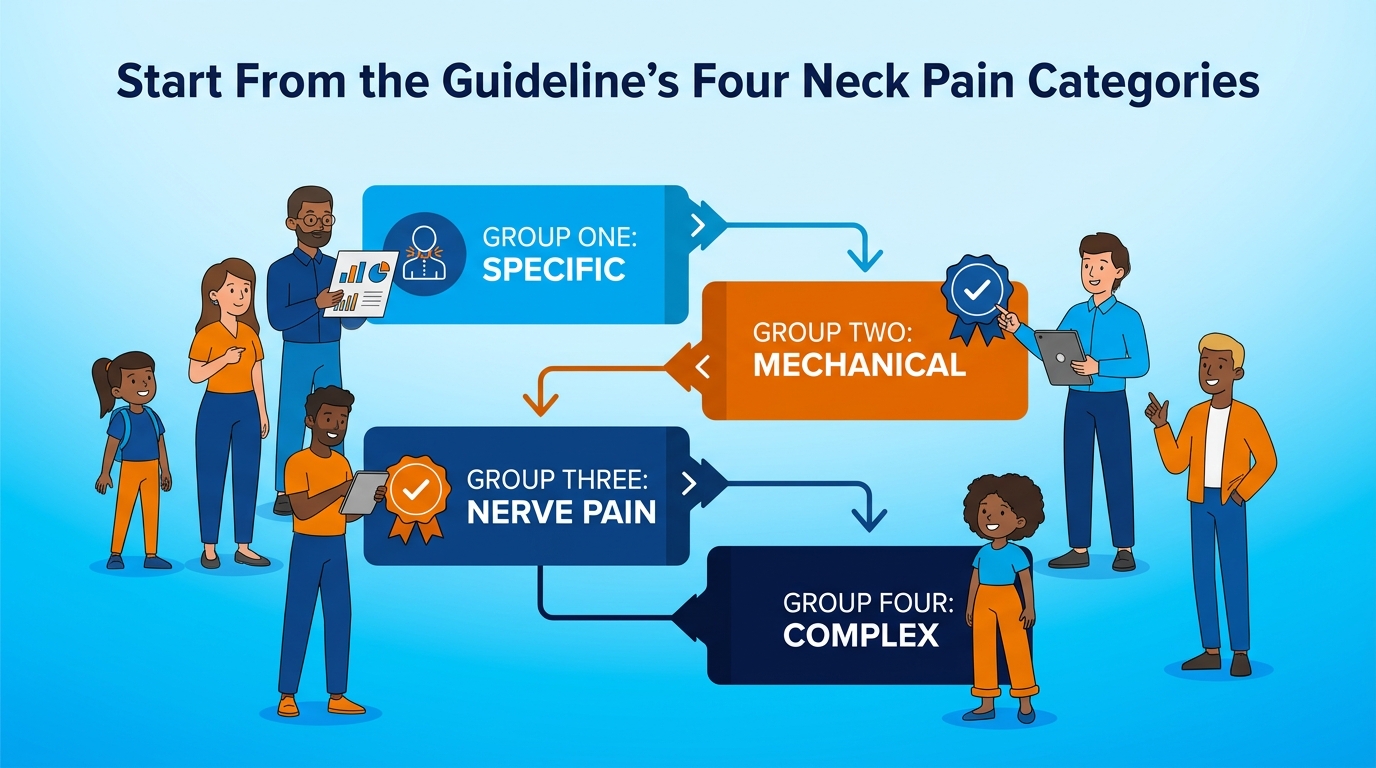
Start your hub from the guideline’s own four groups. Each one becomes a core page.
The Neck Pain Clinical Practice Guidelines – Revision 2017 comes from the American Physical Therapy Association’s Orthopaedic Section. It names the groups like this: neck pain with mobility deficits, neck pain with movement coordination impairments (including whiplash-associated disorder), neck pain with headaches (cervicogenic headache, a headache that comes from the neck), and neck pain with radiating pain (radicular).
The same guideline names the findings for classifying a patient. Clinicians should use motion limitations in the neck and upper back, the presence of cervicogenic headache, a history of trauma, and referred or radiating pain into an arm as useful clinical findings for classifying a patient with neck pain. I put each finding on the page for the category it points to. For the mobility group I also use a Cureus paper, Utilization of CPG Interventions in Conservative Management of Mechanical Neck Pain.
iTech Valet writes these pages as AEO Content Writing. iTech Valet Service Plans & Pricing explains how the work is done.
Mobility Deficits (Mechanical Neck Pain)
Here’s what the Cureus paper lists as common signs and symptoms of mechanical neck pain, taken from the guideline:
- pain in the middle or on one side of the neck
- limited neck range of motion (how far the neck can move)
- neck pain that comes back at the end of that range
- stiff joints in the neck and upper back
Now the care. For long-lasting (chronic) neck pain with limited movement, the 2017 guideline says clinicians should use a mix of treatments. That mix includes manipulation of the upper back (thoracic) and neck (cervical), or gentler joint movement (mobilization) of the neck.
Put both the signs and the care on this page.
Movement Coordination Impairments, Including Whiplash
This page covers sudden (acute) whiplash-type neck pain with movement coordination problems.
The guideline’s advice is to reassure the patient that recovery is expected within the first 2 to 3 months. Say that plainly on your page.
Neck Pain With Headache
For sudden (acute) neck pain with headache, the 2017 guideline says clinicians should give supervised teaching of active movement exercises.
A 2025 study in the HSS Journal gives this page two more anchors. The symptom for this group was headaches brought on or made worse by neck movements or sustained positions (positions held for a long time).
Proper classification meant a positive cervical flexion-rotation test or upper cervical segmental mobility test. Those are exam tests of how the top of the neck bends, turns and moves.
Neck Pain With Radiating Arm Pain
The same HSS Journal study has the anchor for this page. Proper classification as neck pain with radiating pain meant the patient showed a positive Spurling’s, distraction or neurodynamic test. These are hands-on exam tests for neck and nerve problems.
List those tests on this page.
Which Categories Earn Their Own Page
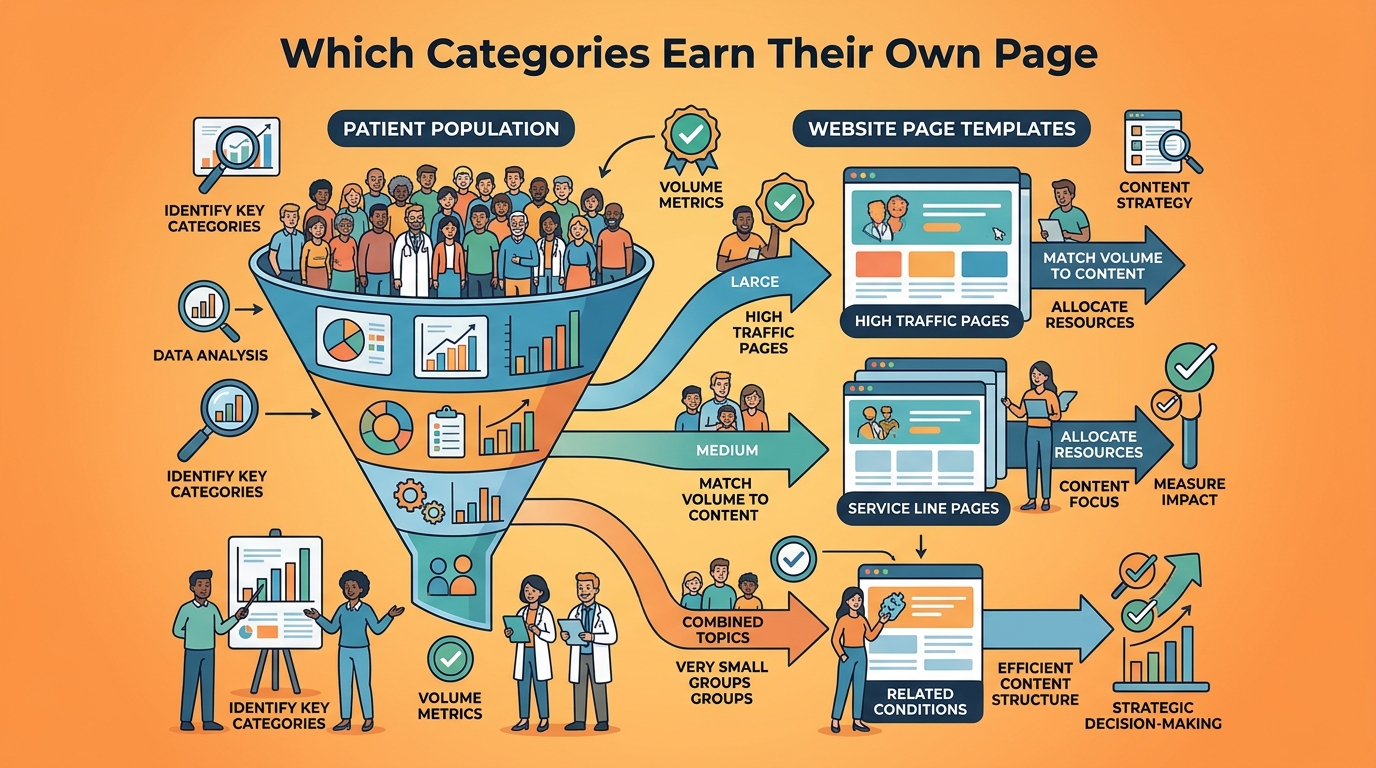
Choose your pages by how patients actually spread across the categories. Not by how many pages you can publish.
Don’t chase volume or frequency. Give an engine fewer pages it can grasp easily, with clear, factual content in a sensible order.
Look at the Evaluation of the Application of CPG Recommendations on the Classification of Patients With Neck Pain, a 2025 study of 397 patients. A little over half (56%) were put into an impairment-based category. Those are neck pain groups based on what is not working right.
The most common group was neck pain with mobility deficits (limited movement) at 24%. About one in four.
The table below shows the share of the 397 patients in each group.
| Category | Share of patients |
|---|---|
| Mobility deficits | 24% |
| Radiating pain | 17% |
| Movement coordination impairments | 8% |
| Headache | 6% |
| Classified into an impairment-based category | 56% |
Where Related Conditions Fit Without Diluting the Hub
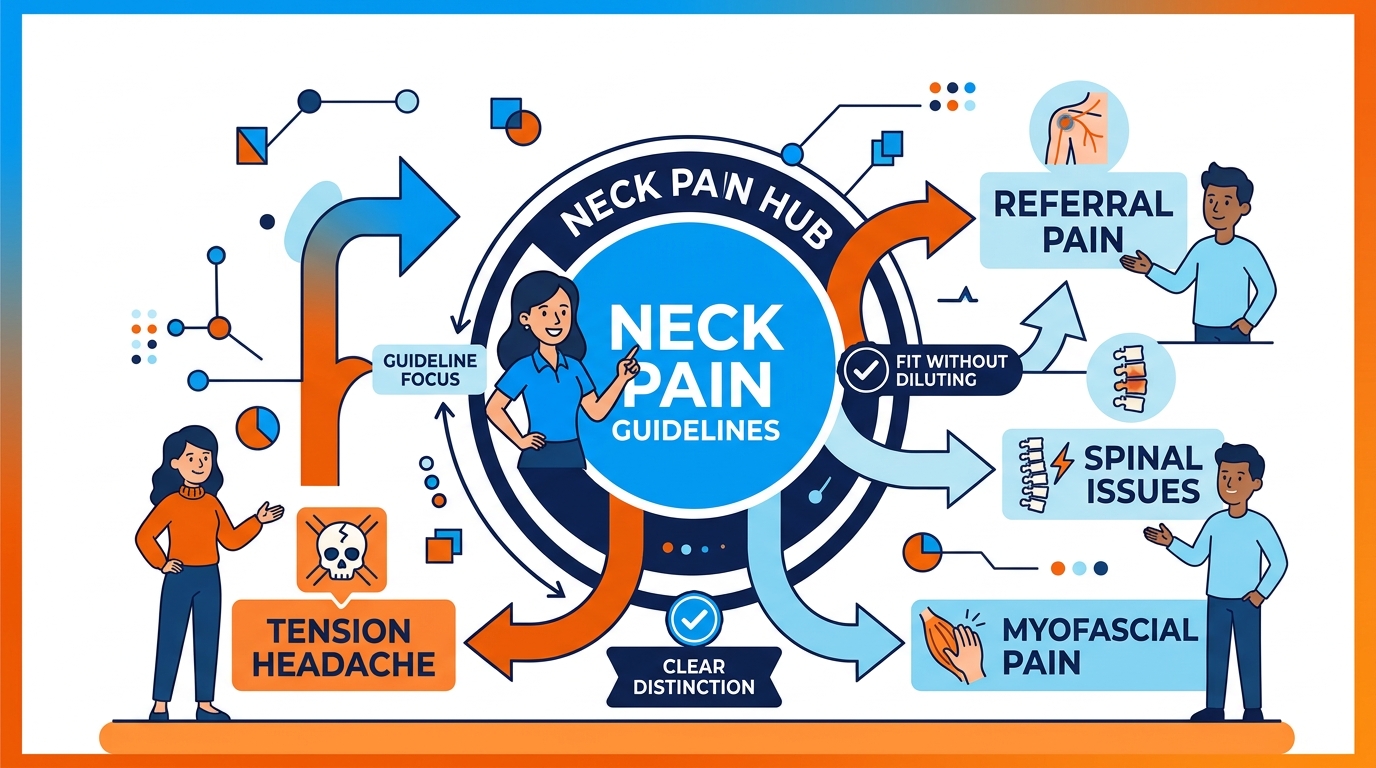
The guidelines draw a line around neck pain. The World Physiotherapy review found nine guidelines that made recommendations about assessment and diagnosis. All nine recommended screening for serious pathologies (serious diseases). All nine also recommended that neurological (nerve-related) conditions be classified separately from neck pain.
So keep neurological conditions off your four core pages.
Rheumatoid arthritis (a disease that swells the joints) is another case. The HSS Journal paper says neck pain is often one of the first signs that the neck spine is involved. It’s the second most common symptom, and it affects over half of all people with rheumatoid arthritis.
Treat these as related pages that stay apart from your four core pages.
What Each Subtopic Page Needs on Assessment and Care
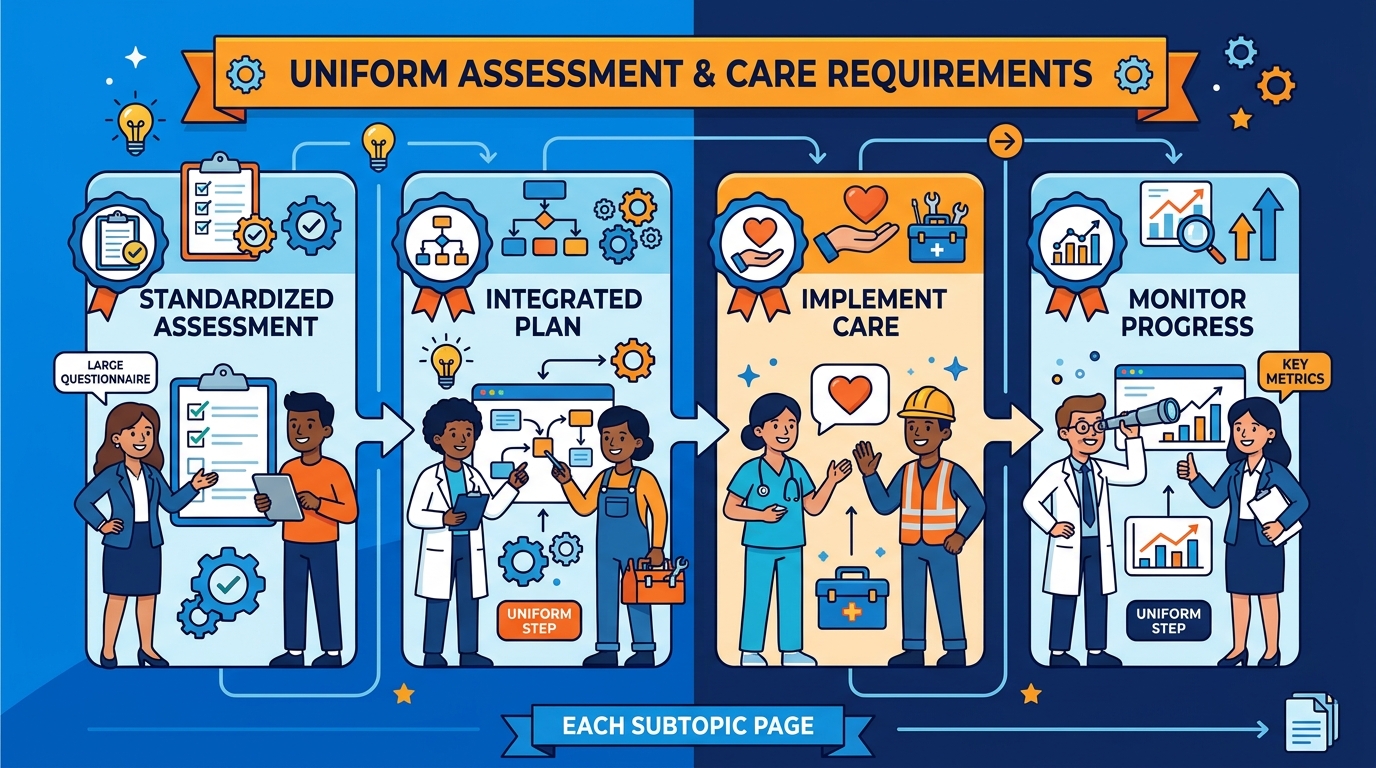
Each subtopic page states the same four points. Here they are.
- Screening. The 2017 guideline says clinicians should do assessments and look for clinical findings in patients with neck pain. The reason is simple: to find out whether a serious condition could be present.
- Questionnaires. The guideline says clinicians should use validated self-report questionnaires. These are forms the patient fills out about themselves, tested to make sure they measure what they should. They find the patient’s baseline status, which is where the patient starts. They also track changes in pain, function, disability and psychosocial functioning (how the patient is doing in mind and in daily life with others).
- Imaging. In the World Physiotherapy review, Clinical Practice Guidelines for Neck Pain: Systematic Review, eight guidelines made recommendations about radiological assessment (imaging). Their advice was consistent: limit plain and specialised imaging to cases of suspected serious pathology or neurological compromise (a serious disease, or harm to the nerves).
- First-line care. Most of the reviewed guidelines said the first step in care should include advice, reassurance and encouragement to stay physically active.
Linking the Core Page to Its Subtopic Pages
Google says the better your anchor text (the clickable words of a link) is, the easier it is for people to move around your site. It also makes it easier for Google to understand what the linked page is about. So on the core page, I name each subtopic page right in the link words.
Research posted on arXiv reports that selection done with an expert’s help better keeps the meaning of the content together (semantic coherence). The same paper says new evidence from research on large language model (LLM) systems suggests that how content is structured, apart from what it means, has a big effect on how these AI models handle information and write their answers. So I pick the links by hand and keep the structure plain. For more on the grouping, see Why Grouping Neck Pain Topics Outperforms Single Articles.
Marking Up Symptoms, Conditions and Treatments
I treat getting picked by artificial intelligence (AI) answer tools as its own discipline. It’s not classic search work with a new name. I don’t chase keywords, inbound links or results-page position. I put the effort into making it easy for these systems to work out who your practice is and whether it’s credible. So I add markup that tells engines what your practice treats.
Schema.org is a shared set of labels for web pages. Each subtopic page on your hub can carry these:
- Sign or symptom. Schema.org’s MedicalSignOrSymptom – Schema.org Type page defines a medical sign or symptom as any feature associated or not with a medical condition. In medicine a symptom is generally subjective (felt by the patient), while a sign is objective (something that can be observed or measured).
- Possible treatment. Schema.org has a property for a possible treatment to address the condition, sign or symptom.
- Differential diagnosis. Schema.org has a property for one of a set of differential diagnoses for the condition. These are the competing diagnoses that could explain it.
- Risk factor. Schema.org has a property for a factor, one that can be changed or cannot be changed, that raises a patient’s chance of getting the condition. Age and another condition the patient has are examples.
The full build is in Building Machine Readable Condition Hubs: A Complete Guide.
Frequently Asked Questions
Do clinicians agree on which category a neck pain patient fits?
Not always. Earlier research showed poor agreement between providers when they classify neck pain. Agreement rates ranged from 55% to 65%, which is a little over half to about two in three. So on each of your pages, state the findings for its category.
How current is the evidence behind the 2017 neck pain guideline?
Its recommendations are based on scientific literature published before August 2016. Keep that date in mind when you cite it.
Does a sitemap guarantee the hub’s pages get indexed?
No. Google says a sitemap file can help it learn about your site. But it does not guarantee indexing (your pages being added to Google’s search), and it does not raise your site’s ranking. Treat a sitemap as a help, not a promise.
How many neck pain guidelines use impairment-based categories?
One. The World Physiotherapy review found that six guidelines said to classify all neck pain using the Quebec Task Force criteria, or a modified version of them. Only one guideline recommended classifying by impairment (what is not working right).
Does using more guideline treatments improve neck pain outcomes?
Not in the Cureus study. It found no significant improvement in pain, range of motion (how far the neck can move) or function based on how many guideline treatments were used during the bout of physical therapy. The p-values (numbers showing how likely a result could be due to chance) were 0.17 to 0.74. So I don’t write pages that suggest more treatments mean better results.
Run Your Own Check on the Hub You Own
The map starts with the four categories and the pages they earn. Next come the related conditions kept apart, the assessment and care points each page states, the links between pages, and the markup. I’d rather see you put your effort and money into a hub you own and build on than buy visibility through ads that stop when the spending stops.
This is the work iTech Valet does. It writes monthly AI Authority content pieces: deep, structured Answer Engine Optimization (AEO) content that covers all five intent layers AI uses to evaluate expertise. AEO means writing so AI tools can use it. Want to know what AI says about your practice right now? Run My AI Visibility Check.