
From Local Doc to National Authority: Scaling Your Practice Beyond the Zip Code
To scale a chiropractic practice beyond a single zip code, you need to stop competing for location and start owning clinical conditions.
That shift isn't a marketing strategy. It's an infrastructure problem. Local visibility is about being findable when someone nearby searches. National AI authority is about being cited by AI engines for a specific condition — regardless of where the patient is, regardless of what city they're in. Those two things require entirely different systems.
AI engines don't produce a list of chiropractors sorted by proximity. For condition-level queries — who's the best specialist for disc herniation, who's the authority on sciatica — they produce a verdict. One answer, sometimes two. That answer is determined by entity depth: the accumulation of verified credentials, condition-specific content, institutional citations, and consistent multi-platform signals that AI reads as genuine expertise.
Research shows AI now acts as the first contact point for healthcare decisions. When your entity signals conflict or your content is thin, AI doesn't rank you lower — it skips you entirely, or worse, fills the gaps with fabricated information because it can't verify what's real.
National AI authority means becoming the Condition Authority — the practitioner AI cites when someone, anywhere, asks who the expert is for a specific condition. That's a different game than local search. It requires condition-focused content architecture, hardened entity data, and multi-signal institutional validation that isn't bounded by geography.
This article breaks down what that infrastructure actually looks like, what separates condition ownership from local map rankings, and what the path from local practitioner to national AI authority requires.
Last Updated: April 10, 2026
Why Local Success Doesn't Travel
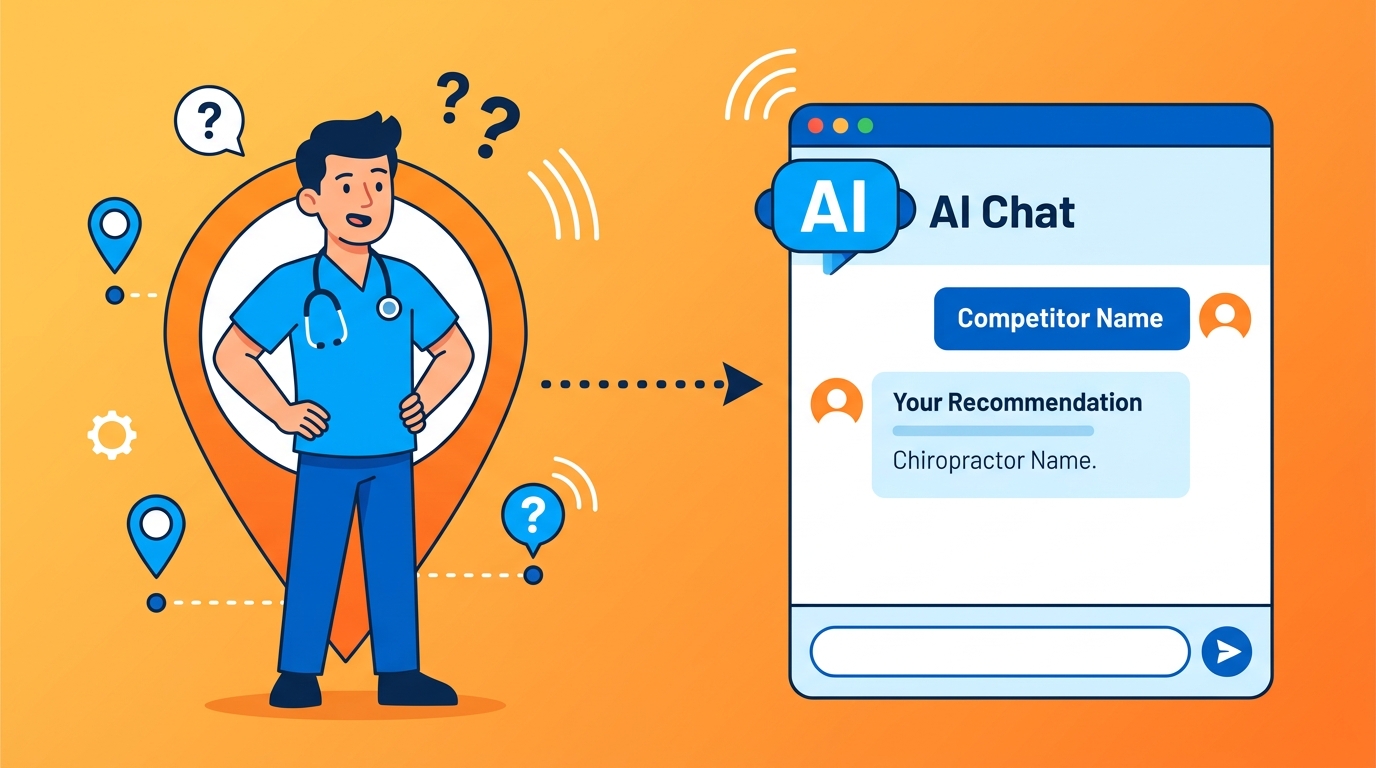
Three years at the top of the map.
Reviews stacked. Schedule full. Agency reports looking great every month. He earned it.
Then a patient texts him: "I asked ChatGPT who the best disc herniation specialist is in the region. It gave me someone else's name."
That's the moment. Not a crisis. Just a text. And in that text is the entire problem laid out.
The AI didn't rank him lower. Didn't penalize him. It just didn't see him — because local visibility and national AI authority aren't the same infrastructure. They don't even run on the same signals.
According to Propel Marketing, AI visibility is driven by structured, factual content (24%) and review signals (16%). Local map optimization builds almost entirely toward the review layer. The content architecture that powers national reach? Most practices haven't touched it.
That gap doesn't announce itself. But it's there. And the AI Authority Engine is designed to close it — but only when it's built intentionally, not as a byproduct of local wins.
Why Traditional SEO Is a Geographic Trap
Traditional SEO optimizes for search engine rankings. Rankings for healthcare queries are proximity-weighted by design.
That's the entire problem.
Every backlink you've built, every keyword you've targeted, every local citation you've cleaned up — it signals one thing to the machine: I serve people near me. That's the story you told it. It believed you.
I've watched this play out with practices that had genuinely solid local presence. The agency reports looked great. Top of the map. Strong visibility. Then the doc tried to reach a patient outside their market through AI and got nothing — because the optimization signals are geo-locked by the algorithm's own logic.
National AI recommendations don't run on those signals. They run on entity depth. Here's what traditional local optimization actually signals to AI — and why it's the wrong architecture for chiropractic scaling beyond the local market:
- Proximity intent — Location pages, "near me" content, and geo-targeted citations. Every signal says: I serve people in this city. The algorithm hears it. Remembers it.
- Review volume — Powerful for local trust-building. At the national AI citation level, one platform's reviews is a single-source signal. Not consensus. Not depth.
- Geographic backlinks — Valuable for local map authority. Irrelevant to national condition citability.
None of those signals get a practice cited nationally for a specific condition. According to Intrepy Healthcare Marketing, the signals that de-risk AI citations are publications, conference appearances, and media mentions — the kind of institutional validation that has nothing to do with how many local backlinks your agency built last quarter.
That's the Digital Brochure Fallacy. A website built for human visitors — polished, patient-friendly, locally optimized — is structurally invisible to AI citation engines. AI doesn't see design. It reads schema, entity relationships, structured content hierarchies, and institutional validation. If those aren't there, the site doesn't exist in AI's world. Doesn't matter how good it looks.
Traditional SEO agencies report on clicks. Authority infrastructure determines whose name AI says. Those aren't variations of the same strategy. One optimizes for a channel AI is replacing. The other builds the channel that's taking over.
The "Near Me" Ceiling
"Near me" is the best intent signal in local search.
It's also the most dangerous thing to build your whole identity around if you want to scale.
Every piece of infrastructure tuned to "chiropractor [city name]" — location pages, proximity-focused content, map optimization — sends the same message to AI: local provider. Not condition expert. Not national authority. Local. And AI, when it's producing a condition-level recommendation for someone two states away, has zero reason to surface a provider whose entire entity footprint says "I serve this zip code."
You told the machine you were local. It listened.
Here's the distinction that trips most docs up. The doc with five clinics across five cities isn't nationally authoritative — he's locally authoritative in five markets. That sounds like scale. It's not. The Authority Engine Doc owns the clinical verdict for disc herniation. Wherever the patient is. That's a categorically different thing.
More than 60% of searches now end without a click. The game isn't driving traffic anymore — it's being the cited answer before the click ever happens. Geographic optimization can't build that.
What National AI Authority Actually Means
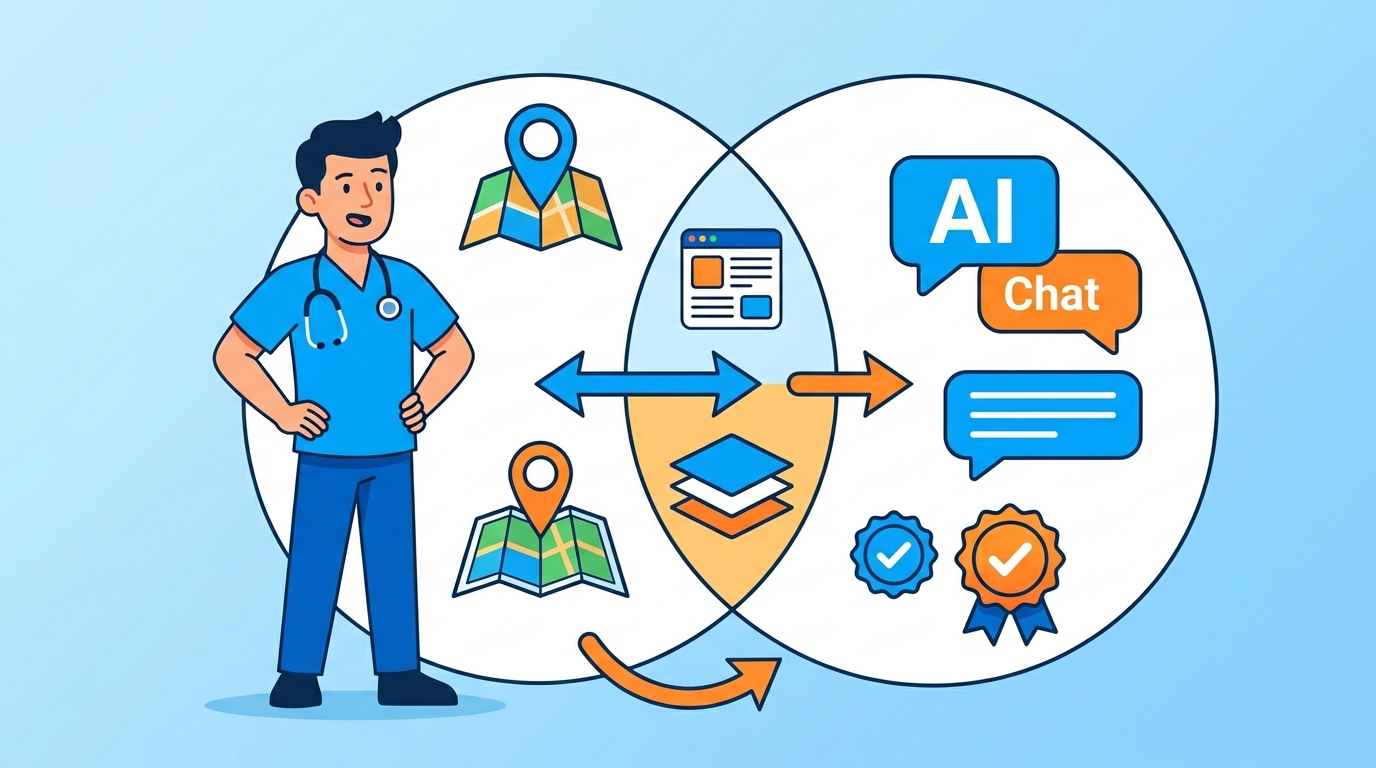
National authority isn't about being well-known in your industry.
Not brand awareness. Not social following. Not even how many colleagues in your specialty respect your work. AI doesn't care about any of that. It reads signals. Verifiable signals it can cross-reference independently — and geography isn't one of them.
Here's the only distinction that matters: local visibility is findability. National authority is citability.
Not the same thing. Not close.
Entity Ownership vs. Location Ownership
Entity ownership means one thing: AI has a complete, verified, consistent picture of who you are — and it can confirm that picture without asking you.
Think about what AI is actually doing when it's deciding who to cite for disc herniation in Denver. It's checking everywhere it can — credentials, publications, directory listings, schema data, content depth. It's asking one question: do all of these point at the same verified expert? When they do, AI cites. When they don't — gaps, old data, contradictions — it moves on.
Location ownership — what traditional local search optimization builds — tells AI you serve a geographic area. That's useful for local. It's also the ceiling. Geographic identity doesn't translate into national condition authority. The signals don't reach that far.
To become nationally citable for a specific condition, your entity needs:
- Condition-specific content depth — Not "we treat back pain." Structured, schema-tagged, clinically specific content for defined conditions. AI reads specificity as expertise. Vague pages don't clear the threshold.
- Institutional validation — Citations from recognized medical directories and healthcare publications. Not your own site saying you're the expert. Independent sources confirming it, separately, where AI can cross-reference.
- Entity consistency — Matching name, credentials, and service descriptions across every platform AI reads. Inconsistency signals uncertainty. AI doesn't recommend uncertainty.
- Expert signals — Conference appearances, guest contributions, media mentions. AI treats these as proof that third parties have already validated the expertise. Your own site claiming you're the expert doesn't move the needle. Other sources confirming it does.
Listed in AI results is data. Cited by AI is authority. Different categories entirely.
The 1.2% Rule: Why AI Is Brutally Selective
ChatGPT recommends about 1.2% of businesses for any given query.
Read that again. One point two percent.
Not because the others are bad practices. Because their entity signals aren't built to citation standard. Most chiropractors with websites, reviews, and digital presence don't register — not as a punishment, just as an absence.
To move from listed to cited, the signals have to be clean. Consistent across sources. Deep enough to validate. Accurate enough that recommending you isn't a risk for the engine. That bar is higher nationally than it is in a local map pack.
That gap between listed and cited is exactly what shows up when you compare what authority signals actually move the needle against what most agencies have been reporting on. The table below makes it concrete:
| Signal Type | What the 1.2% Has | What Everyone Else Has |
|---|---|---|
| Content Architecture | Condition-specific, structured, multi-layer authority content | Generic service pages with local keyword targeting |
| Institutional Validation | Citations from medical associations, healthcare directories, authoritative domains | Google Business Profile and local citation sites |
| Entity Consistency | Verified, matching data across 30+ authoritative platforms | Inconsistent NAP data and outdated directory profiles |
| Expert Signals | Publications, media mentions, conference appearances, guest contributions | Reviews and patient testimonials only |
How to Own a Condition Nationally
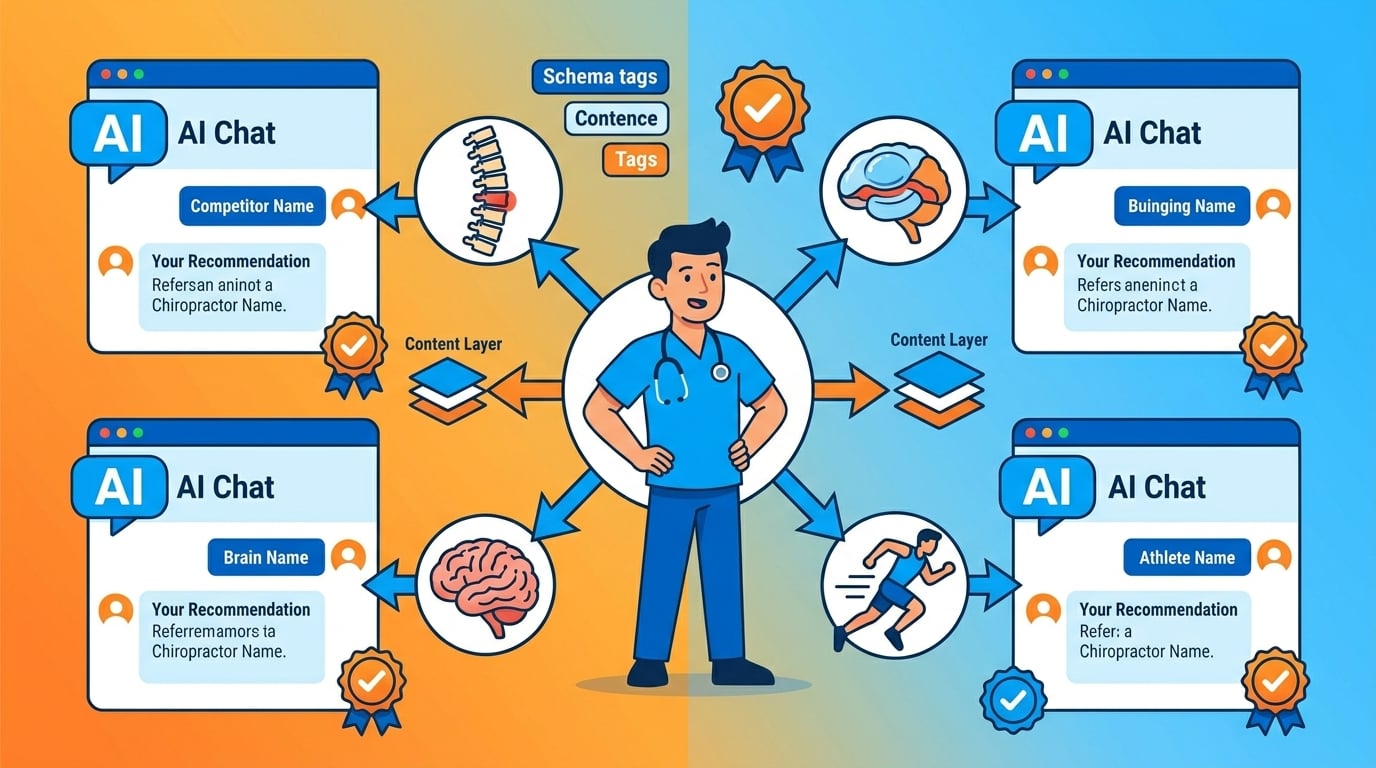
Wrong question: "How do we reach more cities?"
Right question: "How do we own the condition nationally?"
Not word choice. Two completely different problems with completely different answers. The geography question asks: how do I get my name in more cities? The condition question asks: how do I become the answer AI gives when someone anywhere asks about disc herniation? One of those is a logistics problem. The other is what actually gets you cited. And this is the exact wall where most chiropractic scaling efforts stall — docs are solving the first problem while the second one sits completely untouched.
Condition Authority: Own the Clinical Verdict
Condition authority means AI cites you when someone asks about a specific condition — anywhere, in any city, regardless of where your practice is located.
Not "a chiropractor near me." The authority on disc herniation. The practitioner AI reaches for when the condition drives the query, not the location.
That's a different identity than "local doc with a full schedule." Building it requires deliberate architecture:
- Structured condition pages — Comprehensive, schema-tagged content on each condition you want to own. Specificity is the signal. AI reads specificity as expertise and vagueness as uncertainty.
- Multimodal proof — Video content, patient education resources, clinical explainers. Depth across formats tells AI this is genuine expertise — not a single content piece manufactured to check a box.
- Condition-specific internal linking — Not one page on disc herniation. A thread that runs through your entire content system — condition guides, supporting content, FAQ depth — so AI reads it as a specialty, not a mention.
- Institutional external citations — Third-party validation from recognized healthcare sources. AI doesn't take your word for it. Independent confirmation is what builds the case.
DCRank research confirms that strategic content written in natural language is what actually captures qualified patients. Write for the condition. Not the city. That's the architecture that works.
I tell docs: the practitioner who understands how AI maps the five layers of patient intent owns the conversation before the phone rings. That upstream advantage compounds.
And owning the condition at the AI level — for sciatica, disc herniation, sports rehab — is what separates a busy local clinic from a practitioner AI cites across the country. The architecture is specific. You don't stumble into it.
One Authority Engine Beats Five Weak Sites
Here's the mistake I see most often when docs try to scale nationally.
Multiple sites. Different domain for each city or region. Looks like reach. It's fragmentation.
Every new domain splits entity signal strength. Each site gets individually weaker. AI building a confident entity model needs depth and consistency in one place — not thin signals scattered across five. Scattered signals can't produce a confident citation. They produce uncertainty. And uncertainty doesn't get recommended.
One authoritative domain. Condition-focused pages. Intelligent internal linking. Location-specific data embedded where it belongs. That's what gives AI one consistent, deep picture it can actually trust — and cite. The signals stay concentrated. The compounding works in one direction.
Five thin sites versus one deep one isn't a tie. It's not even a contest.
| Scaling Approach | Entity Signal Strength | National AI Citability | Authority Over Time |
|---|---|---|---|
| Single Authority Engine (condition-focused) | High — concentrated and consistent | High — deep, confident entity model | Compounds and grows |
| Multi-site Geographic Spread | Low — split signal per domain | Low — thin entity per site | Dilutes over time |
| Local-Only Optimization | Medium — geo-specific only | Local only — ceiling at market edge | Plateaus at market cap |
Who This Infrastructure Is Not For
I'll be straight here.
If the first filter when evaluating this is how it compares to a $500/month retainer — if price is the primary lens — this isn't for you. That's not a criticism. That's just clarity about fit.
National AI authority isn't a marketing expense. It's infrastructure. Built once, correctly, it compounds for years. The doc who treats it like a monthly ad spend — pilot phase, re-evaluate in 90 days, see if it "works" — will never build what's required. Signal architecture doesn't operate on a trial timeline. You can't compound what you haven't committed to building.
The Budget-First Buyer wants the minimum entry point. Wants to test the concept before committing to the investment. That mindset is the wrong frame entirely. Authority either compounds or it doesn't exist. There's no half-built version of entity depth — only the kind that works and the kind that doesn't.
This is for the doc who understands they're building an asset — something that makes their practice harder to compete with every single month it runs.
If that's where you are, the AI Visibility Check is the right first step. It shows exactly where your entity stands today and what the gap between here and national citation actually looks like.
Entity Hardening: Lock Your Identity Before You Scale
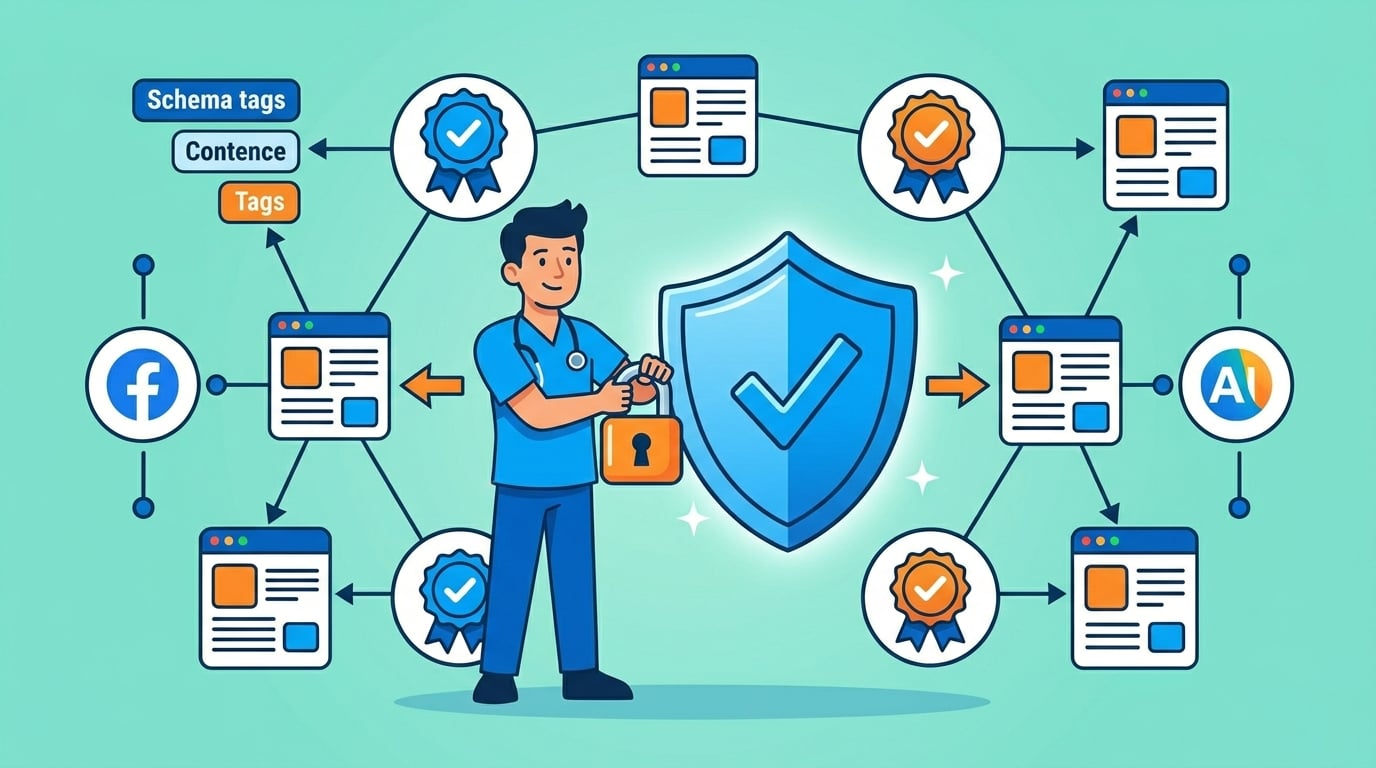
Most practices skip this step.
Not because it's difficult. Because it doesn't feel like forward progress. No new content. No new pages published. Just verification work, cleanup, consistency checks — nothing that shows up in an agency dashboard anywhere.
Skip it and everything you build on top amplifies the problem.
AI cannot confidently recommend an entity it cannot confidently verify. Conflicting addresses across directories, inconsistent credential spellings, outdated practice names, contradictory service descriptions — that's noise. AI reads noise as uncertainty. Uncertainty doesn't get cited. It gets skipped. Or worse — hallucinated.
What Entity Hardening Actually Involves
Entity hardening is the process of making your digital identity AI-readable, consistent, and verifiable across every platform that matters.
Not glamorous. Non-negotiable.
- NAP consistency — Name, address, phone number matching exactly across every directory AI reads. One mismatched address is a conflicting signal AI can't resolve. It registers as doubt.
- Credential verification — Degrees, certifications, board memberships listed correctly and consistently wherever AI looks for them. Inconsistent credentials tell AI the entity can't be trusted.
- Service taxonomy alignment — Describing services in recognized clinical terminology, not marketing copy. Marketing language creates ambiguity. Machines read clinical classification systems. Speak their language.
- Outdated profile cleanup — Old practice locations, previous practice names, ghost profiles from a clinic you closed three years ago. Every one of these is a conflicting signal actively working against your authority. They exist. AI reads them. They create doubt.
Build anything on top of a broken entity model and you're amplifying the conflict, not fixing it.
| Signal Category | Hardening Action | Priority |
|---|---|---|
| Directory Listings | Audit and correct NAP data across 30+ authoritative platforms | Critical — do first |
| Credential Data | Verify and standardize across medical boards, associations, and directories | High |
| Schema Markup | Add and validate structured data on all key website pages | High |
| Social Profiles | Sync bio, service descriptions, and practice name across all active platforms | Medium |
| Legacy Profiles | Identify and correct or close outdated practice entries and ghost listings | Medium |
Multi-Signal Consensus and Why Reviews Alone Won't Scale You
Reviews matter for local trust. A lot, actually.
They just don't move the needle on national AI authority.
What moves it is multi-signal consensus. Here's what that actually means: AI checks your state chiropractic association. Credentials confirmed. It checks Healthgrades. Same credentials. A healthcare publication cites you for that specialty. Your schema data matches. When AI finds all of those pointing at the same verified picture — that's when confidence builds. That's when citation happens.
A hundred reviews from one platform is one data point. Consistent, verified credential data across fifteen institutional sources is consensus trust. Those are not the same thing. They don't produce the same outcomes.
NRC Health confirms that when AI acts as the first point of contact in healthcare decisions, messy institutional data doesn't just fail to help — it actively erodes trust. The damage lands on you, not the engine.
I've watched this surprise docs who had genuinely impressive review counts. The doc with 400 reviews and a thin, inconsistent entity profile loses to the doc with 80 reviews and a hardened multi-signal infrastructure. Every time. At the national level, it's not even close.
Most docs are building for the dashboard. The authority signals that actually fill a waiting room are a different set entirely — and the gap between what's being measured and what actually matters is exactly why so many practices stall when they try to scale nationally.
AI uses every signal it can find to decide whose name to say. Multi-signal consensus is how you make sure that decision goes your way.
Frequently Asked Questions
Why doesn't my #1 local ranking translate to national AI recommendations?
Local rankings are built on proximity signals — map optimization, local reviews, and geographic service language that's designed to surface you when someone nearby is searching.
National AI recommendations run on entity depth — condition-specific expertise, institutional citations, and multi-source credential validation that AI reads independently of location. Those are two separate signal systems with almost no overlap. Winning one doesn't touch the other.
Your local ranking is real and earned. It's also bounded at the edge of your market. National AI condition recommendations run on completely different signals, completely different logic, a completely different threshold. Getting to the top of one doesn't touch the other.
What is the "1.2% Rule" and why does it matter for scaling?
The 1.2% Rule describes AI's observed recommendation selectivity — only about 1.2% of businesses in any given category get cited for a specific query.
When you're trying to scale nationally, that selectivity intensifies. You're not competing locally anymore — you're competing against every well-established condition authority in your specialty across the country. To break into that 1.2% at a national condition level, every dimension of your entity signals needs to be exceptional.
Most local practices have none of those signals built to national standard. That's the gap. It's closable with the right infrastructure. But you have to know it exists before you can close it.
Do I need multiple websites for each region I want to reach?
No. And this is one of the most common mistakes in national scaling.
Multi-site strategies split your entity signal strength across multiple domains. Each site gets individually weaker. AI doesn't reward geographic spread — it rewards depth and consistency concentrated in one place.
A single authoritative domain with condition-focused pages, location-specific data embedded correctly, and intelligent internal linking gives AI one consistent picture it can actually trust. That's what produces a citation. Depth beats breadth. Every time.
Can AI hallucinate my credentials if my entity data is messy?
Yes. This happens more often than practitioners realize — and the risk intensifies when you try to scale without hardening first.
When AI can't reliably verify your identity because your signals conflict, credentials are inconsistently listed, or data is outdated across directories, it fills the gaps with fabricated information. Wrong practice names. Wrong specialties. Wrong individuals attributed to your practice entirely.
This is entity hallucination. More national reach means more AI engines encountering your broken signals — which means more gaps filled with invented data. Lock your identity before you scale. Not after.
What does "Human Touch" mean in a national AI authority strategy?
AI manages discovery. Humans manage conversion. Those are two different jobs that can't be swapped.
Research indicates that 89% of patients still prefer speaking to a human for first impressions — even when an AI engine made the initial recommendation. That preference doesn't disappear because the referral came from ChatGPT instead of a neighbor's suggestion.
National authority drives more inbound from patients who are farther away, asking more specific condition questions, and less familiar with your practice than a typical local referral. If your front desk can't handle that conversion conversation — knowledgeable, comfortable with out-of-market patients, able to speak to specific conditions — you'll generate national visibility without national revenue. AI gets them to the phone. The human on the other end closes it.
How is Answer Engine Optimization different from what my current agency is doing?
Your current agency is most likely optimizing for traffic, map rankings, and lead volume. These are measurable, reportable, and relatively easy to package as a monthly deliverable.
Answer Engine Optimization targets something different: being the cited answer inside an AI engine's response. No click. A recommendation. The patient doesn't select from a list — they receive a verdict and act on it.
Different measurement. Different infrastructure. Different content approach entirely. An agency tracking clicks while AI recommends your competitor isn't just using the wrong tool — they may not even realize the two systems are separate. The channel they're optimizing for and the channel making recommendations aren't the same channel anymore.
What's the right first step before building a national authority strategy?
Find out where your current entity stands before building anything.
How does AI currently see you? What does it cite? What does it hallucinate? Where are your entity signals broken? What condition-level authority do you already have versus what you need to build?
Build without that baseline and you're guessing — which is an expensive way to learn at the national level. The AI Visibility Check shows what AI actually sees when someone asks about your specialty. What it cites. What it hallucinated. Where the gaps are. That's step one. Everything after it builds on what you find.
The Gap Widens Every Month You Wait
Local success is real. It's earned.
And it has almost nothing to do with national AI authority.
Different infrastructure. Different signals. Different machines evaluating different inputs. I've talked to docs who had genuinely impressive local presence — great reviews, strong referrals, packed schedules — who tried to expand and discovered the AI in the new market didn't know them at all. The signals didn't reach. They had to start from scratch in a market where someone else had already been building.
AI gives one answer. If you're not that answer, you don't exist in that conversation. Not penalized. Not buried. Just absent. That's a hard thing to hear when you've worked for years building something real — but the absence isn't about quality. It's about infrastructure.
The practices that scaled nationally built the right foundation before the expansion. Entity hardening first. Condition authority architecture second. Multi-signal consensus across institutional sources third. By the time they were ready to enter a new market, AI was already citing them there.
That's compounding working in your favor.
Every month without it, compounding runs the other direction. Someone else's authority builds. The gap between their trajectory and yours widens. The practices investing in this now will be genuinely difficult to catch in two years. The ones waiting to see how it plays out will spend that time explaining to patients why AI keeps recommending someone else.
That gap doesn't close on its own.
You know local visibility has a ceiling. The question is what your AI footprint looks like right now — and how far the gap is between where you are and where national citation requires you to be.
Most docs who go looking are surprised by what they find. Outdated credentials. Inconsistent entity data. A competitor being cited in their own specialty in their own market.
See where your entity stands today — before you build, before you expand, before you spend anything on a strategy that assumes your foundation is solid.
The practices that own national AI authority two years from now are building the infrastructure right now. Every month without it, the gap compounds against you.
621 Enterprises, Inc. | Copyright 2026 | All rights reserved