
The 5 Layers of Patient Intent: How AI Decides Which Chiropractor to Recommend
AI engines like ChatGPT, Gemini, and Perplexity decide which chiropractor to recommend by evaluating five distinct layers of patient intent: Technical Entity Verification, Proximity and Availability, Clinical Specialization, Consensus Authority, and Conversational Relevance.
This isn't a ranking system. It's a filter.
Unlike traditional search engines that produce a list of results, AI recommendation engines act as answer engines — they synthesize a single verdict. Most of the time, one name. The practice that clears all five layers first wins that response.
Here's the part most chiropractors don't see coming. The filter isn't evaluating how professional your website looks or how many five-star reviews you have. It's evaluating whether your digital infrastructure gives AI engines enough machine-readable proof to confidently recommend you. Structured data that makes your entity verifiable. Consistent citations across authoritative medical directories. Deep topical content that validates your clinical expertise.
If any layer fails — AI skips you. No partial credit. No "close enough." It just names someone else.
Traditional search results don't work this way. If you ranked #3 on Google last year, patients could still scroll down and find you. In AI search, there is no scrolling. There is one answer. That answer is either you or it isn't.
Traditional search volume is projected to fall 25% by 2026 as AI becomes the default answer engine for patient discovery. The practices that understand these five layers now will be the ones AI recommends when that shift completes.
This article breaks down each layer, explains what signals it evaluates, and shows you exactly where most chiropractic practices are currently failing the filter.
Last Updated: April 10, 2026
Why AI Doesn't Rank You — It Decides

Guy gets rear-ended on the 405. Neck locked up, shoulder throbbing. He pulls out his phone and asks ChatGPT for a chiropractor. Doesn't Google. Doesn't Yelp. Reads one name, calls that number, books the appointment. That doc might be two blocks from your clinic — and you never showed up in the conversation.
That's not an edge case. That's Tuesday.
The biggest shift in patient acquisition right now isn't happening in a Google algorithm update. It's happening in chat interfaces most chiropractors aren't even thinking about. And the practices showing up in those conversations didn't get there by accident.
As an AI authority agency, I watch this play out constantly. A doc with a real reputation, real results, real reviews — completely invisible in AI responses. Not because they're doing anything wrong. Because they never built the infrastructure machines can actually read.
The Digital Brochure Fallacy
Here's what most website designers will never tell you: the site they built you was designed for humans to read.
That's not a design critique. It's a structural problem.
AI engines don't browse your homepage the way a patient does. When ChatGPT or Gemini is asked to recommend a chiropractor, it's cross-referencing structured data signals — schema markup, directory citations, content depth — to decide whether your practice is safe to recommend. If those signals are missing or inconsistent, it doesn't give you partial credit. It moves on.
No schema. No authoritative directory citations. Thin content. That's not a website. That's a digital business card only humans can see.
I've watched this cost practices patients they'll never know they lost. Genuinely talented docs. Strong local reps. But their digital footprint looked like noise to the algorithm — conflicting signals, missing structure, nothing to verify against. So the engine named the practice that gave it something clean to work with.
The website got built for the wrong audience. And nobody in the room noticed.
Why Traditional SEO Is the Wrong Tool for This Problem
Traditional SEO optimizes for a list. AI search produces a verdict.
Those aren't variations of the same thing. They're different games with different rules.
AI search visits are seeing double-digit monthly growth, and that growth isn't driven by patients comparison-shopping. They're asking a question, getting one answer, and booking. The old playbook — keyword density, backlink volume, meta title optimization — doesn't address how that recommendation decision gets made.
I tell docs this whenever it comes up: chasing keyword rankings in 2026 is like optimizing your Yellow Pages ad in 2012. The logic isn't wrong. The map is wrong.
Your agency might be handing you green reports every month. Clean metrics, solid impressions, page-one rankings. And the waiting room's still quieter than it used to be. That mismatch isn't a mystery — it's a measurement problem. They're measuring a channel your patients are leaving.
The 5 Intent Layers, Explained

Each layer is a specific set of signals. Clear it — you stay in the running. Miss it — you're out. No partial credit. No "almost passed." These aren't suggestions; they're the filter.
Layer 1 — Technical Entity Verification
This one runs first. Everything else depends on it passing.
Before AI engines evaluate your location, your specialty, or your content — they need to confirm your practice is a real, verifiable entity. Not "probably real." Verifiably real.
Schema.org markup — JSON-LD covering your business name, address, specialty, credentials, and hours — gives AI the machine-readable confirmation it needs. Consistent NAP data across every platform you appear on tells it the entity is stable and not in conflict with itself.
If AI can't verify you exist as a clean, confirmed entity, it can't recommend you exist.
Most practices skip this step entirely because no one told them it was part of the evaluation. That's not an excuse AI accepts. It just names whoever passed.
What this layer evaluates:
- Schema.org markup (JSON-LD format) — business name, address, specialty, credentials, and hours structured so AI can read and confirm them without interpretation or guesswork
- NAP consistency (name, address, phone) — identical across every directory and platform where your practice appears, down to suite number format and phone number style
- Entity stability (no conflicting signals) — zero data contradictions across your web presence that would cause AI to flag your practice as an unverified or duplicated entity
Layer 2 — Proximity and Availability
Yeah, location matters. But probably not the way you think.
Proximity isn't just your ZIP code — it's whether your location data is identical everywhere AI looks. Google Business Profile, Healthgrades, your website schema. One mismatched phone number. A different suite address. These create conflicting entity signals. AI engines treat conflicting signals as trust gaps, and trust gaps knock you out.
Availability feeds this layer too. Your hours, whether you're showing up as accepting new patients — all of it gets factored in.
Zero-click rates now exceed 65% in early 2026 — patients are not comparing options. They're acting on the first AI answer they get. Your location data has to be pristine across every touchpoint. "Pretty close" doesn't pass this layer.
Where practices most often break Layer 2:
- Mismatched address formats (suite number discrepancies) — "Suite 100" on your website vs. "Ste 100" on a directory looks like two different locations to an AI evaluating entity consistency
- Stale hours (outdated availability data) — a Google Business Profile showing hours you stopped keeping two years ago sends a conflicting availability signal to every AI that reads it
- Missing new patient status (no acceptance signal) — if your directories don't indicate you're accepting patients, AI treats availability as uncertain and routes the recommendation elsewhere
Here's where it gets interesting — and where being genuinely good at what you do actually starts to matter to the machine.
When a patient asks AI "who's the best chiropractor for sports injuries near me" — the engine isn't just looking for who's closest. It's looking for a practice that has specifically and clearly demonstrated expertise in that area. Not implied it. Demonstrated it, through structured content and consistent signals.
One line about sports chiropractic buried on your "About" page doesn't cut it. A content cluster — articles that directly address the condition, schema listing the specific service, citations from relevant directories — does.
Your clinical specialty is a real competitive edge. But only if you've built the infrastructure that makes it legible to a machine. Expertise locked inside a human brain — or a thin services page — doesn't pass Layer 3.
What passes this layer vs. what doesn't:
- Passes (dedicated content cluster) — articles that address the specific condition directly, schema markup listing the service by name, and citations from directories relevant to that specialty area
- Fails (surface-level mention) — a single line on an About page, a bullet in a services list, or a "we treat all conditions" statement with no depth behind it
The gap (machine legibility) — AI can't infer your specialty from your reputation or years of practice. It needs explicit, structured signals. If those aren't built, the specialty doesn't register.
This layer is asking one question: does anyone else agree you're credible?
AI engines don't just read your own claims about your practice. They cross-reference your entity against external sources — healthcare directories, medical associations, review platforms, institutional citations. The more authoritative sources confirming the same story, the stronger your consensus score.
New national guidance on responsible AI use in healthcare issued in September 2025 is putting pressure on AI systems to show their work — to justify recommendations with traceable, verifiable sources. Consensus authority is exactly how you become something AI can trace.
Zocdoc. Healthgrades. Vitals. WebMD's provider directory. These aren't just review platforms — they're the consensus trust anchors AI uses as validators. Absent from them, or inconsistently listed? This layer fails.
You can have 500 Google reviews and a beautiful site. Thin consensus authority still gets you skipped.
The platforms that carry the most weight for this layer:
- Healthgrades (primary healthcare validator) — one of the highest-trust platforms AI references when cross-checking provider credibility; absence here is a significant consensus gap
- Zocdoc (booking and legitimacy signal) — your presence signals both active availability and platform-verified legitimacy at the same time
- Vitals (chiropractic citation weight) — high-trust medical directory with strong AI citation value for chiropractic-specific provider verification
- WebMD's provider directory (institutional trust anchor) — treated by AI as a high-confidence confirmation source because of WebMD's institutional authority in healthcare
- State chiropractic association (credential confirmation) — professional body listing that AI uses to validate credential legitimacy across licensing jurisdictions
Most underestimated layer in the stack. Also the hardest to shortcut.
Conversational relevance is how well your content matches the actual language patients use when talking to AI engines. Not keyword-optimized language. The real, specific questions people type into ChatGPT at 11pm when their back is locked up.
"What type of chiropractor should I see for lower back pain that shoots down my leg?" That's what a patient actually asks. A services page listing "lumbar care" doesn't answer that. A structured article that directly addresses that exact question — in patient language, with clinical depth — does.
Healthcare practitioners and platforms are maturing rapidly in the use of AI decision support tools — and the content those tools lean on shares the same structural requirements as conversational relevance signals. Answer the real question. Use the patient's language. Give AI something it can actually cite.
That's why your authority infrastructure can't stop at a homepage and a services list.
What this layer rewards vs. what it skips:
- Rewarded (question-matched content) — articles that directly answer the patient's specific question in their language, with enough clinical accuracy that AI can extract and cite a credible answer
- Skipped (keyword-formatted content) — services pages with SEO-formatted terms, generic "back pain specialist" copy, and thin descriptions written for crawlers instead of conversational AI
- The test (patient language check) — read your own content and ask: would a patient recognize their exact question in it? If not, Layer 5 doesn't pass.
The 5 Layers at a Glance
Layer 4 — Consensus Authority
Layer 5 — Conversational Relevance
Layer 3 — Clinical Specialization Signals
| Intent Layer | Primary Signal | Common Failure Point |
|---|---|---|
| Technical Entity Verification | Schema markup, structured data | No schema installed; inconsistent NAP across directories |
| Proximity and Availability | Location data consistency | NAP discrepancies between Google, directories, and website |
| Clinical Specialization | Content depth and topical clustering | Generic services page with no dedicated specialty content |
| Consensus Authority | Cross-platform directory citations | Absent from or inconsistently listed in healthcare directories |
| Conversational Relevance | Patient-language question-matched content | Keyword-optimized content that doesn't match how patients ask questions |
Where Most Practices Break the Filter
Most of the practices I talk to aren't failing these layers because they're cutting corners.
They're failing them because nobody told them the filter existed.
The site gets built by a designer who knows CSS but not schema. The Google Business Profile gets claimed once and left alone for two years. A few directory listings get created, inconsistently, and forgotten. The blog gets five posts and goes dark.
Each of those is a separate layer failure. AI doesn't grade on a curve.
The "I'm Doing Fine on Google" Trap
I hear this one a lot: "My Google rankings are solid. Why should I care about AI?"
Here's the honest answer: Google ranks pages. AI recommends entities.
Those aren't the same evaluation. They don't use the same signals. A clean Google ranking doesn't mean your entity schema is verified. It doesn't mean your directory citations are consistent. It doesn't mean you've passed conversational relevance for a single patient query.
I've seen practices sitting on page one of Google, completely absent from every AI recommendation in their market. I've seen the reverse too — lighter Google footprint, strong entity infrastructure, showing up in AI responses every time a patient nearby asks the question. The inputs are different. The outputs reflect that.
Understanding how authority signals differ from vanity metrics is where this starts to click. Until you understand what AI is actually measuring, you can't build for it.
I'll be direct.
High-volume website traffic is not what fills a waiting room in 2026. Consensus trust from AI engines is.
Those aren't the same pipeline. A practice driving 10,000 monthly visitors from SEO campaigns might be getting zero AI recommendations. A practice with a fraction of that traffic — clean entity infrastructure, solid directory consensus, well-structured content — might be showing up every time a patient in their zip code asks an AI who to call.
That second practice is growing faster. I've watched that math play out.
Traffic still means something. But it doesn't compensate for a broken entity layer. And the failure doesn't show up on any report your agency is sending you.
Traffic Doesn't Mean AI Recommends You
Not Every Practice Is Ready for This
I'll just say it.
If you're evaluating AI authority infrastructure the same way you'd price out a monthly retainer — comparing line items, looking for the cheapest entry point — this isn't going to be the right conversation.
The Budget-First Buyer isn't making a bad financial decision. They're applying the wrong financial model. An SEO retainer is an expense. You pay, you get the month's deliverable, and you renew. Authority infrastructure is an asset. Built right, it compounds. The entity trust you build this year is still working for you three years from now.
I'm not the right fit for a practice shopping on price against a $500/month retainer. That's not arrogance — it's honest qualification. I've watched practices buy the cheapest version of this, partially implement it, get weak results, and walk away convinced AEO doesn't work. It works. Their approach didn't.
If the empty waiting room eventually changes the math, we'll still be here.
The Budget-First Buyer Pattern
| The Thinking | What It Actually Signals |
|---|---|
| "What's the ROI guarantee?" | Expecting traditional marketing logic to apply to an authority asset |
| "I can probably do this myself after you explain it" | Underestimating the execution depth — this is infrastructure, not a checklist |
| "Can I start with the cheapest option?" | Optimizing for entry cost instead of authority outcome |
| "I already have a blog — isn't that enough?" | Confusing content presence with content infrastructure |
How to Build Each Layer — What Actually Works
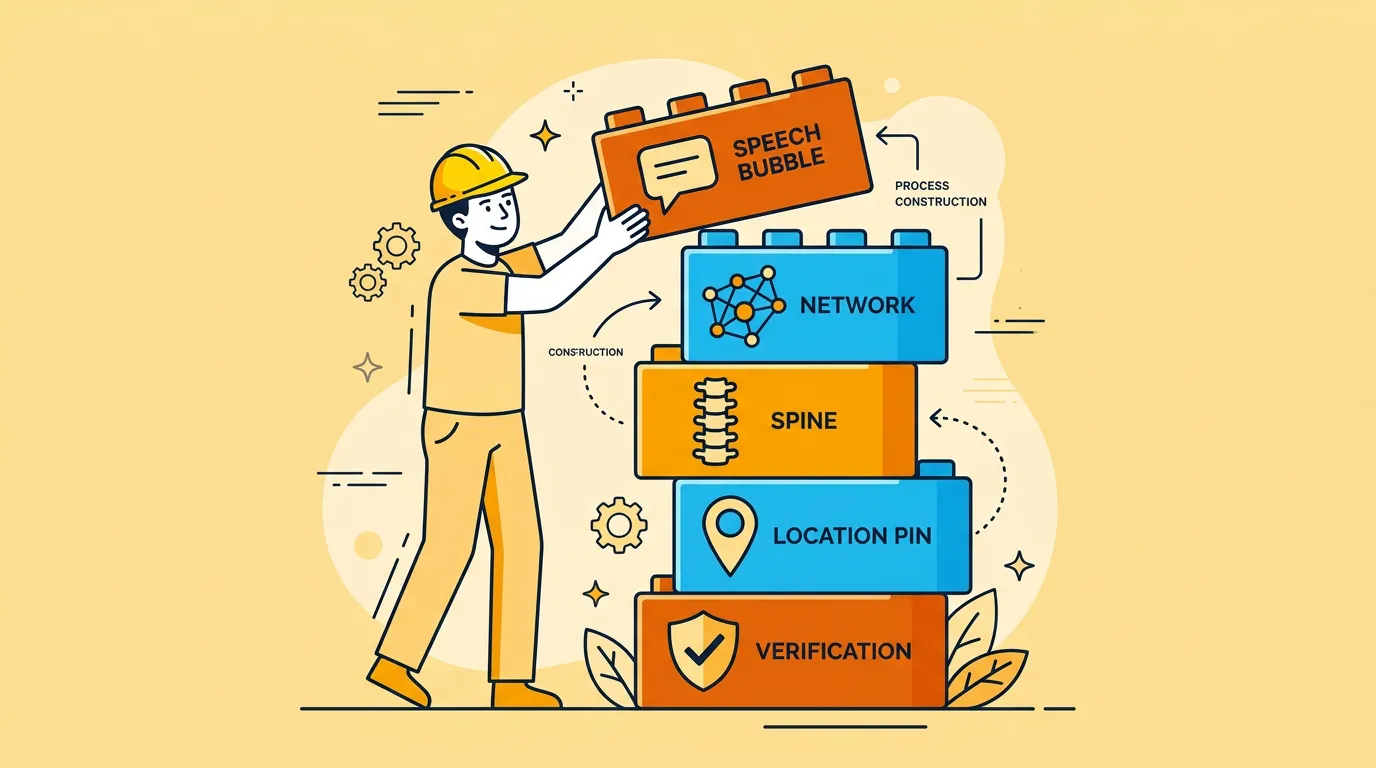
Understanding the filter is the easy part. Building for it is where most practices stall.
This isn't creative work. It's precision work. And precision work done sloppily creates the exact conflicting signals you're trying to eliminate.
Starting With Entity Verification
Nothing stacks cleanly without this. Full stop.
Schema.org markup in JSON-LD — not tag-based — covering your business name, address, specialty, credentials, and hours. Consistent NAP across every directory you appear in. Not "close enough." Identical.
One wrong phone number across three directories isn't a minor inconsistency. It's a conflicting entity signal. AI flags conflicting signals as trust gaps. Trust gaps cost you Layer 1. Lose Layer 1 and the rest of the stack is irrelevant.
I always tell docs: don't build the second floor until the foundation holds. Building local to national chiropractic authority is completely achievable — but it only compounds when the entity foundation is clean. It doesn't recover from a broken base.
Entity verification checklist — start here:
- JSON-LD schema (not tag-based markup) — install at the organization level on every page representing your practice or a service you offer; this is the machine-readable foundation everything else is built on
- NAP audit (every platform, not just Google) — search your practice name, pull every listing, and correct every discrepancy in name format, address, or phone; one inconsistency at this layer costs you the whole filter
- Primary identity lock (canonical business name) — decide on one exact business name format and use it everywhere, including punctuation and abbreviations, so every source confirms the same entity
Building Consensus Authority Across Directories
This is the most underinvested layer in almost every practice evaluation I've done.
It's not glamorous work. Creating and optimizing profiles across Healthgrades, Zocdoc, Vitals, WebMD's provider directory, your state chiropractic association — consistent name format, same address, same specialty framing across every one of them — takes time. It's tedious. Which is exactly why most practices never finish it.
That tedium is the advantage. The practices that complete this layer build a consensus signal their competitors never get around to replicating. Slow-moving moat. But real.
Directory build order for maximum consensus signal:
- Healthgrades (first priority) — claim and fully complete your profile; this platform carries the most AI citation weight for chiropractic providers and is the first place to lock down
- Zocdoc (second priority) — add booking integration where possible; active scheduling signals both availability and legitimacy in one entry
- Vitals and WebMD (third priority) — complete profiles with consistent specialty framing and address format matching your schema markup exactly
- State chiropractic association (credential layer) — listing confirms professional standing and adds a non-directory consensus source that AI treats as a verification signal distinct from review platforms
Content That Signals Specialization and Answers Real Questions
Layers 3 and 5 — specialization and conversational relevance — both get built the same way.
Not with posts about posture tips or "5 reasons to see a chiropractor." That content gets ignored by AI and skimmed by patients. We're talking about AI Authority articles that directly answer the specific questions your target patients are asking — in the exact language they use, with enough clinical depth that AI can extract a credible answer.
A prenatal chiropractor needs content that addresses Webster Technique, pregnancy-safe adjustments, and trimester-specific concerns in a way that's both clinically accurate and readable by a nervous first-time mom at midnight. That passes Layers 3 and 5 simultaneously.
This is what an AI authority agency builds. Not content for the sake of content. Content infrastructure that passes a machine filter.
The content type that passes both Layer 3 and Layer 5:
- Condition-specific articles (patient question format) — written to directly answer the questions patients ask AI about your specialty area, in their language rather than clinical shorthand, with enough depth to be cited
- Procedure and technique content (clinical depth) — articles explaining what you do and why it helps for specific presentations; the clinical specificity is what separates this from generic wellness content
- FAQ-structured content (conversational format) — organized around the real questions patients ask AI engines, not the keyword phrases they typed into Google in 2019
Layer-Building Priority Map
| Layer | Core Action | Timeframe | Who Executes |
|---|---|---|---|
| Technical Entity Verification | Schema markup + NAP audit and cleanup | Weeks 1–2 | Technical specialist |
| Proximity and Availability | Directory listing audit + Google Business Profile update | Weeks 2–3 | Operations or agency |
| Clinical Specialization | Topical content clusters by specialty area | Months 1–3 | AEO content specialist |
| Consensus Authority | Healthcare directory profile creation and optimization | Months 1–2 | Authority infrastructure specialist |
| Conversational Relevance | Patient-language, question-matched AI Authority content | Ongoing | AEO content specialist |
Frequently Asked Questions
What are the 5 layers AI uses to recommend a chiropractic practice?
The five layers are Technical Entity Verification, Proximity and Availability, Clinical Specialization, Consensus Authority, and Conversational Relevance. These aren't a ranking system — they function as a filter. Clear all five and you're in the running. Miss one and you're out. That's not a metaphor — it's how the evaluation actually works.
Why isn't a high Google Maps ranking enough to get recommended by Gemini?
Google Maps rankings are based on proximity and review signals. AI recommendation engines evaluate a different set of signals: structured entity data, directory consensus, clinical content depth, and conversational relevance. Different inputs. Different outputs. I've seen strong Google Maps rankings coexist with zero AI recommendations — because the underlying infrastructure those engines evaluate was never built.
Does my clinical specialty (like prenatal or sports chiropractic) affect how AI layers my intent?
Yes — significantly. Layer 3 (Clinical Specialization) exists specifically to surface the most relevant practice for the patient's specific condition. A practice with deep, well-structured content around a specific specialty will pass Layer 3 more cleanly than a generalist site. The specialty advantage is real. But it only registers if you've built the content infrastructure that makes it legible — a services page mention doesn't pass this layer.
Can a "hallucinated" founder identity cause an AI to ignore my practice's intent layers?
It can. When AI engines construct entity profiles, they pull data from multiple sources — your website, directories, social profiles, and indexed content. Conflicting signals about who owns or operates the practice create entity verification failures at Layer 1. This is why every source — your website, every directory listing, every social profile — needs to reference the same name, credentials, and role. One conflicting signal can disqualify the whole entity before the filter even reaches Layer 2.
How do I build the Consensus Authority layer across medical directories?
Start with the directories AI engines treat as trusted validators for healthcare — Healthgrades, Zocdoc, Vitals, and WebMD's provider directory. Create or claim each profile. Make your business name, address, phone number, and specialty consistent across all of them — and consistent with your website schema markup. That's the signal: not one polished profile, but five that say the same thing. Each new platform that confirms the same entity data strengthens the consensus score.
I have 200 five-star reviews. Why isn't AI recommending me?
Reviews are a human trust signal. AI engines use them as one input, but they're not the primary determinant of an AI recommendation. Your 200 reviews don't pass entity verification. They don't build directory consensus. They don't create clinical specialization signals or conversational relevance. Reviews confirm that humans like you. The five-layer filter is asking whether machines can verify you — and those are two very different questions.
What does "conversational relevance" actually mean in practice?
It means your content needs to match the natural language patients use when asking AI engines questions — not the keyword-formatted language of traditional SEO. The gap is bigger than most docs realize. A patient asking "will an adjustment help my sciatica that gets worse at night?" isn't searching the way they'd fill out a contact form. AI expects content that meets them at that specific question — and practices that have built that content measure its effect in a completely different way than standard metrics.
Is there a quick way to see which of the five layers my practice is failing?
Yes. The AI Visibility Check is a diagnostic tool built specifically to identify where a practice's digital infrastructure is creating gaps in AI recommendation visibility. It maps your current signals against the five-layer framework and identifies the specific failure points. If the phone is quiet and the reports look green, this is the thing to run — because what it finds is usually not what anyone expected.
The Gap Widens Every Month You Wait
AI gives one answer.
One. Not a list. Not "here are a few options near you." One name. If that name isn't yours, that patient doesn't know you're an option. They're not choosing someone over you. You're not even in the room.
That's the current state of patient discovery for anyone using an AI engine to find a chiropractor. And the practices that have built the five-layer infrastructure are putting more distance between themselves and everyone else every single month.
I've talked to docs who knew something was off — reviews solid, website polished, Google looking good — but the phone wasn't ringing the way it used to. That's the filter. They were passing the human test and failing the machine test. Those aren't the same test.
The filter isn't getting more lenient. AI engines are under increasing pressure to justify their recommendations with traceable, verifiable signals. The bar goes up. The practices that started building are already compounding. The ones that wait are building into a steeper hill.
Start building.
You've just learned how the filter works.
Now the honest question: do you actually know which layers your practice is passing?
Most docs I talk to assume they're in reasonable shape — until the AI Visibility Check shows them the specific layer where their infrastructure breaks down. It's not a sales call. It's a diagnostic. You'll see exactly what's working, what's failing, and where to focus first.
If AI is recommending someone else every time a patient in your market asks who to call — find out which of the five layers is the reason.

621 Enterprises, Inc. | Copyright 2026 | All rights reserved