
AI Authority Proof: The Infrastructure of Verifiable Trust
AI Authority Proof is the technical infrastructure that makes a chiropractic practice's clinical outcomes visible and verifiable to AI answer engines — ChatGPT, Gemini, and Perplexity.
In 2026, traditional social proof is broken. Star ratings, text testimonials, and Google review counts are soft signals. AI doesn't trust them the same way a patient skimming Yelp might. AI runs a risk-averse recommendation process — and soft signals don't clear that bar.
What clears it: Verifiable Trust Infrastructure — a machine-readable framework built on three pillars.
Entity Hardening means your practice's identity is structured, verified, and consistent across every platform AI uses to confirm you exist. Business name, address, service descriptions, clinical scope — all locked, cross-referenced, and schema-marked.
Consensus Verification means your clinical claims align with established medical consensus on authoritative domains — the .gov and .edu sources AI engines treat as ground truth. A claim unsupported by institutional consensus is a claim AI won't cite.
Structured Proof Nodes means converting patient outcomes from prose and paragraphs into machine-readable schema markup. The outcome stops being a testimonial. It becomes a data point AI can process, verify, and cite.
Without this infrastructure, your practice doesn't compete for AI recommendations. It doesn't register. In a zero-click environment where most searches now end without a website visit, the practices with verified trust infrastructure are the ones AI names. The ones without it don't show up at all.
This article breaks down exactly what that infrastructure is, why it matters, and what's at stake if you don't build it.
Last Updated: April 24, 2026
- The Social Proof Trap
- The Three Pillars of Verifiable Trust Infrastructure
- The Recommendation Risk Problem
- Closing the Infrastructure Gap
-
Frequently Asked Questions
- Why doesn't ChatGPT care about my 4.9-star Google rating?
- What is 'recommendation risk' and how does it affect my practice?
- How do I turn a testimonial into a machine-readable Proof Node?
- Can AI hallucinate my practice's outcomes?
- What is the 'Michael Walen' hallucination?
- Do I need a clinical white paper to get cited by Perplexity?
- How does the 1.2% Rule impact my social proof?
- The Infrastructure Builds or It Doesn't
The Social Proof Trap
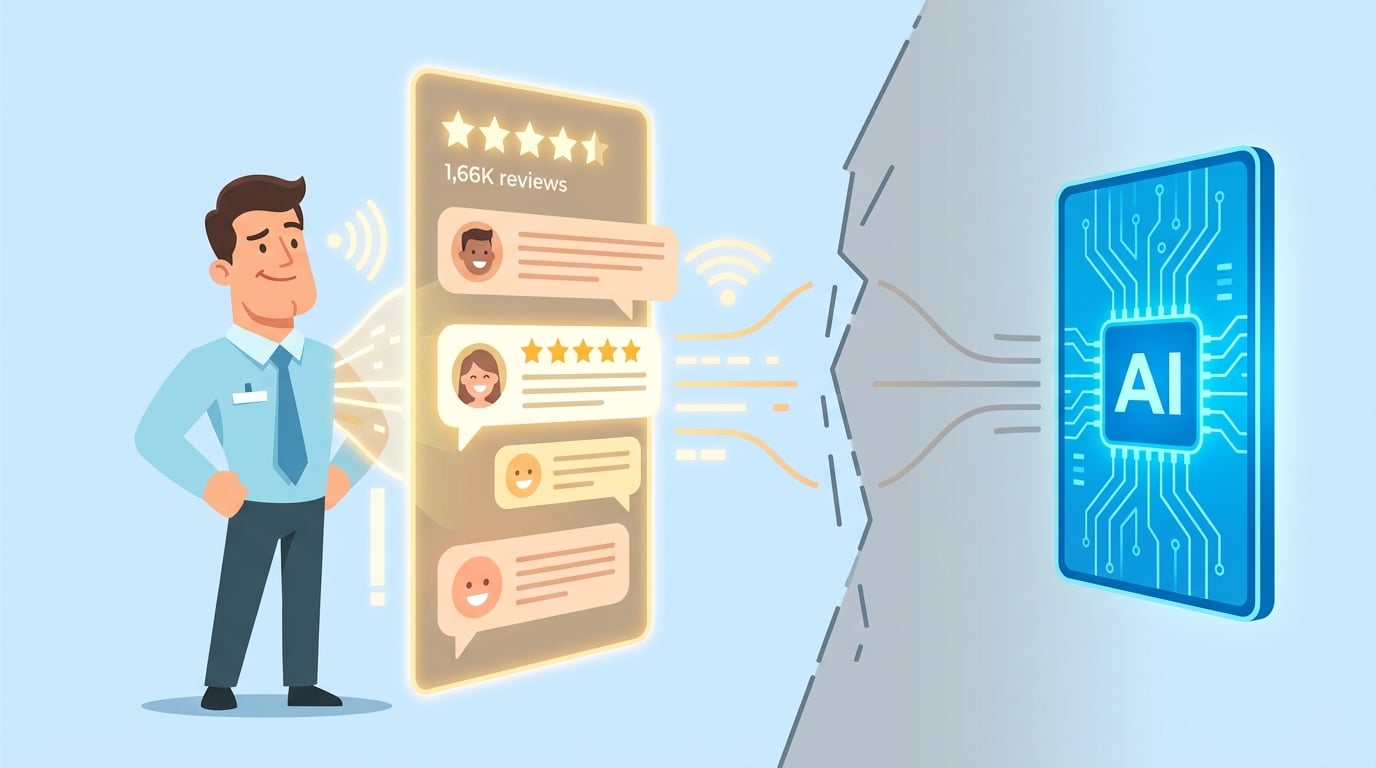
For 15 years, the playbook was simple: collect reviews. Get five stars. Look trustworthy.
AI didn't get that memo.
Your 4.9-star rating, your wall of glowing testimonials, your Yelp page that took years to build — none of it registers as trust to the engines patients are using now. Not ChatGPT. Not Gemini. Not Perplexity. These engines don't browse reviews. They run verification protocols. And your review profile doesn't speak their language.
I've watched this moment happen to docs who thought they were in good shape. A doctor in suburban Phoenix checks his SEO dashboard on a Tuesday morning. Everything green — traffic up, rankings holding, three new five-star reviews that week alone. He opens ChatGPT and types: "Who's the best chiropractor for lower back pain in Scottsdale?" His name doesn't appear. A practice that opened nineteen months ago does. He reads the response three times. Still not his name.
That's the Digital Brochure Fallacy in action. You built a website for human eyes. You built a review profile for human readers. AI doesn't have eyes. It has parsers, schema readers, and entity verification logic. It needs structured data — not patient stories.
The AI Authority Engine exists because this problem doesn't self-correct. It doesn't.
Why Your Testimonials Are Dark Data
Here's the thing nobody told you when you were collecting those 200 reviews: AI can't read them.
Not in the way that matters. When ChatGPT or Perplexity processes a recommendation query, it's pulling from indexed, structured, verifiable sources. Your text testimonial — the one posted in 2018, sitting in a plugin on your website — is dark data. AI can't confirm who wrote it, whether the outcome was real, or whether your practice is even the entity it thinks you are.
According to eSEOspace, AI applies heavy weighting to .gov and .edu domains when evaluating clinical trustworthiness. Private clinic websites — even excellent ones — start at a disadvantage. More testimonials don't close that gap. Structured proof does.
| Signal Type | Soft Signal | Hard Signal |
|---|---|---|
| Testimonials | Prose review on website | Schema-marked Review with structured outcome data |
| Ratings | Star average on Google | Entity-verified citation from an authoritative source |
| Reviews | Google review count | Multi-platform consistent entity data with cross-references |
| Outcomes | Patient success story (prose) | Structured Proof Node with clinical claim and consensus alignment |
| Directories | Yelp listing | Verified directory listing with complete, consistent entity fields |
Soft signals don't move AI's needle. Hard signals do. The difference isn't cosmetic.
Why Traditional SEO Fails This Test
I'm not saying traditional SEO is worthless. I'm saying it was built for a system that no longer controls how patients find providers.
The old chain made sense: optimize a keyword, build backlinks, climb the rankings, patient clicks through, books an appointment. That worked. Past tense.
Gartner projects traditional search volume will drop 25% by 2026 as patients move to AI answer engines. The audience you've been optimizing for is shrinking. And the new system? Backlinks don't tell ChatGPT you're trustworthy. Keywords don't tell Perplexity what conditions you treat. Page authority scores don't tell Gemini whether your clinical outcomes are real.
What AI evaluates: entity clarity, structured proof, and consensus alignment. None of that shows up in a traditional SEO audit.
The practices still running traditional SEO campaigns aren't just behind. They're optimizing in the wrong direction. Why AI ignores most chiropractic websites traces directly back to this — years of investment that never built the signals AI actually checks.
The Three Pillars of Verifiable Trust Infrastructure
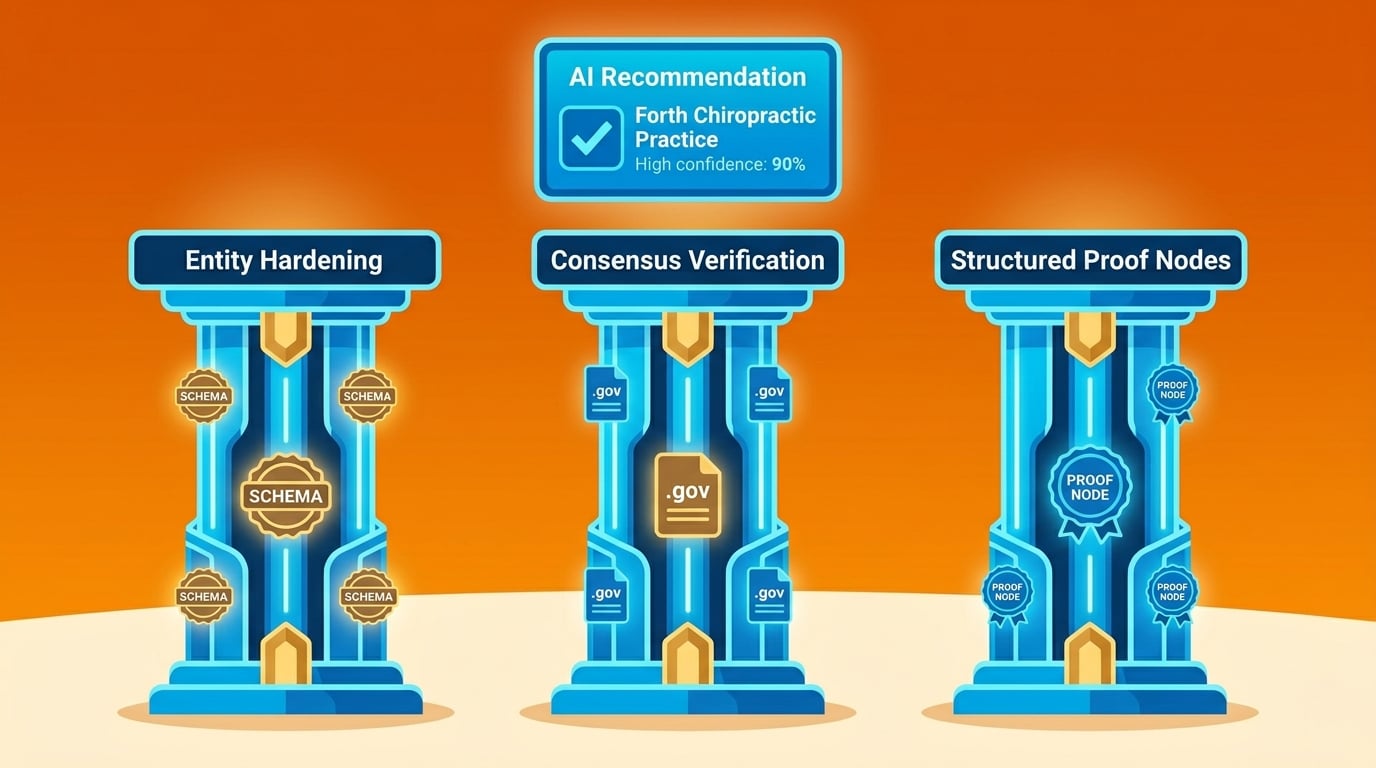
Verifiable trust isn't a feature you add. It's a framework you build.
Three pillars. Interdependent. Built in sequence. Miss one and the whole structure gives AI a reason to look at a competitor instead.
Pillar 1 — Entity Hardening
AI doesn't know who you are. It has to figure that out — and it's using signals you probably aren't managing.
Here's what I mean. Your name, your address, your phone number, your specialty — AI pieces that together from everything it can find indexed on the web. If your name appears differently on Google than it does on Yelp, or your phone number is off by one digit on a directory from three years ago, AI logs that as a verification failure. A reason not to trust you.
Entity Hardening locks every one of those signals down. Same name. Same address. Same scope. Every platform. Structured with schema markup that speaks directly to what AI needs.
Think of it as identity registration — not for Google, but for the engines deciding whose name gets said.
- Business name consistency — One variation across one directory is one reason for AI to question the entity match. Every platform, exact same format.
- NAP alignment — Name, address, and phone locked identically across every indexed source. Inconsistency is a trust signal failure.
- Schema markup — Physician, MedicalOrganization, and LocalBusiness structured data properly implemented and cross-referenced.
- Service scope definition — Machine-readable description of what conditions you treat, what outcomes you deliver, what patients you serve.
Without Entity Hardening, AI is guessing about you. Guessing AI recommends someone else.
Pillar 2 — Consensus Verification
AI won't back a clinical claim it can't verify.
That's the wall most clinics hit. Real outcomes. Real patient results. But those outcomes live in testimonials and staff conversations — nowhere that AI can cross-check against what authoritative sources say is true.
eSEOspace has documented this directly: AI weighs .gov and .edu domains heavily when evaluating clinical claims. If your content says you treat sciatica but doesn't cross-reference the evidence base behind that claim, AI flags it as unverifiable. Unverifiable claims don't get cited.
Consensus Verification means building AEO content that aligns your clinical scope with the institutional sources AI already trusts. Not to fake authority. To actually earn it.
Pillar 3 — Structured Proof Nodes
This is where outcomes stop being stories and start being evidence.
A patient success story in a text block on your website is a narrative. AI doesn't recommend narratives. A Proof Node — schema-marked, data-structured, source-aligned — is something AI can read, verify, and act on.
That's the proof decay problem — outcomes that are real but structurally invisible. And machine-readable social proof is where that gap gets practical: the exact conversion from noise to node.
The move isn't from bad proof to good proof. It's from unstructured proof to structured proof.
| Pillar | What It Does | Implementation Example |
|---|---|---|
| Entity Hardening | Locks identity signals across all platforms | Physician schema, NAP consistency, MedicalOrganization markup |
| Consensus Verification | Aligns clinical claims with institutional authority | AEO content linked to .gov/.edu sources, condition-specific evidence mapping |
| Structured Proof Nodes | Converts outcomes into machine-readable data | Review schema, MedicalScholarlyArticle markup, condition-outcome documentation |
The Recommendation Risk Problem
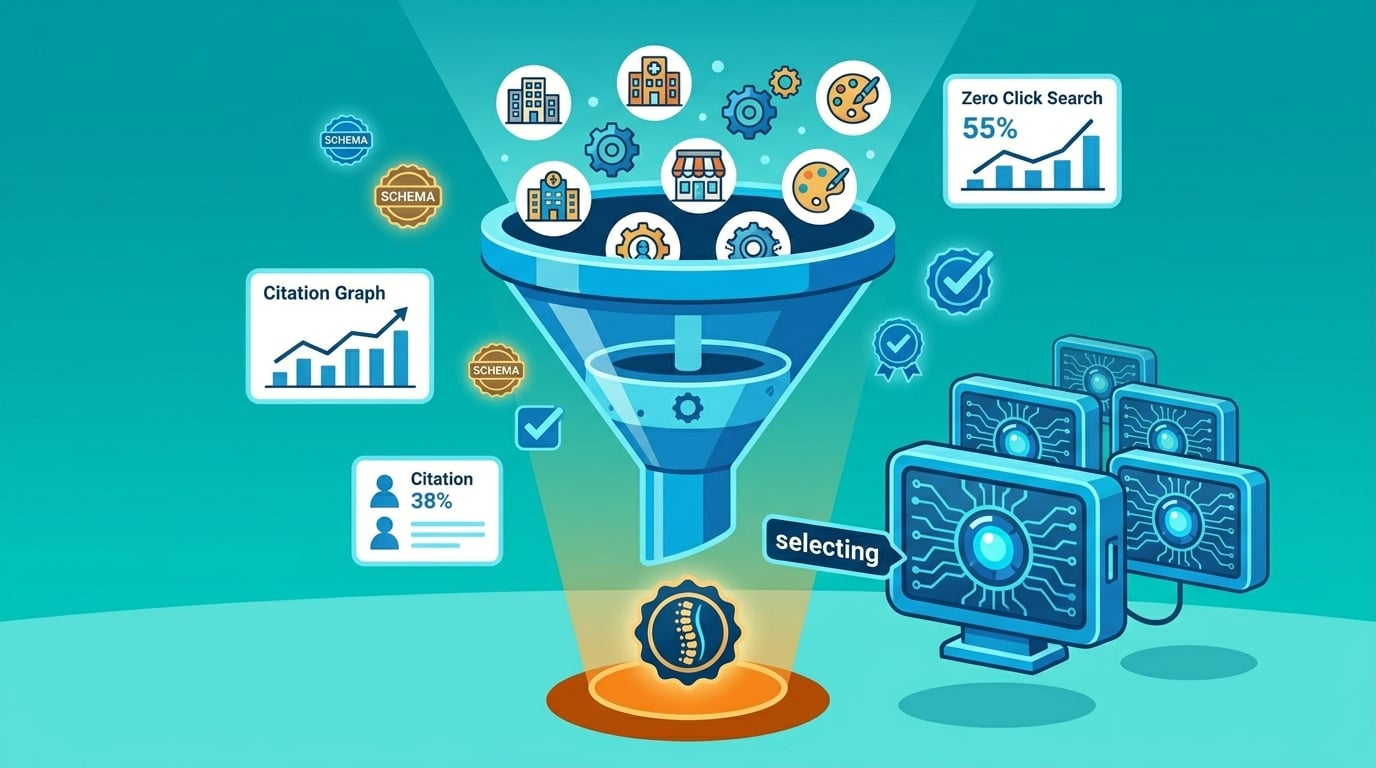
AI doesn't pick randomly. It runs a trust filter.
And most chiropractic practices fail it — not because they're bad practices, but because they never built the infrastructure the filter is looking for.
How AI Decides Who to Trust
When a patient asks ChatGPT who to see for lower back pain, AI isn't browsing your Yelp page. It's running a risk assessment. Every practice in that answer pool gets scored — entity consistency, clinical claim verification, consensus alignment, multi-source confirmation.
According to Online Marketing CT, AI agents prioritize safety and multi-source verification over marketing claims. The practice with the infrastructure clears the bar. The practice with 500 reviews and no schema markup doesn't.
Here's the part that stings. The new clinic down the street — opened less than two years ago — might already be getting AI recommendations over you. Not because they're better clinicians. Because they built the trust infrastructure first.
- Multi-source verification — AI confirms entity data across multiple independently indexed sources before committing to a name
- Clinical claim integrity — Every stated outcome needs documented evidence behind it, not just patient anecdotes
- Entity signal density — Volume and consistency of structured data signals across platforms determines how much AI trusts you
- Consensus alignment — Clinical scope must align with established medical authority sources AI treats as ground truth
The Zero-Click Reality
ClickVision research shows over 68–72% of Google searches end without a click. When AI generates the answer, that number climbs to 83%.
The patient isn't going to your website. They're getting the answer from AI, and they're done. No second click. No comparison shopping. One name. They book.
Gartner projects traditional search volume will drop 25% by 2026 as users migrate to AI answer engines. The audience you've been building your website for is shrinking. The audience that matters is asking AI — and AI is giving one answer.
If that answer isn't your name, there's no second chance.
| Search Behavior | Data Point | What It Means for Your Practice |
|---|---|---|
| Zero-click rate (all Google searches) | 68–72% | Most patients never reach your website |
| Zero-click rate (AI-generated answers) | 83% | AI answers end the search — no click required |
| Traditional search volume decline by 2026 | 25% projected | The SEO audience is contracting |
| AI recommendation output | 1 answer | There is no second place in this model |
This Isn't for the 90-Day Miracle Seeker
Real quick — let's make sure you're in the right place.
If you need your schedule filled in the next 60 days, this isn't your answer. I'm not going to tell you it is. Verifiable trust infrastructure is not a sprint. Entity Hardening, Consensus Verification, Structured Proof Nodes — these compound. They don't flip.
The 90-Day Miracle Seeker wants a guarantee, a timeline, a promised number. I won't promise a timeline — not because this doesn't work, but because integrity matters more than closing the deal. What I know is this: every month of execution builds on the last. The practices that stick with it compound. The ones that quit hand that ground to whoever kept going.
If you're tired of short-term tactics that evaporate the moment the invoice stops — you're exactly who this is built for.
Closing the Infrastructure Gap
AI is making recommendations in your market right now.
Not coming. Already happening. The question is only whether your name is in the answer.
The Michael Walen Warning
Here's what AI does when entity data is thin: it makes something up.
An AI engine once fabricated a founder named "Michael Walen" for iTech Valet. That person doesn't exist. I'm the founder — Gerek Allen — and the only reason that hallucination got caught is because the entity verification protocols were in place to catch it.
For a chiropractic clinic, that same failure mode plays out at scale. AI fills gaps. And the gaps it fills aren't always harmless:
- Wrong specialty assignment — AI may list your practice under conditions you don't treat
- Fabricated practitioners — AI cites a provider who left years ago, or in some cases one who never worked there
- Outdated service claims — AI describes offerings you discontinued or never offered
- Incorrect outcomes — AI cites patient results you never documented and never claimed
Akerman LLP reports that new state laws in California and Texas now require licensed providers to review all AI-generated content to prevent what regulators call "doctor-impersonating" hallucinations. Regulators named it. That's how serious it got.
Verified trust infrastructure doesn't just get you recommended. It controls what AI says when it does recommend you.
Proof Nodes vs. Proof Noise
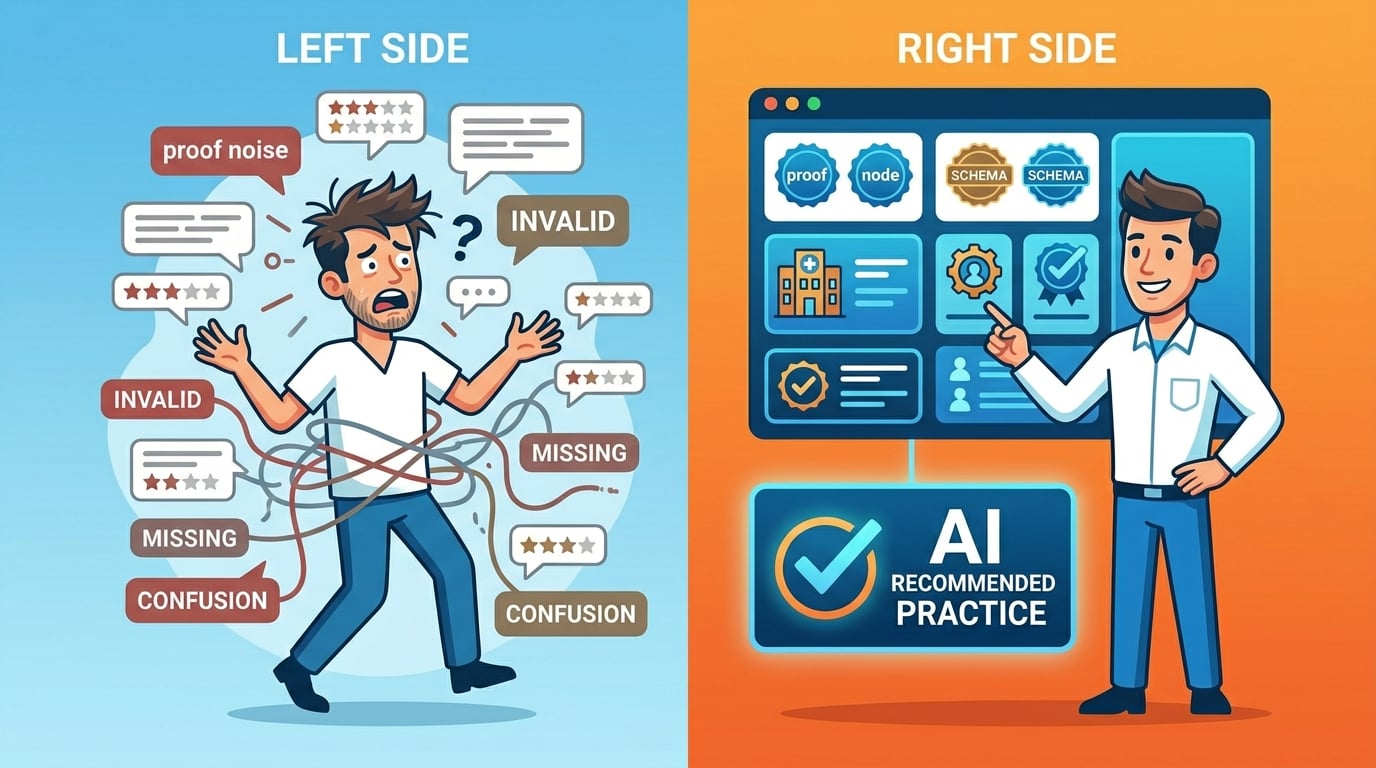
I tell docs this all the time: you don't have a proof problem. You have a structure problem.
The outcomes are real. The patient results happened. But they're sitting in text blocks and plugin-based review widgets that AI can't parse. That's proof noise — unstructured, unverifiable, invisible to every recommendation engine that matters.
How AI layers patient intent to select a recommendation goes deeper on this — and it explains why two practices with identical real-world reputations can get completely different AI outcomes based purely on how their proof is structured.
| Proof Noise | Proof Node | Why the Difference Matters |
|---|---|---|
| Text testimonial on website | Schema-marked Review with structured outcome data | AI can read, verify, and cite the node — it cannot process the noise |
| Five-star rating on Google | Entity-verified multi-source citation | Cross-platform verification confirms trustworthiness |
| Staff bio on About page | Physician schema markup with credentials and scope | AI can confirm provider identity and clinical range |
| Condition page (prose) | AEO content aligned with .gov consensus sources | Consensus-aligned claims are citable — prose claims are not |
The documented practice results that demonstrate this shift aren't marketing claims. They're infrastructure outcomes — the kind AI engines can actually process and verify.
Frequently Asked Questions
Why doesn't ChatGPT care about my 4.9-star Google rating?
ChatGPT and other AI answer engines don't process star ratings as trust signals the way a patient skimming Yelp might. A 4.9-star rating is a soft signal — aggregated, unstructured, and unverifiable from AI's perspective.
The practices getting recommended aren't the ones with the best reviews. They're the ones with the strongest machine-readable trust infrastructure. More stars don't close that gap. Structured proof does.
What is 'recommendation risk' and how does it affect my chiropractic practice?
Recommendation risk is how AI answer engines approach the trust decision. AI acts as a risk-averse advisor — it will not stake a recommendation on an entity it can't verify through multiple independent sources.
Online Marketing CT research shows AI agents prioritize multi-source verification over marketing claims. If your practice has weak entity signals, minimal schema markup, or clinical claims that lack consensus alignment, AI classifies you as too risky to name. Your competitor isn't beating you on quality. They're beating you on verifiability.
How do I turn a text testimonial into a machine-readable Proof Node?
Converting a testimonial into a Proof Node means structuring it — implementing schema markup (Review or MedicalScholarlyArticle) that makes the outcome machine-readable, and aligning the clinical claim with verifiable medical consensus from authoritative sources.
An unstructured testimonial is a story. A structured Proof Node is evidence. AI cites evidence. That's not a preference — it's the mechanism.
Can AI hallucinate my practice's outcomes if my entity data is messy?
Yes — and it does.
If your entity data is incomplete, inconsistent, or contradictory across platforms, AI fills the gaps with whatever it can find — or fabricates. Wrong phone numbers, wrong service descriptions, wrong clinical scope. In some cases, wrong practitioners entirely.
Why AI ignores most chiropractic websites often comes down to this exact failure: messy entity data that forces AI to guess rather than verify. Entity Hardening eliminates the guesswork. It also eliminates the risk of AI inventing your identity.
What is the 'Michael Walen' hallucination and why is it a warning for clinics?
An AI engine fabricated a founder named "Michael Walen" for iTech Valet — a person who doesn't exist. It happened because entity signals were thin and unverified. AI invented the gap.
For a chiropractic clinic, the same risk applies. Weak entity infrastructure means AI can misattribute outcomes, assign wrong specialties, or cite practitioners who no longer work with you. The fix isn't monitoring AI after the fact. It's building infrastructure that leaves no gap to fill in the first place.
Do I need a clinical white paper to get cited by Perplexity?
No. You don't need original published research.
What you need is AEO content that aligns your clinical claims with established medical consensus and links to the institutional sources AI engines already trust. eSEOspace shows AI heavily weights institutional sources when evaluating clinical trustworthiness. The goal isn't to produce peer-reviewed research. It's to build content that sits beside peer-reviewed research in AI's trust hierarchy. That's a content infrastructure problem. Not a publication problem.
How does the 1.2% Rule of AI selectivity impact my social proof?
AI gives one answer. Not a list. Not a top five. One.
The 1.2% Rule is the extreme selectivity of that process. In a market with dozens of chiropractic practices, only the practice with the strongest verified trust infrastructure gets named. Traditional social proof doesn't survive this filter.
How AI layers patient intent to select a recommendation goes deeper on what's happening inside that selection process. Bottom line: only structured, machine-readable Proof Nodes make the cut. Everything else is noise.
The Infrastructure Builds or It Doesn't
AI is giving one answer in your market right now. Either your name is in it or a competitor's is — and the patient who got that answer is already done shopping.
Every month without this infrastructure is a month your competitor uses to compound theirs. The gap between you and the practice getting recommended isn't static. It widens. Every month of their compounding authority makes them harder to catch, and harder to displace once AI decides it trusts them.
I won't promise you a timeline. What I will say: the practices building this now are the ones that will own AI recommendations in their markets six months, twelve months, three years from now. The ones that wait will spend that same time watching someone else's name in the answer.
AI gives one answer. If that answer isn't your practice, it doesn't exist.
If AI is naming someone in your market right now — and it is — it matters whether that name is yours.
The AI Visibility Check is a 15-minute diagnostic that shows you exactly what ChatGPT, Gemini, and Grok say when a patient in your market asks who to trust. Not traffic data. Not rankings. What AI actually says when the question gets asked.
I've run this check with practices that were convinced they were in good shape. Most weren't. Some found one infrastructure gap. Some found several.
The trust infrastructure either exists or it doesn't. The check tells you which one is true for your practice right now.
The practices being recommended in your market didn't get there by accident. They built toward it. Every month you're not building, they're compounding.
621 Enterprises, Inc. | Copyright 2026 | All rights reserved