
Why AI Ignores Your Patient Results (And How to Fix It)
Last Updated: April 24, 2026
The reality most chiropractors don't see: your testimonials page is invisible. Not to humans. To machines. You've got a wall of five-star stories from patients whose lives you changed. AI reads it as noise. Why? Because there's no semantic structure. No data tags. No machine-readable proof that tells ChatGPT, Gemini, or Grok who said it, what condition you treated, or what the measurable outcome was.
You're publishing vibes. AI needs receipts.
Here's what this article covers: the fundamental difference between human-readable content and machine-readable infrastructure, the specific metrics and formatting standards that build AI trust, how to structure case studies and testimonials so they function as authority signals (not marketing fluff), the HIPAA-compliant way to document outcomes without exposing protected health information, and the technical implementation steps that turn patient success stories into machine-verified proof.
The Machine Readability Problem
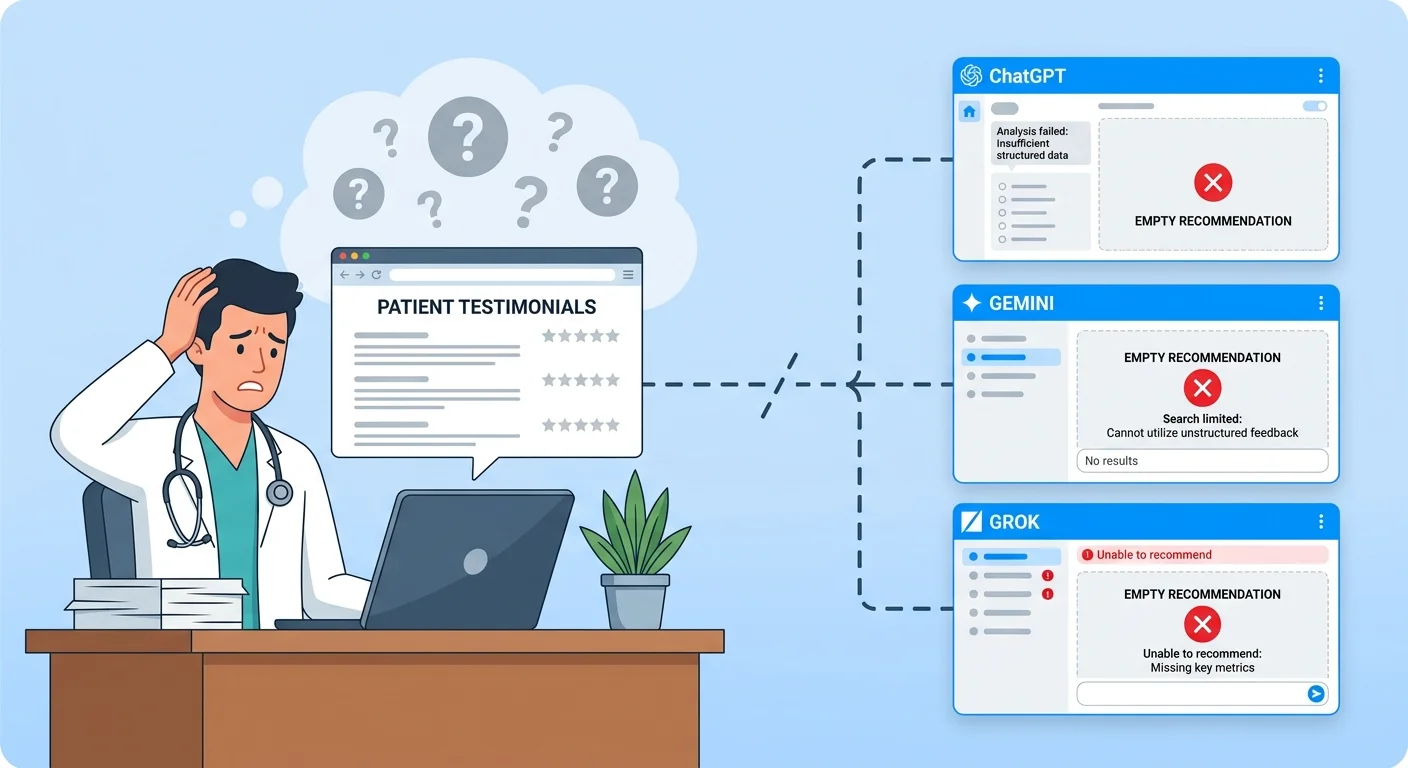
You've got testimonials. Probably a whole page of them.
Sarah J. says you changed her life. Mike R. says he's back to golfing after three years. Lisa M. wrote three paragraphs about how you fixed her neck pain when nobody else could.
Cool. AI doesn't care.
Not because the testimonials aren't real. Because they're not structured. There's no semantic markup telling AI who wrote it, what they rated, or what condition you treated. It's just text on a page. And text on a page — no matter how compelling — is structurally invisible.
Why Your Current Testimonial Page Fails AI
A beautiful website that AI does not recognize is an expensive digital business card.
Your testimonials page might look great. Clean design. Professional photos. Five-star reviews from real patients. But if there's no schema wrapping those testimonials — no machine-readable tags defining the rating, the reviewer, the service being reviewed — AI reads it as noise.
Here's what the typical testimonial looks like:
"Dr. Smith is amazing! I came in with severe lower back pain and couldn't stand for more than 10 minutes. After 6 weeks of treatment, I'm back to running and playing with my kids. Highly recommend!"
— Sarah J.
Human reads that and thinks: This doc gets results.
AI reads that and thinks: Unverified text. No structured data. Moving on.
There's no schema tag identifying this as a review. No rating property. No semantic label for the condition (lower back pain) or the outcome (returned to running). AI can't extract the improvement timeline. It can't verify the treatment type. It can't connect this testimonial to your entity as someone who specializes in lower back pain.
You're asking AI to trust you based on prose. That's not how this works.
What Machine-Readable Proof Actually Looks Like
Machine readability is the new standard for chiropractic social proof.
Machine-readable proof wraps testimonials in Schema.org markup. That's semantic labeling — invisible tags in the HTML that explicitly define each component of the review in a format AI understands.
For a testimonial, that means tagging:
- The reviewer's identity (first name, last initial)
- The rating (5 stars, 10/10, whatever scale you use)
- The service reviewed (chiropractic care, spinal adjustment, etc.)
- The date
- The business entity being reviewed (your practice, your location)
For a case study, that means structuring:
- The condition treated
- The treatment protocol
- The measurable outcome (pain scale drop, ROM increase, functional improvement score)
- The timeframe
You're not changing what the content says. You're adding semantic tags that make AI see structure instead of text. The human experience stays the same. The machine experience transforms.
We don't publish vibes. We publish receipts. Structured data is how you turn patient stories into machine-verified proof.
The Metrics AI Trusts
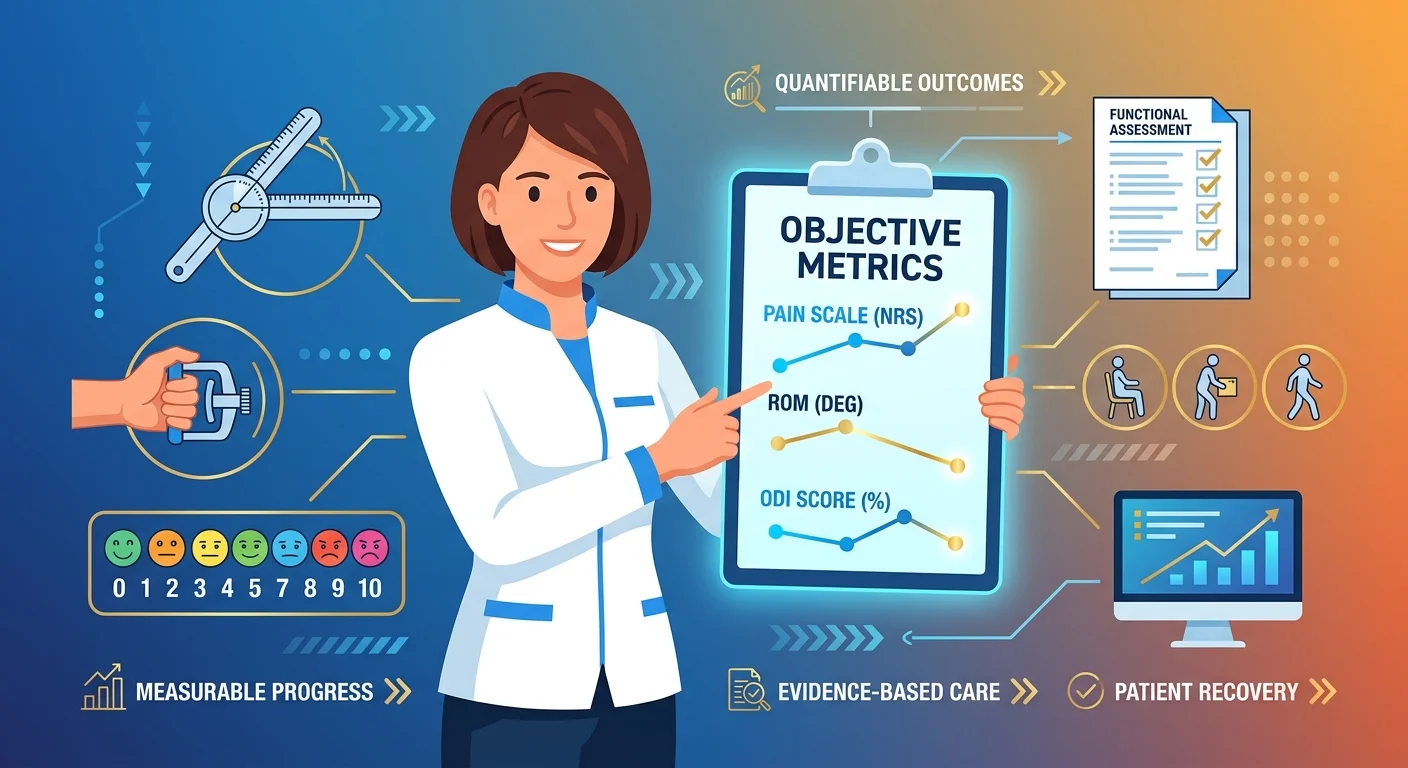
AI doesn't trust "I feel so much better."
AI trusts "Pain reduced from 8/10 to 2/10 over 6 weeks."
One's a vibe. One's a data point. And data points are the only thing that builds machine trust.
If you want AI to recommend you, document outcomes the way AI measures credibility: objective, quantifiable, repeatable metrics.
The Core Metrics for Chiropractic AEO
Not every metric matters equally. Some are gold. Some are noise.
Here's what matters:
Pain Scale Reduction — The most universal metric. Pre-treatment pain score (8/10) and post-treatment pain score (2/10). Use the Numeric Rating Scale (NRS) for consistency. AI knows what that scale means.
Range of Motion Improvement — Objective. Measurable. Repeatable. Document pre- and post-treatment ROM in degrees for the relevant joint. Lumbar flexion. Cervical rotation. Shoulder abduction. Whatever you're treating.
Functional Capacity Scores — Use standardized assessments like the Oswestry Disability Index (ODI) for lower back pain or the Neck Disability Index (NDI) for cervical conditions. These are validated tools AI recognizes. Not proprietary scales you made up.
Activity Restoration — Quantify what the patient can do now that they couldn't before. "Returned to running 3 miles without pain" is stronger than "feels better." One's measurable. One's not.
Treatment Timeline — How many sessions? Over what period? "12 sessions across 8 weeks" gives AI a structured timeframe to evaluate effectiveness.
The more objective and standardized your metrics, the more weight AI assigns. Vague improvements don't build trust. Data does.
Why Patient-Reported Outcomes Matter
Patient-reported outcomes (PROs) are clinical assessment tools that let patients quantify their own experience. Pain levels. Functional limitations. Quality of life impacts. They're standardized. Validated. Widely used in research.
AI trusts PROs because they're structured. When you document a case study using ODI scores, you're not just saying the patient got better. You're providing a machine-readable data point that AI can compare across practices, conditions, and treatment protocols.
Research published by the National Center for Biotechnology Information confirms that implementing PROs in clinical practice improves both patient care and outcome documentation.
For AEO, that documentation becomes the foundation of machine trust.
Start tracking PROs now. Not for research. For visibility.
| Metric Type | What It Measures | Why AI Trusts It | Example Data Point |
|---|---|---|---|
| Pain Scale Reduction | Subjective pain level before and after treatment using standardized 0-10 scale | Quantifiable, standardized measurement that AI can parse as objective improvement | Patient pain reduced from 8/10 to 2/10 over 6 weeks |
| Range of Motion (ROM) Improvement | Degrees of movement improvement in affected joints measured with goniometer | Objective physical measurement verified by clinical tools | Cervical rotation increased from 45° to 75° (67% improvement) |
| Functional Improvement Scores | Validated assessment tools like Oswestry Disability Index or Neck Disability Index | Peer-reviewed, standardized instruments that provide verifiable baselines | Oswestry score decreased from 42% (moderate disability) to 12% (minimal disability) |
| Treatment Duration & Frequency | Number of visits and timeframe required to achieve documented outcome | Provides context and reproducibility data that builds treatment pattern credibility | 12 visits over 8 weeks, twice weekly then once weekly maintenance |
How to Structure Case Studies for Machine Trust
A case study is not a story.
It's clinical documentation. Structured. Machine-readable. Verifiable.
If you format it like a blog post — narrative arc, dramatic tension, emotional payoff — AI ignores it.
If you format it like a clinical report — condition, treatment, outcome, metrics — AI extracts it as proof.
The HIPAA-Compliant Case Study Format
Most chiropractors won't publish case studies because they're worried about HIPAA violations.
Valid concern. But you can document outcomes publicly without exposing protected health information (PHI).
Here's the compliant format:
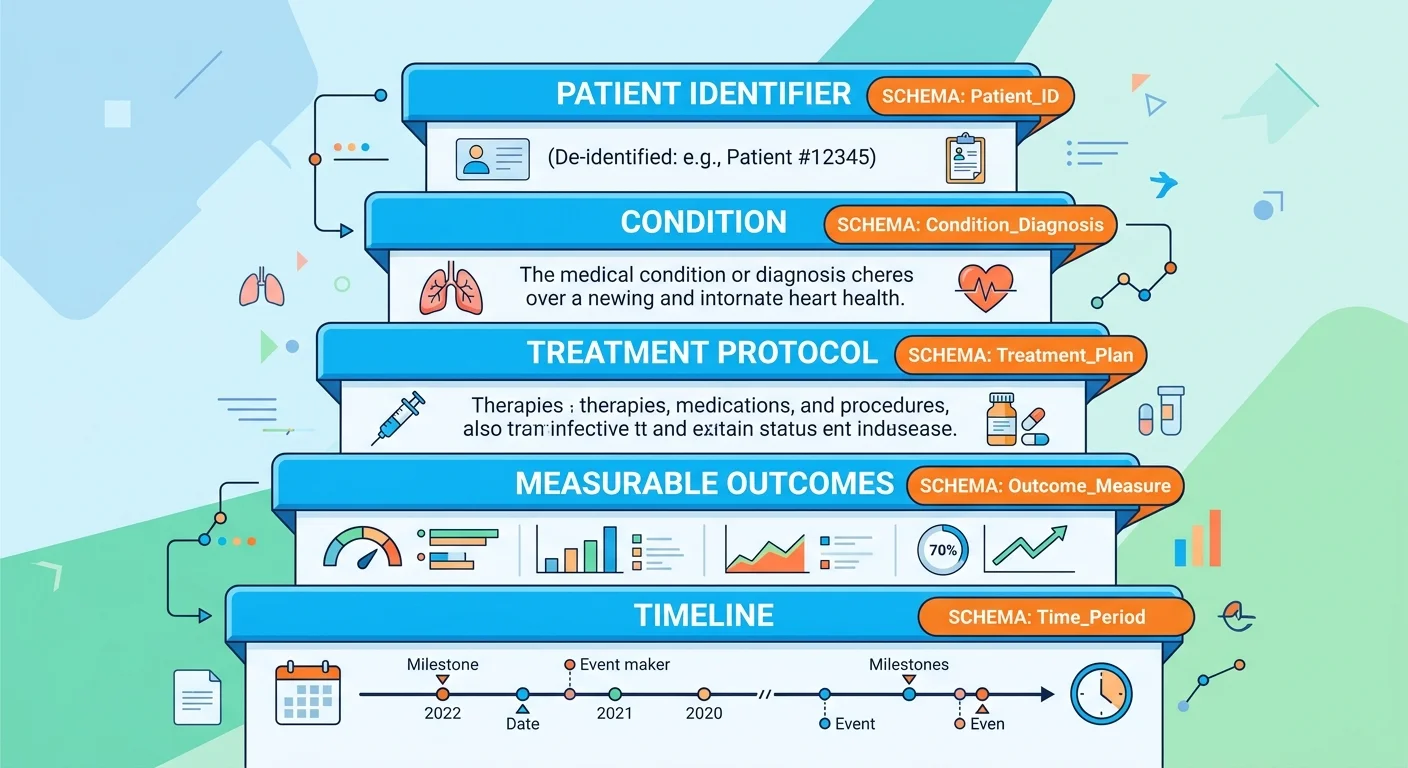
Patient Identifier — First name and last initial only. No full names. No dates of birth. No addresses.
Condition — The presenting complaint. "Chronic lower back pain" or "cervical radiculopathy."
Treatment Protocol — The specific interventions used. "Spinal manipulation, soft tissue therapy, corrective exercises."
Measurable Outcomes — The objective data. "Pain reduced from 7/10 to 2/10. Lumbar flexion improved from 45° to 75°. ODI score decreased from 42% to 12%."
Timeline — How long treatment took. "10 sessions over 6 weeks."
Patient Consent — Always required. The patient must give explicit written consent for their anonymized case study to be published.
No narrative. No backstory. No emotional commentary.
Just data.
That's what machine readability is the new standard for chiropractic social proof looks like.
Using Schema Markup to Tag Case Studies
Once you've documented the case study in the format above, you wrap it in schema markup.
Specifically: MedicalCondition, MedicalTherapy, and Patient schema types from Schema.org.
This tells AI:
- What condition was treated
- What treatment was used
- Who provided the treatment (your practice entity)
- What the outcome was
You're not changing what the case study says. You're adding semantic tags that make AI see structure.
The human visitor reads the narrative. The AI engine reads the schema.
Structured versus unstructured proof is the difference between being invisible and being cited.
| Component | Required Data | HIPAA Compliance Rule | Schema Tag (if applicable) |
|---|---|---|---|
| Patient Identifier | First name and last initial only | Remove all Protected Health Information (PHI): no full names, dates of birth, or specific treatment dates | schema:author (for Review schema) |
| Chief Complaint | Primary condition or pain presentation | Describe condition generally without unique identifiers | schema:about or schema:itemReviewed |
| Baseline Metrics | Pre-treatment measurements (pain scale, ROM, functional scores) | Use ranges or rounded numbers if needed to prevent re-identification | Include in schema:reviewBody or MedicalCondition properties |
| Treatment Protocol | Techniques used and visit frequency | Can be specific to treatment type, not patient-specific details | schema:treatmentType or schema:procedure |
| Outcome Metrics | Post-treatment measurements showing improvement | Same anonymization as baseline—focus on percentage improvement rather than dates | Include in schema:reviewBody with structured data |
| Patient Consent | Written authorization to use testimonial | Must have explicit consent to publish even de-identified information | Not applicable to schema—internal compliance document |
Structured Testimonials vs. Unstructured Vibes
Here's the distinction most practices miss:
Testimonials can build machine trust — if they're structured.
But most aren't. Most are vibes.
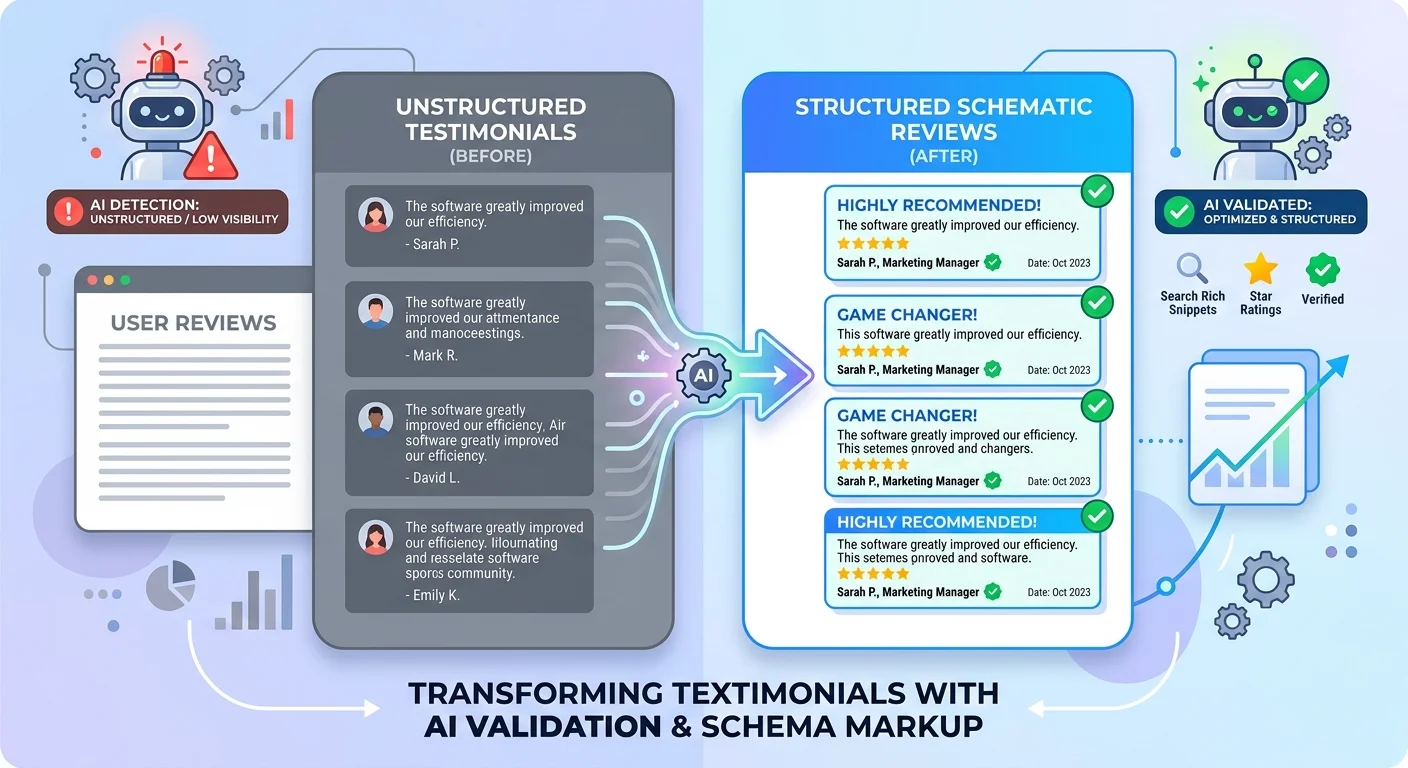
An unstructured testimonial is a paragraph of text on a webpage. No schema. No rating tag. No reviewer identity tag. AI reads it, finds no machine-readable data, and moves on.
A structured testimonial wraps that same content in Review schema. It explicitly defines:
reviewRating— The star rating or scoreauthor— The reviewer's name (anonymized)reviewBody— The text of the reviewitemReviewed— The service or business being reviewed
Same words. Different infrastructure.
One builds trust. One doesn't.
Why Most Testimonial Pages Are Invisible
Modern consumers trust online reviews.
According to BrightLocal's Local Consumer Review Survey, most consumers read online reviews before choosing a local business. Reviews matter.
But here's the problem: AI doesn't trust testimonials just because they exist.
It trusts them when they're formatted as structured data that it can parse, verify, and weight against other signals.
Your testimonials page might have 50 five-star reviews. If none of them are wrapped in schema, AI sees zero verifiable reviews.
You're invisible.
How to Add Review Schema to Testimonials
You don't need to redesign your testimonials page.
You add invisible semantic tags to the HTML.
Search Engine Journal's guide to review schema walks through the technical implementation, but here's the concept:
For every testimonial on your page, you wrap it in a <script type="application/ld+json"> block that defines the review properties.
The visible testimonial stays the same. The schema tells AI who wrote it, what they rated, and what they reviewed.
That's the difference between a pretty page and a machine-trusted authority signal.
Quick pause.
If you're looking for a way to implement this overnight and see immediate results, this isn't it. Authority infrastructure is built in layers — schema first, content compounding on top, AI visibility deepening every month. If that timeline doesn't fit your decision framework, no hard feelings. But if you're tired of short-term tactics that disappear the moment you stop paying for them, you're in the right place.
| Schema Property | What It Defines | Example Value | Required or Optional |
|---|---|---|---|
| @type | Declares this is a Review schema object | "Review" | Required |
| itemReviewed | The service or business being reviewed | "@type": "LocalBusiness", "name": "Your Practice Name" | Required |
| author | Who wrote the review | "@type": "Person", "name": "Sarah M." | Required |
| reviewRating | Numerical rating given | "@type": "Rating", "ratingValue": "5", "bestRating": "5" | Required |
| reviewBody | The actual testimonial text content | "After 8 weeks of treatment, my lower back pain decreased from 8/10 to 2/10..." | Optional but highly recommended for context |
| datePublished | When the review was published | "2025-03-15" | Optional but adds credibility |
| publisher | The organization publishing the review | "@type": "Organization", "name": "Your Practice Name" | Optional but strengthens entity connection |
The Role of Your EHR in Machine Trust

Your electronic health records (EHR) system is already tracking patient outcomes.
Pain scales. ROM measurements. Functional assessments. Treatment protocols. That data exists.
The question is whether it's structured in a way that can be exported, formatted, and published as machine-readable proof.
Most EHR systems aren't built for AEO. They're built for clinical documentation and billing.
But the data inside them is exactly what AI needs to verify your expertise.
Extracting Outcome Data from Your EHR
Start by identifying which metrics your EHR consistently tracks.
Pain scales? ROM measurements? Functional assessments? Treatment timelines?
Those are your core data points.
Work with your EHR vendor (or your IT team) to create a structured export process. You don't need real-time integration. You need a monthly or quarterly export of anonymized outcome data that you can format into case studies and testimonials.
The goal: turn clinical documentation into published authority signals without duplicating effort.
You're already collecting this data. You're just not using it to build machine trust.
Why Most Practices Don't Do This
Because it's work.
It requires coordination between clinical documentation, IT infrastructure, and content execution. Most practices either don't have the bandwidth or don't understand the value.
That's why our AI Authority Engine handles this as part of the infrastructure rebuild.
We don't ask you to export your own EHR data, format your own schema, or manage your own documentation workflow.
The steak gets on the plate. How it got there is our concern.
Authority is not claimed. It is built. And building entity trust starts with the systematic documentation of outcomes that AI can verify.
What You Should Do First
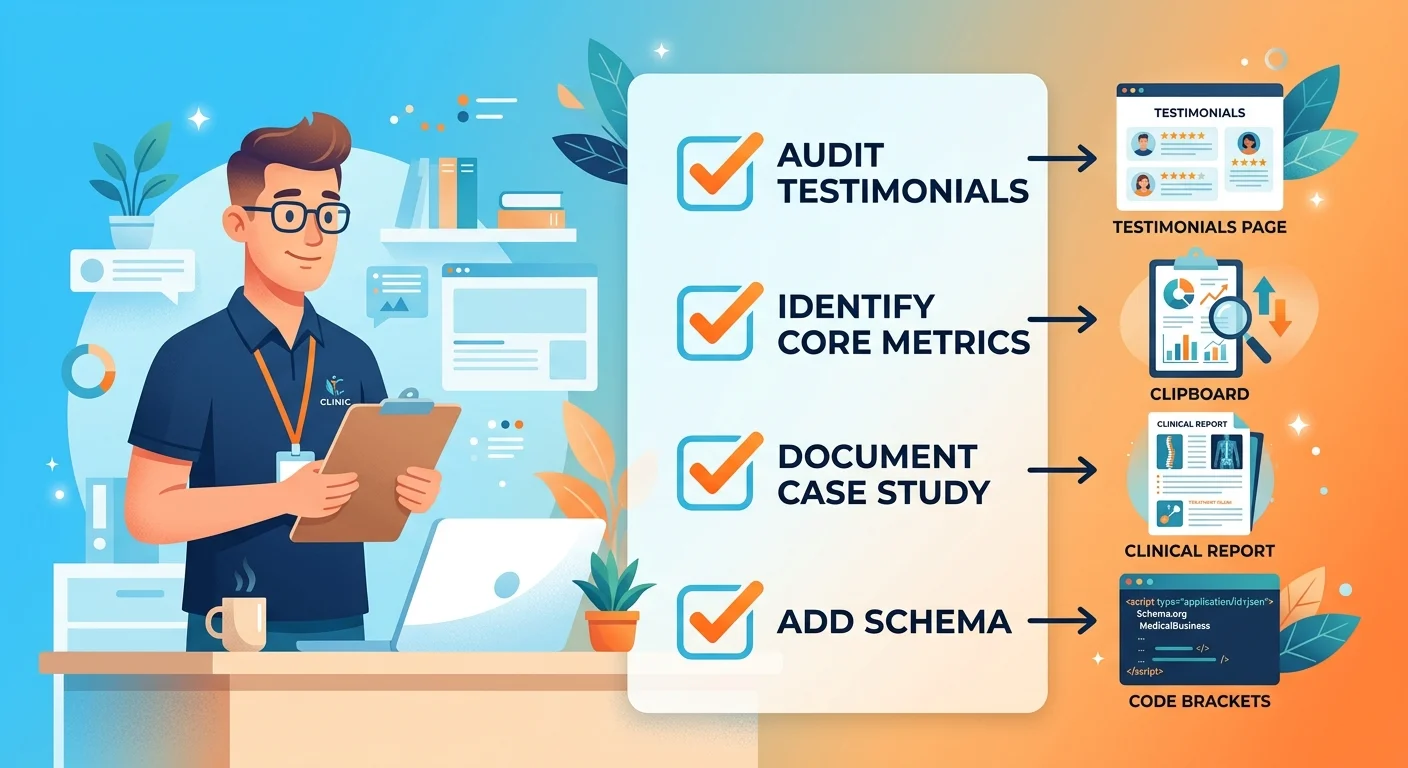
If you're ready to make your patient results visible to AI, start here.
These are the first steps that build the foundation.
Audit Your Current Testimonials
Go to your testimonials page. View the source code. Look for schema markup.
If you don't see <script type="application/ld+json"> blocks with Review or AggregateRating schema, your testimonials are unstructured.
That's not a technical failure. That's a visibility failure. AI doesn't see them.
Identify Your Core Metrics
Look at your clinical documentation. What outcomes are you already tracking?
Pain scales? ROM? Functional assessments?
Those are your starting metrics. Don't invent new ones. Use what you're already measuring.
Document One Case Study
Pick a patient success story. Get written consent.
Document the case using the HIPAA-compliant format: anonymized identifier, condition, treatment, measurable outcomes, timeline. Write it like a clinical report, not a blog post.
That's your proof of concept. That's the first structured case study that AI can extract.
Add Schema to One Testimonial
Take one existing testimonial. Wrap it in Review schema.
Define the rating, the reviewer, the review body, the item reviewed.
You don't need to rebuild your entire testimonials page. Start with one. Verify AI can read it. Then scale.
Understand What an AI Authority Engine Actually Builds
This process — documenting outcomes, structuring data, adding schema, exporting EHR metrics, publishing case studies — is infrastructure work.
It's not a one-time project. It's ongoing execution that compounds over time.
Most practices don't have the bandwidth, the technical expertise, or the understanding of AEO to do this themselves.
That's the problem an AI Authority Engine solves. Not by teaching you how to do it. By doing it.
White-glove execution. You get patients better. We make AI see it.
Frequently Asked Questions
What is the difference between human-readable and machine-readable proof?
Human-readable proof is a simple text testimonial on a webpage—something a visitor can read and understand. Machine-readable proof wraps that same information in structured data (schema), using specific tags so AI engines can understand who said it, what score they gave, what condition was treated, and what the measurable outcome was. Same content. Different infrastructure.
Can I use schema for patient testimonials without violating HIPAA?
Yes, by anonymizing all Protected Health Information (PHI). Use a first name and last initial only. Omit specific dates, addresses, and any identifying details. Focus on the treatment outcome and review itself. As long as the patient has given explicit written consent for their anonymized testimonial to be used, this does not violate HIPAA.
What are the most important metrics to include in a chiropractic case study for AEO?
Focus on quantifiable, objective data: pre- and post-treatment pain scale scores (e.g., 8/10 to 2/10), percentage improvement in range of motion, functional improvement scores like the Oswestry Disability Index (ODI) or Neck Disability Index (NDI), and activity restoration (what the patient can now do that they couldn't before). The more standardized and objective, the more weight AI assigns.
Do simple text-only testimonials still have any value?
They have value for human visitors who are already on your site. But for AI, they're unstructured vibes—not machine-readable proof. To have value for AEO, they must be marked up with structured data (Review schema) so AI can extract the rating, reviewer, and context. Without that structure, AI ignores them.
How does a structured case study help build AI trust?
It demonstrates expertise in a specific area by providing machine-readable proof that you successfully treated a specific condition. By structuring the case study with schema for the condition, treatment protocol, and measurable outcome, you give AI a verifiable "receipt" that proves you can solve that problem. That makes AI more likely to recommend you when someone asks about that condition.
But doesn't adding schema and tracking metrics complicate my workflow?
Yes. That's why most practices don't do it.
That's also why most practices are invisible to AI.
Authority infrastructure isn't simple. It's systematic. The practices that take the time to structure their proof compound visibility. The ones that skip it stay invisible.
If the complexity is a barrier, that's exactly what white-glove execution solves—see our case studies to see how we handle this for practices that don't have the bandwidth.
Can I apply structured data to my old testimonials?
Absolutely. You don't need to collect new testimonials.
You can retrofit your existing testimonials with Review schema. The content stays the same. You're just adding semantic tags that make AI see structure instead of text.
Same testimonials. Different infrastructure.
Isn't this just another SEO tactic that will be outdated next year?
No. Schema markup and structured data are not SEO tactics — they're semantic web standards.
AI engines rely on structured data to understand and verify content. As long as AI answer engines exist, they will need machine-readable proof.
This isn't a trend. It's the foundation of how machines understand authority.
Build it now or watch competitors who did take the visibility you're leaving on the table.
You're Already Collecting the Data
You document patient outcomes every day.
Pain scales. ROM measurements. Functional assessments. Treatment timelines. That data exists in your EHR.
The question is whether you're using it to build machine trust or letting it sit in a database AI can't read.
Every unstructured testimonial is wasted authority. Every case study without schema is proof AI ignores.
The gap between practices AI recommends and practices AI overlooks isn't clinical skill. It's infrastructure. It's whether your outcomes are documented in a language machines understand.
There's no version of this where doing nothing is a safe play. AI is already making recommendations in your market. Either your name is in the answer or a competitor's is.
That gap widens every month it goes unaddressed.
Want to know if AI can actually read your patient results right now — or if you're publishing vibes?
Run the AI Visibility Check. It takes 15 minutes and shows you exactly what ChatGPT, Gemini, and Grok see when they scan your practice for verifiable proof.
If the results don't make the problem self-evident — walk away. But if they do, you'll know exactly what to do next.

621 Enterprises, Inc. | Copyright 2026 | All rights reserved