
The Old CMS Isn't the Wall You Think It Is

The direct answer left one assumption sitting there untouched: that an aging platform knocks a practice out of AI visibility. That assumption treats the CMS like a wall. It's really a foundation.
An older content management system can still support new weight if the addition is engineered correctly. A single well-structured room added to a dated building can outperform the rest of the structure combined, provided it is built to hold its own. The platform's age stopped being the deciding variable once citation, not placement in traditional ranked results, became the measurable outcome.
What a 'Standalone Article' Actually Is
A standalone article is a piece of content engineered to be a self-contained, citable source of truth on a specific topic, designed to be easily added to nearly any existing CMS. It does not depend on surrounding navigation, theme design, or platform version to make its case.
Here's the thing: an answer engine doesn't read a website as one big entity. It reads individual pages, and it pulls from whichever one states the answer most clearly. That's why the smart first stop is what to know before adding AEO content to an existing site, because the technical groundwork matters way more than the template's build year.
Why the Misconception Persists
Many established chiropractic practices are running on websites built years ago, using content management systems that were never designed for the modern, AI-driven search landscape. That reality gets misread as a disqualifying condition rather than a starting point.
The misconception sticks around because legacy search optimization used to reward domain-wide signals stacked up over years, which meant the whole structure got credit and the individual room didn't. An answer engine citing a single page audits that page's own clarity, not the platform underneath it.
When a Rebuild Comes First, and When It Can Wait
The thought of a full website migration is often daunting, leading practice owners to believe they're stuck and unable to publish the kind of authority content that answer engines now prioritize. New content can help on an existing site, but a full rebuild onto the iTech Valet Authority Platform, built for AI visibility, with a design update, is usually the recommended path. Keeping the current site is the fallback: iTech Valet reworks it and rewrites the sales copy, case by case.
The Migration-First Method
The migration-first method assumes a page can't be cited until the whole platform beneath it gets modernized.
An answer engine judges the page in front of it, not the stack underneath. Build a plan around platform-wide readiness alone and you may delay the one move that creates a citable page: publishing it. So a practice working from what to know before adding AEO content to an existing site can skip that delay.
What a Rebuild Costs in Time
A full rebuild may take months before a single new page exists for an answer engine to find. That gap has a cost measured in time, not in result quality, since new citable content may not enter circulation while the migration runs. Reviewing the timeline for citations after a content pack launch shows what that waiting period looks like set against publishing now.
What a Crawler Actually Sees When It Hits an Old Platform
Forget the brand and the reputation, because a crawler hitting an old platform doesn't see either one. It sees markup, file weight, and whatever structure the template actually spits out (nothing more, nothing less).
| File Type | Crawl Limit | What This Means for the CMS |
|---|---|---|
| Standard supported file type (HTML, CSS, JS) | First 2MB of the file | A standalone article's markup stays far under this ceiling, so a lean template has no crawl-size disadvantage |
| PDF file | First 64MB of the file | A PDF resource on an older CMS gets a far larger crawl allowance, but a well-structured HTML article still extracts more cleanly |
Crawl Budget and File Size Limits
Crawl budget runs on hard limits, not vibes. As Google's documentation says, when crawling for Google Search, Googlebot crawls the first 2MB of a supported file type, and the first 64MB of a PDF file. A lean, well-structured standalone article fits inside that ceiling with room to spare, no matter how dated the template around it looks.
Dynamically Injected Content and What Gets Read
Legacy templates often inject content and structured data after the initial page load, through widgets or script. As Google's documentation says, structured data injected dynamically into a page by JavaScript code or embedded CMS widgets can still be read as JSON-LD by Google. That matters for a practice weighing whether a workaround can replace a rebuild, and understanding how older platforms restrict new AEO content clarifies where those limits actually sit.
How Legacy Templates Quietly Bury New Content
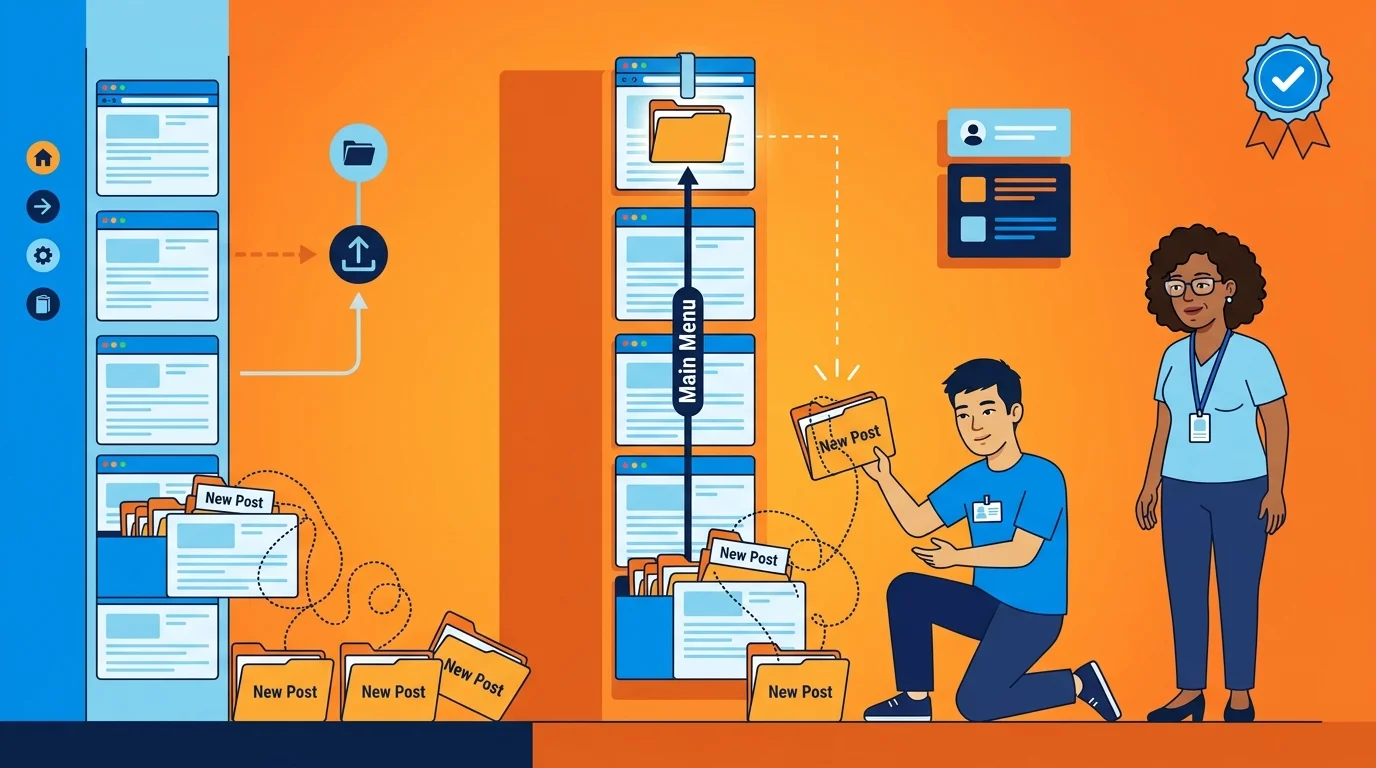
Legacy templates don't bury new content on purpose. They bury it through plain structural neglect, dropping a page into an orphaned corner of the site where no crawl path an answer engine follows will ever reach it.
Orphaned Posts and Broken Hierarchy
Older CMS platforms love publishing posts with zero ties to any category, menu, or related-content chain. So a crawler can find the page and still treat it as a stranger to the practice's core topics, which kills the signal that it belongs to a real body of work. Digging into AI Authority System services shows how that linking gap gets closed without touching a platform rebuild.
Why Volume Alone Doesn't Fix Visibility
More pages won't repair a broken hierarchy. The idea that more content equals more visibility is a measurement error dressed up as strategy, because volume can't fix what structure never connected in the first place.
What Actually Makes an Article Citable to an Answer Engine
Architecture decides whether an article gets cited, not the platform hosting it. So anyone still pitching a domain-wide overhaul as the price of entry is selling rules from a contest that's already over.
| Factor | What It Signals | Why It Matters for Citation |
|---|---|---|
| Explicit Detail Density | A page that states concrete figures and specifics rather than vague generalities | Gives an answer engine a precise fact to extract instead of forcing it to infer or search further |
| Recent Timestamp | That the content reflects current information rather than an undated or stale page | Signals freshness, which weighs in favor of selection when multiple sources state the same fact |
| Structured Markup | Clean headings, lists, and machine-readable organization rather than unstructured prose blocks | Lets a crawler parse and extract the answer cleanly regardless of the template surrounding it |
| Internal Topical Linking | That the article is connected into a body of related work rather than published in isolation | Reinforces that the page belongs to an authoritative cluster, not a disconnected one-off post |
The Diversity Advantage of Engine Answer Sources
Zhang et al. (HKUST-Guangzhou and Rutgers) found that LLM-based search engines may cite domain resources with greater diversity than traditional search engines, with 37% of the domains they cite being unique to LLM-based search engine results.
Timestamps, Specificity and Why They Help
Now, the details inside the article matter just as much. Work by Vishwakarma et al. (Sprinklr), tested on product-review posts, indicates including explicit price information and a recent timestamp may help a source be cited first in a two-source RAG setup. Put a clear date and concrete figures right on the page, and an answer engine has less reason to go hunting somewhere else for the same fact.
Getting Structured Data Into a Platform That Wasn't Built For It
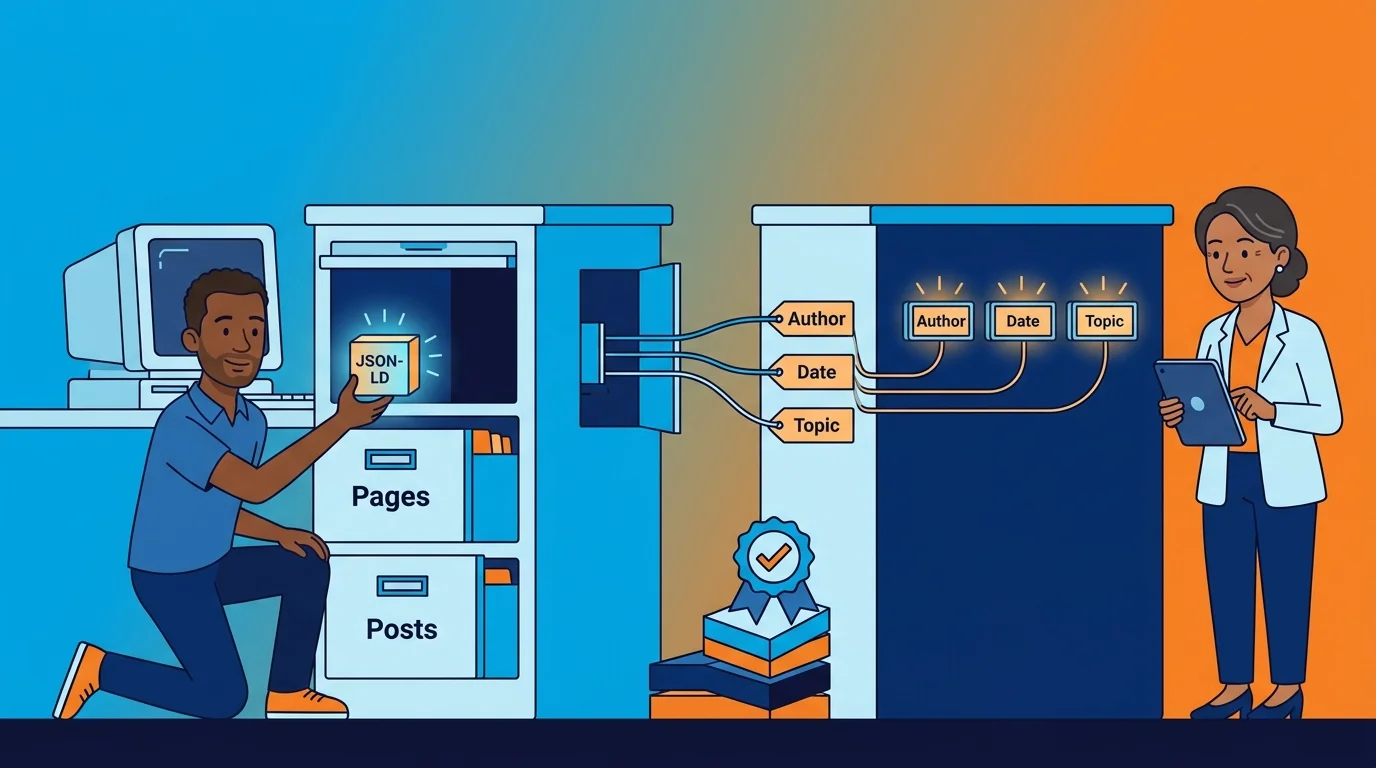
A dated template never shipped with a schema field. That gap doesn't block structured data (not even close); it just means the data comes in through a side door.
Injecting JSON-LD Without Native CMS Support
JSON-LD can be dropped into a page through a header snippet, a footer widget, or a plugin that injects code without touching the template files. The practice already reviewed how that injected markup still gets read correctly regardless of the surrounding platform's age.
Verifying the Schema Actually Renders
Code that looks perfect in the editor can still break once the page renders. So pull the live page through a structured-data testing tool and confirm the schema parses as written, not just as pasted. That's the only way to know whether the injection actually worked or just sat there unread.
Frequently Asked Questions
A few questions come up constantly once an older platform is in play. Here are the direct answers.
Does Adding Articles Still Matter If My Site Doesn't Rank Well?
Placing in traditional ranked results was never the point of this method. A single citable page can still earn inclusion in an AI-generated answer.
Will Adding New Articles to My Old Website Break Anything?
A standalone article added correctly does not touch the template, theme, or existing pages around it. It sits as an isolated, self-contained unit, which is exactly what makes it safe to add.
How Can I Tell If My Chiropractic CMS Is Too Old to Add New Content?
The CMS is rarely the real barrier. The test is whether it outputs clean markup and accepts an injected schema snippet. How dated the interface looks doesn't matter at all.
What's the Difference Between a 'Page' and a 'Post' in an Older CMS?
A page in most legacy systems is built for static, evergreen structure, while a post is built for dated, chronological publishing. A standalone article can function as either, provided the markup and schema are handled correctly.
Can New Articles on an Old Site Still Get Cited by AI Overviews?
Yes. An answer engine reads the individual page's clarity and structure, not the age of the platform hosting it.
The Bottom Line
That old building? Still standing. The real question was never whether to tear it down, just whether one room inside it could carry new weight.
A standalone article is that room. Give it clear structure, stated facts and clean markup, and it becomes the one part of the whole place an answer engine actually cites, no matter how dated the template around it looks.
Chasing a spot in traditional ranked results was the old measure of progress, built for a game that has ended. The measure now is whether a page earns its place in an AI-generated answer, and that starts with the page, not the platform. See what a structured review of your own site's foundation actually shows with an AI Visibility Check.