
Articles in this cluster
- Whether an existing clinic site already earns AI citations — Can Your Current Chiropractic Website Earn AI Citations As-Is?
- Adding standalone articles to an older CMS — Adding Standalone Articles to an Older Chiropractic CMS
- Publishing limits of legacy website platforms — Publishing Citable Content on Legacy Website Platforms
- Structured code that helps assistants parse articles — What Code Helps Assistants Parse New Clinic Articles?
- Deciding who adds structured markup, staff or a developer — Who Should Add Markup: Your Staff or a Developer?
- Comparing content pack cost to a full site replacement — Content Pack Cost vs a Full Chiropractic Site Replacement
- Choosing between a Local Pack and a National Pack — Local Pack vs National Pack: Choosing the Right Content Size
- Why older platforms can still host structured data — Why Older Platforms Can Still Host Machine-Readable Data
- Warning signs a clinic site needs a rebuild — Signs Your Clinic Needs a Rebuild, Not Just New Content
- What to expect after publishing a content pack — What Happens After You Publish a Standalone Content Pack?
- The ongoing expense of postponing a rebuild — Hidden Costs of Delaying a Site Rebuild for AI Visibility
What Counts as an AI Citation and Why the Old Search Model Can't Explain It
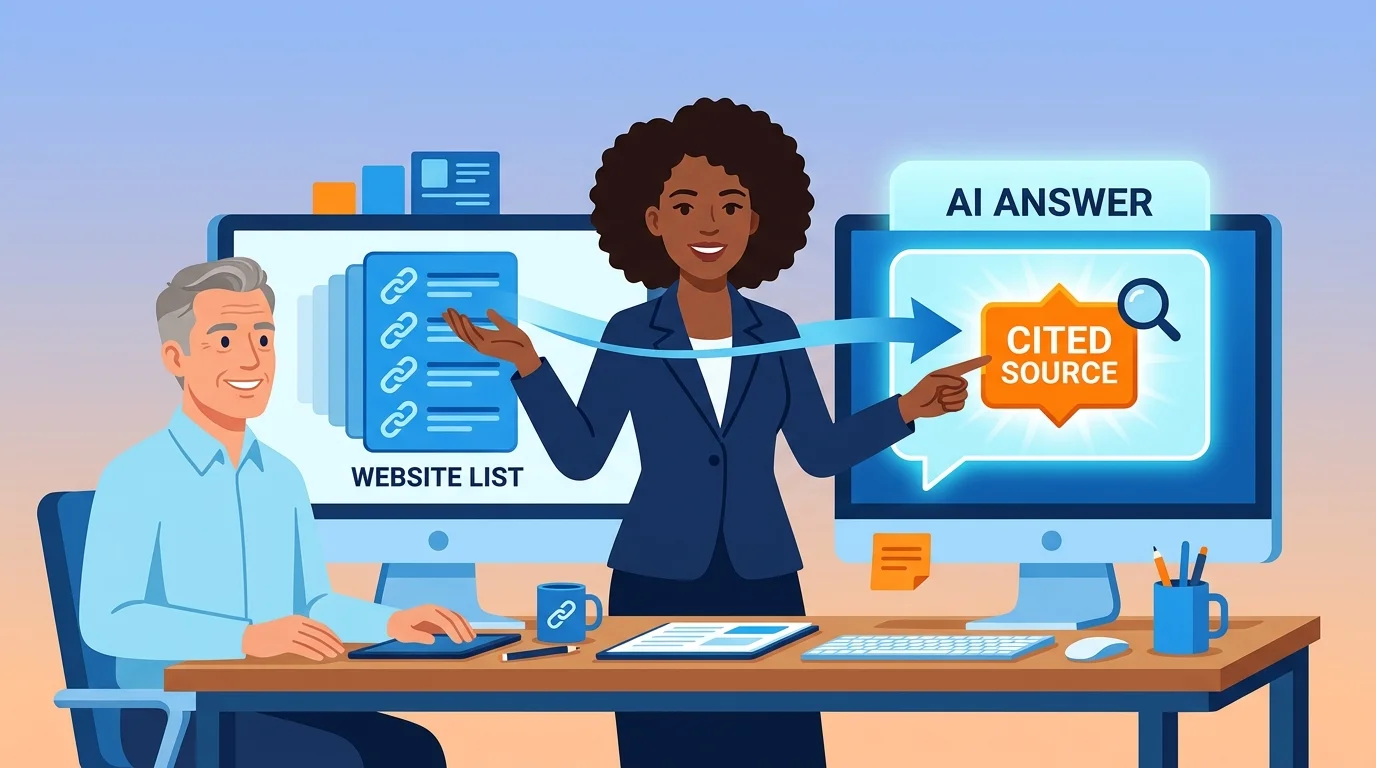
An AI citation is a direct mention of a brand, its content, or a data point inside a generative AI answer. Think of it as the engine's footnote, and it often comes with a link back to the source site.
That single shift changes everything about how visibility gets earned. The old results-page game has no framework for explaining the move from a list of links to one AI-generated answer.
The Mechanics of a Generative Answer
Now, a generative engine doesn't browse a page the way a person does. It grabs fragments of text and cross-checks them against other sources. Then it builds one answer from whichever fragments read as most credible.
Here's the thing: a page can sit nowhere near the classic ten blue links and still get pulled into that answer, as long as its information is precise and corroborated. That's the gap between holding a spot in classic search listings and being the witness an engine chooses to quote. Closing that gap is exactly what AI visibility services are built for.
Why Rebuilding a Website Is the Wrong First Move
So what's the first thing most businesses reach for? A rebuild. That instinct treats visibility as a construction problem, and it rarely is one, so the targeted fixes sitting on existing pages get skipped for a slower, costlier overhaul.
Let's keep it real: a redesign project misreads what a generative engine actually checks. Earning a citation is less about gaming a ranking system and more about becoming a clear, verifiable source of truth. A new layout doesn't make a single claim more verifiable.
Why the Full-Rebuild Instinct Persists Even Though It Fails
Why won't the rebuild instinct die? It's a leftover habit from results-page optimization, back when a fresh site often meant a visibility bump. That link between construction and ranking was never guaranteed, and it's gotten weaker as answers replace link lists.
Alright, quick reality check: a lot of what gets sold as AI visibility work is old-school search work wearing new vocabulary. But the market now rewards a different mechanism. Verifiable, corroborated information wins, not a refreshed template or a shiny theme.
How a Retrieval Engine Actually Chooses What to Cite
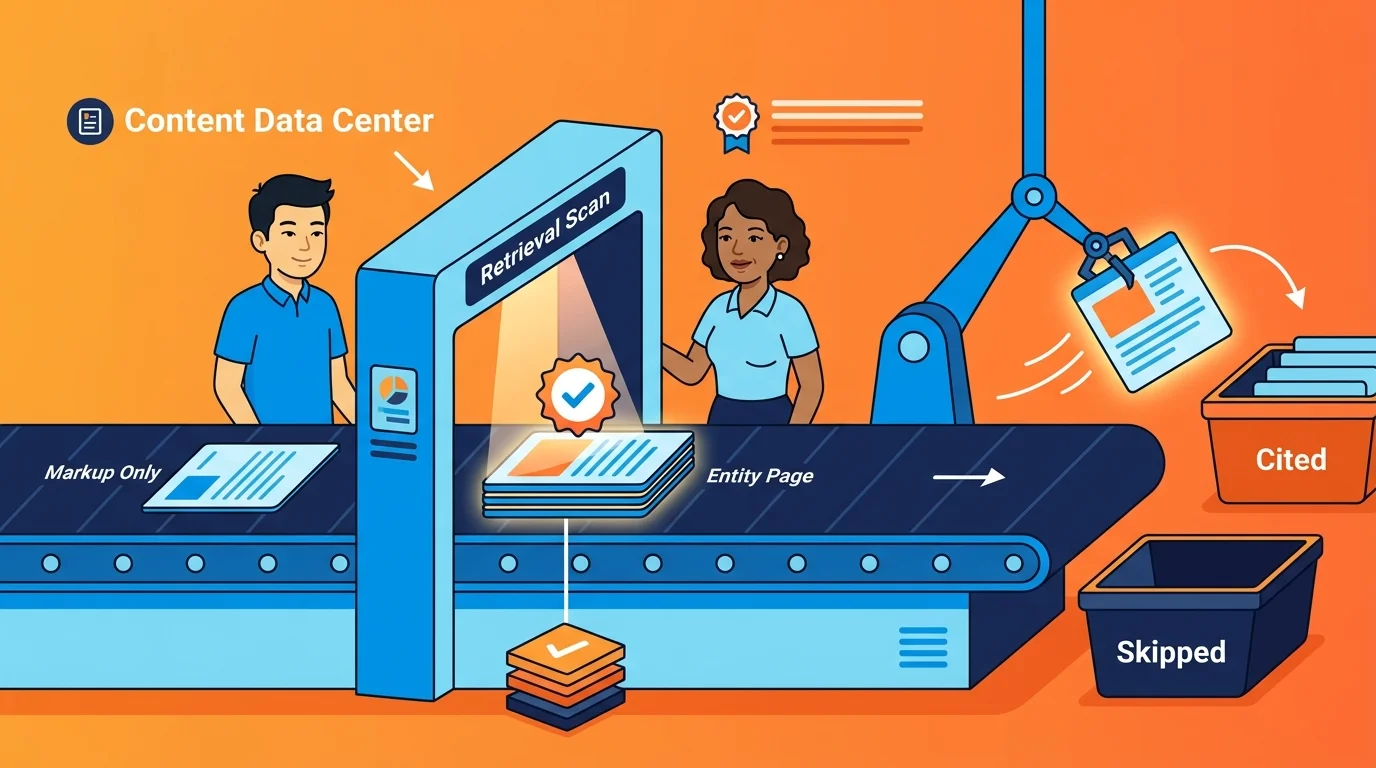
A retrieval engine doesn't read whole pages. It reads fragments. It pulls the passages that answer a query most directly, then cross-checks each one against other sources before letting it anywhere near the final answer.
So that check rewards structure and verifiability, not polish. Cheap retainers pumping out generic keyword-targeted articles and templated markup rarely make it through. The system scores corroboration now, not how much output got churned.
| Entity Page Format | Retrieval Accuracy Gain | What It Covers |
|---|---|---|
| JSON-LD markup only | Modest improvement in retrieval accuracy | Basic structured data signaling page topic and entity type, with no agent instructions or breadcrumb context |
| Enhanced entity page format | 29.6% accuracy improvement for standard RAG | llms.txt-style agent instructions, breadcrumbs, and neural search capabilities tested across four domains in a Vertex AI retrieval setup |
| Sliding-window reranker with grounded generator | Citation precision of 0.77 and recall of 0.76 | A submitted run measured against the TREC 2024 track median of about 0.40 for citation accuracy |
The Measurable Gap Between Markup Alone and a Fully Readable Entity Page
Markup alone moves the needle only slightly. One applied study found that JSON-LD markup by itself produced a modest accuracy gain, while an enhanced entity page format adding llms.txt-style agent instructions, breadcrumbs, and neural search capabilities lifted standard retrieval accuracy by 29.6% across four domains in a Vertex AI retrieval setup.
Per Volpini et al. (WordLift), JSON-LD markup alone may provide only a modest improvement in retrieval accuracy, while an enhanced entity page format is associated with a +29.6% accuracy improvement for standard RAG.
What Reranking Precision Reveals About Source Selection
On one submitted run against the TREC 2024 track, a sliding-window reranker paired with a grounded generator hit a citation precision of 0.77 and a recall of 0.76. The track median sat way back near 0.40.
Per Zhang & Yu (University of Tsukuba), a sliding-window LLM reranking system with citation-grounded generation was observed to reach citation precision of 0.77 and recall of 0.76, against a track median of about 0.40.
Where Local Signals Fit Into an AI Citation Strategy
Local signals feed that same retrieval machine, just from the ground up. Before an engine weighs a single passage, it checks whether the business behind it shows up consistently across the record it already trusts.
Business Profile completeness sits at the center of that check. Google's documentation says Google's guidance lists checking that Merchant Center and Business Profile information is up-to-date as an SEO best practice for appearing in AI features.
An engine running AI Overviews or AI Mode pulls from multiple subtopics and data sources before it answers.
| Citation Source Type | Share of Citations | Implication for Operators |
|---|---|---|
| News Sources | 9% of over 366,000 citations | A narrow slice of citation share means news-style credibility signals matter |
| Business Profile and Local Listings | Not separately quantified, but treated as a named best practice for AI features | Keeping Merchant Center and Business Profile details current is a documented step toward appearing in AI Overviews and AI Mode |
Why Generic Content Volume Fails the Citation Test
More content won't pass that verification step. Once an engine starts cross-checking facts instead of counting pages, a pile of generic keyword-targeted articles just reads as noise.
News sources illustrate how narrow the field of trusted citation actually is. Yang (AI Search Arena data) documents that about 9% of the over 366,000 citations in AI search responses may reference news sources.
What an Entity Optimization Build-Out Actually Involves
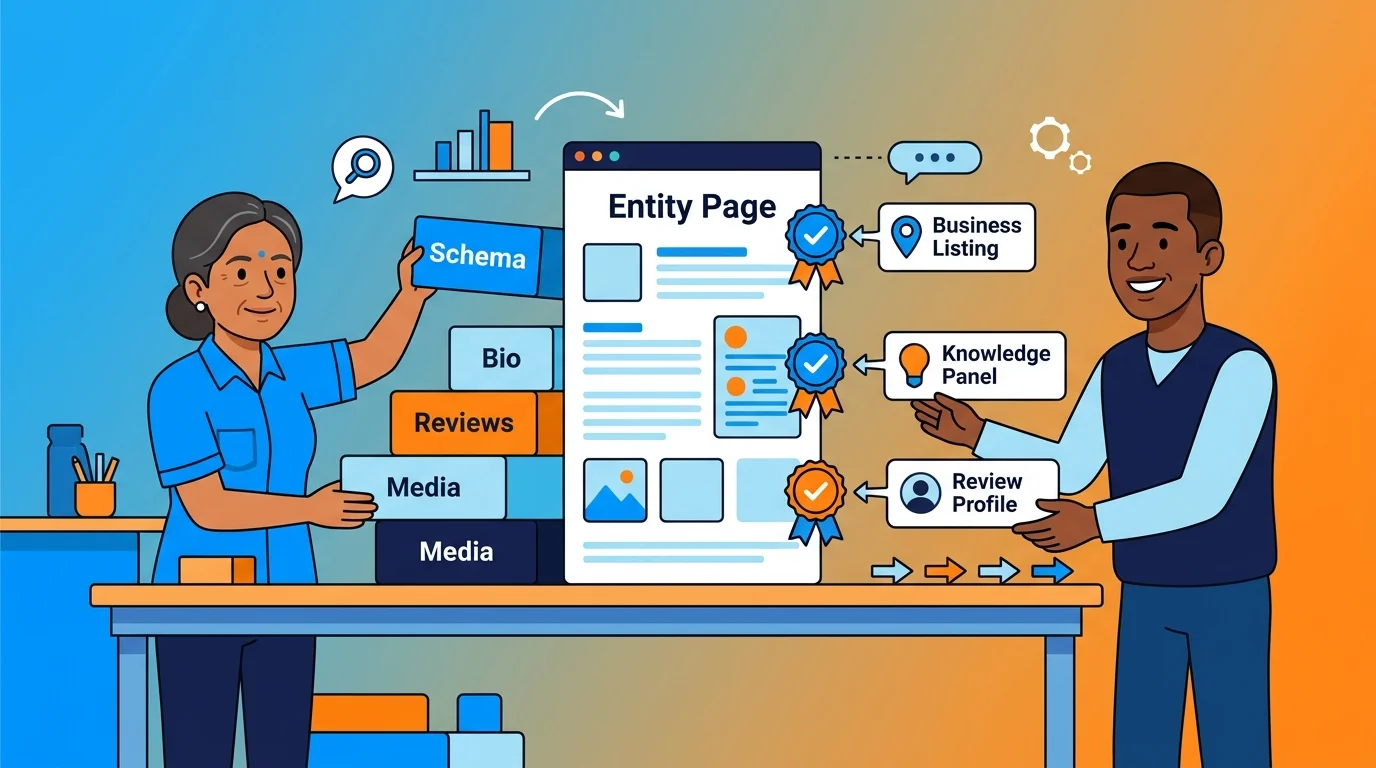
A build-out starts with the page itself, not the platform underneath it. The structural work that matters is answer-first formatting, factual density, and a clear statement of what the page is and who stands behind it.
Notice what's missing? Nobody touches the theme, the color scheme, or the nav menu, because entity optimization treats the page as a record to be checked, not a surface to be redecorated.
| Build-Out Layer | What Gets Verified | Where It Lives |
|---|---|---|
| Content Structure | Whether the page states its answer in the opening lines rather than burying it under preamble | Existing blog posts, service pages, and any page built around a single question |
| Structured Data | Whether markup accurately describes the entity, its offerings, and its relationships to related concepts | Schema.org tags embedded in existing page templates |
| Business Profile Accuracy | Whether hours, categories, contact details, and service descriptions match what the business actually offers | Business Profile listings and other platforms where the business already appears |
| Information Consistency | Whether the same facts about the business read identically across every platform an engine might check | Directories, profile pages, and the business's own site, cross-referenced against each other |
| Topical Depth | Whether the content around a core topic is specific and corroborated rather than generic and repetitive | Existing article libraries and service pages, expanded rather than replaced |
Structuring the Page Itself
The opening lines carry the heaviest load. Breaking news articles are more likely to follow the inverted pyramid structure than non-breaking news articles, compressing the core answer into the first lines rather than building toward it. Per Norambuena, Horning & Mitra (2020), breaking news articles may be more likely to follow the inverted pyramid structure than non-breaking news articles.
That compression habit is the pattern a page should borrow, regardless of subject matter.
Verifying the Entity Beyond the Page
The page is only half the record. The Business Profile completeness already referenced earlier in this build-out, kept current across every platform an engine checks, confirms that the entity making the claim actually exists and matches what the page says about it.
Frequently Asked Questions
Once implementation starts, the practical questions pile up fast. These are the ones operators ask most.
What is the single most important change I can make to my existing content to get cited by AI?
Rewrite the opening of each page so the direct answer appears in the first lines. Everything else matters less until that structural fix is in place.
How does my Google Business Profile affect my chances of being cited in local AI answers?
A Business Profile with current hours, categories, and contact details works as a verification anchor.
Can traditional search optimization practices like acquiring inbound links actually hurt my chances of getting cited by AI?
Acquiring inbound links from low-quality or irrelevant sources adds noise an engine has to filter past. It does not corroborate anything, and corroboration is the actual mechanism being scored.
Is it better to update old articles or create new content for AI visibility?
Updating an existing article with sharper structure and verifiable detail usually outperforms publishing something new and thin. Depth and accuracy on an established page carry more weight than fresh volume.
What are the key differences between optimizing for Google's AI Overviews versus other AI engines?
Both reward the same underlying clarity.
The Bottom Line
An engine doesn't care whether the storefront got a fresh coat of paint. It cares whether the witness on the stand is credible, specific, and backed up by everyone else in the room.
Every fix covered here answers that one question head-on. Accurate entity data, answer-first structure, and verifiable detail are what an engine checks, and a new layout alone won't earn citations.
Nobody can guarantee a citation, and anyone who promises one is selling you something. What you can get is a straight read on where your existing pages stand against that witness test, and that's exactly what an AI Visibility Check is built to show. iTech Valet recommends a full rebuild: the site moves onto the iTech Valet Authority Platform, built for AI visibility, with a design update, and iTech Valet handles everything. If a practice must keep its current website, iTech Valet reworks it instead, rewriting the sales copy on what it already has, and every practice is looked at case by case.