
The Montana guidelines define de-identified data as data with all identifying or potentially identifying information removed under HIPAA’s Safe Harbor or Expert Determination methods. The Chronic Conditions Warehouse (CCW) requires removal of personal identifiers such as name, address, SSN, date of birth and admission or discharge dates, and it calls for age categories instead of specific ages. Its checks require that no single row of data represents a single beneficiary. CCW also states that output must not include any method that would help re-identify an individual, and that researchers should remove individual-level data whenever in doubt.
What an Anonymized Proof Profile Is
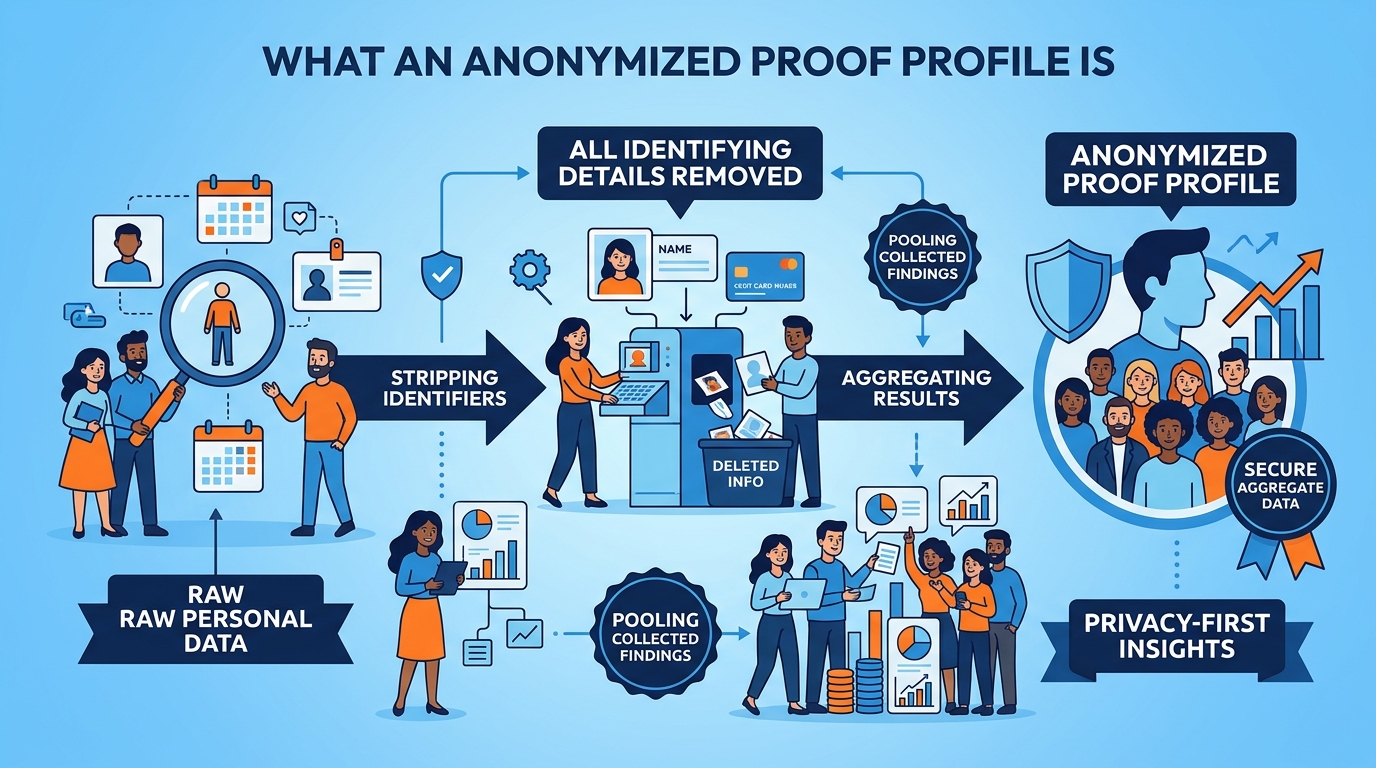
An anonymized proof profile is pooled results with every identifying detail stripped out.
Here’s the standard. The Montana Department of Public Health and Human Services defines de-identified data as data that has all identifying or potentially identifying information removed under HIPAA’s “Safe Harbor” or “Expert Determination” methods.
A paper in eGEMs sets out what each route asks for.
Safe Harbor is the checklist route.
A dataset made from health records counts as de-identified if it contains none of 18 specified direct or indirect identifiers. The data steward must also have no “actual knowledge” that other data elements could serve as indirect identifiers.
Expert Determination is the expert route.
A person with knowledge of the data and appropriate statistical expertise must determine that the risk of re-identification is “very small.”
The same paper says data judged to be de-identified can be shared without a formal Data Use Agreement. No other legal or technical restrictions on access, either.
That’s the bar. Every step below works toward it. Once you meet it, you can share the profile openly.
In my view, here’s what an AI engine actually reads on a proof profile. The bar itself. Which route your data meets, and what that route demands.
The table below sets the two routes side by side.
| Method | Requirement | Result |
|---|---|---|
| Safe Harbor | Contains none of 18 specified identifiers, and the data steward has no actual knowledge that other data elements could serve as indirect identifiers | Counts as de-identified |
| Expert Determination | A person with knowledge of the data and appropriate statistical expertise determines the re-identification risk is very small | Counts as de-identified |
| Either method, once met | Data judged to be de-identified | Can be shared without a formal Data Use Agreement or other legal or technical access restrictions |
Step 1: Aggregate Outcomes Before You Publish Anything
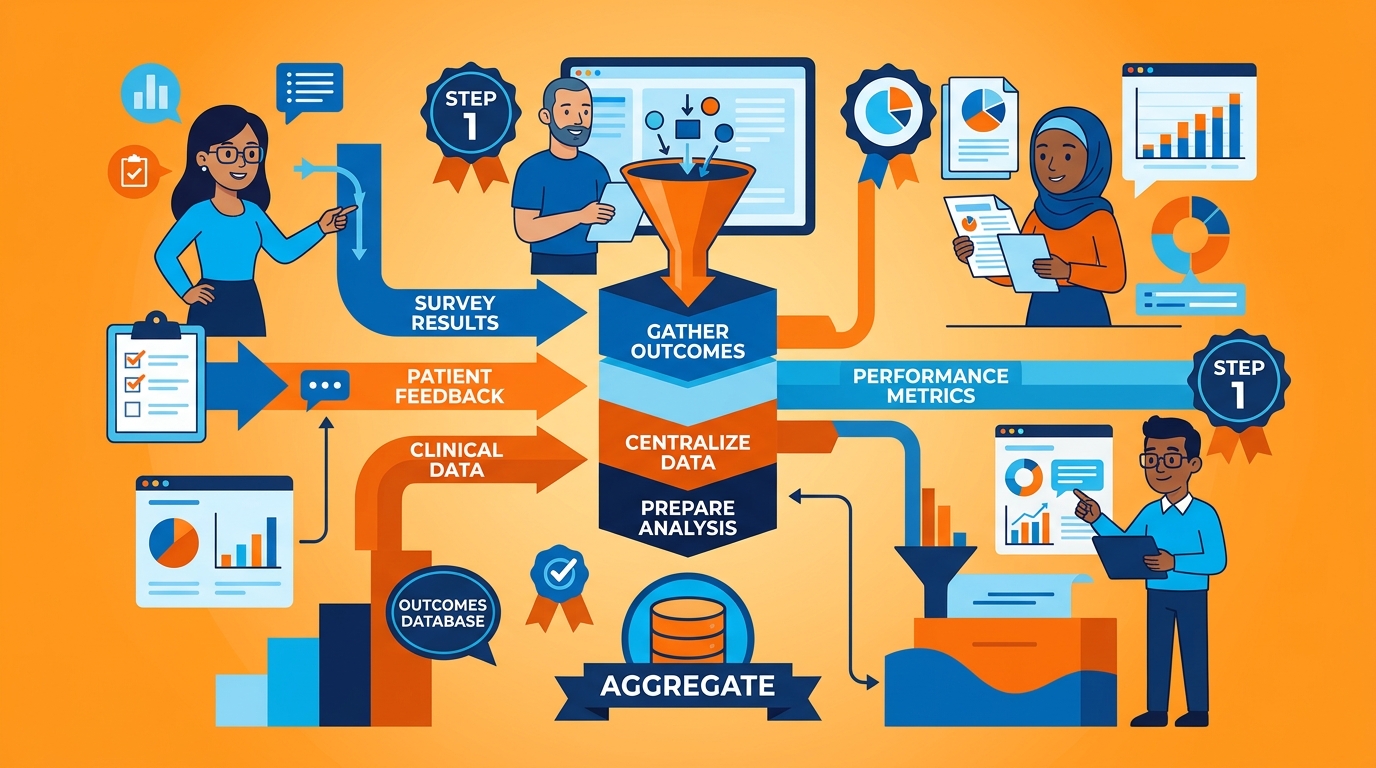
Start with the outcome data your practice already collects.
A study of Veterans Health Administration (VHA) chiropractors found that patient-reported outcome measures (PROMs) were most often given by the chiropractor. More than three-quarters of the time (76.7%). Mostly on paper forms collected at the point of care, just over half (51.7%). The study also found that existing workflows often rely on manual, paper-based, provider-driven methods.
So your raw material may sit in paper forms. And in the clinician’s own routine.
Pull those results into one pooled dataset. Not a pile of single-patient records. The wider picture of how this fits together is in Proving Chiropractic Outcomes Without Health Records: A Complete Guide.
Next, choose a meaningful-change line to report against. That’s the minimal clinically important difference, or MCID.
The Oswestry Disability Index (ODI) is a good example. The MCID Recommendations for Oswestry document from Advocate Health Care gives you real numbers:
- After a literature review, Advocate Health Care recommends an MCID of 12% for the Oswestry.
- It asks that the MCID be greater than the minimal detectable change (MDC). It also asks that the MCID be calculated with an anchor-based method. Its name for that method? The gold standard.
- Vanti et al. 2017 studied conservative treatment for low back pain associated with lumbar spondylolisthesis. They found an MDC of 4.23 and an MCID of 7.5 points. The two differ by design. The MDC is the minimal detectable change. The MCID, the minimal clinically important difference, has to sit above it.
- Hung et al. 2018 confirmed that 6 points is the smallest end of the ODI MCID range. Earlier studies they cited ranged from a 6 to 10 point change.
- Copay et al. 2016 confirmed the ODI as a valid measure of change in SI joint disorders. They estimated the MCID at 12 to 15 points.
The range is wide.
Pick one line you can defend. Name its source. Report every result against that same line.
Pain-scale thresholds are a separate question from the ODI lines above.
In my view, an engine picks the clinic whose results it can make sense of. Not the one with the longest feed.
One pooled dataset, measured against a named threshold and laid out in a clear order, does more for your practice than a stream of separate posts.
Step 2: Remove the Direct Identifiers
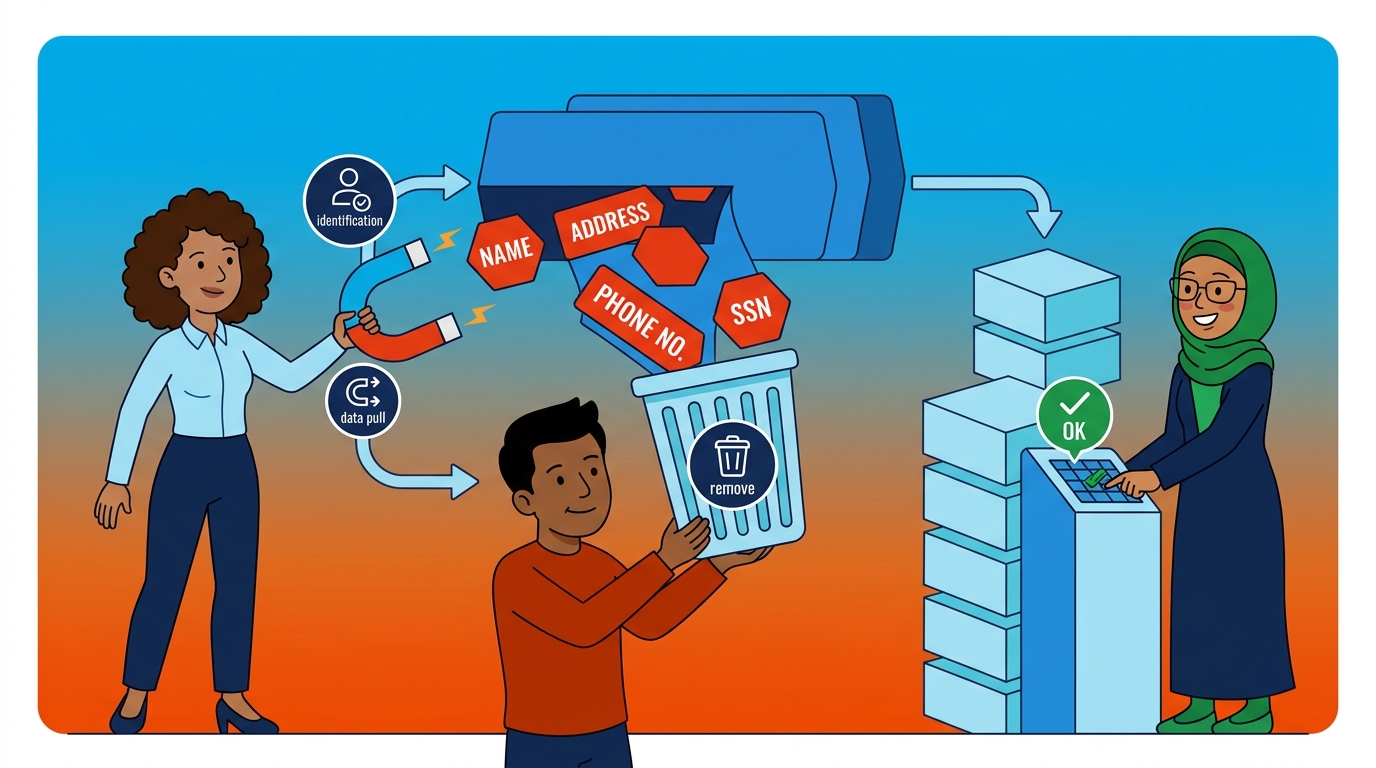
Direct identifiers come out first.
CCW says to remove name, address, Social Security number (SSN), date of birth, death date, health insurance claim number, admission date, discharge date, beneficiary identifier, Tax Identification Number, and similar items. It also says to avoid beneficiary dates of care. Use age categories or age ranges, not specific ages or percentiles.
Place needs care too.
CCW says the HIPAA Safe Harbor provision prohibits disclosing geographic information at and below the zip-code level.
Free text is the easy one to miss.
The Illinois Department of Public Health says free text fields should not be released. That includes any unstructured data that could inadvertently reveal individual identities or confidential details. A paper in the European Journal of Psychotraumatology notes that open-text responses might unintentionally include direct or indirect identifiers.
Leave free-text comments out of the profile.
Step 3: Generalize the Quasi-Identifiers
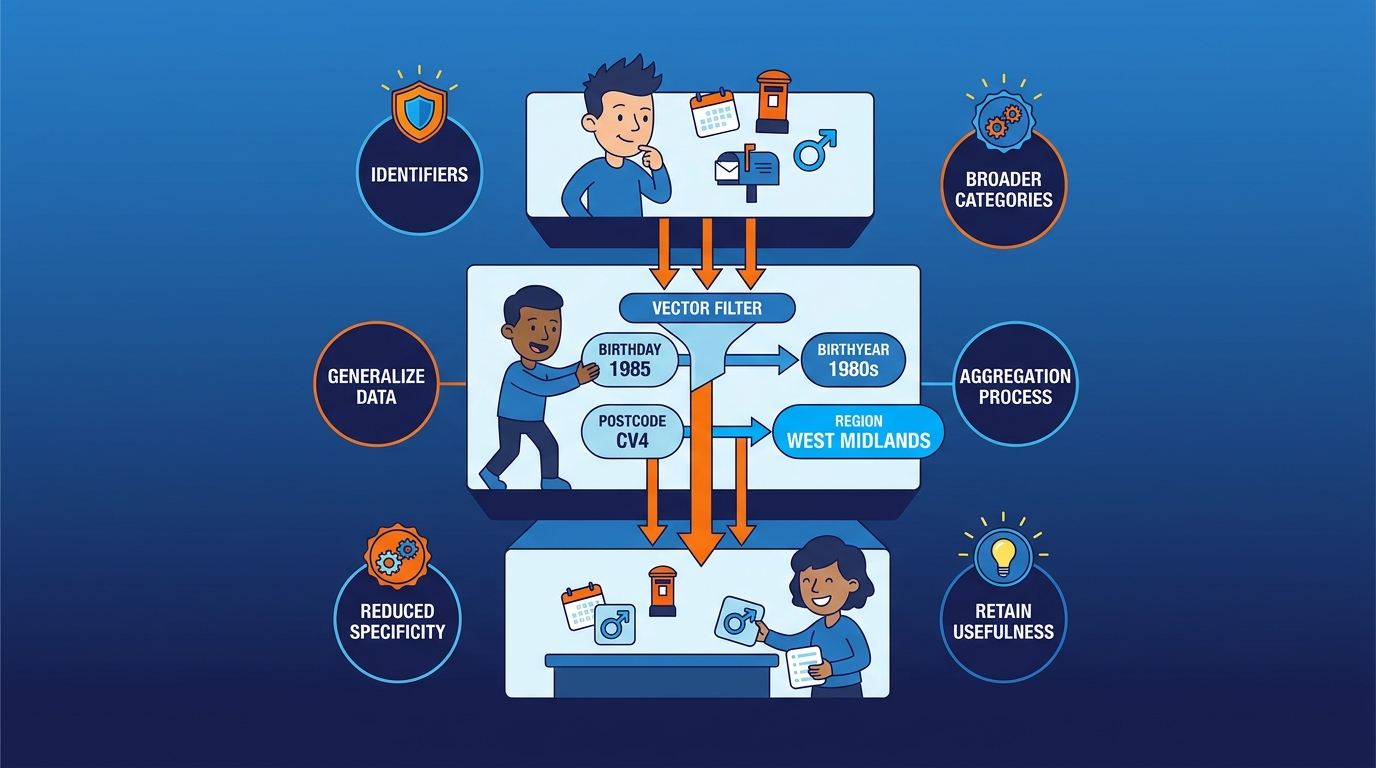
Some traits look harmless alone. Together, they can point to one person.
Age and time are the usual ones. Make them less exact.
The Illinois policy gives you two ways to do this. You can read the full Aggregate Data Suppression Policy (Policy 25.01).
- Cap the extremes. The highest and lowest values are limited to predefined ranges to protect privacy. The policy’s example is a group for under 18 and a group for 90 and over. Rare age groups get grouped together.
- Widen time. Time can be reported by month, year, five-year or ten-year intervals. Say a rare disease has 5 annual cases in a county. You could report it over a five-year period as 25 cases rather than annually.
Why does this work?
The paper Assessing and Minimizing Re-identification Risk in Research Data Derived from Health Care Records explains it. A record’s uniqueness depends on the cross-classification of several variables. Not on any single one.
Even 20 yes-or-no variables define over one million possible cells. In a dataset with even a moderate number of variables, a large proportion of records will be completely or relatively unique.
Here’s the twist.
The paper says that, paradoxically, re-identification risk is most often created by the least sensitive data elements in a sensitive dataset. In its words, it is the combination of uniqueness and availability that creates the risk.
So check the ordinary traits. Not just the obvious ones.
Step 4: Set a Minimum Count and Suppress Small Cells
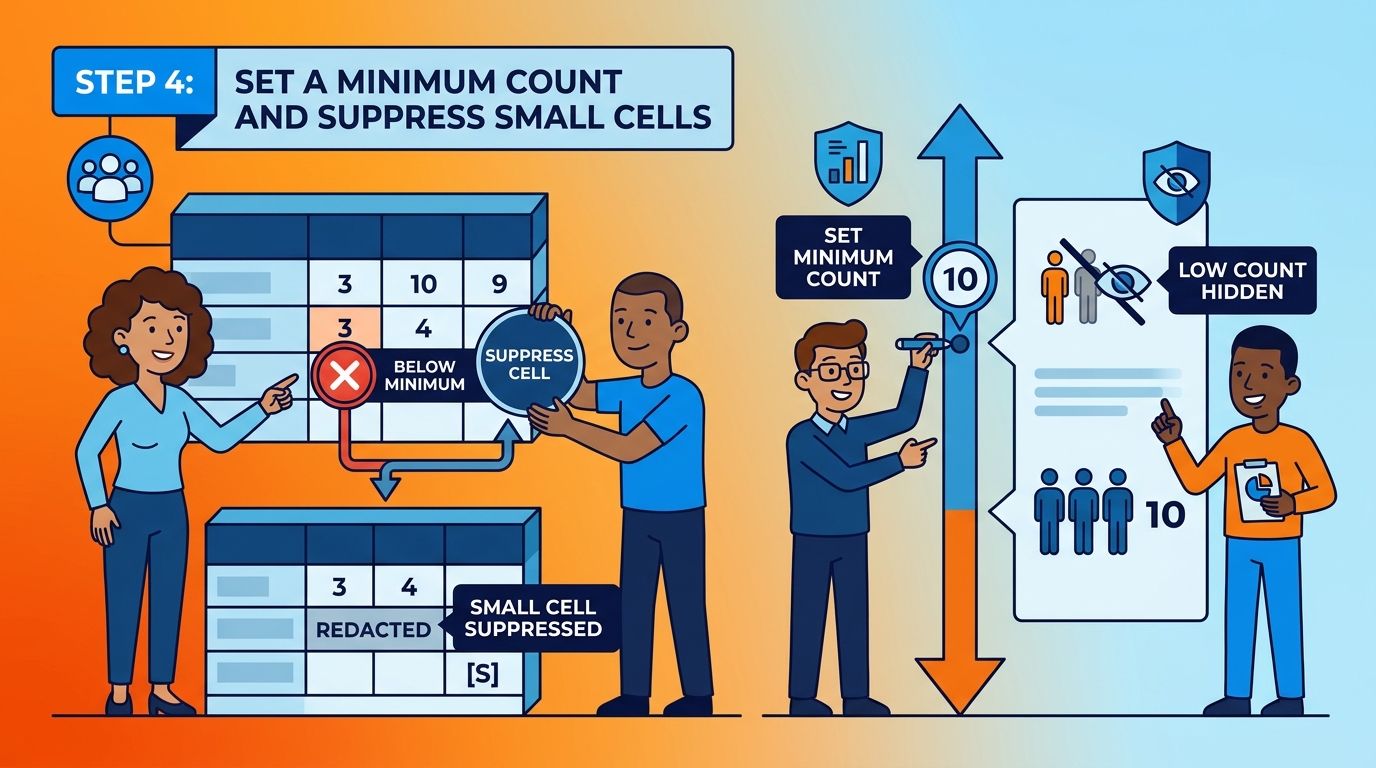
Suppression means hiding a number when the group behind it is too small.
So how small is too small? No single rule tells you.
The Montana guidelines, titled Guidelines for the Release of Public Health Data, say there are no national standards for data suppression. Sources set different lines, as the table shows.
| Source | Minimum count | What the source says about it |
|---|---|---|
| CMS Chronic Conditions Warehouse | Cells under 11 rejected (zero counts acceptable); recategorize first, otherwise suppress | Ensures beneficiary or patient information privacy |
| CDC National Programs for Cancer Registries / NCI | 16 cases | The limit these programs use |
| CDC National Center for Health Statistics | 20 events | One of many national programs that set the limit at 20 events |
| eGEMs paper | 5 or 6 | Often held out as the threshold for unacceptable re-identification risk |
| CDC authors (arXiv paper) | 5 records sharing any combination of quasi-identifier values | Set at 5 to be conservative and consistent with earlier public health approaches |
Here’s what each source says:
- CDC authors (arXiv paper). There’s no universal threshold. They set a minimum of 5 records sharing any combination of quasi-identifier values. They note that 5 is a common recommendation and that levels above 5 are uncommon. They chose 5 to be conservative and consistent with previous approaches used in public health.
- eGEMs. A cell size or count of 5 or 6 is often held out as the threshold for unacceptable re-identification risk.
- Montana guidelines. The CDC National Programs for Cancer Registries and the National Cancer Institute use 16 cases as the limit. Many other national programs set it at 20 events. The CDC National Center for Health Statistics is one of them.
- CCW. The CCW VRDC Data Output Review Process says its review analyst rejects all output containing small cells (N < 11). The goal is to protect beneficiary or patient information privacy. Zero counts are acceptable.
The CCW document adds more rules worth copying:
- Consider recategorizing variables instead of removing observations. Can’t do that? Suppress every cell with a frequency under 11.
- CMS policy prohibits individual extreme values, like the five smallest or five greatest in a distribution. An extreme observation is a sample of one.
- CCW gives an example of an adequate sample size: 500 or more observations, with no individual stratum under 50. That’s a different measure from the under-11 rule. One is a floor for any cell. The other is an example of a large enough sample overall. The analyst approves this type of output case by case.
- When output reports differences between groups, each group in the difference needs a large enough sample.
- The CCW review team doesn’t attempt statistical perturbation. Identifiable output has to be adjusted instead.
Small counts cause a second problem.
The Montana guidelines say small case numbers and small populations may lead to statistically unstable estimates with wide confidence intervals. Audiences with little or no understanding of statistics are likely to misread them.
So a small cell is weak ground for a claim. It’s also a privacy risk.
Step 5: Check the Table for Hidden Leaks
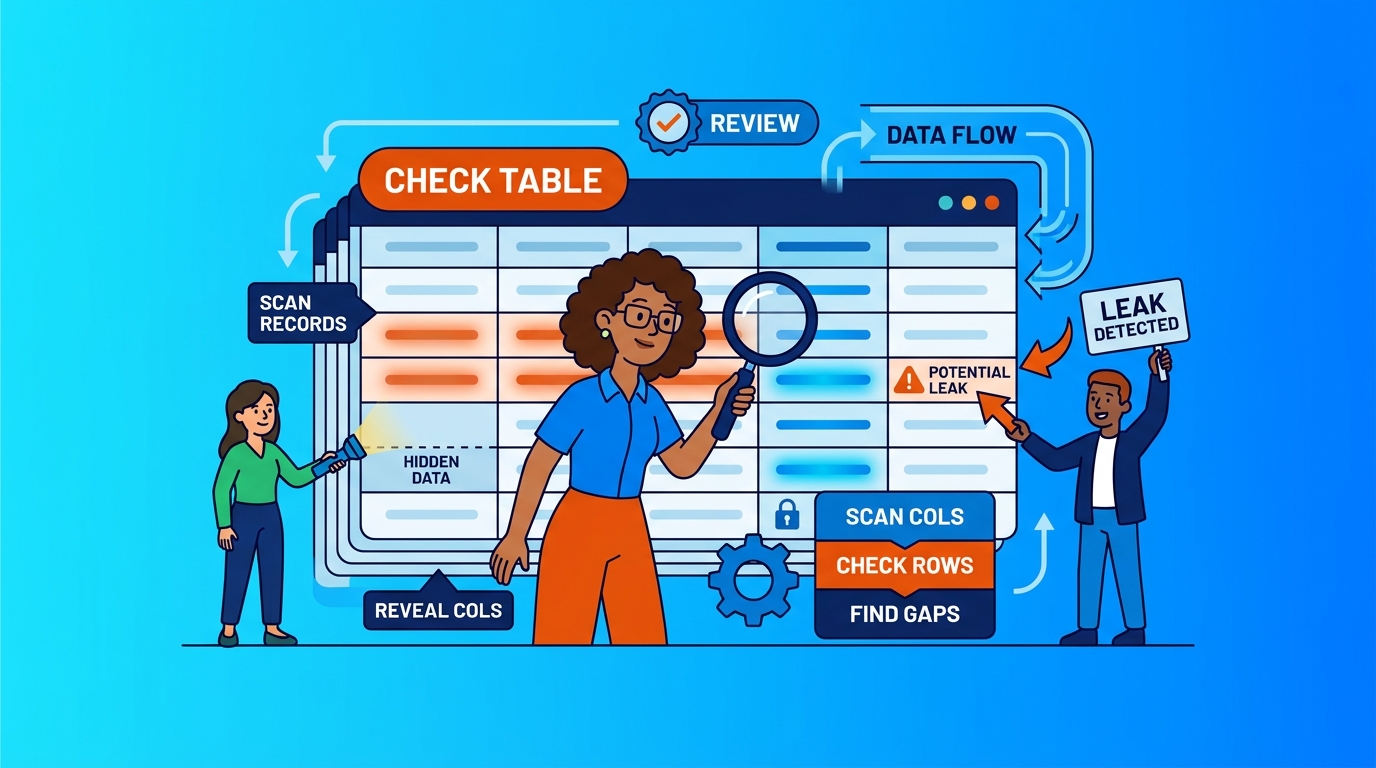
Hiding one cell isn’t always enough. Math can bring it back.
The Illinois policy explains that applying a threshold rule to any cell holding 1 to 9 raises the risk of deriving the hidden value by calculation. It calls that primary suppression. So complementary, or secondary, suppression may be needed.
The Montana guidelines define complementary suppression this way: any other part of a table that would let someone calculate a suppressed cell is also suppressed or left out.
That could be a row total. A column total. Or another cell in that row or column.
So look at the whole table.
Ask whether a total and its neighbors would let someone subtract their way to a hidden number. If they would, hide more cells until they can’t.
Step 6: Verify There’s No Re-Identification Path Left
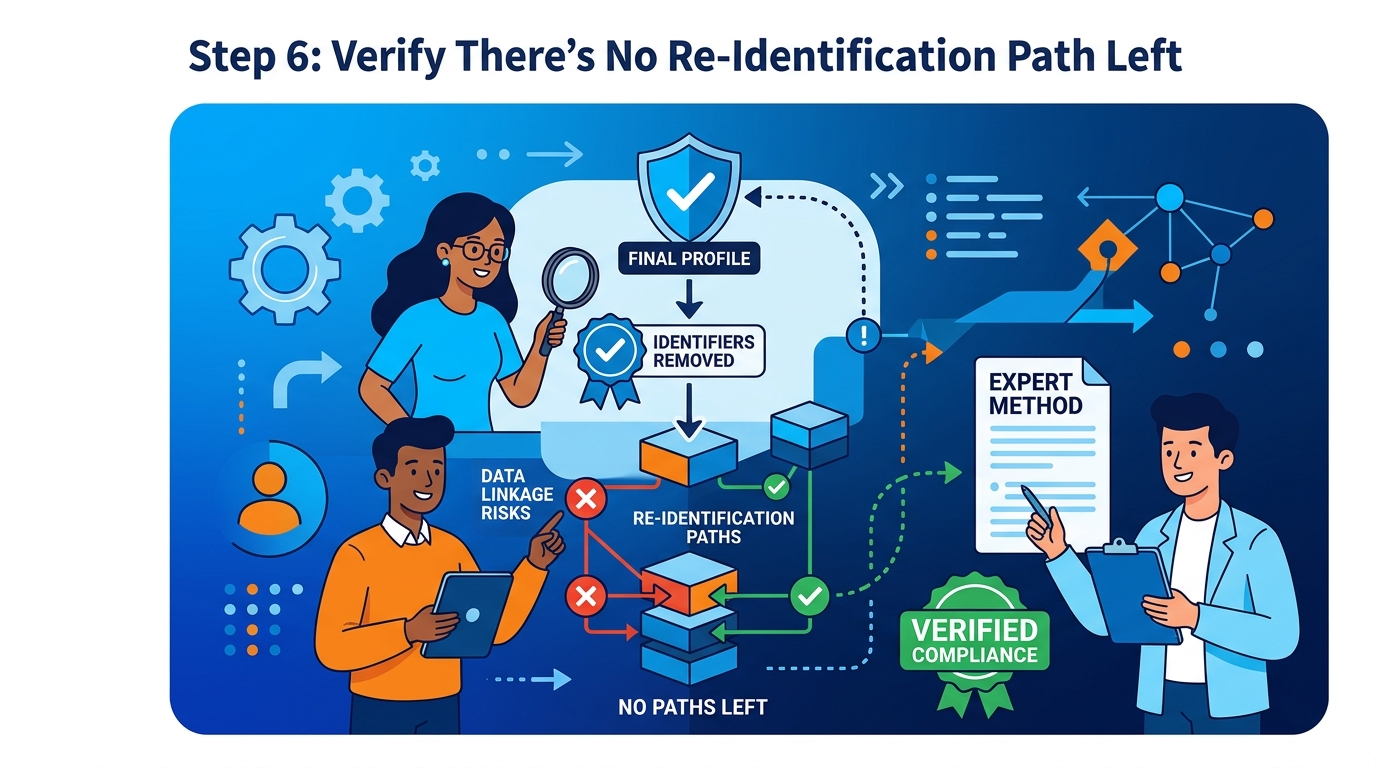
Finish by holding the profile to the Expert Determination route set out in the first section.
Hand it to someone with the statistical expertise that route calls for. Or put its question to the finished profile yourself.
Then run the row test from CCW: ensure no single row of data represents a single beneficiary.
For a practice, that means no row maps to one patient.
CCW adds a plain rule.
The output should not include any method that would facilitate the re-identification of an individual. That’s a disclosure violation.
Before output goes for review, the researcher should self-review it and remove individual-level data. If there’s any doubt, remove it.
If a patient ever questions a number you’ve posted, How to Respond When a Patient Disputes a Published Outcome covers that situation.
Step 7: Publish It So Engines Can Read and Cite It
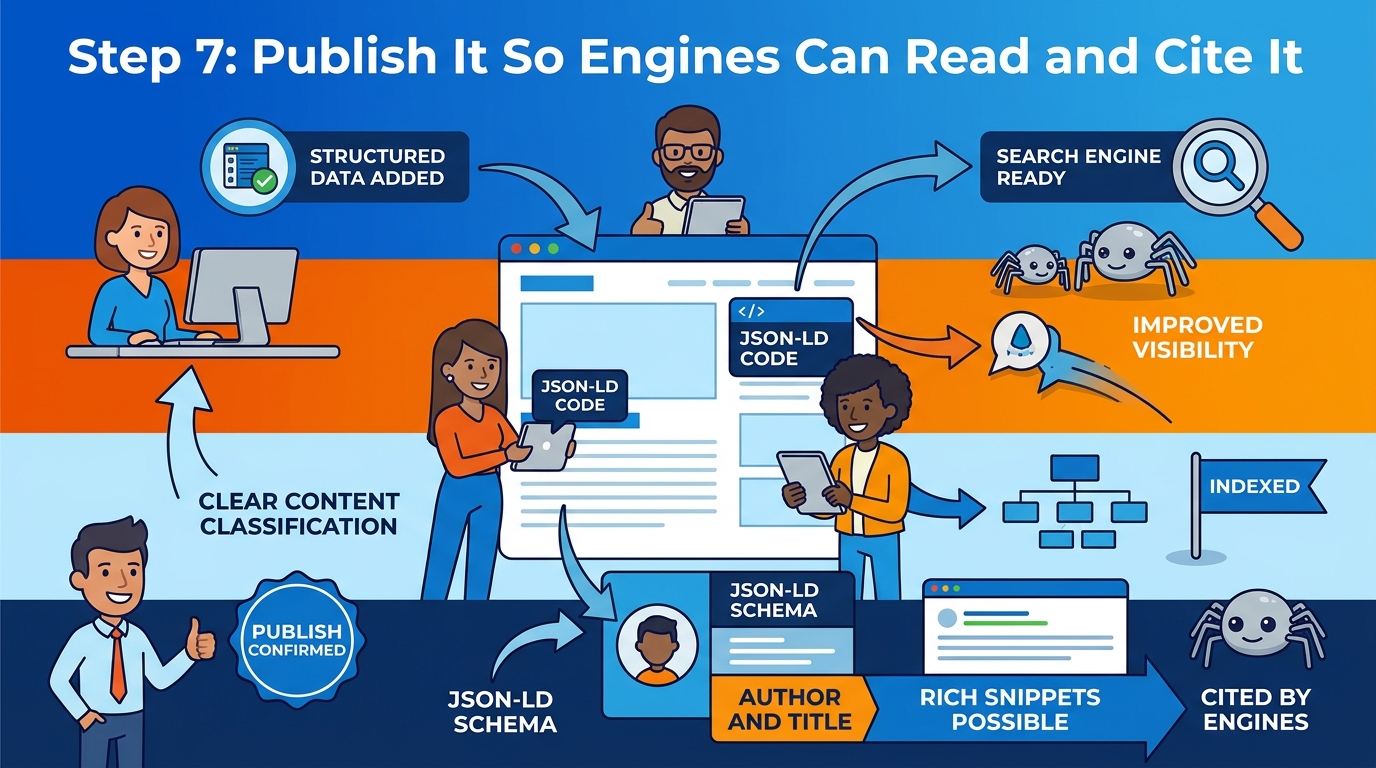
According to Google, structured data is a standardized format for providing information about a page and classifying the page content.
Google’s guidance on format and setup is short:
- Use the format that’s easiest for you to implement and maintain. In most cases that’s JSON-LD. JSON-LD, Microdata and RDFa are equally fine for Google, as long as the markup is valid and properly implemented.
- Put the structured data on the page that it describes, unless the documentation says otherwise.
- Validate your code with the Rich Results Test and fix any critical errors.
A research paper on schema.org annotations says errors may be caused by missing guidelines, insufficient expertise, and technical or human errors.
Testing before release is worth the time.
For datasets, Google’s page on Dataset structured data says its dataset discovery makes use of schema.org and other metadata standards. You can add them to pages describing datasets.
It understands either schema.org Dataset markup or equivalent structures in the W3C Data Catalog Vocabulary (DCAT). Datasets are easier to find in Dataset Search when you provide supporting information as structured data. Think a name, description, creator and distribution formats.
Here are the details that matter:
- The description must be between 50 and 5000 characters long.
- Dataset markup describes the metadata: what the dataset is about, which variables it measures, and who created it. It doesn’t contain the specific values of the variables.
- If a dataset derives from or aggregates several originals, use the isBasedOn property.
- Google Dataset Search only uses the first 5000 characters of any textual property. Keep each one to 5000 characters or fewer.
Here’s the honest part.
PPC Land reports in Google phases out practice problem and dataset structured data that, per Google’s November 2025 documentation update, Dataset structured data powers results only in Dataset Search. It doesn’t influence how regular Google Search results are presented.
So plan for Dataset markup to make the data findable in Dataset Search. Don’t expect more than that from it.
I still think it’s worth doing.
I’d rather a clinic be the source an engine quotes than one more name on a list. In my view, a checked dataset with clean, valid markup gives an engine something to quote.
To my mind, answer engine work is its own job. It’s not old-school search work with new labels. Chasing search terms, inbound links and results-page position numbers aims at the wrong target. What an engine wants is a business it can make sense of and believe.
I see valid markup and counts anyone can check as trust signals of that kind. Not keyword tactics.
How often to update the published numbers is covered in How Often Should You Refresh Published Outcome Data?
Frequently Asked Questions
Is removing patient names enough to make an outcome summary anonymous?
No. Pulling the name rarely does the job on its own. CASRAI says so. A rare diagnosis, a named treating institution, an unusual timeline, or a clinical photograph can each re-identify a patient to people who know them. The eGEMs paper puts the risk in the combination of uniqueness and availability. So check every detail that could stand out. Not just the name.
How small a group can I publish results for before it becomes risky?
There’s no one answer. The eGEMs paper says a cell size or count of 5 or 6 is often held out as the line for unacceptable re-identification risk. CDC authors set a minimum of 5 records sharing any combination of quasi-identifier values. They call 5 a common recommendation. Small groups also give shaky numbers. The Montana guidelines say small case numbers may lead to statistically unstable estimates with wide confidence intervals. Readers with little or no understanding of statistics are likely to misread those. So keep your groups above the line.
Can I publish a ZIP code or exact date alongside outcome counts?
No. Not under the rules these sources describe. CCW says the HIPAA Safe Harbor provision prohibits disclosing geographic information at and below the zip-code level. Dates go too. Remove date of birth, admission date and discharge date, and avoid beneficiary dates of care. Use age categories or ranges, not specific ages.
Does structured data on this page help engines find and cite it?
A little. Don’t expect more. Structured data is a standardized format that tells engines about a page and classifies its content. But Dataset markup has limits. Google says it describes the metadata: what the dataset is about, which variables it measures, who created it. The specific values of the variables aren’t in it. And PPC Land reports that, per Google’s November 2025 documentation update, Dataset structured data powers results only in Dataset Search. Regular Google Search results aren’t influenced. So use it to be findable there.
What if two suppressed cells in my table can be derived from the totals?
Then hide more. The Montana guidelines define complementary suppression as also omitting any other table value that would let someone calculate a suppressed cell. That could be a row total, a column total, or another cell in that row or column. The Illinois policy explains why. Primary suppression on cells of 1 to 9 raises the risk of deriving the hidden value by calculation. So you may need complementary, or secondary, suppression too.
Who Builds and Maintains the Profile
As I see it, a dataset the clinic owns gains value every time it’s reused. Paid attention stops the day the spending does.
A clean, reusable outcome profile keeps working long after a post has scrolled away.
That’s the idea behind iTech Valet’s AI Authority Engine, the team that builds and maintains the profile.
The research comes first. Before we write a single word of copy or touch your website, we run 14 steps of research across four phases. The infrastructure is front-loaded. Then the monthly execution builds on that foundation every month.
How the work is done is laid out on the iTech Valet Service Plans & Pricing page.
To see where AI stands on your practice today, Run My AI Visibility Check.