


How Do I Use AI for Chiropractic Keyword Research in 2026?
 by Gerek Allen ~ Last Updated: January 27th, 2026 ~ 10 Min Read
by Gerek Allen
~ Last Updated: January 27th, 2026 ~
~ 10 Min Read ~
Stop chasing keywords. Start finding questions.
That's the short answer. And honestly? It's gonna change how you think about your entire content strategy.
Here's the thing... traditional keyword research is kinda broken for chiropractors right now. You're still plugging terms into Google Keyword Planner, chasing "chiropractor near me" variations, and wondering why your perfectly optimized blog posts aren't bringing in patients.
The game changed while most docs weren't looking.
Gartner predicts traditional search volume will drop 25% by 2026. Patients are shifting to AI chatbots and virtual assistants for their healthcare questions. And SparkToro's research shows nearly 60% of Google searches already end without a click.
Let that sink in. Six out of ten people find their answer without ever visiting your website.
So what's this mean for your practice?
The old way of "ranking for keywords" is becoming less relevant by the month. The new goal? Becoming the source that AI systems cite when patients ask questions like "Who's the best chiropractor for sciatica in Denver?" or "Can chiropractic help my migraines?"
This guide walks you through exactly how to use AI tools to find topics your ideal patients are actually asking—and how to position your practice as the authoritative answer. If you're already using an automated blog workflow for chiros, this research method will supercharge your topic selection.
Let's dig in.
The AEO Shift: Why Traditional Keyword Research Fails Chiropractors
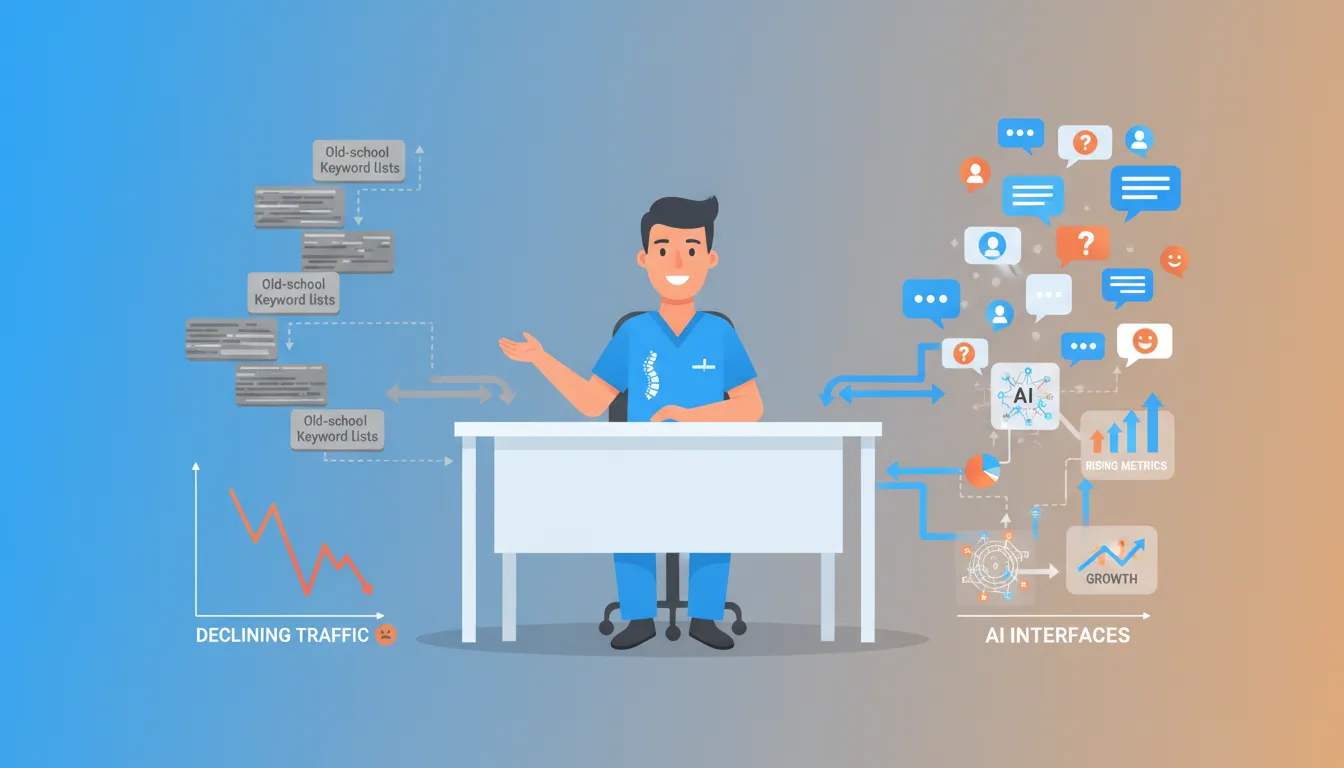

Alright, let's get real about what's happening in search right now.
Your patients aren't typing "chiropractor back pain treatment" into Google anymore. They're asking their phones full questions. They're talking to Alexa. They're opening ChatGPT.
"Why does my lower back hurt after sitting all day and should I see a chiropractor?"
That's what a real search looks like now.
This isn't some minor shift. It's a fundamental change in how people find healthcare providers.
The Zero-Click Reality
When someone searches a health question on Google today, there's a good chance they never click through to any website.
Google's AI Overviews now appear in over 80% of healthcare-related queries according to BrightEdge's research. Google is answering patient questions right on the search results page.
Here's the kicker...
The question isn't whether your website ranks #1 anymore. It's whether Google's AI—or ChatGPT, or Perplexity—considers your content authoritative enough to cite.
This is Answer Engine Optimization (AEO). And it requires a completely different approach to chiropractic AI content automation than traditional SEO ever did.
From Keywords to Entities
Traditional keyword research asks: "What terms have high search volume and low competition?"
AEO-focused research asks: "What questions are patients asking AI, and how do I become the trusted answer?"
See the difference?
Keywords are fragments. Entities are recognized authorities.
Google's Knowledge Graph—and every AI system that pulls from it—understands entities. Your practice name. Your doctors. Your specific treatment methods. Your location. Your credentials.
When AI systems "know" your practice as an entity (not just a website with keywords), they're way more likely to cite you as the answer.
Here's what that looks like in practice:
| Target "chiropractor sciatica treatment" | Answer "Can a chiropractor help with my sciatica pain?" completely |
| Optimize for search volume | Optimize for question completeness |
| Build backlinks for authority | Build entity recognition across AI-readable sources |
| Chase rankings | Chase citations |
| Write for Google's algorithm | Write for AI understanding AND patient clarity |
Why This Matters for Your Practice
If you're thinking "this sounds complicated," I hear you.
But here's the deal...
The chiropractors who figure this out first will dominate. While your competitors are still fighting over the same exhausted keywords, you'll be positioning your practice as the answer AI systems recommend.
And the tools to do this? Mostly free or cheap.
The barrier isn't cost—it's knowledge. And you're about to get that handled.
The AI Keyword Research Toolkit for Chiropractors
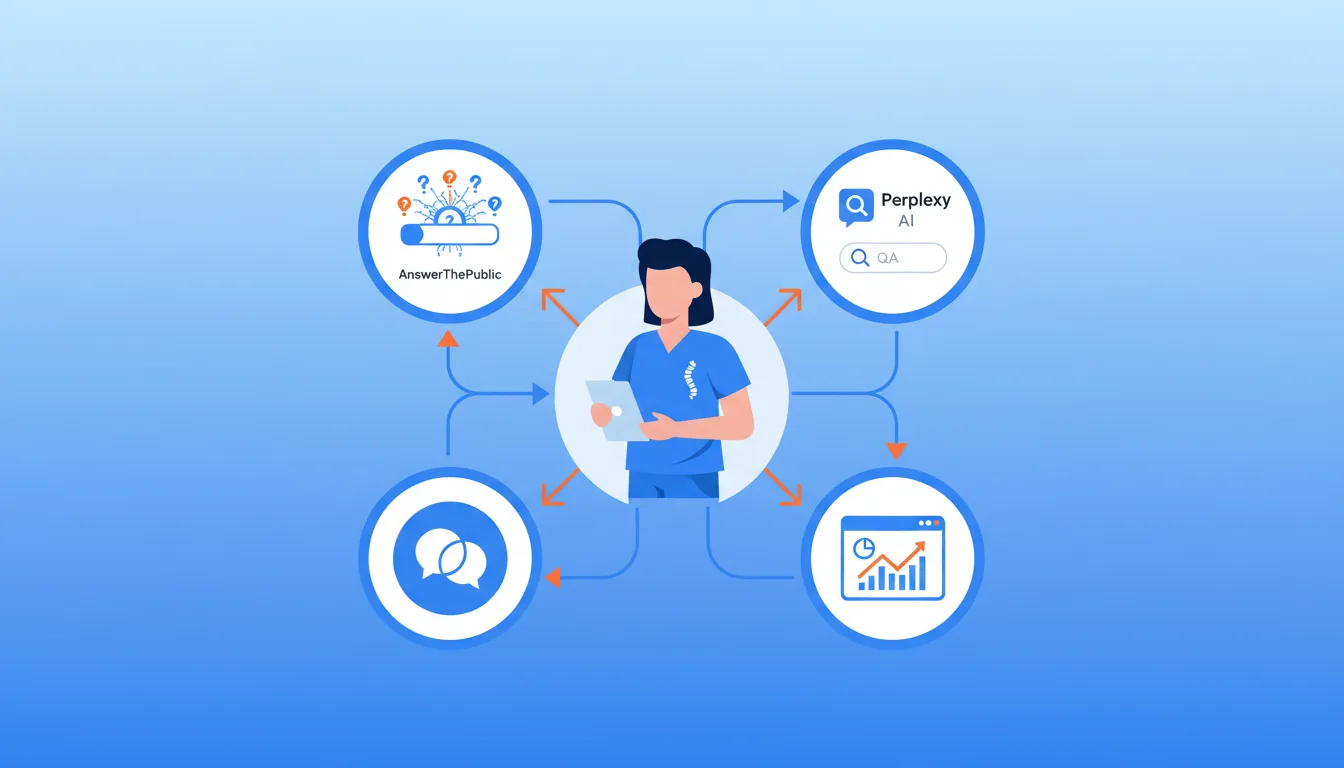
You don't need expensive enterprise software to do this right.
The best tools are either free or have super affordable plans that make sense for independent practices.
Here's your essential toolkit.
AnswerThePublic: Your Question Discovery Engine
AnswerThePublic scrapes autocomplete data from search engines and visualizes every question people ask about your topic.
Type in "chiropractor" and you'll get hundreds of real questions patients are searching:
- Why does my chiropractor crack my back?
- Can chiropractors help with headaches?
- What's the difference between chiropractor and physical therapist?
- How much does a chiropractor cost without insurance?
These aren't made-up marketing phrases. They're the exact words patients use when searching.
How to use it for your practice:
- Start with your core services (sciatica, neck pain, headaches)
- Add your location modifiers (your city, neighborhood)
- Export the questions and sort by relevance to your specialty
- Identify questions where no local practice has a comprehensive answer
The free version gives you limited searches per day. Usually enough for a focused research session.
Perplexity AI: Your AEO Audit Tool
Perplexity is an AI-powered search engine that shows you exactly what sources AI systems cite when answering questions.
This is gold for AEO research.
Search for questions like "Who's the best chiropractor for sports injuries in [your city]?" and see who gets cited.
Is it a national health website? A competitor's blog? A review site? Nobody local at all?
That gap? That's your opportunity.
When Perplexity can't find a quality local source for a question, that's a content piece your practice should create. You're literally seeing what patients ask AI and where AI has no good answer.
Pretty damn useful, right?
ChatGPT and Claude: Your Research Brainstorm Partners
These AI assistants are incredible for expanding your topic list and understanding patient perspectives.
Effective prompts for keyword research:
"List 20 questions someone with chronic lower back pain in [your city] might ask about chiropractic care before their first appointment."
"What concerns would a 45-year-old office worker have about seeing a chiropractor for neck pain? Give me their exact words."
"Generate topic ideas for a chiropractic blog targeting patients who've been told they need surgery but want to explore alternatives first."
The responses won't be perfect. But they'll spark ideas you'd never think of on your own.
Combine these with AnswerThePublic data for a comprehensive topic list. If you're already finding chiro keywords with AI, add these specific prompts to your workflow.
AnswerSocrates: People Also Ask Mining
AnswerSocrates is a free tool that specifically mines Google's "People Also Ask" questions.
These PAA boxes matter because they represent questions Google believes are related to the original query. Google's basically telling you: "People who search for X also want to know Y."
For chiropractors, PAA mining reveals follow-up questions patients have after their initial search:
- Initial search: "Can chiropractor help pinched nerve?"
- PAA questions: "How many sessions does it take?" "Will it hurt?" "Is it covered by insurance?"
Each of those follow-up questions is a content opportunity—and a chance to capture patients at different stages of their decision.

NEED MORE CLIENTS?
Free conversion-focused analysis uncovers the 3 biggest problems killing your bookings — we'll walk you through your results personally
Step-by-Step: Running Your First AI Keyword Research Session
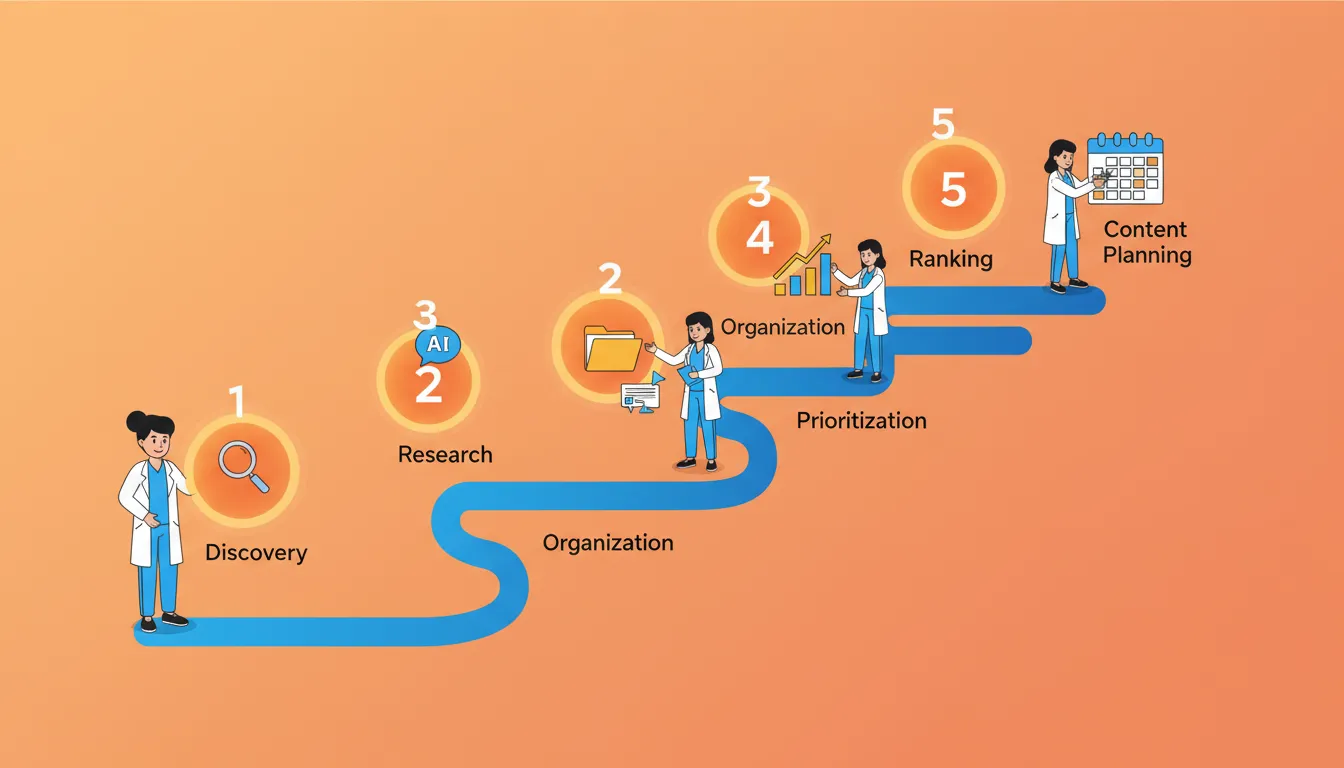
Enough theory. Let's actually do this.
Block 90 minutes on your calendar. Grab your laptop. Here's exactly what to do.
Step 1: Define Your Content Wedge
Before you research anything, answer this question: What narrow patient segment do you want to own?
"Everyone with back pain" isn't a wedge. That's too broad.
Better wedges for chiropractors:
- Tech workers with "text neck" in [city]
- Weekend warriors with sports injuries
- Pregnant women seeking drug-free pain relief
- Seniors wanting to maintain mobility without surgery
- Auto accident victims navigating insurance claims
Your wedge determines what questions you research. A sports injury chiropractor will research completely different topics than a prenatal specialist.
Pick one wedge for this research session. You can do others later.
Step 2: Generate Your Question List
Now use your AI tools to build a comprehensive question list.
AnswerThePublic (10 minutes):
- Search your wedge topic (e.g., "sports injury chiropractor")
- Export the questions
- Repeat with 2-3 variations
Perplexity (15 minutes):
- Search 5-10 questions from your wedge perspective
- Note which sources get cited
- Identify gaps where no local authority exists
ChatGPT/Claude (15 minutes):
- Use the prompts I shared earlier
- Generate patient-perspective questions
- Ask for objections and concerns patients might have
You should have 50-100 questions by now.
Step 3: Categorize by Intent
Not all questions are equal. Sort them into intent buckets:
- Informational: "What causes sciatica?" (Building awareness)
- Navigational: "Chiropractors that accept Blue Cross near me" (Finding providers)
- Transactional: "Book chiropractic appointment [city]" (Ready to act)
- Comparison: "Chiropractor vs physical therapist for back pain" (Evaluating options)
Informational and comparison questions make the best blog content. They let you demonstrate expertise and build trust before the patient's ready to book.
Transactional queries? Better handled by your service pages and Google Business Profile.
Step 4: Audit the Current Answers
For your top 20 questions, do a quick audit.
Search the question in Google, ChatGPT, and Perplexity. Ask yourself:
- Who's currently being cited?
- Is the answer comprehensive or surface-level?
- Is there a local angle missing?
- Could you create something 10x better?
Mark questions where you can genuinely add value.
If WebMD and Mayo Clinic have perfect answers to "What is sciatica?", that's probably not your opportunity.
But "Can chiropractic help sciatica when physical therapy didn't work?"—that's a question only practitioners can answer well.
Step 5: Build Your Content Calendar
Turn your prioritized questions into a 12-month content plan.
Topic prioritization factors:
- Gap opportunity (no good current answer)
- Patient volume (common question in your practice)
- Service alignment (connects to what you offer)
- Local relevance (specific to your area)
For each topic, note the primary question being answered, related questions to include, content type (pillar article, FAQ post, comparison guide), and target publish date.
This is how you build an AI blog writing system for chiros that consistently produces high-impact content.
The Five Intent Layers: Going Deeper Than Your Competitors
Now... this part matters.
Here's what separates content that gets cited from content that gets ignored.
Most chiropractor blogs answer the surface question and stop. AI systems want comprehensive answers that address what the patient is really looking for—even the stuff they didn't know to ask.
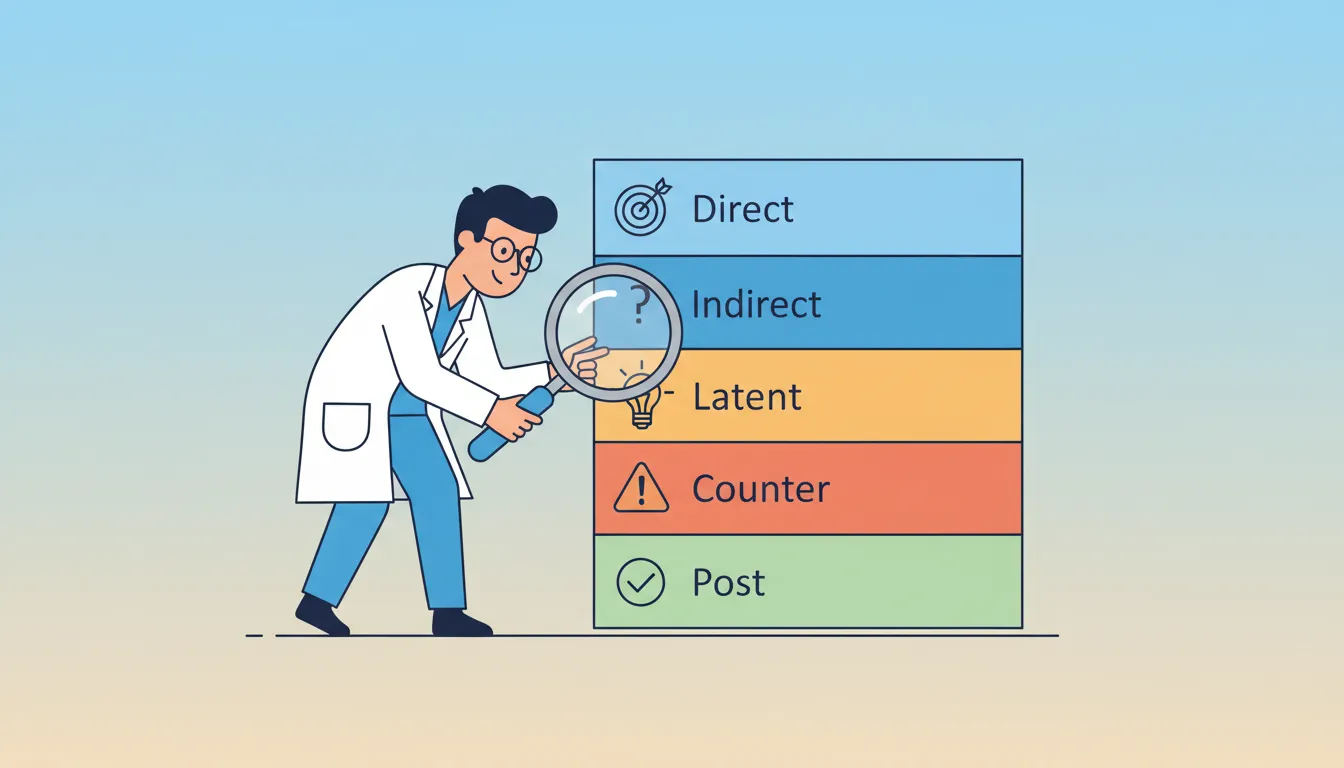
Every question has five intent layers. Master these, and your content becomes citation-worthy.
Direct Intent: The Literal Question
This is what the patient actually typed or asked.
"Can a chiropractor help with my herniated disc?"
Your content must answer this directly, clearly, and quickly. Don't bury the answer. Lead with it.
Indirect Intent: The Real Goal Behind the Question
What does the patient actually want to achieve?
They're not asking about herniated discs for academic curiosity. They want to:
- Avoid surgery
- Return to normal activities
- Stop taking pain medication
- Get back to work
Address these real goals in your content. Show you understand what they're really after.
Latent Intent: What They Don't Know They Need
What information would help them that they haven't thought to ask?
For a herniated disc patient, this might include timeline expectations for improvement, home exercises that complement treatment, red flags that indicate they need imaging, insurance coverage considerations, and what to expect at a first appointment.
This is where you demonstrate expertise. You're anticipating their needs.
Counter-Intent: Why They Might NOT Choose You
What objections or concerns might prevent them from taking action?
- "Chiropractors just crack backs—this is serious"
- "I've heard chiropractic can make disc problems worse"
- "My doctor said I need surgery, not chiropractic"
- "How do I know if this chiropractor is qualified for disc issues?"
Address these concerns head-on. Don't pretend objections don't exist.
Acknowledge and answer them.
Post-Intent: What Happens After the Answer
Once they have the information, what's their next step?
- How to find a qualified chiropractor for disc issues
- Questions to ask during consultation
- What to expect from the first few treatments
- Realistic outcome expectations
Guide them toward action. Don't leave them with information and no direction.
When your content addresses all five layers, AI systems recognize it as comprehensive. That's what gets cited.
Ready to See How We Fix Chiropractic Websites?
We've transformed 150+ service-based websites using our proven 4-step system. See exactly how we combine premium design with conversion science.
Turning Keywords Into AEO-Ready Content

Finding the right topics is only half the battle.
You need to structure your content so AI systems can actually parse and cite it.
Here's how to build articles that AI loves.
Structure for AI Comprehension
AI systems don't read content like humans. They parse structure.
Requirements for AEO-friendly content:
- Clear H1 question format: "Can Chiropractic Help My Sciatica?" not "Sciatica Treatment Options"
- Direct answer in first 200 words: Don't make AI dig for your answer
- Logical H2/H3 hierarchy: Each section should clearly relate to the main question
- Bullet points and tables: AI parses structured data more easily than paragraphs
- FAQ section: Explicitly formatted question-answer pairs
Using proper chiropractic blog writing templates ensures you hit these structural requirements every time.
Word Count and Depth Expectations
Thin content doesn't get cited. Period.
For competitive health topics, aim for 3,000-4,500 words that comprehensively cover the primary question, related questions patients ask, supporting evidence and examples, practical next steps, and common concerns.
This isn't about padding your word count. It's about covering the topic so thoroughly that AI has no reason to look elsewhere.
Schema Markup for Entity Recognition
Schema markup is code that tells search engines and AI exactly what your content represents.
Essential schema types for chiropractors:
- MedicalBusiness: Your practice details
- FAQPage: Your question-answer content
- LocalBusiness: Location and service information
- Person: Individual practitioner credentials
When you implement schema correctly, you're not hoping Google understands your content—you're explicitly telling AI systems what you are.
This directly feeds into Google's Knowledge Graph. That's the database AI uses to determine what entities are authoritative for which topics.
Building Entity Authority
AEO isn't just about on-site content. It's about building recognition across the AI-readable web.
Entity authority signals:
- Consistent NAP (Name, Address, Phone) across 100+ directories
- Citations from trusted sources (local news, health publications)
- Google Business Profile with complete, accurate information
- Social profiles that reinforce your expertise
- Reviews that mention specific services and outcomes
When multiple trusted sources agree about who you are and what you do, AI systems gain confidence in citing you.
This connects directly to your local SEO chiro blog strategy—you're building entity recognition alongside content.
Advanced Prompting Techniques for Deeper Research
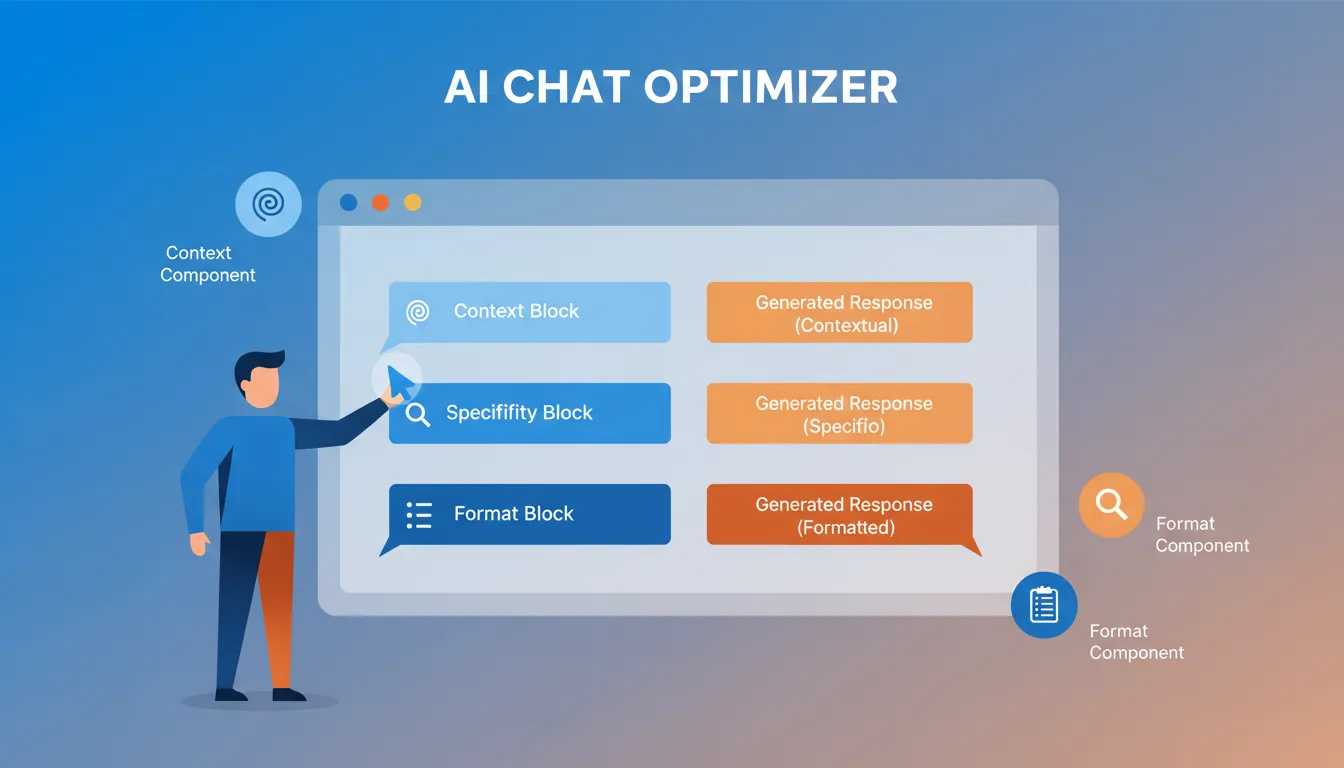
Once you're comfortable with basic AI keyword research, these advanced techniques will uncover opportunities your competitors completely miss.
The Patient Journey Prompt
This prompt reveals content gaps at every stage of the patient decision process:
"Map the complete patient journey for someone experiencing [condition] in [city] who is considering chiropractic care. Include: initial symptom awareness, research phase, provider comparison, decision factors, appointment preparation, and post-treatment evaluation. For each stage, list the questions they're asking and concerns they have."
You'll get 30-50 content ideas from a single prompt. Seriously.
The Competitor Gap Prompt
Use this to find what competitors are missing:
"I'm a chiropractor specializing in [specialty] in [city]. My main competitors are [competitor 1] and [competitor 2]. Analyze their likely content strategy and identify topics they probably haven't covered comprehensively. Focus on questions where a local expert could provide better answers than national health websites."
AI won't actually visit competitor sites. But it'll reason about typical gaps in chiropractic content strategies.
The Objection Mining Prompt
Find the reasons patients don't book:
"List 25 reasons someone might hesitate to visit a chiropractor even after deciding they need one. Include practical concerns, misconceptions, past experiences, and emotional barriers. For each objection, suggest how a chiropractor could address it through content."
Each objection is a content opportunity. Turning patient questions into SEO gold means addressing what patients really worry about.
The Long-Tail Expansion Prompt
Expand a single topic into comprehensive coverage:
"Take the topic '[your chosen topic]' and generate 15 specific long-tail variations that someone in [city] might search. Include variations by: severity level, specific symptoms, demographic (age, occupation, activity level), treatment concerns, and comparison queries."
This helps you build content clusters where a single pillar article is supported by 6-8 related pieces—all cross-linked for maximum authority.
The HIPAA-Safe Content Prompt
Healthcare content has compliance considerations. Use this prompt to stay safe:
"I need to create content about [topic] for my chiropractic practice. Suggest ways to discuss patient outcomes and case examples without violating HIPAA. Focus on general patterns, condition-specific information, and educational content that doesn't reference specific patient information."
Super important. Keeps your content helpful and compliant.
Measuring What Matters: AEO Metrics for Chiropractors
Alright, quick reality check...
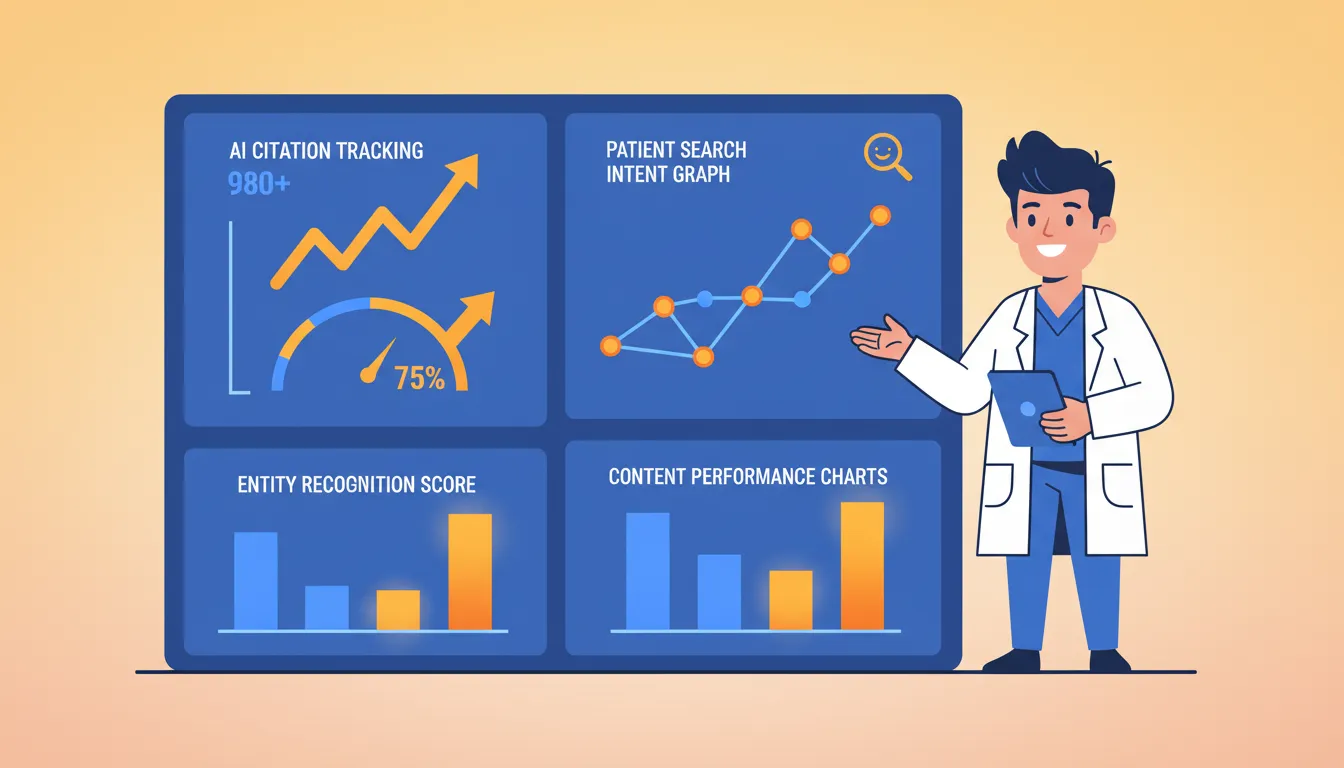
Traditional SEO metrics tell you about rankings. AEO metrics tell you about authority.
Here's what to track.
AI Citation Monitoring
Regularly check whether your content gets cited by AI systems.
Search your target questions in Perplexity, ChatGPT, and Google AI Overviews. Note when your content appears as a source. Track which competitors get cited instead.
There's no automated tool for this yet (it's coming). For now, manual checks monthly are your best bet.
Entity Recognition Tracking
Monitor how AI systems understand your practice.
Search your practice name in AI tools and see what comes up. Check Google's Knowledge Panel for your business. Verify your information is consistent across directories.
If AI systems have incomplete or incorrect information about your practice, fix the source data.
Content Performance Indicators
| Time on page | Content engagement depth | 3+ minutes |
| Scroll depth | Content completion | 70%+ to FAQ section |
| Zero-click visibility | SERP feature appearances | Increasing trend |
| Citation frequency | AI authority | Monthly monitoring |
| Entity search volume | Brand recognition | Growing over time |
The Reality Check
Here's the honest truth: AEO metrics are still evolving. We're in the early stages of understanding what drives AI citations.
What we know works:
- Comprehensive content that addresses multiple intent layers
- Proper schema markup and entity signals
- Consistent information across the AI-readable web
- Regular content updates that maintain freshness
Track what you can. Improve consistently. Stay ahead of competitors who aren't paying attention yet.
Common Mistakes Chiropractors Make With AI Keyword Research
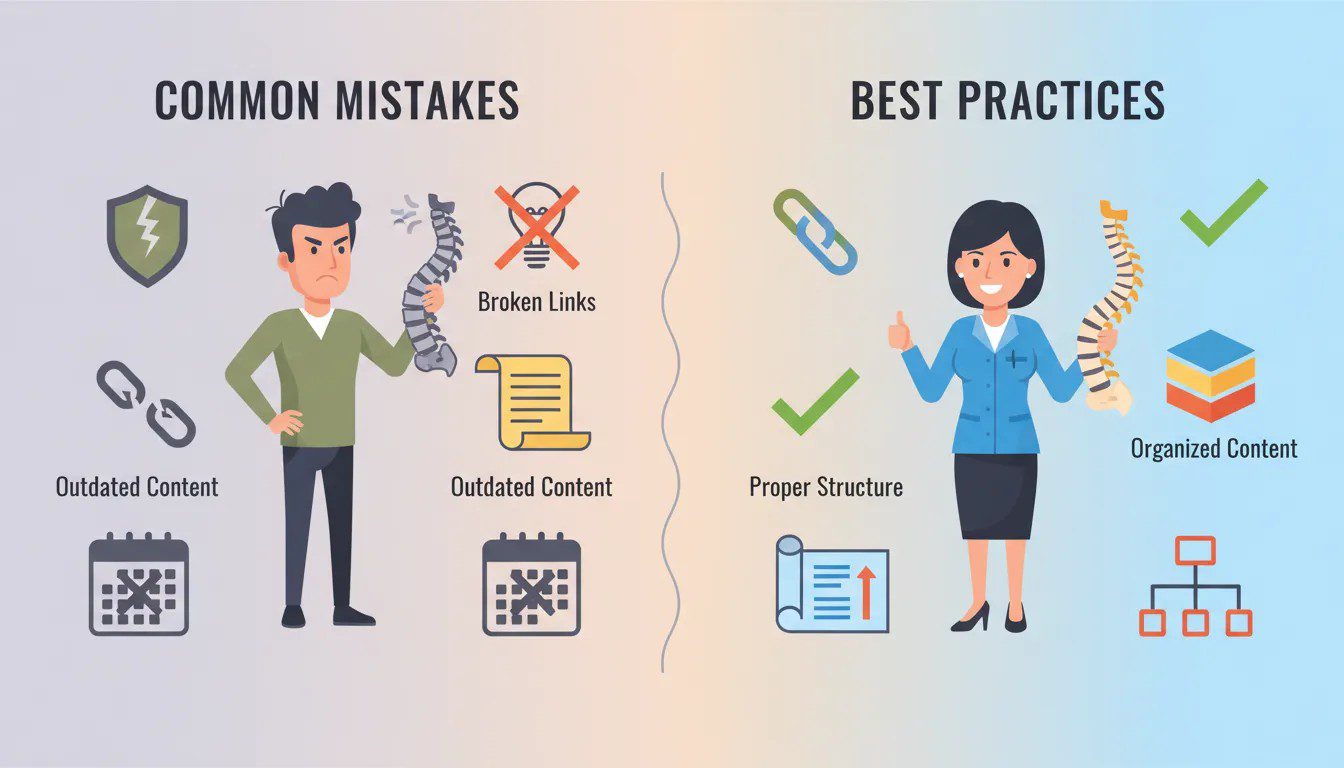
Let's talk about where this goes wrong.
Mistake #1: Still Chasing Volume Metrics
A keyword with 10,000 monthly searches sounds better than one with 500.
But if that 10,000-search keyword triggers AI Overviews that answer the question completely, those searches aren't coming to your website anyway.
Better approach: Target specific questions where you can provide unique local expertise that AI currently can't find.
Mistake #2: Ignoring Entity Optimization
You can create the best content in the world. But if AI systems don't recognize your practice as a legitimate entity, you won't get cited.
Better approach: Build entity signals across directories, schema markup, Google Business Profile, and consistent online presence.
Mistake #3: One-and-Done Content
Publishing content and never updating it is a recipe for declining citations. AI systems favor fresh, current information.
Better approach: Review top-performing content quarterly. Update statistics. Add new information. Refresh examples. Signal to AI that your content stays current.
Mistake #4: Copying National Content Patterns
WebMD and Mayo Clinic already own the generic health information market. Trying to compete with them head-on? Pointless.
Better approach: Focus on local angles, practitioner expertise, and specific condition applications where national sites can't compete.
Mistake #5: Skipping the Research Phase
Jumping straight to content creation without proper AI keyword research means you're guessing at what patients want.
Better approach: Invest time in research. Use the tools and processes in this guide. Let data drive your content strategy.
Understanding chiro patient search intent research is the foundation of everything else.
Frequently Asked Questions
How is AI changing keyword research for chiropractors in 2026?
AI is shifting keyword research from volume-based metrics to intent-based topic discovery.
Instead of chasing high-volume keywords, chiropractors now need to identify conversational queries that AI assistants like ChatGPT, Perplexity, and Google's AI Overviews will cite as authoritative answers.
The focus has moved from ranking for keywords to becoming the trusted source AI systems reference when patients ask health questions. This means creating comprehensive content that answers questions completely, implementing proper schema markup, and building entity authority across the web.
What are the best free AI tools for finding chiropractic blog topics?
The best free tools include AnswerThePublic for discovering conversational patient queries, Perplexity AI for auditing who gets cited for specific questions, and AnswerSocrates for mining People Also Ask questions.
ChatGPT and Claude also work well for brainstorming topic variations and identifying patient pain points when given proper prompts about your local market and specialty.
The free versions provide enough functionality for effective research sessions.
Do I still need to use Google Keyword Planner for my clinic?
Google Keyword Planner still has value for understanding search volume trends. But it shouldn't be your primary research tool anymore.
Traditional keyword planners miss conversational queries that AI systems prefer. They also don't show you who's getting cited or what content gaps exist.
Use it as a secondary validation tool while focusing primarily on AI-powered research that reveals how patients actually phrase their questions.
How do I find zero-click keywords patients are asking AI?
Use Perplexity AI to search for questions patients commonly ask about your services. Then analyze which sources get cited.
Look for patterns in question phrasing, the depth of answers provided, and gaps where no authoritative local source exists.
AnswerThePublic also reveals the exact conversational phrases people use. When you find questions that AI either can't answer well or can't answer locally, that's your content opportunity.
Can I use AI to find local keywords for my specific neighborhood?
Absolutely.
Prompt ChatGPT or Claude with specific geographic modifiers like your city, neighborhood, or nearby landmarks. Ask it to generate questions someone in your area might ask about chiropractic care.
Combine this with Google Business Profile insights about what local searches trigger your listing to identify hyper-local content opportunities that national competitors can't touch.
How do I make my website the answer ChatGPT gives for sciatica?
Create comprehensive, authoritative content that answers every possible question about sciatica treatment in your area.
Use proper schema markup including MedicalBusiness and FAQ schemas. Build your entity authority through consistent NAP data across directories, citations from trusted sources, and content that demonstrates E-E-A-T signals.
The goal is becoming a recognized entity that AI systems trust—not just a website with keywords.
Will AI-generated blog topics help my local Map Pack rankings?
AI-researched topics can absolutely support Map Pack rankings when executed correctly.
Content that comprehensively answers local patient questions signals relevance to Google's algorithms.
But the real win? Creating content that gets cited by AI systems while also supporting traditional local SEO factors like reviews, NAP consistency, and Google Business Profile optimization. These work together.
How often should I update my keyword research with AI?
Review your AI keyword research quarterly at minimum. Monthly is ideal for rapidly evolving topics.
AI tools and patient search behavior change quickly. What gets cited today might not get cited tomorrow.
Set calendar reminders to audit your top-performing content, identify new question patterns emerging in AI search, and refresh outdated information. Freshness signals matter for AI citations.
Your Next Move
Here's what separates chiropractors who thrive in the AI era from those who struggle: action.
You now have the complete playbook for AI-powered keyword research. The tools are free or affordable. The process is straightforward. The opportunity is massive because most of your competitors haven't figured this out yet.
Start with one focused research session this week.
Pick your wedge. Run through the tools. Identify 10 high-potential topics. Then create one piece of comprehensive, AEO-optimized content that addresses all five intent layers.
That's how you build momentum.
The practices that invest in AEO research now will own their local markets when AI search fully matures. The practices that wait will wonder why their traffic disappeared.
Which one are you gonna be?
Look, I get it—this all makes sense, but between seeing patients and running your practice, finding time for comprehensive keyword research feels impossible.
That's exactly why most practices never execute on this. They know what to do but can't carve out the hours to actually do it right.
If you're thinking "I need help implementing this," you're not alone. Most successful chiropractors we work with felt the same way before they realized their website was quietly costing them 15-20 qualified patient leads every single month.
That's why we created our Free Website Conversion Analysis. It's not a sales pitch—it's a genuine walkthrough of the 3 biggest problems killing your bookings, delivered personally via Loom video within 24 hours.
We'll show you exactly:
- Why visitors leave without booking
- What's broken on mobile devices (where most searches happen)
- Missing trust signals costing you patients
- Where you rank vs. local competitors
- Simple fixes that drive more calls this month
You'll also get an instant case study while you wait, showing real examples of how other chiropractors fixed these exact problems.
Get your free analysis here — no credit card, no obligation, just actionable insights you can use whether you work with us or not.
Because every day you spend researching keywords the old way is another day AI is sending patients to competitors who figured out the new game first.

Gerek Allen
Co-Owner iTech Valet
Entrepreneur, patriot, CrossFit junkie, IPA enthusiast, loves to travel to tropical destinations, and knows way too many movie quotes.


About iTech Valet
iTech Valet specializes in web design and content marketing for online entrepreneurs who want to share their expertise.
Services Include:
- Web Design
- Graphic Design
- Sales Copy
- Funnel Building
- Authority Sites
- Membership Sites
- Course Creation
- Email Systems
- Content Marketing
- Competitive Analysis
- Tech Integrations
- Strategic Planning
NEED MORE CLIENTS?
Free conversion-focused analysis uncovers the 3 biggest problems killing your bookings — we'll walk you through your results personally

621 Enterprises, Inc. | Copyright 2022 | All rights reserved