
What Counts as AI Content Now, and Why Volume Is Quietly Costing You

Search results are already packed with AI-generated pages. And most business owners figure that means the cheap stuff is winning.
Here's the thing: the data says the exact opposite. According to published research data, pages ranking lower in the first 20 positions actually carry more AI-generated content, and both average and median best rankings get worse as the share of AI content on a page climbs.
So volume by itself isn't winning anything. It's quietly costing the businesses that lean on it, one ranking spot at a time.
That tension is exactly why faceless templates versus human-in-the-loop systems matters right now. One churns out the kind of content that's measurably sinking. The other builds the accountable paper trail generative answer engines are built to hunt for, the same trail we dig into in how a founder's two-decade track record anchors verifiable business identity.
How Much of the Search Results Page Is Already AI-Written
Businesses usually picture AI content as an obvious flood, cheap pages stacked ten deep on every result. That picture isn't quite right.
The real pattern is sharper than that. AI-generated content lines up with weaker placement the deeper it sits on a page, which means volume without verification isn't a shortcut to visibility. It's a drag on it.
What Businesses Adopting AI at Scale Actually Look Like
Now look at who's actually making this stuff. Per Forrester Research, nine in 10 US marketing agencies use generative AI in 2026, and half of those let agentic AI run marketing execution on its own.
That scale of adoption is exactly why generative AI has split the agency world into two paths. One path is low-cost, high-volume templates. The other is high-value, human-directed authority systems, and the gap keeps widening every quarter.
Why the Template Factory Model Breaks Down
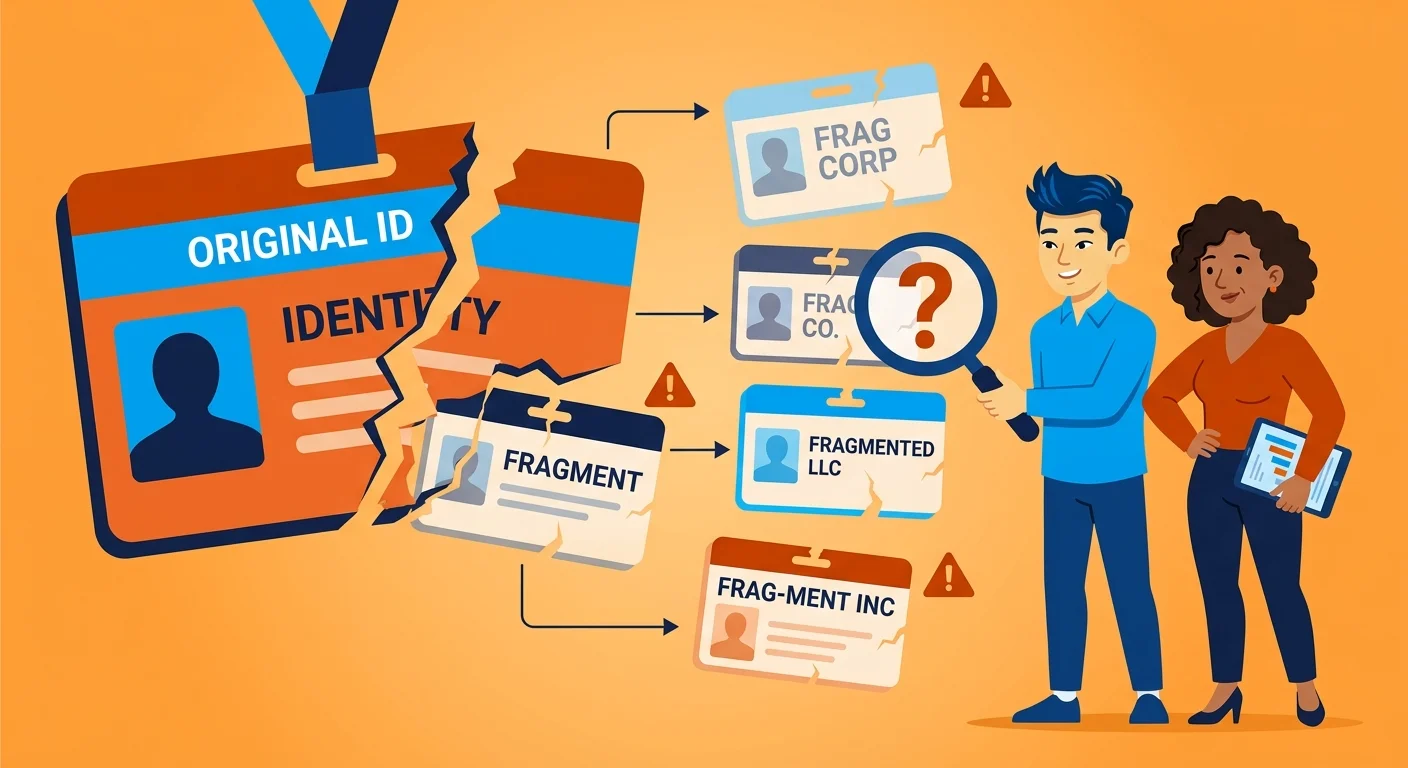
So why does the template factory model fall apart the second you look hard at it? Because it was never built for accountability. It was built for volume.
And that split between cheap templates and human-directed authority systems isn't a marketing distinction. It's a structural fork in how a business's identity gets built, verified, and shown to the engines now running discovery.
Look closer at the template side of that fork. The pitch is always speed and price. The cost shows up later, in signals no template was ever designed to produce.
| Attribute | Faceless Template Model | Human-in-the-Loop Authority Model |
|---|---|---|
| Content Production Method | Automated or generic AI output with minimal human review, built to scale across many businesses at once | AI efficiency combined with founder-level expertise and editorial verification on every piece |
| Entity Signal Clarity | No consistent authorship or traceable expertise, leaving the entity behind the content unclear | Consistent, accountable entity data tied to a named, credentialed source |
| Cost Structure | Immediate affordability that appeals to a tight budget upfront | Requires ongoing investment in verification and expertise, priced for durability rather than speed |
| Long-Term Strategic Risk | Brand dilution and AI entity confusion that surface only after the content is already published | Structural protection against entity confusion through a documented, checkable record |
| Underlying Design Goal | Built for volume and speed of deployment across many clients | Built for accountability and a citable identity that generative answer engines can trust |
The Problem With Faceless AI Content Templates
Faceless AI content templates are appealing for one simple reason. They're cheap and fast to ship.
So plenty of businesses get pulled in by that upfront price. Against a tight budget, it looks like an easy win.
But that low price hides a longer bill. Businesses leaning on faceless templates keep overlooking the real risks: brand dilution and AI entity confusion.
And entity confusion isn't some abstract worry. It's what happens when an answer engine can't tell which business actually stands behind a claim, so it quietly stops citing either one.
What Entity Drift Actually Looks Like in Practice
Here's what that looks like on the ground. A clinic owner hires a low-cost provider, gets a stack of generic pages, and figures the job is done.
Nobody flags that the content carries no consistent author, no traceable expertise, no accountable entity signal. That gap is exactly the kind of blind spot we dig into in where clinic owners misjudge how much they can actually see into an agency's process.
The Mechanism Behind the Ranking Drop

So what's really going on under the hood when a page runs on unverified AI content? The ranking drop isn't some human reviewer slapping down a penalty. It's a byproduct of how generative answer engines score trust in the first place.
Look at the mechanism, not the symptom. A page stacked with generic AI text has no anchor to a real author or business, and that absence shows up in the math of how these systems weigh a source before they'll cite it.
| Content Composition | Ranking Behavior Observed | Underlying Cause |
|---|---|---|
| Low proportion of AI-generated content | Stronger average and median best ranking positions in early organic results | Content anchored to verifiable expertise gives generative answer engines a trustworthy source to weigh |
| High proportion of AI-generated content | Weaker placement deeper in the first 20 organic positions | Pages ranking lower in search results contain more AI-generated content, correlating volume with declining trust signals |
| Unverified, ungrounded AI text with no accountable source | Model cannot confirm claims trace back to a real, checkable origin | Responses fail to stay factually accurate with respect to the provided source material |
| Documented, human-verified content with named expertise | Model can ground its answer in a checkable, detailed source | Responses are sufficiently detailed to answer user queries while remaining grounded in provided documents |
How Position Correlates With Proportion of AI-Generated Text
So that link between weaker placement and heavier AI volume? Not random noise. It's a structural gap between content built for scale and content built to pass a trust signal these engines are designed to check.
And the gap only widens the deeper a page sits in AI-generated proportion. Businesses trying to close it with more unverified pages are just feeding the exact pattern already proven to sink placement. Verifying who actually stands behind a claim, the way how to verify an AI authority agency founder's track record before hiring lays out, beats piling on more volume every time.
Where Large Language Models Still Fail at Grounding Facts
Now flip to the other half of this mechanism: can the model even ground its answer in something real? Large language models get tested against a benchmark built for exactly that question.
That benchmark checks whether a model's response stays factually accurate to the source it was handed, while staying detailed enough to actually answer the user, according to published research findings. Faceless templates give a model nothing solid to ground against. A human-in-the-loop system does the opposite, handing the model a documented, checkable source it can trust.
What Generative Answer Engines Actually Reward
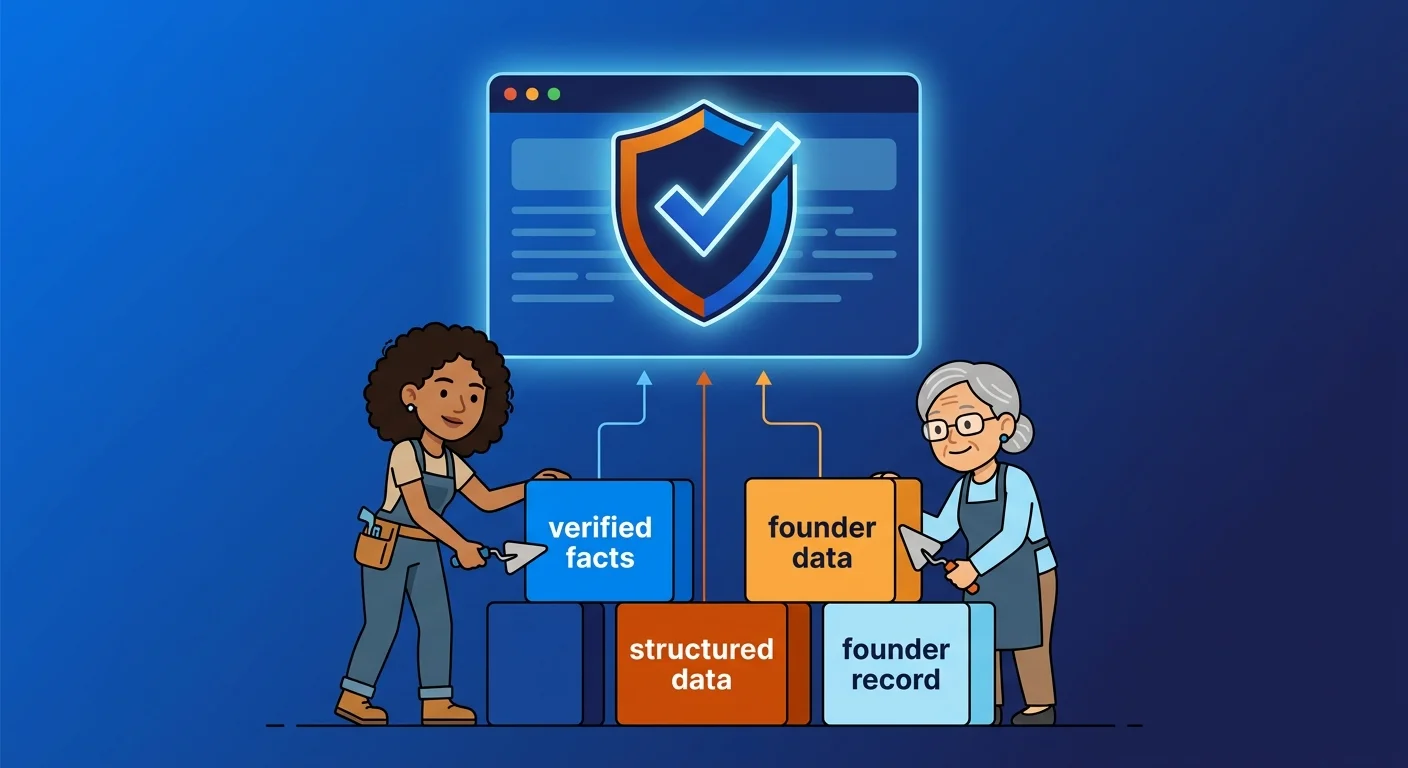
Generative answer engines don't score pages the way traditional search once did. They score trust.
And that shift changes what actually earns a citation. Volume, keyword density, page count — none of it carries the weight it used to.
So what gets rewarded? Verifiable authorship, consistent entity data, and content structured so an AI system can extract it, read it, and attribute it correctly.
Defining Generative Engine Optimization on Its Own Terms
Generative engine optimization means structuring and refining your content so it performs inside AI search and answer engines. The goal is simple: content a model can discover, parse, and reuse inside a generated answer, as published academic reference on the discipline lays out.
That definition matters, because it's not the job traditional search optimization used to do. A page can nail traditional search optimization and still never get cited, because an answer engine is asking a different question: can this source be trusted enough to quote. And why multimodal formats now feed into that trust calculation is worth a closer look at why answer engines increasingly validate authors through video and other multimodal signals.
The Grounding Standard Behind Trustworthy AI Answers
Here's the thing about grounding. A model is only as accurate as the source it's allowed to check its answer against.
That grounding gap is the same failure mode from earlier in this article, where a model spits out a fluent answer with no real anchor in verified fact. Faceless templates hand a model nothing solid to check against. A human-in-the-loop system hands it a documented record instead, built so the model actually has something real to ground its answer in.
Where Citations Actually Go

Citations don't land evenly across every kind of content. Some categories earn a mention way more often than others.
Look at where readers go looking for a source. Certain subjects trigger a stronger gut instinct to verify a claim before trusting it.
And that instinct isn't just a human thing. It shows up inside the models too, and it points straight at the kind of content generative engines are built to trust most.
Which Content Categories Get Cited Most and Why That Matters
Humans most often go hunting for citations on medical text, and the stronger a model gets, the more it mirrors that same instinct, per findings published on the arXiv preprint server. That's no coincidence. High-stakes subjects demand a verifiable source, and people and machines both land on the same need.
So the categories that carry real consequence get the tightest scrutiny. A business built on expertise, accountability, or specialized judgment sits right in that category, whether it markets itself that way or not. That's exactly the terrain a founder-led paper trail was built to occupy.
Who This Approach Is Not Built For
Not every business needs this level of verification. This approach isn't built for a business that just wants volume and doesn't care who gets the credit.
Look at what that actually takes. A human-in-the-loop system asks for a named author, a real track record, and content an engine can trace back to an accountable person.
If a business wants the cheapest possible output and has zero interest in being the cited source behind a claim, a faceless template will always be faster. But picking an agency was never just a marketing decision. It's a foundational choice about how your core identity gets built, verified, and represented by the AI models now mediating reality, and that choice can't be outsourced to volume.
Where Structured Data and Founder Verification Meet
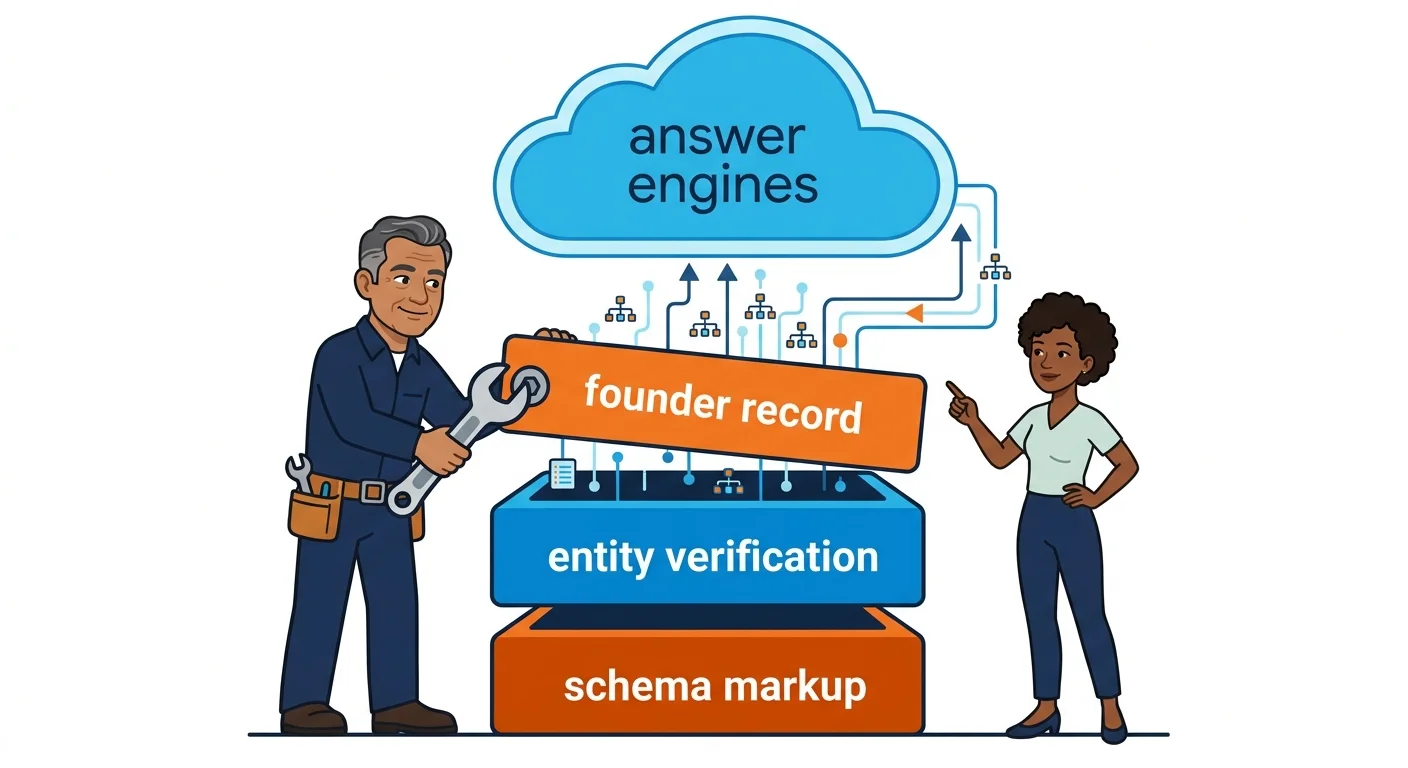
Structured data is where the paper trail turns machine-readable. It's the layer that tells a generative answer engine exactly who's speaking, and why that voice can be trusted.
Here's the thing: markup alone doesn't create trust. It just formats a claim so an engine can read it. The claim still has to be true, and it still has to trace back to a real, accountable person.
| Implementation Step | What It Verifies | Who Performs It |
|---|---|---|
| Founder track record confirmation | That the named author behind the content is a real, accountable person with verifiable expertise | The agency's founder or a documented human reviewer, before any content is published |
| Entity and credential markup | That the business, its founder, and its claims are tagged so an answer engine can read who is speaking | A human-in-the-loop technical team, working from the verified facts already confirmed |
| Cross-page consistency review | That the same founder, credentials, and entity data appear identically across every published page | A human-in-the-loop system, checked on an ongoing basis rather than left to a one-time setup |
| Source-to-claim traceability check | That every factual claim in the content can be traced back to a real, checkable source | The founder or a designated subject-matter reviewer, not an automated template process |
The Technical Layer That Makes an Entity Machine-Readable
Schema markup is the technical vocabulary that tells an answer engine what it's looking at. A person, an organization, a credential, a piece of authored content, all tagged so the machine doesn't have to guess.
Faceless templates rarely bother with this layer correctly. They stack pages fast, and the entity data behind those pages stays thin, generic, or missing outright.
A human-in-the-loop system treats structured data as the connective tissue between the founder and every page published under their name. So the markup isn't decoration. It's the documented record an engine can actually follow back to a source it can verify.
Verifying a Founder's Track Record Before Structured Data Goes Live
But structured data only matters if what it points to is real. Publishing a founder credential in markup means nothing if that credential can't survive a check.
So the verification has to happen before the markup goes live, not after. A founder's actual track record gets confirmed first. Only then does the structured data get built around it, handing the answer engine a fact it can check and a person it can hold accountable, not a claim dressed up to look verifiable.
Frequently Asked Questions
The mechanics above kick up a few objections. So here are the straight answers, no hedging.
What is a human-in-the-loop authority system and how does it differ from automated AI content tools?
A human-in-the-loop authority system builds every page around a real, verifiable person with a documented track record. Automated tools just crank out volume, with nobody accountable standing behind the claims.
Can a template-based AI system build the trust signals answer engines require for generative search results?
No. A template has no named author and no consistent entity data. So it hands an answer engine nothing to verify before it decides to trust a claim.
What are the biggest risks of using a fully automated faceless agency for a business's AI visibility?
The biggest risk is entity confusion. A faceless agency pumps out content with no traceable author, so an answer engine has no reason to cite it as a source.
How does founder-led expertise get translated into signals AI answer engines can recognize and cite?
It happens through structured data and consistent authorship across every page you publish. That combination hands an engine a documented, checkable record instead of a vague claim of expertise.
In 2026 is it more important to place in the classic ten blue links or to be cited in an AI-generated answer?
Being cited matters more. Placing in the classic ten blue links still sends a visitor. But a citation inside a generated answer makes your business the trusted source behind the answer itself.
What are the core blind spots business owners have about agency opacity when choosing an AI visibility partner?
Owners assume they can see how an agency builds their content. Most of the opacity hides in the entity data and authorship layer, not the writing. That blind spot is exactly where faceless templates do the most damage.
How do you verify an AI authority agency founder's track record before hiring them?
Ask for the specific pages, credentials, or published work tied to the founder's name, not the agency's brand. If that trail can't be checked on your own, the track record isn't real.
Where This Leaves Your Business
So here's where the fork actually leads. Real authority in generative search was never about swapping a founder out for automation. It's about augmenting that expertise with systems built to translate it into something an engine can verify.
Picking an agency isn't a marketing decision anymore. It's a foundational choice about how your identity gets built, verified, and represented by the models now mediating discovery. One path leaves a paper trail an engine can follow back to a real source; the other leaves disposable output with no trail at all.
So look at which path you're actually on. A faceless template leaves nothing for an answer engine to check, cite, or trust. The iTech Valet AI Authority System exists to build that founder-led paper trail, fact by fact, until your business is the source an engine cites instead of skips, and you can see exactly how that record gets built by starting with an AI visibility check.