
Where you are and how close you are still are key things Google uses to build its answers in AI Mode. When you add “near me” to a search, Google shows a wider mix of businesses, from your own area and from nearby areas. If the search names a different city, the results are in that city. Google understands that someone looking for a dental clinic might be willing to travel across town to find the best one. That’s not true for someone looking for a pharmacy, where Google usually shows the three closest results. Your Google Business Profile has been named the most important place AI gets checked facts about local businesses.
How Google Works Out Where a Searcher Is
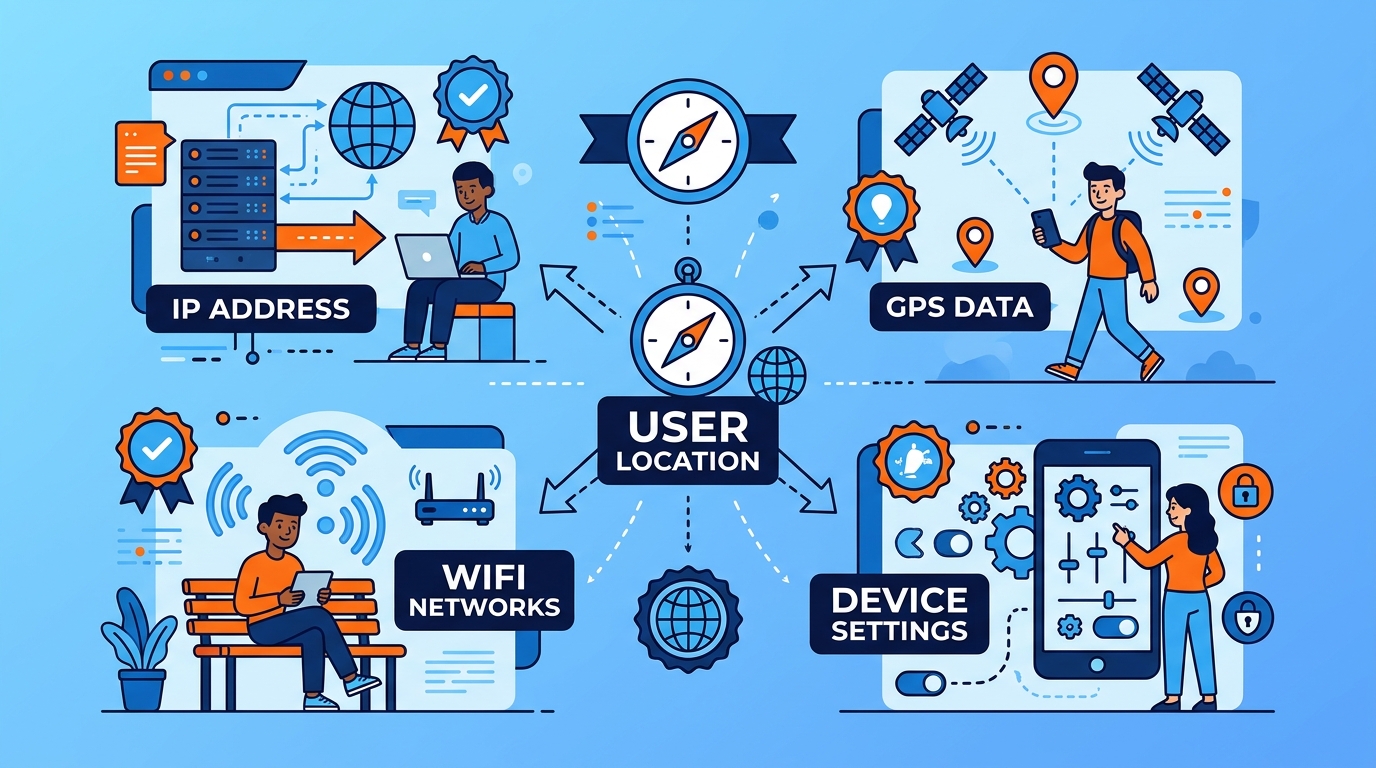
Here’s the starting point.
For a long time, Google has shaped local results mainly by how close the searcher is to a business.
Whitespark puts it this way: “Google’s main customization of local results has long been based on the physical proximity of a searcher to a business.”
Want the source?
Google lists the location signals it uses on How Google uses location information.
- General area searches. When you search using a general area, your search uses an area of at least 3 square kilometers, or grows until the area covers the locations of at least 1,000 people.
- Past searches. Sometimes, places you have searched from before may be used to guess a useful location for your search. For example, if you search for coffee shops while in Chelsea, Google might show results for Chelsea in future searches.
- Personalized Recommendations. When your Personalized Recommendations in Search services setting is on, these services may show results, curated feeds, and AI answers that fit a general area you have searched from before.
- IP address. IP addresses are roughly tied to where you are. So any app, service, or website you use, including google.com, may be able to guess and use some details about your general area from your IP address.
- Home or work address. If you set your home or work address, it can be used to make things easier, like getting directions or finding results closer to your home or work, and also for ads.
Here’s the good news.
This saved location info is deleted on its own from your Search Services History after 30 days.
How AI Mode Builds Local Answers
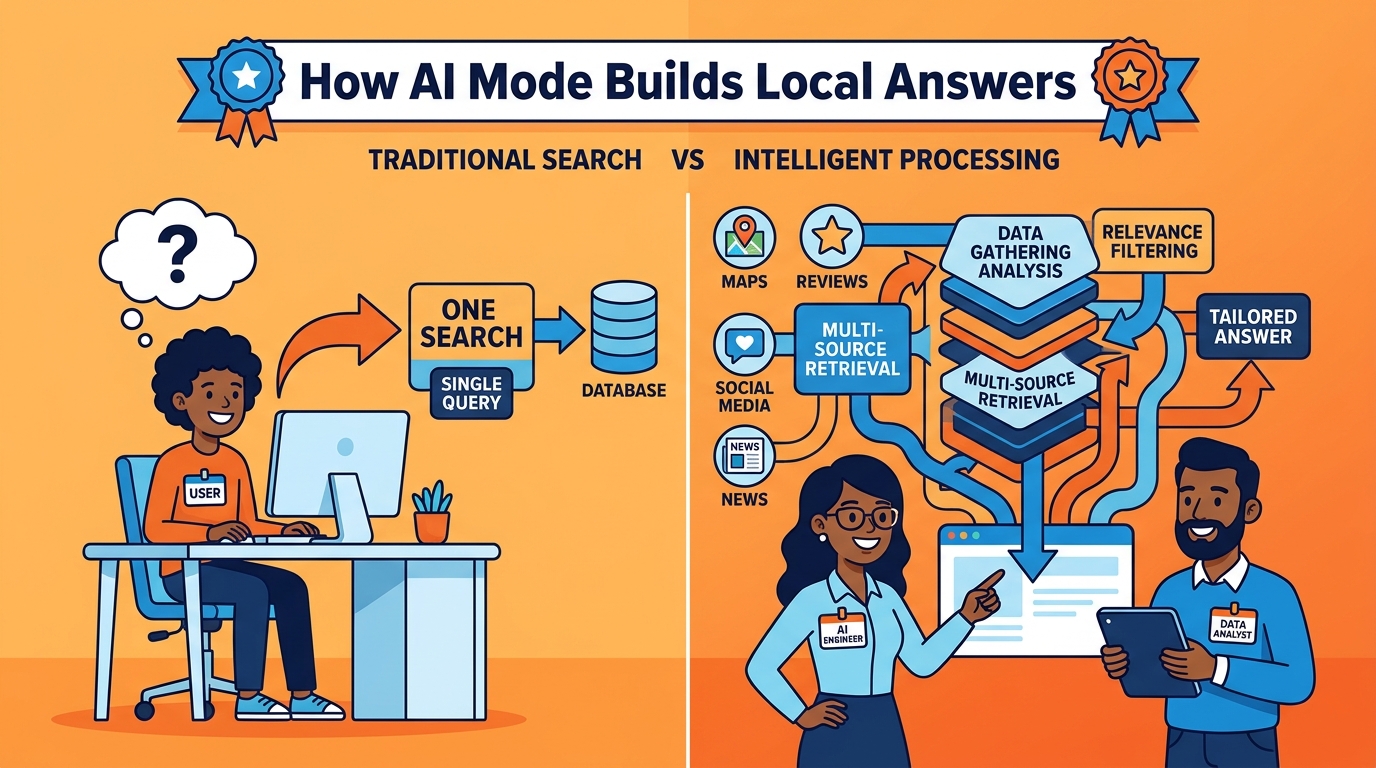
A regular local search runs just one search. AI Mode works by “query fan out”: it runs many searches and checks to come up with what it shows you. Whitespark lays this out in Whitespark’s Guide to Google AI Mode for Local Businesses.
Here’s how often AI shows up.
A small study in May 2025 looked at AI Overviews. They’re now usually shown along with AI Mode. They came up for a bit more than half (57%) of local searches.
They were most dominant for searches looking for information. Not for searches looking to find or buy from a local business.
Regular Google results usually show a Local Pack with three businesses. In Europe, you sometimes get a second Local Pack at the bottom.
AI Mode is bigger. Human Level has seen lists with up to ten businesses.
The top three businesses that usually show up in the Local Pack also show up in AI Mode. That reinforces the importance of a well-set-up Google Business Profile for your chances of showing up in AI Mode.
The table below puts the Local Pack and AI Mode side by side.
| Feature | Local Pack | AI Mode |
|---|---|---|
| Number of businesses shown | Typically three | Lists with up to ten seen |
| Overlap with Local Pack top three | Top three usually appear here | Those top three also show up |
How Proximity Weighs Differently by Service Type
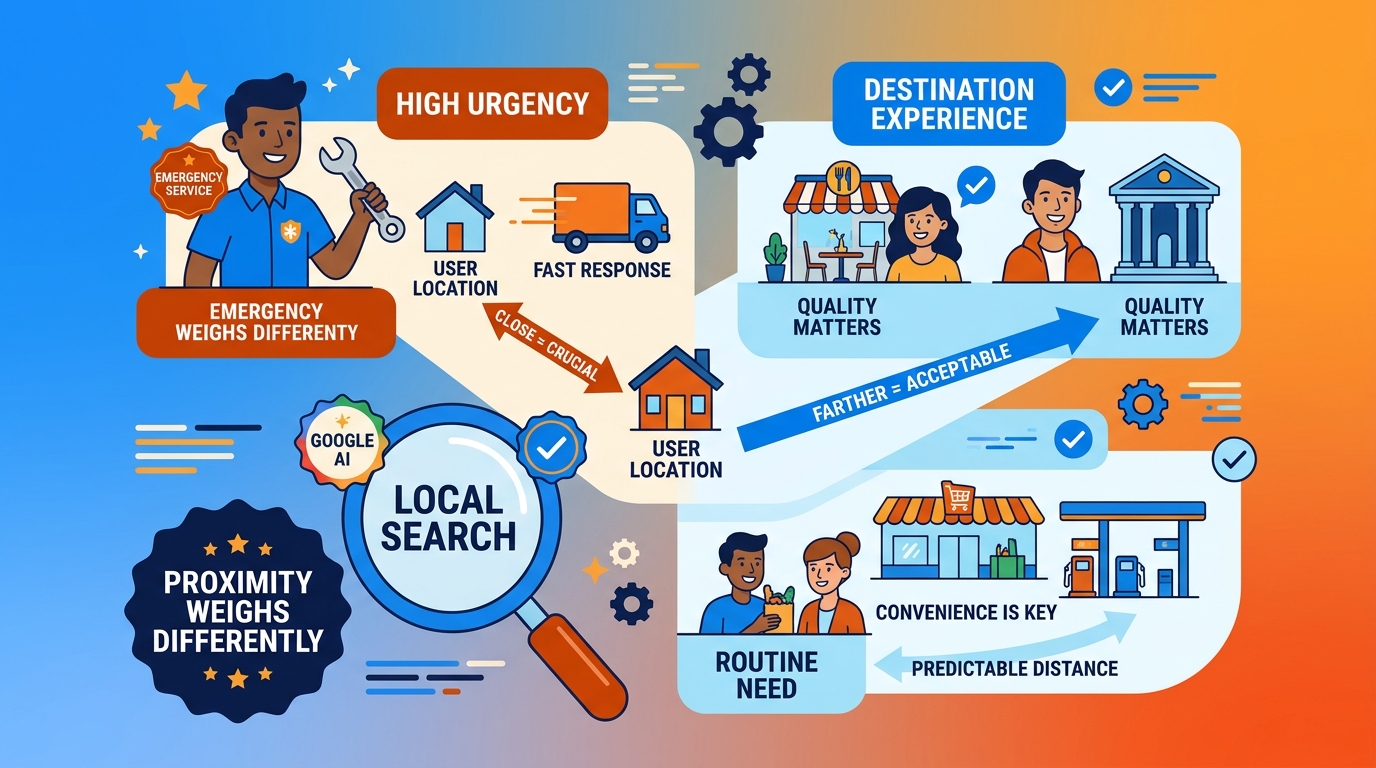
Human Level, in Google AI Mode and local search results, shows distance counting differently from one search to another.
Add “near me” to a search, and Google shows a wider mix of businesses. Some from your own area. Some from nearby areas.
Name a different city? The results are in that city.
Google understands that someone looking for a dental clinic might be willing to travel across town to find the best one. That’s not true for someone looking for a pharmacy, where Google usually shows the three closest results.
Where you are and how close you are still are key things Google uses to build its answers in AI Mode.
Two clinics in one group chasing the same county? See What Happens When Two of Your Clinics Compete for the Same County?
What AI Reads to Judge a Clinic’s Coverage
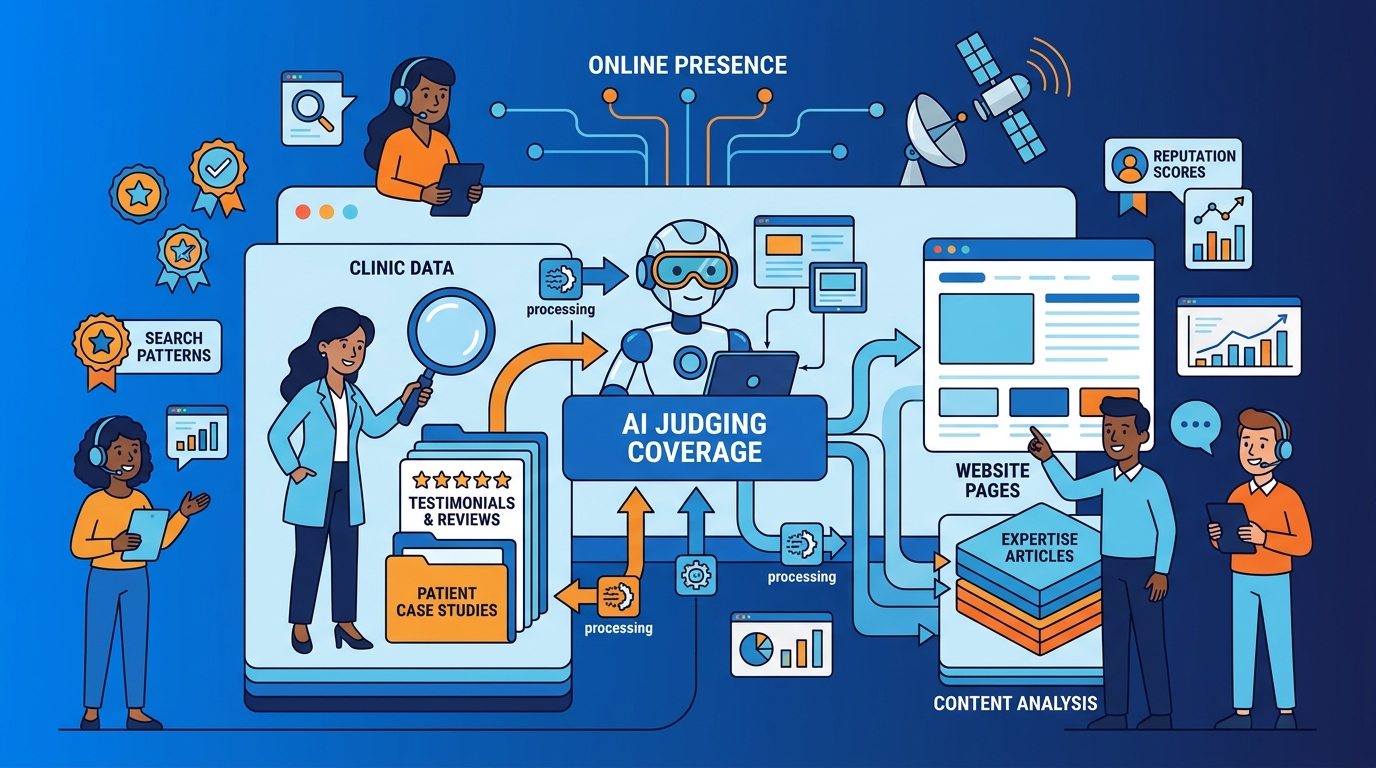
I don’t treat getting picked by AI answer tools as old search work with a new name.
I won’t chase keywords, inbound links or a ranking spot. That aims at the wrong target.
I build for what these systems are trying to work out. Who a company is. Whether it’s credible.
Then I put the effort into making that easy for them to see.
Search Engine Journal covers these signals in How Will AI Mode Impact Local Search?.
Adding clinics raises its own questions. Those are covered in Multi-Clinic Expansion and AI Recommendations: What to Know Before You Start.
The table below sorts the signals into structured and unstructured.
| Signal type | Example | What it does |
|---|---|---|
| Structured | Google Business Profile | Identified as generative AI’s most critical source of verified local data |
| Structured | LocalBusiness schema with geo property | Meets AI’s need for hyper-local accuracy in “near me” and navigational queries |
| Unstructured | Reviews | One of the key sources AI Mode returns for local search prompts |
| Unstructured | Blogs, news, community hubs | Mentions AI Mode depends heavily on for local search answers |
Structured Signals: Profile, Schema and Listings
Start here.
Your Google Business Profile has been named the most important place AI gets checked facts about local businesses.
Your LocalBusiness schema is the code on your site that describes your business.
It must include the geo property. That’s your exact latitude and longitude.
Why? So AI can be precise about where you are. For “near me” searches. And for searches for a specific place.
Here’s a trap.
Your website lists four services. Your Google Business Profile lists six.
Now AI may not be able to give a clear, sure summary of what you offer.
Human Level says to mark your location details with structured data, the code that helps search engines read your site. Search crawlers like this. How you set it up will change depending on whether you have one location or several in different cities.
Whitespark makes a point about timing.
AI chat tools have come along. So it matters more that your structured citations are accurate and consistent.
Unstructured Signals: Reviews, Mentions and Local Coverage
Reviews are now one of the main sources Google AI Mode shows when people search for local businesses.
Google AI Mode leans heavily on mentions when it answers local searches.
Whitespark says to get your business mentioned in these places:
- blogs
- online news sites
- social media
- community sites
- industry magazines
- sponsorship pages
- job sites
- local business group sites
- the websites of other local businesses near you
Here’s what the research shows.
There’s a strong link between brands named in AI Overviews or AI Mode and how often those brands are mentioned across the web.
That includes social media. Blogs. Forums like Reddit.
Why County-Level Knowledge Is Harder for AI to Get Right
Here’s what LocalBench is.
It tests how well AI models know U.S. counties. About 15,000 (14,782) checked question-and-answer pairs. 526 U.S. counties across 49 states.
The sources are mixed. Census numbers. Talk on local subreddits. Regional news.
The paper is LocalBench: Benchmarking LLMs on County-Level Local Knowledge and Reasoning.
Why counties?
They’re the smallest U.S. government area with numbers about people’s lives and money that are reported in a steady, matching way. Think ACS, CDC, and USDA data.
The researchers used Rural-Urban Continuum Codes (RUCC) to sort counties. Urban (RUCC 1 to 3). Suburban (4 to 6). Rural (7 to 9).
Here’s what the benchmark found:
- The best AI models got only a little over half right (56.8%) on story-style questions.
- Number reasoning? They struggled. Scores below 15.5%.
- Web search helped Gemini (up 13.6%). It hurt GPT-series models (down 11.4%).
- Bigger models, or mixture-of-experts (MoE) models, showed no steady edge over smaller non-MoE models.
Local sources like these are rarely fully indexed by search engines, are set up in mixed ways, and often need someone to piece them together and make sense of them instead of just pulling them up.
Today’s AI language models, as a pattern, give too much weight to big cities, leaving rural areas and smaller towns ignored.
Unequal Opportunities: Examining the Bias in Geographical Recommendations by Large Language Models found steady demographic biases in the geographic recommendations these models give.
Those biases could keep a “rich-get-richer” effect going. They could widen money gaps that already exist.
The paper points to research by Johnson and others. It shows a clear city-versus-country divide in these knowledge platforms. City areas are written up more fully than rural ones.
It also points to research on brand bias. AI language models tend to favor global and luxury brands over local ones. That could make money gaps worse.
Large language models have some problems, including making things up and training data that has outdated knowledge or is missing information about certain fields.
I don’t publish more to get a clinic named.
Where AI knows little about a county, I give it a few clear, factual pages. In a sensible order. Pages it can grasp easily.
I’ll take that over a high count of posts any day.
Why Business Data About Clinics Is Often Wrong or Incomplete
Google sets out how it handles location on How Google uses location information.
One study compared business lists from two companies.
Neither gave a completely accurate count of businesses.
How well listings matched and how many businesses they covered were lowest for health care places. Same for leisure and entertainment businesses.
They were highest for popular places people walk to, places to eat, and places that sell alcohol or tobacco. They also shifted somewhat with how many people live in the area.
So where did the mistakes come from?
Old or wrong addresses. And businesses with no fixed location.
Researchers looked at 21 years of data in 23 counties around New York City. They checked how well locations were mapped and businesses were sorted.
The finding? Health-related businesses in an area change a lot over time.
Bad actors see the gap.
Some local data sellers higher up the chain do a poor job of checking data quality. Bad actors take advantage of them. They use them to post listings that promote illegal drug businesses.
The Census Bureau’s Business Register works differently.
It’s updated constantly. It takes the newest and best information from the Census Bureau and other federal statistics and records programs.
Google describes a system that understands facts about people, places, and things. It learns from material shared across the web, and from open and licensed databases.
It has gathered over 500 billion facts about five billion of these things.
Here’s where I put a clinic’s effort and money.
Into what it controls. Clear, credible information about itself. I’ve watched that keep paying off and grow over time.
Visibility bought through ads or paid placements is different. It ends the day the spending ends.
So when I advise where money should go, I pick the first.
Frequently Asked Questions
Does ranking in Google’s organic top 10 mean a clinic will show up in AI Overviews?
No. A Ziptie study found that a top 10 spot in Google’s regular (organic) results gives you only a 1 in 4 chance (25%) of showing up in AI Overviews. Page one alone isn’t your AI plan.
Do patients check the sources AI cites before trusting them?
Mostly, no. The GatherUp study found about two out of three people (67%) don’t carefully check the sources AI points to. So what AI says about you needs to be right.
How many consumers already use conversational AI to find a local business?
Almost half. GatherUp studied more than 1,000 U.S. shoppers in the third quarter of 2025 (Q3 2025). Nearly half (48%) had used an AI chat tool while looking for local business information. Your patients are already asking.
How much do clicks fall when an AI Overview doesn’t cite a business?
By as much as 61%. When an AI Overview shows up and doesn’t name your business’s content, clicks on the regular results can drop that far. Get named in it.
Should licenses and certifications sit behind tabs or accordions?
No. Content that shows who you are and why you can be trusted must not hide behind a click. Licenses. Certifications. Key service details. Location details. No toggles, tabs, or accordions. No code that needs a click before it shows.
County-Wide Naming Comes Down to Proximity and Proof
Where you are and how close you are still are key things Google uses to build its answers in AI Mode. Your Google Business Profile has been named the most important place AI gets checked facts about local businesses. And now that AI chat tools have come along, it matters more that your structured citations are accurate and consistent. Closeness, plus facts AI can check.
I build for a clinic to be the source an AI names and draws on as the county’s answer. Not one more name in a list.
iTech Valet Service Plans & Pricing explains how the work is done.
Want to see where your clinic stands now? Run My AI Visibility Check.