
Treat each location as its own separate business with its own online pieces, and move past copy-and-paste pages. Make a page for each location that shows your services, what makes you different, and your local know-how, such as staff bios, questions and answers about that location, photos of the neighborhood, and local events. Your business name, address, phone number, and other key details should be correct and the same across sites. Locations with facts that don’t match send mixed signals to AI, and that gives AI a reason to leave them out of its answers. If each location has its own page, make a separate LocalBusiness data item for each one, and use the parentOrganization or branchOf property to link each back to the main Organization data item. For a brand with many locations, relevance has to be local: content should speak to the needs, setting, and questions of each community you serve.
Why AI Names Multi-Location Brands Less Often Than Single-Location Businesses
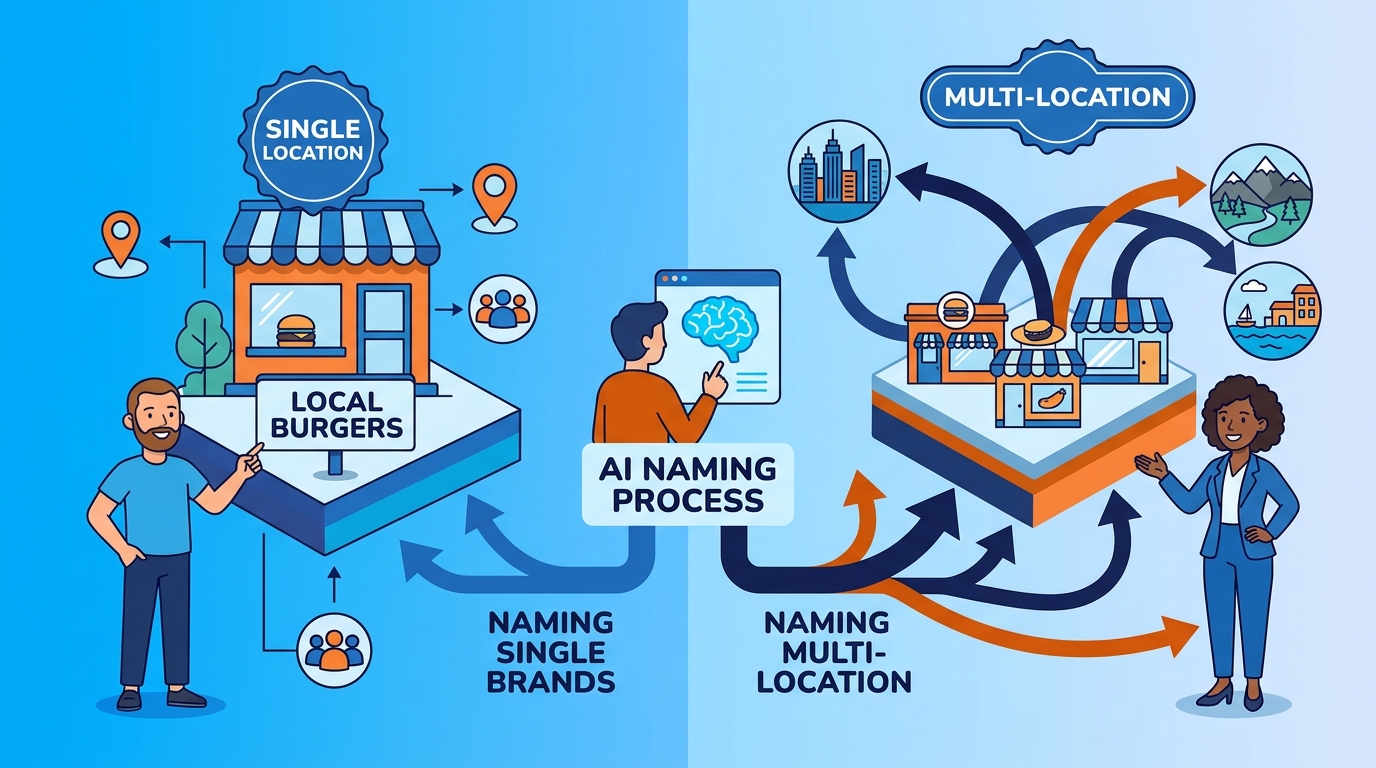
Start with the definition.
AI visibility is how often a business shows up when tools like ChatGPT, Gemini, and Perplexity make recommendations. People ask about products, services, or local businesses. The AI answers.
Unlike traditional search, it counts how often you get recommended. Not what spot you hold in a ranked list.
I don’t use rank reports as the score anymore.
Once AI tools started giving direct answers instead of lists of links, a spot in a results list stopped telling me much. It doesn’t tell me whether a business gets found.
I read a rank report as something that looks good but doesn’t drive outcomes.
So I count how often a clinic gets recommended. I’ve retired position-tracking as a success measure.
SOCi reports that brands showed up in Google’s 3-Pack 36% of the time. ChatGPT’s recommendations averaged 4.3 stars. Brand locations showed up in AI recommendations 6.5% of the time.
SOCi’s 2026 Local Visibility Index looked at about 350,000 locations from 2,751 multi-location brands. Brand locations showed up in the Google 3-Pack 35.9% of the time. ChatGPT recommended just 1.2% of brand locations, Gemini 11.0%, and Perplexity 7.4%. The table below lists the index’s figures, with SOCi’s 6.5% figure for AI recommendations added as its own row.
| Platform | Appearance Rate |
|---|---|
| Google 3-Pack | 35.9% of brand locations |
| AI recommendations (SOCi’s brand-location figure) | 6.5% of the time |
| ChatGPT | 1.2% of brand locations |
| Gemini | 11.0% of brand locations |
| Perplexity | 7.4% of brand locations |
This is a problem for brands with many locations.
They show up much less often in AI recommendations than local small and mid-size businesses do.
Early patterns point one way.
AI chat tools often favor single-location businesses. Their data, reputation, and activity signals are simpler. More unified.
One weak location can hurt the rest.
AI takes in signals from every location, platform, and review. It forms one opinion of the brand. Then it uses that opinion everywhere.
If even a small group of locations is inconsistent, inactive, or underperforming, AI sees risk. And it holds back its recommendations.
SOCi’s full write-up is AI Visibility: How Brands Get Recommended by ChatGPT, Gemini, and Perplexity.
One page per clinic or one page for a whole metro? That’s its own question.
It’s covered in Satellite Offices vs Metro-Wide Service Pages: What Works?
How Split Ownership Leaves Clinic Data Inconsistent
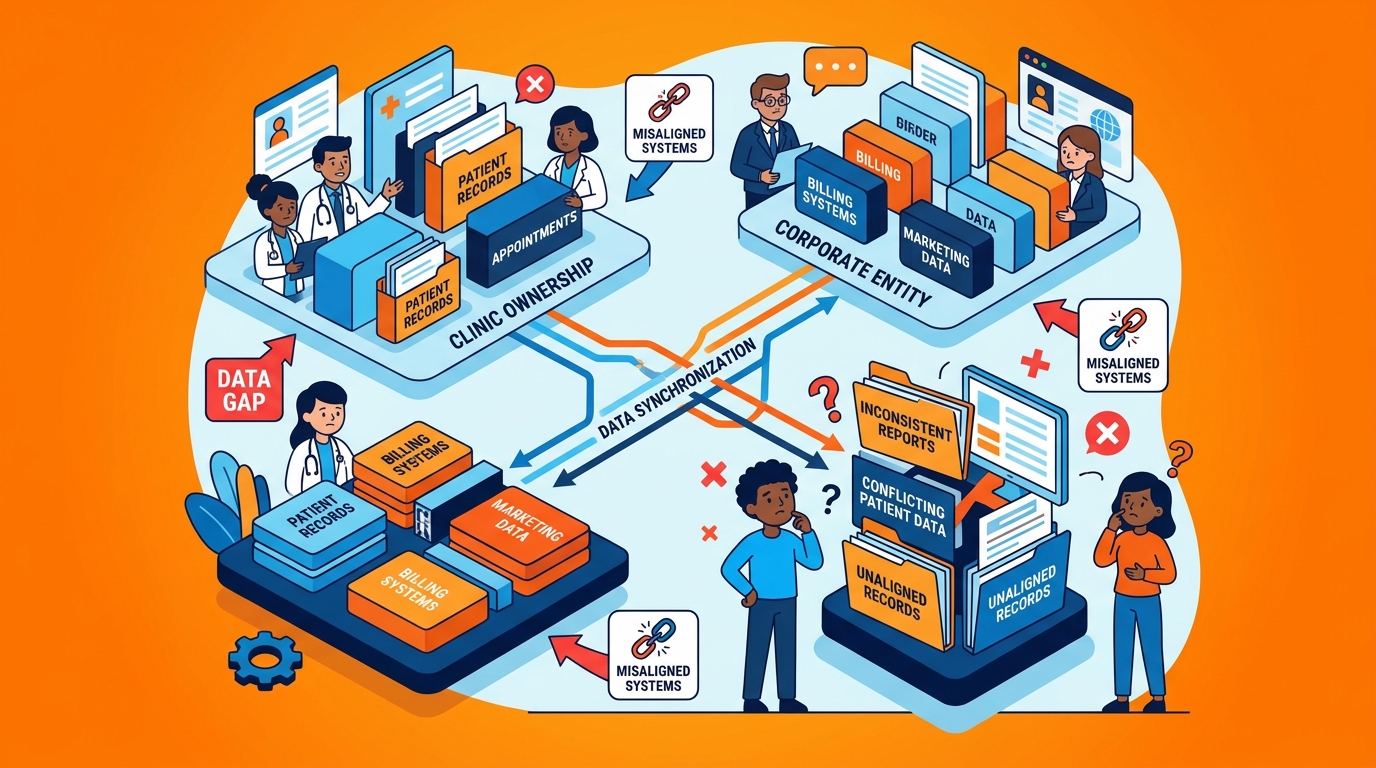
Here’s where the mess starts.
For many multi-location brands, inconsistent local data comes from split-up ownership inside the company. One team handles website content. Another handles listings. Reviews fall to local operators.
Street Fight lays this out in Why AI Is Raising the Cost of Inconsistency for MULO Brands.
AI pulls business data from many places, including Google Search and Maps, Yelp, Bing, brand websites, and local pages. It does not sort out the differences. Every inconsistency signals uncertainty: hours that don’t match, duplicate listings, old phone numbers, missing attributes, and naming that conflicts.
A study of provider records dug into the problems.
Providers changed their names. They moved, or listed different addresses in each database. Their names were misspelled in either record. Or they had the wrong taxonomies tied to their provider information in the federal database.
Give Each Clinic Its Own Distinct, Consistent Identity
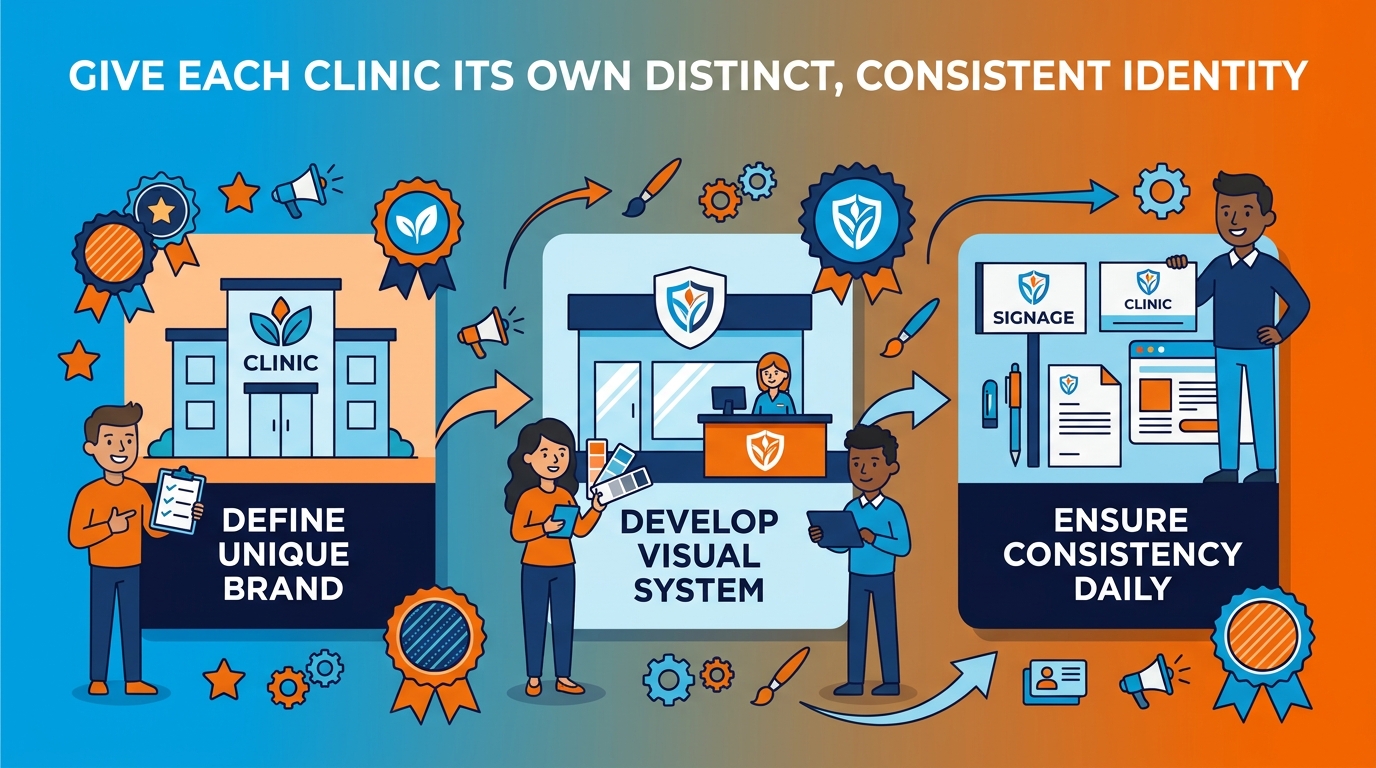
The fix has three parts.
Keep the core details the same everywhere. Give each clinic its own page. Use one primary category across clinics that offer the same service.
Street Fight covers the shift in AI Search Is Rewriting Traditional Search Optimization for Multi-Location Brands.
Two clinics competing for one county raise their own problem: What Happens When Two of Your Clinics Compete for the Same County?
I put a clinic’s effort and money into assets it owns. A page for each location. Profiles that match.
Clear, credible information about a clinic keeps paying off. It grows.
I don’t lean on ads or paid placements. That visibility is gone the day the spending stops.
Keep Name, Address and Phone Consistent Across Every Platform
Your business name, address, phone number, and other key details should be correct and the same across sites. Locations with facts that don’t match send mixed signals to AI. That gives AI a reason to leave them out of its answers.
To help keep your Business Profile correct, Google collects information from different sources, like reports from users and content it has a license to use.
Build a Distinct Local Page for Each Location, Not a Copied Template
Treat each location as its own separate business. With its own online pieces.
Move past copy-and-paste pages. Make a page for each location that shows your services, what makes you different, and your local know-how.
Add staff bios. Questions and answers about that location. Photos of the neighborhood. Local events.
Each page has to show that location’s real details. And how its market searches.
Copy the same template for every location? Search engines and AI assistants have no reason to pick one over another.
I don’t chase publishing volume.
I write for how easily AI can grasp a clinic’s information. So I’d take one clear, factual page per location, in a sensible order, over a pile of copied ones.
Here’s what SOCi’s study found.
Accurate, complete data gets a location into the small group AI recommends. So does differentiated local content, particularly on local pages the brand owns.
For multi-location brands, relevance has to be local. Your content should speak to the needs, setting, and questions of each community you serve.
Keep One Primary Category Across Locations That Offer the Same Service
Keep one primary category for all your locations.
GMB Club advises this, citing Google: all locations of a business must share a primary category. Secondary categories can vary.
GMB Club also notes that Google’s rule is explicit.
All locations must have the same category if they offer the same service.
Mark Up Each Location So AI Can Tell Branches Apart
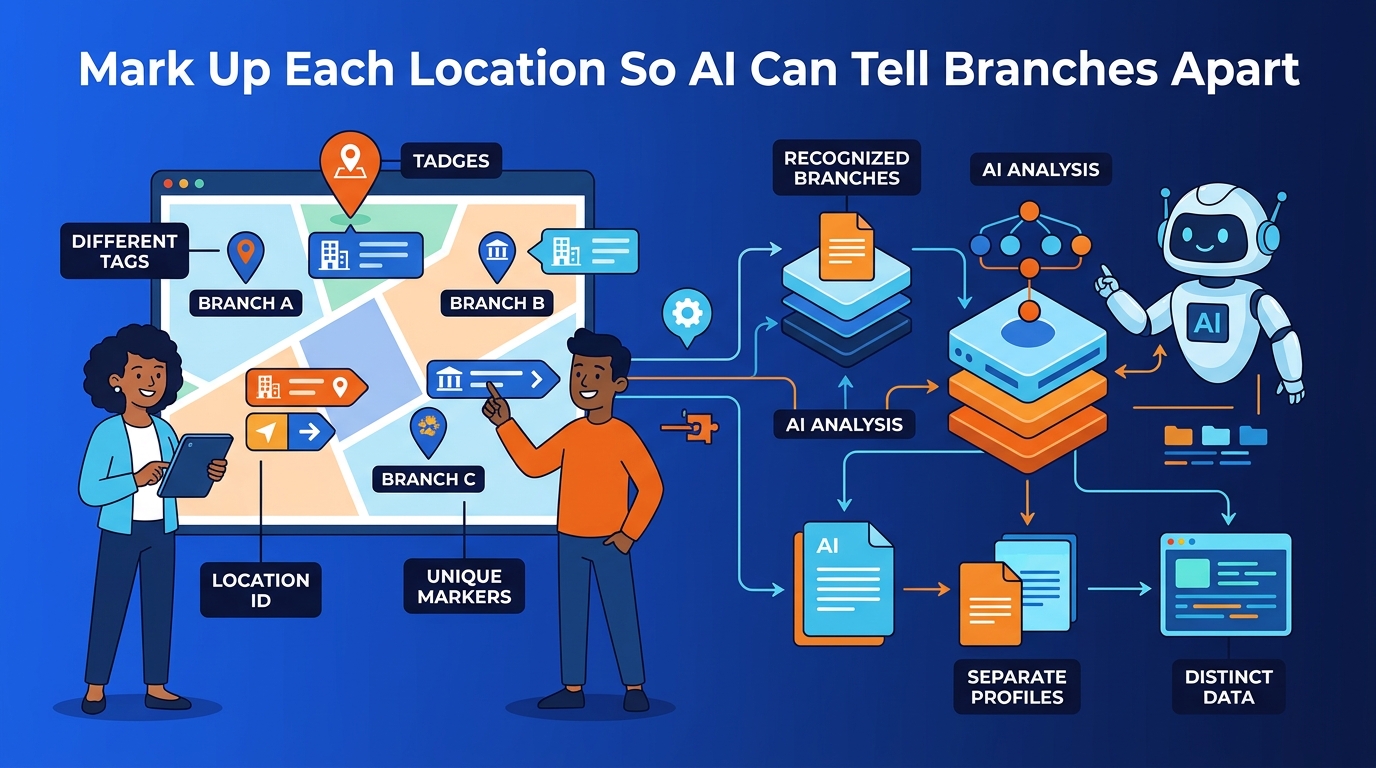
Here’s how I see it.
Getting picked by AI answer tools is its own discipline. It’s not the old search work with a new name.
I don’t chase keywords. I don’t chase inbound links. I don’t chase ranking position.
I help these systems work out who a company is and whether it’s credible. So I mark up each branch to make that easy for them.
Schema App’s How-to Guide for LocalBusiness Schema Markup is the base for this part.
Structured data makes it easier for AI to pull together facts about your business.
Your site needs a strong technical foundation. And it has to give AI consistent metadata it can understand.
In general, Google suggests using whichever format is easiest for you to set up and keep up. In most cases, that’s JSON-LD. All three formats are equally fine for Google, as long as the markup is valid and set up correctly according to that feature’s documentation.
The table below shows what Schema App advises. It covers the markup elements in this section.
| Element | What Schema App Advises |
|---|---|
| Structure when each location has its own page | Separate LocalBusiness item per location page, linked back to the main Organization item via parentOrganization or branchOf |
| Structure when other locations are also listed on the homepage | Select the Organization’s subOrganization property and create LocalBusiness markup for each location |
| Address property | Required; the physical location of the business; include as many properties as possible |
| URL property | Fully qualified, working URL for that specific location |
| Latitude | A number, precise to at least 5 decimal places |
| Name property | The business name as it appears in your directory listings (NAP) |
Use a Separate LocalBusiness Item Per Location Page
If each location has its own page, make a separate LocalBusiness data item for each location page. Then, from each one, use the parentOrganization or branchOf property to link back to the main Organization data item.
If your homepage also lists your other locations and their addresses, select the Organization’s subOrganization property. Then create LocalBusiness markup for each of those locations.
Schema.org defines a LocalBusiness as one particular physical business. Or a branch of an organization.
Its examples? A restaurant. A particular branch of a restaurant chain. A branch of a bank. A medical practice. A club. A bowling alley.
Adding organization structured data to your home page can help Google better understand your organization’s administrative details and tell your organization apart from others in search results.
Set Address, URL, Geo and Matching Details for Each Branch
- Address. The physical location of the business. It is required. Fill in as many properties as you can.
- URL. The fully qualified web address of that one business location. Unlike the @id, this should be a working link.
- Latitude. A number giving the latitude of the business location, precise to at least five decimal places.
- Name. Your business name as it appears in your directory listings (NAP).
- sameAs. This asks for other pages on the web that represent the same thing. Link to the social media accounts or directory listings shown on the page.
Schema.org adds one more thing.
The sameAs property also relates a thing to a page that indirectly identifies it. It emphasizes well-known pages.
The mainEntityOfPage property does a different job. It makes clear which of several entities is the main one on that page.
Test Each Location’s Structured Data Before Publishing
Check your code with the Rich Results Test. Fix any critical errors.
The Schema Markup Validator checks your Schema.org syntax. It does not show whether you are eligible for rich results.
One study traces these errors to three causes. Missing guidelines. Insufficient expertise. Technical or human slip-ups.
Where AI Draws Local Data and What Patients Check Next
Here’s how SOCi’s list of sources breaks down.
Google Maps makes up about a third (32.5%). Multiple niche sites together make up about a quarter (26.3%). Brand websites are almost a quarter (23.1%). Yelp is about 1 in 10 (10.5%). Facebook is less than 1 in 10 (7.6%).
Brand websites are the third-largest source. And the only one on this list a brand fully owns.
I’d rather my clinics be the source AI names and draws on. Not a line in a directory.
I rank being relied on above merely being present.
That’s why I build each brand-owned local page as a source for AI to cite. SOCi explains how to keep those pages found and cited in Dynamic Local Pages.
Whitespark’s 2026 Local Search Ranking Factors says local page and link signals drive about 57% of local organic visibility and 37% of AI search visibility, outweighing other factors.
Here’s what Yext’s 2026 consumer research found.
Only 5 in 100 (5%) AI users act on a recommendation without any additional research. The other 95% verify. Across multiple channels at once.
After an AI recommendation, about 6 in 10 (62%) immediately search Google for more. Almost 6 in 10 (58%) visit the business’s website directly. About half (52%) click through to the sources the AI cited.
What moves AI to name a clinic from outside town is covered in What Proof Convinces AI to Recommend an Out-of-Town Clinic?
Yext also found that review signals make up five of the top six purchase influencers.
Star ratings. Review recency. Review sentiment.
They consistently rank above price, proximity, and brand familiarity.
Frequently Asked Questions
How many consumers already use AI to find a local business?
About half (52%) of U.S. shoppers. SOCi found they used an AI tool to find or research a local business in the last 30 days. That’s up 6 times (6X) from 2025.
Yext’s 2026 Consumer Search Behaviors Report backs it up. It surveyed 3,848 consumers globally. Nearly half of all U.S. adults used an AI tool to find a local business in the past month.
Does it matter that AI gives a different answer each time the same question is asked?
It means no single answer is fixed. AI tools are probabilistic rather than deterministic. Even when the same question is asked repeatedly, the model may give different answers each time.
Why do AI visibility studies count appearances instead of rank position?
In SOCi’s study, AI responses varied in length and order, so the researchers did not track rank position. For each query, they asked the AI tool to recommend 10 businesses, and checked only whether the target brand appeared within the first five.
What happens when a clinic’s information is missing online?
People leave. SOCi reports that almost two out of three people (63%) say they have walked away from a local business because of missing information.
What does letting location pages go stale cost?
About a fifth (around 20%) of your site visits.
That’s what content decay is estimated to cost pages, according to a figure SOCi cites.
Distinct Data for Each Clinic Is What Sends Patients to the Right Branch
Give each clinic its own matching details. Its own page. Its own markup.
Then AI can tell the branches apart. And that’s what lets it send a patient to the right one.
Seeing this led to iTech Valet’s AI Authority System.
It’s a data-first method. It makes service businesses the recommended answer in ChatGPT, Gemini, and Grok.
The Local AI Authority Engine is our main service.
How the work is done is laid out on iTech Valet Service Plans & Pricing.
I won’t choose who runs multi-location work on monthly price.
A cheap agency retainer buys thin work. Little real progress. A contract that builds nothing. I count that as the more expensive deal.
I also refuse to sell the old search playbook. Many agencies still offer it.
I see it as tactics aimed at a results page that’s gone. That’s a flaw in the industry’s offer.
So I build our work for the conditions AI created instead.
Want to see how AI reads your clinics today? Run My AI Visibility Check.