Why Your Agency's Old Scorecard No Longer Predicts AI Visibility
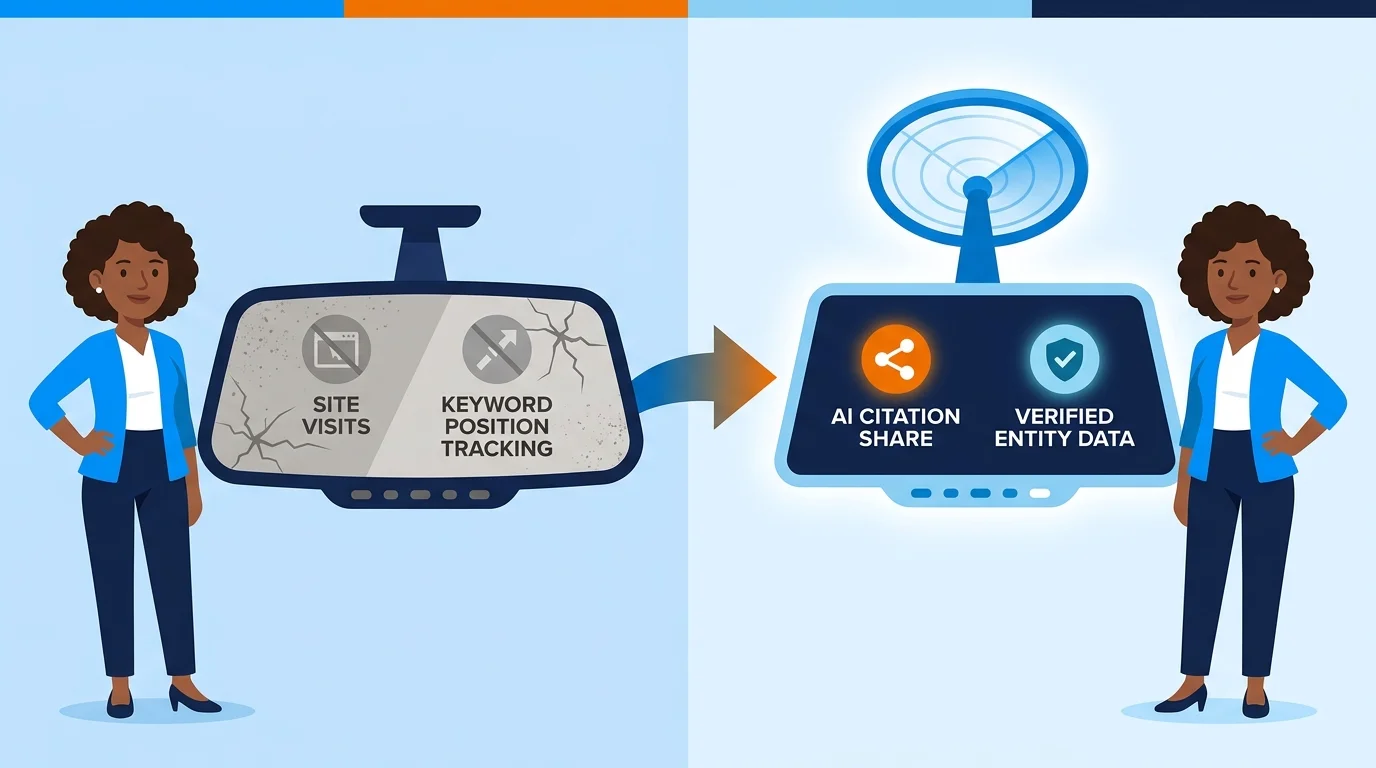
Generative AI changed the agency relationship, whether your agency admits it or not. The scorecard they've used for years — keyword position tracking, site visits reports, backlink counts — was built for a world where a human typed a query and scrolled through ten links.
But that world is shrinking fast. AI Overviews now show up on 20.5% of all keywords, so a growing chunk of the queries your agency once optimized for never produce a scrollable list at all.
So the question isn't whether the old scorecard is accurate. It's whether it still measures the moment your customer actually finds you.
Here's the thing: a report full of historical position tracking can look impressive and still miss the whole event. If your facts never get pulled into the answer an AI system builds, that position tracking never mattered.
| Old Scorecard Metric | What It Actually Measures | AI-Era Replacement Metric |
|---|---|---|
| Keyword position tracking | Where a page lands in the classic ten blue links for a given search term | Citation frequency inside AI-generated answers across the queries your customers actually ask |
| Site visits | How many people clicked through to a page from a search results screen | Whether your business's verified facts get pulled into an AI-generated answer at all, whether or not a click ever happens |
| Acquiring inbound links | How many external sites point back to your website | How consistently your business's structured entity data matches across every platform an AI system draws from |
| Backlink counts | Raw volume of referring domains, treated as a proxy for authority | Whether your name, location, credentials, and services are recorded identically everywhere, not just linked to often |
What Consumers Are Actually Doing Before They Call You
Consumers already moved. Nearly six in ten U.S. consumers now lean on AI-generated summaries at least some of the time when they search online, a shift confirmed by published research data tracking behavior across the broader population.
And that reliance runs even heavier among younger buyers. It shows up everywhere service businesses live or die on first impressions, which is exactly why phone calls dropping while competitors dominate AI search has become its own diagnosable symptom instead of a coincidence.
The Metrics Your Agency Reports Versus the Metrics That Matter Now
Look at what your agency actually hands you at the end of each month. Most reports still center on keyword position tracking, site visits, and acquiring inbound links — numbers built to describe a search results page, not an AI-generated answer.
None of those numbers tell you whether your business got cited, recommended, or left out of a generative answer. That gap is confirmed by Search Engine Journal's reporting on how often AI-generated results now show up instead of traditional listings, which is exactly the metric your agency's scorecard was never built to track.
The Traditional Search Optimization Playbook Is Failing Your AI Visibility
The old playbook is failing for a simple reason: it was built to win a contest generative engines don't run anymore. It fought for a spot inside a list of ten links, not for a citation inside a synthesized answer.
And that difference isn't cosmetic. Here's the thing: an agency can still win the old contest and lose the new one completely, handing you placements no AI assistant ever reads.
So this isn't a performance gap you close by grinding harder at the same tactics. It's a mechanism gap. Those tactics were never built to feed a generative model's retrieval process, and repeating them louder fixes nothing.
Why Placing in the Classic Ten Blue Links No Longer Guarantees You're Seen
Placing in the classic ten blue links assumed a human would scroll, compare, then click. That assumption is now shaky for a big and growing share of queries, because generative engines answer you straight instead of handing back a list.
Generative models don't read a results page the way you do. They pull fragments from across the web, weigh them, and stitch an answer together — and accuracy under that kind of pressure is far from a sure thing.
And that fragility isn't a hunch. It's measurable. In one test, GPT-4 got zero-shot prompts to pull answers straight from SQL databases, and its accuracy rate landed at just 16%, according to published trade reporting on how these models hold up outside controlled conditions. If a model fumbles that hard retrieving from a structured database it can query directly, it's got even less room for error pulling loose, inconsistent facts about your business off the open web.
What Verified Digital Identity Actually Means to an AI Engine
Verified digital identity isn't a slogan an agency drops in a deck. It's the exact set of facts about your business — name, location, credentials, services — held consistent and structured clearly enough that a retrieval system trusts them without guessing.
Here's what an AI engine actually knows about you: nothing. It only knows what it can retrieve, cross-check, and cite with confidence, which is exactly why messy, inconsistent listings get skipped for a competitor's cleaner data.
And this same failure pattern is already showing up in nearby industries. It's part of why referral-driven trust alone no longer protects a practice from disappearing out of AI search results — word of mouth builds your reputation with humans, not with the retrieval systems now sitting between your business and the customer asking the question.
The Five Questions That Separate a Data-First Agency From a Buzzword Agency
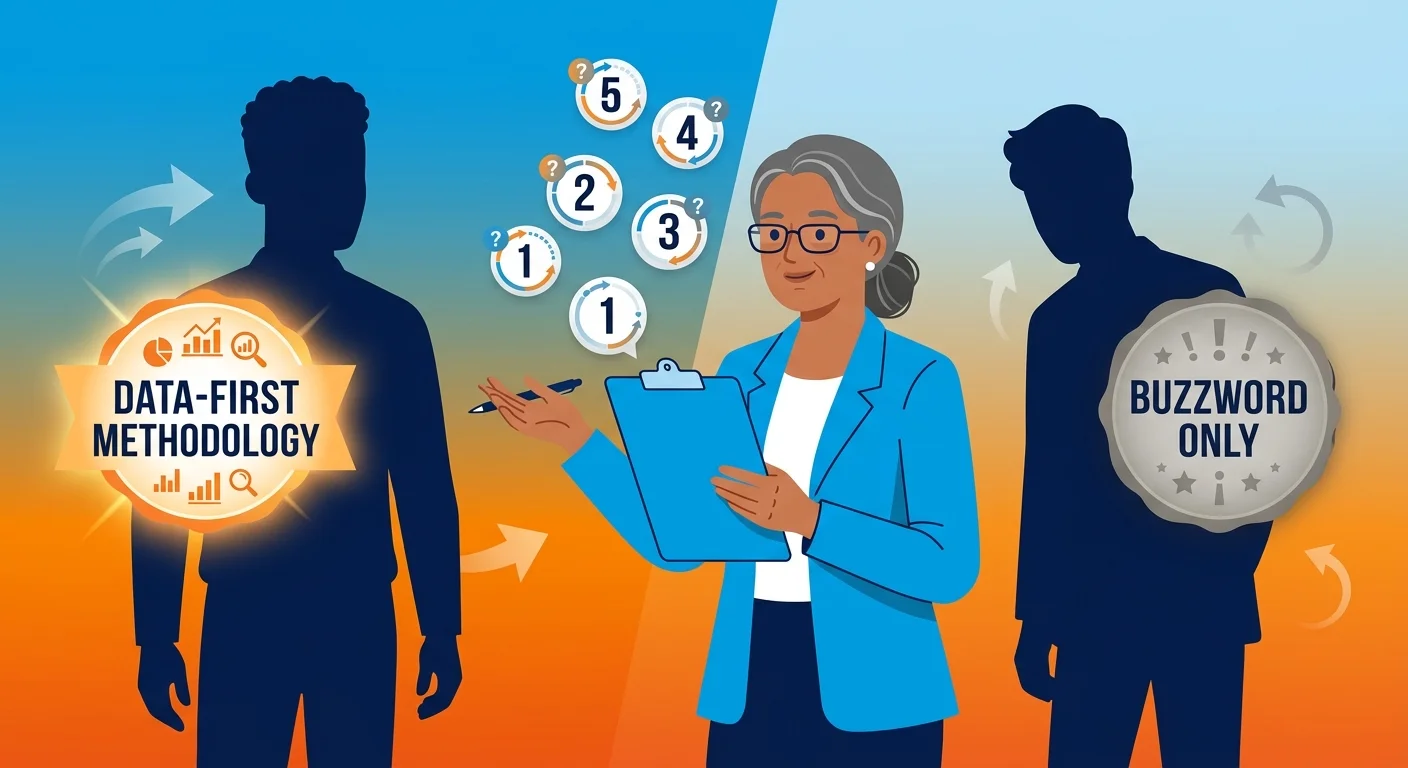
So here are the five questions that actually separate a data-first agency from one that just bolted AI onto its pitch deck. Ask them straight, and watch how fast the vague answers stop being vague.
An AI Recommendation Readiness audit isn't a checklist of tools your agency claims to use. It's a diagnostic of their methodology, and whether that methodology treats your business's facts as the product they're actually managing.
Knowing which questions to ask is how you separate the agencies running real AI-native strategies from the ones who slapped AI onto the same old service. The five questions below expose that difference fast, and one digs straight into how your agency handles RAG workflow design and implementation, the retrieval process a paper indexed in the ACL Anthology shows can be run several different ways, with real consequences for accuracy.
| Audit Question | Passing Answer Sounds Like | Failing Answer Sounds Like |
|---|---|---|
| What structured data types do you implement for our business facts? | Names specific data formats and points to exactly which pages and platforms carry them. | Says "we use AI tools" or "we're monitoring the AI space" with no named methodology. |
| How do you track our citation and mention performance inside generative answers? | Shows a citation or mention report and explains what it measures. | Hands over a keyword position tracking report and calls it coverage. |
| How do you keep our listings, directories, and knowledge panels consistent as one record? | Describes a defined process for auditing platforms against each other for consistency. | Cannot name which platforms they check or how often they check them. |
| Can you walk me through how a generative model would retrieve our business's facts? | Explains the retrieval mechanism step by step, including where it could break down. | Talks fluently about AI in general but cannot describe the actual mechanism. |
| What does your RAG workflow design and implementation actually look like for a client like us? | Describes a specific, repeatable process built around retrieval accuracy. | Gets defensive or redirects to a site visits chart when pressed on methodology. |
Reading the Answers: What a Passing Grade Looks Like and What a Failing One Sounds Like
A passing answer is specific. The agency names the exact structured data types they implement, points to the platforms they audit for consistency, and hands you a citation report instead of a keyword position tracking report.
A failing answer stays vague on purpose. "We use AI tools" or "we're monitoring the AI space" with no named methodology behind it? That's a signal, not a reassurance.
Here's the thing: a confident answer isn't the same as a correct one. Ask them to walk you through exactly how a generative model would retrieve your business's facts, and if they can't describe that mechanism, they never built for it, no matter how smooth the rest of the pitch sounds. That same gap in service businesses is what drives why some clinics quietly lose revenue while their AI-visible competitors capture it instead, because invisibility in a generative answer costs money whether or not anyone in the building has noticed yet.
This Audit Is Not for Agencies Chasing Vanity Metrics
This audit isn't for agencies still chasing vanity metrics dressed up as progress. If their proudest slide is a site visits chart with zero mention of citation performance, that's the answer right there.
And it's not for agencies that treat acquiring inbound links or keyword position tracking as the finish line. Those numbers describe a results page a shrinking share of your customers ever see.
It's also not for agencies that get defensive the second you ask them to name their methodology instead of their metrics. A data-first agency welcomes the interrogation, because they built their process to survive it.
Auditing the Technical Layer: Structured Data, Entity Consistency, and Retrieval Readiness
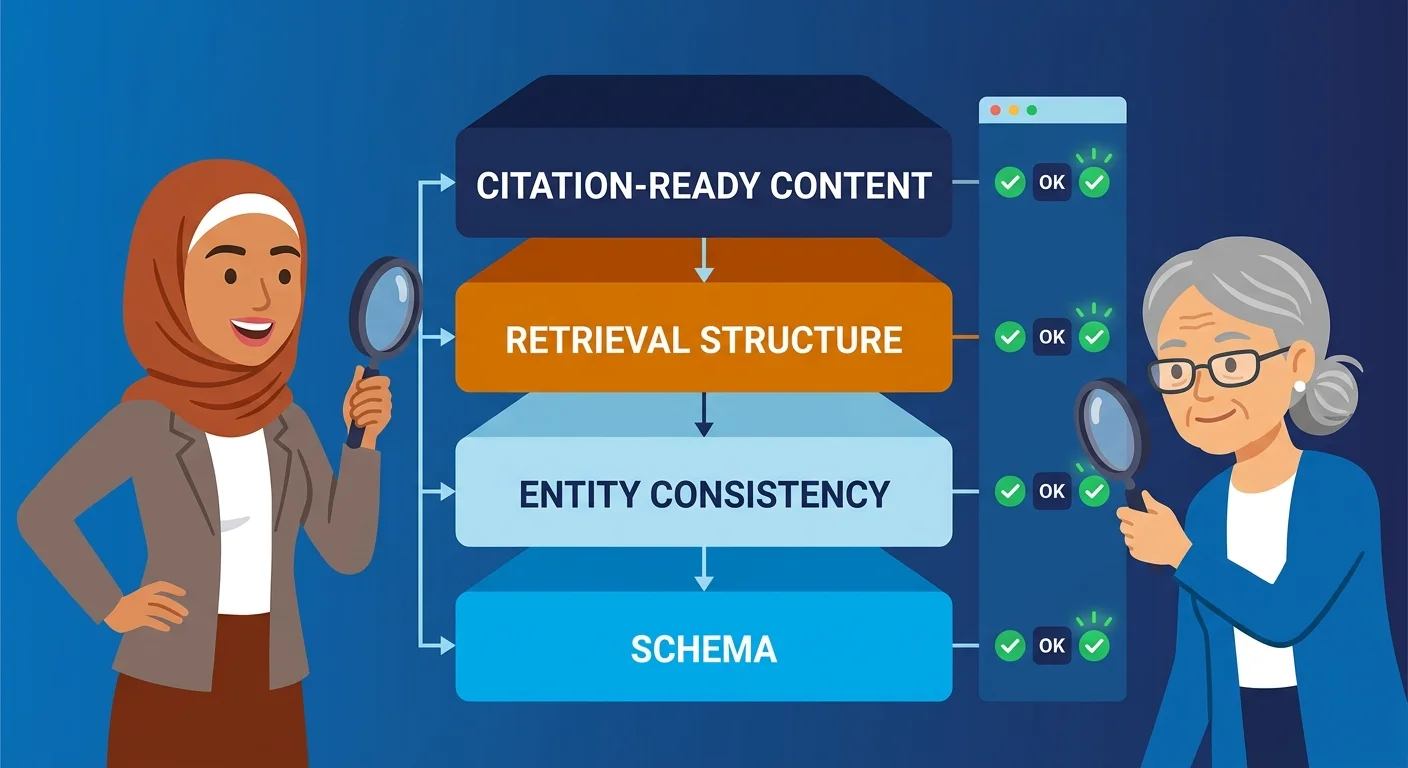
An audit that stops at agency behavior is only half done. Look underneath the reports and the meetings, and the real question turns technical: does their work actually produce facts a machine can read?
That's where structured data, off-site consistency, and retrieval design come in. These aren't abstract worries for some development team down the hall. They're the concrete artifacts this audit exists to inspect.
So this section gets specific. It walks through exactly what your agency should be building, and exactly what to check when they swear they already are.
| Technical Layer | What the Agency Should Be Managing | Evidence It's Being Done |
|---|---|---|
| Structured Data Markup | Standardized formatting on services, credentials, and location data so machines can parse the page instead of guessing at raw text. | The agency can show you exactly which markup types are implemented and where, not a vague claim that it exists somewhere on the site. |
| Off-Site Entity Consistency | One matching version of your business's name, address, credentials, and services across every directory, listing, and citation source. | A cross-platform audit report exists, and discrepancies get flagged and corrected on a defined cycle rather than discovered by accident. |
| Retrieval Readiness | Content and data structured so a generative model can retrieve your business's facts confidently instead of stitching together conflicting fragments. | The agency can walk through the retrieval mechanism step by step and point to specific pages built to be cited, not just read. |
| Governance and Maintenance | An ongoing process for catching drift as listings, credentials, or service details change across the web. | Change logs or update cadences exist, showing the agency treats identity data as maintained infrastructure, not a one-time setup task. |
Structured Data Isn't Optional Anymore
Structured data is a standardized format for describing a page's content in a way machines can parse, not just people. It's what lets AI systems and search tools read a business's information instead of guessing at it from raw text.
Google's own guidance makes this concrete in a related context: datasets get easier to surface in Google Search Central's documentation on Dataset Search once their name, description, creator, and distribution formats are provided as structured data. The same logic runs straight through your business's core facts.
If your agency isn't implementing structured markup for your services, credentials, and location data, they're leaving that interpretation to chance. A retrieval system forced to guess will often guess wrong, or skip your business entirely for a competitor whose data was labeled clearly.
Off-Site Consistency and the Retrieval Problem
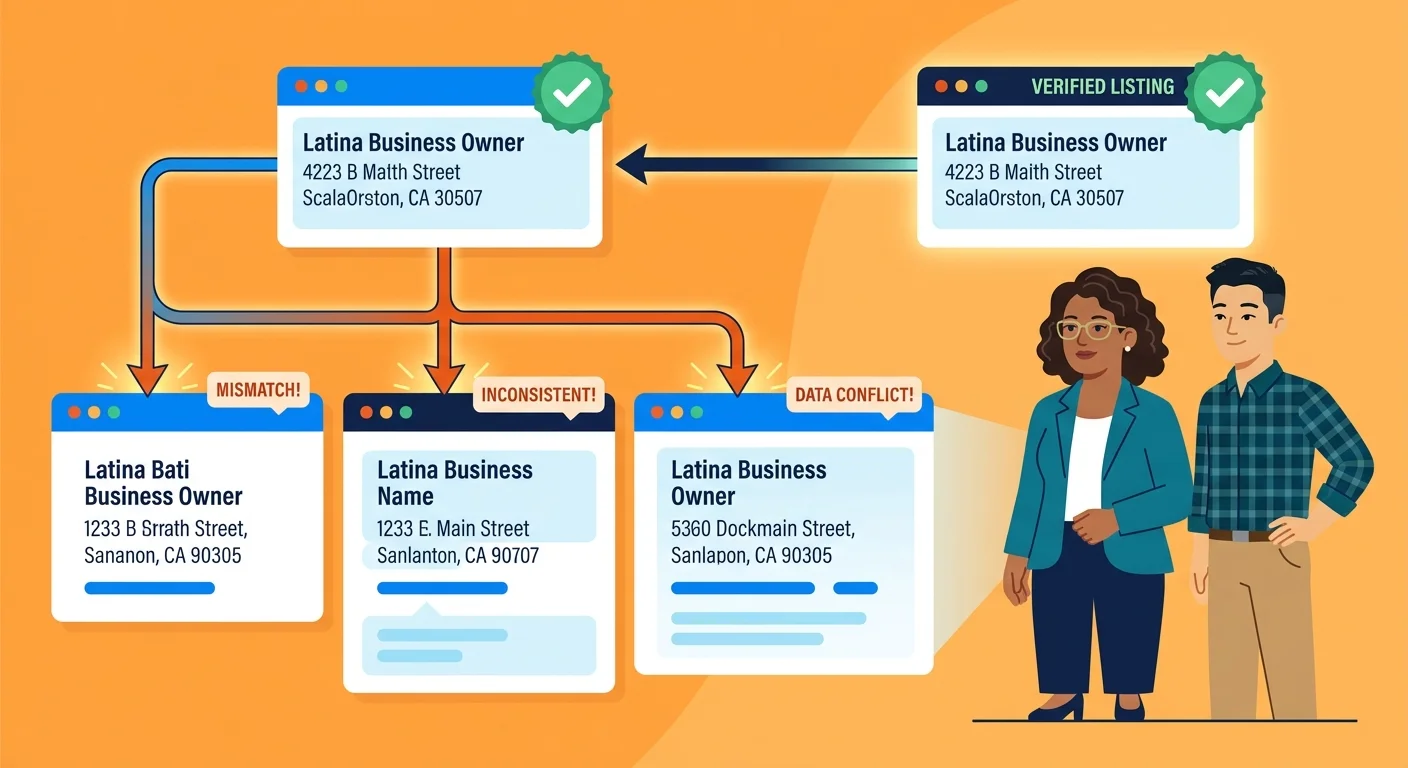
Structured data solves the on-site half. But a retrieval system doesn't stop at your website. It cross-references your listings, directories, and citations scattered across the open web.
Here's the thing: those fragments have to agree with each other. A generative model weighing three different versions of your name, address, or credentials has no reliable way to know which one is current.
This is exactly the mechanism behind how AI search engines decide which sources deserve authority in a generated answer, and it's worth understanding before you assume your agency has it handled. Remember the model that fumbled clean database queries earlier? Same fragility here, except the input isn't a tidy database — it's your business's identity, scattered across a dozen platforms an unprepared agency never bothered to reconcile.
Frequently Asked Questions
So you've run the audit. Here are the questions that come up next, once you point it at your own agency.
What specific data points should I request from my agency to prove their AI readiness?
Ask for the exact structured data types on your site, the platforms they audit for listing consistency, and a citation or mention report. Anything short of named specifics isn't an answer. It's a red flag.
What are the most common red flags that a marketing agency is unprepared for generative AI search?
"We use AI tools" with no named methodology behind it? Clearest red flag there is. So is a reporting deck built entirely on site visits and keyword position tracking, with nothing about citation performance.
How does an AI readiness audit differ from a traditional marketing audit?
A traditional audit reviews tactics for placing in the classic ten blue links. This one reviews whether your agency treats your business's verified digital identity as the thing they actually manage.
My agency says they use AI. What specific tools and methods should a prepared agency use?
Look for structured data across your services and credentials, active reconciliation of your listings across platforms, and a documented approach to retrieval design. Named methodology beats named software every time.
If my agency fails this audit, what are the immediate first steps to take?
Don't book another tactics meeting. Get a straight read on where your business's facts stand today, starting with an honest look at your current digital identity.
How can I tell if my agency is focused on outdated metrics versus true AI visibility indicators?
Outdated metrics live on site visits and keyword position tracking, with no word on how your business gets cited. Real indicators track citation share and whether generative engines can even retrieve your facts correctly.
The Verdict: What Happens After the Audit
This was never a performance review. It was a diagnostic exam, run the way a doctor orders tests before naming the condition. The results confirm one of two things: your agency treats your business's verified digital identity as the product it manages, or it doesn't.
So here's the verdict. An agency still selling placement inside the classic ten blue links is diagnosing yesterday's illness. Generative AI is rewriting the deal between a business and its agency whether either side has clocked it yet, and one that can't name its structured data methodology already told you which side it's on.
Don't wait for a slower competitor to make that diagnosis for you. If the audit turned up vague answers where real methodology should've been, the next move isn't another meeting about tactics. It's a straight look at where your business's facts actually stand today, and you can start with an AI visibility check.