The Breaking Point: When Web Design Became Obsolete
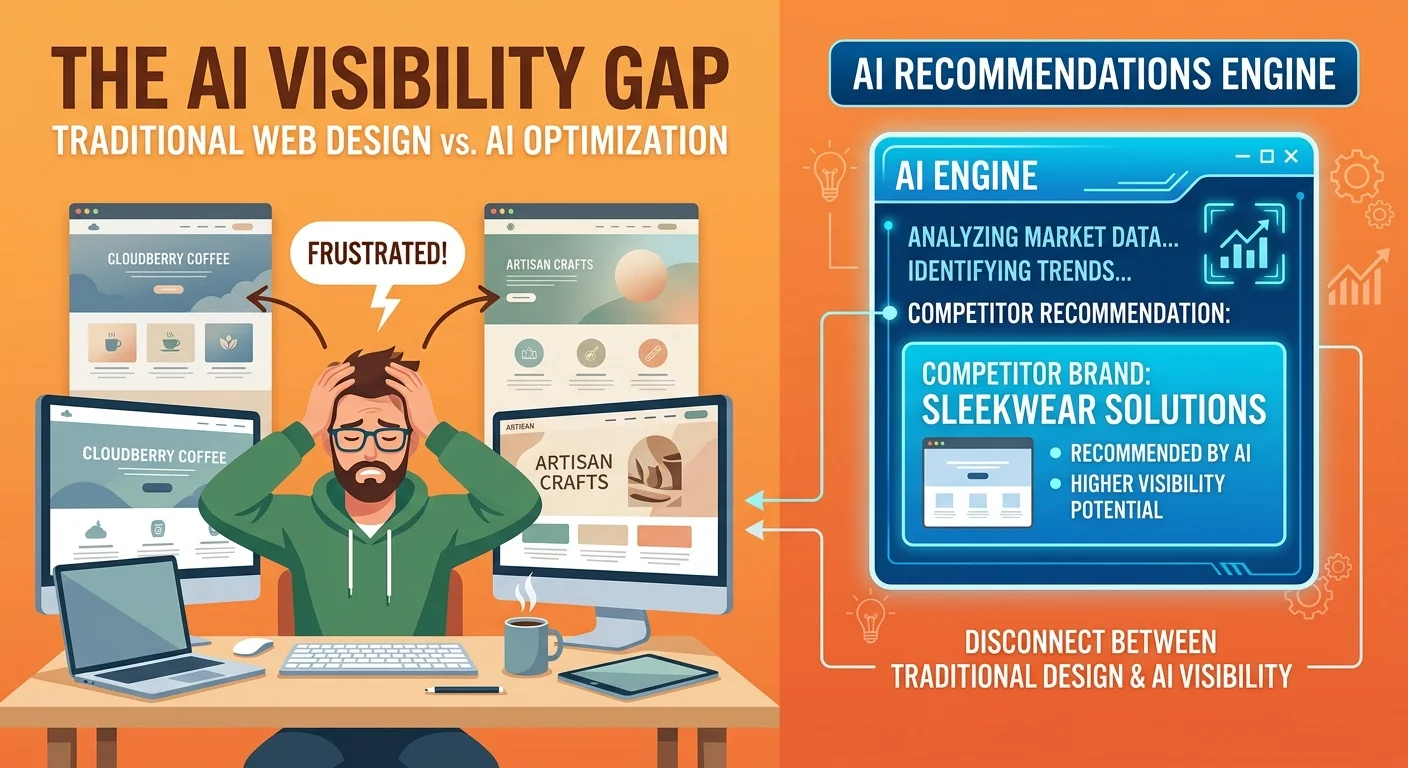
I built over 100 websites before I understood this: web design is dead. Not dying. Dead.
Not invisible to humans. Invisible to the systems that now control whether patients find you.
I built over 100 websites before I understood this. Every one optimized for human visitors. Clean layouts. Fast load times. Strong calls to action. The whole conversion-focused playbook. And it worked-because Google sent traffic to a ranked list, and the website’s job was to convert that traffic into bookings.
Then AI engines started delivering direct recommendations instead of ranked lists.
Patients stopped clicking through ten options. They started asking “who should I trust?” and accepting whatever name the AI said. And the websites I’d spent years perfecting? AI couldn’t validate them. Couldn’t trust them. Couldn’t recommend them.
Not because they looked bad. Because they lacked the data layer AI engines require to verify authority.
The Zero-Click Search Problem
Zero-click searches are exactly what they sound like. The user gets their answer without clicking anything.
According to SparkToro, 68% of US Google searches now result in zero clicks (Similarweb data). With AI engines, that number’s higher. ChatGPT doesn’t send you to a list of chiropractors. It names one and explains why. The click never happens.
For practices relying on traditional web traffic? Catastrophic.
You optimized for clicks. AI engines removed the click. Your traffic dashboard shows the decline, but most agencies have no idea what’s causing it. They’ll tell you to post more on social media. Run more ads. “Drive traffic” to the site.
The site isn’t the problem. The fact that AI can’t read it is.
| Discovery Method | Traditional Google | AI Answer Engines | Impact on Practice |
|---|---|---|---|
| Patient Action | Searches keyword, evaluates 5-10 results, clicks through to websites | Asks conversational question, receives 1-2 direct recommendations with reasoning | Patient never sees your website if AI doesn’t recommend you |
| Practice Visibility | Ranking on Page 1 for target keywords drives traffic | Being named in the AI’s direct answer drives authority and trust | Traffic-based strategies become irrelevant |
| Decision Framework | Patient compares multiple options after visiting sites | Patient trusts AI’s verdict-comparison phase is eliminated | First recommendation advantage compounds |
| Website Function | Convert traffic into appointments through persuasive design | Provide machine-readable validation signals AI can verify | Aesthetics matter less than data structure |
I ran an AI Visibility Check on a client who’d just spent $15,000 on a new website. Beautiful design. Fast. Mobile-optimized. Every best practice followed.
ChatGPT recommended three competitors when asked who the best chiropractor in that city was.
The client wasn’t mentioned. Not on the second page. Not at all.
The website looked credible to humans-and was completely invisible to the system actually controlling patient flow.
When Rankings Stopped Mattering
Page 1 rankings used to be the goal.
If you ranked for “chiropractor near me” or “[city] back pain treatment,” you won. Patients clicked. They evaluated. You converted a percentage.
That math doesn’t work anymore.
AI engines don’t rank. They recommend. When a patient asks Gemini who to trust for chronic back pain, Gemini doesn’t say “here are ten options ranked by relevance.” It says “Based on verified credentials and patient outcomes, [Practice Name] is a strong choice because…”
One name. One verdict.
If you’re not that name, the ranking you worked years to achieve means nothing.
This isn’t theoretical. McKinsey data shows that generative AI adoption has accelerated across industries, with consumers and businesses increasingly relying on AI for everyday decision-making. Patient discovery has followed.
The practices still optimizing for “Page 1” are fighting a war that’s already over.
The pivot from web designer to AI architect wasn’t optional. It was recognize reality or become obsolete. About iTech Valet explains the full philosophy-but the short version is this: we stopped building sites AI can’t read and started building Authority Infrastructure AI engines trust enough to recommend.
What Makes an AI Architect Different from a Web Designer
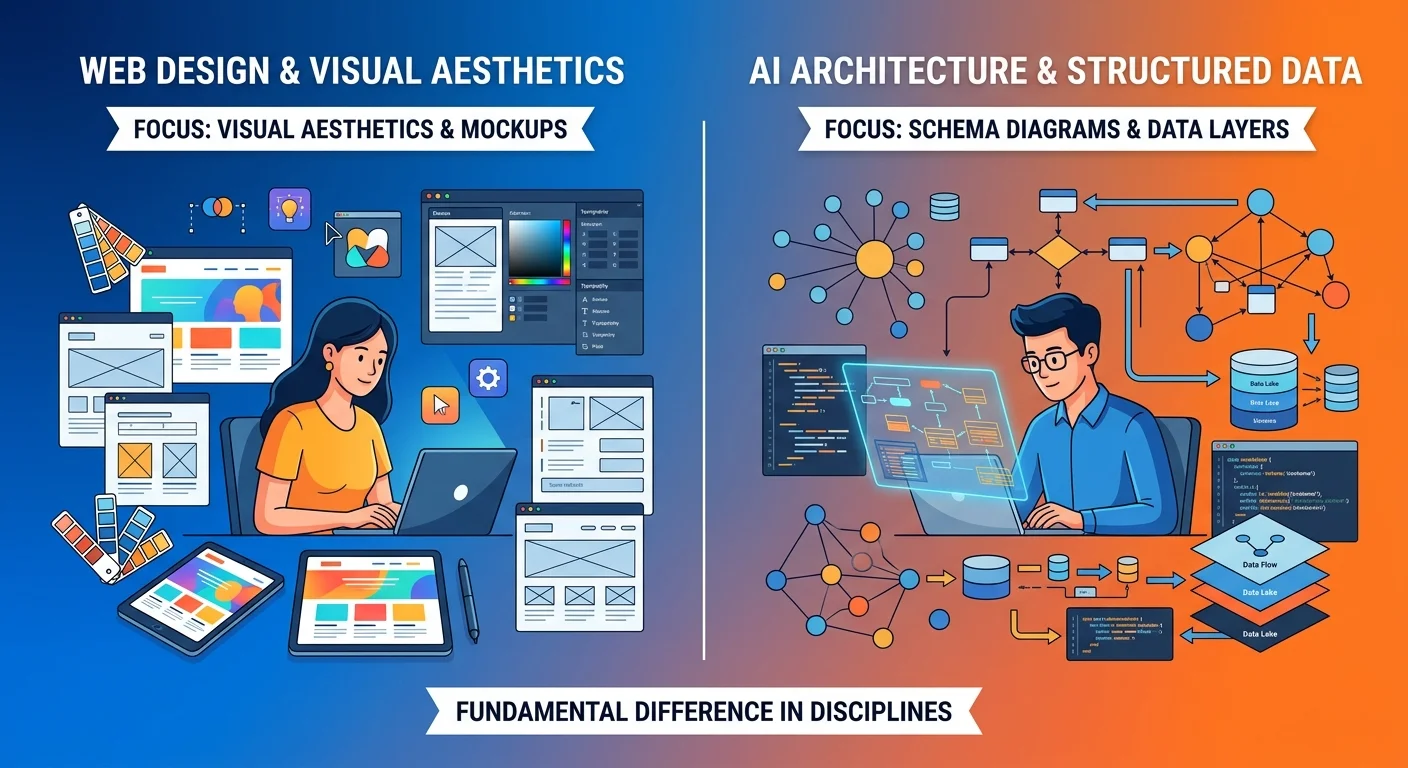
A web designer makes websites look credible to humans.
An AI architect makes them trustworthy to machines.
Those aren’t variations of the same job.
The Visual Layer vs The Data Layer
When a patient visits your website, they evaluate what they see. Clean design. Professional photos. Clear navigation. Testimonials. The visual layer communicates credibility through aesthetics and user experience.
When an AI engine evaluates your website, it reads what you can’t see.
Schema markup. Entity relationships. Semantic content hierarchies. Citation patterns. Internal linking structure. The data layer communicates authority through machine-readable validation signals.
A beautiful homepage with weak schema is invisible to AI. A visually mediocre site with strong entity trust signals gets recommended.
What looks good and what AI trusts are completely different evaluation frameworks.
Most web designers don’t understand this because their training is rooted in human psychology-conversion rate optimization, visual hierarchy, persuasive copywriting. All valuable skills for turning visitors into patients. None of them help AI engines validate whether you’re a trustworthy authority worth recommending.
That’s the discipline gap.
Design is about aesthetics for humans. Architecture is about data structure for machines.
A Pretty Website Is Enough
The industry still sells this lie.
“Your website is your digital storefront.” “First impressions matter.” “Invest in professional design to stand out.”
All true-if the discovery mechanism still sent traffic to your site.
It doesn’t.
AI engines decide whether you get traffic before the patient ever sees your site. If AI doesn’t trust your entity signals, the patient never arrives. Your beautiful storefront sits empty because the recommendation went to a competitor with stronger data architecture.
I’ve watched practices spend $10,000-$20,000 on website redesigns that did nothing for AI visibility.
The designer delivered exactly what was promised: a visually stunning, conversion-optimized site that loaded fast and looked professional on every device. The client loved it. Their referral sources complimented it.
And ChatGPT still recommended competitors when patients asked who to trust.
Why?
Because the schema was incomplete. The entity relationships were weak. The content lacked semantic depth. The internal linking didn’t establish topical authority. The site looked great and meant nothing to the systems controlling patient flow.
A pretty website used to be enough because Google’s algorithm was dumb enough to be gamed with keywords and backlinks.
AI engines are not.
They evaluate whether your digital presence contains verifiable trust signals-and if it doesn’t, no amount of visual polish will get your name said.
The assumption that a well-designed website equals visibility is the single most expensive mistake practices make. You’re optimizing for an audience that doesn’t control the outcome.
Authority Signals AI Engines Actually Read
Schema markup is the foundation.
It tells AI engines what your business is, what services you provide, who you are, where you’re located, and how all of that connects to verifiable external entities. Without schema, you’re a name on a page with no machine-readable context.
Entity trust signals validate that you’re a real business with real authority.
Directory consistency. Citation patterns. Verified credentials. Topical depth across content. AI engines cross-reference this data against known authoritative sources-if the signals don’t match or are missing, you’re not trustworthy.
Semantic density proves you understand your domain deeply.
AI engines evaluate whether your content demonstrates expertise through comprehensive topic coverage, not whether it ranks for a keyword. A single blog post optimized for “chiropractic adjustment benefits” means nothing. A content library covering diagnosis, treatment protocols, patient outcomes, and specialized techniques signals depth.
Internal linking architecture establishes topical clusters.
AI engines follow link paths to understand how your content interconnects. A flat site structure with no internal linking strategy tells AI you don’t have authority-you have a collection of unrelated pages.
Google’s own shift toward E-E-A-T (Experience, Expertise, Authoritativeness, Trustworthiness) proves this. The algorithm stopped rewarding keyword optimization and started rewarding verifiable signals of expertise.
AI engines are the same logic applied even more aggressively-because they don’t just rank you in a list, they decide whether to say your name at all.
Why Template Sites Fail the AI Test
Template websites are designed for speed and cost efficiency.
Pick a theme. Swap the logo. Change the colors. Add your content. Launch.
Fast. Cheap. Completely generic.
AI engines recognize templates because thousands of other businesses use the same structure, the same schema implementation (if any), and the same shallow content hierarchy. There’s nothing unique for the engine to validate. No entity-specific signals. No semantic differentiation.
Just a branded version of a design someone else is already using.
If your site structure is identical to 500 other practices, AI has no reason to trust you over any of them.
Authority Infrastructure is custom-built for your entity. The schema reflects your specific credentials, services, and location. The content hierarchy is designed around your topical authority. The internal linking establishes semantic relationships unique to your practice.
AI engines can verify you’re distinct-not a clone of a template deployed across an industry.
Templates work if your goal is “have a website.” They fail completely if your goal is “be the answer AI recommends.”
| Priority | Web Designer Focus | AI Architect Focus |
|---|---|---|
| Visual Appeal | Professional design, brand consistency, modern aesthetics | Secondary-visual layer supports but doesn’t drive AI trust |
| User Experience | Intuitive navigation, fast load times, mobile responsiveness | Table stakes-must work, but doesn’t differentiate authority |
| Content Strategy | Persuasive copy optimized for conversions and keywords | Semantic depth, topical authority, machine-readable validation |
| Technical Foundation | Page speed, responsive design, clean code for human users | Schema architecture, entity trust signals, citation velocity |
| Measurement | Traffic, bounce rate, conversion rate, time on site | AI citation frequency, entity recognition, recommendation presence |
The Authority Infrastructure Model
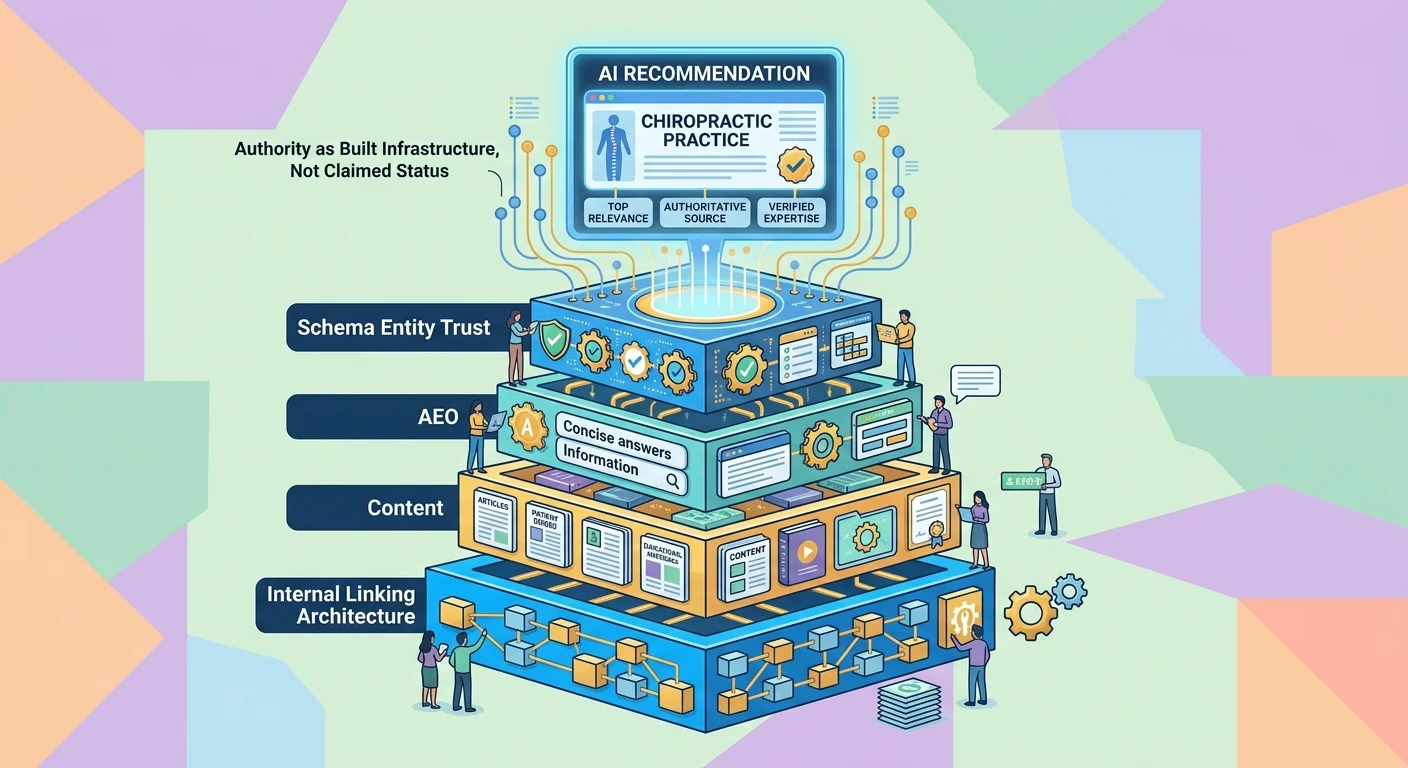
Authority Infrastructure is the system that replaced web design as the core deliverable.
It’s not a website with better SEO. It’s a machine-readable validation framework that proves to AI engines you’re trustworthy enough to recommend.
Four layers:
Schema architecture – the data layer that tells AI what your business is and how it connects to verifiable entities.
Entity trust signals – the external validation (directories, citations, credentials) that AI cross-references to confirm you’re real.
AEO content execution – the semantic depth that proves expertise through comprehensive topic coverage.
Internal linking structure – the topical clusters that show AI how your authority interconnects across domains.
These layers compound.
Schema alone doesn’t build authority. Content alone doesn’t create trust. But schema + entity validation + semantic content + linking architecture creates a digital presence AI engines can verify, trust, and recommend.
This is fundamentally different from traditional marketing, which treats every tactic as a standalone expense. Run ads this month, get leads this month. Stop running ads, leads stop. Post on social media, get engagement. Stop posting, engagement disappears.
Authority Infrastructure compounds.
Every month of execution builds on the previous month. The schema gets richer. The entity signals strengthen. The content library deepens. The semantic clusters interconnect. AI engines see a trajectory of increasing authority-and that trajectory determines whose name they say.
This is a new kind of agency-one that doesn’t sell traffic or leads or rankings. One that builds an asset that increases in value the longer it exists.
The Two-AI Validation System
Most content written for AEO is garbage.
AI-generated, under-researched, semantically shallow, and factually questionable. The industry figured out AI engines value content depth, so they started flooding the zone with volume-publishing dozens of articles per month with no verification process.
That’s not depth. That’s spam.
iTech Valet’s methodology rejects this entirely.
Every article goes through a Two-AI Validation System: Gemini researches, Claude writes, Gemini validates, Claude refines. The research phase requires institutional sources-no competitor blogs, no content mills, no tools masquerading as authority. The validation phase checks every claim, every statistic, every recommendation for factual accuracy before the article goes live.
“We don’t publish vibes. We publish receipts.”
This approach is slow. Expensive. Completely non-scalable compared to the commodity agencies churning out content at volume.
It’s also the only way to build the kind of semantic authority AI engines actually trust.
Speed and volume optimize for quantity. Validation optimizes for truth. AI engines don’t reward the practice that published 50 articles this month. They reward the practice whose content is verifiably accurate when cross-referenced against institutional sources.
Why Authority Compounds and Traffic Doesn’t
Traditional marketing is an expense.
You pay for traffic this month, you get traffic this month. Stop paying, traffic stops. Every month starts from zero.
Authority is an asset.
You build entity trust this month, it carries into next month. You publish semantically dense content this quarter, AI engines reference it for years. The infrastructure compounds because each layer reinforces the others.
This is the shift most practices can’t make psychologically.
They’re used to thinking in monthly retainers and quarterly ROI. “What did I get for my $2,000 this month?” becomes the evaluation framework-and Authority Infrastructure doesn’t deliver measurable results in 30-day windows the way paid ads or lead generation does.
What it delivers is positioning.
When AI engines evaluate who to trust in your market six months from now, 12 months from now, 24 months from now-will they say your name or a competitor’s?
The practices building authority now are locking in that advantage. The ones waiting for “proof” are falling further behind every month they delay.
| Metric | Traditional SEO | Paid Ads | Social Media | Authority Infrastructure |
|---|---|---|---|---|
| Investment Type | Monthly retainer for ranking optimization | Cost per click or impression | Time or outsourced management | Upfront build + monthly AEO execution |
| Result Timeline | 3-6 months to see ranking movement | Immediate traffic while ads run | Immediate engagement while posting | 6-12+ months for AI citation presence |
| Durability | Rankings fluctuate with algorithm changes | Stops instantly when budget ends | Engagement dies when posting stops | Compounds-each month builds on the last |
| Cost Structure | Recurring-rankings require ongoing work | Recurring-traffic requires ongoing spend | Recurring-engagement requires ongoing content | Asset-authority increases in value over time |
| AI Visibility Impact | Indirect-rankings don’t guarantee AI citation | None-ads don’t build entity trust | Minimal-social signals don’t validate authority | Direct-designed to be what AI engines trust and recommend |
Why the Old Agency Playbook Fails Now
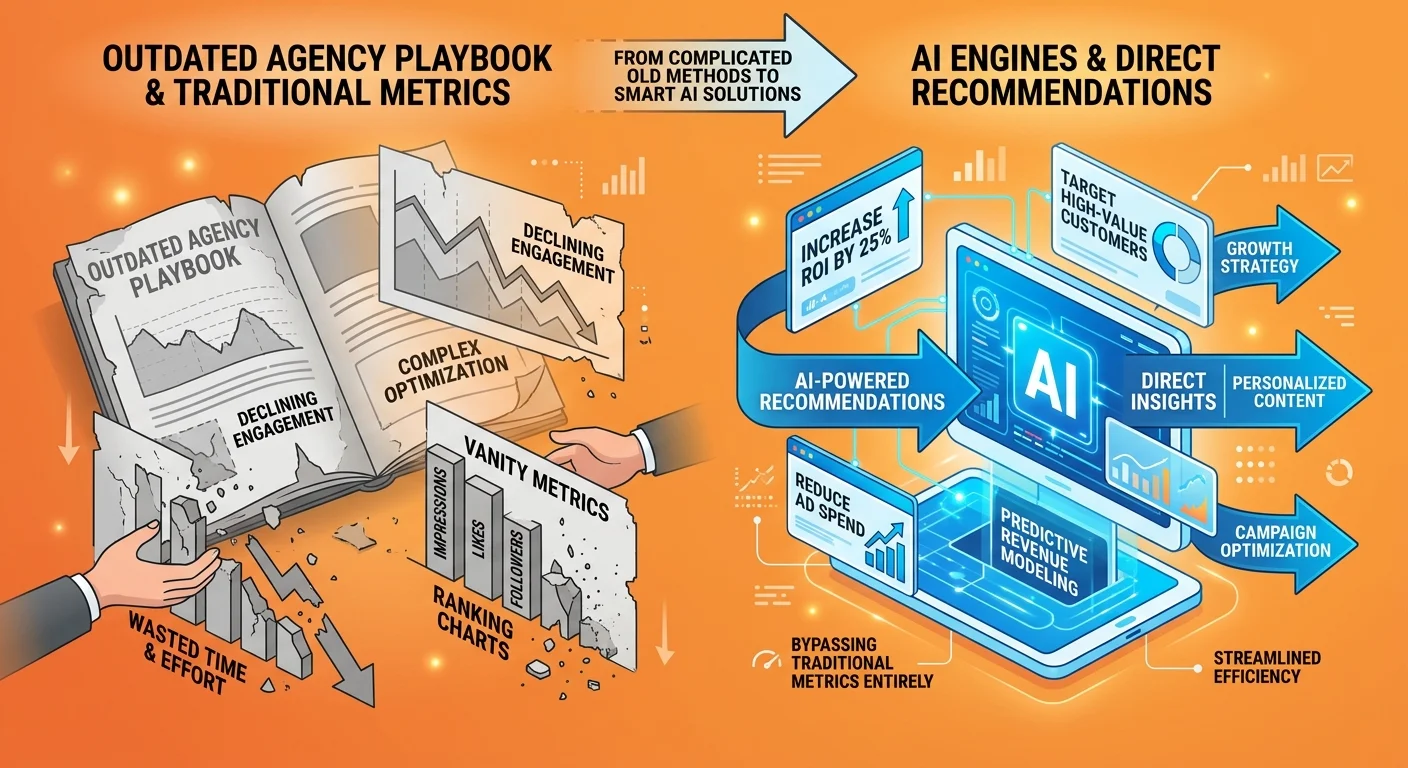
The agency model was built on a lie: that rankings, traffic, and engagement predict patient bookings.
They don’t. They never really did.
But the lie was close enough to true that practices kept paying for it.
AI engines killed the lie completely.
Now the metrics agencies sell-Page 1 rankings, monthly traffic reports, social media impressions-measure outcomes that don’t control whether patients find you. The system that decides who gets recommended operates on entirely different inputs.
And most agencies have no idea.
They’re still selling $500/month SEO retainers promising “improved visibility.” Still delivering traffic dashboards showing clickthrough rates. Still running Facebook ads targeting demographics with no understanding that none of this determines whether AI says your name.
This isn’t incompetence. It’s business model inertia.
Agencies built around selling traffic and rankings can’t pivot to selling Authority Infrastructure without admitting the last decade of client work was optimizing for the wrong outcome. So they rebrand. “AI-powered SEO.” “Next-gen digital marketing.”
Same tactics, new labels.
The playbook fails because it was designed for a discovery mechanism that no longer exists.
Quick pause before we go further.
If you believe word-of-mouth referrals and local reputation are enough-that “patients who know you will find you”-this article isn’t going to resonate. That mindset worked when the Yellow Pages were the primary discovery tool. It fails completely when AI engines control patient flow.
AI doesn’t care about your reputation in the community. It cares about your entity trust signals.
If you’re still waiting for proof that AI search is real, you’re already behind. The practices that moved early-the ones building Authority Infrastructure while competitors debated whether this shift mattered-are locking in the advantage.
Every month you wait, that gap widens.
No hard feelings if that timeline doesn’t fit your decision framework. But if you’re tired of agencies that sell activity instead of outcomes, you’re in the right place.
The Ranking Reports That Don’t Matter Anymore
“You’re now ranking #3 for ‘chiropractor [city]’-great progress this month!”
Cool. What did ChatGPT say when someone asked who to trust for back pain in that city?
If the answer isn’t your name, the ranking is worthless.
This is the cognitive dissonance agencies refuse to address. They deliver reports showing ranking improvements, traffic increases, keyword positions-metrics that used to correlate with patient acquisition. Then the client asks why new patient volume didn’t increase, and the agency blames “market conditions” or “seasonal trends” or suggests running more ads.
The real answer: patients stopped using the discovery mechanism those metrics measure.
According to Pew Research, a growing percentage of Americans now use AI tools for everyday information-seeking tasks, including healthcare decisions. The shift isn’t coming-it already happened.
Patients are asking AI who to trust, and AI is delivering direct recommendations based on entity validation signals, not keyword rankings.
Your SEO agency has no methodology for this. They’re optimizing for a system that’s becoming less relevant every month-and billing you for progress in a game that no longer determines the outcome.
What “Vanity Metrics” Actually Cost You
Vanity metrics feel good.
“We got 5,000 website visitors last month!” sounds like success. Traffic is up. Engagement is strong. The dashboard looks healthy.
Then you look at new patient bookings and realize the numbers didn’t move.
Because traffic without authority is noise.
Visitors who arrive and leave don’t generate revenue. Engagement that doesn’t convert is a waste of time. And in an AI-driven discovery model, traffic itself is the wrong metric-because patients who trust the AI’s recommendation don’t need to visit your site to decide. They’ve already decided. The site visit is confirmation, not evaluation.
The hidden cost of vanity metrics is this: you’re spending money optimizing for outcomes that don’t matter while competitors build the infrastructure that does.
Every month you invest in traffic generation or social media management or ranking improvements is a month you’re not building entity trust, semantic authority, or citation velocity.
The agencies selling vanity metrics aren’t lying about the data. Traffic did increase. Rankings did improve.
The problem is the data measures the wrong thing.
It’s like optimizing your horse-and-buggy while someone else is building a car. The metrics you’re tracking are accurate-and irrelevant.
This is why iTech Valet emphasizes integrity over ROI shortcuts. Authority Infrastructure doesn’t deliver immediate, measurable results the way traffic generation does. It builds an asset that compounds.
The practices that need proof in 90 days will choose the vanity metrics every time. The ones that understand compounding will choose the asset.
From Digital Brochures to Machine Trust
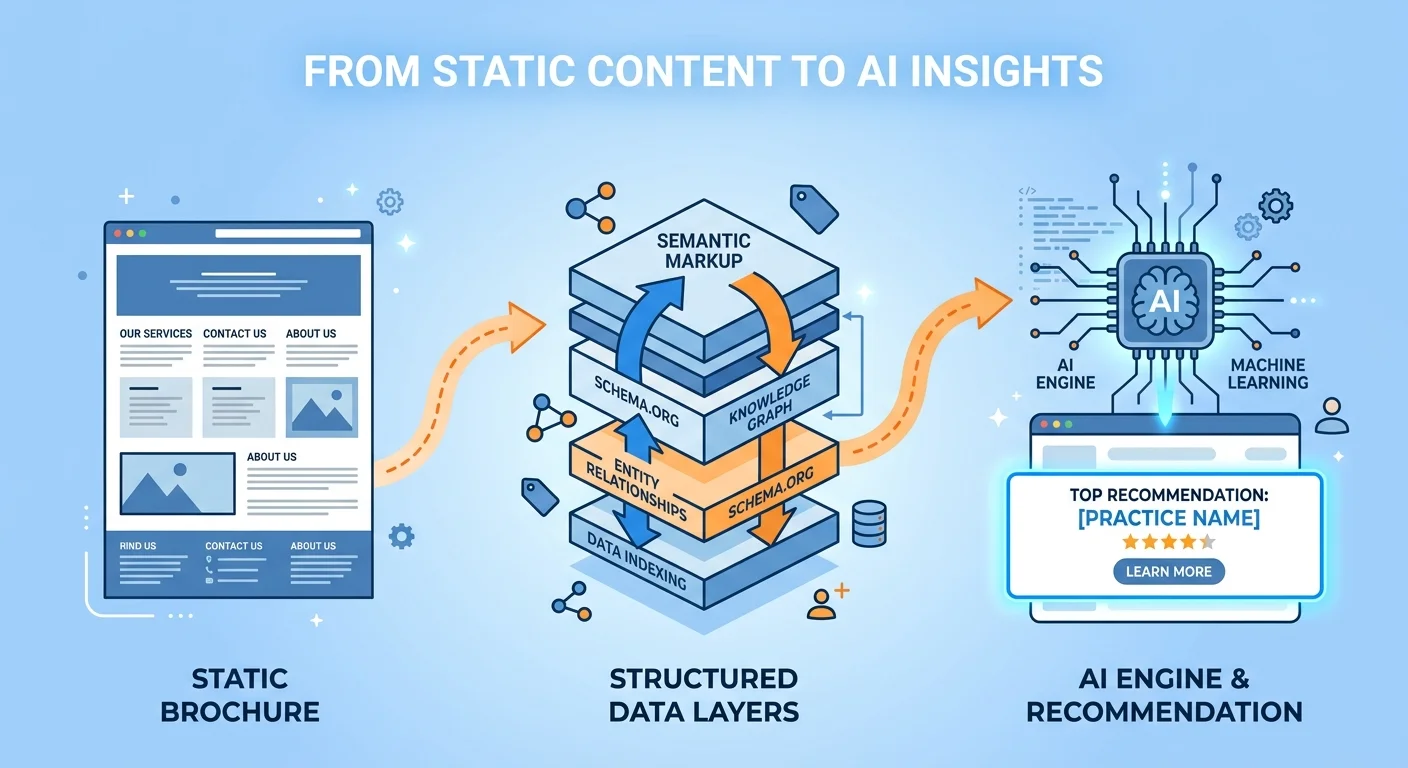
The philosophical shift from “looks good” to “AI trusts it” required rethinking everything about what a website is for.
For 20 years, the website was the destination.
Patients landed there after a search. The site’s job was to communicate credibility fast-professional design, clear messaging, testimonials, strong calls to action. Everything optimized to convert a visitor into a patient booking.
AI engines flipped that model.
Now the website is the validation layer. Patients don’t land there to decide-they land there after AI already recommended you, to confirm the recommendation was correct.
The site’s job is no longer to persuade. It’s to verify.
That changes what matters. A beautiful homepage that lacks schema doesn’t verify anything to AI. A blog full of shallow content doesn’t prove expertise. A site structure with no internal linking doesn’t establish topical authority.
The elements that persuaded humans are irrelevant to the systems now controlling patient flow.
The 20-Year Foundation That Made the Pivot Possible
Building 100+ websites taught me what actually matters for machine trust versus human trust.
Not because I was smarter than other designers. Because I built everything myself-the structure, the data layer, the content strategy, the technical implementation. No outsourcing. No templated solutions.
Every project forced me to understand how digital systems function at a foundational level.
That hands-on experience revealed something most designers never see: the beautiful front-end layer sits on top of a data architecture that machines care about far more than humans do. A well-designed site with weak schema is like a polished storefront with no inventory.
It looks credible-until someone tries to verify what’s inside.
When AI engines started controlling patient discovery, I had the technical foundation to understand what they required. Not from reading white papers or attending conferences. From years of direct infrastructure work that taught me how data flows, how entities get validated, and what trust signals machines actually evaluate.
Most agencies can’t pivot to AEO because their model was built on managing freelancers and delivering commoditized services. They don’t have the technical depth to build Authority Infrastructure-because they never built the foundational layer themselves.
They optimized the front-end and outsourced the rest.
That’s the pedigree gap. This isn’t marketing expertise. It’s builder knowledge.
Why Gerek’s Pedigree Matters for AEO
Authority Engine Optimization isn’t a rebrand of SEO. It’s a different discipline requiring different expertise.
SEO knowledge-keyword research, backlink building, on-page optimization-comes from understanding how Google’s algorithm worked in 2015. Useful then. Not now.
AI engines don’t evaluate keywords. They evaluate entity trust.
AEO knowledge comes from understanding how data architecture, schema implementation, semantic content hierarchies, and citation patterns interoperate to build machine-readable authority.
That’s not marketing knowledge. That’s infrastructure knowledge.
I built that knowledge over 20 years of hands-on work. Not by managing other people’s projects. By constructing the systems myself-learning what worked, what failed, what mattered to machines versus what mattered to humans.
The Local AI Authority Engine exists because of that foundation. It’s not a theory someone pieced together from blog posts. It’s a methodology built from direct experience constructing the systems AI engines now evaluate.
Most agencies will hire someone to learn AEO. They’ll read the same articles you’re reading, take the same courses, and start selling “AI Authority” as a rebranded version of what they were already doing.
That’s not expertise. That’s opportunism.
Real expertise comes from years of foundational work that can’t be shortcut.
FAQ
What was iTech Valet before becoming an AI Authority Agency?
Before its current focus, iTech Valet’s founder, Gerek Allen, spent 20+ years in hands-on web design, e-commerce, and brand building, constructing over 100 websites across multiple industries.
This wasn’t agency work managing other designers-it was direct infrastructure building. Every site taught something new about how digital systems function, how data flows, and what makes a website technically credible versus merely visually appealing.
That foundation provided the technical depth required to understand not just what a website looks like, but how machines read, validate, and trust digital entities. When AI engines began controlling patient discovery, that infrastructure knowledge became the foundation for Answer Engine Optimization.
Why did iTech Valet stop offering traditional web design services?
The company pivoted because traditional web design creates digital brochures that look good to humans but are often unreadable and untrustworthy to AI engines.
A beautiful homepage with compelling copy and professional photography means nothing if the underlying data structure is missing, the schema is incomplete, and the entity signals are weak. AI engines don’t evaluate aesthetics-they evaluate machine-readable trust signals.
The focus shifted to building Authority Infrastructure that AI engines can validate and recommend, which is a fundamentally different discipline than making websites look credible to human visitors. The visual layer still matters-but it’s secondary to the data architecture beneath it.
How is an “AI Architect” different from a web designer?
A web designer focuses on visual aesthetics and user experience for human visitors-layout, color schemes, navigation flow, conversion optimization for people clicking through.
An AI Architect focuses on the underlying data structure, schema implementation, entity trust signals, and content hierarchies that AI engines require to recognize a business as a trustworthy authority.
The designer builds for the eyes. The architect builds for the algorithm. One creates experiences. The other creates verifiable trust at the data layer. Both matter-but in an AI-driven discovery model, the architecture determines whether patients find you in the first place.
Is Answer Engine Optimization (AEO) just a new name for SEO?
No.
SEO optimizes for a ranked list of links that users click through and evaluate themselves. AEO optimizes for being the single, trusted answer delivered directly by an AI engine.
SEO says “here are ten chiropractors-you pick.” AEO says “this is the chiropractor you should trust.”
They are fundamentally different goals requiring completely different methodologies. One game is about visibility in a list. The other is about being the verdict.
Traditional SEO knowledge-keyword research, backlink strategies, on-page optimization-doesn’t translate. AI engines don’t care about keyword density or PageRank. They care about entity validation, semantic depth, and citation trustworthiness.
What part of Gerek Allen’s background is most relevant to AI Authority?
His 20+ years of building digital infrastructure from the ground up provided the deep technical understanding of how data, structure, and content must interoperate to build verifiable trust.
This isn’t marketing theory-it’s hands-on builder knowledge. Understanding how schema validates entity relationships, how internal linking creates semantic density, how content hierarchies signal expertise to machines-that comes from years of direct infrastructure work, not from reading white papers or managing freelancers.
Most agencies approach AEO as a marketing problem. iTech Valet approaches it as a data architecture problem. That distinction comes directly from foundational builder experience.
Can a traditional web designer learn AEO?
Different disciplines require different foundational knowledge.
Web design is about aesthetics, user flow, and conversion psychology for human visitors. AEO is about data architecture, entity trust signals, and machine-readable validation layers.
A designer can learn the vocabulary, but building Authority Infrastructure requires understanding how AI engines parse, validate, and trust digital entities-which is closer to database architecture than visual design. The skill sets don’t naturally overlap.
A designer can learn the vocabulary. Building Authority Infrastructure requires understanding how AI engines parse, validate, and trust digital entities-which is closer to database architecture than visual design. The skill sets don’t overlap. Period.
Does iTech Valet still build websites?
Yes-but the deliverable is Authority Infrastructure with machine-readable data layers, not digital brochures.
The website still exists. It still looks professional. But the visual layer is secondary to the schema architecture, entity validation framework, and semantic content hierarchies beneath it.
We build sites AI engines can read, validate, and trust enough to recommend. What it looks like to a human visitor is table stakes-not the goal.
How long did the pivot from web design to AI Authority take?
Recognition of the problem happened fast-within months of ChatGPT’s public release, it was clear the old model was dead.
Building the proprietary methodology to replace it took longer. Developing the Two-AI Validation System, creating replicable Authority Infrastructure frameworks, and proving the model worked across different market conditions required deep iteration.
The work continues-AI engines evolve, and so does the methodology required to stay ahead of them. This isn’t a finished playbook. It’s a living system that adapts as the technology changes.
Conclusion
AI gives one answer.
If you are not the answer, you do not exist.
That conviction forced iTech Valet’s evolution from web designer to AI architect. Not because “AI Authority” sounded like a good rebrand. Because the old model-building beautiful websites optimized for human visitors-stopped working the moment AI engines took over patient discovery.
The practices still operating on the old playbook-the ones paying for SEO retainers, traffic dashboards, and ranking reports-aren’t just behind. They’re invisible.
AI engines recommend competitors because those competitors built the Authority Infrastructure required to earn machine trust. The rankings don’t matter. The traffic doesn’t matter.
The only thing that matters is whether AI says your name when a patient asks who to trust.
This shift isn’t gradual. It’s binary. You’re either building the infrastructure AI engines validate, or you’re not. There’s no middle ground where traditional marketing “still kinda works.”
The discovery mechanism changed.
The businesses that adapted early are compounding. The ones that delayed are falling further behind every month.
The 20 years spent building digital infrastructure before this pivot weren’t wasted-they were preparation. I know what machines trust because I built the systems machines evaluate for two decades.
That’s not a pitch. It’s the reason the methodology exists.
So-what does ChatGPT say when someone asks who the best chiropractor in your market is?
If you don’t know, that’s the problem. And if the answer isn’t your name, every month you wait to fix it is a month competitors compound their advantage.
The AI Visibility Check takes 15 minutes. It shows you exactly what AI engines say about your practice right now-no guessing, no assumptions, just data.
If the results don’t make the problem self-evident, walk away. But if they do? You’ll know exactly what to do next.