Why Most Marketing Retainers Are Structured to Fail
The business model selling you that retainer agreement isn’t designed to build anything permanent.
It’s designed to justify a monthly fee.
The marketing agency industry figured this out decades ago. Selling hopium is more profitable than building assets. Monthly retainers keep the cash flowing. Reports keep clients placated. And the second you stop paying? Everything they “built” for you vanishes.
Because it was never yours to begin with.
Retainers are structured around activity. Not outcomes. If yours isn’t – you’re the exception, not the rule. Number of blog posts published. Keywords tracked. Reports generated. Social media posts scheduled. The deliverables sound impressive in the proposal. They’re just motion. Busy work creating the illusion of progress without actually moving the business forward.
The work exists to justify the invoice. Not to build something permanent you own.
The Activity Trap: Why Agencies Sell Tasks, Not Outcomes
Retainer contracts are written around deliverables.
Five blog posts per month. Three social media updates per week. Monthly analytics reports. Quarterly strategy calls.
Notice what’s missing?
Patient bookings. Revenue growth. Actual business outcomes.
That’s not an oversight. It’s intentional.
If the contract was built around outcomes, the agency would have to prove ROI every month. That’s harder than proving they published the content they said they’d publish. So they structure the agreement around what they can control – tasks – and avoid accountability for what actually matters.
You’re not buying results. You’re buying a to-do list someone else checks off while billing you $1,500 a month.
And when you ask why the phone isn’t ringing?
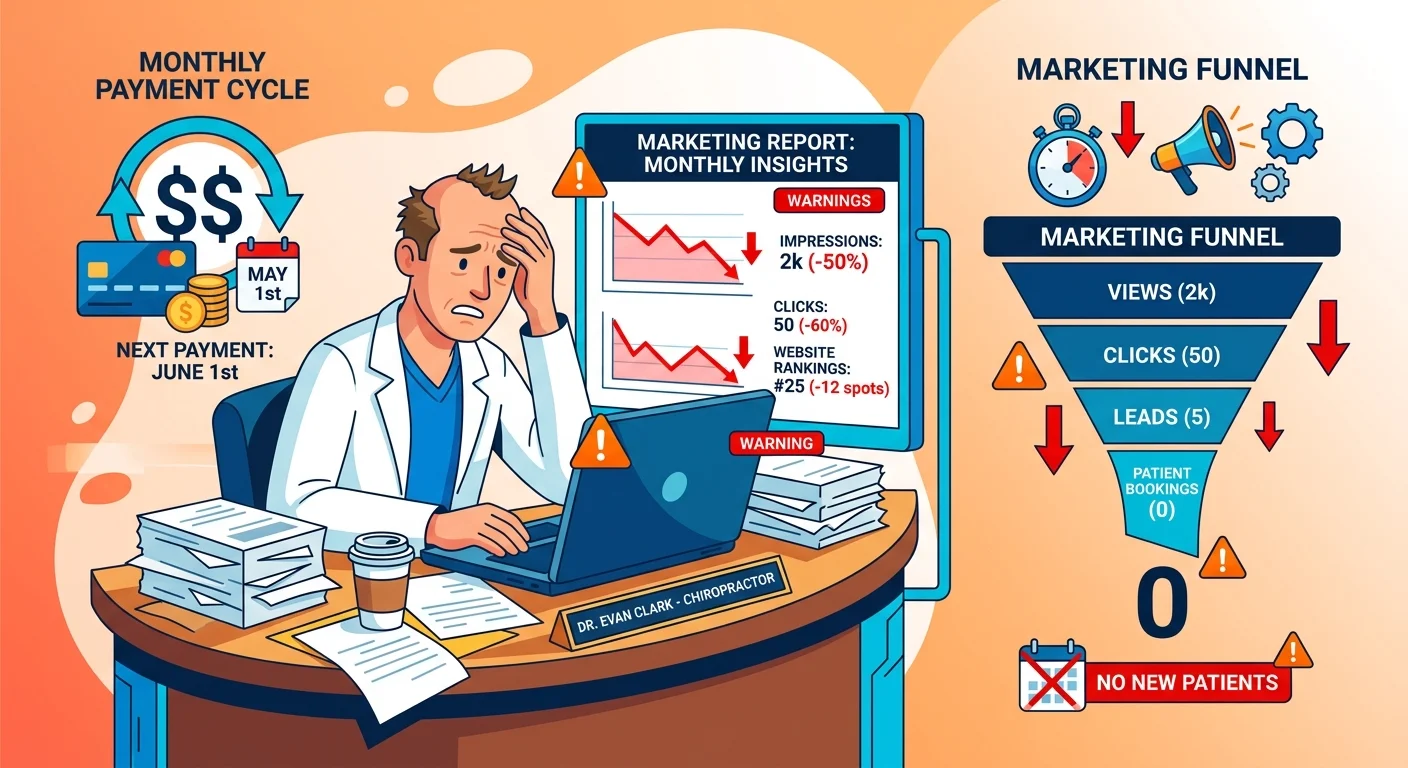
They’ll point to the reports. Traffic’s up. Impressions are climbing. Rankings improved for three keywords nobody’s searching for.
The numbers look like progress. Your schedule’s still empty.
That’s the activity trap. You’re paying for motion, not traction. Motion without direction is just expensive noise.
I built iTech Valet because I got tired of watching practices get sold this exact con every single month.
The Hopium Cycle: Reports That Look Like Progress
Every month, the report shows up in your inbox.
Page views are up 12%. Bounce rate dropped 3%. You ranked on page one for “chiropractor near me with evening hours.”
Looks like progress. Feels like progress.
But when you check the appointment book? Nothing changed.
That’s not a coincidence. That’s the design.
The retainer industry runs on vanity metrics. Traffic. Impressions. Rankings. Time on site. These numbers are easy to move. They’re also almost completely disconnected from whether anyone books an appointment.
According to HubSpot Research, the average B2B client-agency relationship lasts just 2.5 years. Churn is driven primarily by a lack of measurable business results despite consistent monthly spend.
Here’s why.
The metrics agencies track are designed to justify their existence. Not prove their value.
Traffic doesn’t book appointments. AI answer engines do. And AI doesn’t care how many people clicked through to your site last month. It cares whether your entity is trustworthy enough to cite when someone asks for a recommendation.
Retainers optimize for the wrong scoreboard. They’re chasing numbers that mattered in 2015 when Google still showed ten blue links and people clicked through to compare options.
That’s not how patients find chiropractors anymore.
Now they ask ChatGPT. Gemini. Perplexity. Those engines produce one answer. Not a list.
If you’re not that answer, the traffic report is irrelevant. You’re still invisible where it counts.
Why the Work Disappears When Payments Stop
Cancel a retainer and watch what happens.
The blog posts stop. The social media updates disappear. The “SEO work” they were doing – whatever that actually was – vanishes. And within 60 days, your rankings start sliding backward.
Not because you did something wrong.
Because the work they were doing was never designed to last.
Retainers optimize for temporary visibility. Paid ads run while you’re paying. Algorithmic SEO signals decay the moment someone stops feeding them. Content gets published but isn’t structured to compound in authority – it just sits there doing nothing because it was written to hit a keyword quota, not to build entity trust.
This isn’t a flaw in the execution. It’s the business model working exactly as designed.
If the work they did for you in month one still delivered value in month thirteen without ongoing payments, you wouldn’t need to keep paying them. So they build the model around dependency. Monthly spend for monthly value. Stop paying, lose the value.
You’re not building an asset. You’re renting one.
And the landlord keeps the keys.
| What You’re Comparing | Retainer Model | Partnership Model |
|---|---|---|
| What You Pay For | Monthly activity (posts, reports, rankings) | Permanent infrastructure + ongoing content execution |
| What You Own | Nothing (access ends when payments stop) | Authority infrastructure, entity signals, content library |
| What Happens When Payments Stop | All value disappears within 60-90 days | Infrastructure remains, authority persists, compounding stops |
The Retainer Model Optimizes for a Dying Ecosystem
Here’s the uncomfortable truth most agencies won’t tell you.
The retainer model they’re selling you was built for a version of the internet that’s being replaced in real time.
It was optimized for Google’s 2015 algorithm. Rank on page one. Get clicks. Drive traffic. Hope someone converts.
That playbook is dying.
And every month you spend paying someone to execute it, you’re funding work that’s becoming less effective by the day.
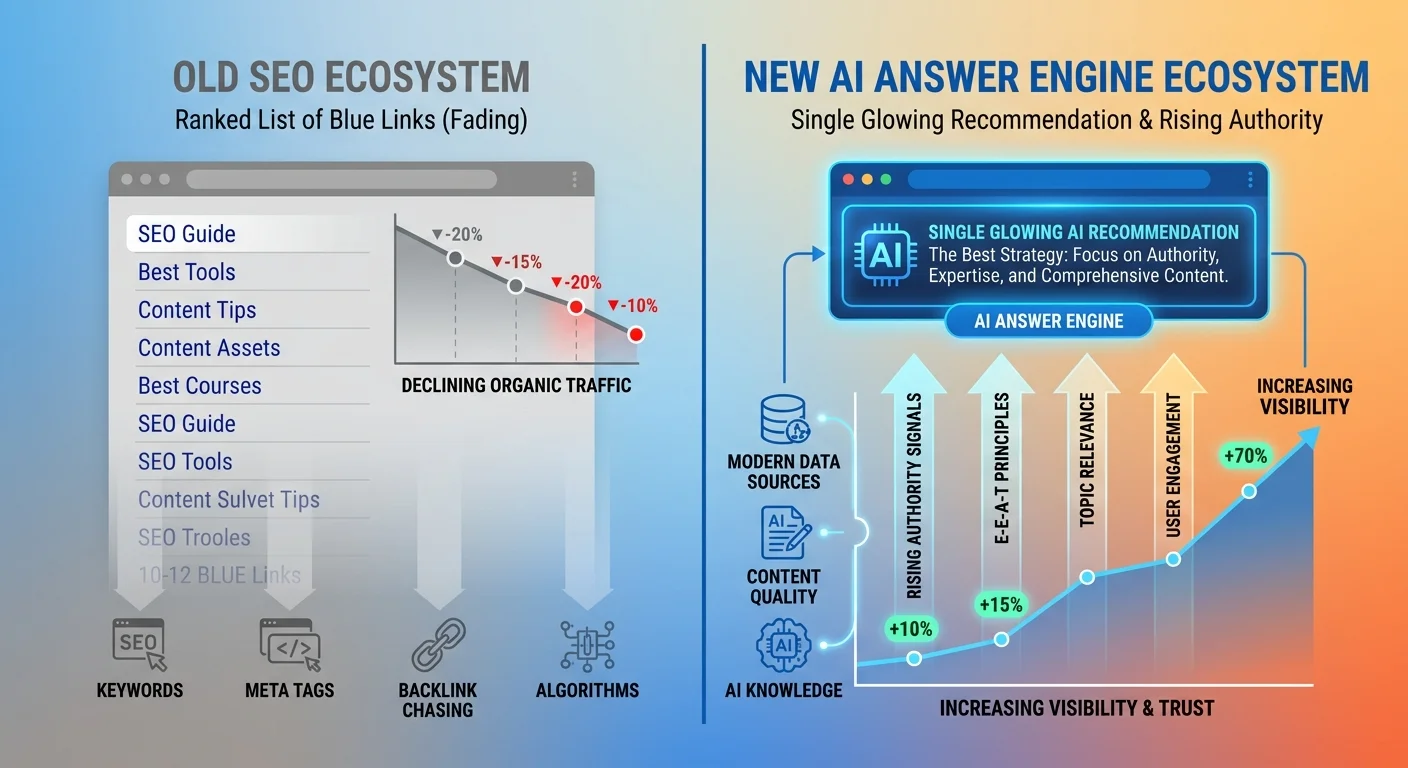
AI answer engines don’t produce a list of ten options for patients to compare. They produce a verdict. One name. One recommendation. One answer.
ChatGPT doesn’t say “Here are the top chiropractors in your area – click through and decide for yourself.”
It says “Based on verified credentials and patient outcomes, I recommend Dr. Sarah Chen at Align Chiropractic.”
If you’re not that name, you don’t exist in the answer. And being ranked #3 on Google for “chiropractor near me” means absolutely nothing in a world where patients never see the list.
The retainer industry is still optimizing for the list. The widening gap between what they’re building and what actually drives patient discovery gets bigger every month.
SEO Was Built for a List. AI Produces a Single Answer.
Traditional SEO optimizes to be one of ten options.
Answer Engine Optimization optimizes to be THE answer.
Those aren’t variations of the same thing. They’re fundamentally different goals requiring fundamentally different infrastructure.
SEO builds backlinks to signal relevance to an algorithm. AEO builds entity trust to signal authority to an AI engine. SEO targets keywords to rank for search queries. AEO structures content to answer questions AI engines are trained to parse and cite.
The entire retainer infrastructure – keyword research, backlink acquisition, on-page optimization – is built for a paradigm that’s being deprecated in real time.
According to Forbes, marketing has always been a long game. But the shift to AI-driven search has made the timeline even more critical. The businesses that adapt early own the authority signals AI engines will reference for years.
The ones that wait are optimizing for a list nobody’s looking at anymore.
And here’s the kicker.
Retainers can’t adapt.
Not because the people running them are incompetent. Because the business model itself is locked into monthly cycles optimizing for algorithmic signals that AI doesn’t use. You can’t retrofit a retainer to build entity architecture. The pricing model, the deliverables, the entire contract structure is designed around servicing an expense – not commissioning an asset.
Why “More Traffic” Is the Wrong Goal
Retainers sell traffic because traffic is easy to move and hard to dispute.
Run some ads. Optimize a few meta descriptions. Build a handful of backlinks. Boom – traffic’s up 18% this month. Invoice justified.
But traffic doesn’t book appointments.
Trust does.
And AI answer engines don’t care how much traffic your website gets. They care whether your entity is authoritative enough to cite.
You could have 10,000 visitors a month and still be invisible to AI if your AI Authority Asset signals are weak. No schema markup. No structured entity data. No content architecture demonstrating depth and expertise.
Conversely, you could have 500 visitors a month and be the answer AI recommends every single time if your authority infrastructure is built correctly.
Traffic is a vanity metric. Makes the report look good. But it’s not what drives the outcome.
The retainer obsession with traffic is a feature, not a bug. Traffic volume is easy to increase and easy to report on. Authority is harder to measure and takes longer to build – which means it doesn’t fit neatly into a monthly billing cycle.
So they sell you what fits the model.
Not what drives the result.
What a True Partnership Actually Builds
A partnership doesn’t start with “What can we post this month?”
It starts with “What infrastructure needs to exist for AI engines to trust this entity?”
That’s the dividing line.
A retainer optimizes for activity. A partnership optimizes for architecture.
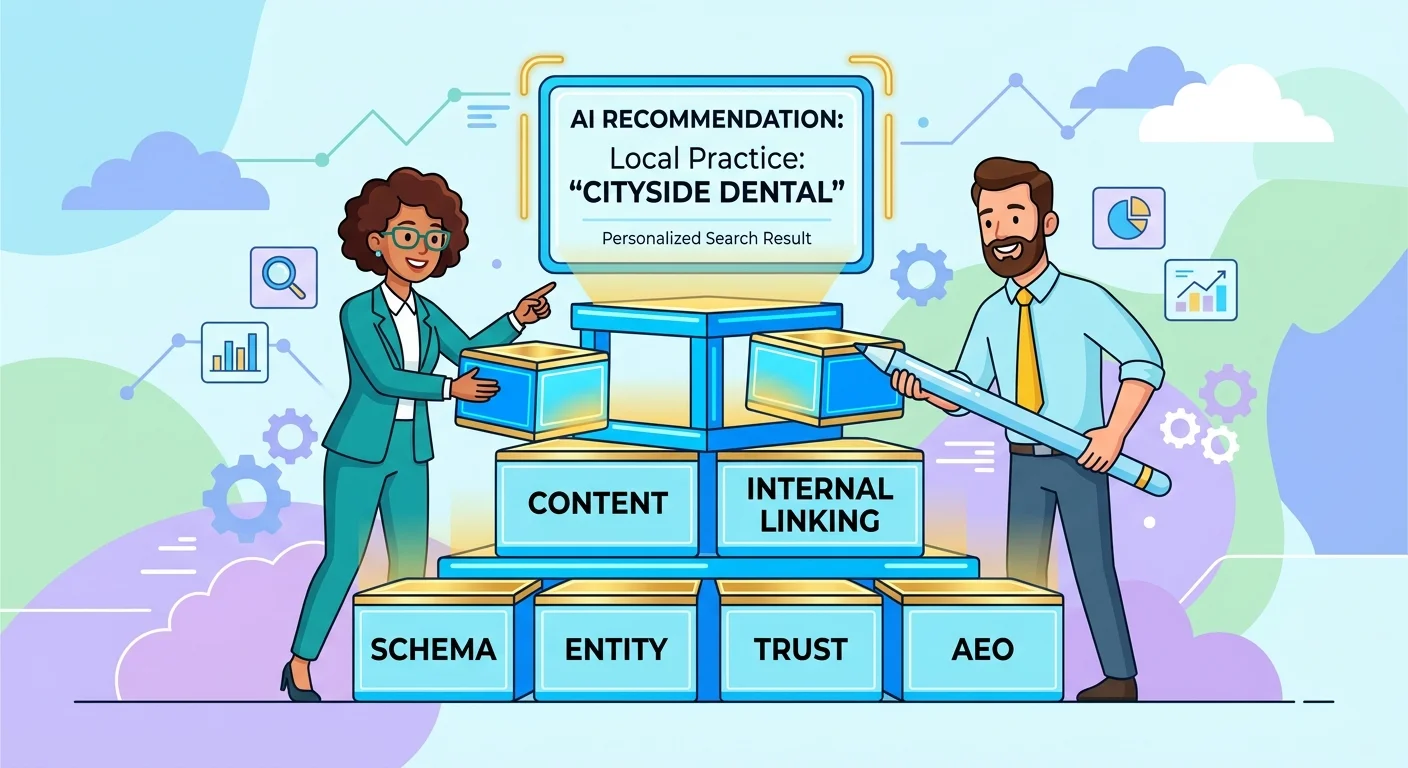
The work isn’t about publishing content to fill a calendar. It’s about building the machine-readable foundation AI answer engines use to form verdicts. Schema markup that tells AI who you are. Entity signals that validate your credentials. AEO content execution demonstrating depth and expertise across your specialty.
This infrastructure is yours. You own it. It persists whether or not you continue paying for ongoing execution.
This is what I mean when I talk about the values of authority. Authority isn’t rented. It’s built. And once it’s built, it’s permanent.
The Infrastructure Layer: What You Own
The authority infrastructure has four core components.
Schema Markup – Machine-readable structured data telling AI engines who you are, what credentials you hold, where you’re located, and what services you provide. This is the entity foundation. Without it, AI has no way to verify your identity or classify your expertise.
Entity Signals – Verification layers proving your business exists and is trustworthy. NAP consistency across directories. Verified listings on authoritative platforms. Structured citations AI can parse and validate. These signals tell AI engines you’re not a fabricated entity.
AEO Content Architecture – A content library built to answer the questions AI engines are trained to parse. Not blog posts optimized for keyword density. Articles structured to provide complete, cited, verifiable answers AI can extract and present as authoritative responses.
Internal Linking Structure – A semantic architecture connecting your content in a way AI can crawl and understand. This isn’t about passing link juice. It’s about demonstrating topical depth and signaling to AI that your content ecosystem covers a subject comprehensively.
This is what you own at the end of twelve months.
Not access to a platform. Not a stack of reports. The actual infrastructure AI engines reference when forming a recommendation.
If you cancel after the build phase, this doesn’t disappear. It’s yours. It stays live. It keeps working.
That’s the difference between commissioning an asset and renting a service.
The Execution Layer: What Compounds
After the infrastructure is in place, ongoing AEO content execution deepens and maintains authority.
Each article published isn’t starting from scratch. It’s stacking on the foundation you already built. Month one’s content supports month two’s. Month six’s content references and builds on month three’s. By month twelve, you’re not starting from zero – you’re starting from eleven months of accumulated authority signals.
This is compounding in action.
Retainer work resets every month because it’s optimizing for temporary algorithmic signals that decay. AEO content execution stacks because it’s building entity trust that persists.
And here’s the critical point.
Authority doesn’t decay when payments stop. It just stops growing.
If you cancel after twelve months, you still own everything you built. The infrastructure. The content library. The entity signals. Competitors can close the gap over time if they execute while you don’t. But you’re not starting over from scratch. You’re pausing growth, not losing the asset.
That’s what makes it an investment instead of an expense.
| Infrastructure Component | What It Does | Who Owns It | What Happens After 12 Months |
|---|---|---|---|
| Schema Markup | Tells AI engines your entity identity, credentials, services | You | Remains live, continues validating your entity |
| Entity Signals | Verifies your business exists across authoritative platforms | You | Stays active, maintains trust layer |
| AEO Content Library | Provides cited, structured answers AI engines can extract | You | Persists on your domain, continues compounding if maintained |
| Internal Linking Architecture | Demonstrates topical depth AI can crawl and validate | You | Remains in place, maintains semantic structure |
According to the U.S. Small Business Administration, the most successful marketing functions are those aligned strategically with long-term business growth rather than tactical execution isolated from core objectives.
That’s the partnership model. Strategic alignment. Permanent infrastructure. Owned outcomes.
Authority as a Compounding Asset vs. Monthly Expense
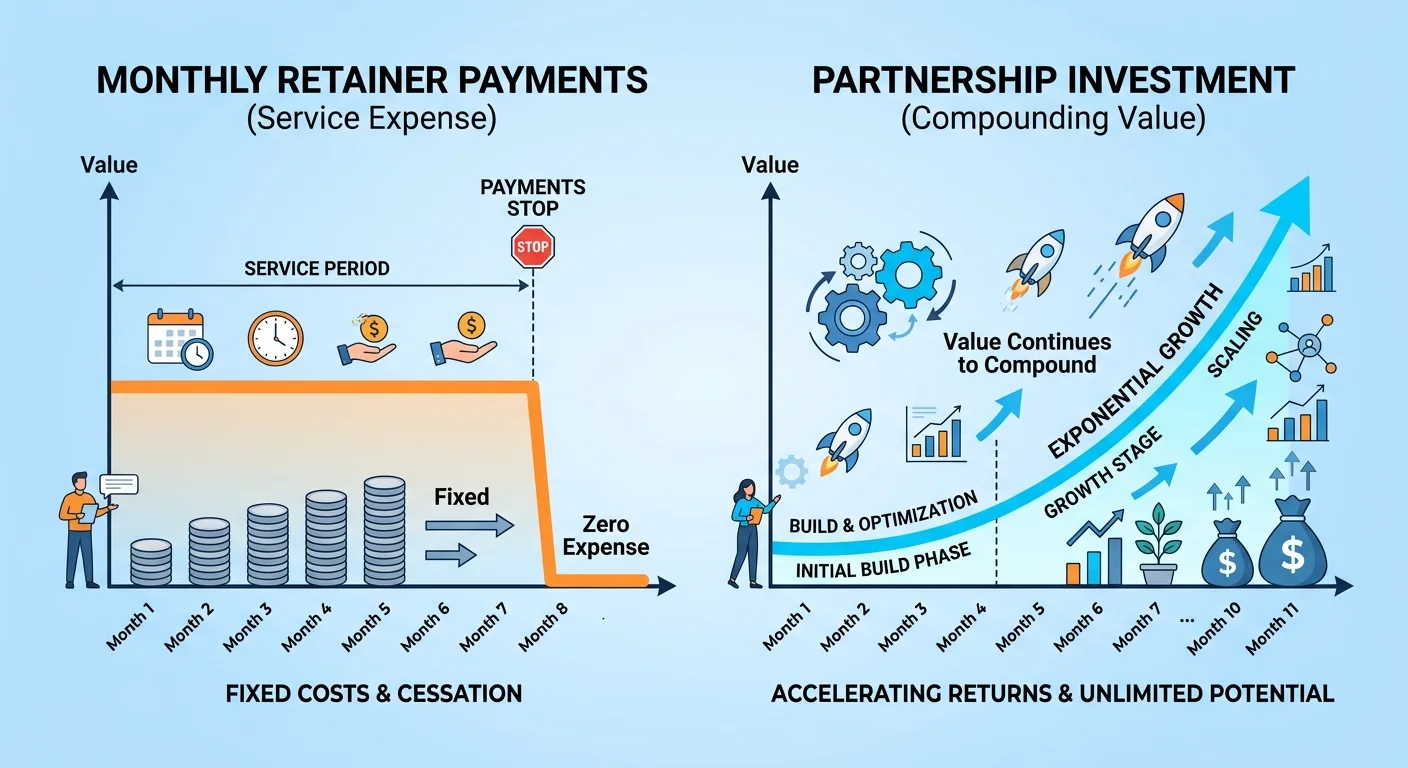
The fundamental economic difference between a retainer and a partnership isn’t how much you pay or how long the contract lasts.
It’s what you own at the end.
A retainer is an expense. The value exists only while you’re paying. Stop paying, lose the value. It’s the business equivalent of renting an apartment. Every month, you write a check for access to something you’ll never own.
A partnership is an investment. The value compounds and persists. Stop paying for ongoing execution, and the asset you built remains. It’s the business equivalent of buying a house. You own it. It’s yours. The mortgage might end, but the house doesn’t disappear.
This isn’t marketing language. It’s structural reality.
I spent 20 years in marketing before I realized the entire industry was selling the wrong model. Retainers optimize for agency cash flow. Partnerships optimize for client outcomes.
The Compounding Principle: Authority Builds on Itself
Authority works like compound interest.
The first month of AEO content execution builds on the infrastructure. The second month builds on both the infrastructure and month one’s content. By month twelve, you’re not starting from zero – you’re starting from eleven months of accumulated trust signals AI engines have already indexed and validated.
This is compounding in action.
Each layer of execution makes the next layer more effective.
According to the University of Colorado, compound interest is often called the eighth wonder of the world because the growth accelerates exponentially over time. The same principle applies to building digital authority. Early execution creates the foundation. Later execution multiplies the impact.
Retainers reset every month because they’re optimizing for temporary algorithmic signals, not permanent entity trust. The work done in month one doesn’t stack with month two’s work – it just expires and gets replaced.
That’s not compounding. That’s churning.
You’re paying every month for the same baseline level of visibility. Traffic stays relatively flat. Rankings fluctuate but don’t trend upward. You’re servicing an expense, not building an asset.
What Happens When You Stop Paying
With a retainer: the activity stops, the visibility disappears, and you’re back to zero.
The blog posts stop getting published. The social media updates go dark. The “SEO work” they were doing – whatever that actually was – ceases. And within 60 to 90 days, any rankings you gained start sliding backward because the signals propping them up are gone.
You spent $18,000 over twelve months. You own nothing. The work evaporated the moment the contract ended.
With a partnership: the infrastructure remains, the content library stays live, and the authority you’ve built continues working.
You stop compounding new layers of content. Competitors who continue executing will close the gap over time. But you don’t lose what you already built. The schema markup is still there. The entity signals are still validated. The AEO content is still indexed and still being cited by AI engines when patients ask for recommendations.
You stop growing. But you don’t reset to zero.
That’s the difference between renting and owning. One disappears the moment you stop paying. The other persists because it was always yours.
| Month | Retainer Value Delivered | Partnership Value Delivered (Cumulative) |
|---|---|---|
| 1 | $1,500 (activity) | Infrastructure build begins |
| 3 | $4,500 (activity) | Infrastructure + 3 months content execution |
| 6 | $9,000 (activity) | Infrastructure + 6 months content compounding |
| 12 | $18,000 (activity) | Infrastructure + 12 months authority asset owned |
| 13 (post-cancel) | $0 (all value lost) | Infrastructure + 12 months authority asset still working |
The Real Risk: Paying Every Month for Work That Disappears
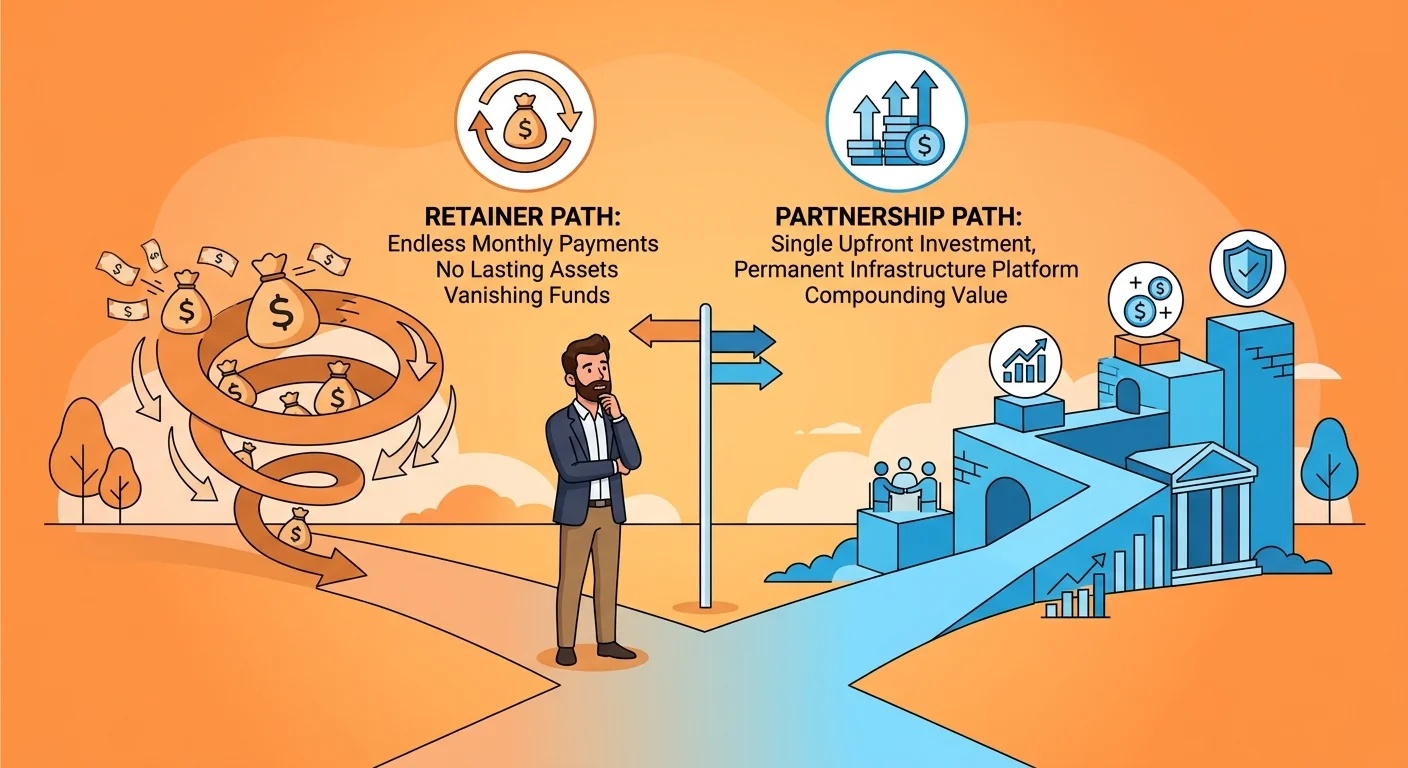
Let’s talk about risk.
Not the risk the marketing agency warns you about. The risk they don’t mention.
The real risk isn’t committing to a long-term partnership and having it not work out. The real risk is spending $6,000 to $12,000 every single year for three years running – $18,000 to $36,000 – and owning absolutely nothing at the end of it.
That’s not a hypothetical. That’s the default outcome for the retainer model.
If you’re reading this and you’ve already cycled through two or three agencies in the last five years, you know exactly what I’m talking about. You paid. They delivered activity. The reports looked fine. And when you finally canceled because the phone still wasn’t ringing, everything they “built” for you disappeared.
Because it was never there.
Here’s the part that makes it worse.
This isn’t for everyone.
If you’re looking for a 90-day sprint to flood your schedule, a partnership isn’t your fit. A retainer is designed for that mindset – and that’s exactly why it fails. Authority is a long-term build. Foundation first. Content compounding on top. AI visibility deepening every month.
If that timeline doesn’t fit your decision framework – no hard feelings. But if you’re tired of short-term tactics that disappear the moment you stop paying for them, you’re in exactly the right place.
Why “Cancel Anytime” Is a Feature, Not a Benefit
Monthly retainers market themselves as low-risk because you can cancel anytime.
No long-term commitment. No big upfront investment. Just month-to-month flexibility.
Sounds safe. It’s not.
“Cancel anytime” is a signal the vendor isn’t building anything permanent. If they were, they’d be confident enough to structure the agreement around the asset you’re commissioning – not the activity they’re delivering month to month.
According to MarketingProfs, the B2B agency-client relationship is in crisis specifically because agencies optimize for short-term retention instead of long-term value creation. Clients churn because the work doesn’t compound. And the “cancel anytime” model perpetuates that cycle.
Real risk is spending $1,200 a month for three years and owning nothing at the end of it. That’s $43,200 in sunk cost with zero durable value.
Compare that to a partnership where you spend $15,000 upfront to build the infrastructure and $1,200 a month to compound content execution on top of it. After twelve months, you’ve spent $29,400 – and you own the asset.
Which one is actually lower risk?
The Sunk Cost of Retainer Churn
Most practices burn through two to three agencies before they figure out the model itself is the problem.
Agency one promises results. Delivers activity. No results. Cancel.
Agency two promises they’re different. Delivers slightly better activity. Still no results. Cancel.
Agency three has a fancier proposal. Better reports. Same outcome. Cancel.
Every time you switch, you start over. The work the last agency did doesn’t transfer. The “SEO” they built decays. The content they published sits there doing nothing because it wasn’t structured to build authority – it was written to justify an invoice.
With a partnership, the work stacks – even if you switch partners later.
The infrastructure you commissioned is yours. The entity signals are validated. The content library is indexed. If you decide to move to a different execution partner after twelve months, you’re not starting from scratch. You’re building on a foundation that already exists.
That’s the difference. One model makes churn catastrophically expensive. The other makes it manageable because you still own what you built.
How to Identify a True Partner vs. a Vendor Calling Themselves One
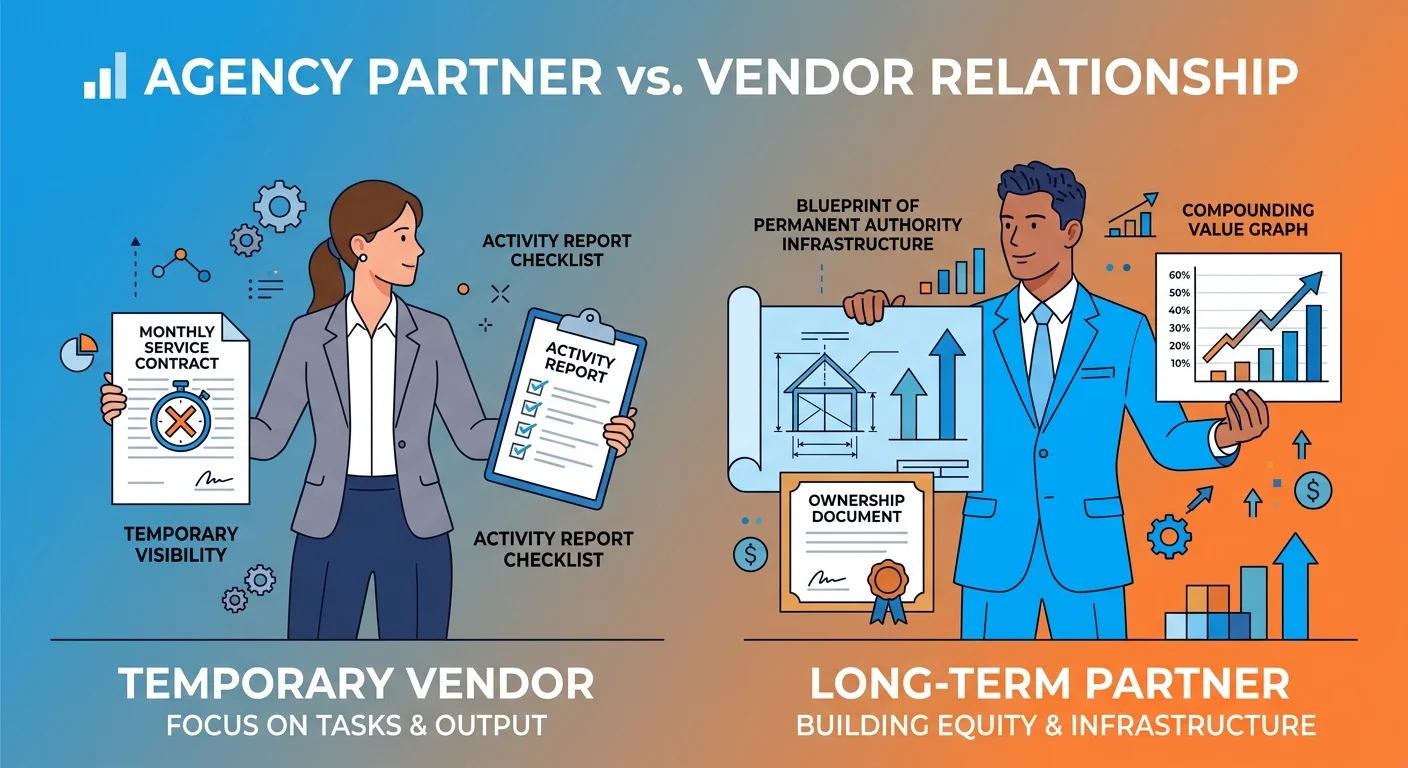
The language has been co-opted.
Every agency calls their retainer a “partnership” now. It’s in the proposal. It’s in the sales pitch. “We’re not just a vendor – we’re your partner in growth.”
Cool story. Let’s see if that’s true.
Here’s how to tell the difference. Ask three questions. Listen to the answers. The vendor will talk about what they’ll do for you. The partner will talk about what you’ll own.
One focuses on the activity. The other focuses on the asset.
If you can’t tell which one you’re talking to after these three questions, you’re talking to a vendor pretending to be a partner.
Question 1: What Do I Own at the End of 12 Months?
A vendor will tell you about the work they did.
“We published 48 blog posts. We optimized your site for 200 keywords. We built 50 backlinks. We posted to social media three times a week. We sent you monthly reports showing your traffic growth.”
That’s activity. Not ownership.
A partner will show you the infrastructure you now own.
“You own the schema markup that validates your entity to AI engines. You own the AEO content library that’s indexed and being cited. You own the internal linking architecture that demonstrates topical depth. You own the entity signals that prove your credentials across authoritative platforms.”
If the answer to “What do I own?” is “the work we did” or “access to our platform,” you’re buying a service, not building an asset.
And here’s the test.
If you cancel, does the value disappear?
If yes – vendor. If no – partner.
It’s that simple.
Question 2: What Happens If I Stop Paying?
A vendor’s answer: “The work stops.”
The blog posts stop getting published. The reports stop showing up. The rankings start sliding. And within 90 days, you’re back to where you were before you hired them.
That’s not partnership. That’s dependency.
A partner’s answer: “The infrastructure stays. You stop compounding new layers, but what you’ve built remains.”
The schema markup doesn’t disappear. The content library stays live. The entity signals stay validated. Competitors who continue executing will close the gap over time. But you’re not losing what you already own.
You stop growing. But you don’t reset.
If canceling means losing everything, it wasn’t a partnership – it was a rental agreement with a 30-day cancellation clause.
Question 3: Are We Optimizing for Traffic or Trust?
A vendor optimizes for algorithmic signals.
Traffic. Rankings. Impressions. Time on site. All the metrics that look good in a report but have zero correlation with whether patients actually book appointments.
They’ll tell you traffic is up 22%. They won’t tell you that AI answer engines aren’t looking at your traffic – they’re looking at whether your entity is authoritative enough to cite.
A partner optimizes for entity trust.
The signals AI answer engines use to determine whether your business is trustworthy enough to recommend. Schema validation. Citation velocity. Content depth. Semantic density. These are the signals that drive the outcome.
One chases a list. The other builds the answer.
Here’s the simplest way to frame it.
If the agency’s primary deliverable is a report showing you how many people visited your website, they’re optimizing for the wrong thing.
If the agency’s primary deliverable is infrastructure that makes AI engines say your name when patients ask for recommendations – that’s the right thing.
For more on how I approach this, visit About.
| Question to Ask | Vendor Answer | Partner Answer |
|---|---|---|
| What do I own at the end of 12 months? | “The work we did” or “access to our platform” | Permanent infrastructure: schema, entity signals, AEO content library |
| What happens if I stop paying? | “The work stops” (all value lost) | “Infrastructure stays, compounding stops” (you still own the asset) |
| Are we optimizing for traffic or trust? | Traffic, rankings, impressions (algorithmic signals) | Entity trust, citation velocity, authority signals (AI validation) |
FAQ
How is an AI Authority Engine different from a monthly SEO retainer?
An SEO retainer focuses on influencing a search algorithm’s ranked list. Temporary result that exists only as long as the optimization work continues.
The work is structured around monthly deliverables – blog posts, backlinks, on-page tweaks – that service an algorithm. When payments stop, the signals decay, and your visibility slides backward. You’re renting space on a list.
An AI Authority Engine builds permanent digital infrastructure AI engines use to form a trusted verdict. Schema markup that validates your entity. AEO content that answers the questions AI is trained to parse. Entity signals that prove your credentials across authoritative platforms.
This infrastructure is yours. It persists whether or not you continue paying for ongoing content execution. You’re not renting visibility – you’re owning authority.
The retainer optimizes for temporary algorithmic signals. The Authority Engine builds a durable asset that compounds in value over time.
What happens to the “authority” if I stop the partnership after the initial build?
The foundational authority infrastructure you’ve built remains yours permanently.
The schema markup stays live. The entity signals stay validated. The AEO content library stays indexed on your domain. AI engines don’t delete their understanding of your entity just because you stopped publishing new content.
However, authority requires ongoing execution to maintain and grow.
Competitors will continue building their own authority infrastructure. If you pause execution after twelve months and they don’t, the gap between your authority and theirs will narrow over time. You’re not losing what you built – you’re just not compounding new layers.
Think of it like building a house. After the initial build, you own the house. It doesn’t disappear. But if you stop maintaining it while your neighbors continue improving theirs, the relative value shifts.
The infrastructure doesn’t decay. It just stops growing.
Why do most marketing agency retainers fail to deliver long-term value?
Most retainers are structured around activity rather than building a compounding asset.
The contract specifies deliverables. Five blog posts per month. Three social posts per week. Monthly analytics reports. The agency executes the tasks. You get billed. Repeat.
But the work isn’t designed to stack. Each month’s deliverables exist in isolation. The blog post published in January doesn’t make February’s post more valuable. The backlink built in March doesn’t compound with April’s.
When payments stop, the activity stops – and any temporary visibility gained from it quickly fades.
Compare that to a partnership model where the work is explicitly designed to compound. Month one’s infrastructure supports month two’s content execution. Month six’s content references and builds on month three’s. By month twelve, you’re not starting from scratch – you’re building on eleven months of accumulated authority.
Retainers fail to deliver long-term value because they’re not trying to. They’re trying to justify a monthly invoice. Authority requires a fundamentally different structure – and that structure doesn’t fit neatly into a month-to-month billing cycle.
Isn’t a long-term partnership riskier than a monthly retainer I can cancel?
Nope.
A short-term retainer carries the risk of wasted spend with no lasting value.
You pay $1,500 a month for two years. That’s $36,000. At the end of it, you own nothing. The blog posts are still on your site, but they’re not structured to build authority. The backlinks decay. The rankings slide. You’re back to square one.
That’s not safety. That’s sunk cost with zero durable outcome.
A true partnership is front-loaded to build a permanent asset, de-risking the long-term investment by ensuring you own the outcome, not just rent the process.
You pay $15,000 to build the authority infrastructure. Then you pay $1,200 a month to compound content execution on top of it. After twelve months, you’ve spent $29,400 – and you own the asset. The schema. The entity signals. The AEO content library.
If you cancel after twelve months, you still own everything you built. With a retainer, if you cancel after twelve months, you own nothing.
Which one is actually riskier?
How can I tell if an agency is offering a true partnership or just a long-term retainer?
A true partner focuses on building a tangible, permanent asset you own.
They’ll talk about infrastructure. Schema markup. Entity architecture. AEO content designed to answer the questions AI engines parse. Internal linking that demonstrates topical depth. These are durable components you own whether or not you continue paying for execution.
A retainer vendor focuses on delivering a list of monthly services and activity-based reports.
They’ll talk about how many blog posts they’ll publish. How many backlinks they’ll build. How many social posts they’ll schedule. How much traffic they’ll drive. These are activities that justify a monthly fee – not assets you own.
Ask the three diagnostic questions from the section above.
- What do I own at the end of 12 months?
- What happens if I stop paying?
- Are we optimizing for traffic or trust?
Listen to the answers. A vendor will talk about the work they do. A partner will talk about what you’ll own.
If they can’t clearly articulate what infrastructure you’ll own at the end of the engagement – independent of their ongoing involvement – you’re talking to a vendor calling themselves a partner.
Conclusion
Authority is built, not claimed.
A partnership is a building contract. A retainer is a claiming contract.
One commissions a permanent asset that compounds in value over time. The other rents you space in a dying ecosystem and disappears the moment payments stop.
The practices that own their authority infrastructure in five years are the ones that stopped renting and started building today.
The widening gap doesn’t close on its own. It accelerates every month you wait.
Every month a competitor builds their entity signals while you’re still paying for traffic reports, the distance between where they are and where you are grows. And AI doesn’t give partial credit. It doesn’t say “Well, you were close.” It names one answer. If that’s not you, you don’t exist in the conversation.
You have two options.
Keep paying rent in an ecosystem that’s being replaced – burning $12,000 to $18,000 a year on activity that evaporates the second you stop writing checks.
Or commission a permanent home in the ecosystem replacing it. Build the infrastructure. Stack the content. Own the authority. And compound it every month for the rest of your career.
The retainer model worked when Google showed ten blue links and patients clicked through to compare options. That’s not how discovery works anymore.
Now patients ask AI. And AI gives one answer.
Either your name is in that answer, or a competitor’s is. There’s no third option. No “we’re both on page one.” No shared visibility. One practice gets named. Everyone else is invisible.
The businesses that adapt early own the authority signals AI engines will reference for years. The ones that wait are optimizing for a list nobody’s looking at anymore while their competitors lock in the spots that matter.
This isn’t a marketing decision. It’s a structural business decision about what you own versus what you rent.
And the longer you wait to make it, the more expensive the gap becomes to close.
You’ve spent years paying agencies to move numbers that don’t move the business.
Traffic up. Rankings improved. Impressions climbing. And your schedule’s still empty.
That’s not bad execution. That’s the wrong model. You’ve been renting visibility in an ecosystem that’s being replaced – and the work disappears the moment payments stop.
Want to see what AI actually says about your practice right now? Not what an agency promises it could say. What it says today. When a patient asks ChatGPT or Gemini who to trust in your market – are you the answer, or is your competitor?
The AI Visibility Check takes fifteen minutes. Shows you exactly where you stand across the three engines that matter. No sales pitch. No pressure. Just data.
If the results don’t make the problem self-evident, walk away. But if they do – you’ll know exactly what needs to happen next.
The practices building authority infrastructure today are locking in the positions that will matter for the next decade. The ones waiting are watching that gap widen every month.