
What Counts as a Mass-Production Marketing Shop
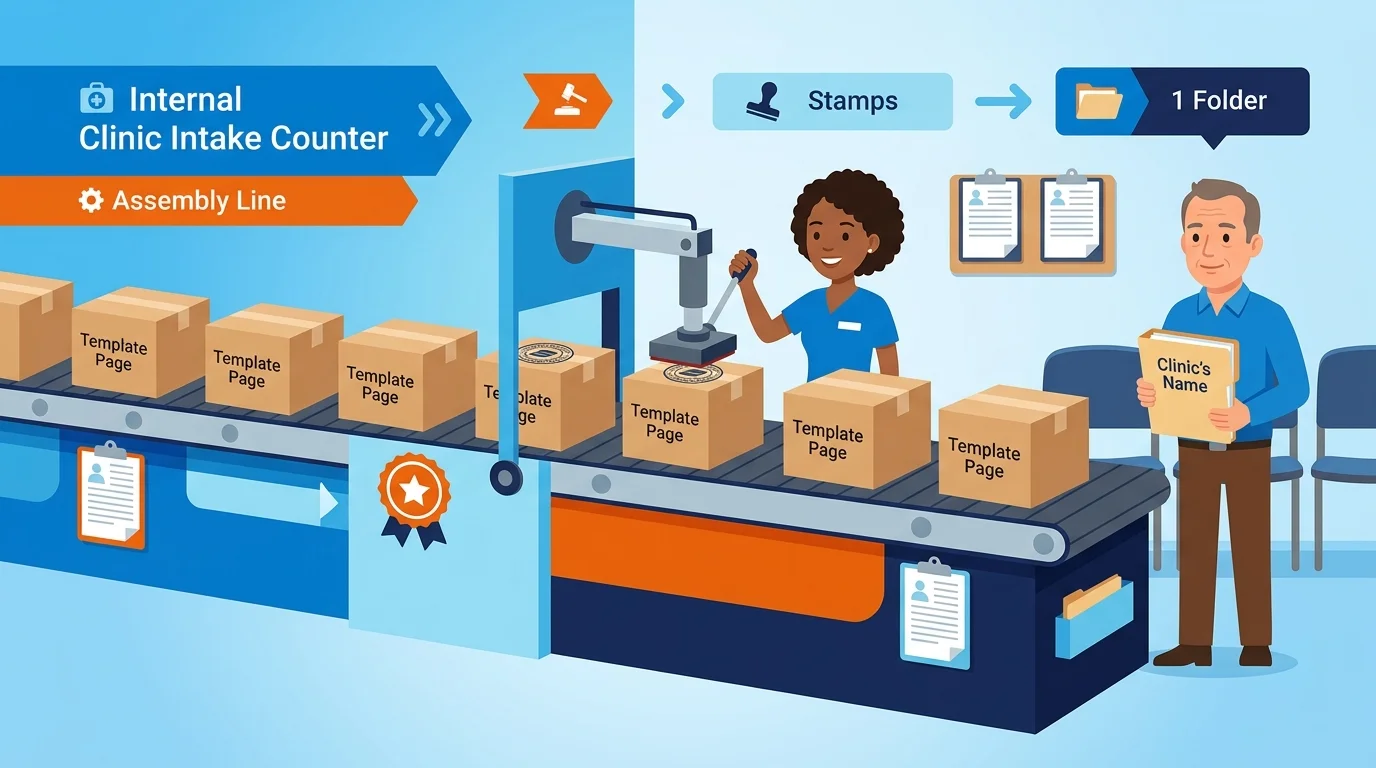
Here's the thing: a mass-production marketing shop is defined by how it operates, not by what its sales page promises. It sells volume, with dozens or hundreds of client accounts pushed through the same system.
That factory model treats a clinic the same way it treats any other small business on its roster. For a solo clinic owner, signing with one of these shops can feel like the obvious next step toward growth, yet the wrong kind of partner does more damage than no partner at all.
The Volume Template
Rankings and output volume were the old scoreboard, built for a search era that rewarded how much you shipped over whether it was accurate.
Now… this part matters: the template is the product. One boilerplate structure gets copied across hundreds of unrelated clients, which is exactly why what clinic owners should consider before picking an authority partner deserves a hard look before anyone signs a contract.
Why the Template Model Breaks Down at Scale
At ten accounts, a template runs clean. At hundreds? The same scaffolding that made the model profitable starts cranking out the very conflicts that wreck it.
Under old-school search work, boilerplate language and duplicated citations were liabilities you could live with, because volume signals papered over the mess. Not anymore. AI systems picking which clinics get recommended now read mismatched or duplicated data as a trust problem (not a formatting hiccup).
Where Cheap Retainers Cut Corners
Here's the kicker: cheap retainers stay cheap by cutting the one cost a factory can't absorb, which is individualized verification. That corner goes first because nobody sees it missing until an AI system cross-checks the record and catches the inconsistency.
The assembly line produces identical parts; AI search checks each clinic against a single, specific, verifiable file, not a stamped-out template. That mismatch is the mechanical reason the model breaks down at scale, and it's the reason protecting a clinic's reputation through boutique craftsmanship looks different from a retainer built to process volume.
What AI Search Actually Checks Before It Will Cite a Clinic
Here's what AI search may check: whether a clinic matches its own verifiable record before it gets cited. And that check runs on consistency, not on how many pages a marketing account has pumped out.
Google treats this as baseline infrastructure, not some advanced feature. Google's documentation says AI Overviews and AI Mode have no additional technical requirements beyond normal Search eligibility, and that keeping business information such as Business Profile details up-to-date is recommended as a best practice. Accurate Business Profile fields are basic upkeep.
| Signal Checked | What We Check | What Mass-Production Shops Typically Deliver |
|---|---|---|
| Business Profile accuracy | Current, consistent details matched against the practice's own record | A templated profile entry, updated rarely, shared in structure across other accounts |
| Entity consistency across citations | Matching address, phone, and credential data across every listed source | Duplicated citation blocks copied from one client file to the next |
| Service and location description | Specific, defensible language describing what a practice actually offers and where | Generic boilerplate service copy reused across unrelated clinics |
| Fan-out subtopic coverage | Related details that hold up when cross-checked across multiple linked searches | A single generic page with no depth across the subtopics a fan-out search touches |
| Content originality | Distinct, practice-specific language rather than recycled phrasing | The same paragraph structure and phrasing stamped across hundreds of sites |
Query Fan-Out and Why Consistency Beats Volume
And discovery doesn't stop at one lookup. Google's documentation says Google's AI Overviews and AI Mode may issue multiple related searches across subtopics and data sources to develop a response.
Let's keep it real: calling AI visibility traditional search optimization with new vocabulary just keeps the old scoreboard on sale, while the mechanism underneath now checks identity, not output. The breakdown of corporate agencies and the trouble with solo clinic data shows exactly where that mismatch starts.
Where Structured Data Fits and Where It Doesn't
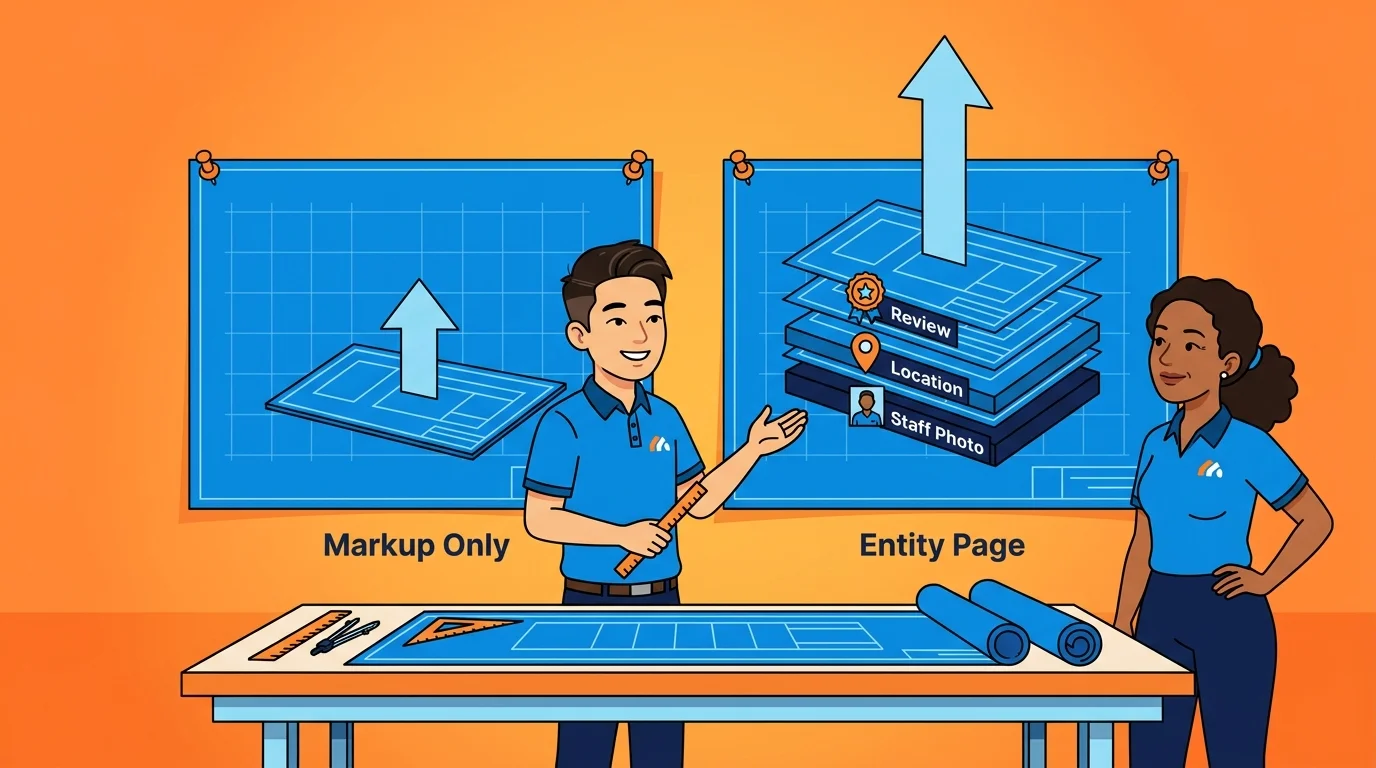
Structured data does have a real job. It tells a search system what a page's content means, not just what the words say.
But that job has limits. More markup doesn't buy more visibility, because no amount of tagging can fix an entity record that contradicts itself across directories and profiles.
| Approach | Accuracy Gain Measured | What It Requires |
|---|---|---|
| JSON-LD markup alone | Modest improvement, well short of transformative | Correct schema syntax applied to a single page, with no verification against the clinic's broader record |
| Enhanced entity page format | Substantial improvement over markup alone | Consistent business details, structured entity signals, and agent-readable context built around a single verifiable record |
The Enhanced Entity Page Compared to Markup Alone
According to a preprint by WordLift, a vendor of AI-search tools, in a study testing retrieval-augmented generation systems, JSON-LD markup alone was associated with only modest improvements in retrieval accuracy, while an enhanced entity page format was observed to achieve a +29.6% accuracy improvement for standard RAG. That finding points to a mechanism, not a settled industry standard. Markup describes a page. It can't reconcile a mismatched phone number sitting on some other client site that ran through the same factory template.
So why does an enhanced entity page work? It hands an AI system something to verify against, not just something to tag. That's the layer a factory retainer has zero incentive to build, and it's where professional AEO implementation for clinics actually starts. Google's structured data guidelines say markup must be a true representation of the page content, and not to mark up content that is not visible to readers of the page.
How Boilerplate Content Fails the Trust Test
Boilerplate content fails the trust test because it can't anchor a clinic to a verifiable record. A clinic's standing in AI-driven search rides on how accurately and consistently these systems understand the practice as a real-world entity (not on how many pages happen to mention it).
The Mechanics of Entity Data Conflict
A template written for one clinic says nothing specific about the next one. Swap the clinic name and the service list reads exactly the same, because nothing in it ties the practice to a distinct address, credential set, or patient population.
That genericness *is* the conflict. An AI system hunting for confirmation finds a description that matches hundreds of other pages instead of one practice, and a description that fits everyone confirms no one.
What Low-Quality Link Acquisition Signals to AI Systems
The same measurement standard applies to inbound links built on volume rather than relevance. A link acquired from an unrelated directory adds no verification value.
Building a Verifiable Entity Record Instead of a Template

So what replaces the template? A verifiable entity record, and it starts from the opposite premise: it describes one practice, with details that hold up when an AI system checks them against every other source that mentions it.
| Step | What Gets Verified | Why Order Matters |
|---|---|---|
| Identity Confirmation | Practice name, address, phone number, and core credentials checked against every directory and profile where the clinic appears | This is the baseline an AI system cross-references first, so unresolved conflicts here undermine everything written afterward |
| Service and Scope Verification | The specific services, specialties, and patient population the practice actually serves, stated in terms unique to that clinic | Generic service language only becomes a liability once identity is already confirmed, so this step has to follow confirmation, not precede it |
| Profile and Panel Accuracy | Business Profile details and any existing knowledge panel data, checked against the confirmed identity and service record | A panel built on unverified fields just repeats the mismatch at a more visible layer, which is why it waits until the record underneath it is settled |
| Content Alignment | New pages, descriptions, and articles, written to reflect the verified record rather than a reusable template | Content produced before verification describes a placeholder practice, and rewriting it later costs more than sequencing it correctly the first time |
The Sequence That Builds Entity Trust
The sequence runs from the ground up. Verified address, credentials, and service details get locked first, because an AI system cross-references those fields before it trusts anything built on top of them. Content written after that foundation describes a specific practice instead of a generic one, which is what the earlier citation record showed AI systems actually require.
Verifying a Knowledge Panel Before Expanding Content
Now… this part matters: a knowledge panel shows what these systems already believe about a practice, so confirming it before adding content stops one mismatch from compounding across every new page. Cheap retainers skip this step because verification doesn't scale across hundreds of accounts. That's why the discount model is a trap, not a shortcut.
Frequently Asked Questions
Once you lay the factory model next to the verified entity file, the same few mechanical questions keep popping up. Here's where they land.
How can a cheap marketing agency actually hurt my clinic's online presence?
Cheap agencies copy the same boilerplate and citations across hundreds of accounts. To an AI system checking a clinic's record, that mismatch looks like a trust problem. It's not a little formatting glitch.
What is entity data and why does it matter more than old-school search work for my practice?
Entity data is the verifiable record of a practice's address, credentials, and services. AI-driven discovery checks that record for consistency before it checks anything else, which is why it outweighs old-school search work.
Can an AI system penalize my clinic for boilerplate content my marketing agency writes?
Google's spam policies say Google can act against scaled, low-value content.
What are the most common mistakes large marketing firms make with a clinic's Google Business Profile?
Big firms often let Business Profile details go stale or drift out of sync with other listings. That breaks the basic upkeep AI systems expect before they trust a profile.
What is query fan-out and how does it change what a clinic needs online?
Query fan-out means an AI system runs multiple related searches across subtopics and sources to build one answer. So a clinic needs one consistent record everywhere, not just one polished page.
The Bottom Line
The factory model and the verified entity file can't both be right. One stamps out identical parts and prays volume covers the mismatch. The other builds a single record that holds up every time an AI system checks it.
That breakdown is not a future risk. It is the mechanical reason template-driven retainers stop working the moment discovery shifts from counting signals to confirming identity. A clinic represented by conflicting data does not get a second look; it gets passed over for the practice whose record actually matches.
Here's what I tell docs: betting your clinic's reputation on a factory that profits from sameness is the wrong trade. Build one defensible, accurate entity record around your practice, not a template stretched across hundreds. Start by seeing where that record stands today with an AI Visibility Check.