
Ask each customer question twice in a fresh chat: once naming the city with location sharing off, and once with location sharing on from inside your service area. Write down four things: whether a map appears, whether you are on it, where you are in the list, and which competitors appear instead. When you ask ChatGPT the same local question twice, the median result is that only 29% of the named businesses show up in both answers, a bit more than 1 in 4.
How Often Local Customers Ask AI, and How Few Businesses Get Named
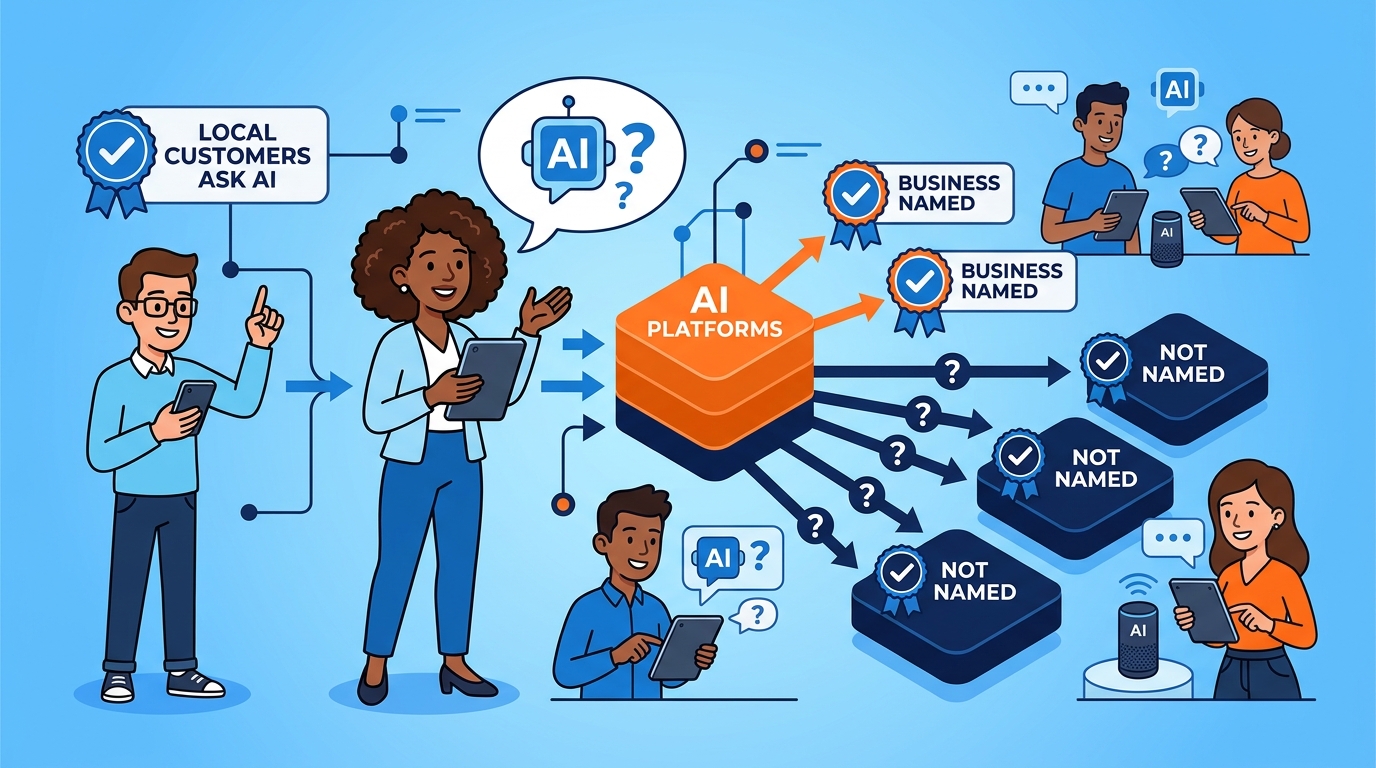
Here’s how fast this moved.
In the past year, 45% of consumers (a bit under half) asked an AI tool for a local business recommendation. The year before, it was 6%. Almost 2 in 3 adults aged 30 to 44 (64%) have asked. That’s the highest share of any age group.
People trust what they get. About 6 in 10 AI users (63%) trust the local recommendations. Almost 9 in 10 (88%) fact-check them.
Few businesses get named.
Only 44% of the local businesses in one sample were named by at least one AI assistant. ChatGPT named 36%. Google’s AI Mode named 18%. Just 10% were named by both.
Google Maps showed a tracked business in about 2 out of 3 searches (66%). The AI surfaces showed one in about 1 out of 3 searches (32% to 38%).
Brand stature works like a three-tier ladder.
On their first tracking run, global household names such as Stripe and Nike show up in about 3 out of 4 (73%) of the relevant AI answers. Established mid-market and regional brands such as Olipop and Klaviyo show up in a little over 4 out of 10 (44%). Niche and small brands show up in about 1 out of 9 (11%).
Each tier sits about 30 percentage points below the one before it.
I build for your practice to be the source an AI names and draws on. Not one more line in a directory.
Named or left out of the answer? That’s the line I measure against.
Want to see how these answers turn into bookings? Read How Assistant Answers Impact Bookings: A Complete Guide.
Check Each Assistant Separately, and Repeat
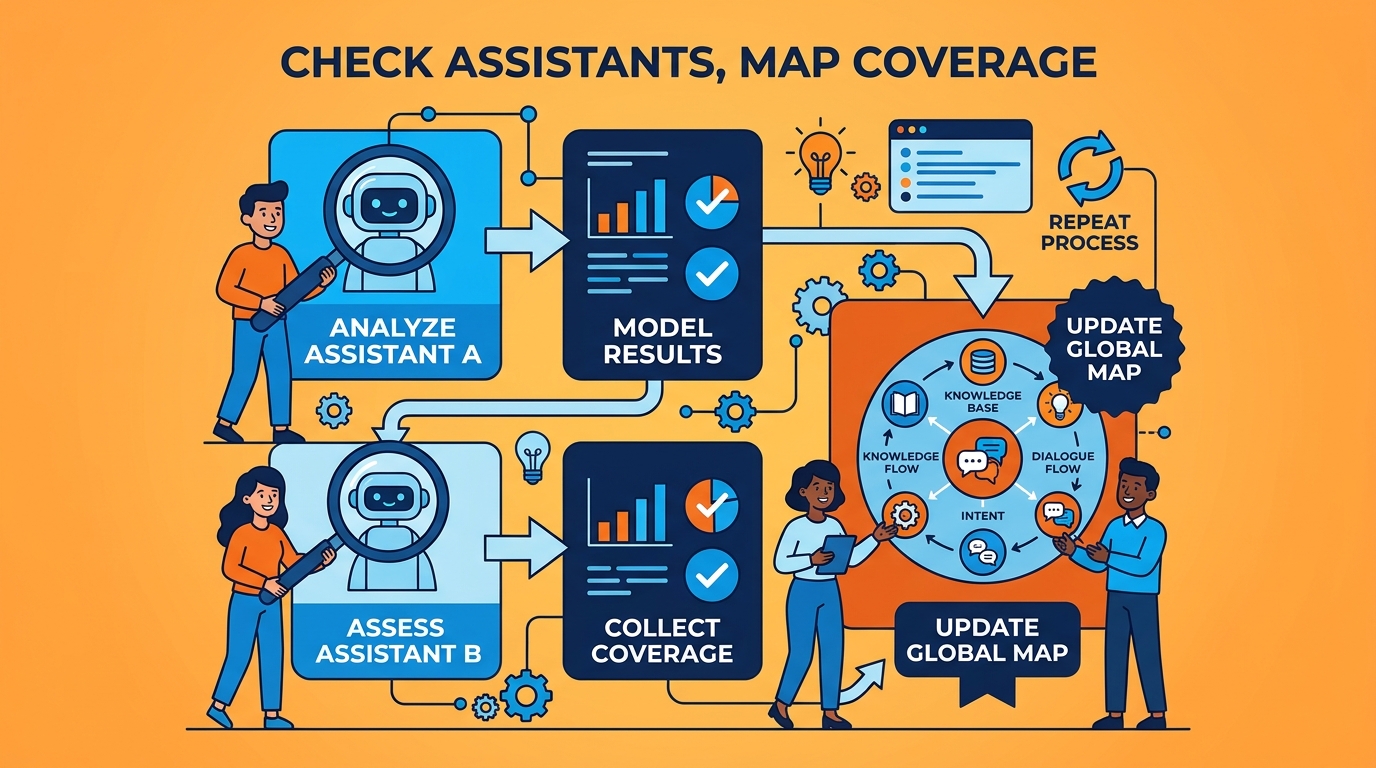
Map model coverage. For each relevant prompt, write down whether ChatGPT, Gemini and Claude mention your brand.
The assistants don’t agree.
ChatGPT’s local answers match Google’s AI Overviews or AI Mode only 19% to 20% of the time. That’s about 1 time in 5. One study found the sources retrieved are substantially different for each search engine (average Jaccard similarity below 0.2).
Roughly 5% of brands (about 1 in 20) were underexposed in large language models relative to their search standing. About 4% (about 1 in 25) were AI overperformers.
Repeat the audit over time. Model versions, underlying data and prompt behavior can change the results. The DEV Community piece AI Visibility Is Not One Score: How Brands Should Audit ChatGPT, Gemini and Claude lays out this model-by-model method.
Want to know how those checks connect to new patients? See Measuring the Link Between AI Visibility and Patient Acquisition.
How the Test Mimics a Real Patient Asking
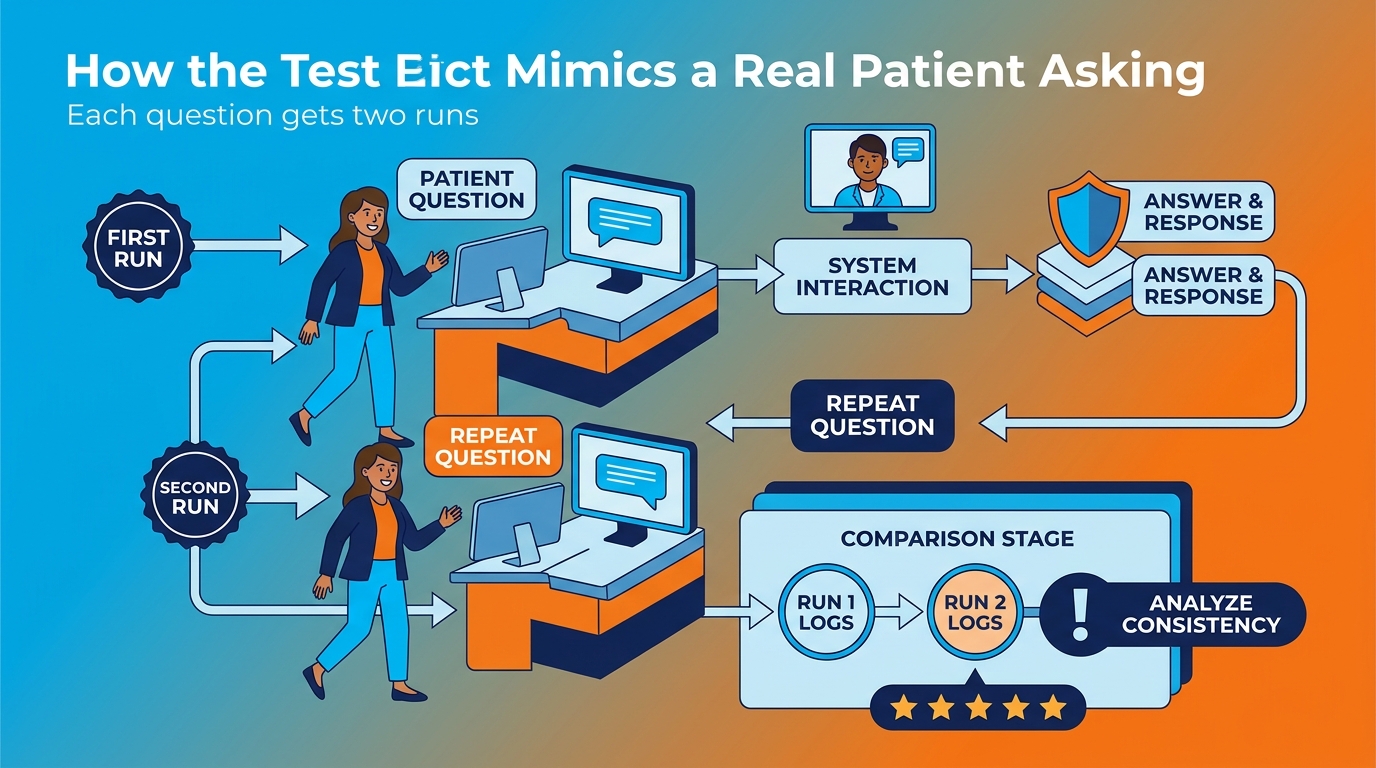
Each question gets two runs. Each run gets the same four notes.
Ask Each Question Twice
Ask each customer question twice in a fresh chat. Ask once naming the city with location sharing off. Then ask again with location sharing on, from inside your service area.
ChatGPT offers optional device location sharing, including precise location, for local recommendations. ChatGPT Maps: How It Works and How to Get Listed (2026) covers how that works.
What Gets Recorded
Write down four things for every run:
- Whether a map appears
- Whether you are on it
- Where you are in the list
- Which competitors appear instead
Want to see how iTech Valet runs this test? The AI Visibility Check page lays it out.
Why One Spot-Check Misleads
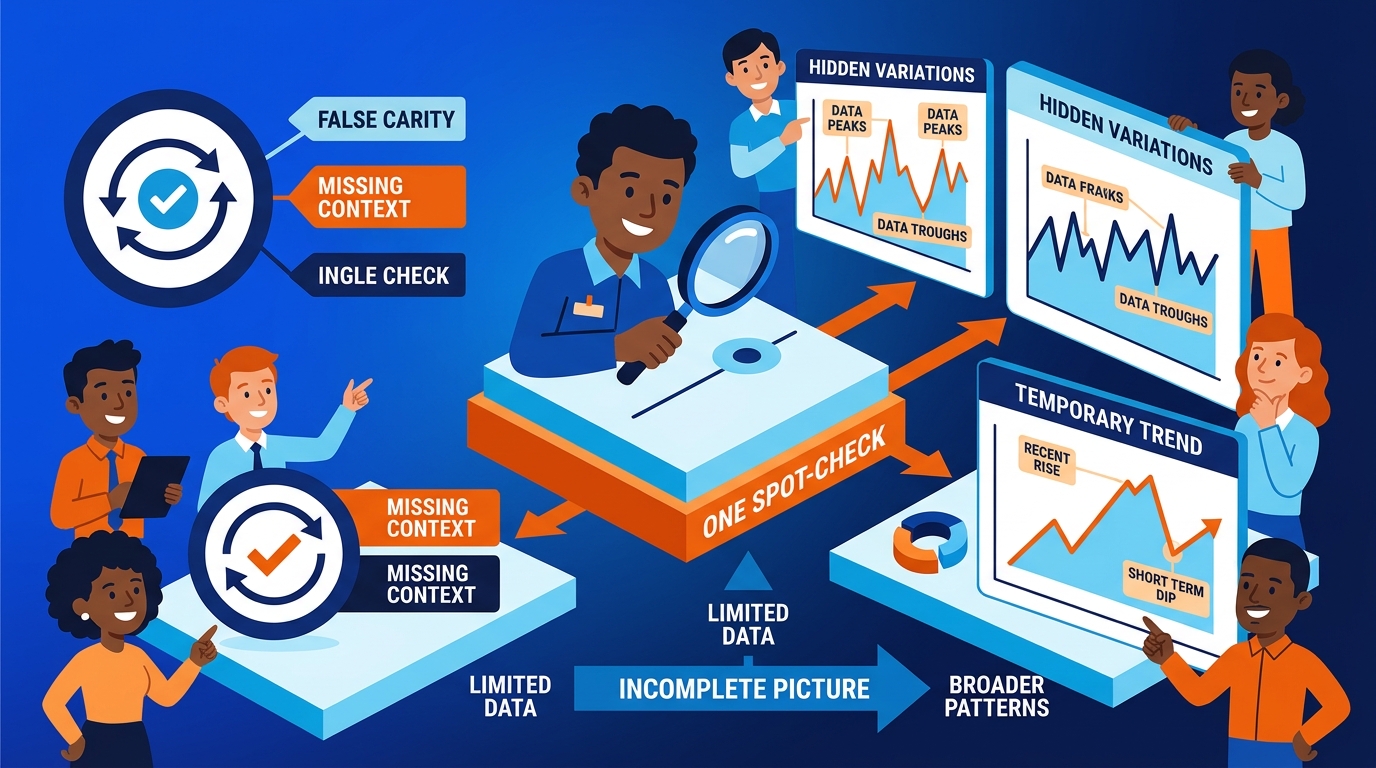
Here’s the problem with one look.
Ask ChatGPT the same local question twice, and the median result is that only 29% of the named businesses show up in both answers. That’s a bit more than 1 in 4.
See yourself in one ChatGPT answer? You have roughly a coin-flip chance of showing up in the next one.
That makes single spot-checks misleading in both directions. It’s why tracking needs repeated runs across several engines. The numbers come from ChatGPT Local Business Recommendation Statistics (2026).
I don’t use rank-tracking reports as a scorecard.
AI tools now give direct answers instead of lists of links. So where a site sits in a results list is a poor guide to whether a business gets found. I count position-tracking as an outdated success measure.
I run repeated checks instead of trusting one look.
If your practice gets named once and drops out later, see A Practice Drops Out of AI Recommendations: What Happens Next?
What Separates Businesses AI Names From Those It Skips
Here’s what goes with being named. Review volume and your existing Google standing. Star ratings barely differ.
ChatGPT names businesses with 1,000 or more Google reviews 22.2% of the time. That’s a bit more than 1 in 5. Fewer than 25 Google reviews? Only 3.4% of the time.
In another sample, businesses that AI assistants named had a median of 444 Google reviews. The ones that weren’t named had a median of 192. That’s a 2.3× gap.
Star ratings barely differed. Named businesses averaged 4.9 stars and the rest 4.8. A good rating is the entry ticket, not the tiebreaker.
Every business that AI named already ranked in Google’s top 20 for its trade and city. Every one. The Great Local Pros guide, How to get your local business recommended by ChatGPT, Gemini and Google AI, reports the review, rating and ranking figures for that sample.
The table below puts the numbers side by side.
| Measure | Finding |
|---|---|
| Named by ChatGPT, by Google review count | 22.2% with 1,000+ reviews vs 3.4% with under 25 |
| Median Google reviews, named vs unnamed | 444 vs 192 |
| Star rating, named vs unnamed | 4.9 vs 4.8 |
| Google ranking of AI-named businesses | Every one already in Google’s top 20 for its trade and city |
I treat getting picked by AI answer tools as its own discipline. It’s not old-school search work with a new label. I don’t chase keywords, inbound links or ranking position for it. I put the effort into making it easy for these systems to work out who your practice is and whether it’s credible.
Where AI Gets the Details It Repeats
Here’s where the details come from. Business websites make up 42% of all citations in AI local answers. Google Business Profile makes up 28.5%.
It shifts by industry. In healthcare, listings made up 52.6% of citations, a bit over half. Reviews and social hit their highest share, 13.3%, in food service.
An August 2026 study by Steady Demand ran about 2,900 (2,880) prompts across 12 US metros. It found Yelp grounding about 96 percent (95.83%) of structured business cards. Foursquare? None (0%).
Only about 7 in 10 (68%) of the business contact details shown by ChatGPT and Perplexity match the Google Business Profile. You can find the citation-share and contact-detail figures in ChatGPT Local Business Recommendation Statistics (2026).
I put your effort and money into what you control. Your website and your profile, with clear, credible information about your practice. I count that as visibility that keeps paying and grows. Visibility bought with ads or paid placements is rented. I count it as ending the day the spending ends.
When the Details AI Finds Are Wrong or Thin
Stale sources are the first problem. An old directory listing or a years-old page may still show your previous hours, prices or address. And the AI repeats it.
Then there’s hallucination. The AI invents a plausible detail, such as a service you don’t offer. Why? It has thin information to work from, so it fills the gap.
The result? A customer who turns up at the wrong time. Expects the wrong price. Or never contacts you because the AI implied you had closed.
Published research on provider records shows the same pattern. Inaccuracies stemmed from outdated or incorrect addresses and non-fixed locations. Records in two databases, one of them federal, were compared. A qualitative evaluation found these challenges:
- Providers who changed their names
- Providers who moved or listed different addresses in each database
- Name misspellings in either record
- Providers with incorrect taxonomies tied to their information in the federal database
Here’s your move.
Ask ChatGPT, Gemini, Google AI and Perplexity what your business does, where you are, your hours and roughly what you charge. Note anything wrong or missing. Then trace it back to the source. The MattDarm post Is AI Telling Customers the Wrong Things About Your Business? walks through this.
When your information is thin, I don’t answer with volume. I write clear, factual content in a sensible order. I hold that AI favors businesses whose information it can grasp easily. Publishing frequency doesn’t enter into it.
What Money Can’t Buy in an AI Answer
There’s no paid placement in standard AI answers. Be wary of services that promise it. That’s the answer in the Great Local Pros guide, How to get your local business recommended by ChatGPT, Gemini and Google AI.
OpenAI’s stated rules are specific. “Ads do not influence the answers ChatGPT gives you,” and ads are “always clearly labeled” and “visually separated from the organic answer.”
There’s no “ChatGPT Business Profile” to claim. You can’t log in and edit your ChatGPT listing.
I won’t sell the old search playbook. The conditions it relied on have changed. I count tactics aimed at that old landscape as a fault in the industry’s offer, not in the practice owner who paid for them.
When I weigh a provider making cheap promises of AI placement, I look past the low monthly price. The real cost is thin work, little real progress and money tied up in a contract that builds nothing.
Frequently Asked Questions
Is GPTBot the crawler that puts a site into ChatGPT’s answers?
OpenAI describes GPTBot as a training crawler. It is used to crawl content that may be used in training OpenAI’s generative AI foundation models.
Did Google’s 2021 local update change what matters for nearby searches?
Yes. Google’s December 2021 Vicinity Update placed more importance on proximity as a ranking factor. It also decreased the significance of adding keywords in a business name on Google Business Profile.
Does ChatGPT know where the person asking is?
Roughly. Even if a person gives no permission, ChatGPT “may use your IP address to estimate your general location, such as your country, state, or city.” An IP (Internet Protocol) address is the number that identifies your device on the internet. Location sharing is optional and off by default. It stays off unless you turn it on.
How many businesses does ChatGPT name in one local answer?
About four. ChatGPT names an average of 4.1 businesses in each local answer. That’s a short list. You want your practice on it.
See Who AI Names Instead of You
The AI Visibility Check shows who is named in place of your practice, which sources feed the answers, and where your details are wrong. It is free and diagnostic, and it does not sell. It is a secondary service to iTech Valet’s main work.
That main work starts with research. Before any copy is written or your website is touched, the AI Authority Engine starts with 14 steps of research, grouped into four phases. The iTech Valet Service Plans & Pricing page explains how the work is done.
Gerek Allen is iTech Valet’s founder. He had more than 20 years (20+) of entrepreneurial experience and had built over 100 digital properties. Then he discovered his own business was invisible to AI search engines.
Run My AI Visibility Check and see which competitors AI names for your practice today.