
At a decline of 1.21% a week, a full year leaves 53.1% of a page’s site visits (0.9879 raised to the 52nd power), so an untouched page loses roughly 47% of its organic site visits per year. Ahrefs found that URLs cited by AI assistants are 25.7% “fresher” than the organic search results for the same queries. Standard update posts on your Google Business Profile rotate out of the prominent spot on your profile after about seven days.
Why the Facts Behind AI Answers Go Stale

Here’s the problem with the AI tools that write answers for your customers. One study puts it this way: “LLMs face some challenges, including hallucination and the presence of outdated knowledge or missing information from specific domains in the training data.” LLMs are large language models. Hallucination means they make things up. And what they learned from can be old or incomplete.
Your world doesn’t sit still, either. Many real-world domains, meaning areas of knowledge, are inherently dynamic. Facts change. Things pick up new attributes. Relationships that were valid before become outdated (Polleres et al., 2023).
One fix has emerged as a promising solution: Retrieval-Augmented Generation, or RAG. It’s a method where an AI tool brings in knowledge from external databases instead of relying only on what it was trained on.
So here’s where I point your effort and your money. Put it into information you own: clear, credible facts about your practice. Ads and paid placements are rented visibility, and the visibility ends when the spending ends. And keep your owned information current, because it only pays off while it’s current.
How AI Engines Weigh Recent Sources

Freshness shows up in what AI cites. One study found that including a clear price and a recent timestamp (the date and time something was updated) helps a source get cited first. It helps consistently, too.
Ahrefs looked at what AI assistants cite. The URLs (web addresses) they cite are 25.7% “fresher” than the organic search results for the same queries. Organic results are the unpaid ones. That’s reported in Content Decay Statistics 2026.
Wondering where your core pages stop and your monthly content starts? I draw that line in Entity Hubs vs. Monthly Content: Where One Ends, the Next Begins.
How Google Handles Freshness, Page by Page and Query by Query
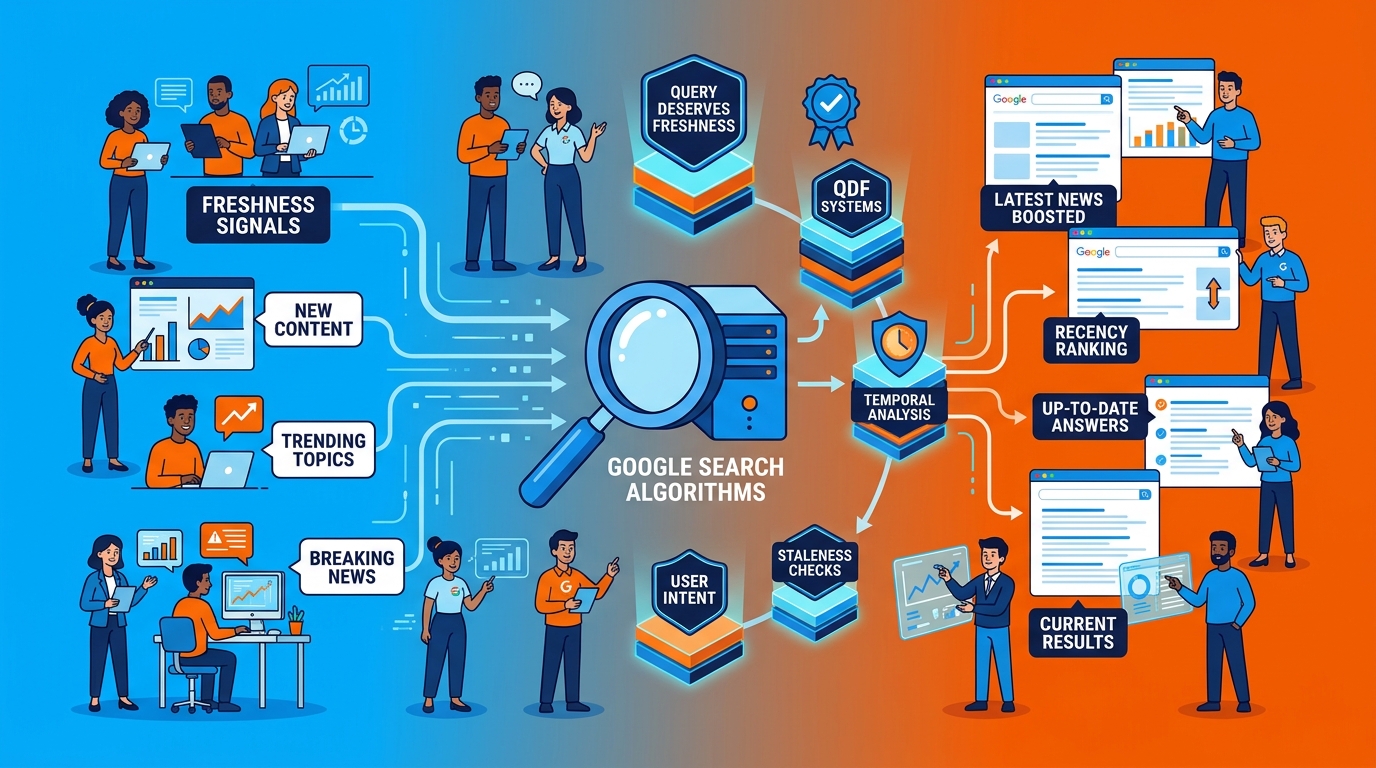
Google says it has various “query deserves freshness” systems. They’re designed to show fresher content for searches where you’d expect fresher content.
Here’s the part that matters for your practice. According to Google freshness systems by Laurelin Labs, freshness applies per query, not per site. Google judges one search at a time, not your whole site at once. The same page notes that Google has not published which specific signals its freshness systems use.
Google also looks at your site one page at a time. In A guide to Google Search ranking systems, Google says its ranking systems are designed to work at the page level. They use a variety of signals and systems to understand how to rank individual pages. Site-wide signals and classifiers are also used, and they contribute to Google’s understanding of pages.
Several times a year, Google makes significant, broad changes to its search algorithms and systems.
What Happens to Pages Once Updates Stop
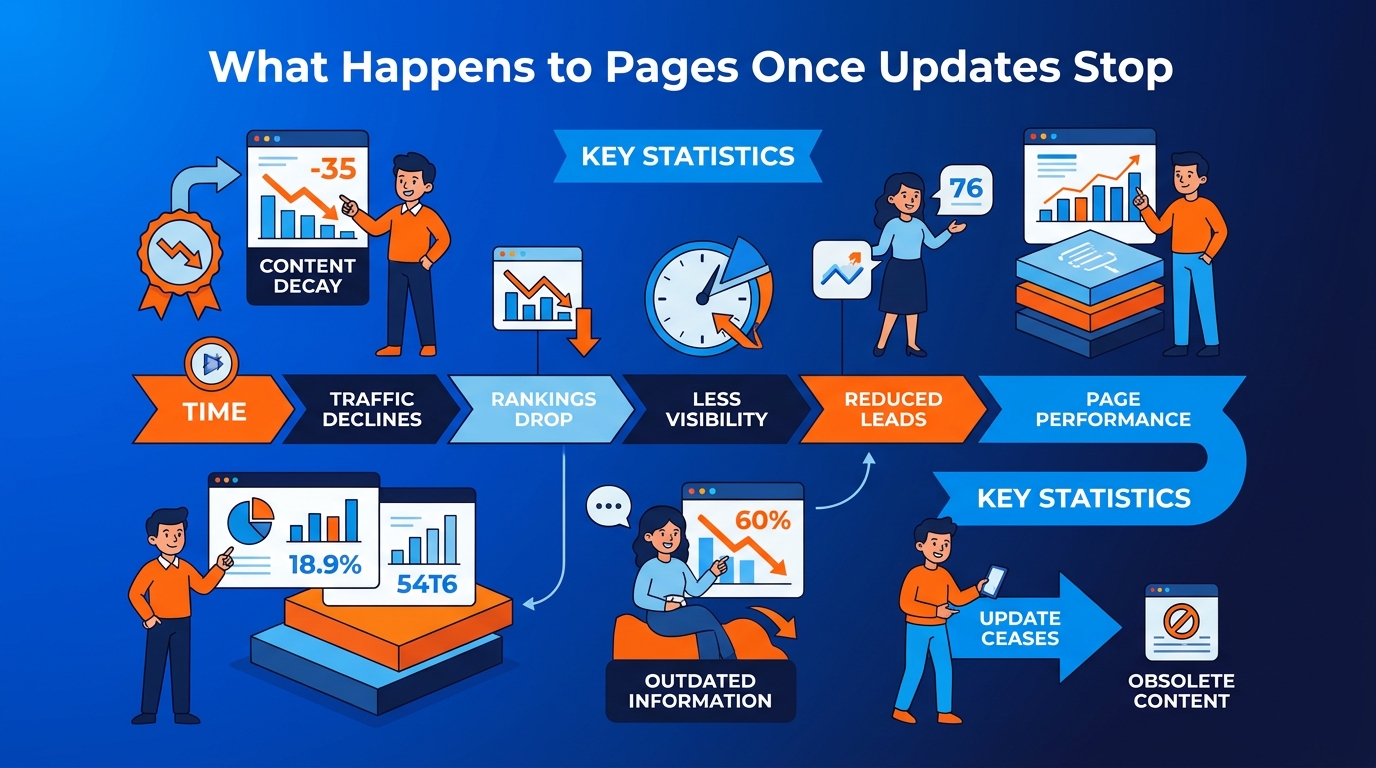
The figures below come from Content Decay Statistics 2026.
| Timeframe | What the data shows |
|---|---|
| 57 weeks, roughly 13 months | A page holding a 1.21% weekly decline keeps half of its site visits |
| 12 months (a full year) | The same 1.21% weekly rate leaves 53.1% of site visits; an untouched page loses roughly 47% of its organic site visits |
| After six months live | 90% of one successful Appcues post’s lifetime site visits arrived after this point |
| 14 months | A successful refresh returns a page to roughly where it stood 14 months earlier |
| 730 days on average | Time since content on page one of Google was last updated (spread of 143 to 1,420 days by query type) |
How Fast Organic Site Visits Fall Without Updates
Here’s what’s happening. On the AdEspresso blog, pages that were decaying lost organic site visits at an average of about 1.2% (1.21%) per week. Organic means visits from unpaid search results.
The rate compounds. So even when the percentage stays the same, the loss gets bigger in real numbers.
At that pace, a page keeps half of its site visits for 57 weeks. That’s roughly 13 months.
Now stretch it over a full year. A 1.21% drop a week leaves 53.1% of the site visits. That’s 0.9879 raised to the 52nd power, because a year has 52 weeks.
By my math, a page you leave untouched loses roughly 47% of its organic site visits per year.
What a Refresh Does Instead
Animalz found that 97% of the lifetime site visits to one successful Appcues post arrived after the initial promotional spike, and 90% arrived after the post had already been live for six months.
HubSpot updated and republished posts, and monthly organic search views to those posts went up by an average of 106%. Organic search views are views from unpaid search results.
Look at where HubSpot’s results come from, too. About 76 out of 100 monthly blog views (76%) came from posts published in earlier months. So did more than 9 out of 10 monthly blog leads (92%).
By my math, a refresh that works puts a page back to about where it stood 14 months earlier. That’s why updating a page once a year is the least you can do to keep it from sliding.
Siege Media’s April 2025 analysis of 17,749 keywords carrying 283 million monthly searches found that content on page one of Google was last updated 730 days ago on average. The average hides a spread by query type, from 143 days to 1,420 days.
Orbit Media’s 2026 survey found that bloggers who update old articles are twice as likely to report strong results.
What Happens to Google Business Profile Posts
Standard update posts on your Google Business Profile move out of the prominent spot on your profile after about seven days.
Google has never said exactly how long a post stays there. The seven-day figure comes from owners and local search-optimization trackers who have watched the pattern for years. They see standard updates lose their prominent place after about seven days, as Do Google Posts Expire? reports.
Google’s own help documentation says it plainly: Google Business Profile posts older than 6 months are archived unless a date range is set.
Offer and Event posts work differently from regular updates. They stay visible until the end date you set.
If your post disappeared within a day, it was usually rejected for breaking Google’s content rules. It usually didn’t simply run out of time.
Why Changing the Date Doesn’t Restore Freshness
Updating the date on a page does not, on its own, help it rank. Google’s byline date guidance says its systems look at several factors to estimate when a page was published or significantly updated. It asks for a prominent visible date and says visible and structured data dates should match. In Google’s words: “Ensure that the date (and optional time and timezone) match between the equivalent user-visible and structured values.”
Laurelin Labs covers this guidance on Google freshness systems. And if you want to know how the work of keeping pages current gets done, it’s laid out on iTech Valet Service Plans & Pricing.
Frequently Asked Questions
Do inbound links earned earlier keep working if publishing stops?
Many don’t last. Ahrefs looked at the links pointing to about 2 million sampled websites (2,062,173). It found that 66.5% of them, about 2 out of 3, had rotted since January 2013. Rotted means they no longer work. Count crawl errors and other blocks too, and the loss climbs to 74.5%, about 3 out of 4.
By my math from that Ahrefs data, the yearly survival rate of backlinks, which are links from other sites to yours, is 0.335 raised to the power of one ninth. That’s 0.8856, an 11.4% loss a year. The half-life is the time until half are gone. You get it by dividing the natural logarithm of 0.5 by the natural logarithm of 0.8856. That comes to 5.7 years.
Do older pages still hold top spots in Google?
Yes, many do. In a 2025 Ahrefs study, 72.9% of pages in Google’s top 10 results, about 73 out of 100, were more than three years old. That’s up from 59% when Ahrefs ran the same study in 2017.
The average #1 ranking page in Google is five years old. In 2017 it was two years old.
Do Business Profile posts help a practice’s search placement?
No. ReplyOnTheFly says a controlled test and a survey of 47 experts both point to the same answer: Google Business Profile posts do not help traditional search optimization, which is the work of getting found in Google search.
Does every search need equally fresh results?
No. Amit Singhal described three kinds of query that need different freshness: recent events or hot topics, regularly recurring events such as elections or earnings, and topics with frequent updates such as product reviews. He noted that a week-old result can be fresh for one query and stale for another.
A Finished Install Still Needs Upkeep
The moment you stop making content, competitors who are still publishing start closing the gap.
By my math, a refresh that works puts a page back to about where it stood 14 months earlier. So updating a page once a year is the least you can do to keep it from sliding.
Do you want to see whether AI assistants name your practice today? Run My AI Visibility Check