
The infrastructure is front-loaded, and the monthly execution builds on that foundation every single month. Google recommends placing your Organization information on your home page, or on a single page that describes your organization, such as the about us page. You don’t need to include it on every page of your site. AirOps says visibility isn’t earned at the time of publication. It is maintained through ongoing updates.
What the Entity Hub Holds: One Page That States Who the Practice Is
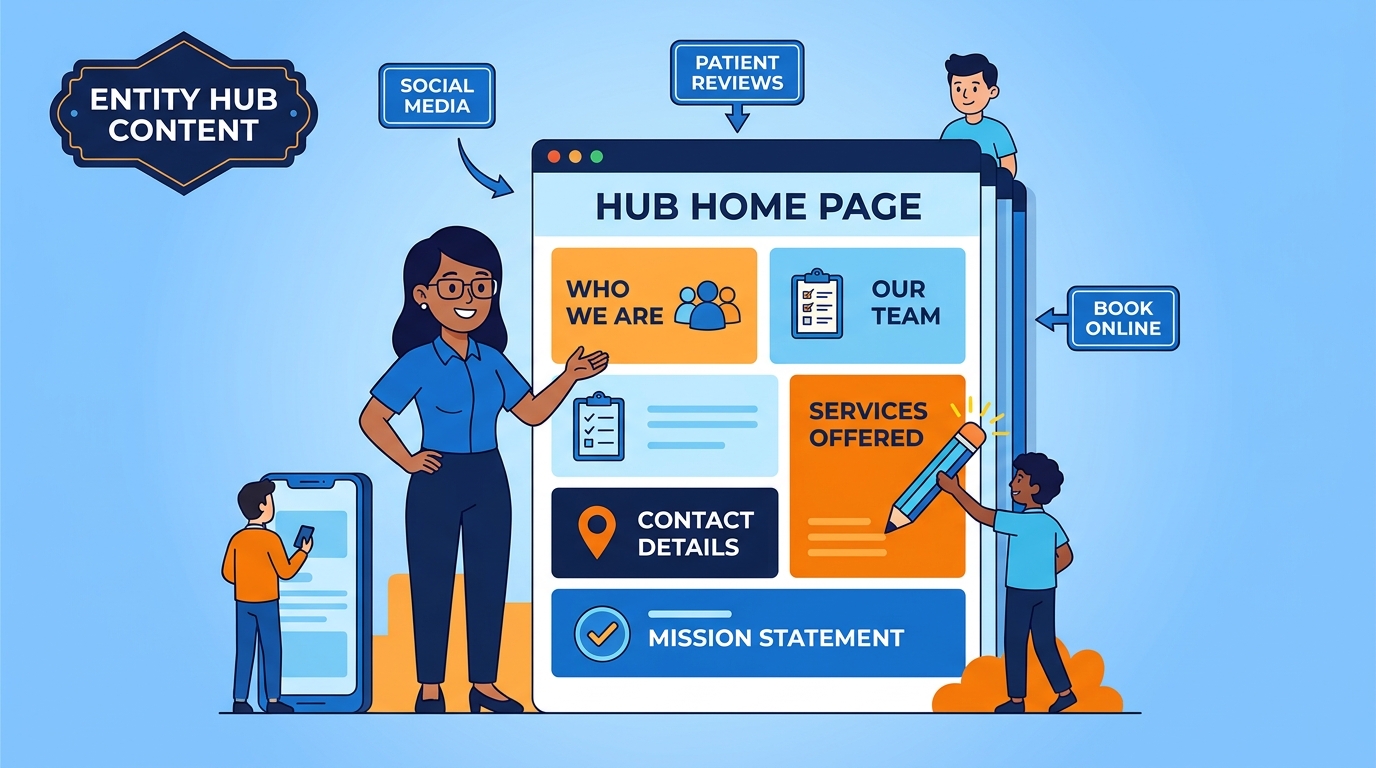
Your hub is your home page, or one single page that describes your practice, like the about us page. That’s where your Organization details live. Google recommends putting them there. You don’t need to repeat them on every page of your site.
Getting picked by artificial intelligence (AI) answer tools is its own job. It’s not old search work with a new name. I don’t chase keywords, inbound links or ranking position. These systems are trying to work out who a company is and whether it can be trusted. So I put the effort into making who your practice is easy to read. The way the parts connect is set out in How Entity Data, Schema and Content Work Together in One Build.
The table below shows what your hub states, with Google’s guidance for each part.
| Hub element | Google’s guidance |
|---|---|
| Where the Organization details go | The home page, or a single page that describes the organization, such as the about us page; not needed on every page |
| Name and alternate name | Use the same name and alternateName as the site name |
| sameAs links | The URL of a page on another website with more information about the organization, if applicable, such as a profile page on a social media or review site |
| Business type | For a local business, the most specific subtype or subtypes of LocalBusiness |
Using One Name Everywhere
Google’s Organization markup has a name and an alternateName. An alternateName is simply another name your organization goes by. Google says to use the same name and alternateName that you use for your site name.
Linking Out to the Practice’s Profiles
In Google’s Organization structured data, sameAs is the web address of a page on another website with more information about your organization, if that applies. For example, it could be your organization’s profile page on a social media site or a review site.
Choosing the Most Specific Local Business Type
If your site is about a local business, such as a restaurant or a physical store, Google recommends giving your administrative details with the most specific subtype or subtypes of LocalBusiness. A subtype is just a more exact business type listed under the LocalBusiness label.
Where the Build Ends and Monthly Work Begins
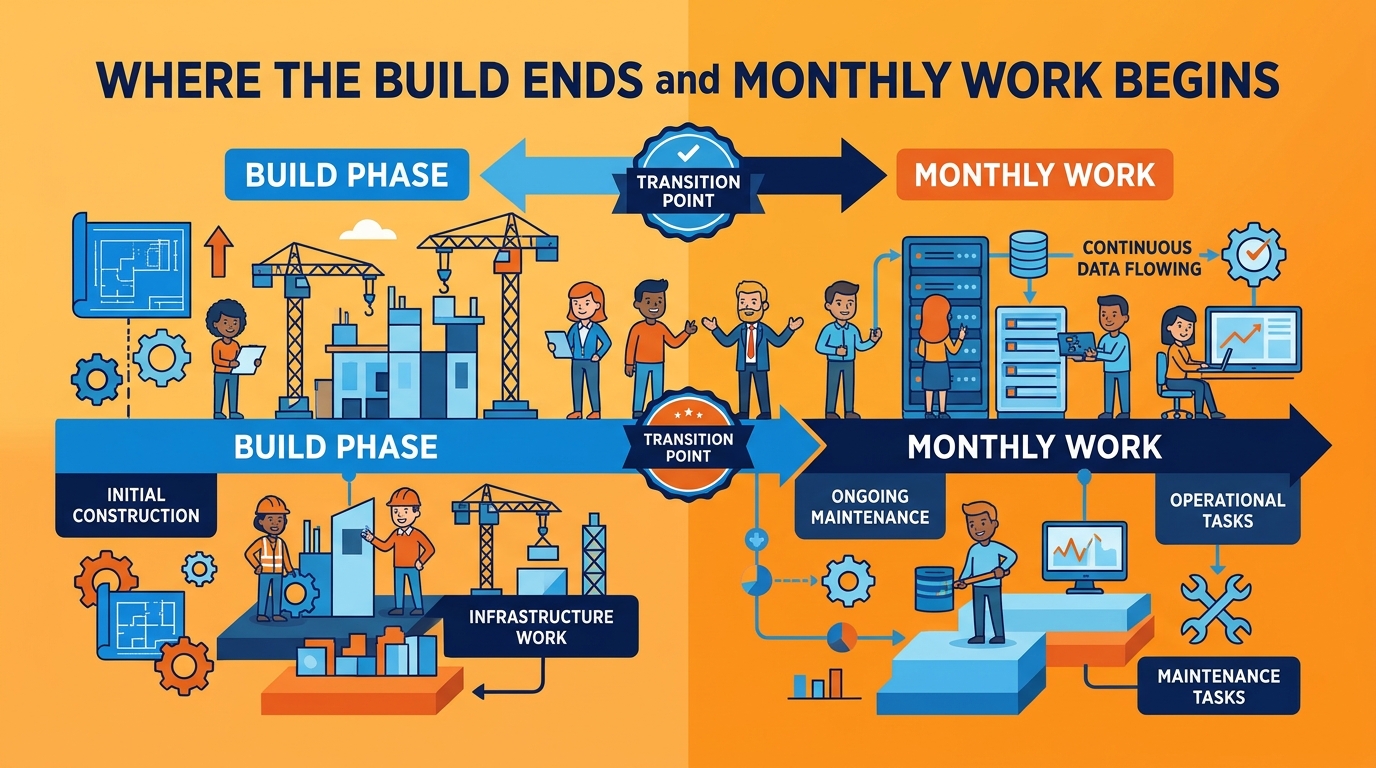
The infrastructure work gets done up front. Then the monthly work builds on that foundation, every single month.
AirOps says visibility isn’t earned at the time of publication. It is maintained through ongoing updates. The way the build and the monthly work fit together is laid out in Setting Up a Full AI Authority Engine: How the Pieces Fit Together.
What Local AI Answers Draw On, and What Monthly Work Keeps Current
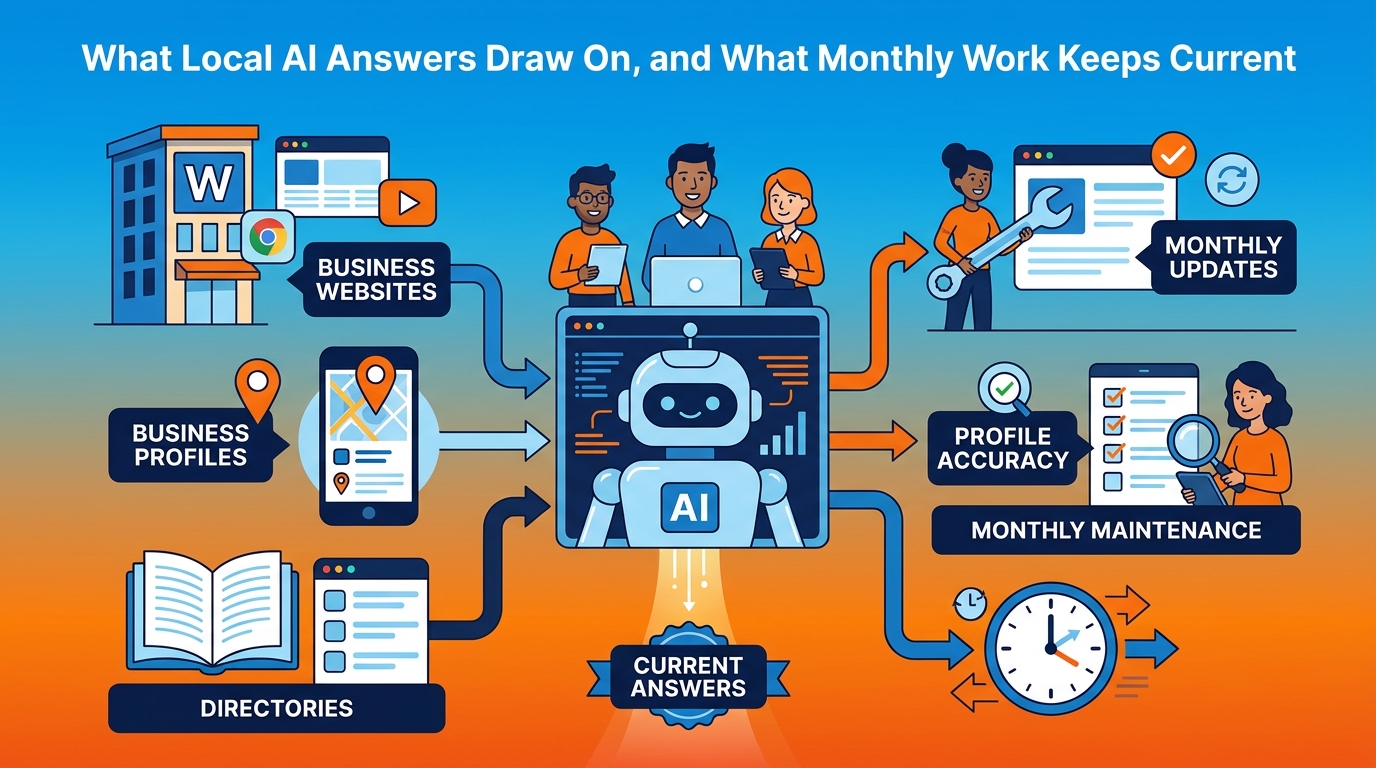
Here’s what local AI answers draw on: business websites, Business Profiles and directories.
Count by unique domain, and BrightLocal found that more than nine in ten (93%) of the sources used in local AI answers were business websites. Count by citation, and those business sites made up about four in ten (42%) of all citations. In What 200k local AI searches tell us about what businesses get recommended, Google Business Profile made up a little more than one in four (28.5%) of all citations across ChatGPT, Google AI Mode, and Google AI Overviews. BrightLocal’s recent research also found that large language models used 415 different directories as sources when they looked for information on local businesses. Google Business Profile, Yelp, Facebook, and TripAdvisor led the list.
I build your practice’s own website to be the source an AI names and draws on, not one more line in a list of businesses. Being relied on counts for more than just being there.
Plenty of small businesses let these sources go stale. The upkeep figures below come from BrightLocal Report: Small Businesses Losing Online Visibility and Are small businesses underestimating Google? (SMB Marketing Report 2026).
Profiles and Listings
BrightLocal reports that more than four in five small businesses (85%) say they own a Google Business Profile. But only about one in three (35%) keep it active. And about one in five (21%) haven’t updated their profile in over three months.
Health and medical businesses lead the way when it comes to active websites (58%, a little over half) and active Google Business Profiles (52%, about half).
BrightLocal advises you to make your address easy to find on your website. It also advises you to keep your NAP (name, address, and phone number) the same across your listings and mentions on other sites.
If you don’t keep your information up to date, and you don’t gather reviews across the top sites, AI tools may show old information about your practice. They may also fail to show it at all.
The Practice’s Own Site
BrightLocal says to keep the structure simple. Have obvious location pages and service pages. Answer the common questions clients ask.
If any content on your website feels out of date or wrong, update it or take it down. That way it can’t cause confusion.
Why One Check of AI Answers Isn’t Enough
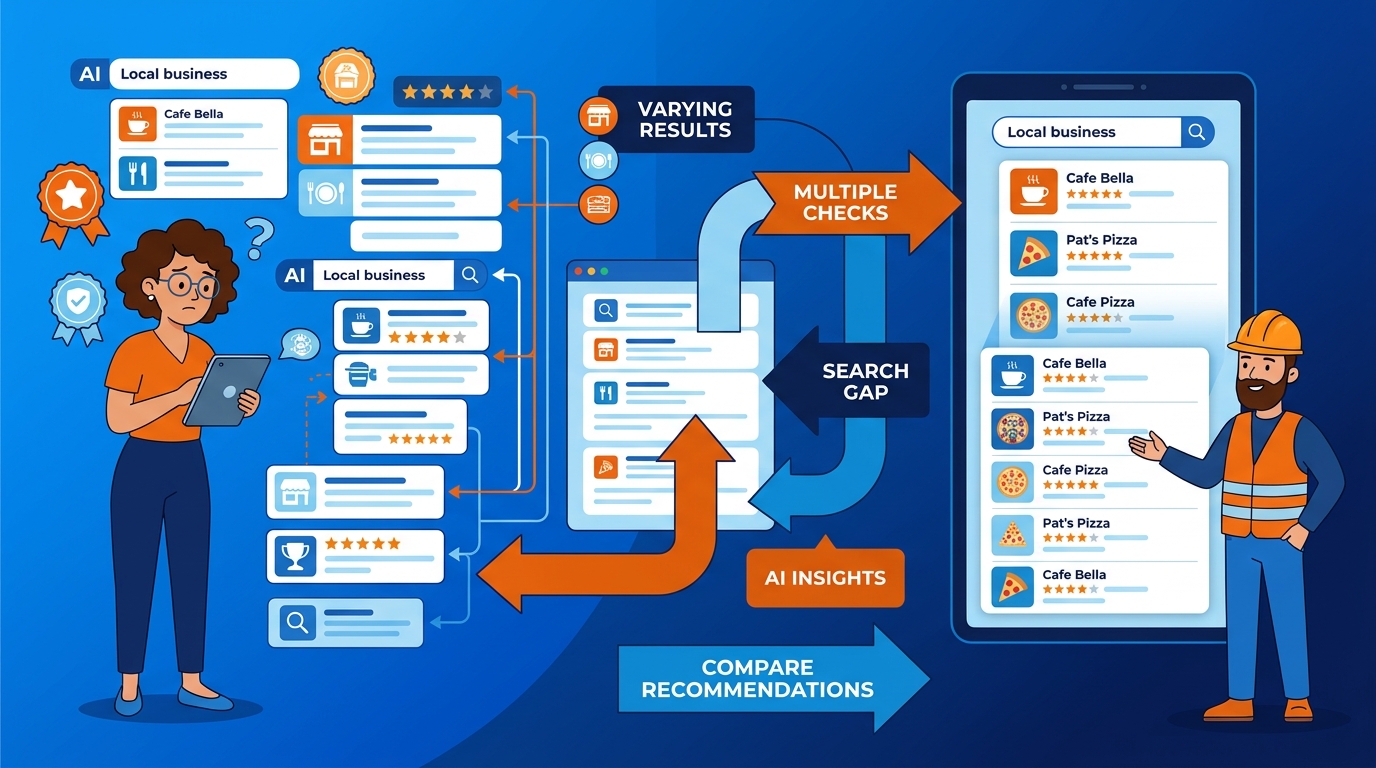
Here’s the gap, from What 200k local AI searches tell us about what businesses get recommended. In BrightLocal’s study, Google Maps mentions a tracked business in 66% of searches. That’s about two out of three. On AI surfaces, the places where artificial intelligence (AI) gives answers, the figure is 32-38%. About one out of three.
Now run the same search again. Result sets on repeat searches overlapped by only 20-33% on average, about one fifth to one third. By tool, that was 23% for ChatGPT, 21% for AI Mode, and 33% for AI Overview.
That overlap number compares whole result sets. Persistence is different. It tracks a single business. When a business shows up once in a local AI answer, it’s seen again in about half of later attempts. That’s 50% for ChatGPT and AI Mode, and 58% for AI Overview.
BrightLocal recommends you track your presence in artificial intelligence answers. Also note who else is being mentioned or cited, over a period of time.
I no longer treat a rank position as a measure of success. Answers now come as direct replies, not lists of links. And they shift. A single position number looks neat, but it doesn’t tell you if your practice gets named. So I watch the changing answers. And I watch the names that show up beside yours.
How Recently Cited Pages Were Updated
More than 70% of the cited pages in the AirOps study were updated within the past 12 months. AirOps says freshness is now a baseline requirement for gaining AI visibility. Pages not updated in over a year are more than 2X as likely to lose citations, and market share to competitors. The AirOps report is How Stale Content Costs You AI Citations.
Even in slower-moving industries, over 30% of the cited Healthcare & Wellness content, about 3 in 10 pieces, was refreshed in the past six months. AirOps says that shows growing urgency as the competition to be seen by artificial intelligence gets stronger.
In fast-moving industries like SaaS, Finance, and News, the freshness window is narrow. AirOps says content there must be updated at intervals of less than 3 months to keep its competitive visibility. In slower-moving fields, such as Education or Research, evergreen content can stay relevant for 12 months or more before updates are needed.
The table below sets the AirOps freshness findings side by side.
| Industry pace | Example verticals | Freshness window |
|---|---|---|
| Fast-moving | SaaS, Finance, News | Updates needed in less than 3 months |
| Slower-moving | Education, Research | Evergreen content can stay relevant 12 months or more before updates |
| Healthcare & Wellness | Health and wellness content | Over 30% of cited content refreshed in the past six months |
Wondering what follows when updates stop? It’s covered in What Happens If Monthly Content Publishing Stops After Setup?
What Google Says About Publishing Volume
Google asks you a question. Are you adding a lot of new content, or removing a lot of older content, mainly because you believe it will help your search rankings overall by making your site seem “fresh”?
Its answer is no. It won’t. That comes from Creating Helpful, Reliable, People-First Content.
Explaining Scaled Content Abuse from PPC Land says text written by an artificial intelligence (AI) tool, by a team of freelance writers, or by a template filled in from a spreadsheet can all count as scaled content abuse. That’s true as long as the volume is high, the added value is low, and the purpose is ranking.
Google’s guidance goes further. Making pages automatically from data feeds, or using generative AI to produce large amounts of text without a person overseeing or curating it, shows little to no effort.
I push back on the idea that more posts win. I write for how easily AI can grasp your practice’s information. Not for how much gets published.
So I write clear, factual pages. I put them in a sensible order. And I don’t count output.
Google Business Profile Posts as a Monthly Task
You can currently choose from three types of Posts on a Google Business Profile: Update Posts, Offer Posts, and Event Posts. BrightLocal covers them in A Guide to Google Business Profile Posts.
BrightLocal says the people who read your update posts are very different from the people who might keep up with your blog posts. BrightLocal’s research on profiles includes its Google My Business Insights Study.
On events, BrightLocal says one of the best moves is to have your own events on your website, on a unique page for each one, marked up with event schema. Event schema is code that tells search engines the page is about an event.
Posts can also be rejected if they have phone numbers or other contact details in them.
Want to know how this work gets done? It’s laid out on the iTech Valet Service Plans & Pricing page.
Frequently Asked Questions
Does Google require any particular fields in Organization markup?
No. Google’s Organization structured data has no required properties. That means no fact you must fill in. Google recommends you add as many properties as are relevant to your organization.
Is there a publishing rate that triggers Google’s spam policy?
Not a published one. Google has never said what number of pages, how fast you publish, or what ratio sets it off. Nothing in its documentation makes volume alone a violation.
Do Google’s spam rules apply to AI Overviews and AI Mode?
Yes. On May 15, 2026, Google said its spam policies apply to answers written by artificial intelligence in Search. That includes AI Overviews and AI Mode.
Does Google prefer a set word count for monthly articles?
No. Google says it has no preferred word count. So don’t write to a set length because you heard Google likes one. You don’t need to.
What can a health practice post on its Business Profile?
Under Google’s rules for posts, a business offering products or services in a regulated industry is allowed to use posts. It can’t post content related to the products themselves.
Start With What AI Says Today
The hub states who your practice is. Once. On one page. The monthly work keeps everything around it current.
The infrastructure work is done up front. Then the monthly work builds on that foundation every single month.
Google recommends you put your Organization information on your home page, or on one single page that describes your organization, such as the about us page. You don’t need it on every page of your site.
I put your effort and money into what you own: clear, believable facts about your practice. They keep paying off and they grow. I steer away from visibility bought through ads or paid placements, because it stops when the spending stops.
iTech Valet builds that foundation and handles the monthly AI Authority content work for practice owners, white-glove, so you do nothing.
Ready to see what AI says about your practice right now? Run My AI Visibility Check.