
What Actually Happens to AI Recommendations When a Practitioner Departs
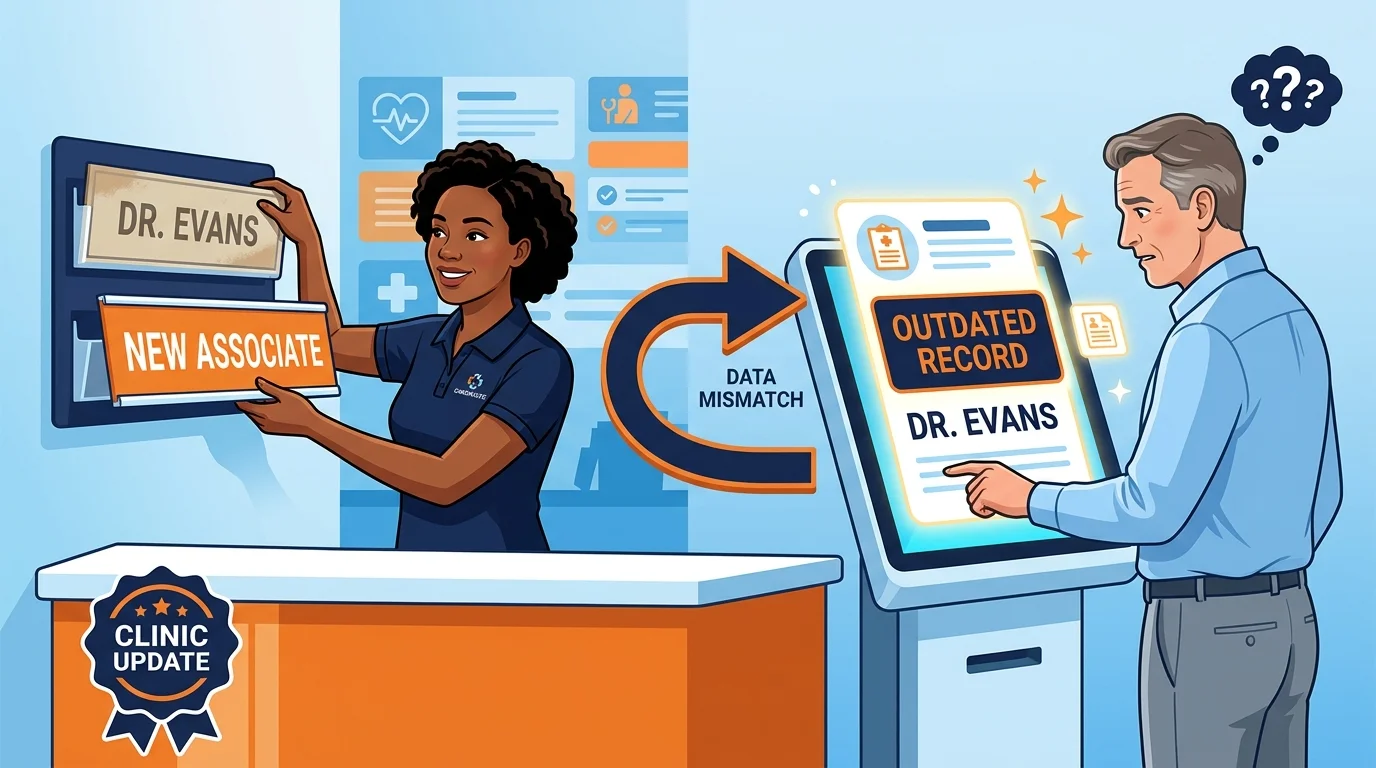
Here's the thing: AI recommendation engines can boil mountains of public data down into one convenient answer. That's exactly where it breaks. The engine may have no clue anyone left, because it only knows what the data says (and the data still says the former associate works there).
A practitioner walks out the door, but the digital trail stays behind in dozens of databases and directories, every entry tagged to the same address and phone number. So working out who AI trusts starts with how to make a clinic's details consistent across the web, the ledger of affiliations this whole mess keeps circling back to. Old-school search work cared about consistency too, sure, but here's the kicker: the machine now turns those signals into one sentence a patient reads as fact, not a list of links to compare.
Why Listing-Chasing Can't Keep Up With a Departure
Most practices react to a departure the same way: they start chasing listings. Someone spots a wrong entry, fixes it, then goes hunting for the next one (and the next, and the next).
That reflex treats the symptom. Not the condition. It patches one line in a scattered ledger of affiliations and never tells the AI which account it should trust first.
The Problem With Treating a Directory Listing as Proof of Current Staff
Let's keep it real: a directory listing doesn't prove who works at a practice today. It's a snapshot, written once, and it keeps aging long after the people in it have moved on.
Treating a listing as current status rather than historical record is where entity confusion starts. The AI reading that listing may not be able to tell a snapshot from a live feed unless something else tells it which one it is looking at.
Why Manual Directory Updates Fall Behind the Moment They Start
Manual updates fall behind the second they start, because each fix only covers the platform it was made on. Meanwhile, dozens of other databases keep carrying the stale affiliation, untouched.
Being a listed address was never the same as being the cited source. One entry corrected by hand does nothing to resolve the conflict across the rest of the ledger, which is why keeping AI systems current after a clinic moves matters as much after a departure as it does after a move.
How AI Models Actually Decide Which Practitioner Record to Trust
An AI model doesn't vote on truth. It may weigh sources against each other and pick the one it trusts most at the moment someone asks. That weighing is called entity resolution, and it can run on consistency signals, not certainty.
So why does a departed associate's data hang around in AI answers? Two mechanisms explain it: how the model pulls in fresh facts, and how it builds the structured map of who works where.
| System Component | What It Does | Where Stale Data Slips In |
|---|---|---|
| Retrieval Layer | Pulls current facts from external databases at query time instead of relying only on trained knowledge | A directory or listing still tagged to a departed associate can get retrieved as though it were an active, current fact |
| Knowledge Graph | Maps the relationships between a practice, its practitioners, and the services each one performs | Extraction systems may read a relationship once and have no built-in signal that the relationship has since ended |
| Entity Resolution | Weighs competing sources against each other to decide which one represents the current, trustworthy record | Conflicting signals across dozens of directories leave the model choosing between a stale snapshot and an outdated bio |
| Source Consistency Signal | Checks whether a practice's name, address, and staff details match across the sources the model can see | A single corrected listing may do little when the rest of the ledger of affiliations still disagrees with it |
How Retrieval-Augmented Systems Pull in Fresh Practice Data
Retrieval-Augmented Generation lets a model grab current facts from outside databases instead of leaning only on what it learned during training.
A survey by Gao et al. found retrieval-augmented generation may allow generative AI models to incorporate knowledge from external databases and receive continuous knowledge updates.
The whole point is to keep answers current.
But a retrieval system is only as current as the database it queries. If a directory still lists a departed associate as active staff, the model may retrieve that stale record as though it were fresh.
The practice's own site becomes the one entry in the ledger that can out-rank every outdated listing, provided it is the clearest, most consistent account available. For the mechanics of making a name change stick everywhere the model looks, see technical steps for renaming a clinic online.
Why Information Extraction Falls Behind a Changing Knowledge Graph
A knowledge graph maps the relationships between a practice, its practitioners, and its services. Building that map depends on information extraction systems reading those relationships off the web.
In academic work on updating Wikidata, Zaporojets et al. (EMERGE) report existing information extraction methods may operate largely independently of the current state of a knowledge graph, which can leave questions about updating outdated facts unaddressed.
Many real-world domains keep changing, and a staff departure is exactly that kind of change. The extraction process may have no built-in signal telling it the relationship it once read is now false.
The Data Authority Problem Behind Every Outdated AI Answer
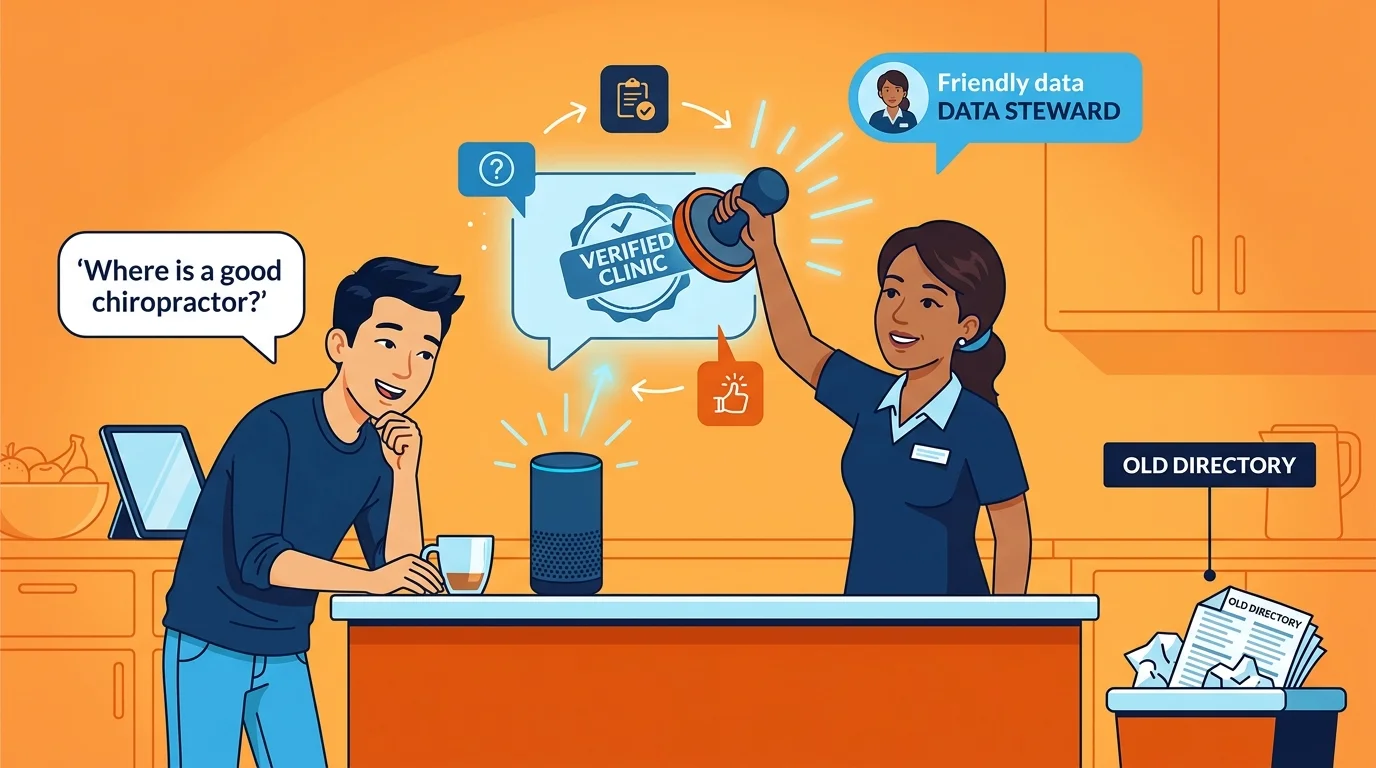
Here's the verdict: once a model has to pick between conflicting entries, being the cited source beats being a listed address. A practice's own site is the one line in the ledger it actually controls, so it can out-rank a stale directory snapshot as long as it stays the clearest, most consistent account (and directories compete on consistency, not accuracy, which is something a practice can set on purpose instead of leaving to luck). Clinics that want that consistency built and kept up can look at done-for-you AEO services instead of chasing every listing by hand.
| Finding | Population Measured | Why It Matters for Practice Data |
|---|---|---|
| 58% of U.S. adults saw an AI-generated summary from at least one Google search | 900 U.S. adults' browsing data, Pew, March 2025 | Some patients may see the summary before the practice's site |
| Trust in AI was strongly associated with willingness to act on its health information | 4775 adult internet users, Czech Republic, cross-sectional survey | Trust can shape whether a patient acts on the summary |
What Patient Reliance on AI-Generated Answers Means for Practice Data
In a Pew analysis of 900 U.S. adults' browsing data, the Pew Research Center reports about six in ten U.S. adults (58%) may have conducted at least one Google search in March 2025 that produced an AI-generated summary. So some patients may see the summary before the practice's site. Trust can shape whether that answer gets acted on at all. Švestková, Huang & Šmahel (Digital Health, 2025) found trust in AI was strongly associated with willingness to use AI for health information in a survey of 4775 adult internet users in the Czech Republic.
Where a Departed Associate's Footprint Actually Breaks Down
Here's where the data chain actually snaps: the fight between a practice's website and a dozen directory listings that can't agree. There's no neutral referee for the AI to call. It may pick which account to trust, and whatever it picks is what a patient reads as fact.
Why Structured Data Markup Fails Silently When It's Incomplete
More markup does not settle that contest. A practice can tag every page it owns, yet still lose the trust decision if the structured data describes a staff roster the directories contradict. Volume of tagging is not the variable that resolves entity confusion; consistency between what the markup claims and what every other source repeats is.
The Operational Sequence for Reclaiming Entity Authority After a Departure
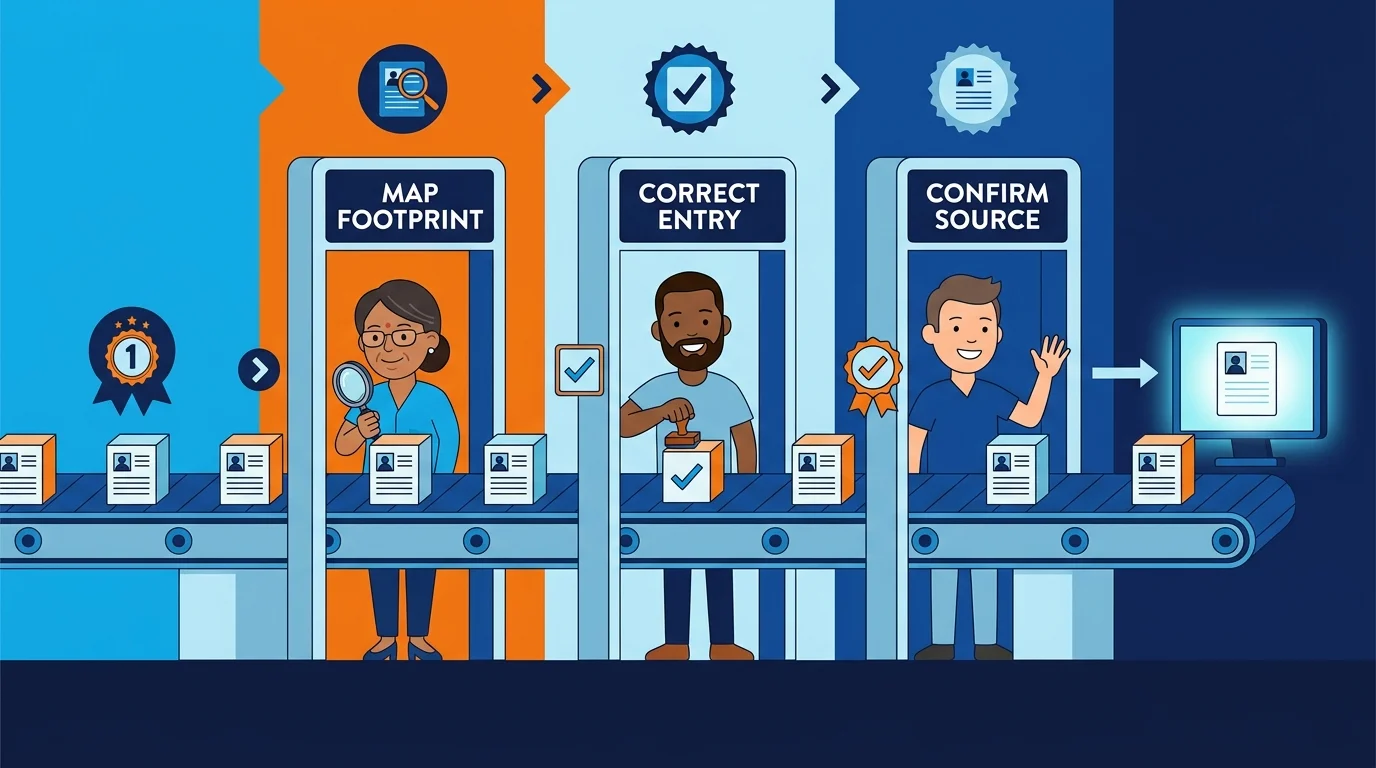
One edit won't fix entity confusion. It takes a sequence, and the order matters every bit as much as the moves themselves.
| Step | What Happens | Risk If Skipped |
|---|---|---|
| Full Inventory | Every directory, licensing board, insurance panel, and review platform still carrying the departed associate's name gets mapped in one list before any edits begin. | Corrections start blind, missing listings keep feeding the model stale affiliations long after the visible ones are fixed. |
| Anchor Correction | The practice's own site and primary structured data get updated first, because that's the part the practice controls. | Low-authority listings get corrected first, handing the model more conflicting snapshots instead of a clear reference point. |
| Directory and Platform Updates | Each mapped listing gets brought into line with the now-corrected anchor account, in the order the inventory surfaced them. | Scattered manual edits leave dozens of untouched databases still repeating the former associate's name. |
| Ongoing Consistency Monitoring | The corrected ledger gets checked on a recurring basis, since directories and platforms can quietly revert or re-import stale data. | A one-time fix erodes as unmonitored sources drift back out of alignment with the anchor account. |
Mapping the Directory Footprint Before Touching Anything
The first step is an inventory, not a correction. A practice needs a full map of every directory, licensing board, insurance panel, and review platform still carrying the former associate's name before anything gets changed.
Sequencing Corrections So AI Systems Don't Re-Learn the Wrong Thing
Fix things out of order and the model may learn the wrong lesson, because updating low-authority listings before the practice's own site is current just hands it more conflicting snapshots to weigh. So the practice's own record gets corrected first, because it's the part the practice controls. Directories and platforms come next, once that anchor entry in the ledger is accurate and consistent.
Frequently Asked Questions
That sequence leaves a few mechanical questions on the table. Here are the ones practices ask most about timing, impact and process.
How long does it take for AI to update a former associate's information across all platforms?
No model guarantees a timeline for propagating a correction. Retrieval-based systems can surface updated facts, but each directory still updates on its own schedule. The safest assumption is that stale listings persist until each source is individually corrected.
Can a departed associate's old listings negatively impact my clinic's new patient flow?
It can. A stale affiliation surfacing in an AI-generated summary may be the first thing a prospective patient reads. If that summary names the wrong practitioner, the patient may not look further before forming an impression.
What is the first step to fix incorrect AI recommendations about my practice's staff?
Inventory before correction. Map every directory, licensing board, insurance panel, and review platform still carrying the former associate's name, then correct the practice's own site first so every later fix has an anchor to match against.
How can I proactively monitor what AI systems say about my clinic's current practitioners?
Periodically query the major AI assistants directly, asking who currently practices at the clinic. Treat any wrong answer as a signal pointing back to a specific stale source, not as a one-time check to run once and forget.
Does updating my website alone resolve the conflicting data across directories?
No. A corrected website gives the model one clean entry, but a dozen conflicting directories can still outweigh it. Resolving the conflict requires updating the surrounding ledger of listings, not just the practice's own page.
The Bottom Line
A former associate walking out the door doesn't wipe the ledger clean. It leaves the practice's own account as the one entry that can outrank every stale directory snapshot still floating around the web.
Outranking those snapshots is not automatic. It can happen when the practice's own data is the clearest, most consistent account an AI model can find, so the model has a reason to trust it over a dozen conflicting listings.
So stop chasing directories one by one after the damage is done, because that never settles who the AI believes. If you want to see exactly where your ledger still fights the record, start with an AI Visibility Check.