
In a study of what people search online about sciatica, Question 1 was “How to reduce inflammation of the sciatic nerve?”, Question 2 was “How to cure sciatica?”, Question 3 was “Where is the sciatic nerve located?”, Question 4 was “How to reduce inflammation of the sciatic nerve with drugs?” and Question 5 was “How to sleep with sciatica?”. Sciatica is an old, broad term that can refer to any back or leg pain, but in most cases it refers to pain that radiates from the buttock and lower back to the lower leg and foot. A list of herniated lumbar disc questions in Medicine included question 11: is it advisable for a patient with an acute herniated lumbar disc to do daily activities, or is it better to rest and lie down? Research based on interviews and open-ended answers has consistently shown that one of the main needs of people with sciatica is clear and simple information about their condition.
The Sciatica Questions Patients Search Most
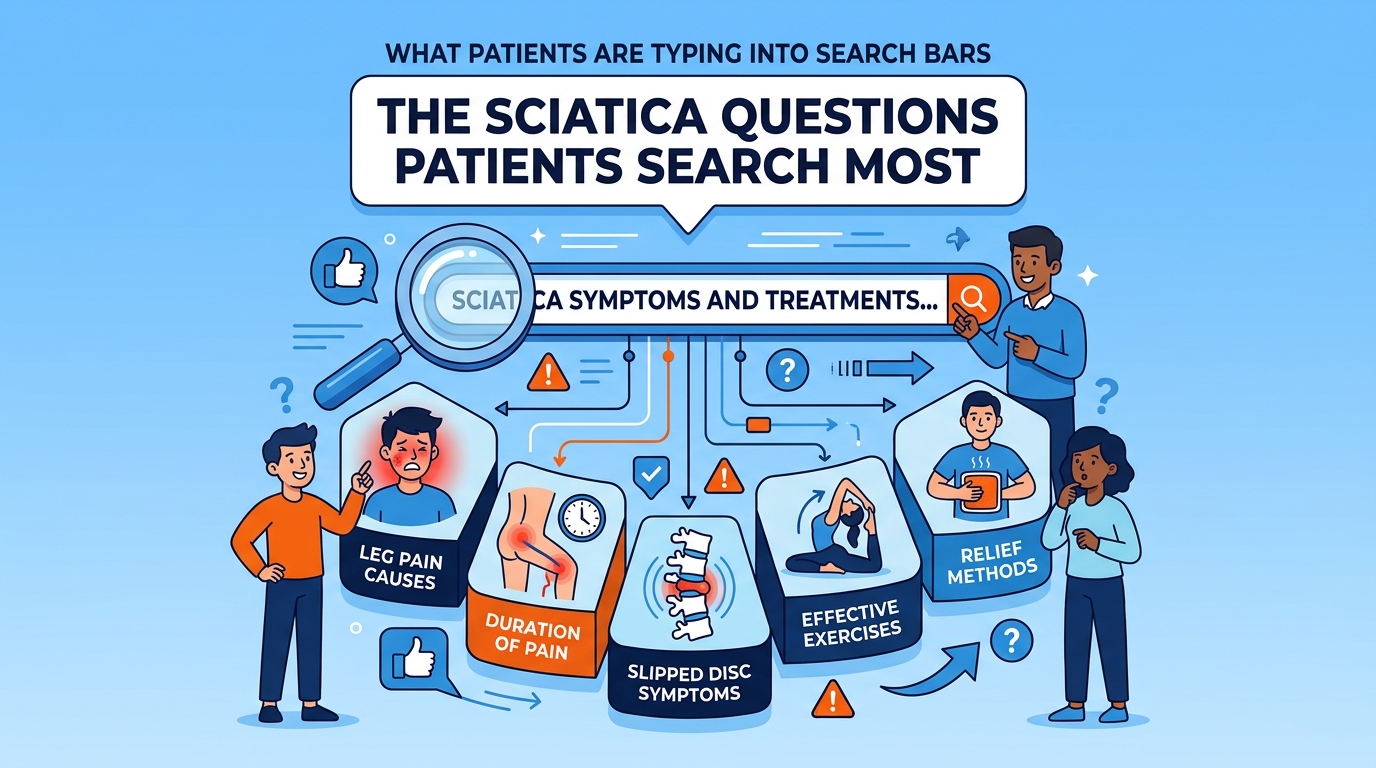
Here’s what patients are typing into search bars. In a study in Archives of Physiotherapy, What do people search online about sciatica? What answers do they get from Dr. Google?, the search volumes for the questions ranged from 750 to 8,100 searches a month.
The study numbered its questions. Question 1 was how to reduce swelling and irritation (inflammation) of the sciatic nerve. Question 2 was how to cure sciatica. Question 3 was where the sciatic nerve is located. Question 4 was how to reduce inflammation of the sciatic nerve with drugs. Question 5 was how to sleep with sciatica.
Look at what those questions are really asking. Four of the five want relief: easing the nerve’s inflammation, easing it with drugs in Question 4, curing sciatica, or sleeping with it. Only one asks where the nerve is.
The most-searched keywords tell the same story. They included remedies for sciatica, like quick ones, homemade ones and exercise. They also included ways to manage pain and inflammation with and without drugs, sciatica symptoms, and the sciatic nerve itself.
One more thing worth knowing. Sciatica is an old, broad (umbrella) term that can refer to any back or leg pain. In most cases, though, it refers to pain that radiates from the buttock and lower back area down to the lower leg and foot.
The table below lines up each search question or keyword with what it asks for.
| Search question or keyword | What it asks for |
|---|---|
| How to reduce nerve inflammation with drugs | How to reduce inflammation of the sciatic nerve with drugs (Question 4) |
| How to reduce nerve inflammation without drugs | Ways to manage pain and inflammation without drugs (a most-searched keyword) |
| How to cure sciatica | How to cure sciatica (Question 2) |
| Where the sciatic nerve is | Where the sciatic nerve is located (Question 3) |
| How to sleep with sciatica | How to sleep with sciatica (Question 5) |
| Remedy keywords: quick, homemade, exercise | Remedies for sciatica: quick ones, homemade ones, exercise |
The Questions Patients Bring to the Clinic
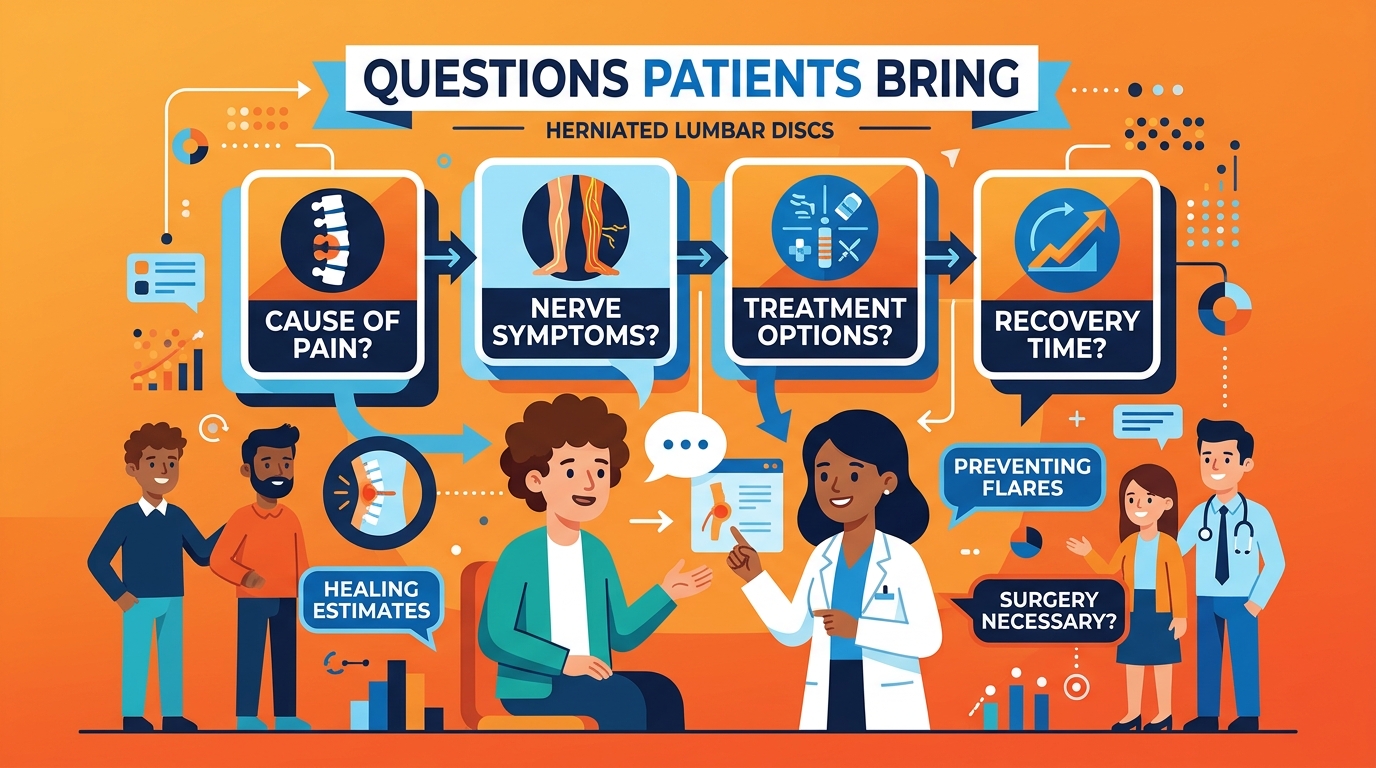
A study in Medicine listed questions about herniated lumbar disc. Question 1 was what a herniated lumbar disc is. Question 2 was what the reasons for herniated lumbar discs are. Question 3 was what the treatment is. Question 4 was when patients with herniated lumbar discs should undergo surgery. Then Question 11 asked whether a patient with an acute herniated lumbar disc should do daily activities, or rest and lie down.
Another study, Are large language models valid tools for patient information on lumbar disc herniation?, combined questions into one pool of 133. The researchers then ranked them to find the top 10 topics that came up most often. One of the questions asked: “What are the most common symptoms of lumbar disc herniation, and how are they different from other back issues?”
The study Can ChatGPT support patient–physician communication regarding spine disorders? used 7 questions. They were developed from clinical experience and from watching which questions patients asked most often at outpatient visits for back pain and for wear-related (degenerative) diseases of the lower spine. Question 7 was: “My back pain is getting worse. What should I do?”
Why Patients Search Before They Call
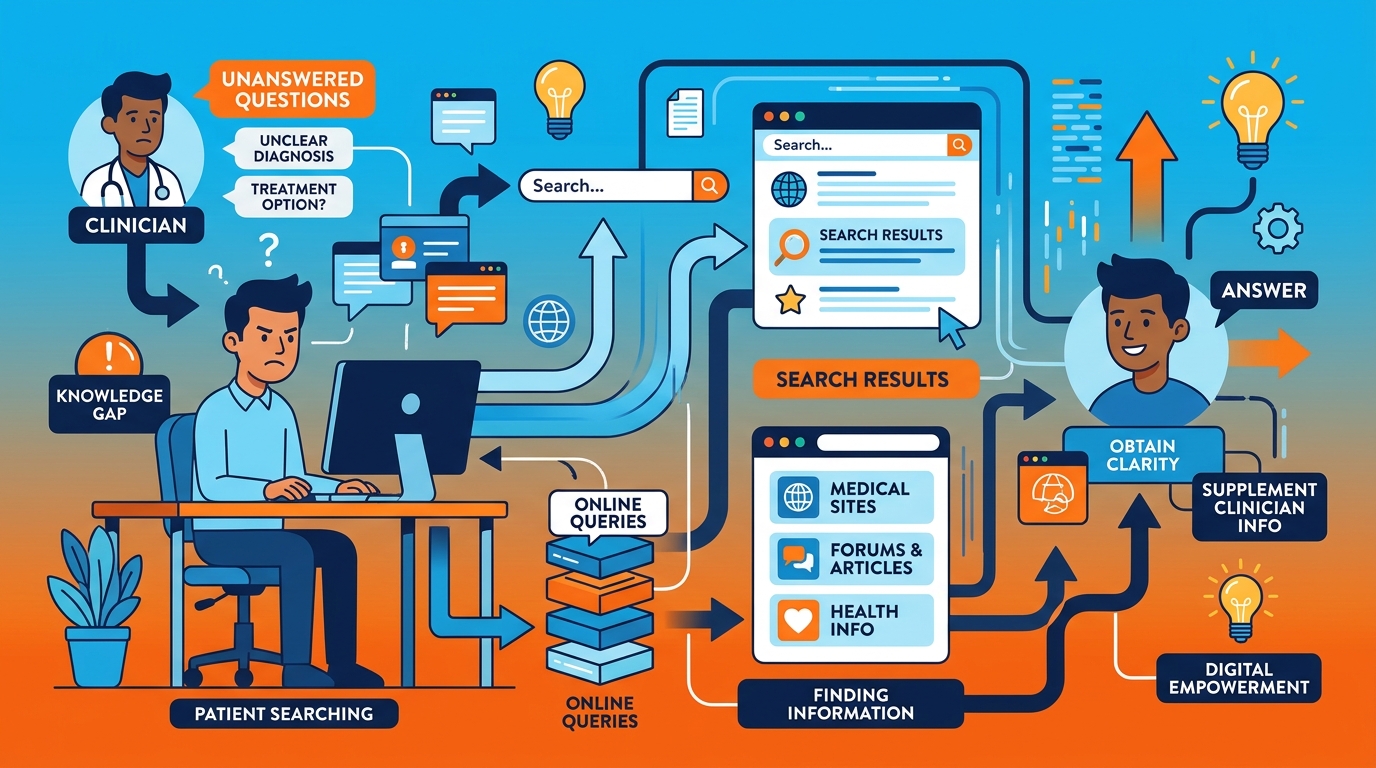
Patients now search online to find answers their clinicians did not give them.
Research based on interviews and open-ended answers has so far shown, again and again, that one of the main needs of people with sciatica is clear and simple information about their condition.
Earlier studies found that about half (approximately 50%) of patients with various conditions have “navigational needs.” That means they need to seek out more types of online health information, from a wider mix of sources.
Access plays a part too. Owing to limited access to physicians and restricted clinical hours, many patients with a herniated lumbar disc have difficulty getting sufficient medical information.
How Many Patients Now Ask AI First
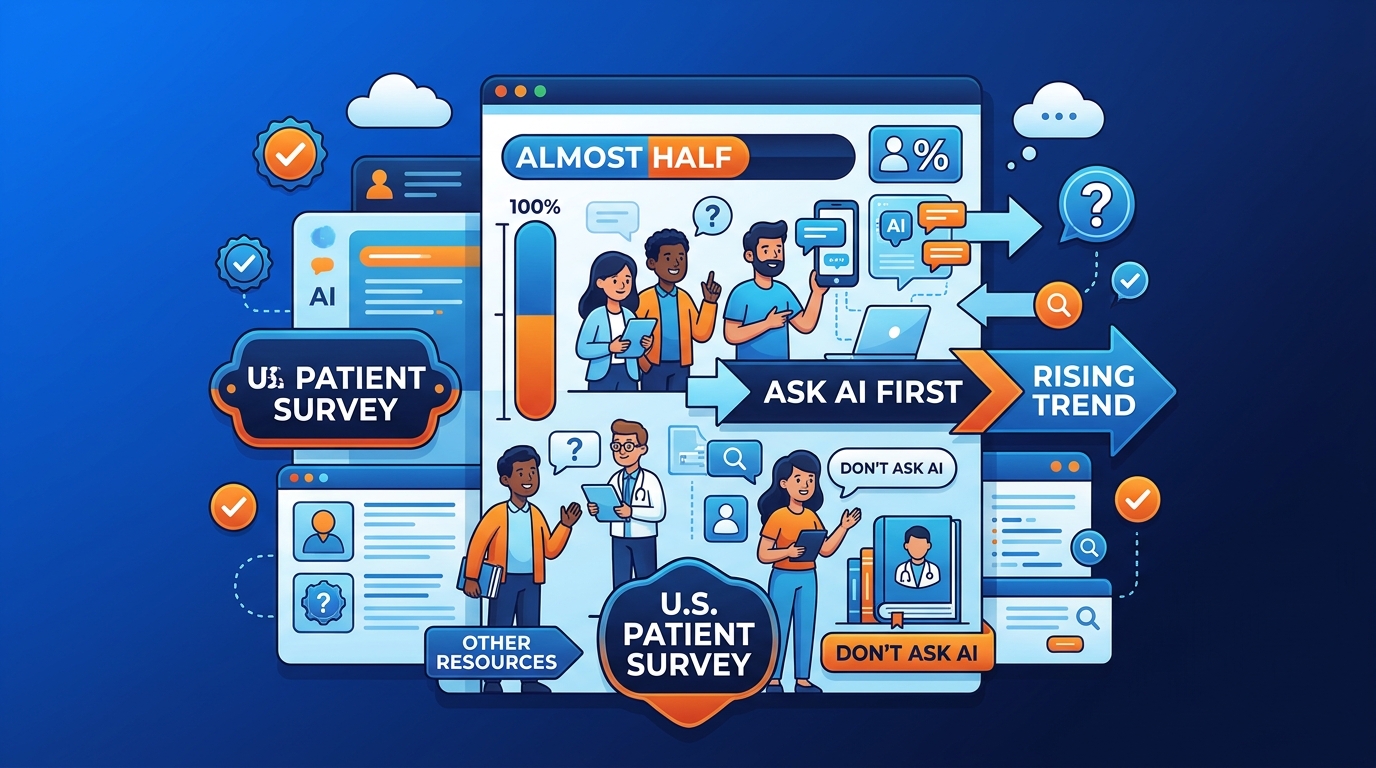
In rater8’s 2026 survey, almost half (47%) of U.S. patients said they have used an AI tool to research healthcare providers, up from about 3 in 10 (31%) in rater8’s 2025 survey, nine months earlier.
The scale is bigger than that. OpenAI says more than 230 million people around the world ask ChatGPT health and wellness questions every week. That number comes from its own analysis of conversations, with personal details removed (de-identified).
Trust matters too. In a survey of 4,775 adult internet users in the Czech Republic, trust in AI was strongly associated with willingness to use AI.
Once AI tools started giving direct answers instead of lists of links, I stopped using rank position as my measure of success. Where a site sits in a list tells me very little about whether a business gets found. I treat rank-tracking reports as numbers that look good without driving outcomes. What I look at instead is whether patients who ask AI hear your practice’s name.
What the Most-Clicked Sciatica Pages Tell Them
Researchers scored the five most consulted web pages for each question on how believable they were. The total scores ran from 1 to 14 out of 28 possible points. Archives of Physiotherapy’s PDF on this topic is Arch Physioter 2025: Google searches and answers on sciatica (PDF).
No page scored more than 1 on the Attribution item. That means none of them pointed to even one scientific article you could identify.
The pages were also hard to read. Scores on the study’s reading-difficulty index ran from 47 to 20. The study estimated that people with an elementary educational background would find 100% (25) of the web pages “almost incomprehensible.”
The researchers also checked the pages against a set of coded points. 11 codes (41%) were aligned with. 7 codes (26%) were contradicted. And 26 codes (96%) were entirely omitted from at least one web page.
For Question 2, here’s what the top pages highlighted:
- Acute pain: rest (not too much) and medicines
- Subacute pain and prevention: physiotherapy
- Last resort: surgery
- Favorable prognosis: 6 weeks
How ChatGPT Answers the Same Questions
ChatGPT is not a certified medical tool. But more and more people use it, the general public and health professionals alike. One team tested it on herniated lumbar disc questions in Validity, safety, and utility of ChatGPT for patients with herniated lumbar disc.
Where the Answers Hold Up
On validity, ChatGPT’s answers got 4 points for 9 of 12 questions, three quarters of them (75.0%). Those were questions 1, 2, 4, 5, 6, 7, 9, 11 and 12. They got 3 points for 3 of 12 questions, a quarter (25.0%). Those were questions 3, 8 and 10. The points are on that study’s own scale.
In the Brain & Spine study, 71.1% of answers from large language models (AI chatbots that write answers) were rated excellent or satisfactory for lumbar spine surgery education. That’s a little under 3 in 4. Here’s how all the answers split:
- 27.2% were excellent.
- 43.9% were satisfactory with minimal clarification.
- 18.3% were satisfactory with moderate clarification.
- 10.6% were unsatisfactory.
Where the Answers Fall Short
ChatGPT’s answer to “What is the treatment for herniated lumbar disc?” got 3 points for validity and for usefulness, because it did not report various treatment options, such as electrical therapy using transcutaneous electrical stimulation and manual therapy.
The authors say ChatGPT cannot give up-to-date medical information, because it was trained on data up to the year 2021. It did not clearly answer what the recurrence rate of herniated lumbar disc is, even though it is known to be about 15%.
In the Brain & Spine study, the reasons for unsatisfactory answers were:
- Clear mistakes: 36.4%
- Too little information: 28.4%
- Other reasons: 27.0%
- Too much information: 6.8%
- Off-topic: 1.4%
One study cited in the European Journal of Translational and Clinical Medicine paper tested a large language model (an AI tool that writes answers). It was moderately accurate, up to 70%. But it struggled to match the difficulty of its wording to the average patient’s reading level.
Why AI and Search Answers Miss on Health Questions
One study found that between 50% and 90% of responses from large language models (AI chat tools) are not fully supported, and sometimes are contradicted, by the sources they cite.
Search engines don’t get a pass. In one test, they answered about half to 7 out of 10 (50–70%) of health questions correctly. They were often held back because many of the results they pulled up didn’t answer the health question.
A Stanford study looked at how four generative search engines (AI tools that write answers to searches) responded to 1,450 search queries. About half (50%) of the statements they wrote had no citation to support them. And only about three out of four (75%) of the citations they gave truly support the statements.
Google says that for topics like news and health, it already has strong guardrails in place.
When a health answer needs a source it can rely on, I want your practice to be that source. Not one more name in a directory or list. I build your pages to be relied on and named, not just present.
What a Clinic’s Sciatica Page Should Answer First
The researchers’ findings suggest that wrong, not very believable, and hard-to-read information about sciatica is common online. That points to likely topics you could teach your sciatica patients about.
Start with the first questions, the ones above: how to ease the nerve, how to cure sciatica, where the nerve is, and how to sleep. For the acute pain questions, I wrote Structuring a Sciatica Article to Answer Acute Pain Questions. I do this work under AEO Content Writing. And the page that explains how the work is done is iTech Valet Service Plans & Pricing.
I don’t chase publishing volume or frequency to get a business recommended by AI. I write so AI can grasp your information easily: clear, factual content in a sensible order. I’d take one clear answer to the first question over a pile of extra articles any day.
Frequently Asked Questions
Does dating a health article change how credible it scores?
Yes. On this credibility scoring tool, an article with no date gets 0 points. A dated article that’s 5 years old or older gets 1 point. One dated within the last 5 years gets 2 points.
Do patients and physicians rate ChatGPT’s back pain answers the same way?
No. Patients rated ChatGPT’s answers higher than physicians did, especially for how clear the answers were.
Which age group is most likely to research a provider with AI?
Adults ages 45 to 60. In rater8’s 2026 survey, about 2 in 3 of them (64%) had used AI to research a healthcare provider. That’s ahead of every other age group, including adults ages 18 to 29, at a little over 1 in 4 (28%).
Why might an AI answer about sciatica be out of date?
Large language models (LLMs, the AI tools behind chatbots) face some challenges. One is outdated knowledge, or missing information from specific areas in the data they learned from. They can also make things up. That’s called hallucination.
Do large language models meet evidence-based health communication standards?
Not in one paper’s first study. In one study, large language models (AI chat tools) failed evidence-based health communication standards.
Clear Sciatica Answers Your Clinic Owns
Your patients ask what sciatica is, how to ease it now, and how to sleep. Research based on interviews and open-ended answers has shown, again and again, that clear and simple information about their condition is one of their main needs. The findings also suggest that wrong, not very believable, and hard-to-read sciatica information is common online. That leaves you with likely topics to teach.
When you ask me where to put your effort and money, I point you to clear, credible information you control. I count on it to keep paying off and grow over time. Visibility bought with ads or paid placements stops the moment the spending stops. Your own clear sciatica information is an asset that lasts.
iTech Valet does AEO content writing and builds AI-readable authority infrastructure for chiropractic practices and other local service businesses. Want to see what AI says about your practice today? Run My AI Visibility Check