
Comparing pages of the same website, pages whose title and paragraphs match the questions people ask are cited more. FAQ blocks, structured data, summary boxes and page speed appear effective only across websites. Patients should be safety netted about the symptoms of cauda equina syndrome and advised to seek emergency care if symptoms are present. One study of ChatGPT and low back pain concluded that a moderate reading level, not maximal simplicity, yields the most reliable outputs in complex domains like pain. Nonspecific or mechanical low back pain lacks a specific anatomical cause and typically resolves on its own within four to six weeks.
Build the Page Around the Questions Patients Actually Ask
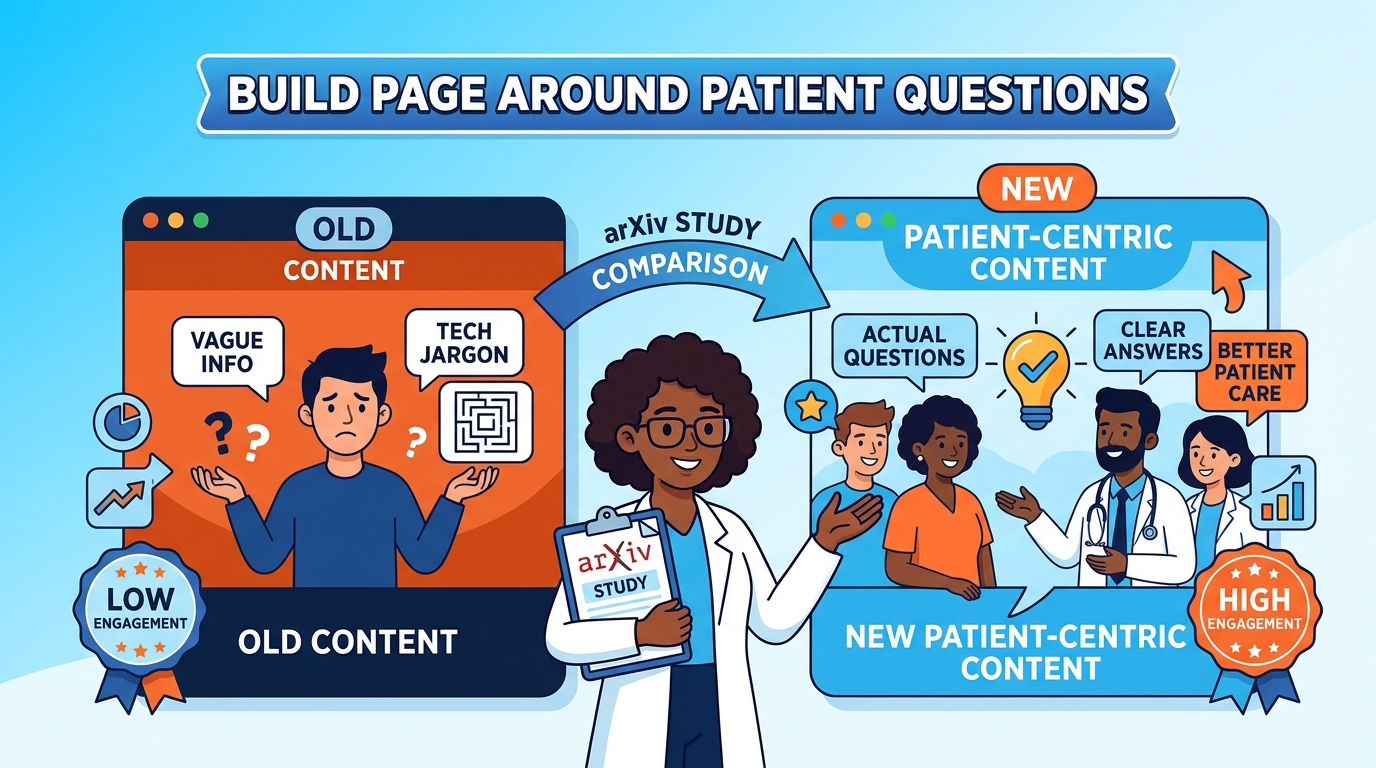
An arXiv study compared pages of the same website, and content matters in one way. Pages whose title and paragraphs match the questions people ask are cited more. FAQ blocks, structured data, summary boxes and page speed appear effective only across websites.
So match your title and your paragraphs to the patient’s question. Take that over any add-on. Don’t judge your pages by how many you publish. Write clear, factual content in a sensible order, so an AI engine can grasp it easily.
Patient questions fall into groups. One pain study built a standardized set of 25 questions and divided them into five key categories. Two of them matter here. Diagnosis (questions 1 to 5) evaluates the ability to recognize potential pain-related conditions. Medical Professional Guidance (questions 6 to 10) assesses whether recommendations about seeking professional care are appropriate. Want to know the questions patients start with? Read What Patients Ask First When Searching for Sciatica Relief.
Name the Pain Pattern and Its Usual Course Up Front
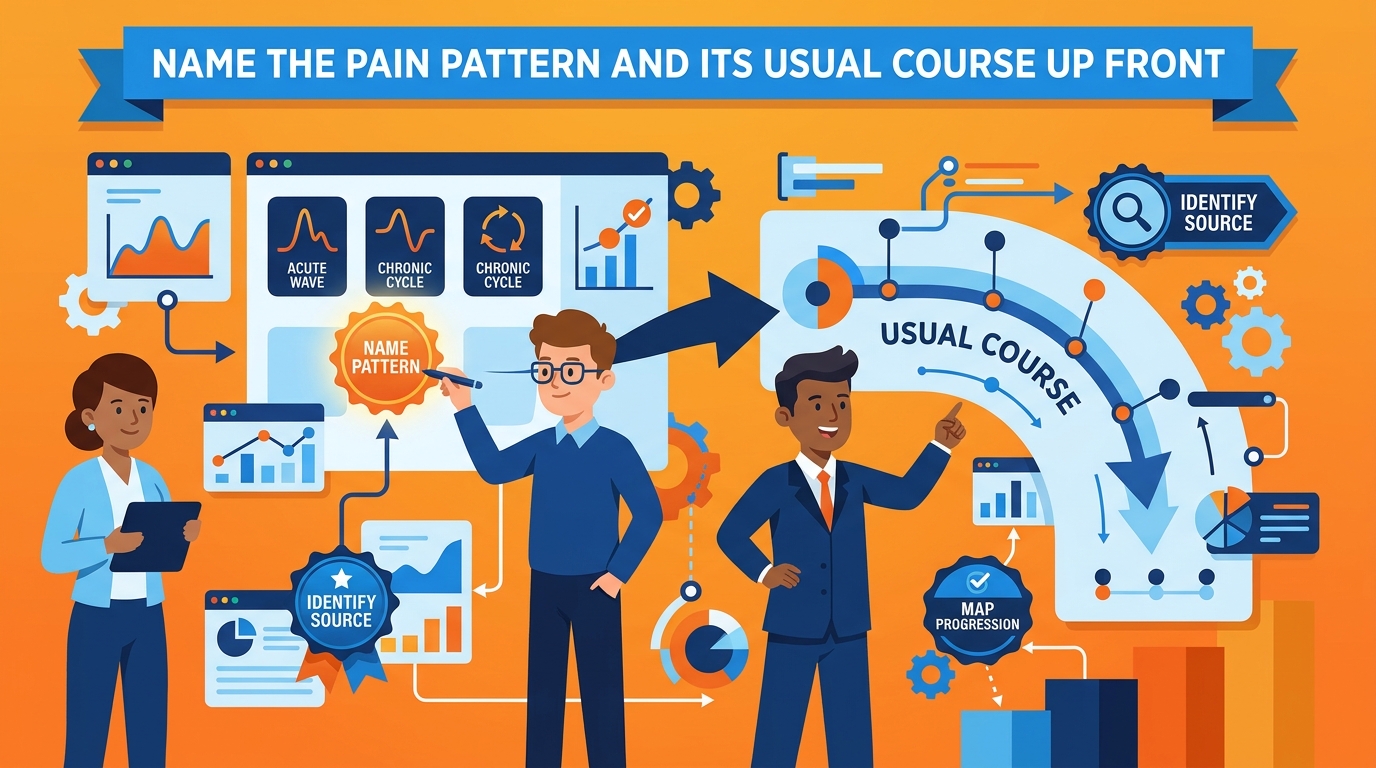
Say which pattern your page covers. One study describes a typical lumbosacral radicular pain pattern as pain that travels along the path of a spinal nerve. It usually starts in the lower back or the sacral region, the lowest part of the spine. It may spread to the buttocks, thighs, or legs.
Then give the usual course. Low back pain that is nonspecific or mechanical, meaning it has no specific physical cause, typically goes away on its own within four to six weeks.
Put Red Flags Before Any Self-Care Advice
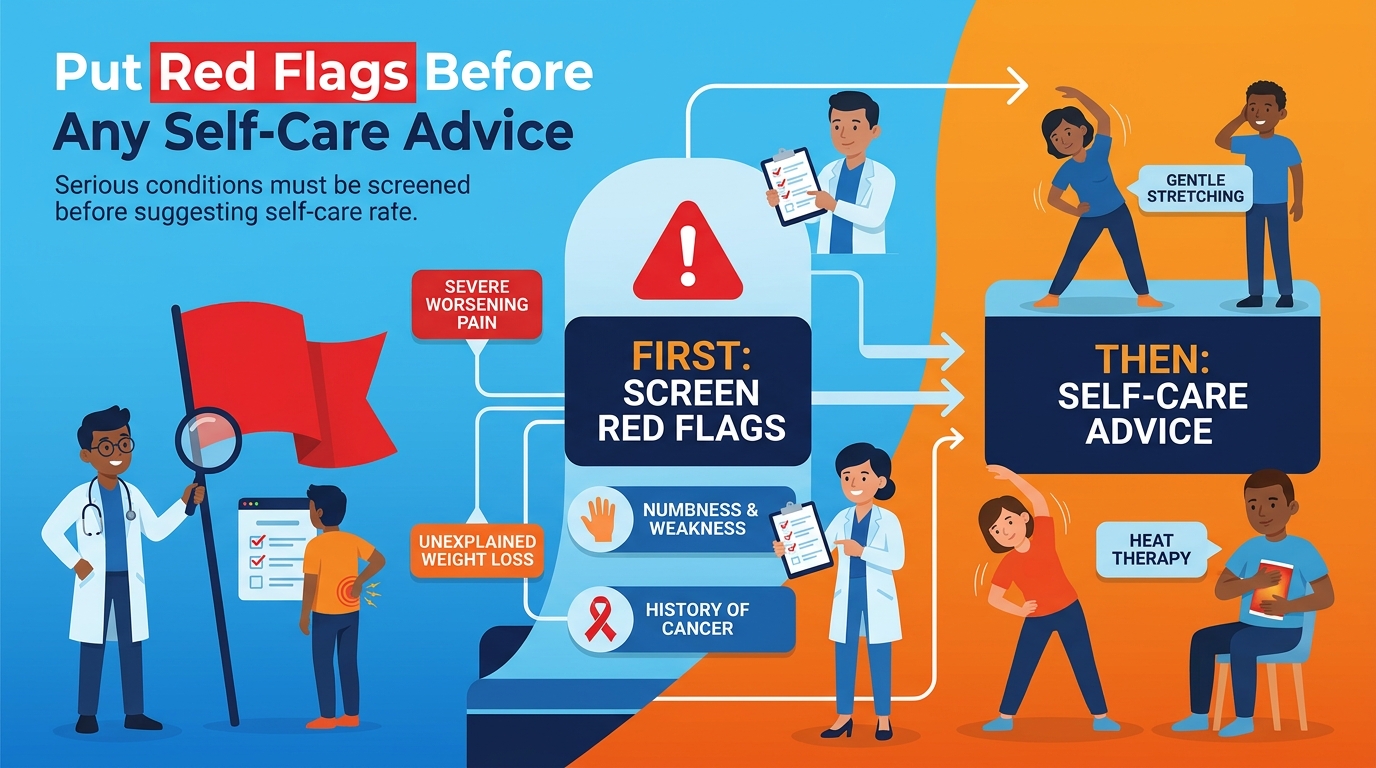
In low back pain, serious conditions are called red flags. If clinicians fail to diagnose one, that can lead to delayed treatment and increased patient morbidity (illness) and mortality (death). So put the warning signs first. Relief advice comes after them.
The red flags include cancer, broken spine bones (vertebral fractures), cauda equina syndrome, infection, and aortic aneurysms (a bulge in the body’s main artery). The most frequent are cancers and vertebral fractures.
Under the guidance for primary care, patients should be safety netted about the symptoms of cauda equina syndrome. That means they’re told what to watch for and advised to seek emergency care if symptoms are present. That guidance is in Assessment of cauda equina syndrome: new national guidelines and implications for primary care. NHS Lothian RefHelp lists more serious signs in Serious lumbar spine conditions (Red Flags).
Cauda Equina Warning Signs and Referral Timing
Since 2020, national guidance for GPs has stated that symptoms of cauda equina syndrome are sufficient to mandate emergency referral for imaging. That holds even in the absence of objective signs of it.
GPs must ask all patients with low back pain and sciatica two things. Do they have new urinary problems? Do they have new altered sensation in the saddle area? It is essential to record that questioning.
In cases of acute cauda equina syndrome caused by a disc prolapse (slipped disc), the guidance reports these symptoms:
- Back pain, often severe, in 96% of cases.
- Sciatica in 93%, more often unilateral (54%) than bilateral (46%).
If the answer to either question is yes, the patient must be referred for urgent same-day magnetic resonance imaging (MRI). After referral from primary care, a patient with suspected cauda equina syndrome should have an MRI within 4 hours.
Other Red Flags: Bilateral Sciatica, Bladder Changes, Foot Drop and Suspected Malignancy
NHS Lothian RefHelp names more signs:
- Bilateral sciatica. Sudden pain in both legs from irritated nerves, or one-sided nerve pain that has progressed to both sides, is a red flag for suspected cauda equina syndrome.
- Bladder changes. Difficulty starting to urinate, or an impaired sensation of urinary flow, is a cauda equina red flag. If untreated, it may lead to irreversible urinary retention (being unable to empty the bladder) with overflow urinary incontinence (leaking from an overfull bladder).
- Foot drop. The guidance classifies it as weakness of dorsiflexion (lifting the foot up) at grade 3 or less on the Oxford scale. It says there is no current agreed timescale that would define an acute (sudden) episode.
- Suspected cancer. No symptomatic improvement after 4 to 6 weeks of conservative low back pain therapy (care without surgery) is a red flag for suspected cancer.
What the ‘What Helps Now’ Section Must Get Right
Don’t dumb it down too far. One study found that making a question too simple, for example down to a 4th-grade level, makes ChatGPT worse at giving clinically complete answers to low back pain questions.
Length doesn’t fix it either. The same study says word count is an unreliable proxy for informational completeness or clinical correctness in AI outputs. And most errors stem from omission, not commission.
The authors concluded that a moderate reading level, not the simplest possible one, gives the most reliable ChatGPT answers on complex topics like pain. So when you write your “what helps now” section, check what it leaves out before you check how long it is. Here’s the study: ChatGPT and low back pain – Evaluating AI-driven patient education.
Where AI Chatbots Go Wrong on Sciatica Advice
One test put AI chatbots’ advice on lumbosacral radicular pain against clinical practice guidelines. The match rate is how often a chatbot’s answers matched those guidelines. Perplexity had the highest match rate at 67%. Google Gemini followed at 63% and Microsoft Copilot at 44%. ChatGPT-3.5, ChatGPT-4o and Claude showed the lowest performance, each at 33%.
The table below lines up the match rate for each chatbot.
| Chatbot | Guideline match rate |
|---|---|
| Perplexity | 67% |
| Google Gemini | 63% |
| Microsoft Copilot | 44% |
| ChatGPT-3.5, ChatGPT-4o and Claude | 33% each |
The study authors said doctors and patients should be careful when relying on these chatbots. Depending on the chatbot, one-third to two-thirds of the recommendations may be inappropriate or misleading.
The main finding: no chatbot gave advice in absolute agreement with clinical practice guidelines, the written medical rules for treating a problem. That confirms what was found earlier in other lower back pain conditions. You can read the test yourself in Accuracy of AI chatbots in advising on lumbosacral radicular pain against clinical practice guidelines.
The same study found the wording of answers to the same question varied a lot. The median range of text consistency was 26% to 68%.
And the sources don’t always back up the claims either:
- The study calls one model 4o. Even when it uses Web Search, about 3 out of 10 of its individual statements (approximately 30%) are unsupported, and nearly half of its responses are not fully supported.
- An arXiv study broke Google’s AI Overview answers into 98,020 small claims. About 1 in 9 of them (11.0%) were not backed up by the pages the answer cited. The most common way they failed was by leaving things out.
One low back pain study scored chatbot answers on four rating scales for the quality and reliability of health information. Perplexity scored significantly higher than the other chatbots (p < 0.001). A gap that big would happen by chance less than 1 time in 1,000.
When answers are this uneven, I build your practice’s pages to be the source an AI names and draws on, not one more entry in a list of businesses. I’ll take being relied on over being present every time.
Want to see the red-flag test of ChatGPT-3.5 and Google Bard? It’s here: ChatGPT-3.5 and GoogleBard in Identifying Red Flags of Low Back Pain.
Where AI Answers Do Flag Urgency
Chatbots did well on one point. Most answers about a single symptom made clear how serious the situation was. That was 93.1% of ChatGPT-3.5 answers (about 93 in 100) and 94.8% of Google Bard answers (about 95 in 100). All of the answers about several symptoms did this too.
The study judged this by looking for phrases such as these:
- “serious medical condition”
- “take prompt action”
- “severe health issue”
- “consult a doctor”
- “immediate medical attention needed”
- “do not delay”
Setting a Reading Level Patients Can Use
Standards set by the US Department of Health and Human Services, the American Medical Association and the National Institutes of Health say patient education materials should be written at a reading grade of six or below. That’s the bar your patient pages have to clear.
A study tested ChatGPT, Gemini and Perplexity on common low back pain keywords. The readability of the responses from all three chatbots was higher than the recommended 6th grade level (p < 0.001). A result this clear would happen by chance less than 1 time in 1,000.
In another study, reference prompts to ChatGPT on low back pain had a median grade level of 14.3, with an interquartile range of 12.5 to 17.1. That is language appropriate for undergraduate education or higher.
I write your patient-facing lines near grade six, and I keep the clinical points in them. For a worked example, see Writing About Disc Bulges Without Losing a General Reader. The readability study is Readability, quality and reliability of ChatGPT, Gemini, Perplexity responses on low back pain.
Authorship, Trust and Headings That Let AI Engines Cite the Page
I treat getting picked by AI answer tools as its own discipline, not classic search work with a new name. I don’t chase keywords, inbound links or ranking position. I put the effort into making it easy for AI engines to see who your practice is, who wrote the page and why both can be trusted.
Google’s own guidance is in Creating Helpful, Reliable, People-First Content. For linking your condition pages together, see Building Machine Readable Condition Hubs: A Complete Guide. iTech Valet writes pages like this through AEO Content Writing, and iTech Valet Service Plans & Pricing explains how the work is done.
Bylines, Author Markup and Honest Credentials
Google strongly encourages you to add accurate author information, such as a byline (the author’s name at the top), to content where readers might expect it.
Google calls it a form of deception to make up creator profiles. That includes AI-generated headshots, made-up names or false credentials used to make content look like it was written by human experts. I only put a real name and real credentials on a page.
Google also says to make sure all the authors presented as authors on the page are included in the markup.
Why Trust Carries Extra Weight on Health Pages
Of the aspects Google weighs, it says trust is most important. The others contribute to trust, but content doesn’t necessarily have to demonstrate all of them.
Google says its systems give even more weight to content that meets its strong quality standards when the topic could significantly affect people’s health, financial stability or safety, or the welfare or well-being of society. Those standards go by E-E-A-T, Google’s shorthand for experience, expertise, authoritativeness and trustworthiness. Sciatica advice is a health topic, so your pages sit squarely in that territory.
Google also says E-E-A-T is not itself a specific ranking factor. Still, using a mix of factors that can spot content with good E-E-A-T is useful.
Headings, Length and Structural Changes That Lift Citation
Google lists a page’s visible title and the headings throughout the page as part of its main content. They sum up the topic and help people decide whether to visit.
Google says it has no preferred word count. You don’t need to write to a set length because of something you heard or read.
An arXiv test across six generative engines, which are AI tools that write answers, showed steady citation improvements of 17.3%. Ratings based on people’s opinions showed an 18.5% average improvement in how good the content seemed.
Frequently Asked Questions
How common is cauda equina syndrome among back pain patients?
Of all patients with low back pain, 0.3% (about 3 in 1,000) will have cauda equina syndrome. In clinically suspected cases, 19% (about 1 in 5) have both clinical and imaging confirmation of it. So write the warning on your page in plain, calm words that don’t suggest most back pain is this.
Is a rectal exam still needed to rule out cauda equina syndrome?
No. In primary care, a rectal exam for altered feeling around the anus and anal tone is no longer required. It cannot exclude cauda equina syndrome. So don’t present it on your page as a test that rules the condition out.
Should the page send red-flag patients to physical therapy?
No. NHS Lothian RefHelp says not to refer patients to the muscle and bone physiotherapy service if they have significant red flags, a suspicion of a serious spinal condition, or suspected inflammatory spinal pain. So put your red-flag warnings first, and don’t point those readers to physiotherapy.
Should the article disclose that AI helped write it?
Yes, when readers would reasonably expect it. Google says notes that tell readers AI or automation was used are useful for content where someone might wonder, “How was this created?” So consider adding a short note on how your article was made.
Where This Order Leads a Practice
Start with the questions your patients ask. Name the pain pattern and its usual course. Put the red flags before any self-care advice. Then give what helps now, at a moderate reading level.
I’d put your money into vetted articles you own, which I count on to keep paying off and grow over time. I wouldn’t put it into ads or paid placements, which I expect to stop the moment the spending stops.
iTech Valet writes answer engine optimization (AEO) content for practices like yours. Every article goes through its own two-AI check: one AI tool writes the article and another checks it. It’s designed to help AI tools like ChatGPT, Gemini and Grok recognize and recommend your practice. Want to see where your practice stands with AI engines today? Run My AI Visibility Check.