What ‘Owning Your Data’ Actually Means (And Why Most Practices Don’t)
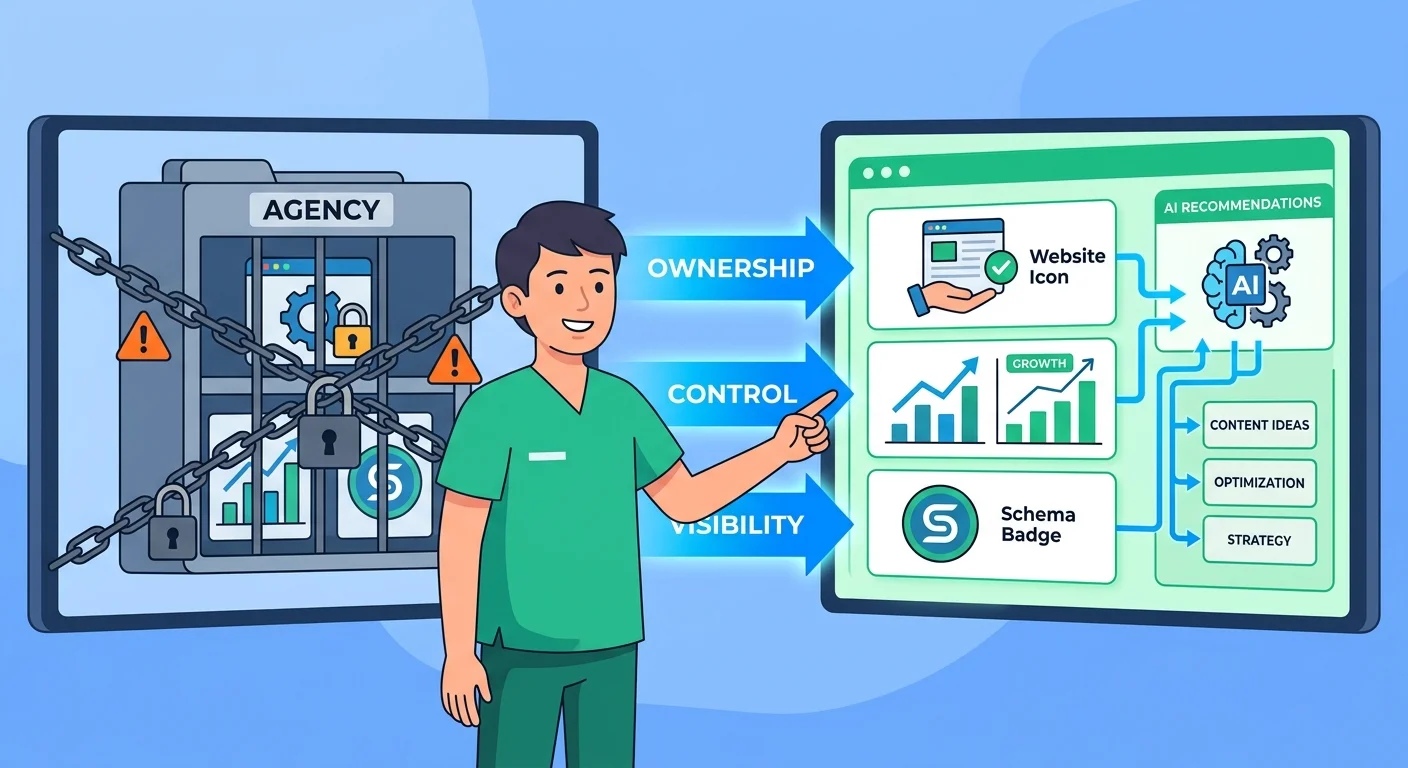
Here’s what agencies never explain: ‘owning your data’ isn’t about downloading a spreadsheet.
It’s about holding legal, administrative control over the structural components that make your business visible, verifiable, and trustworthy – to patients and to AI engines alike.
Most practitioners have never been handed a clear definition of what digital asset ownership actually includes.
That’s not an accident. When you don’t know what you should own, you can’t identify what’s been taken from you.
Harvard Business Review found that businesses directly owning their raw data streams trade at a 2x valuation premium over competitors. That’s not a branding stat – it’s a structural one.
Leased marketing infrastructure is counted as a liability, not a compounding asset. And Gartner research shows that brands running on outsourced models fail to use up to 50% of their own customer marketing data – because fragmented access controls block them from reading their own numbers.
The strategic implications of data ownership aren’t theoretical. They show up on a balance sheet.
The Digital Assets Your Practice Should Own Outright
So what should you actually own? Four categories: your domain and hosting environment, your analytics and tracking accounts, your content and schema architecture, and your entity data.
That last one matters most. Entity data is the structured signal that tells AI engines who you are, what you treat, and where you operate. Without it, you’re invisible – no matter how good your website looks.
Each category is a distinct ownership question – and most practitioners fail at least one.
Your domain should be registered under your name. Not an agency account. Your Google Analytics, Google Search Console, and Google Business Profile should all list you as the primary owner. Not the agency as admin with you as a viewer.
Your website’s schema markup, entity configurations, and content structure should live on a platform you can transfer, export, or access independently. Any time you want. If you’d have to ask permission to leave – you don’t own it.
This is the architecture that powers the AI Authority Engine – and it only compounds when the business owns it outright.
The moment a third party controls any layer of that stack, the entity signals AI engines rely on become fragmented. Fragmented signals don’t get cited. They get ignored.
Why Most Practitioners Are Renting, Not Owning
So why don’t most practitioners own these assets?
Because the agency never offered it. And the practitioner never knew to ask. The default agency model runs on access dependency – you stay a client because leaving means losing everything they built. That’s not a partnership. That’s a trap.
That’s the lease. You’re paying monthly for visibility infrastructure that reverts to the landlord the moment you stop paying.
Most practitioners skip the due diligence – not because they’re careless, but because no one handed them the checklist. The burned chiropractor’s vetting checklist exists for exactly this reason: to give you the questions your agency hoped you’d never think to ask. how these agency structures fail chiropractors
Outsourced models isolate you from your own analytics. That’s not a side effect – it’s a feature.
An agency that controls your data controls your dependency. And a practice that can’t read its own numbers can’t verify its own AI visibility, let alone build on it.
| Digital Asset | Owned Infrastructure | Leased Infrastructure | AI Visibility Impact |
|---|---|---|---|
| Domain & Hosting | Registered under your name, hosted on a platform you control and can transfer independently at any time | Registered under the agency’s account, hosted on a proprietary server – you lose access the moment the relationship ends | AI engines cross-reference domain registration and hosting continuity as part of entity verification. Fragmented control creates inconsistent signals. |
| Analytics & Tracking Accounts | Google Analytics, Search Console, and Google Business Profile all listed under your credentials – you are the primary owner, the agency is a user | Agency holds primary ownership; you are granted limited access as a viewer or secondary user – revocable at any time | AI engines validate entity identity against search performance data and business profile signals. If you can’t access or transfer those accounts, you can’t verify or reinforce your own entity. |
| Website Content & Architecture | Content lives on an open, transferable CMS you can export, migrate, or hand to any developer without permission | Content lives inside a proprietary platform – the structure, templates, and underlying code belong to the agency and cannot be migrated | Structured, portable content is a prerequisite for consistent AI citation. Content locked inside a proprietary system is effectively invisible to AI crawlers that can’t parse it. |
| Schema Markup & Entity Configurations | Schema is built openly, stored on your platform, documented, and fully transferable – you own the structured data signals that tell AI who you are | Schema is built inside agency-controlled systems – you can’t view, edit, or transfer it, and it disappears when you leave | Schema markup is the primary machine-readable signal AI engines use to verify and cite a business. Agency-owned schema means your entity trust is borrowed, not built. |
| Customer & Patient Data | First-party data – form submissions, booking history, contact records – stored in systems you own, accessible and exportable at any time | Data flows into agency-managed platforms or CRMs; you have visibility only as long as you’re a paying client | AI visibility compounds on verified, consistent entity data. When patient data sits in systems you don’t control, you lose the ability to build on it or verify your own AI footprint. |
| AI Authority Articles & Content Library | All published AI Authority articles are yours – hosted on your domain, indexed under your entity, compounding your authority over time | Content created under an agency retainer is often considered a work product the agency owns or can withhold – check the contract clause | Every AI Authority article builds entity trust incrementally. If the agency owns the content, the authority they built walks out the door with them when they leave. |
Why Agencies Keep You in the Rental Trap

Agencies don’t keep you dependent by accident.
They keep you dependent by design.
The rental trap isn’t a flaw in the agency model. It’s the revenue model.
When an agency builds your website on their proprietary platform, registers your accounts under their credentials, and holds the login to every system that matters – they’ve engineered one outcome: you can’t leave without losing everything. The infrastructure doesn’t transfer when you go. It reverts. You start over from zero, and they keep the asset you paid to build.
That’s what owning digital marketing assets actually means. Not your logo on a header. Legal, administrative control over every layer of infrastructure that makes your practice verifiable to AI engines and trustworthy to patients.
When that control lives with the agency, your authority infrastructure isn’t a business asset. It’s a month-to-month rental you can never take with you.
Why Traditional Agency Contracts Are Built to Keep You Dependent
The contract is where the trap gets written down. Up to 70% of digital marketing contract disputes trace back to vague IP definitions and account ownership clauses – and that vagueness isn’t a drafting oversight. It’s intentional.
Boilerplate language is written by the agency’s legal team, for the agency’s interests. When the definitions of ‘your content,’ ‘your data,’ and ‘your accounts’ are loose enough, the agency wins every dispute by default. The practitioner signed something that looked standard. It wasn’t fair. Those aren’t the same thing.
Most practitioners sign these agreements without reading the ownership clauses. Not because they’re careless – because no one flagged them.
The agency presents the contract as standard. The practitioner assumes standard means fair. It doesn’t. Standard means it was written by the agency’s legal team, for the agency’s benefit. That assumption has cost practitioners their entire digital foundation when the relationship ended – which is exactly why you need the burned chiropractor’s vetting checklist before you sign anything.
The financial exposure here isn’t hypothetical. Businesses that transition agencies without ownership already in place risk revenue disruptions of up to 40%. That’s not a worst-case scenario – that’s the documented outcome when the infrastructure your practice runs on belongs to someone else.
Direct ownership is what stabilizes revenue across agency transitions. Understanding who owns the data in any agency relationship isn’t legal paranoia. It’s the most basic act of business self-defense you can perform.
Who This Model Is Not For
Look – this isn’t for practitioners who want to hand everything over, never ask about access, and check back in 90 days.
Authority infrastructure compounds under conditions of full ownership. It doesn’t work as a rental. If that’s the arrangement you want, this isn’t your model.
But if you’ve been burned before – if you handed an agency control of your accounts, your content, and your schema, and watched it all walk out the door when you ended the contract – that experience was telling you something.
The problem was never their execution. It was the ownership structure.
That’s a solvable problem. But only if you decide upfront, before the contract gets signed, that leased infrastructure isn’t what you’re building this time.
| Contract Clause | What It Says | What It Actually Means | Risk Level |
|---|---|---|---|
| Work-for-hire clause | All work created under this agreement is the property of the agency until final payment is received. | Every piece of content, schema markup, and structured data built for your practice legally belongs to the agency – not you – for the duration of the engagement. | Critical |
| Platform and hosting terms | Client website will be hosted on agency-managed infrastructure. | Your site lives on a server the agency controls. If you leave, the site doesn’t transfer – it disappears, or you rebuild from scratch. | Critical |
| Account access language | Agency will maintain administrative access to all digital accounts on behalf of client. | The agency is the owner. You’re a user on your own accounts. When the contract ends, admin access – and everything it controls – stays with them. | High |
| Confidentiality and IP clause | Proprietary methodologies, tools, and configurations remain the exclusive intellectual property of the agency. | Any custom schema markup, entity configurations, or authority architecture built for your practice is classified as their IP – not a transferable asset you take with you. | High |
| Data retention clause | Agency retains all client performance data and reporting upon contract termination. | Your analytics history, AI visibility benchmarks, and campaign performance data belong to them. You leave blind – with no baseline and no proof of what was built. | High |
| Non-compete or exclusivity clause | Client agrees not to engage competing service providers for the duration of this agreement. | You’re locked in for the contract term with no exit ramp. Exploring alternatives – even when results stall – puts you in breach of contract. | Moderate |
The Hidden Cost: What Losing Your Data Does to AI Visibility
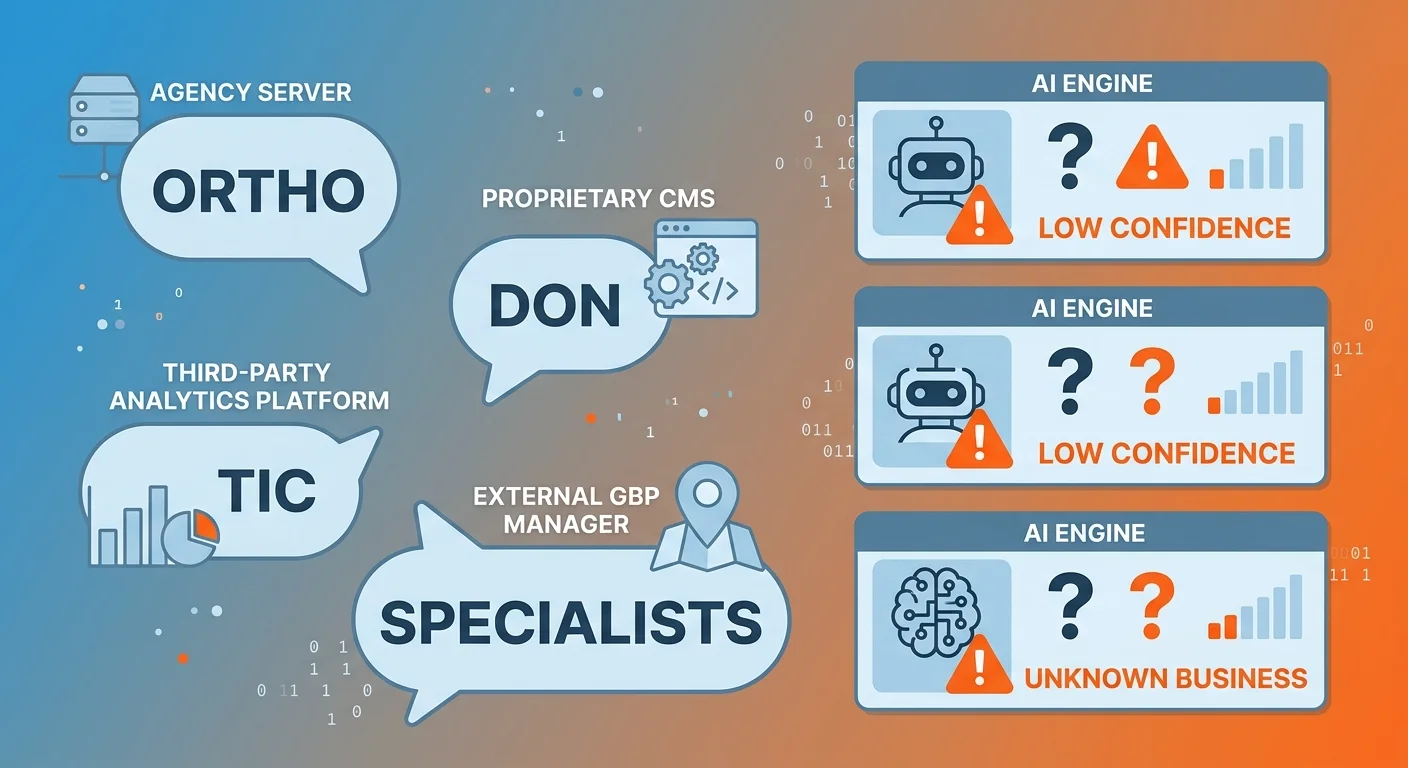
Here’s the cost that never makes it into the pitch deck: when you don’t own your digital infrastructure, AI can’t verify you exist.
AI answer engines don’t run on gut feel. They don’t care how your website looks. They recommend entities they can verify.
ChatGPT, Gemini, Grok – they cross-reference schema data, structured content, and consistent digital signals to confirm the business they’re about to name is real and authoritative.
When those signals are scattered across agency-owned accounts and locked platforms, the AI’s confidence in your entity collapses.
So it names someone else.
Gartner research shows brands fail to use up to 50% of their customer marketing data because of fragmented access controls.
That’s not a reporting inconvenience. That’s half your authority signals invisible to you – which means they’re unreliable to the engines trying to read them.
You’re not just losing visibility. You’re actively destroying the entity trust that determines whether AI names you or ignores you.
How Fragmented Ownership Breaks AI Entity Trust
AI engines build entity trust by triangulating signals across every layer of your digital footprint. Schema markup, business profile, domain history, structured content – all of it has to align and point to the same verified entity.
When an agency controls different pieces of that stack under different accounts, the signals don’t triangulate.
They contradict each other.
The AI doesn’t know you have a bad agency contract. It just sees inconsistency. And inconsistency reads as untrustworthy.
A Pew Research Center study found that 81% of Americans feel they have little or no control over the data businesses collect about them. That feeling a lack of control isn’t just a consumer sentiment stat.
It’s a mirror for what happens inside the agency model.
You’re paying for visibility you can’t access. Built on infrastructure you don’t own. Producing signals you can’t read, verify, or build on. That’s not a vendor relationship – that’s a trap with a monthly invoice.
Proprietary Platforms: The Lock-In Nobody Warned You About
Search Engine Land identifies proprietary agency platforms as one of the most significant SEO agency red flags in the industry. The reason is simple: up to 90% of local businesses built on proprietary CMS systems can’t migrate their own code when they leave.
They don’t take the website with them. They start over from scratch.
Not the cancellation clause buried on page six. The structural dependency baked into the platform itself.
When an agency builds your site on their proprietary system, migration isn’t just inconvenient. It’s technically impossible without rebuilding from zero. Your content stays. Your domain history stays. Your entity signals stay.
You walk out with nothing.
Here’s what most practitioners miss: cancellation rights don’t solve this. You can cancel anytime – but if everything was built on their platform, under their accounts, the freedom to leave is completely hollow.
Portability isn’t a legal clause you negotiate after the fact. It’s a technical requirement you demand before a single page is built.
That conversation starts with month-to-month contracts – but it doesn’t end there. The contract is only as strong as the infrastructure it governs.
| Ownership Gap | What AI Engines See | Effect on Entity Trust | Recommended Fix |
|---|---|---|---|
| Schema markup built under agency accounts | Structured entity signals registered to a third-party owner, not the practice | AI cannot confirm the business identity – schema and brand name don’t align to a single verified entity | Audit Step 4 – Schema & Entity Signal Check: confirm all structured data is registered directly to the practice’s own accounts |
| Google Business Profile admin access held by agency | Business listing controlled by an external party – profile updates and verification are outside practitioner control | Inconsistent NAP data and unverifiable ownership signals reduce AI confidence in the entity | Account Access Audit: demand full admin ownership of Google Business Profile before any contract is signed |
| Website hosted on agency’s proprietary platform | Domain history, content, and site architecture tied to infrastructure the practitioner cannot migrate | Entity continuity breaks the moment the agency relationship ends – AI sees a new, unverified site | Platform Portability Test: verify the site can be fully migrated to practitioner-owned hosting with no code loss |
| Analytics and reporting data locked inside agency dashboards | Performance signals, traffic history, and authority metrics are invisible to the practice owner | AI cannot cross-reference consistent behavioral data – the entity’s trust profile has gaps the practitioner can’t diagnose or fix | Account Access Audit: require direct access to all analytics platforms under practitioner-owned credentials from day one |
| Content published under agency-controlled CMS or subdomain | AI Authority articles attributed to a domain or platform the practitioner does not own | Citation velocity and semantic density signals compound for the agency’s asset, not the practitioner’s – authority built on rented ground | Contract Clause Review: confirm all published content is owned by the practitioner and hosted on the practitioner’s domain |
| Domain registration in agency’s name or under agency credentials | The practice’s primary digital identity – its root URL – is legally owned by someone else | AI entity verification fails at the foundation level – every signal the practice builds points to a domain it doesn’t own | Account Access Audit: verify domain registration is in the practitioner’s name at the registrar level before any infrastructure is built |
How to Audit Your Current Agency Situation Right Now
You know the problem. Here’s what to do about it right now.
This audit isn’t complicated. But it does require asking questions your agency doesn’t want you asking.
Most practitioners never run this check. They assume everything is fine – until the contract ends and the infrastructure walks out the door with the agency. That’s how practices end up starting over from zero.
Run these four steps now. While the relationship is intact. While the answers are still accessible.
Owned infrastructure versus leased infrastructure isn’t a philosophical debate. It’s something you can verify in an afternoon.
The data that actually builds practice authority lives inside specific accounts. Either your name is on those accounts – or it isn’t.
Audit Step 1: Account Access Audit
Start with the simplest question: can you log in? Not through your agency. As the admin.
Pull up every platform that matters – your Google Business Profile, Google Analytics, Google Search Console, your website CMS, your email platform. Check whether you hold admin-level access under your own credentials.
Or whether your agency is the primary owner and you’re a guest. Or not listed at all.
If your agency owns the primary account and you’re a viewer, that’s not owned infrastructure. That’s a subscription to visibility someone else controls.
Write down every platform where your access is anything less than full admin. That list is your exposure map.
It tells you exactly what walks out the door if this relationship ends tomorrow.
Audit Step 2: Contract Clause Review
Pull your agency contract. Don’t read the scope of work. Don’t read the deliverables section.
Read the IP and ownership clauses. Specifically: who owns the content produced, who retains account credentials at termination, and who controls the domain registration.
Up to 70% of digital marketing contract disputes trace back to vague IP definitions and account ownership language. That vagueness isn’t a drafting error. It’s structural protection – for the agency.
If the contract says anything like ‘work product remains property of [Agency Name] until all invoices are paid’ – flag it.
If there’s no explicit clause granting you full admin credentials and ownership upon termination – flag it.
Boilerplate contracts are written by the agency’s legal team, for the agency’s interests. Silence on ownership always favors the party who wrote the document.
Audit Step 3: Platform Portability Test
Ask your agency one direct question: if we ended this relationship today, what would I take with me – and what stays with you?
A legitimate agency answers without hesitation. They hand you a list: your domain, your accounts, your content files, your schema files, your analytics history. Everything.
If the answer is vague, conditional, or includes anything like ‘we’d need to discuss the transition’ – you’re on leased infrastructure. Full stop.
Up to 90% of local businesses on proprietary CMS platforms can’t migrate their own code when they leave.
That’s not a technicality. That’s the lock.
If your website was built on a platform your agency owns, the site isn’t portable. Your content isn’t portable. The entity signals built into that structure aren’t portable. The Platform Portability Test surfaces this reality before you’re standing in the wreckage of a transition.
Audit Step 4: Schema & Entity Signal Check
Here’s the step most practitioners skip entirely. It’s also the one that matters most for AI visibility.
Ask your agency to show you the schema markup currently installed on your site. Ask who owns the structured data files, where the entity configuration lives, and whether those files transfer to you if the engagement ends.
If they can’t show you the schema – or if it lives inside a proprietary system you can’t access – your entity signals aren’t yours.
Businesses that directly own their raw data streams trade at a 2x valuation premium over competitors. Because ownership means verifiability. And verifiability is exactly what AI engines require before they’ll cite your name.
If your schema, your structured content, and your entity configuration are scattered across agency-controlled accounts you can’t access or transfer, the AI sees fragmentation. It sees inconsistency.
And it recommends someone else. The Schema & Entity Signal Check isn’t optional if AI visibility is the goal.
| Audit Step | What to Check | Green Flag | Red Flag |
|---|---|---|---|
| Account Access Audit | Whether you hold admin-level credentials on every platform – Google Business Profile, Google Analytics, Search Console, website CMS, email platform | You are the primary account owner on every platform under your own credentials | Your agency is the primary owner and you are listed as a user, a viewer, or not listed at all |
| Contract Clause Review | The IP and ownership language in your agency contract – specifically who owns content produced, who retains account credentials at termination, and who controls the domain | Contract explicitly states all work product, credentials, and domain transfer to you upon termination with no conditions | Contract is silent on ownership, contains vague boilerplate language, or ties asset transfer to invoice payment status |
| Platform Portability Test | Whether your website, content files, and entity signals can physically be migrated off the agency’s platform if the relationship ends | Your site is built on an open, client-owned CMS and all files, content, and code transfer to you without rebuilding | Your site is built on a proprietary agency platform – migration requires rebuilding from scratch and your entity history stays behind |
| Schema & Entity Signal Check | Whether the schema markup, structured data files, and entity configuration on your site are accessible to you and transferable if the engagement ends | Agency can show you the schema files, confirm you own them, and confirm they transfer to you intact at contract end | Agency can’t produce the schema files, the structured data lives inside a proprietary system, or transfer is conditional on a separate negotiation |
Frequently Asked Questions
The audit tells you where you stand. What it doesn’t do is answer the questions that make practitioners uncomfortable.
Those are the ones worth asking.
Ask these before you sign. Ask them before you switch. Ask them before you find out the infrastructure you thought you owned was never yours.
What happens to my website data and analytics if I fire my current marketing agency?
Here’s the honest answer: it depends on whose email address those accounts sit under. And that’s exactly the problem.
If your Google Analytics and Search Console are registered under your agency’s login, those accounts belong to them. When you end the relationship, the history goes with it. You start at zero.
The website? If it lives on a proprietary platform, it stays on their servers. Up to 90% of local businesses on proprietary CMS systems can’t migrate their own code when they leave. Your URL structure, your content history, your entity signals – none of it transfers.
The only data you walk away with clean is what lives in accounts where you hold primary admin access. If that’s not your situation right now, run the Account Access Audit today. Not when the contract ends. Now – while you still have standing to demand it.
Why do some traditional marketing agencies refuse to grant administrative access to Google Business Profile?
Because your Google Business Profile is one of the highest-value authority signals in your entire digital footprint. An agency that controls it controls your visibility.
That’s not a theory. It’s a structural incentive.
If they’re the primary owner, you need them to update it, respond to reviews through it, post to it. The moment you leave, access becomes a negotiation. And negotiations after a breakup don’t go well.
Some agencies frame it as operational convenience – they manage dozens of profiles, centralized access makes it easier. That’s true. It also makes leaving significantly harder. The practical effect is identical: you’re on leased infrastructure.
Demand admin access to your own Google Business Profile before any engagement begins. A legitimate agency has no reason to refuse.
How does digital asset ownership affect how AI search engines evaluate and recommend my brand?
AI answer engines don’t rank websites. They verify entities.
The way they verify yours is by reading structured signals – schema markup, entity configurations, account consistency, content authority – and cross-referencing them against sources they already trust.
So here’s what fragmented ownership actually looks like to an AI engine: an unverifiable entity. It sees signals split across agency-controlled accounts you can’t access. It can’t confirm who you are. The infrastructure that’s supposed to declare your identity is locked inside systems you don’t control.
Owned infrastructure gives AI a clean, unified, verifiable signal. Leased infrastructure gives it inconsistency.
AI engines respond to the former by citing your name. They respond to the latter by recommending someone else. That’s not a ranking factor. It’s a trust factor – and trust is the only currency that matters in AI search.
What specific legal clauses should I look for in an agency contract regarding content ownership?
Three clauses. Read them before anything else.
First: the IP ownership clause. It should state explicitly that all content produced under the engagement is your property from creation – not contingent on invoice payment, not retained by the agency after termination. Up to 70% of digital marketing contract disputes trace back to vague IP definitions. Vague language here always favors the party who wrote the contract. That’s not you.
Second: the account credentials clause. It should specify that all account logins, admin access, and platform credentials transfer to you in full upon termination – no conditions, no transition fees, no delays.
Third: the domain and hosting clause. Your domain should be registered in your name, under your billing account. If the contract is silent on this, treat it as a red flag and resolve it before signing.
These three clauses are non-negotiable. If any of them are absent or ambiguous, the Contract Clause Review has already found your problem.
Can an agency legally keep the custom schema markup and semantic structures they built for my practice?
Legally – it depends on what the contract says. And that’s the problem.
American Bar Association analysis shows that up to 70% of digital marketing contract disputes stem from vague IP definitions and account ownership language. Schema markup and structured data files are intellectual property. If the contract doesn’t explicitly state those files belong to you at termination, the agency has a legal basis to keep them.
Boilerplate contracts are written to protect the agency. Not you.
Here’s what that means practically: if your schema lives inside a proprietary system the agency controls and the contract doesn’t grant you those files at exit, you don’t just lose the infrastructure. You lose the entity configuration that tells AI who your business is. You’d rebuild those signals from scratch.
The fix is one contract clause: all structured data, schema files, and entity configuration work product are your property and transfer to you in full upon termination. If your current contract doesn’t have that language – you know what to do. Run the Schema & Entity Signal Check. Ask your agency directly. Get the answer in writing before it becomes a dispute.
The Bottom Line on Agency Data Ownership
Here’s the only thing that matters: you can’t become the AI’s recommended answer if you don’t own the infrastructure that tells AI who you are.
No ownership. No authority. No citation.
It’s that simple.
Every layer – accounts, contracts, platforms, schema – is another piece of your entity footprint. It either belongs to you or it belongs to someone else. That’s the whole equation.
AI answer engines don’t grade on effort. They don’t care what you paid your agency or how long the relationship lasted. They read signals. When those signals are scattered across agency-owned accounts and locked inside proprietary systems, the AI sees an unverifiable entity.
So it moves on. It cites the practice with clean schema, unified account access, and portable structured content – because that practice looks like a real, trustworthy entity. That’s not a theory. That’s how entity trust actually works.
The four audit steps aren’t a checklist exercise. The Account Access Audit, the Contract Clause Review, the Platform Portability Test, the Schema & Entity Signal Check – run them now, while the relationship is intact and the answers are still accessible. Not after you decide to leave. Now.
Because this isn’t about firing your agency. It’s about building authority infrastructure that compounds on your behalf – infrastructure AI can read, verify, and trust enough to say your name when a patient asks who the best chiropractor in their area is.
That’s what iTech Valet builds. You own every piece of it from day one. Not a rental. Not a subscription to someone else’s platform. Yours.
Here’s the thing: AI only recommends businesses it can verify. If you don’t own the infrastructure that tells AI who you are, you’re not in the running. The AI Visibility Check shows you exactly where you stand – before the next patient asks and gets someone else’s name.