
What Counts As Authority Infrastructure When the Answer Is the Product
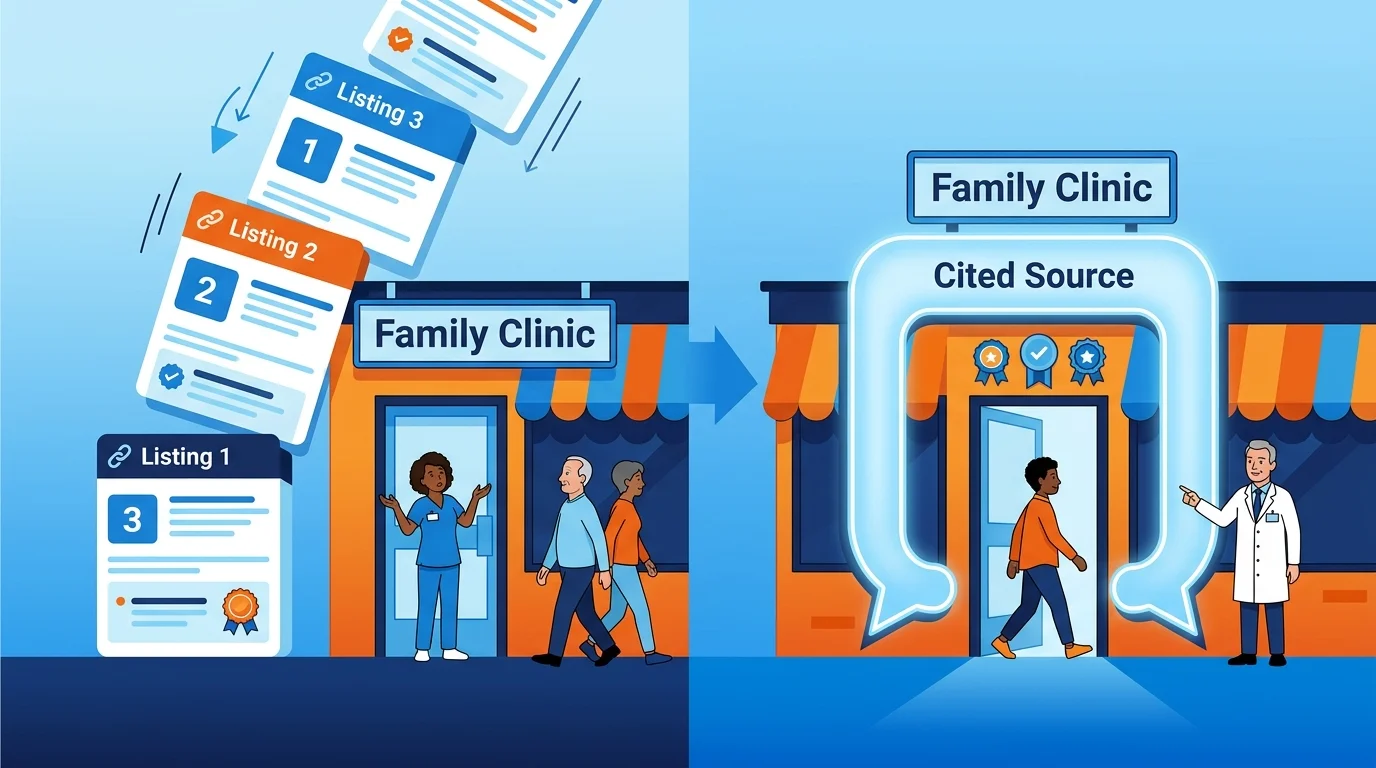
Authority infrastructure is the mix of technical architecture, structured data, and content strategy that tells AI systems a source is trustworthy and actually knows its stuff. Think of it as the full background check an AI engine runs before it'll quote anyone out loud.
The Shift From Listed Address to Cited Source
Being online used to mean earning a spot on a list of links. Now the prize is the single cited answer: one verdict, not ten addresses. Here's how that shift plays out across the architecture behind an AI authority engine.
Why Rankings Stopped Being the Scoreboard
Plainly: AI visibility is not traditional search optimization wearing new vocabulary. Rankings tracked where a site sat on a list, and citation tracks whether an engine trusts a source enough to speak its content as the answer. So ranking first stopped being the win, because the win now is being the trusted source an AI engine quotes.
Why Minimal-Viable Websites Can't Be Verified as Sources
A minimal-viable website can publish words, but it can't prove who wrote them, what credentials back them, or why an engine should trust them. In healthcare, that gap is fatal, because AI engines have far less tolerance for ambiguity and a much higher demand for verifiable authority. Rankings became a vanity metric the day answers replaced links.
The Mechanics of a Thin Entity Profile
A thin entity profile usually looks like one generic bio, no linked credentials, and no structured markup tying the practice to its claims. That's a witness showing up to court with no ID (and wondering why nobody calls them). See how a complete build closes that gap in the AEO versus full-stack comparison.
What Gets Lost Without Verifiable Credentials and Citations
Without verifiable credentials and citations, an engine can't confirm a claim before it repeats it, and that risk is measurable. Findings published through Stanford University show between 50% and 90% of large language model responses to medical questions may not be fully supported, and are sometimes contradicted, by the sources they cite.
Why a Template Site Reads as a Blank Entity to a Language Model
A template site fills pages with words but leaves the connective tissue missing. It supplies no structured signal tying a credential to a provider, a provider to a service, or a service to the entity making the claim.
That gap is measurable. On a page from WordLift, researchers found that adding JSON-LD markup alone produced only modest improvement in retrieval, a Δ of +0.17. Their enhanced entity page format, built with llms.txt-style agent instructions, breadcrumbs, and neural search capabilities, produced a +29.6% accuracy improvement for standard RAG.
According to WordLift, structured data alone may produce only modest retrieval gains, while an enhanced entity page format with agent instructions and breadcrumbs was associated with a +29.6% accuracy improvement for standard RAG.
More pages without that architecture do not close the gap. Volume without structure reads to a language model as noise, not depth.
See how that build looks when it is done completely in clusters that pair a condition with search intent.
| Signal a Model Looks For | What a Template Build Typically Supplies | What a Citable Build Supplies |
|---|---|---|
| Structured data markup | A missing or boilerplate schema snippet, rarely matched to the content a visitor actually sees | Structured markup tied directly to credentials, services, and conditions, matching what the page displays |
| Entity-to-credential linkage | A generic bio page with no connection between a provider's name and a verifiable credential | Linked credential data that ties a named provider to a specific claim an engine can check |
| Content depth per topic | A single thin page summarizing an entire specialty in a few paragraphs | Dedicated pages built around individual conditions and services, each carrying its own structural signals |
| Agent-readable instructions | No guidance for how an automated system should parse or prioritize the page's content | Agent instructions and breadcrumb structure that tell a retrieval system how the page is organized |
| Consistency across the site | Isolated pages that repeat claims without reinforcing one another | A connected architecture where every page reinforces the same verifiable entity |
What the Numbers Say About Trust, Retrieval and Getting Quoted
Rankings stopped predicting who gets quoted the day answers replaced links. One study ran search engines against 150 TREC health questions, and they got only 50 to 70% right, mostly because the results they pulled never answered what was actually asked. Findings published through University of Santiago de Compostela show search engines correctly answer 50–70% of health questions, though this performance is often hindered by many retrieval results not responding to the health question. Large language models hit about 80% on the same kind of queries (though that number shifts with how the question gets phrased).
| Measurement | What It Found | What It Means for a Practice's Visibility |
|---|---|---|
| Search engine accuracy on health questions | Correctly answered 50–70% of 150 TREC health questions, often hindered by retrieval results that never addressed the question asked | Appearing in a results list does not guarantee a practice's content actually answers the question an engine is trying to resolve |
| LLM citation reliability on medical queries | Between 50% and 90% of LLM responses to medical questions are not fully supported, and are sometimes contradicted, by the sources they cite | Models already cite sources that do not fully support what they say, so a citation on its own does not prove the answer matches the page |
| Query fan-out exposure | AI Overviews and AI Mode may issue multiple related searches across subtopics and data sources before producing one answer | A thin entity profile gets tested against every subtopic search generated, not just the single question a visitor typed |
How Query Fan-Out Multiplies the Cost of a Thin Entity Profile
It gets harder from there: Google has confirmed that AI Overviews and AI Mode may use a query fan-out technique, firing off multiple related searches across subtopics before writing one answer. According to Google, Google states that AI Overviews and AI Mode may use a "query fan-out" technique, issuing multiple related searches across subtopics and data sources to develop a response. So a thin entity profile doesn't face one question. It gets cross-examined by every subtopic search the engine runs, which is why some clinics now lean on managed AI visibility programs built for exactly that kind of scrutiny.
How a Citable Architecture Is Actually Assembled
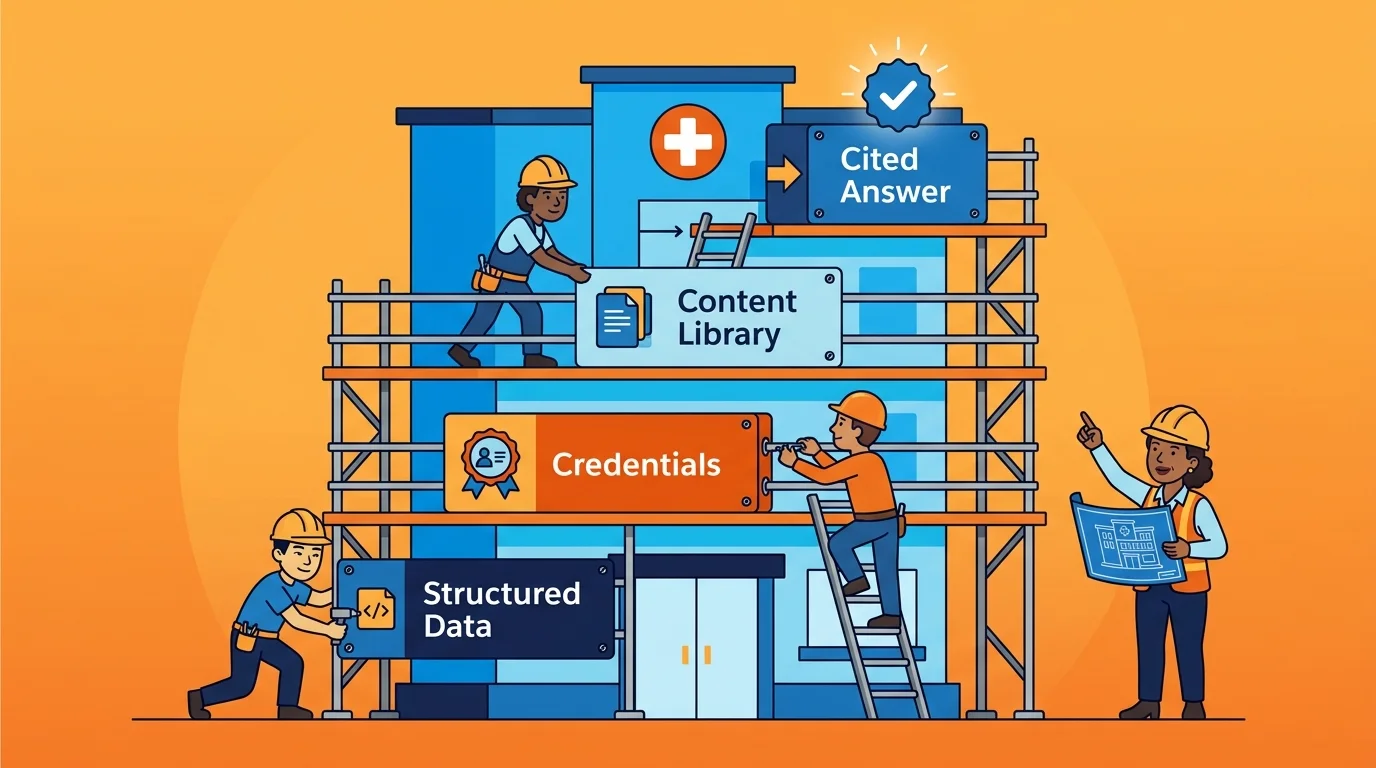
| Build Stage | What Gets Assembled | Why a Model Checks This Layer |
|---|---|---|
| Entity Foundations | A verified provider profile linking named practitioners to credentials, specialties, and the practice itself | A model needs a confirmed identity behind a claim before it will repeat that claim as fact |
| Structured Markup | Schema connecting services, conditions, and credentials into a machine-readable map of the practice | Structure lets an engine parse what a page asserts instead of guessing from visible text alone |
| Depth Content | Condition-specific and service-specific pages that demonstrate experience beyond a generic bio | Depth signals expertise a model weighs against competing sources before choosing one to quote |
| Cross-Layer Consistency | Matching claims across the entity profile, the markup, and the content itself with no contradictions | A verifier treats any mismatch between layers as a reason to withhold citation entirely |
Structured Data as the Foundation Layer
A citable architecture starts underneath the words a visitor actually reads. Structured data marks up providers, services, and credentials so a machine can parse what a page claims, not just put it on a screen.
Entity Signals and the YMYL Standard Health Content Is Held To
Now… this part matters, because health content answers to a stricter standard than almost anything else online. Entity signals have to tie a named provider to a credential, that credential to a service, and that service back to the practice itself. Leave a gap anywhere in that chain and a verifier will flag it.
Where This Gets Built, Step by Step
So the build runs in order: entity foundations first, structured markup second, depth content stacked on top of both. Skip a layer to launch faster and you've taken the exact shortcut that leaves a site listed but never quoted.
Frequently Asked Questions
A few mechanical questions still sit under everything above. Straight answers close the gap between theory and the actual build.
What is authority infrastructure in the context of AI search?
Authority infrastructure is the architecture, structured data, and content that signal expertise to AI. It's what an engine checks before quoting a source, not just listing it.
How is AI visibility different from traditional search position tracking?
Rank-tracking reports measured where a site sat on a list of links. AI visibility asks a different question. Does an engine trust a source enough to speak it as the answer?
What specific technical elements make a website citable for an AI engine?
Structured data markup, verifiable credentials tied to named providers, and full topic depth all count. A generic template missing those connections rarely earns citation, no matter how polished.
How does query fan-out change what a healthcare practice's content needs to cover?
Query fan-out turns one question into several subtopic searches before the engine writes one answer. Content built around one page or keyword leaves most of those searches empty-handed.
What does structured data actually do for an AI engine evaluating a page?
Structured data marks up providers, services, and credentials so a machine can parse the claims. Without it, an engine sees words but no proof of who's making the claim.
Why does YMYL scrutiny apply so heavily to healthcare content?
Bad medical information carries real consequences, so AI engines filter health sources harder. That higher bar rewards verifiable depth and credentials. Thin, unstructured content gets penalized, however good it reads to a human.
The Bottom Line
Here's the verdict: cheap infrastructure doesn't fail because it looks unfinished. It fails because an AI engine can't verify what it can't see.
A template site gets listed as a witness nobody ever calls to the stand, while real authority infrastructure gets quoted as the verdict itself. That happens because it hands the engine every credential, structure, and signal it needs to trust your practice before repeating a single word. Now that the answer has replaced the list of links, that's the outcome worth building toward.
Let's keep it real: nobody can tell you which week that citation shows up, and anyone promising one is guessing. What you can control is whether your infrastructure is built to be verified at all. So find out where your build actually stands with an AI Visibility Check.