
What a Condition-Intent Content Cluster Actually Is
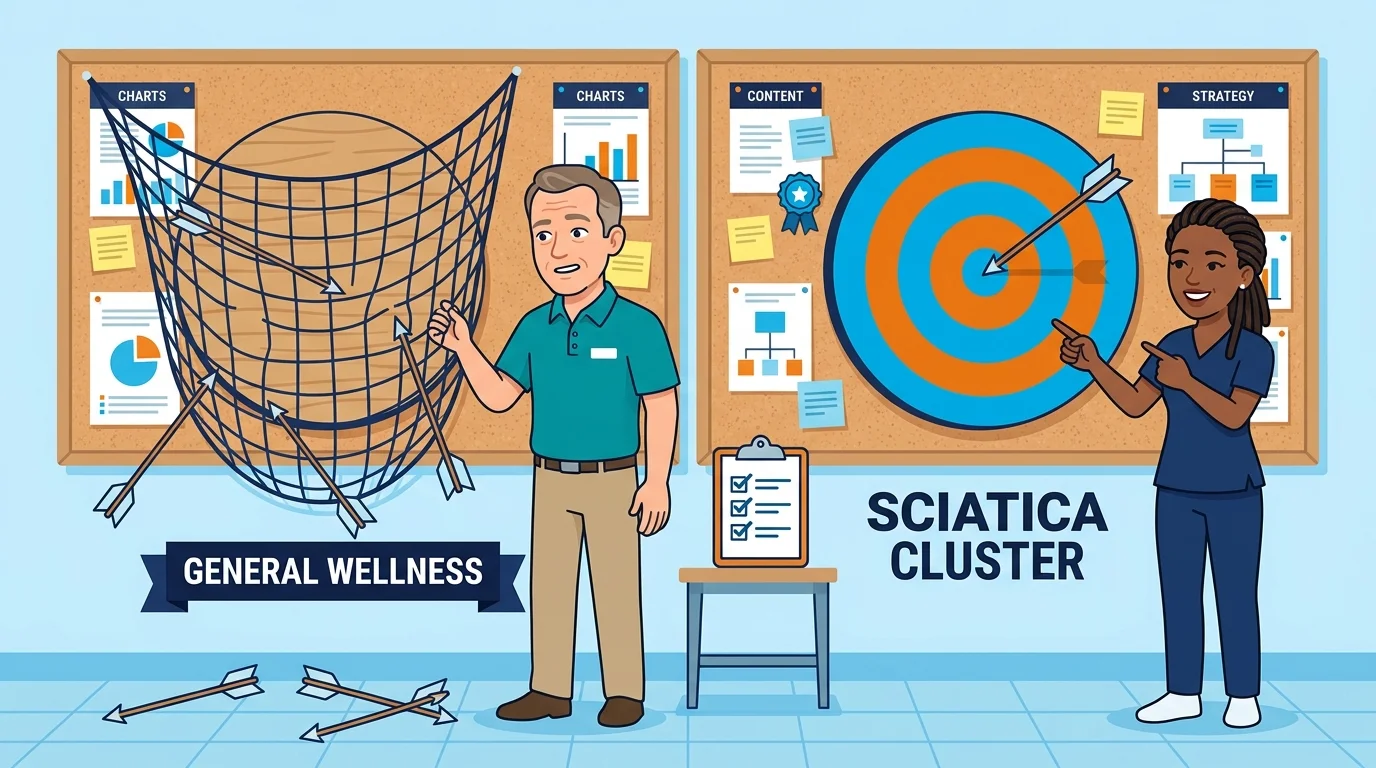
So what actually breaks the old cluster model? A condition-intent content cluster is built around one defined situation, question, or decision point instead of a broad subject. Every page inside it answers a problem conditional on something the reader already knows about their own circumstance.
Treating AI visibility as traditional search optimization with new vocabulary misreads what changed. Topic clusters spread broadly across loosely connected pages to chase a link-driven ranking system, but condition-intent clusters are engineered for precision, aiming to be the most authoritative answer for one narrow query context. That shift is the starting point of authority architecture built for healthcare, where generic coverage doesn't earn a citation anymore.
Why the Broad Topic Cluster Model Breaks Down Here
Generative answers sitting right inside search results are the biggest shift in how people find information in over a decade. And most organizations are still writing for a search engine that hands out lists of links, not one that builds a single definitive answer.
So the old model keeps tuning itself for a results page that's quietly disappearing. A broad topic cluster was built to place for dozens of nearby keywords at once, which spreads relevance thin across dozens of pages.
Why Covering a Subject Broadly Fails to Earn a Citation
Breadth waters down the exact semantic signal a generative model is hunting for. A page written to loosely cover a whole subject is a weaker match for any one narrow question.
Getting indexed somewhere in all that broad coverage? Still just an address on a map nobody drives to anymore. That failure shows up in infrastructure choices too, including the pattern this cluster breaks down in why thin practice websites lose AI citations.
How Generative Engines Actually Select What They Cite
So what decides which page a generative engine actually picks? Not the one with the most coverage. It's the one most relevant to a tightly scoped question.
That pull toward relevance is why a scattered content calendar tends to lose to a narrow one. And "more content equals more visibility"? That's a measurement mistake, because volume was never what selection rewards, and rankings stopped predicting citations the moment answers replaced links.
| Factor | What It Measures | Why It Matters for Citation |
|---|---|---|
| Query Relevance | How directly a page answers the exact query condition, rather than drifting across a broad subject | Reranking weighs relevance to the query, so a tightly scoped page is an easier match for a narrow question than general coverage |
| Redundancy Against Other Sources | Whether a page adds something the other retrieved pages do not, instead of repeating them | Reranking can reduce redundancy, so a near-duplicate of another page is less likely to be shown beside it |
| Content Specificity | Whether a page is built around one defined situation or stretched across many loosely related ones | A page narrowed to a single condition produces a cleaner signal than one trying to serve many intents at once, improving its odds of being the selected source |
| Technical Eligibility | Whether a page is indexed and able to appear in Search with a snippet in the first place | This is a baseline gate, not a differentiator, since indexing alone does not explain why one page gets cited over another that is equally indexed |
What Relevance and Redundancy Mean in Practice
In practice, retrieved pages are weighed against the question and against each other, so a page smeared across five adjacent topics is a weaker match than one built around a single condition. Google's documentation says Google's AI features such as AI Overviews and AI Mode may have no additional technical requirements beyond being indexed and eligible to appear in Search with a snippet. Eligibility is the floor every indexed page already clears, which is exactly why it explains nothing about who gets cited.
Entity consistency does the same job at the structural level, and a knowledge graph machines can query keeps it intact as a cluster grows so a model traces every page back to one coherent source. Work available through this published analysis indicates monetization is associated with a 13.0 percentage point lower deployment of AI Overviews in search results.
The Architecture of a Citable Content Cluster
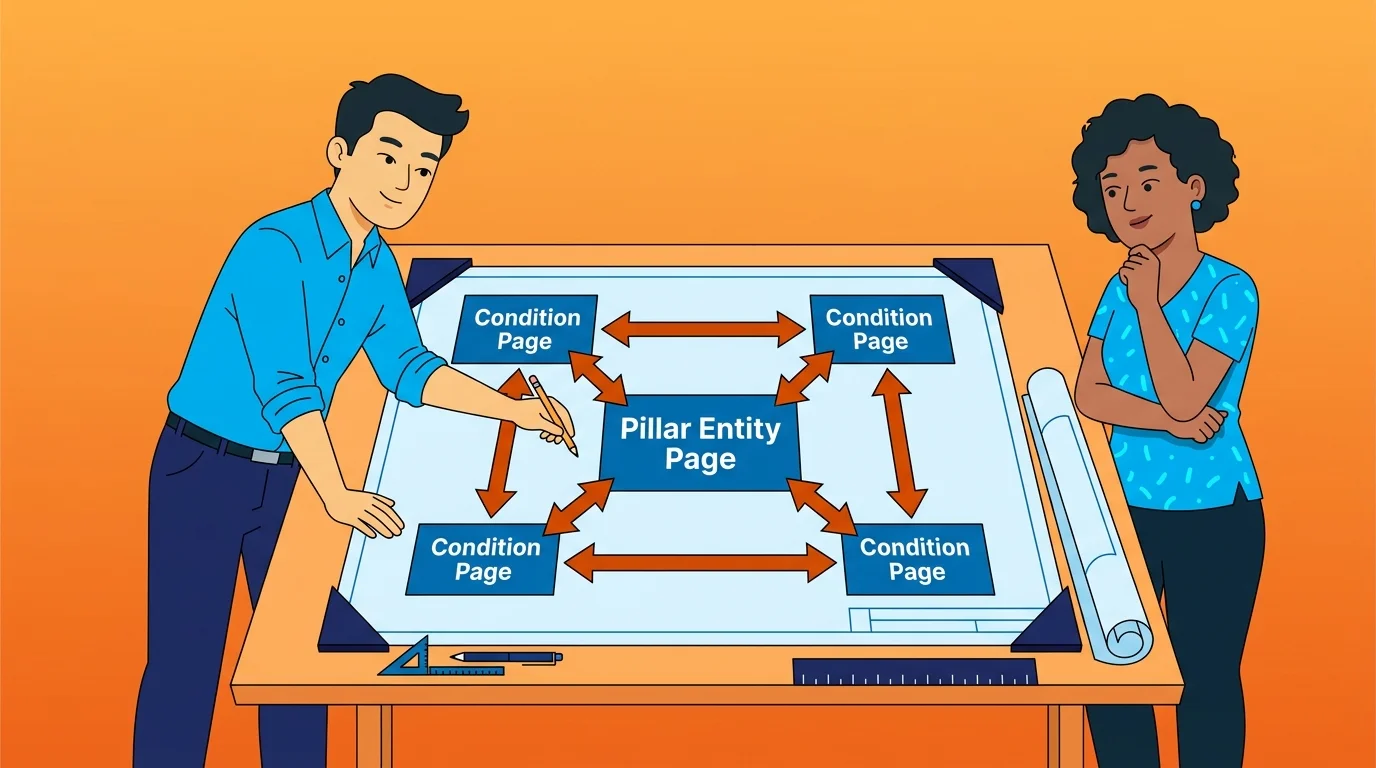
Think of a citable cluster as a building, framed on purpose so every page holds up the others. Nothing gets repeated, and nothing sits there as random filler.
Architecture here comes down to three parts working together: internal links that signal relationship, retrieval behavior that rewards distinct answers over duplicates, and entity consistency that tells a model exactly who's talking. Pull any one of those out, and the whole cluster reads like noise instead of structure.
How Internal Linking Reinforces Entity Recognition
So how does a model know these pages belong to the same authority? Descriptive anchor text is part of the answer. Google's documentation says descriptive anchor text may help both people and Google understand what the linked page is about. That guidance applies as much to a machine parsing a cluster as it does to a person clicking through a site, which is why vague anchors like click here waste the signal a cluster depends on.
Every page worth citing inside a cluster needs at least one link pointing at it from somewhere else on the same site, because that's how a model learns the page matters enough to connect to. I've watched clinics build this structure on their own and skip that step completely. That's one reason practices hand the internal architecture to done-for-you AEO services, so it gets built right the first time.
How Retrieval Systems Rerank for Novelty, Not Just Relevance
Relevance alone is not what retrieval systems optimize for anymore. Reranking exists specifically to push back against redundancy. Research published through published research data found Maximal Marginal Relevance may rerank retrieved documents to balance query relevance against novelty, which can reduce redundancy so that a user is not shown many near-duplicate documents about one topic. A cluster built from five near-identical pages about one condition gives a retrieval system nothing to differentiate. Rankings stopped predicting who gets cited once answers replaced links, and redundancy is exactly what gets filtered out of that selection. A cited source earns its seat by being distinct, not by being repeated. There is more on done-for-you AEO services if this is the part that matters to you.
Where Cluster-Building Efforts Collapse in Practice
So where does it all fall apart? Teams get the architecture, nod along, then slide right back into publishing volume because volume feels like progress.
The Volume Trap in Content Production
More pages don't buy more visibility once answers replaced links as the thing being chosen. A calendar graded on output count rewards the exact breadth that waters down semantic tightness. You end up with a stack of look-alike articles instead of one page a model can pick with confidence.
The Cost of Treating Eligibility as the Finish Line
Eligibility is a floor, not a trophy. Getting indexed and showing up with a snippet is the baseline every page already clears, so building a strategy around it makes zero sense. Call that the finish line and a cluster stays technically present while never getting chosen.
Building the Cluster: Sequence and Technical Requirements

So how does a cluster actually get built, step by step? Order matters more than most teams think: structure the page so a machine can extract the answer first, then grow the cluster, and never the other way around.
| Build Stage | Primary Task | Technical Component |
|---|---|---|
| Foundation | Define the single condition and intent each page must answer | Encyclopedic answer formatting with the conclusion stated in the opening sentences |
| Structural Linking | Connect the cluster so relationship is visible to a crawler, not just a reader | Descriptive internal anchor text pointing to every page worth citing |
| Entity Consistency | Name the same entity the same way across every page in the cluster | Consistent entity naming paired with structured data that matches the visible content |
| Retrieval Tuning | Reduce near-duplicate pages competing for the same query | Domain-specific retriever fine-tuning informed by real query and click behavior |
| Sequential Expansion | Confirm one page fully answers its condition before publishing the next | Staged publication tied to verified extraction performance rather than a content calendar |
| Signal Source | What It Verifies | Reported Figure |
|---|---|---|
| Retriever fine-tuning on domain data | Whether the retrieval layer has been trained to recognize precision over general relevance | Notable improvement in retrieved results, per Adobe retriever training loss data |
| Click-pair weighting in retriever training | Whether higher-value click signals are weighted more heavily than low-value ones during training | Multiple documents clicked per query receive greater attention when pairs are weighted |
| AI Overview deployment vs. monetization | Whether monetized query intent correlates with lower AI Overview deployment, measured across Google queries in two waves spanning 2025-2026 | 13.0 percentage points lower |
Structuring Pages So Machines Can Extract the Answer
Extraction comes first: a model has to find the answer before it can cite it. A page built for this states its conclusion in the first sentences, then supports it with specific detail the model can parse without guessing. That same logic applies below the surface, inside the retrieval systems that decide what a model even sees.
Work available through Adobe indicates fine-tuning the retriever on domain-specific documents and click data may lead to notable improvement in retrieved results.
Domain-specific training on real query behavior is what separates a retriever that finds the right page from one that merely finds a related page. A cluster's structure only pays off if the system retrieving it has been tuned to recognize precision rather than reward breadth.
Sequencing Cluster Expansion Without Diluting Precision
But sequencing is where most clusters lose their nerve. Publish one page and make sure it answers its condition completely. Add the next one only once the first is rock solid.
Frequently Asked Questions
So before we wrap, a handful of mechanical questions deserve straight answers. This is where the build sequence gets specific.
What is the difference between a topic cluster and a condition-intent cluster?
A topic cluster spreads one subject across lots of loosely connected pages. It's built to place for adjacent keywords. A condition-intent cluster answers one specific problem tied to a known situation, built to get cited instead of just covering ground.
How does structured data influence whether my content gets cited by AI?
Structured data only matters when it matches what the page actually shows. It won't earn a citation by itself. But mismatched or inflated markup can knock a page out before a model ever reads it.
Can I optimize my existing blog posts to be part of a condition-intent cluster?
Yes, if each post gets narrowed to answer one condition cleanly. A broad post juggling five scenarios has to be split apart. Relinking alone won't fix it.
How many pieces of content are needed to form a complete cluster for AI citation?
There's no magic number. Every condition a practice actually serves needs its own page, linked into the others. No gaps, no overlap.
What are the most common mistakes businesses make when trying to get cited in AI Overviews?
The big one is grading progress by publishing volume instead of semantic precision. Close behind? Burying the conclusion instead of stating it up front, where a model can actually find it.
How long does it typically take for AI engines to recognize and start citing a new content cluster?
Nobody can promise when a model starts citing a cluster. What improves the odds is finishing one page per condition completely. Then you move to the next.
The Bottom Line
A citation is a seat at the table. A listing is an address on a map nobody drives to anymore. That's the hill this whole cluster stands on.
So no, chasing broad coverage and hoping a model notices was never the strategy. One page per condition, built for extraction and wired into a deliberate architecture, is what earns the citation. Measuring progress by publishing volume means optimizing for a results page that's quietly fading out.
One point is worth sitting with: being chosen by a model and being ignored by one sit miles apart, and closing that gap is the entire reason this cluster model exists. If you want to see where your own pages stand against that standard, iTech Valet's AI Visibility Check is the place to start.