
What Authority Visibility Metrics Actually Measure (And What They Don't)
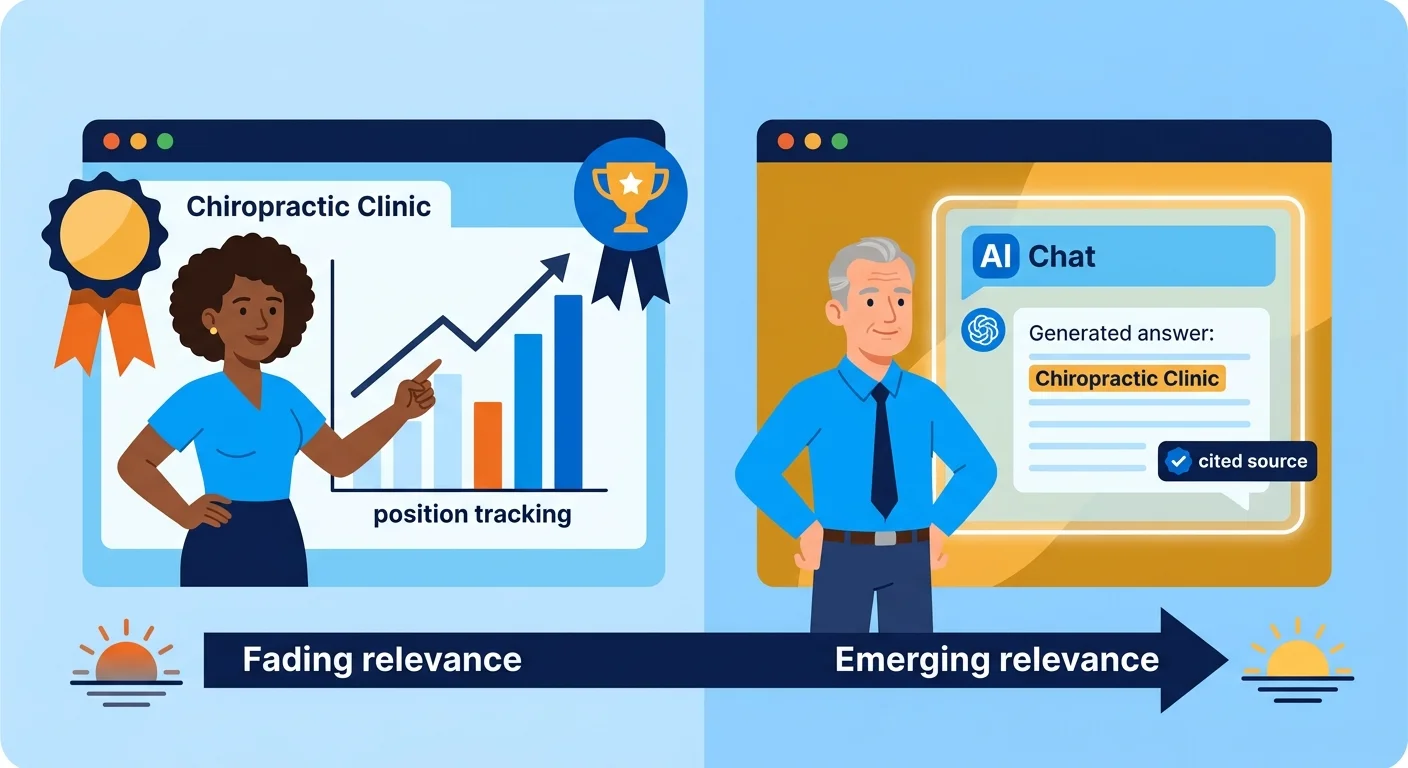
Authority visibility metrics measure exactly one thing: where a page sits in a ranked list for a given search term. What they can't measure is whether a practice's presence is verifiable enough for a generative system to cite it as a trusted entity inside its own knowledge base. And the two don't move together.
Here's the mechanism that makes it matter. A high placement only proved a page existed in a ranked list, not that any system trusted what it said. Rankings stopped predicting who gets cited the day answers replaced links as the thing patients see first.
For a local service like a chiropractic practice, that shift changes what visibility even means. It's not a spot on a list of blue links anymore. It's whether an AI-driven answer engine treats that practice as the definitive, trusted answer to a direct question a patient asks.
So the two metrics measure different worlds, and mixing them up is exactly how a practice can spend on traditional answer engine work and still register zero AI visibility. A results-page position and a citable-entity standing can move in opposite directions at the same time. Most dashboards were never built to show the second one.
| Metric | What It Measures | What It Misses |
|---|---|---|
| Keyword Position Tracking | Where a practice's page sits among competitors for a given search term on the results page. | Whether an AI-driven answer engine recognizes the practice as a citable, trusted source. |
| Site Visits | How many people land on a page after clicking through a results list. | Whether a patient ever received a direct answer from a generative system without clicking anything at all. |
| Citable Entity Presence | Whether an AI-driven answer engine can identify, verify, and surface a practice's information as the source behind a generated answer. | Nothing about position on a page, because position is not the currency this system trades in. |
| Backlink Volume from Acquiring Inbound Links | How many external pages link back to a practice's site, a signal built for the ranked-list era. | Whether the practice's own structured data and entity signals are consistent enough for a generative system to trust as a source. |
Why Keyword Position Tracking Fails as a 2026 Authority Signal

Keyword position tracking describes a results format patients see less of every month. That one fact is the whole problem with treating a position number as an authority signal in 2026.
Here's the thing about a metric built for a ranked list. It can only ever describe the list, never an answer engine that skips the list entirely and writes its own response from whatever sources it trusts most.
So a practice's keyword position tracking numbers can hold steady for months. Meanwhile the AI-driven system generating patient answers has already stopped pulling from that practice's pages, and the dashboard has no way to notice.
And that disconnect isn't a temporary reporting gap. It's a structural mismatch between what the metric measures and what the market now rewards.
Rankings measure position among competitors on a page format that generative answers are actively pushing out. Citable entity presence measures something else entirely, and how a practice's current visibility to major generative systems is actually checked walks through the verification method a position number can never stand in for.
Why Chasing the Classic Ten Blue Links Breaks Down
Chasing those positions breaks down the moment the result itself stops being a list. A ranking only exists relative to other ranked items.
But an AI-driven answer engine doesn't rank a set of pages against each other the way a traditional results page does. It selects, synthesizes, and cites, which is a completely different job than sorting links by relevance score.
Look at what that does to a practice still reporting position numbers as its main visibility metric. The number can climb while the practice's actual presence inside generated answers stays flat or slides, because the two systems aren't measuring the same behavior.
And the gap only widens as generative answers absorb more of how patients search. A metric anchored to the old format can't track a shift happening inside a format it was never built to see.
The Zero-Click Mechanism That Makes the Old Signal Meaningless
The zero-click mechanism is what makes the old signal meaningless rather than just outdated. Across 10.2 billion Google searches between October 2024 and December 2025, nearly half, 46.96%, ended without a single click to an organic or paid result.
That means the searcher got an answer straight from the results page itself. No click happened, so no ranked link was ever visited, and a keyword position tracking dashboard has nothing to record for that search even though an answer was delivered.
So a rising share of patient searches now resolve without ever touching the mechanism keyword position tracking was built to measure. The old playbook of chasing position on a list of links is going obsolete precisely because the list is no longer where a growing share of answers get delivered, a point published industry reporting on zero-click search behavior makes plain.
The Mechanism: How AI Overviews Decide Which Practice Gets Cited
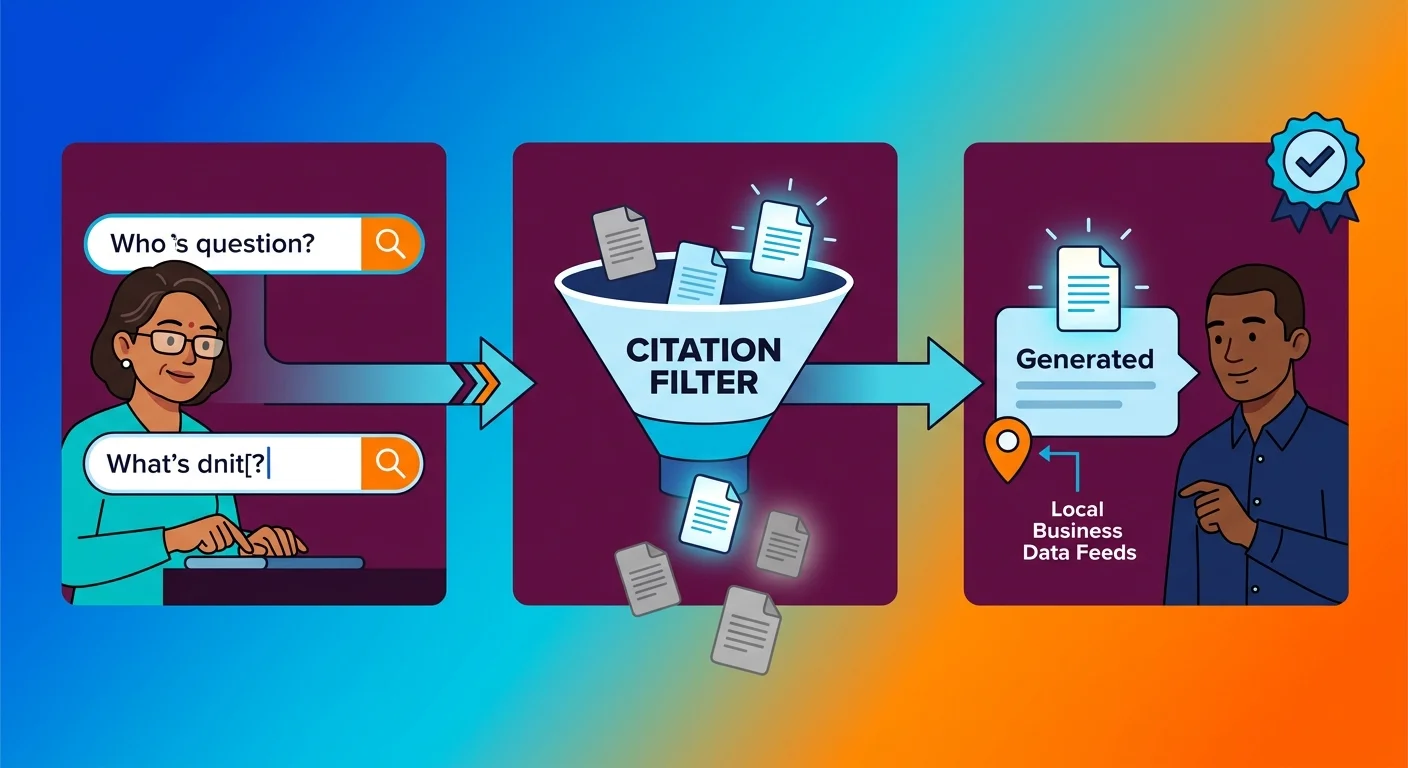
So how does a generative system actually pick which practice earns the citation? Not off a position number. It runs a verification pass across structured data, consistent citations, and content it can parse without guessing.
Here's the kicker: that pass runs per query, not once a month. A practice can get verified and cited for one question, then vanish on the next one when its signals go thin in that specific category.
But the mechanism stops being mysterious the second you split its two inputs. One is local behavior data — how often a generative answer even shows up for a search. The other is content selection — which trusted sources actually get named.
That split matters, because a practice can win one input and lose the other flat out. A retainer built around keyword position tracking has no way to see the gap between them, which is a separate failure from the one covered in the retainer economics behind traditional answer engine optimization contracts.
| Search Behavior | Local Search Finding | Why It Matters |
|---|---|---|
| Local search query volume | AI-driven Overviews appear on approximately 6.85% of local search queries in the Ahrefs index | A local chiropractic search is still less likely to trigger a generated answer than a broader informational query, narrowing the window a practice needs to win |
| Local pack presence inside generative results | Google Business Profile data appears in 100% of SGE results that contained local packs, with carousel links to local.google.com running alongside them | Profile data is one of the most reliably cited inputs a local practice directly controls once a local pack is present |
| Content selection at citation time | Generative search engines cite website content exhibiting significantly lower perplexity, meaning more predictable language patterns aligned with how large language models generate text | Citation is earned by content structured for machine extraction, not by site visits or subjective writing quality |
Local Search Behavior and the Local Pack Connection
Look at where generative answers even show up first. AI Overviews appear on approximately 6.85% of local search queries inside the index Ahrefs' research examined, a smaller slice than the broader search landscape.
So a generative summary is still the exception for local queries, not the rule — at least for now. And that gap is exactly why the practices that do get cited inside it stand out so sharply from the ones that don't.
Now look at what fills that summary when it does appear. Profile data carries the weight almost every single time a local pack is involved.
What Determines Which Source Gets Quoted
According to Moz's reference material, Google Business Profile data appears in 100% of SGE results that contained local packs, with carousel links back to the map interface running right alongside them.
That's not a partial correlation. It's a structural dependency, and it means a practice's profile fields are doing citation work that a keyword-targeted article never touches.
So which source actually gets quoted once a generative system hits the content layer? Not the longest page. Not the most recently published one either.
How a Rented-Attention Model Fails When Answer Engines Take Over

A retainer built for the old results page rents a practice's attention. It doesn't earn that practice a durable place inside a knowledge base, and that difference matters a lot more now than it did five years ago.
Rented attention has one defining property: the second the check stops, the position vanishes. Nothing about the deal builds toward a practice getting recognized as a citable source without paying to keep it up.
So the model was never built to produce entity status. It was built to produce a rank — and a rank is a lease, not an asset.
Now here's what a lot of established practices are finding out the hard way: years of spend on traditional search optimization never turned into visibility inside the new AI-driven answer engines. The money was real. The citation status it was supposed to buy just never showed up.
The Retainer Model's Dependency Problem
Look at what a retainer actually sells — continued effort against a metric the market has already started walking away from. The dependency isn't a side effect. It's the product.
And that dependency breaks in a very specific way once generative answers take over. A practice keeps paying every month for keyword position tracking while the answer engine reaching patients has quietly stopped citing it, and the retainer has nothing built in to catch it or fix it.
So the fix isn't another retainer aimed at the same dead target. It's a structure built around what an answer engine actually verifies — which is the whole reasoning behind our managed AI visibility programs for clinics that need entity presence measured directly, not guessed at from a position number.
Building the Architecture: What Makes a Practice a Citable Entity
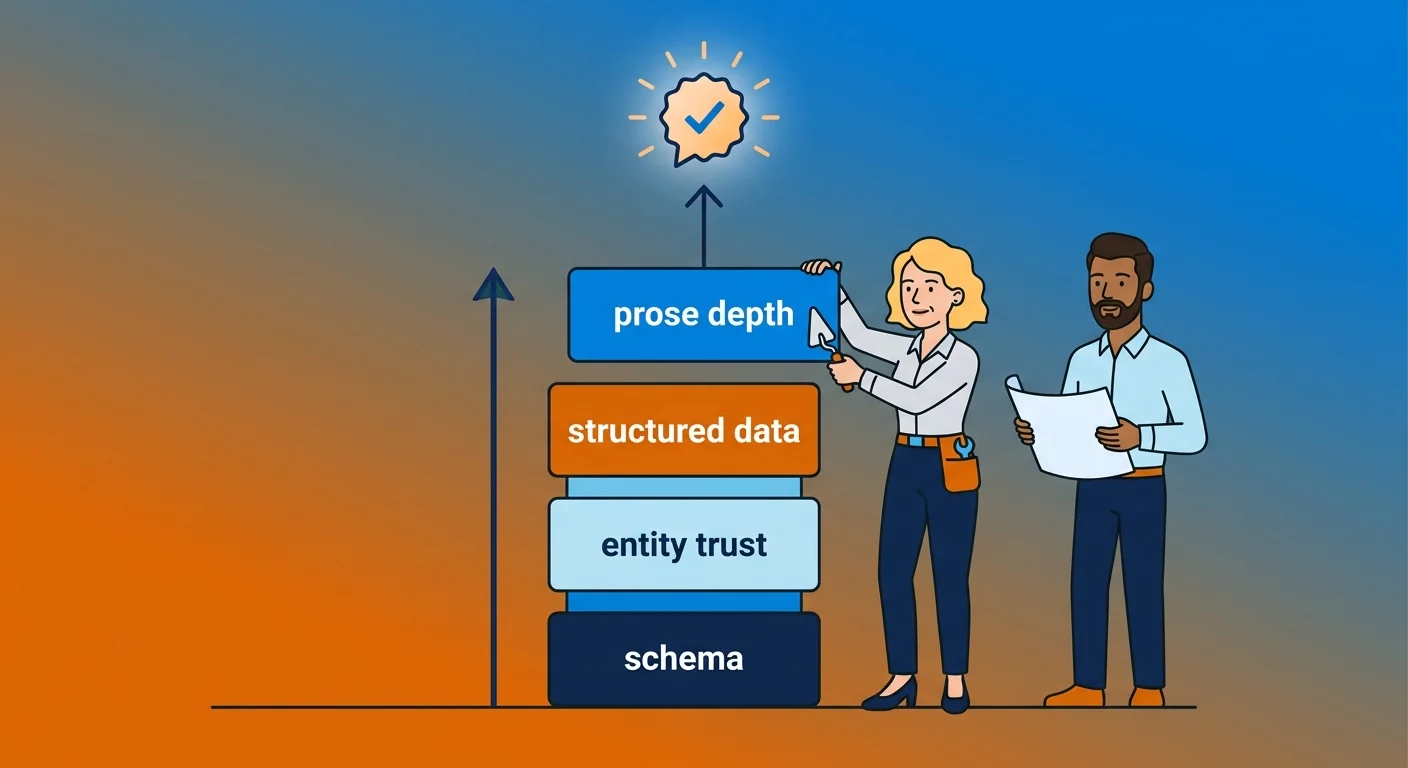
So what does a citable entity actually take, structurally, once the diagnosis is clear? Not a slicker dashboard. A different foundation, from the ground up.
Authority visibility, in the sense that matters now, isn't a score a practice checks once a month. It's a standing — one a practice either holds or doesn't hold inside a generative system's own trusted sources.
That standing gets built in two layers, and most practices have only ever built one. The next two sections walk through both, starting with the layer almost nobody outside the technical work ever sees.
| Architecture Layer | Function | Operator Input Required |
|---|---|---|
| Entity Recognition Layer | Trains the generative model to identify the practice as a distinct, trustworthy source rather than an anonymous page on a ranked list | Structured practice data annotated in a consistent, machine-readable format across every page and profile the practice controls |
| Content Extraction Layer | Determines whether a generative system can parse and reuse the practice's own language with confidence once it has identified the practice as a candidate source | Prose written in predictable, well-structured patterns rather than dense marketing copy built for a human skimming a ranked page |
| Local Presence Layer | Feeds the profile and map-based signals that generative systems draw on heavily for location-specific queries | Complete, accurate, and actively maintained business profile data rather than a one-time setup left untouched for years |
| Consistency Verification Layer | Confirms the practice's identity, credentials, and details match across every source the generative system already trusts before it will cite the practice directly | Uniform practice details maintained across every listing, profile, and page rather than left to drift as staff or hours change |
The Fine-Tuning Layer
Large language models don't come out of the box recognizing a specific chiropractic practice as a distinct, trustworthy entity. That recognition gets trained in, through a fine-tuning process built on annotated examples.
One documented method for local business entity recognition works by defining a desired output structure — say, a list of JSON objects with a set of predefined keys — then annotating roughly 100 to 500 text passages in that format, a process spelled out in published data on model fine-tuning methods. That's a small, specific training set. Not a sprawling content library.
What that number actually tells you: the model is learning a pattern, not memorizing a practice. A practice becomes recognizable through structure, not through the sheer volume of pages published. That one fact reframes what fine-tuning actually rewards.
The Content Layer
But structure alone doesn't finish the job. The content layer is where a practice's actual language gets tested against what a generative system can pull with confidence.
Remember the earlier split between predictable, well-structured prose and content a system struggles to parse? The content layer is where that split gets built on purpose instead of left to chance.
A listing only proves a page exists; a citation proves a system trusts it. A listed address only had to exist somewhere on a ranked page. A cited source has to be verifiable, consistent, and structured well enough that a generative system trusts it enough to name it outright.
Implementing Entity Authority: The Operational Sequence
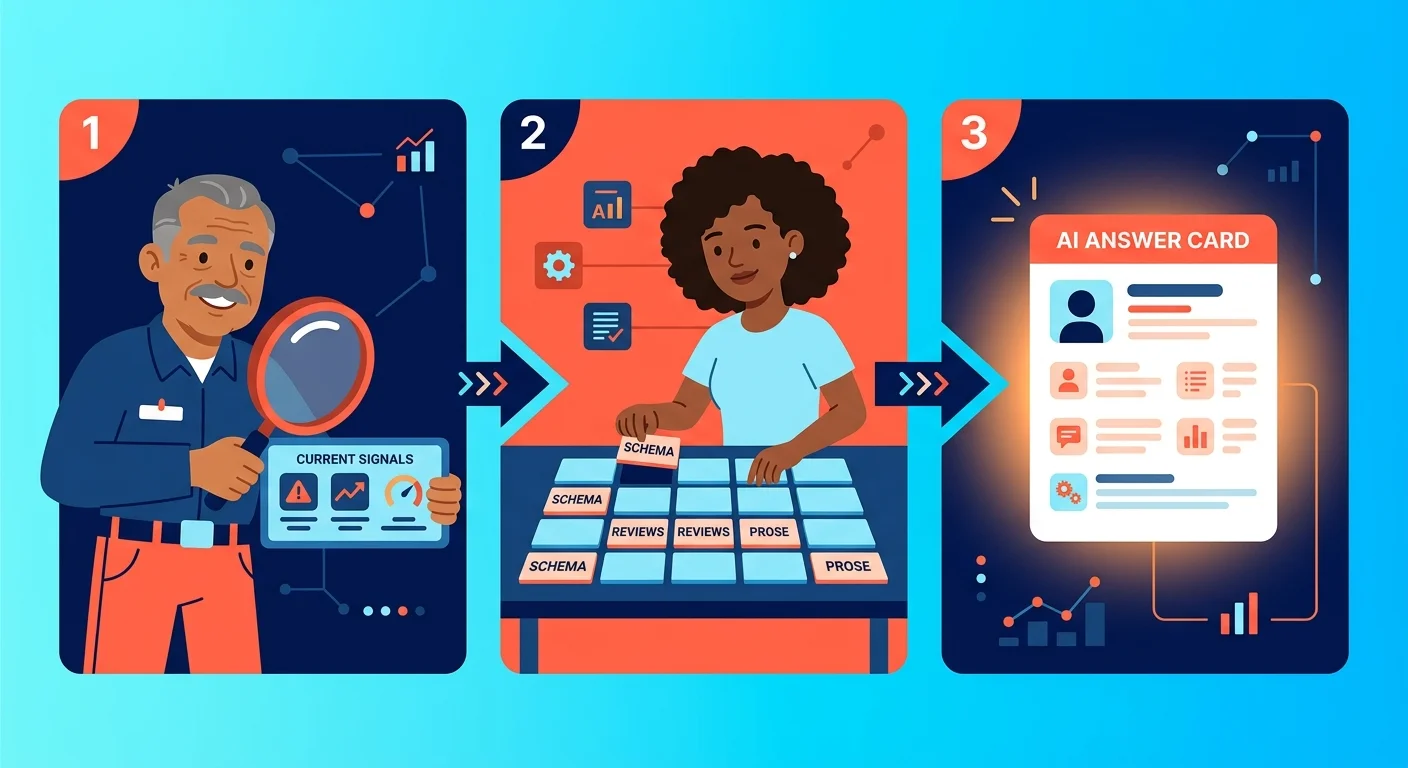
So what does building this actually look like, one step at a time, once the diagnosis lands? Not a content calendar. It's an operational sequence with a fixed order, because building the layers out of sequence just burns effort on the wrong foundation.
The order has one non-negotiable: it opens with an audit, not a publishing sprint. A practice can't structure an entity layer around signals it's never once inventoried.
More content was never the lever. A generative system doesn't reward a bigger archive of pages. It rewards a smaller set of signals it can verify and trust — and that's exactly what the next two subsections are built to show.
| Step | Action | Signal It Strengthens | Sequence Position |
|---|---|---|---|
| Audit the entity footprint | Inventory Google Business Profile fields, name-address-phone consistency, and existing page language for parseability | Baseline recognizability a generative system can currently verify | First |
| Structure the signal layer | Apply schema markup and consistent structured data across every page describing services and credentials | Machine-readable consistency a system can extract without guessing | Second |
| Rewrite for extraction | Convert prose into predictable, low-perplexity language patterns a generative system can parse with confidence | Content trust, the property that determines whether a source gets quoted | Third |
| Reinforce with fine-tuning-aligned examples | Format a small set of practice descriptions the way annotated training passages are structured, prioritizing consistency over volume | Entity recognition trained through pattern, not page count | Fourth |
| Monitor citation, not position | Track whether the practice is being named directly inside generative answers rather than watching keyword position tracking | Durable standing as a citable source instead of a rented rank | Ongoing |
Auditing Current Signals
So the first move is inventory, not production. A practice has to see what a generative system currently has to work with before it adds a single new page.
That means checking the Google Business Profile fields, the name-address-phone consistency across the web, and whether the existing pages describe services in language a system can parse cleanly. Most audits stop at keyword position tracking and never touch this layer at all.
So the audit's real output is a gap list, not a score. Where is the entity signal thin, inconsistent, or flat-out missing — and which of those gaps sits closest to what a generative system already trusts.
Structuring the Entity Layer
Once the gaps are named, the entity layer gets structured on purpose instead of assembled by accident. That means schema markup, consistent structured data, and prose written in the predictable form a system can extract with confidence.
But volume isn't the goal here, and the earlier fine-tuning example makes that plain. A small, well-structured set of examples trains recognition. A large, loosely structured archive doesn't.
That same logic scales right down to one practice's content. Publishing more pages without structural discipline just adds volume a generative system has to sort through — not signal it can trust. A market still grading itself by page count is optimizing for the wrong variable entirely.
Frequently Asked Questions
The same questions surface whenever this argument lands on a practice for the first time. Here are the mechanical ones worth closing out straight.
Are traditional search optimization metrics like placing in the classic ten blue links completely irrelevant for chiropractors now?
Not irrelevant. Just demoted. Placing in the classic ten blue links still matters for the shrinking slice of queries that land on a traditional results page, but it no longer tells you whether a generative system will name a practice as the answer.
How do patient reviews on platforms like Google Maps influence AI-generated answers about my clinic?
Reviews work as a trust signal a generative system reads right alongside profile data. Consistent, detailed reviews reinforce the same entity signals schema markup and site content are meant to establish. So sparse or contradictory reviews weaken the case an AI has for citing that practice at all.
What kind of website content does my chiropractic practice need to become a citable source for AI?
Content written in clear, predictable prose that states services, conditions treated, and credentials directly, without burying them in narrative. That's the structural form a generative system can parse and extract with confidence. Not simply more pages.
If I can't track clicks from an AI answer, how can I measure entity authority signal strength?
Presence measures it, not clicks. That means checking whether a practice's name-address-phone data stays consistent everywhere it appears, whether schema markup is implemented right, and whether a generative system actually surfaces that practice when asked a direct question in its category.
Can incorrect information in an AI Overview about my practice be corrected?
Yes, though the fix runs through the same channels that built the wrong impression. Correcting Google Business Profile fields, cleaning up inconsistent citations across the web, and updating structured data on the practice's own pages are the documented paths for correcting what a generative system has learned.
What is the difference between a local pack listing and an AI-cited entity?
A local pack listing is a spot on a map interface, tied to proximity and basic profile completeness. An AI-cited entity is a trust designation a generative system assigns after verifying structured data, consistent citations, and content it can extract with confidence. And one never guarantees the other.
The Bottom Line
So here's that rearview mirror one last time. A dashboard full of green keyword position tracking numbers isn't wrong, exactly. It's just accurate about a road the practice already left behind.
The windshield metric is a different animal. Citable entity presence inside a generative system doesn't tell you where a practice used to stand. It predicts whether that practice gets named the next time a patient asks an AI-driven answer engine a direct question — and that's the only number worth steering by now.
Keep funding the mirror while ignoring the windshield and you're choosing a lease over an asset, and the market's already moving past that lease. Here's the thing: you don't find out which one you're holding by waiting. The first move is seeing where your practice actually stands inside the systems patients ask first, and that's exactly what an AI visibility check is built to show you.